I seem to be convinced that I need cardigans, because I cast them on all the time. And I LOVE self-striping yarns. They entertain me enormously. I saw some Noro Kureyon on sale and could not resist.
On Ravelry, in the listing for Noro Kureyon, it says that “Kureyon” is the way that Japanese speakers pronounce “Crayon”, so the yarn is named for its bright colour combinations. Noro, of course, is a Japanese manufacturer. This is such a good story that I hope it’s true.
Top down raglans are insanely easy to knit and to fit – you can just try on the sweater as you go and adjust the fit accordingly. And there’s no sewing at the end! No seams! It’s all one piece. You just have to sew in the ends.
I used Laura Chau’s (a.k.a. CosmicPluto Knits) free pattern for an Easy Top Down Raglan, partly because she had knit it with the same weight of yarn. I did use smaller needles, though – 4mm instead of her 5.5mm – because I wanted a denser fabric. The only difference that made (because you do try it on as you go) was that it took more increases to get to the underarms. Laura suggests 24 but I did 30. Instead of ribbing, I worked the edges in seed stitch. I left out the buttonholes for a cleaner front. I did some waist shaping, but mostly I wanted a big loose cardi in pretty colours. I also was (big surprise) pretty compulsive about keeping the self-striping in sequence, even when changing balls of yarn.
It’s had a good soak (and is much softer for it), then a block. Here’s the result: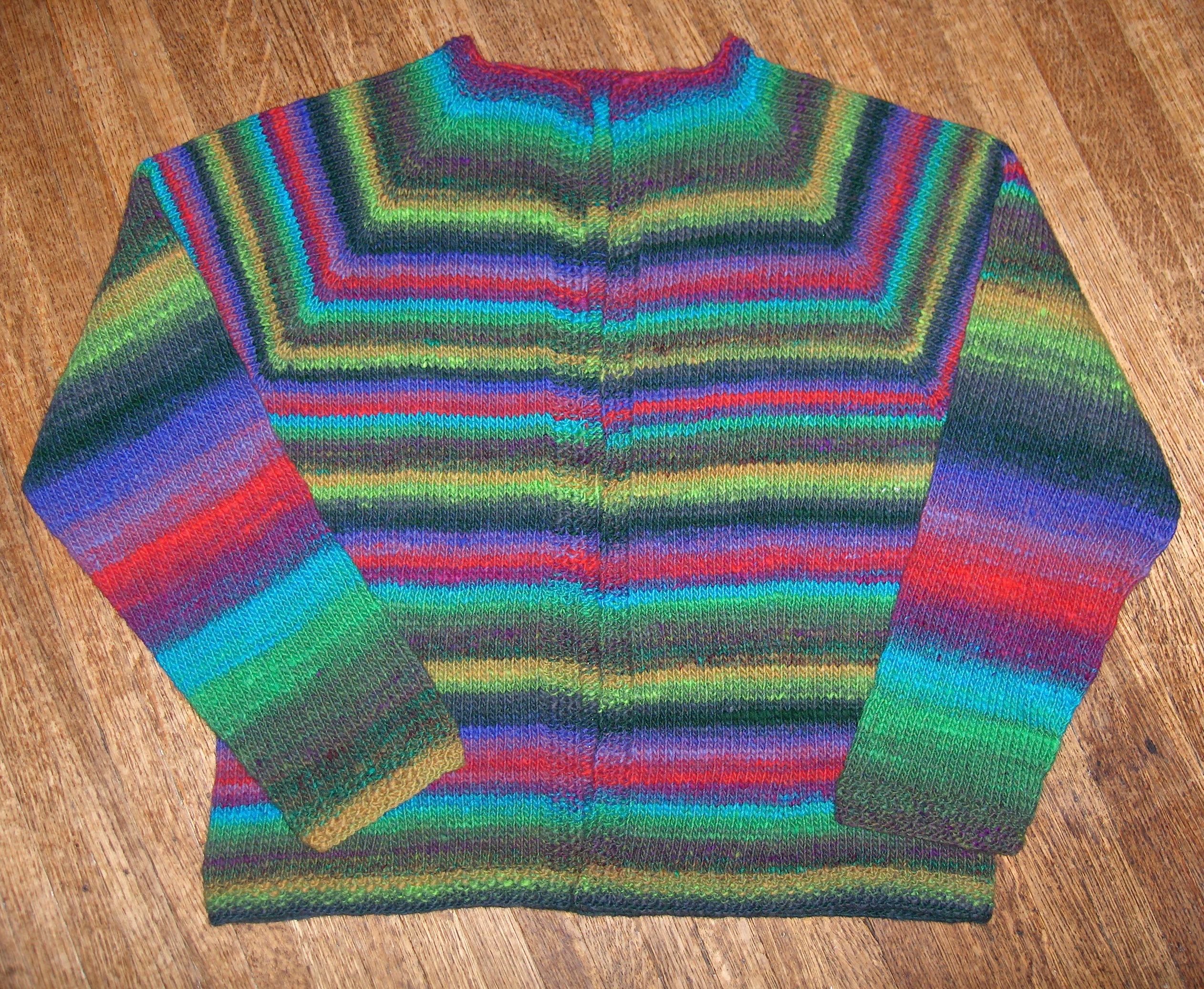
You can see that the sleeves aren’t a perfect match. I had to change balls in the light green near the top of the sleeve on your right, and it looks like I didn’t break off enough green. See the dark green line in the middle? The dark green band should have started there, not three or four rows down. That’s what threw off the match, but by the time I saw it, I didn’t want to rip back. It did become more out-of-step as the sleeves became more narrow, but I’ll live with it.
A couple of notes:
• From the 12 balls of Noro Kureyon, I used parts of 11 balls in my matchy-matchy fussiness. There’s a little more than 150 g left, though – so if I hadn’t been fussy, but had just knit it as it came off the balls, I would have needed 9.
• I did change the method of increasing at the raglan seams. The pattern instructs you to knit to one stitch before each marker, then KFB, move marker, KFB and continue. I don’t like how knitting front and back into the same stitch looks. Because each stitch is made into two, a knit stitch and a purl stitch, it makes a purl stitch right where the marker is and again to the left of the stitch after the marker.
I prefer when there is a neat line down the length of the raglan. So, I kept the increases outside of the two stitches that bracket the marker, leaving those two stitches to make that line. To do that, I knit to one stitch before the marker, make 1, knit 1, move the marker, knit 1, make 1, and continue.
Here’s a picture of different styles of increases so you can see what I mean. KFB is near the bottom of the sample. I’m not sure which of the M increases is the one I use, as these are the poster’s assigned names – it’s either M1A or M1L/F (and the corresponding M1T and M1R/B). It’s amazing to see how many ways there are to make a new stitch, isn’t it?
Of course, I’ve finished this winter cardi exactly as summer starts. This is pretty funny. It’s done just in time to be stashed away – while all the cotton ones linger on the needles. OTOH, in September, I’ll have a new sweater to wear. Look at the yummy colours!
 Have you ever knit a top down raglan? What did you think of the method? And the result? Is your knitting “in season”? Or do you finish things at the wrong time to wear them, like me?
 Alive & Knitting