I’ve gotten back into making bags this fall and here’s a completed one to show you. I’ve been waiting for a sunny day to take some pictures, but it’s raining raining raining, so we get some pix taken on my sewing table instead. The blog has been too quiet and I’m done with waiting for sun.
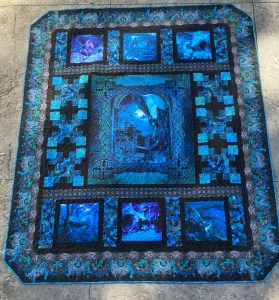
You might remember my blue dragon quilt, which was a kit (and is now FINISHED! HA!). That’s it at right.
I had some leftover of the various fabrics and used them for this, along with a shiny black pleather. They really were bits and ends, so it ended up a bit patchworky but everything coordinates well.
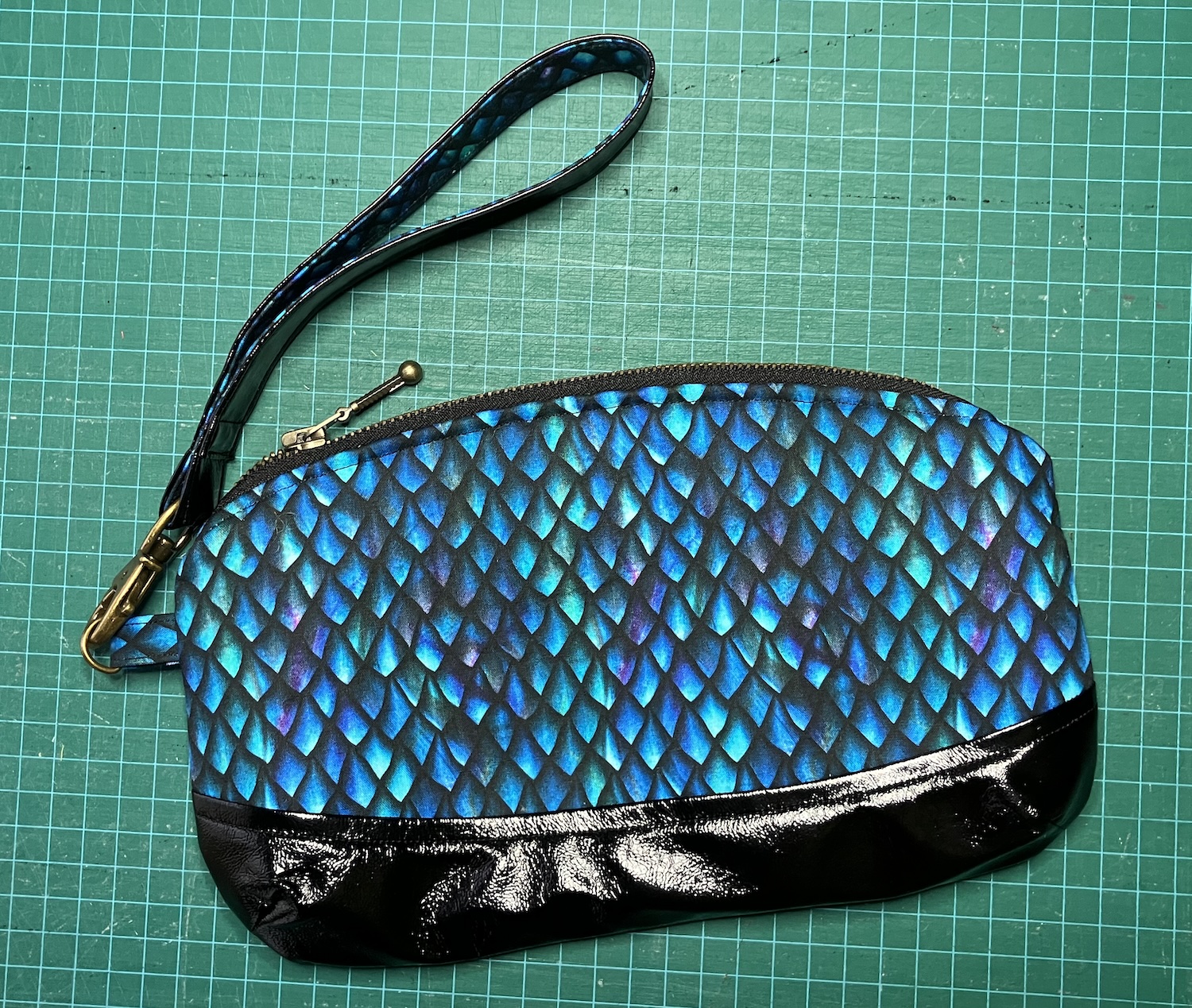
This is the Clematis Wristlet, a free pattern from Blue Calla Patterns. This little bag has fusible fleece on the outside pieces, which gives it a bit of substance, and more interfacing besides. I didn’t have a 9″ brass zipper, so I cut down a 14″ one for this project.
On one side, I used the scales. I also had a strip of this print to use on the inside of the strap.
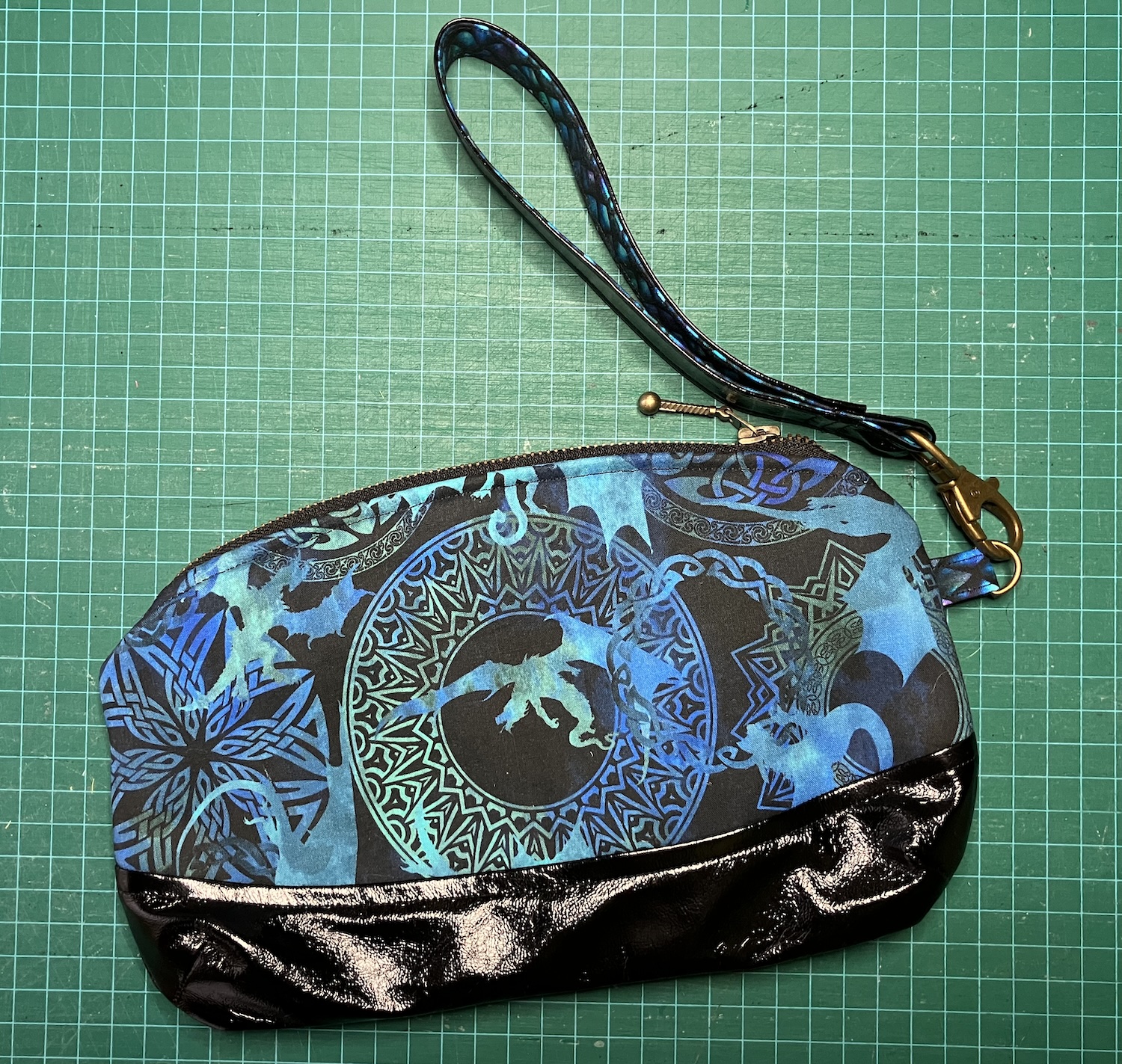
On the other side, I used the background with dragons and circles.
The lining is the Celtic/tattoo background fabric. (I see I picked up a thread on my cutting table and included it inadvertently in this shot.)
And the pocket inside is made of the dragons from the border print. There are only scraps now, so they’ve gone into my bag for real patchwork.
This pattern is a pretty easy make, and the finished bag is a useful size. I’m always looking for something flat to hold my cash at bookfairs and this might just do the trick.
I like the idea of the dragons watching over my hoard!
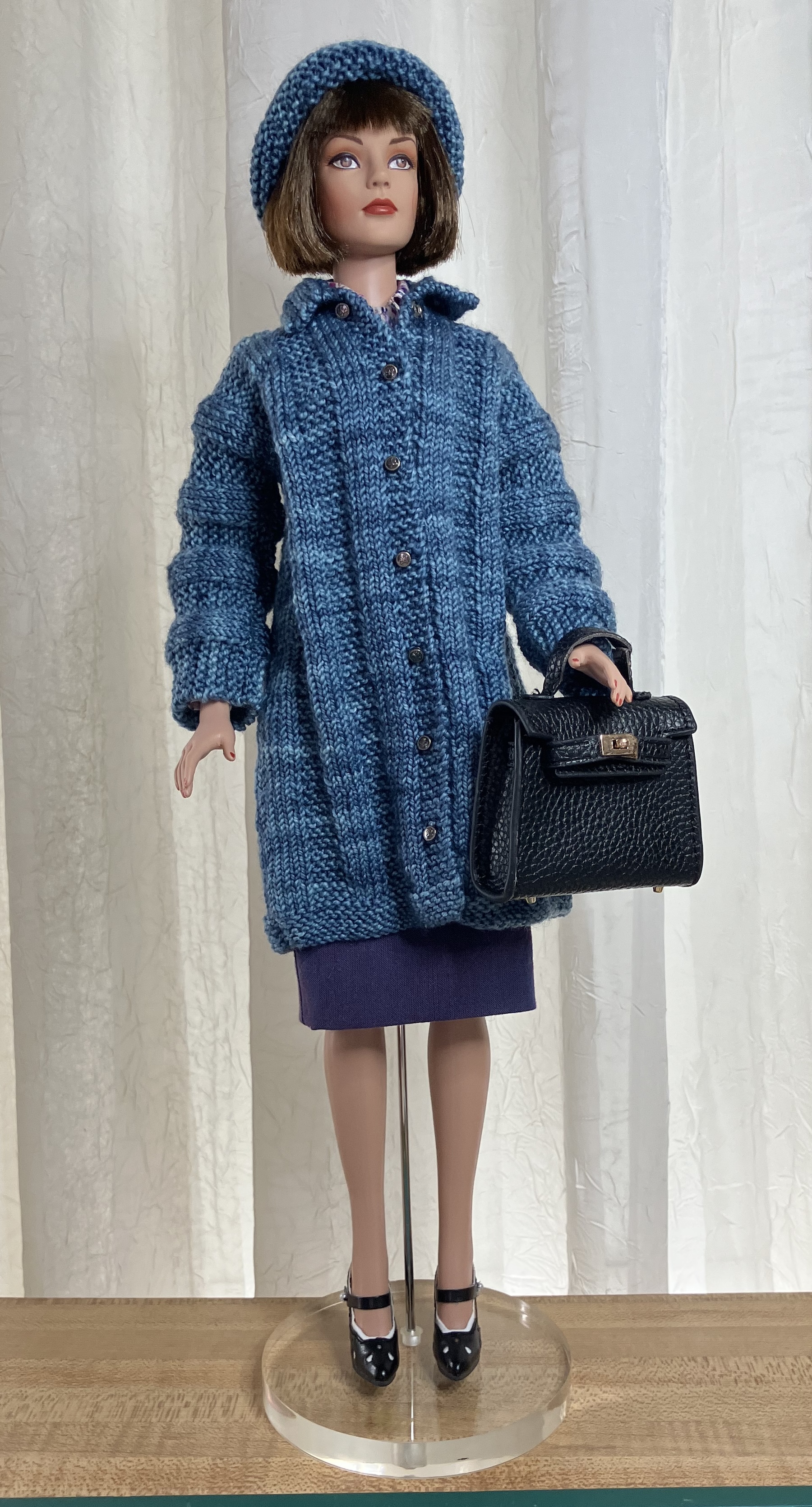
You might remember the knitted coat and hat I made for Barbie, using patterns from Sticka till Barbie. The pattern was #101 Yellow Coat along with the coordinating hat. That post is right here.
I decided to resize the pattern for my 16″ girls, and I think it came out pretty well. I used Koigu KPM and it took almost the entire 50g skein for the coat. Fortunately, I had another skein to make a matching hat.
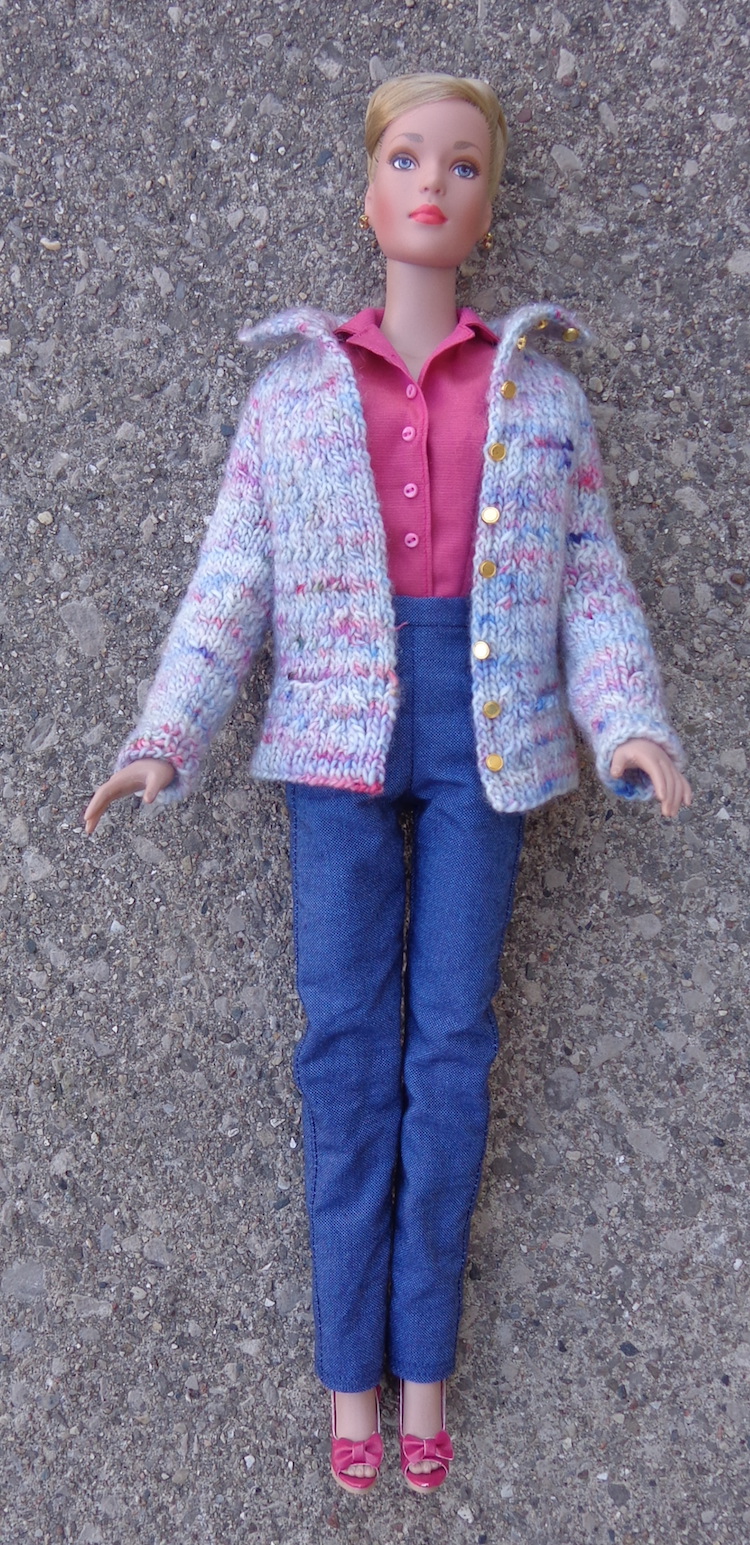
This is Mosaic Modern Sydney Chase doing the honours today. I wish I had an umbrella to add to this combo. It has a bit of a retro look, and not just because of the shoes. (They are from a shoe pack, which included the pink slingbacks that Tyler is wearing in the picture below this one.)
The Koigu KPM has a kettle-dyed look, which worked out really well for this one. I was afraid a variegated or space-dyed yarn might pool – also Sydney says she can wear it with more things.
If I knit a second one, I might add pockets to the front. I thought of that this time, but wasn’t entirely certain what row they should be on. I’ll mark this one, just at her hand, then count the rows up from the front to know for next time.
I would make them like the pockets in this cardigan – it’s hard to see the line of cast off stitches in each front but have a look. The pocket hangs inside, like a welt pocket without much of a welt. I can just slide the tip of my finger into it.
I also made Sydney a blouse and skirt to wear with this knitted coat. She looks like a librarian to me in this combo, thus the glasses and book.
This is the blouse from McCalls 3701 (the same pattern used for the pink one above) which is actually a bodysuit. It’s made of Liberty Tana Lawn. Quite a clever little design, even if the collar is fussy fussy.
The skirt is drawn from the basic skirt sloper in Rosemarie Ionker’s Fashion Doll Clothing. It’s made of Kaffe Fassett shot cotton and lined with Bemberg rayon.
And two more girls are on their way to me, NRFB and from an estate sale. I’ll show them to you when they arrive. 🙂
Things have been a little quiet here, mostly because of real life. When things get busy and even a little unpredictable, I always choose some comfort knitting. Lately that’s been knitting for the girls, as well as mittens and socks. Today, we’ll look at my latest completed project for the girls.
This is another free pattern from Sticka till Barbie, this time for a knitted coat. It’s amazing that I’m always learning more about fitting clothes for the girls – this time, I learned that vintage Barbies have shorter arms than modern Barbies. MTM and Silkstone (articulated and original) all have longer arms than vintage B.
I knitted the first coat following the instructions for #101 Yellow Coat. Here’s a Ravelry link for the pattern. The original website was taken down in 2022. The wayback machine’s backup of the original site has changed now – previously you could download individual patterns from there. There is also this other backup at the Internet Archive. Scroll down for the link to download a zip file of all the patterns. I’d do this soon, as it seems the content is vanishing. There are so many clever patterns in this collection.
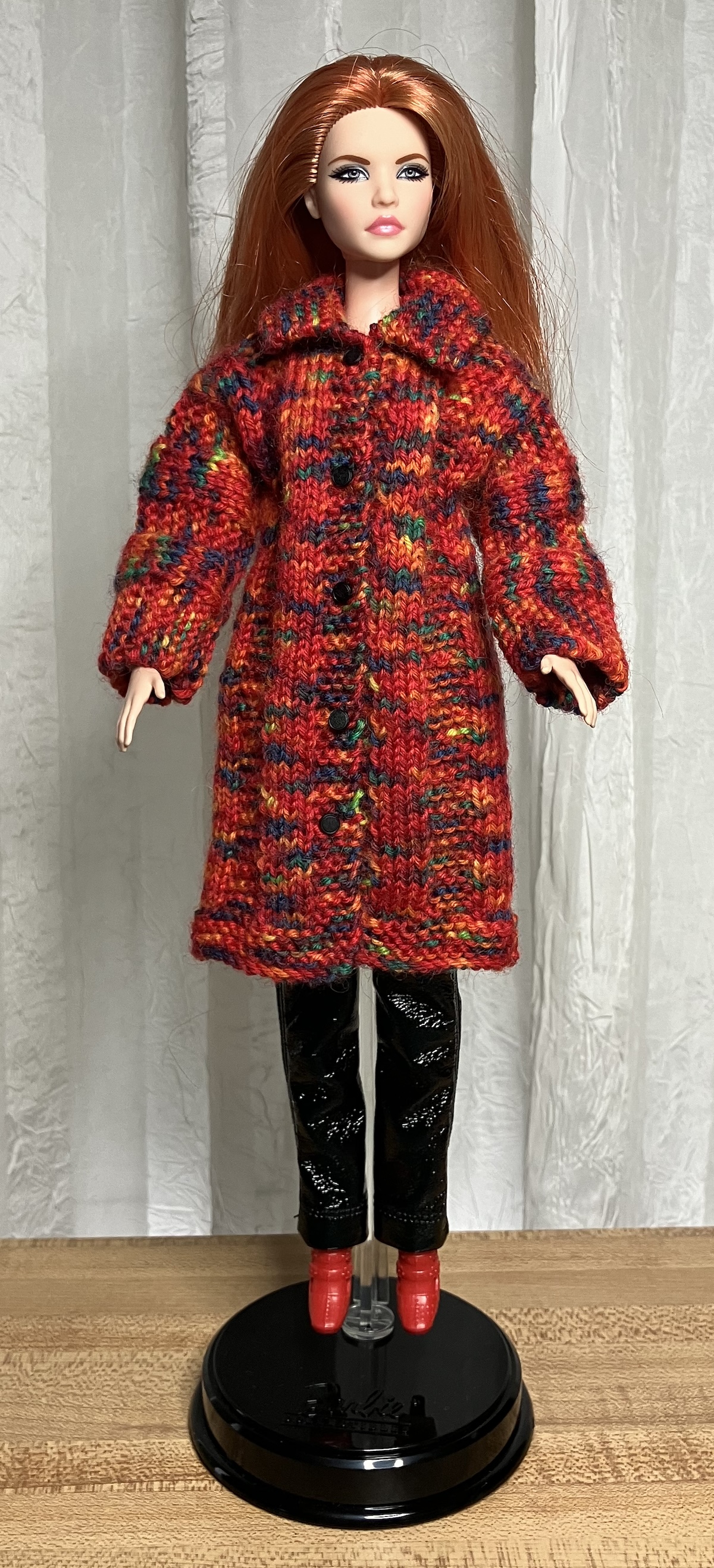
Here’s my first coat in Patons Kroy sock yarn, on a MTM doll.
This coat is knit from the front hem up over the shoulder and down the back. You knit one front, then the other, then join them at the back collar line and knit down the back. The sleeves are added as you go – it’s shaped like a T, kind of like a kimono. Stitches are picked up at the neck for the collar.
This coat took 35g of Patons Kroy – I just barely made it with my partial ball of the red mix, so couldn’t make the hat shown with it in the pattern picture.
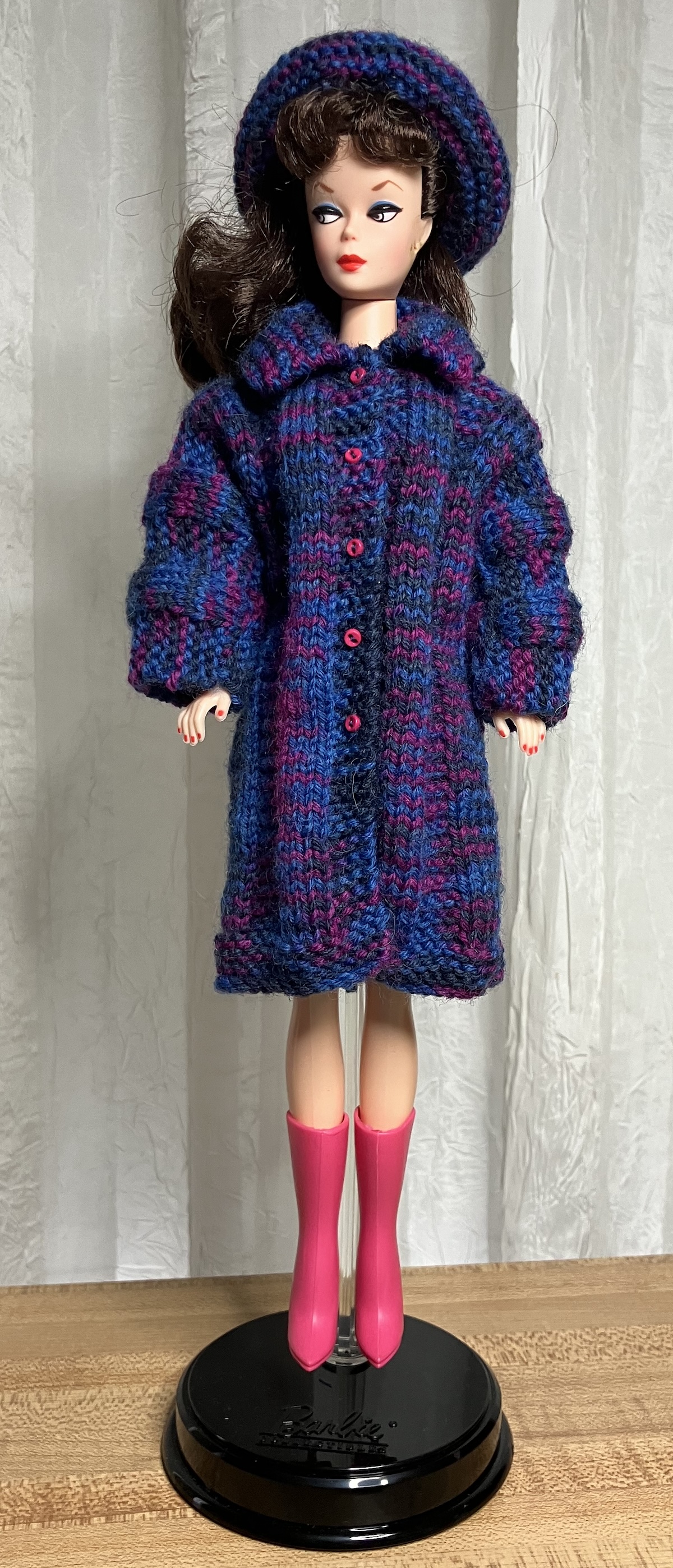
I cast on a second version and cast on two less stitches on each sleeve, to make shorter sleeves for vintage B. Here’s that one – this time, I had enough yarn for the hat, too.
The hat is cute and quick to make. I joined mine in the round so there wouldn’t be a seam, although the instructions are to knit it flat. The hat pattern is A-41.
I’m working on a modification of the coat, resizing it for the 16″ girls. I’m knitting it in a kettle-dyed Koigu that is quite pretty. It’s amazing how much more knitting that requires, but I’m headed down the back now and should have it done soon.
Well, May vanished in a hurry, didn’t it? I have been crafting but not finishing many things – partly because the day-job has been busy. I’ll catch you up in another post, but today, let’s talk about an interesting conundrum.
I found a stash of yarn at the thrift store this week. It’s kind of a puzzle when this happens. The first thing I want to do – if I like the yarn and bring it home – is try to figure out what project the de-stasher had in mind when the yarn was originally acquired. In some instances, that’s easy; in others, not so much. Ravelry is such an awesome resource for that. You can use the Advanced Search to specify the yardage you have, the weight of the yarn, even the name of the yarn, then sort through the results.
Last winter, for example, I found a stash of Briggs & Little worsted, with the old label. No colour names or numbers, just dye lots. I think this weight would be called Regal now. (That’s a link to B&L’s website.) Briggs & Little is located in the Maritimes and the oldest yarn mill in Canada. I really like how sturdy their yarn is and particularly like the heathered colourways.
This stash was nine skeins when I found it: 1 red, 1 grey, 1 cream, 1 light blue, 1 navy and 4 medium blue.
Skald, a Järbo SE design
I think this last one might be Quoddy Blue. It has a lovely heather look to it. (As does the grey.) Someone likely planned an icelandic or fair isle sweater, so I had some fun looking at options on Ravelry. (There are lots.) The skeins are over 200m each, so this is a lot of yarn.
The mister likes blue, so I found this pattern called Skald (that’s a Ravelry link) which I think will work out. (Here’s the designer website, but it’s in Swedish.) There might not be enough of one colour to do the lice. We’ll see.
My inclination is to leave out the red, but it might make a nice pop if used as an accent. Hmm. That one’s waiting for me to finish up one of my projects on the needles.
This week’s thrift store find was eight skeins ofAllHemp3. (That’s a Ravelry link.)
My Ravelry search came up with this pattern, Flaming June from Knitting 2012 (that’s a Ravelry link – here’s the one on Knitty), as a likely candidate spurring the initial stash. The designer is Cheryl Niamath, who designed the Fetching fingerless gloves that I’ve knit a bunch of times. (That’s another free pattern from Knitty.)
Eight skeins is enough for the main colour in the middle sizes, in which case there would have been two or three skeins in a contrasting or coordinating colour, too. Someone might have grabbed those for string bags earlier. For a teeny size, eight skeins might be enough for the whole sweater.
I read the pattern and learned that hemp grows in blocking. My first swatch on the recommended needles had perfect gauge, but wasn’t blocked yet. I went down to a 3mm, which resulted in a much tighter fabric, then washed and blocked it. The hemp was interesting to knit, similar to cotton in that it has no boing at all, but even stiffer.
The hemp softened nicely when washed and this swatch now has perfect gauge. I read the project notes on Ravelry from others who had made this sweater and it seems that many of them found that the sweater grew a lot in length after blocking, when they wore it.
I’m between sizes and already know the sleeves as written will be too long either way. My inclination is to make the smaller size of those two. From the notes on Ravelry, I should maybe go down another size again. Hmm. I also know I need to watch the width of the shoulders, because mine are narrow.
One variable is the effect of weight upon the finished garment. My sweater coat knit following that Kaffe Fassett pattern gets longer all the time – just the weight of the garment pulls it down, making it grow. (I actually took a repeat off the bottom of that coat after it was done, because it had gotten too long for me. I was caught once in a drizzle, which just made it worse.)
The other wrinkle is the tightness of the knitting. The looser the stitches, the more likely the garment is to stretch in wearing. Only one person who specified their needle on Rav was using a small one (2.75mm in that case, while I’m using a 3mm) – most were using 3.75mm or so. Are they tighter knitters than me? Did they wash and block their swatches? It’s hard to be sure.
So, I’m going to knit a sleeve first as a big gauge swatch, maybe even wash and block it to see what happens before knitting the body of the sweater. It’s a weird plan, but I’m hoping it will save me frogging the whole thing and knitting it again.
I may have to buy another skein or two of the Allhemp3, but at least it’s still available. I don’t want a second colour, and with any luck, the black dye lots will be close, if I do have to add more to finish the project.
One thing about making a discovery like this at the thrift store is that it’s a good way to play with a new yarn or fibre.
My TV knitting has been an entrelac scarf in Noro Silver Thaw. I found three skeins of this yarn at the thrift store, and couldn’t just leave it there. (It’s Noro!)
Noro Silver Thaw is an aran-weight and a single ply yarn with a gratual colour change over the length of the yarn. (That’s a Ravelry link.) It’s also discontinued. This is colourway #11 which is not as bright as many Noro colourways. The Mister really liked it.
I’ve wanted to knit an entrelac scarf for a while. I found this free pattern on Ravelry. I used a 4.5MM needle instead of the 5mm recommended because I preferred the look of the finished fabric.
Here’s the scarf:
The finished size is 67″ x 9″ unblocked. I kind of like the texture of it as it is and don’t plan to block it. (It would get flatter, wider and longer if I did.)
This is great for a long thinner scarf and the Mister is happy with it. If I made one for myself, I’d add another square to the width of the scarf and probably make it shorter. I tend to fold the ends of my scarf over my chest beneath my coat.
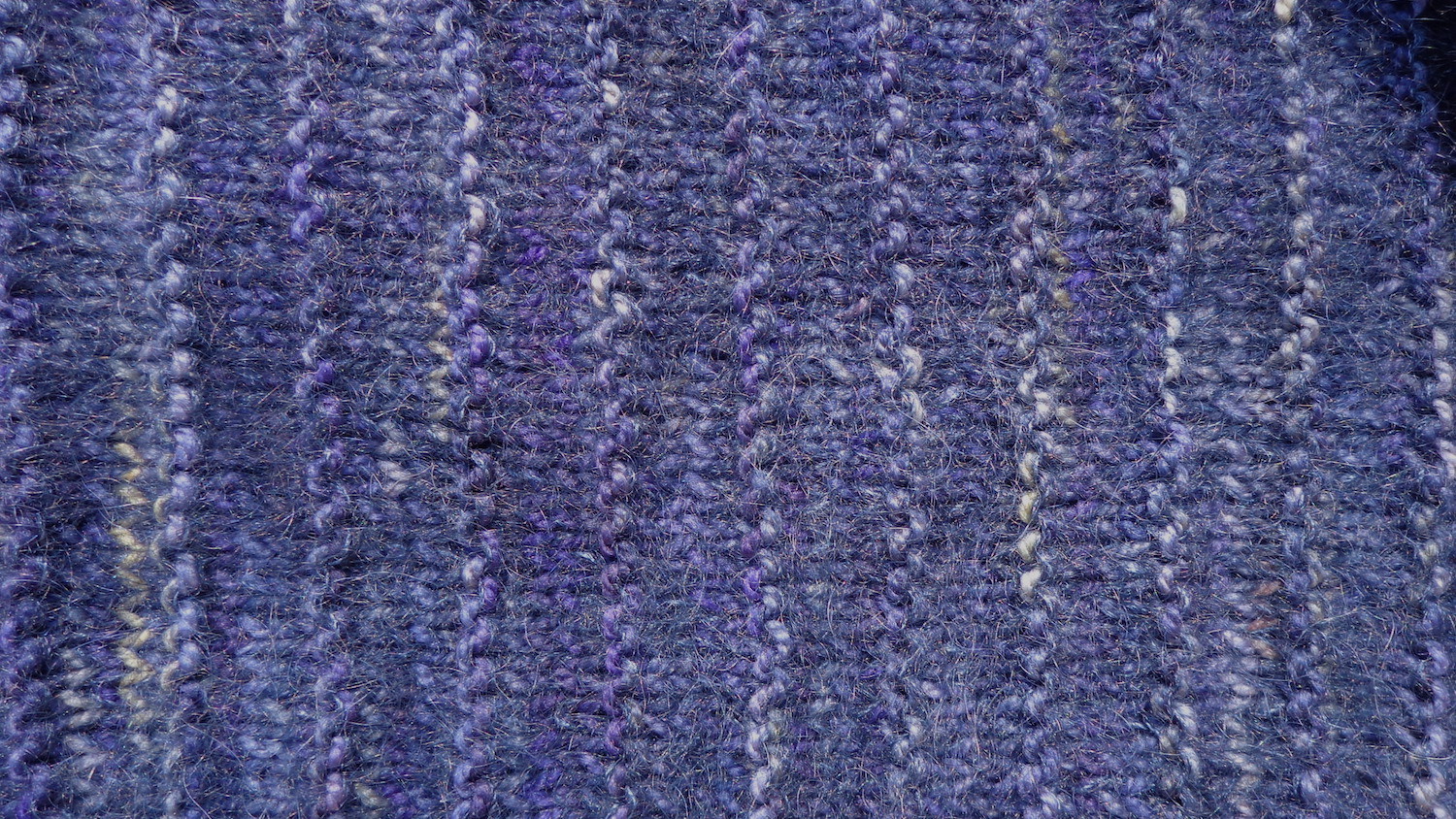
I started this project a year ago, in February 2022. (It was a free pattern then, but might not be so now.) I liked the design a lot but didn’t want to buy more yarn, so I shopped my stash. I came up with some Koigu KPPPM in a mixy blue and some Rowan Kidsilk Haze in Turkish Plum which matched. The resulting fabric is lovely and soft, with enough variation from the Koigu to make the colour interesting.
Mmm. Squishy goodness.
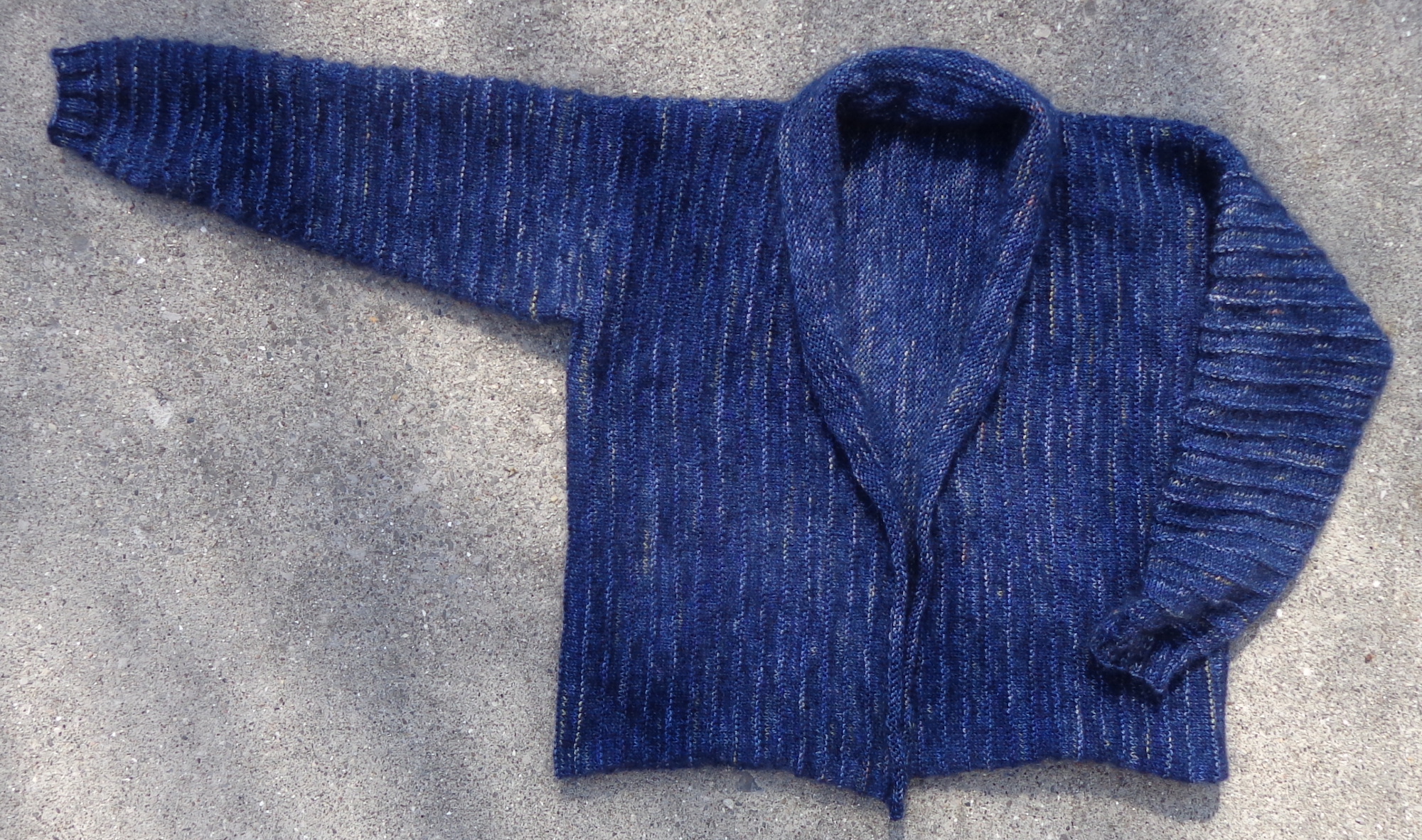
The construction is interesting. You can tell by the ridges that it’s a sideways knit. You cast on provisionally at what might be considered a sideseam, knit across the back, cast off stitches for the sleeve, then knit across one front. You put those stitches on a holder. You go back to the provisional cast-on to pick up enough stitches for the other front, then when it’s done, put them on a holder. You sew the shoulder seams, then start knitting those front stitches, up one side, pick up stitches across the back for the collar, then down the other front. This makes a self-rolling shawl collar after you knit five inches of it. Then you go back to each sleeve opening to pick up stitches and knit in the round, decreasing down to each cuff.
By the elbow of the second sleeve, I was sure that I would run out of yarn. I stopped knitting so I could look for something matchy-matchy at the Koigu tent sale in August. The best I could do was some solid-ish navy (it looks kettle-dyed) so I decided to use it on the cuffs and the front edge of the collar, if necessary. I frogged a lot of the collar to be sure I had enough Koigu for the second sleeve. By this time, I’d lost momentum and the project sat. As is so often the case, I picked it up finally and finished it in a couple of evenings.
And – ha! – I didn’t run out of yarn. I took the remaining Koigu and knit on the collar until it was gone.
Here’s Halo completed.
Morning sunlight through the tree branches makes for dappled light and shadow. 🙂
Mine came out a bit smaller than anticipated. I made the larger size, which meant it should have been 25″ long and 48″ wide. There’s no row gauge specified, probably because it’s stretchy, but the stitch gauge is 20 sts to 4″. Mine is right on, but my sweater is 22″ long and 42″ wide. So, if and when I make another of these cardigans, I’ll add 15 stitches to the length and 7 or 8 repeats to the width, probably 4 across the back and 4 on each front.
I’m thinking I might knit a second one of these rather than another Lunenberg-meets-Hebrides cardigan. I have more of the KPPPM in the teal colourway than I had of the navy, so that should work out well – plus I have KSH in Trance to knit with it. Or I might buy a Halo bundle from Fleece Artist and actually knit the sweater in the specified yarn. (Had to sit down for a minute there. Phew. What a concept.) We’ll see after I finish up a few projects still on the go.
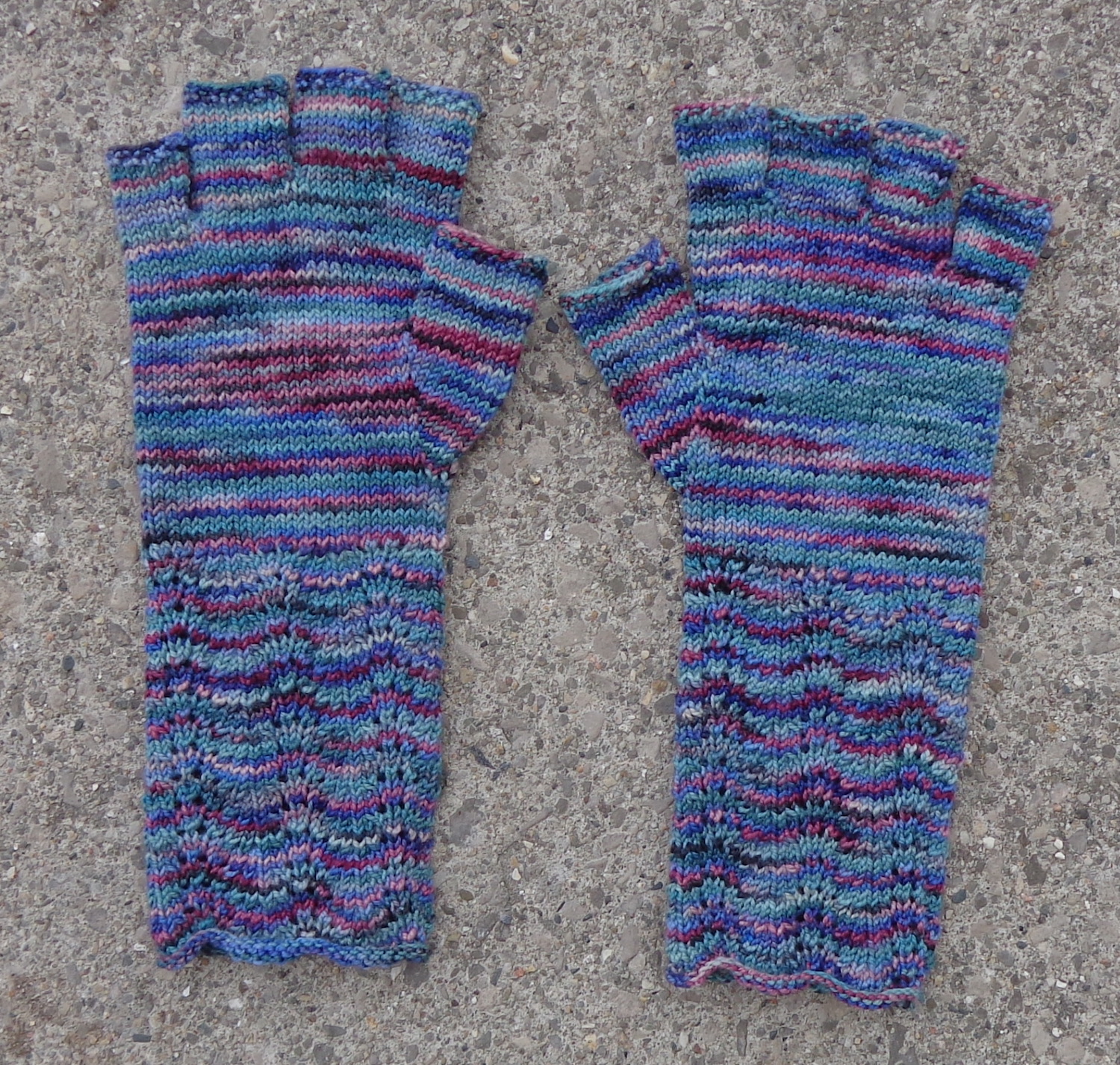
This is a pattern from Fleece Artist to make fingerless gloves called Fairy Fingers. Fairy fingers is also an old term for foxglove flowers. As seems to be happening a lot lately, I made my first pair from Koigu KPPPM. (They were done last week, but a gift, so I couldn’t show you before the recipient saw them!)
Here they are:
This is the colourway that made a swirl in my teal Navelli so was frogged and returned to the stash as a result. I wasn’t sure what it would do in these gloves and was pleasantly surprised by the result. The colourway is P528. Here’s the other side of them:
I did only 12 repeats of the pattern on the cuff instead of the 15 specified.
The pattern calls for 2.75mm needles but I thought the cuff looked too loose, so I went down to 2.5mm needles. I really like the fabric that resulted, but this might make the gloves too small for some people. They fit me perfectly 🙂 which is inevitable since they were a gift.
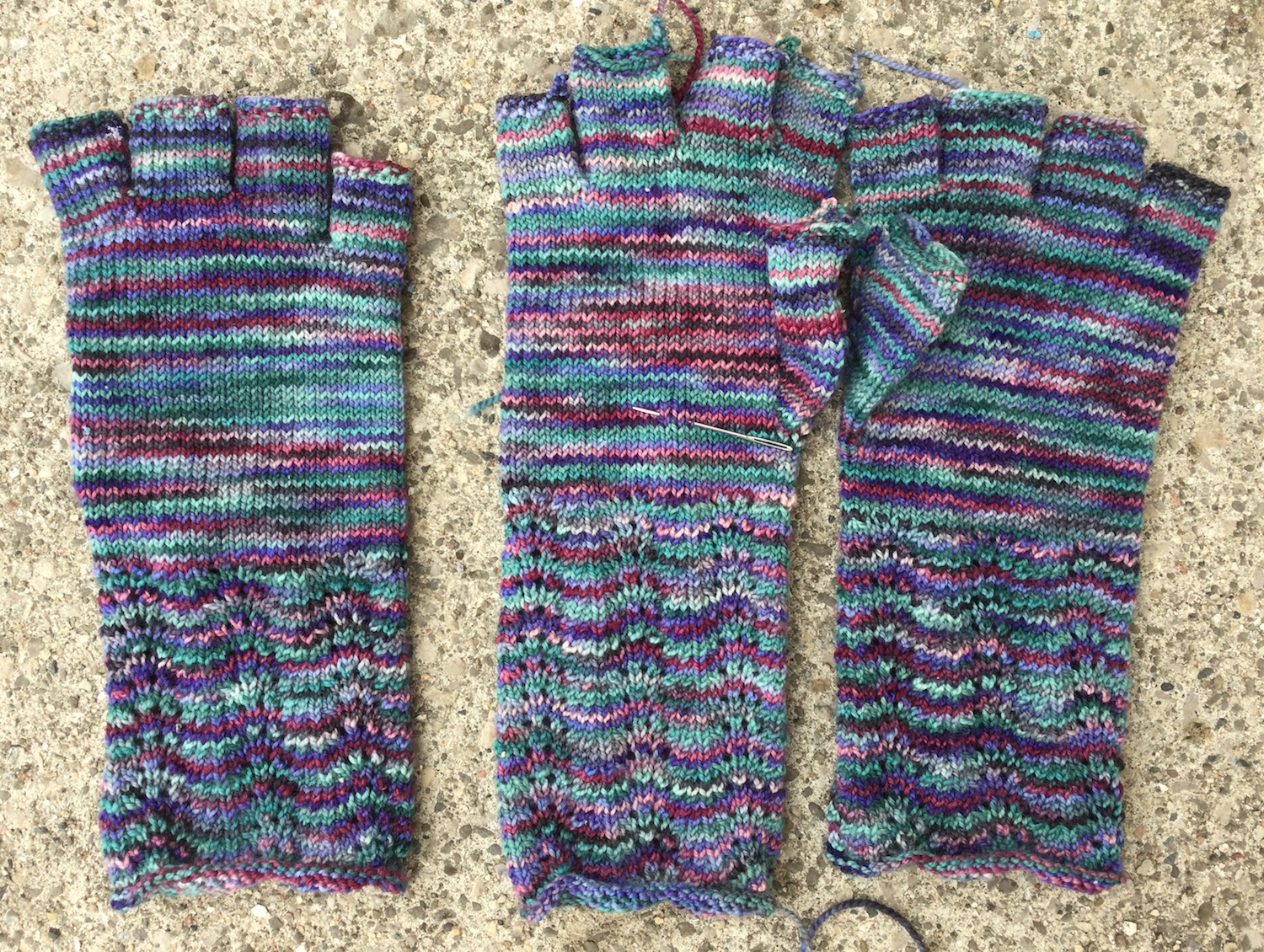
I did end up with a pair for myself, though. When I cast on the second glove from a different skein of Koigu, it didn’t look like it would match the first one. I knit one with 15 repeats in the cuff then and made a second pair, which I kept. You can see that glove in the middle here – doesn’t it look a bit lighter than the outside two?
Instead of using a second skein, I went back and cast on the second of the shorter gloves from the leftovers of the first skein, to make sure it matched. Koigu comes in skeins of 50g and the first short glove used 28g. For the second glove, I got all of it out of the remainder of the skein except the fingers – if there’s a colour difference, you can’t see it.
This pattern also launched me on a hunt for Fleece Artist yarn. I love their colourways. There’s some new Fleece Artist yarn on its way to me, which I’ll show you once it’s knitted up.
Just editing this to show the other pair, the longer ones that are for me.
I’m also noticing the pooling on the hand with this pair – the other pair has it, too, but I’m taking a better look now. 🙂 If I flip one over, you can see that it worked out the same way on both, just it ends upon on the back of one and the palm of the other.
I did do the fussy-knitting thing of casting on at the same point in the colour gradation – I usually do this with a self-striping yarn by choosing a point (like where the burgundy changes to the turquoise) and making my cast-on knot there for both mitts (or socks). That way, the striping will unfurl the same way on both. A second fussy-knitting fix would have been to knit an extra half row on the hand before starting the thumb gusset, moving it to the other side so that the two palms would be the same (and the two backs). They wouldn’t mirror but they’d match.
This hat is a free pattern in the most recent Knitty online magazine. I knit one of these right away for the mister – here’s that blog post.
I folded it in quarters for this picture.
The pattern is called Planetarium (that’s the Ravelry link – here’s the Knitty link) and it’s knit in two colors of a fingering yarn. These two are from my stash. I had a skein of a zingy purple Koigu KPPPM and some leftovers of Lichen and Lace sock in Citron. (I used it for my Stargazer Mittens.)
I made the same changes to the pattern as the last time. This one doesn’t feel like it’s going to pill, so that’s a good thing.
This hat is a free pattern in the most recent Knitty online magazine. I thought it was so pretty that it jumped right onto my needles!
I folded it in quarters for this picture.
The pattern is called Planetarium (that’s the Ravelry link – here’s the Knitty link) and it’s knit in two colors of a fingering yarn. I used KnitPicks Chroma for mine, because I had it in the stash. The colourways are Black and GoGo Boots, which is a gradient yarn. it’s a very clear pattern and an easy knit IMO.
I made a couple of changes to the pattern. I knit it exactly as written the first time, but the mister doesn’t like slouchy hats so much. My gauge was also a bit tight. Rather than changing needles, I knit a larger size (actually one repeat larger than the largest size) and I left out one of the three star bands to make the hat shorter. It fits more like a watchcap, which makes him happy.
As much as I like the colours, I think the yarn is going to pill – it’s a single ply, loosely spun. If I make a second one for myself, I’ll use a yarn with more of a twist, maybe Koigu KPPPM. Hmm. Time to check the stash!
Berroco has a tradition of publishing patterns for miniature knitted sweater ornaments. Every year, I think I’m going to knit a bunch of them and make a garland of mini-sweaters as a Christmas decoration. This was the first year I actually cast on one of them. Here’s what happened.
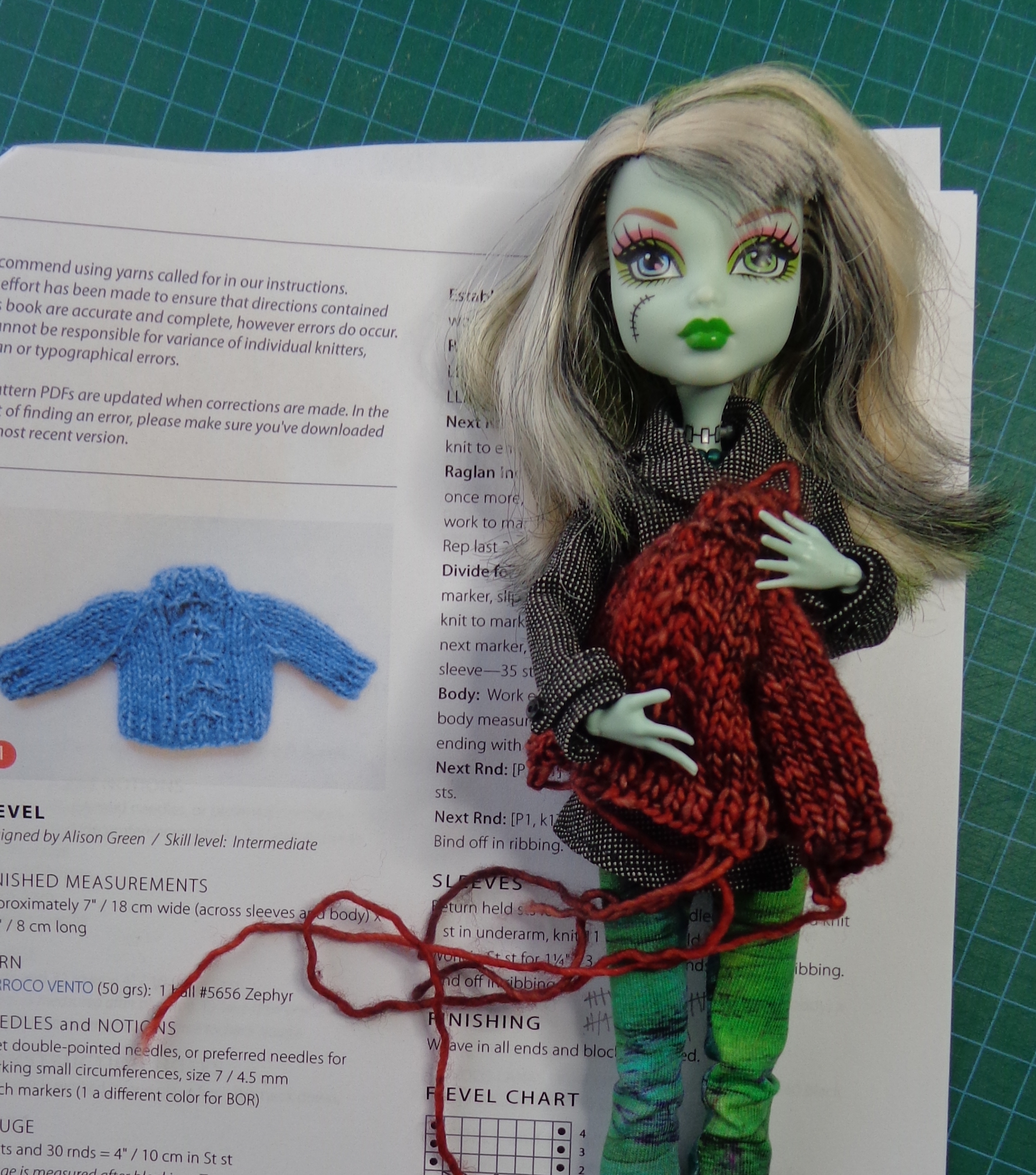
Fievel is one of the 2022 Minutia designs from Berroco. (Here’s the Ravelry link and here’s the Berroco link. This is a free download in both places.) It’s supposed to be knit in a DK weight yarn on 4.5mm needles, but I decided to make mine smaller. Here it is in MadTosh Merino Light in Cardinal, knit on 2.5mm needles:
There’s a small difference – I don’t have a single knit stitch following the raglan line on mine. Maybe that stitch is missing from the instructions. (?) The result is quite cute, though.
I was thinking about the size of this little sweater and then this happened:
She’s right. It would fit her – if she could get it on. And so, I revised the instructions: as instructed, you start knitting at the back left shoulder and work in the round. There’s not an opening, just an end to sew in. So, I moved the starting point to the center back and added a stitch so there’s a wee bit of overlap. I worked flat until the work was divided for the sleeves, then continued in the round. I had to make the sleeves longer (fortunately, you can take off the hands of MH dolls to get a sweater on).
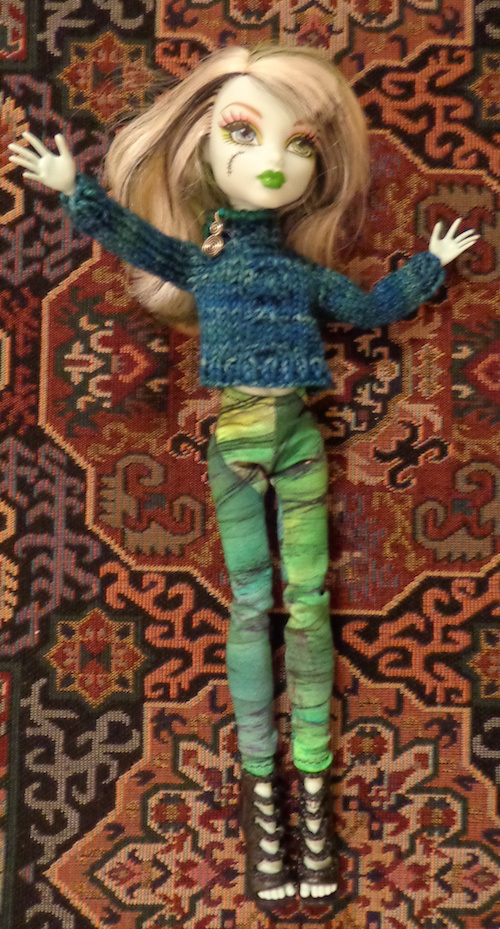
Here’s Frankie at right with her holiday sweater, a giftie from me. This one is Malabrigo Sock in Rayon Vert, knit on those 2.5mm needles.
Oddly, she doesn’t look much happier.
You can guess what happened next: Babs wanted one, too.
I used those same directions with the split at the center back but used a thicker yarn – this is Kidsilk Aura knit on 4.0mm needles. I’d been envisioning a chartreuse fluffy sweater for B with this yarn, as a good match with this fakey leather skirt. I had to frog this one back a couple of times, given B’s curves – I kept ending up with too much sweater in the back.
The final result has decreases on the back after the work is split for the body and arms, making the back narrower. It’s also shorter, more of a cropped sweater that ends at the waist. It opens all the way down the back – I’d thought of joining it, but there was all that bulk and I went with simple. There are snaps on the back and little non-functioning buttons.
If I knit it again (ha!) I’d change the stitch distribution so there were more stitches on the front than the back. It is a bit stretched over her bust, and that’s where the extra bulk is in the back. At least two stitches should move, maybe four. The decreases in the back might not be necessary then.
Here are the three versions.
Phew. Do I dare to cast on another mini-sweater Christmas ornament?












 Alive & Knitting