Roan in Kauni

I haven’t posted much about knitting lately, for two reasons: first, there’s been a lot of book news and I know you’re more interested in that, and secondly, I haven’t finished many projects this summer. I’ve been knitting a lot of stranded colourwork and fair isle, and that’s time consuming – though I love the results.

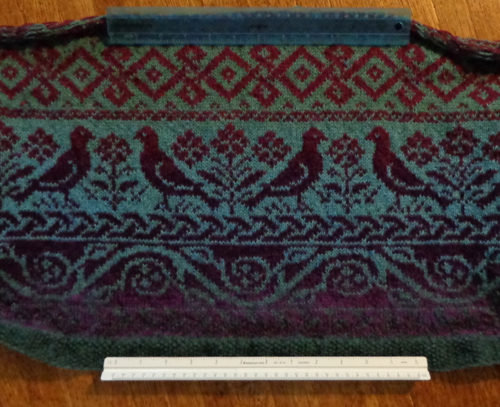
Here’s one that’s on my needles right now:Roan by Martin Storey knit in Kauni Effektgarn by Deborah CookeThis pattern is from the latest Rowan magazine, #56, and is called Roan. It’s a kimono style sweater and is knit in heavier yarn than the one I’m using. This yarn is Kauni Effektgarn, a yarn I love because of the way it gradually changes colour. This is the teal colourway and the pink/purple colourway. I had to recalculate things to ensure that the sweater fits – I’ll be getting more stitches per inch in both directions – so I’m knitting by the directions for the large size to get a sweater slightly smaller than a medium. I’ll need to add more repeats of the Celtic knot to get the length, too.

What do you think? I just love it!

Octopus Mittens and Tension

This was supposed to be a Christmas gift, but complications with the needle size delayed my progress. Maybe they’re mine now. 🙂

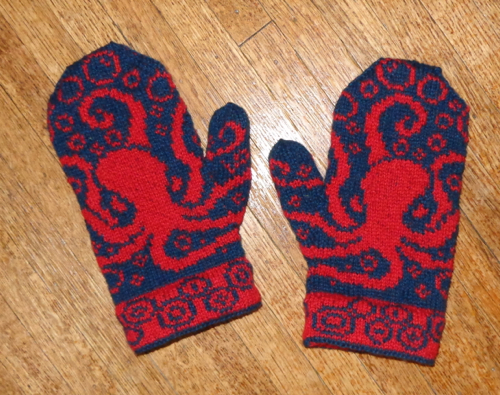
The pattern is Octopus Mittens – as usual, that’s a Ravelry link – which is a fair isle mitten pattern. The yarn is one I found at my LYS, which is from Scandinavia. It’s a wool called (improbably, at least in English) Tuna. Here are the mitts: Octopus Mittens by Emily Peters knit in Tuna Feltgarn by Deborah CookeActually, this is two right mitts. Thanks to the flash, the colour shows as being a bit brighter than it is in real life. I knit the one on the right first with 2.25mm needles. It’s not very long – I have small hands and it just fits. The problem was that the intended recipient has longer fingers than me. I also wasn’t happy with the way the hem curled under. There’s a ribbed cuff that you turn to the inside after the band with the suckers is knit – on the right mitt, it pulls under too much. For the left, I knit two more rows of ribbing on that cuff and it looks much better. The left mitten is also knitted on 2.5mm needles. I knew changing needle size would make a difference, but look how much longer the one on the left is! Yet it’s not very much wider. How interesting.

By Christmas I had two right mitts, which isn’t very useful to anyone, especially as one is bigger than the other. I’m almost done the bigger left mitten, and since I’ve missed the deadline anyway, I think I’ll line both pairs. The bigger ones are so much bigger that they fit Mr. Math – so they might be too big for the intended recipient. She got something else this year, and maybe will get something else next year, too.

I’ll show you a pair when they’re done. The left one is a mirror image of the right.

Fightin’ Words

These were too much fun – I love knitting them and I’m hoping the recipient loves wearing them. In fact, I’ve cast on another pair.

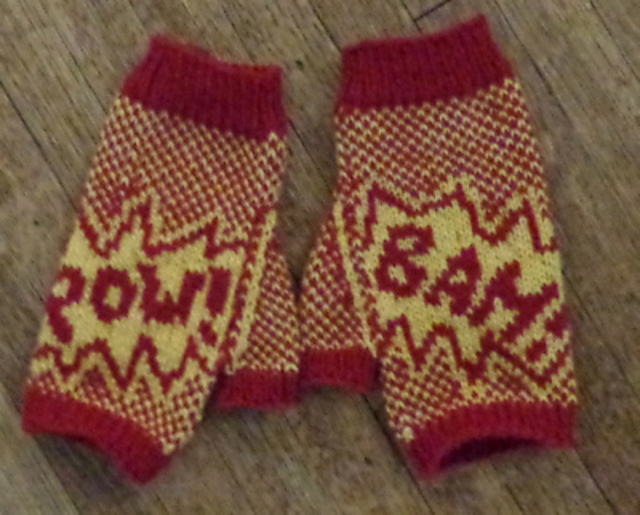
The pattern for these fingerless gloves is Fightin’ Words (that’s a Ravelry link) and I knit them in Knitpicks Palette. (Every time I look at this yarn on the KP site, I’m tempted by their Palette Sampler, which includes one ball each of 150 different colours. What fun!) The pattern was available at a special price for December as part of an indie-designer knit-a-long.Fightin' Words by Annie Watts knit in KnitPicks Palette by Deborah CookeWhat do you think?

Sipalu Felted Bag

I’ve finished another felted bag – is it possible to have too many of them? – and although it still needs to be lined, I thought I’d show it to you today. It won’t look any different from the outside once it’s lined, after all. 🙂

The Sipalu bag was available from Knitpicks as a kit, including the wool, but I didn’t like that it wasn’t felted. I knew the result would be less sturdy unfelted, particularly knit of a fingering weight yarn (the kit came with Palette.) The pattern for the Sipalu bag was and is available on its own, so that’s what I bought. The pattern specifies knitting with a number of colours, but I decided to use a self-striping yarn with a contrasting solid instead. I dug into my stash and came up with my felting standby, Patons Soy Wool Stripes and Soy Wool Solids. I used Black and Natural Plum.

I did run out of black. Since the SWS yarn is discontinued, I couldn’t find any more. (I tried.) I then substituted solid red SWS, but didn’t like it in the fair isle – there wasn’t enough contrast with the self-striping Natural Plum – so I frogged that back but used the red on the garter stitch edges. The bag sat, unfinished, in my knitting basket while I tried to figure out what to do. One day I saw a very similar yarn to SWS balled with another company’s label, which gave me the idea of using the Ravelry search engine to find a substitute. Ravelry has a great search engine that lets you specify many variables – I used the content (soy and wool) and the weight (aran) , then looked for single ply yarns in solid colours. I found Gjestal Bris, with a buy link, so ordered some of that. It’s a bit thinner than the SWS, but since I was felting the end product, it worked out just fine.

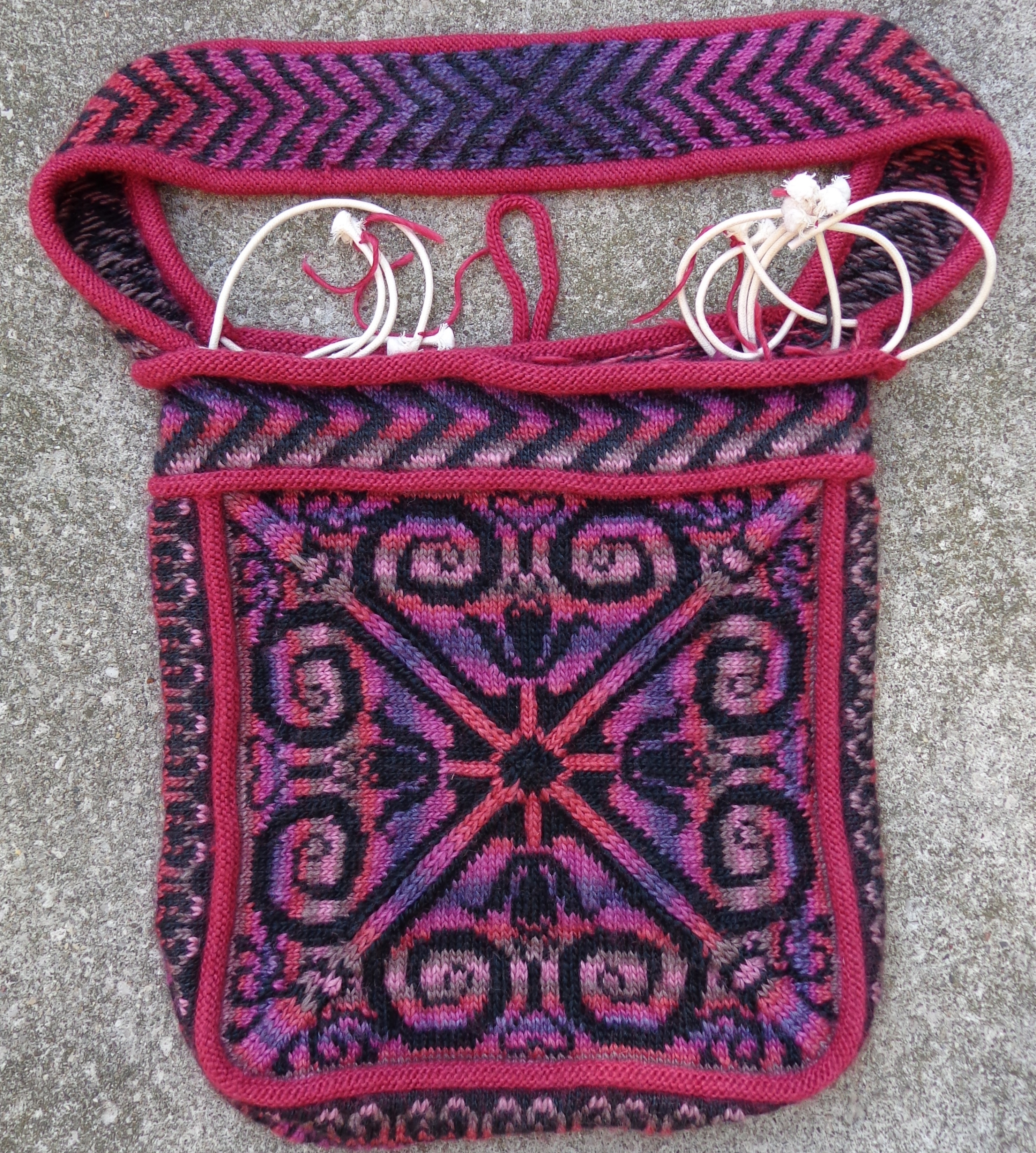
Here’s the unfelted version of the bag: Sipalu Bag by Kerin Dimeler-Laurence knit in Patons SWS by Deborah CookeYou’re probably wondering about the white cording. I decided that I wanted the edges of the bag to be more round than the garter stitch alone would make them. I wanted them to be like piping around the edge. So, I bought some cotton cord at the fabric store, the kind that’s used to make piping (!), and sewed it in to all the edges. (I slip-stitched the garter stitch ridge closed on the inside of the bag, with the cord trapped inside.) Because I wasn’t sure if the cord would shrink – or whether it would shrink at the same rate as the SWS – I left the ends long. After the felting was done, I tugged the cords so that the piping was smooth on each edge, then trimmed them and secured the ends inside the bag.

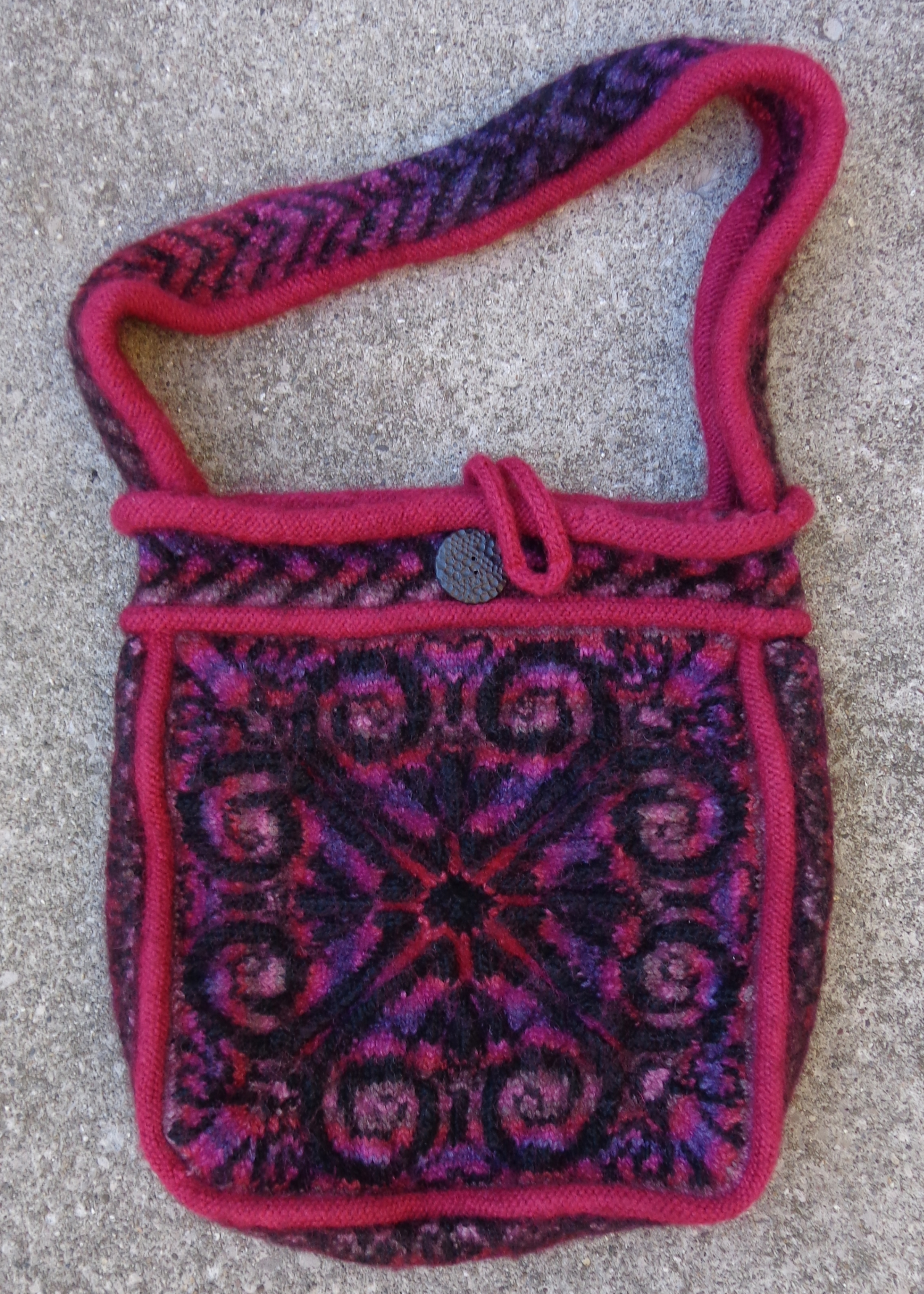
Here’s the bag felted and ready for its lining. It could have been felted just a little bit less, but felting is an inexact science. The button is handmade of porcelain. Sipalu Bag by Kerin Dimeler-Laurence knit in Patons SWS by Deborah CookeHere’s my project page on Ravelry, if you want to see more nitty gritty details.

What do you think?


Hippocamus Mittens

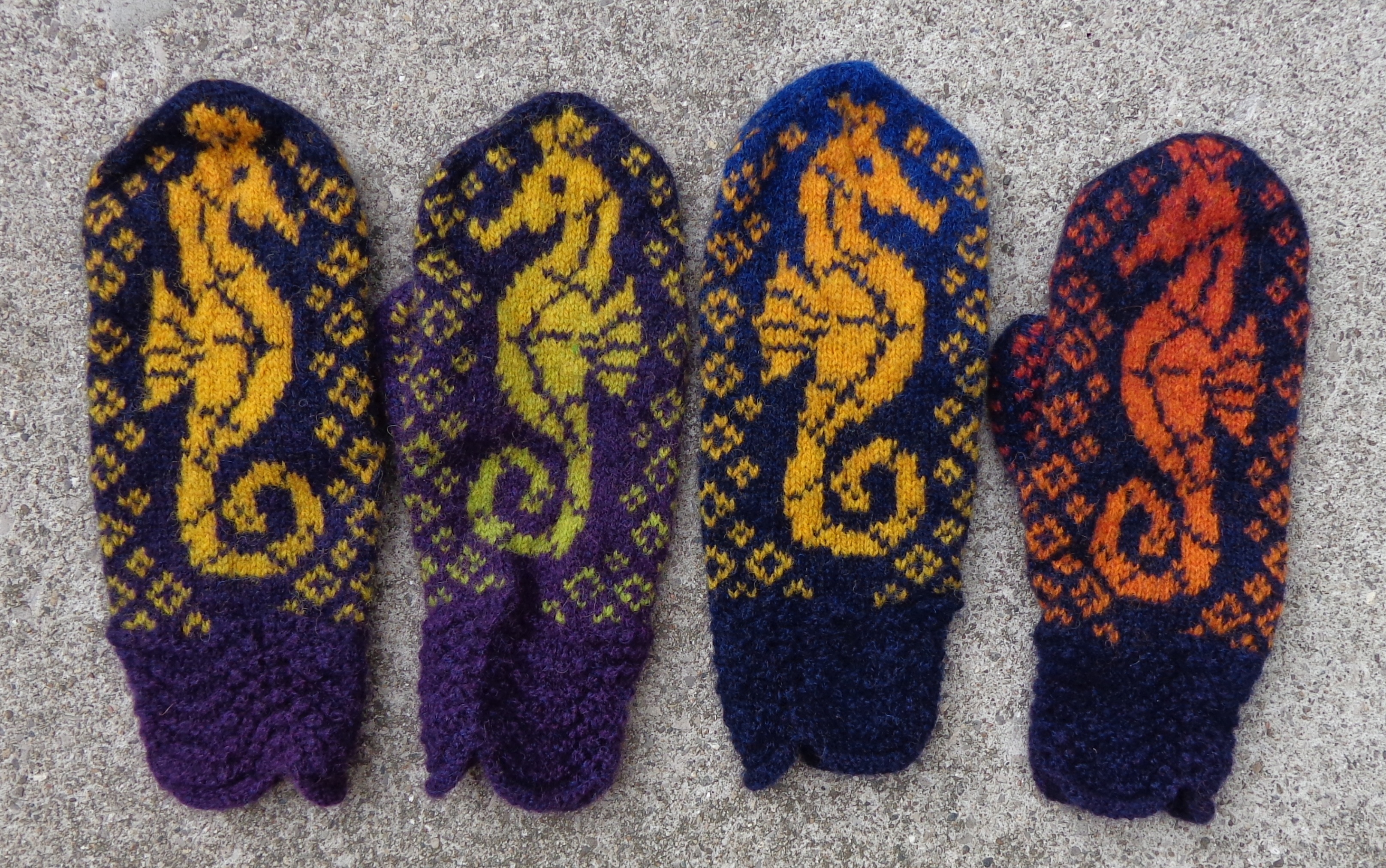
I haven’t shown you any knitting for a while, but I’m really proud of these so you get to see.Hippocamus Mittens by Tori Seierstad knit in Kauni Effektgarn by Deborah CookeThis pattern is called Hippocampus Mittens (here’s the Ravelry link). I’ve liked them for years and finally decided to knit a pair. I had some bits and ends of Kauni Effektgarn left over from knitting Mr. Math’s Elrond Sweater so I could shop the stash for this project. I have sweaters on the go, but sometimes a small project is exactly what you need.

I knit the middle pair first, but didn’t think they looked like a match. Since the pattern used less yarn than I’d expected, I had enough for a second pair. I then knit the outside pair, ensuring that the background on the cuff for each matched one of the original mitts. So, these are the two pairs resulting. They then went into the washer to full and shrink a bit, and here they are. I like them a lot – pluse there’s one pair for me and one for a Christmas gift. 🙂

There’s a pair knitted in Noro on the pattern page, which is a very tempting possibility. I might have to knit another pair (or two).

It’s very strange for me to have a Christmas gift knitted before July, but it appears that I’m organized this year. Ha! Isn’t that a good thing?

DIY Gradient Cardigan 3

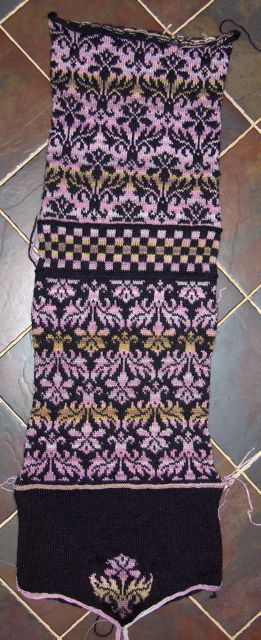
So, I’m still talking about that strange knitting project of mine – the adventure began here and continued here. I know you’re impatient to see how it looks knitted up, so without further ado, here’s the work in progress:variation of Venezia by Eunny Jang knit by Deborah CookeThis is the back of the raglan sleeved cardigan I’ll knit from the reclaimed yarn. I did a small gauge swatch, calculated my gauge per inch, then multiplied it by width I wanted the finished back to be. Then I cast on that many stitches in the mauvey colourway and knit 6 rows of seed stitch – that’s in blue.

The fair isle design is from a pattern by Eunny Jang called the Venezia Pullover. Just as you might suspect, this pattern is for a pullover, which isn’t what I wanted to knit. But I’ve always liked the curves of the fair isle pattern. The pattern as written uses a number of different colours, but they are marked as foreground and background. So, I got a sheet of graph paper and coloured in all the squares that are foreground. Presto – a two-colour chart! I centered the chart over my back stitches – it’s just over four repeats – and started to knit.

Self-striping yarns are always a bit addictive to me. I really want to see what they’re going to do next. In this case, I tried to paint the yarns so that the lights and darks would end up opposed to each other. What I didn’t anticipate is that when they’re switching – like where the green is getting darker and the blue is turning pink – the design is harder for the eye to pick out. I think this will be less of an issue as the sweater progresses and more repeats are visible. You’ll be better able to see what’s happening. But I like it, even the less contrasty bits.

What do you think? Have I converted you to the cause of creating your own colour-graduated yarn?

Damask Bag in SWS – 4

Well, you probably remember me going on and on (and on) about this fair isle messenger bag. Happy to say that it is DONE and you won’t have to hear anymore about it after today. I finally finished the knitting after abandoning that double knitted strap that wasn’t going to get knitted in my lifetime.

The most recent post on the bag is HERE, and it has links to the earlier posts. Unfortunately, the nifty black I-cord I was showing you in that picture is no more. After finishing the strap, I decided that all of the I-cord had to be in the variegated violet — so I ripped out the black I-cord. I’m not a huge fan of knitting I-cord, so it nearly made me weep to tear out three feet of it. BUT it looks much better with the I-cord all the same colour.

Here it is, ready to be felted:Kauni Damask Understated Bag by Karen Stelzer knit in Patons SWS by Deborah Cooke
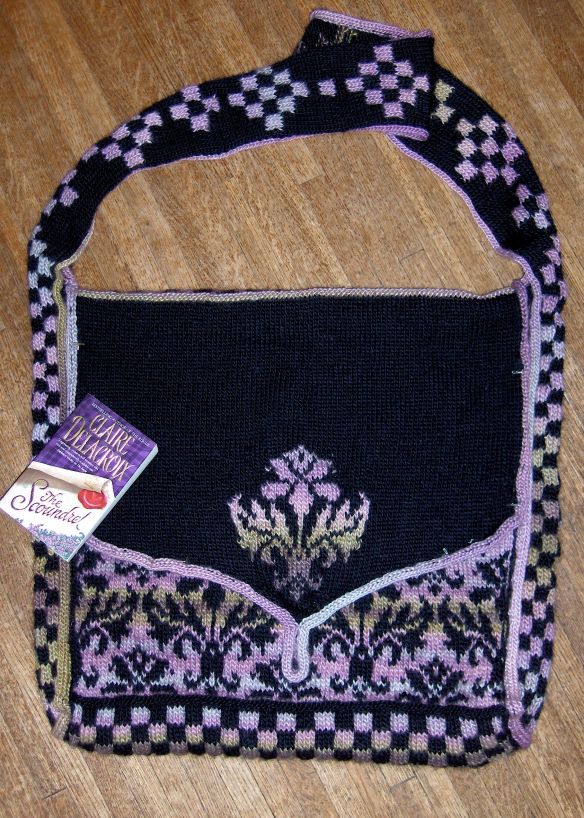
It’s about 24″ wide and 22″ deep in its unfelted state. My hope was for a bag more like 18″ wide and 13″ deep. I’ve felted a lot of SWS and that seemed about reasonable to expect in terms of shrinkage. I was a bit worried about it being so humungous – would this be the felting project that finally finished off my trusty (ferocious) top-loading washing machine?

Nope. But it didn’t felt the way I expected. Felting is, by nature, somewhat unpredictable, at least the way I do it. Putting the piece into a pillowcase then chucking it into the washing machine and coming back in half an hour leaves lots of opportunity for variation. I just don’t have it in me to stand guard over a felting piece though, pulling it out of the machine at regular intervals, much less to felt by hand in the tub with a plunger. I have made my peace with unpredictability.

Sometimes. On the first ride through the washer, the bag felted quite a bit. The flap and strap hardly felted at all. The design was starting to lose definition on the bag, but the bag was still pretty big. I had to leave it on the top of the washing machine and visit it regularly – poke it, prod it – to come up with a plan. Mostly I had to accept that I was past the point of no return – it was useless as it was; there was no going back; I might as well risk another run through the washer.

Before putting it back into the pillowcase, though, I tried to figure out how to make the strap and flap felt more than the bag on this run. The front of the bag had also felted more than the back on the first pass. So, I rolled up the bag and tied it into a big roll, with the back of it on the outside, much the way a butcher ties up a roast. It seemed that less exposure to hot water and less agitation could make the bag felt less. (Remember that I make stuff up for a living.) The flap and strap were free to move around inside the pillowcase. Back into the machine it went.

This worked pretty well. I made progress. But now, I have to get down to regional felting. Ugh. This is the handwork, in the sink, rubber gloves and hot water, just to get the flap and the strap to felt consistently with the rest. I have doubts. For the moment, I have to let it sit, maybe visit it, poke it and prod it once in a while. It’s still huge – about 18″ by 18″, but mostly I’m not loving it as much as I did (although this photo might change my mind.) Here it is:Kauni Damask Understated Bag by Karen Stelzer knit in Patons SWS by Deborah Cooke

What do you think?

Damask Bag in SWS – 3

So, I’m still knitting on this ginormous bag, and still loving it to bits. Let’s see – I started to tell you about it HERE, then continued the story HERE. This is the third installment of the story!

I’ve finished one side of the bag, in the same checkerboard pattern as the base. Here’s what it looks like now:Kauni Damask Understated Bag by Karen Stelzer knit in Patons SWS by Deborah CookeSo, the bottom of the bag is at the bottom of the photo here, folded behind the front and back. The top that will remain open is at the top, and the flap off to the top right. To knit the side, I picked up the stitches across the bottom, then picked up stitches all along the edge of the front and the back. Those I left on spare needles. As I knit the side, I joined it to the front and back by working two stitches together at the end of every row. Once I got up to the top, I worked applied I-cord all the way down the join, across the bottom and up the other side – that makes that nice thick black line. Right now, the live stitches at the top of the side are on that green piece of sock wool.

I’ve flipped it over since taking this picture and am repeating this exercise on the other side of the bag. Once that’s done, I’ll just need to knit the handle. I think I’m going to try double knitting on that, so the checkerboard pattern will be on both sides. I’ll knit from one end, make the strap, then graft it to the other side of the bag once I guess that it’s long enough.

After that, there’s just the felting to be done! I can’t wait to see this bag felted and finished.

What do you think of it so far?

Damask Bag in SWS – 2

I told you a few weeks ago about a fair isle bag I had started to knit and intended to felt.

Well, here’s an update. (I’m going on about this bag because I really really really like it, so you get to hear about it!)

I’ve finished the knitting of the bag itself and here’s a picture of it flat:Kauni Damask Understated Bag by Karen Stelzer knit in Patons SWS by Deborah Cooke

The edges really want to curl, and it’s not entirely straight, but you get the idea. I had to hold the camera over my head to get the shot – it’s that big – so the end of the button loop didn’t make it into the image. Oh well! It is about 66 inches long and roughly 22 inches wide – of course, it will shrink a lot when I felt it.

I changed direction twice with my knitting to get the flowers to all be knitted the same way. The first part I knit actually ended up in the middle – it’s the section with the black flowers with the coloured background: I knit from the black line which is just below the checkerboard in this picture down to the pink line. This will be the back of the bag.

When that was done, I picked up stitches at the bottom (a provisional cast on would have been an excellent plan) and knit in the other direction: I knit the checkerboard for the bottom of the bag, then the panel with the coloured flowers on the black background, casting off at the end. This will be the front of the bag.

I used the same technique as in my Stripey Noro Messenger bag and knit two rows in reverse stockinette where the bag will fold.

Then I knit the flap, starting at the point. I tried to replicate the curve of the original, even though my gauge was completely different and I was knitting in the other direction. It’s not too far off. I knit one flower motif, then 40 more rows of plain black. When that was done, I knit that pink line and left the stitches on the needle. I knit pinky-purple I-cord around the flap, then grafted the flap to the top of the first panel I’d knit. The bag will open at the top and the flap will hang over the front of the bag.

And presto – all the flowers are knit in the same direction AND they will all be right side up when the sides are done. I really like how the shading worked out for the single flower on the flap – the brown at the bottom looks like roots in the soil, then yellow- greeny bits for the leaves and pink/purple for the flowers. A happy accident there.

Since this photo was taken, I’ve continued with the sides. I’m knitting them the same way as my Stripey Noro Messenger bag too – first I picked up stitches across the bottom of the bag (on either side of the checkerboard), and now I’m knitting up the sides of the bag, joining to the front and the back as I go. When I get to the opening and flap at the top of the bag, I’ll knit the handle.

Getting there!

What do you think?