Damask Bag in SWS – 1

I have a tendency, it seems, to make things more complicated than they need to be.

In fact, I really enjoy when a project of any kind evolves into a much more complicated project than I’d originally anticipated. This is true of books and it’s true of knitting projects. In a way, a project that becomes a complicated beast is a good thing – it means, to me, that the project has taken on a life of its own, and demands its own shape. And when it does that independent of how such a move impacts my own scheduling and other demands, I know it’s not just got a life of its own – it’s got a bit of attitude. I like that a lot.

So, this month, I have been wrestling with a book manuscript that ran off and did that, as well as a knitting project that has run off and done that. We’ll talk about the knitting project today. This was supposed to be straightforward.

Uh huh. Nothing worth doing is ever straightforward, and this bag has proven to be very much worth the doing.

Here’s the basic idea. There is a fair isle pattern which is extremely popular in the land o’ knitters, and is particularly gorgeous in our old fave Kauni Effektgarn. It’s become known as Damask.

Here’s the sweater and quite possibly the first reference to it. (The stripey bits in the middle are for steeks – she would later cut open the front to make a cardigan.)

As much as I like this sweater, I didn’t want to make a cardi like this. I have other plans for my Kauni.

But then, I saw this pattern, for a tote bag, using the same fair isle pattern. It’s called Kauni Damask Understated Bag. (Not sure if you can see this without being on Ravelry, but it’s free to create an account. Go for it.) Since I noticed in the notes that some people were unhappy with the resolution of the design once the bag was felted, I decided to use thicker yarn. Venturing into the almost-endless wealth of the stash, I discovered a hoard of Patons SWS, which is excellent for felting. I decided to use one variegated colourway with black.

Of course, I didn’t actually have enough of either colourway in my stash, so had to hunt down more. This was my first complication. Both are discontinued, but I found the yarn with some online searching. Getting it only required a trek through the snow on a Friday to a LYS which isn’t particularly local. No worries. I had the materials.

Time for the second complication. This bag is worked in the round. You knit the rectangle for the bottom of the bag, then pick up stitches on all four sides and knit up. This works because the Kauni has very long colour gradations. SWS does not. Sooooo, I decided to knit the front of the bag, then knit the back. This would allow the SWS to do better stripey things.

I cast on. As I knit the front, the third complication came to me. I realized that the flower would have to be right side up on both sides of the bag. I hadn’t started at one edge – I’d started at the bottom and I would have to start the other side from the bottom as well.

Okay. After I knit the front, I put all my stitches on waste yarn because I’m not sure yet about the flap. I then picked up stitches for the bottom of the bag on the cast-on edge. (At this point, I realized that a provisional cast-on would have been an excellent idea, but no, I hadn’t done that. This counts as a consideration, not a complication. It’s not that hard to pick up from a cast on edge and since the bag is going to be felted, any extra tension there isn’t an issue.) I knit the bottom, then started up the other side, reversing the colour usage. Just because.

It’s a good thing I really like how it’s coming out. Here’s how it looks, on the needles and unfelted.Kauni Damask Understated Bag by Karen Stelzer knit in Patons SWS by Deborah Cooke
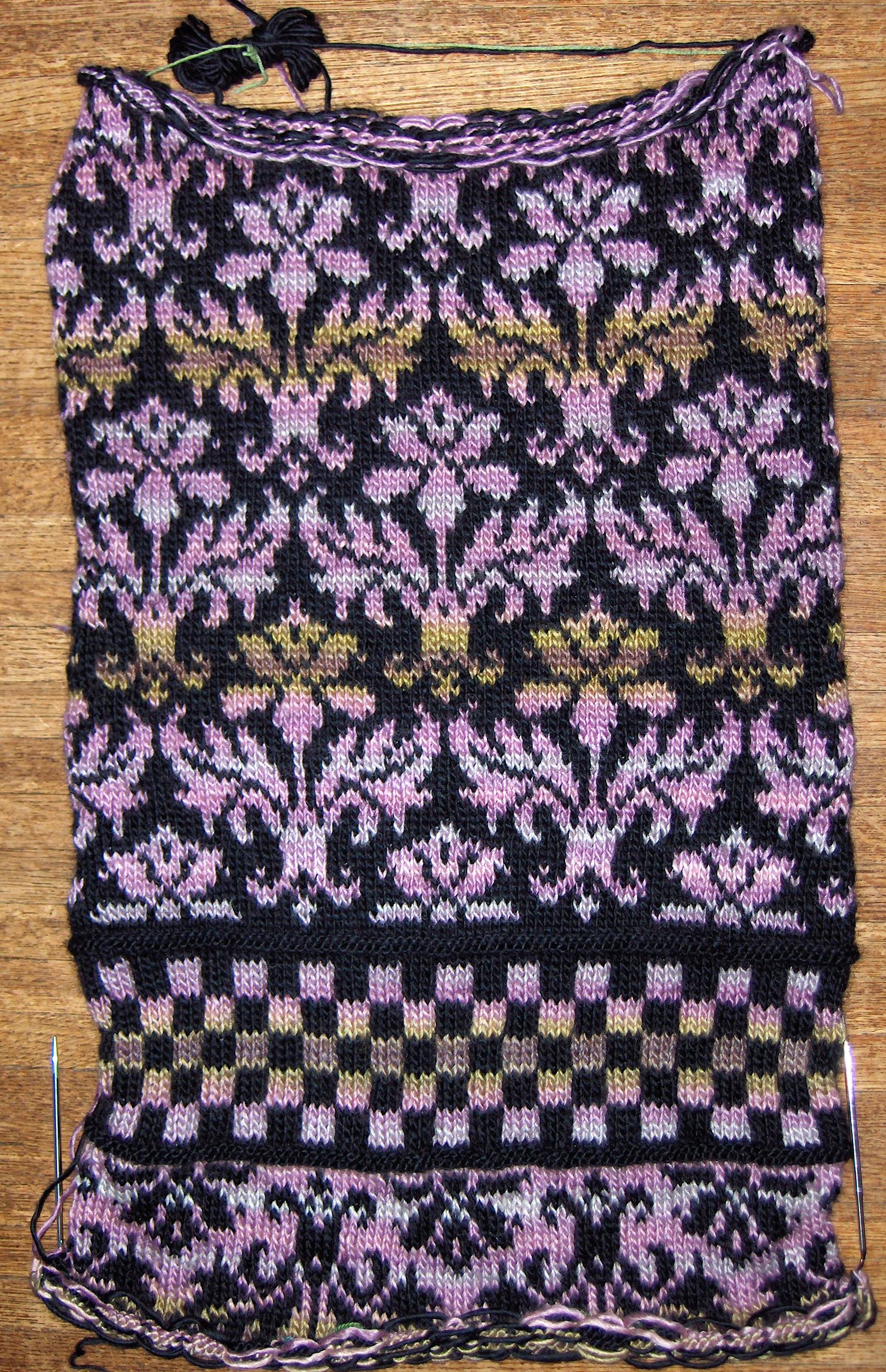
Time for another complication? It is! I had been thinking of putting a flower on the bag flap, instead of leaving it plain as in the pattern. That’s why I left those stitches on waste yarn – I was pretty sure I wanted the first colour combo on the back, and I figured I’d just grab those stitches and knit the flap. As I knit the other side, though, I realized that the flower on the flap would also have to be knit right side up. There’s our complication. Instead of carrying on from the back to knit down the flap to the point, I’ll have to cast on the point of the flap and knit UP, then graft the flap to the back of the bag.

I haven’t even thought about the handles yet. There’s got to be another complication there, just lurking…

Do you ever start projects that morph into more than you expected? Do you like that challenge or not?

The Elrond Sweater

I finished Mr. C.’s Kauni fair isle sweater a while back. (You may remember me talking about the swatching and the pattern choice here.)

When it came off the needles, it looked like this:

elrond1.JPG

It sat for a bit while I worked up the nerve to throw the completed sweater into the washing machine. I had to do it, because I had knit the sweater 10% too big to allow for the shrinkage in washing. It didn’t fit him, so into the pillowcase it went, then into the machine. That was a stressful 45 minutes! But it came out beautifully soft and 10% smaller.

It had to sit a few days more before I was ready to sew in the zipper. I always fret about sewing zips in with the machine, but not enough to baste them by hand first. This one, as has recently been the case, went in perfectly the first time.

Since then, Mr. C. has had it on his back and I’ve been trying to get it from him to take a picture of it! Here it is, all done:

elrond2.JPG

Yet more proof that I’m not a photographer! Unfortunately, you can’t feel how much the wool softened in the washing machine. It’s incredible. The sweater is so soft now that you wouldn’t think it was the same yarn. It didn’t felt – it just fulled and shrank.

For this sweater, I used the Kauni Rainbow colourway for the bright bits, but not all of the colour repeat. The purple, turquoise and green bits didn’t contrast enough with the purple, navy and blue background, so I broke them out of each repeat. I had a whole pile of these pieces left, so I knit something else with them. I’ll show it to you tomorrow.

Magnificent Mittens

When Pam and I visited Little Knits in Seattle, Fulay put a ball of this yarn into my hands. I simply could not put it down. It was so soft and the colours were so lovely. It’s called Kauri Merino-Possum-Silk and this is the fingering weight. We rummaged in the box – with authorization – and I chose two colours, 02 Kea and 14 (I think) Red Waina.

This yarn is a blend of merino, possum and silk. It’s extremely soft, and feels a great deal like alpaca. A bit of research revealed that it has other similarities to alpaca – possum is another hollow fibre, thus both light and warm. Evidently it also takes dye well, like alpaca, and that bit of silk gives it a lovely smooth gloss. More about the fibre itself right HERE and about conservation efforts HERE. I have mixed feelings about this stuff – it is a “kill fibre” – but let’s not get into that today. (If I had known the whole story, I probably would have just bought alpaca.)

I decided to knit a pair of mitts from MAGNIFICENT MITTENS by Anna Zilboorg, a book that is out of print but provides oodles of lovely eye candy. It’s taken me many versions over the past year or two to get to liking my cast-on – these mitten patterns are knit from the fingertip down. And here they are:

mmitts.JPG

The red is leftover Hand Maiden Somoku. The red in the cuff and on the mitt itself is done in duplicate stitch, btw. I still have to knit the linings, but the mitts are lovely and soft and warm already. What do you think?

Kauni Fair Isle

I’m fascinated with the wool with the long colour gradations called Kauni Effektgarn. (That’s a Ravelry link.) This is going to be a zip-front cardigan for Mr. C. – the plan is for it to replace one of his fleeces. It’ll be warmer, plus I think it’ll look better than recycled pop bottles ever could.

Not that I’m biased toward knitted sweaters!

I decided to knit a top-down raglan. This is because you do all the math at the beginning, then just knit. Also, the pieces match perfectly – a good thing with stripes like the Kauni makes – and the only seam you have to sew up is a little teeny one in each underarm. Finally, you can try it on as you go, and check the fit. This beats the heck out of frogging an entire sweater.

There are a lot of free top down raglans available in the wide world. Here’s one at Woolworks. Designer Stephanie Japel has created a lot of patterns for top down raglans – here’s her instructions on designing your own.

Once you’ve made the basic calculations, you can play.

I had bought two colours of the Kauni – the slowly changing blue called EL and the rainbow gradation called EQ. My plan was to do “something fair isle”. Since it’s for Mr. C. and I knew he wouldn’t wear it if it was too vivid, the idea was for the jacket to be mostly blue with intermittent fair isle stripes in the two colourways.

A terrific resource for fair isle – including its history and a number of patterns – is Alice Starmore’s Book of Fair Isle Knitting. This book has been out of print for some years, and used hard cover copies were selling for incredible prices. The good news for all of us knitters is that the book is being reprinted in paper this year – you can preorder a copy at the online booksellers for $20 or so. Or you can look in your library for a copy.

I had Mr. C. choose three fair isle patterns that were variations on a theme – a “peerie” or narrow pattern, a wider pattern and a border. All of the ones he chose use the same motif – in this case, a diamond, although there are lovely patterns in stars, X’s and O’s, lots of choices. These were the ones he liked and it’s his sweater. Let’s call them 1, 2 and 3, 1 being the narrowest and 3 the widest. I’ve knit them 1 – 2 – 3 – 2 – 1 – 2 – 3 – 2 etc. with 6 rows of the blue between each one.

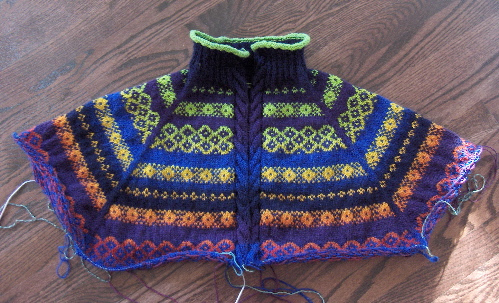
I just split the work for the underarms, so you can have a peek. Here we are.

Elrond Cardigan knit in Kauni Effektgarn by Deborah CookeKnitting this has been addictive. There’s just something about self-striping yarns that always has me knitting one more row “just to see”. I’m not a fast knitter, but I can be an obsessive one! One of the fun things about fair isle is that if you make a small mistake, it tends to get lost.

Mr. C. loves this sweater. He says it awakens his inner Celt – we all have one – but I think the way the colours shift and change on this sweater is even more magickal than that. I’m calling it the Elrond Sweater, just the thing for those chilly evenings at Rivendell.

A few details:

• Most of these raglan patterns suggest starting at the collar line, then going back, picking up stitches and adding the collar when the rest of the sweater is done. I knew the blue probably wouldn’t match if I did that, so I took a chance and started at the collar cast-on instead. I used the same number of stitches that I’d calculated to cast on at the neck, then because it looked SO BIG, I worked it in 2×2 ribbing. Voilà. The collar is done and it matches.

• I also ran a cable down either side of the front, the two cables mirroring each other to frame the zipper. I like the look of cables with fair isle – one designer who seems to put the two together a lot is Fiona Ellis. This particular cable is a 12 stitch band on each side, with 2 purl stitches on either side of the 8-stitch cable – purl stitches always make cables pop from the background of the sweater – and the cable twists every 8 rows.

• I’ll knit I-cord down the fronts as well, in contrast, to accent the opening even more, then will edge cuffs and hem the same way as the collar. I’d like them all to be the same green, so here’s hoping I have enough.

• It’s kind of fun how the gradation of the rainbow is working out – I like that it made one cycle from green to red from the neck to the underarms. The rainbow goes from red into purple, blue and turquoise, but I’ve broken that section of the colourway out of the yarn. There just won’t be enough contrast in the fair isle against the blue background. I’m heading back from red to green again.

The sleeves will change colour more slowly than the body, because there will be fewer stitches. I had debated the merit of breaking the yarn to make everything matchy-matchy, but have decided to just go with it. As long as the sleeves match each other, it’ll look good.

It’s going to shrink a little bit when I wash and block it, about 1/8″ for every inch, so the yarn will tighten up and the fair isle will snap even more. The wool also softens and fulls in the wash, making it look a bit fuzzier. I like how the swatch looks, so am aiming for the same finish.

So, what do you think?