Damask Bag in SWS – 1

I have a tendency, it seems, to make things more complicated than they need to be.

In fact, I really enjoy when a project of any kind evolves into a much more complicated project than I’d originally anticipated. This is true of books and it’s true of knitting projects. In a way, a project that becomes a complicated beast is a good thing – it means, to me, that the project has taken on a life of its own, and demands its own shape. And when it does that independent of how such a move impacts my own scheduling and other demands, I know it’s not just got a life of its own – it’s got a bit of attitude. I like that a lot.

So, this month, I have been wrestling with a book manuscript that ran off and did that, as well as a knitting project that has run off and done that. We’ll talk about the knitting project today. This was supposed to be straightforward.

Uh huh. Nothing worth doing is ever straightforward, and this bag has proven to be very much worth the doing.

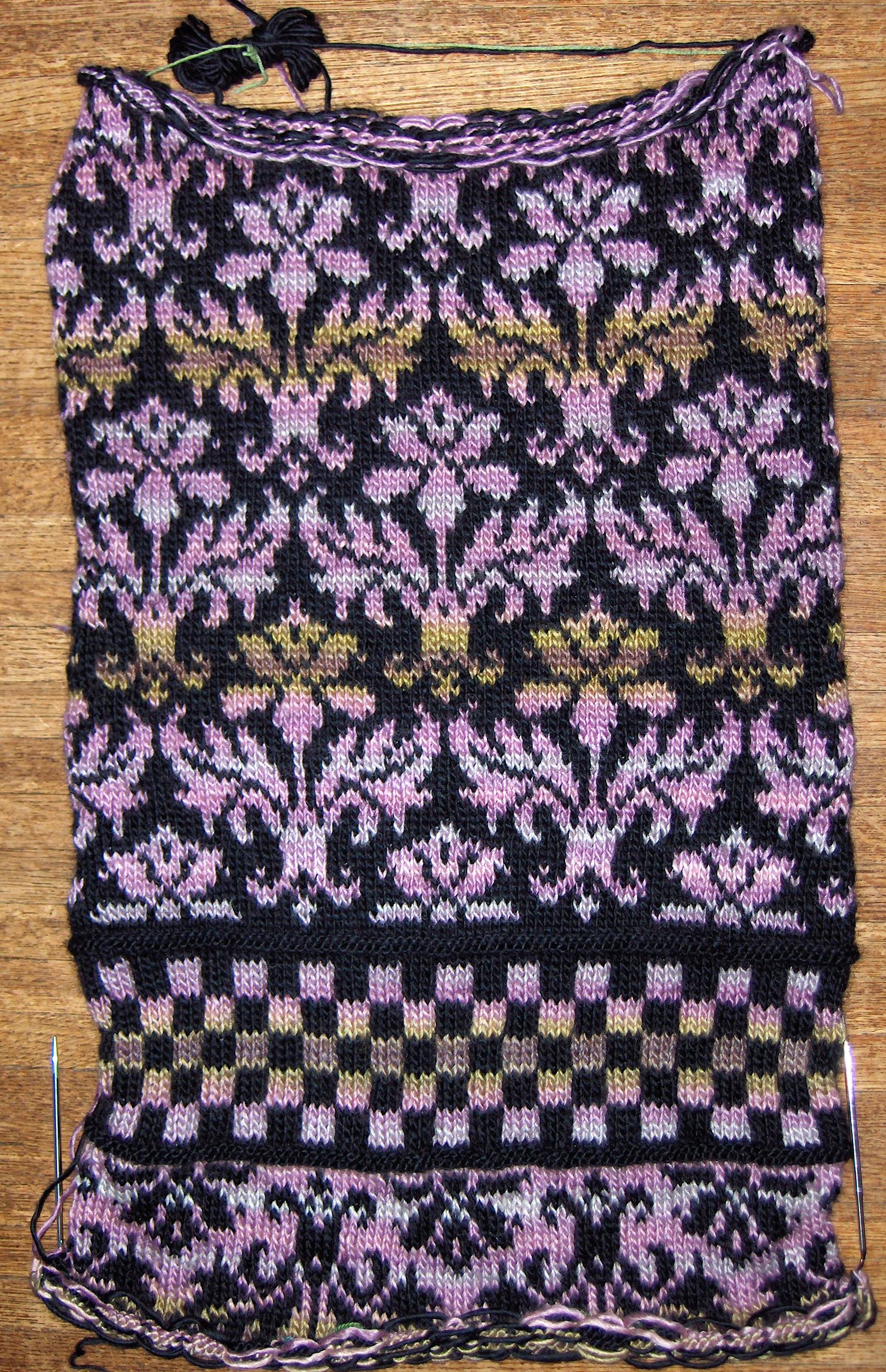
Here’s the basic idea. There is a fair isle pattern which is extremely popular in the land o’ knitters, and is particularly gorgeous in our old fave Kauni Effektgarn. It’s become known as Damask.

Here’s the sweater and quite possibly the first reference to it. (The stripey bits in the middle are for steeks – she would later cut open the front to make a cardigan.)

As much as I like this sweater, I didn’t want to make a cardi like this. I have other plans for my Kauni.

But then, I saw this pattern, for a tote bag, using the same fair isle pattern. It’s called Kauni Damask Understated Bag. (Not sure if you can see this without being on Ravelry, but it’s free to create an account. Go for it.) Since I noticed in the notes that some people were unhappy with the resolution of the design once the bag was felted, I decided to use thicker yarn. Venturing into the almost-endless wealth of the stash, I discovered a hoard of Patons SWS, which is excellent for felting. I decided to use one variegated colourway with black.

Of course, I didn’t actually have enough of either colourway in my stash, so had to hunt down more. This was my first complication. Both are discontinued, but I found the yarn with some online searching. Getting it only required a trek through the snow on a Friday to a LYS which isn’t particularly local. No worries. I had the materials.

Time for the second complication. This bag is worked in the round. You knit the rectangle for the bottom of the bag, then pick up stitches on all four sides and knit up. This works because the Kauni has very long colour gradations. SWS does not. Sooooo, I decided to knit the front of the bag, then knit the back. This would allow the SWS to do better stripey things.

I cast on. As I knit the front, the third complication came to me. I realized that the flower would have to be right side up on both sides of the bag. I hadn’t started at one edge – I’d started at the bottom and I would have to start the other side from the bottom as well.

Okay. After I knit the front, I put all my stitches on waste yarn because I’m not sure yet about the flap. I then picked up stitches for the bottom of the bag on the cast-on edge. (At this point, I realized that a provisional cast-on would have been an excellent idea, but no, I hadn’t done that. This counts as a consideration, not a complication. It’s not that hard to pick up from a cast on edge and since the bag is going to be felted, any extra tension there isn’t an issue.) I knit the bottom, then started up the other side, reversing the colour usage. Just because.

It’s a good thing I really like how it’s coming out. Here’s how it looks, on the needles and unfelted.Kauni Damask Understated Bag by Karen Stelzer knit in Patons SWS by Deborah Cooke

Time for another complication? It is! I had been thinking of putting a flower on the bag flap, instead of leaving it plain as in the pattern. That’s why I left those stitches on waste yarn – I was pretty sure I wanted the first colour combo on the back, and I figured I’d just grab those stitches and knit the flap. As I knit the other side, though, I realized that the flower on the flap would also have to be knit right side up. There’s our complication. Instead of carrying on from the back to knit down the flap to the point, I’ll have to cast on the point of the flap and knit UP, then graft the flap to the back of the bag.

I haven’t even thought about the handles yet. There’s got to be another complication there, just lurking…

Do you ever start projects that morph into more than you expected? Do you like that challenge or not?
Stripey Noro Messenger Bag

Well, this week we have kind of a re-useable bag theme going on here, at Alive & Knitting. First there were bags we could make from reclaimed or vintage sweaters, that had been felted to make them tough. And now, here’s a bag knitted from scratch, ready to be used again and again and again.

But first, a bit of a saga. Remember the sweater I made from Noro Kureyon? Well, I had some leftover yarn and wanted to use it. (Stash management is key, right?) Remember my Dr. Seuss Socks? There’s just something about using a self-striping yarn like Noro in stripes that works for me in a big way. Noro Kureyon is said to felt wonderfully, so I decided to make a felted stripey messenger bag with those leftovers.

I paired the Noro with a colourway of Patons Classic Wool that I bought on a pilgrimage to Spinrite – thus, yes, doing some responsible stashbusting while pursuing a responsible project. This must have been a test colour because it’s not on their site. ($9.99 C for 8 x 100g balls. That’s not temptation. That’s inescapable acquisition.) Actually, there were a number of colours available at the mill, all of which had one ply that had a long graduated colour change. This is a mustard with the coloured ply changing through reds and purples. It worked well with the greens in the Noro Kureyon.Patons Classic WoolThis is the massive project that has been taking up my needle time. After all the knitting was done, I wanted to add I-cord. Ugh. There are about 10,000 miles of applied I-cord on this bag. It’s not strictly necessary, but it does make the edges look so much better. Here’s a shot of the I-cord in progress – it’s done on the left but not on the right:Stripey Noro Messenger Bag by Deborah Cooke knit by Deborah CookeSee how the I-cord neatens up those edges, and makes the bag look more crisp? I get really bored knitting I-cord, but I love the results.

I found some amazing buttons in my stash – I bought these because they were so wonderful, but never found a project for them. (Until now.) They look like pieces of amber, but have little lines inside them – Mr. C. says they look like rutilated quartz. I’m taking his word on that.

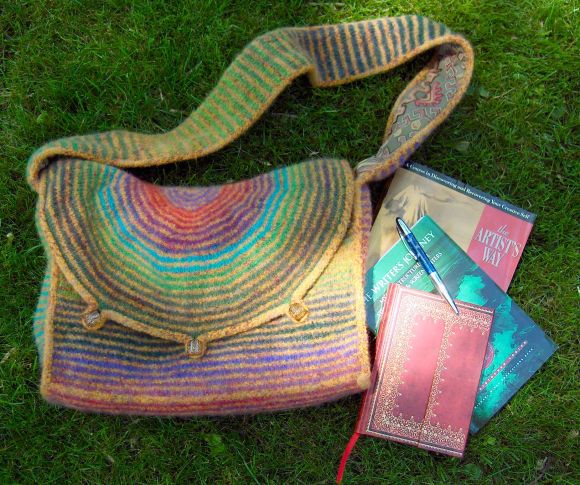
And here’s the finished bag before felting:Stripey Noro Messenger Bag by Deborah Cooke knit by Deborah CookeIt’s HUGE. The edges wanted to roll so I pinned them down – here’s hoping they just stay flat once it’s felted.

And here it is, after felting and finishing. Of course, it has a zipper and a lining, because I’m kind of compulsive like that.

Stripey Noro Messenger Bag by Deborah Cooke knit by Deborah CookeI LOVE this bag! What do you think of it?

My Ravelry project page is here.

The pattern is posted as a free download on Ravelry right here.

Upcycled Bags

Another day on the re-useable bag theme. Today’s bags aren’t vintage bags in themselves – although it can be fun to score an oldie but a goody. I saw airline totes from the 1970’s the other day in a thrift store. So cool!

These bags are made from old sweaters.

It’s one thing to felt a piece of new knitting. But you can also felt a piece of old knitting. Or machine knitting. Or make use of a wool sweater that you might not use otherwise – one that doesn’t fit anymore, one you don’t like anymore, or one you bought for $2 at the thrift store.

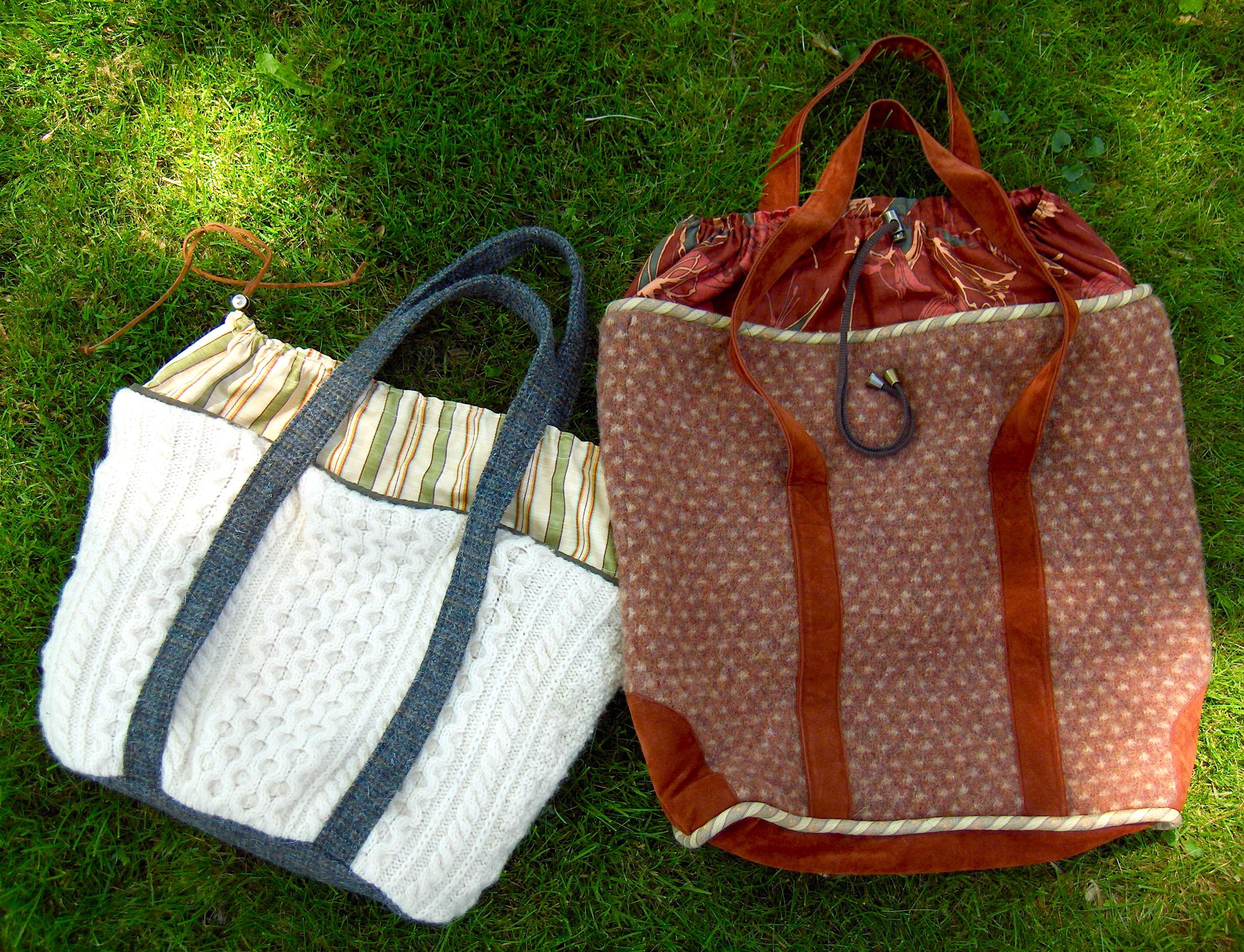
Like this:upcycled bags made from felted vintage wool sweaters by Deborah Cooke

The first thing you need is a 100% wool sweater. Ideally, it will also be a colour (or pattern) that you like.

The second thing you need to do is felt the sweater. Knot it up in a pillow case and toss it into the washing machine, with some towels and/or jeans to balance the load. If it doesn’t felt enough to lose stitch definition – i.e. if you can see the individual stitches – put it in for another round. Heat and agitation make wool felt. Front loading washing machines are more gentle and will require more repeats to felt an item. Hot water works faster. You can also fill the tub with hot water, toss in the sweater, put on your rubber boots, grab a plunger and get in there to agitate it. Your choice.

Once the sweater is felted, you need to decide which part to use. You can cut felted knitting without worrying about it unravelling. The bag on the left was the simplest kind – I cut it off straight at the underarms. The bottom ribbing became a seam allowance (a big one) in the base. The base is oval, just eyeballed from the size of the bottom plus a seam allowance. I edged the top with some piping from my fabric stash, made matching handles and a lining, and that’s that. I’m not much for open bags, but that would have been even easier.

The one on the right was one I wanted to be as big as possible. Those fake suede patches at the base actually cover the armscye from where I cut away the sleeves. The waist ribbing from the sweater is at the top, underneath that piping edge. This one has a square bottom which was a little bit trickier to sew. To cut the right size rectangle, I flattened the bag, then measured the whole width. The sum of the narrow side of the rectangle base and the long side of that base had to be the same as the width of the flattened bag. The other thing with this one was that I discovered after getting home that it had one little moth nibble. I unravelled some yarn from the cuff (which I knew I was going to cut off anyway) and darned the hole with the same wool. After felting, I couldn’t even find the repair again.

Have you made any bags from recycled or thrifted materials?

Revontuli

There’s not a pot of gold at the end of the Kauni rainbow – just some northern lights.

As mentioned yesterday, I used the EQ or Rainbow colourway of Kauni in Mr. C’s Elrond sweater. I paired it with the EF colourway, which is navy, purple and blue, so some of the rainbow didn’t have enough contrast. I broke out the purple, turquoise and green bits of the rainbow and set those parts aside. When his sweater was done, there was a ziplock full of purple, turquoise and green.

I thought of making something for myself, maybe another shawl.

This pattern is called Revontuli, which apparently is the Finnish word for the northern lights. (That’s a Ravelry link.) It just so happens that every time I’ve seen the northern lights, they’ve been lime green or turquoise, so this worked out perfectly. There’s a smidge of yellow at the centre cast on and at the outer hem.

I washed this by hand once, giving it a good soak, but it still didn’t soften as much as Mr. C.’s sweater. So, into the pillowcase and into the washing machine it went. Here’s the finished piece – I love it!

revon1.JPG

The colours are not quite as vivid as the flash makes it appear – it shades from gold at the centre into lime, then a softer turquoise than this, then purple. I turn back at red-purple. This looks quite primary, but the real thing is more like petroleum on water. I like that palette!

revon2.JPG

It shrank quite a bit in the washer, because it was knit at a looser gauge (on 4.5mm needles). It blocked 33″ from the middle to each point when I washed it by hand – after the washer, it blocked at 28″. It’s not felted, though – you can still see the stitches – but it is closer to being felted than Mr. C.’s sweater. Once again, the Kauni really softened. This is like having a soft blanket tucked around the shoulders. I think I’ll wear it a lot because it is so snuggly.

Weekend Getaway Satchel

I can’t believe this beast is finally done. I love it, but it was a lot more work than anticipated.

Then I couldn’t figure out how to photograph it!

But finally, here it is, my Weekend Getaway Satchel from Interweave Knits (hmm. I can only find a picture on Ravelry), designed by Marta McCall:

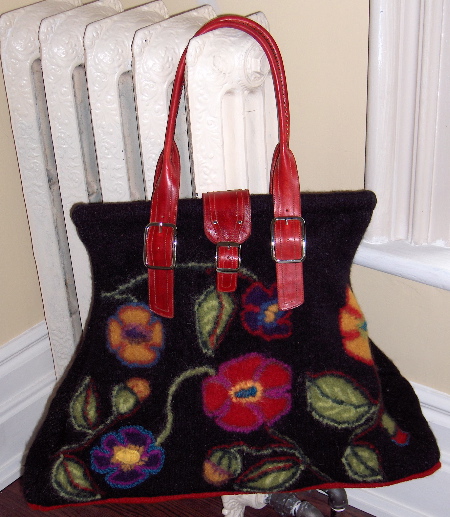
Weekend Getaway Satchel knit in Patons Classic Wool by Deborah CookeMake no mistake – it’s huge. The base is 24 x 8 and it’s so tall that I have to put it on my shoulder. Part of the height issue is my fault – I couldn’t bear to cut away all the excess knitting to make the felted pieces the same size as the schematic, so mine is a few inches taller than recommended. I never thought about the extra height from the handles (or my lack of height) but the end result is that I can’t just carry it in my hand without it dragging. Oh well. I like shoulder bags.

I changed the handles as well, using leather handles from Grayson E. instead of the felted handles suggested in the pattern. I don’t find that felted handles stand up to stress that well – plus didn’t like the idea of knitting that enormous length of red strap shown in the pattern. These handles are beautiful but expensive – I could only justify them by using odd balls and mill ends for the wool. It’s mostly Patons Classic Merino, which is now called Patons Classic Wool – you can see that one teal blue, the one that outlines the flower at the bottom left, was NOT wool and didn’t felt, but I like how frilly it looks.

working on the Weekend Getaway SatchelThe pattern is easy to follow and the knitting isn’t complicated. Most of the detail is embroidered on to the intarsia. I had thought to pattern the back as well, but by the time I finished the front, I was ready to knit a plain back as the pattern specified. The finishing, though, was a bear. I lined the bag – because I hate unlined bags – and sewing that lining in, after the base was installed, the handles were sewn on and the hex frame was sewn in, was an acrobatic feat. Fortunately, blood doesn’t show in black tweed because I stabbed myself with the needle a number of times!

I really love this bag, but I won’t be in a hurry to make another. In fact, I think I’m worn out with felted bags for a while.

What do you think? Do you knit felted bags?