Basic Sock Variations

Last week, I explained how I knit a basic sock. Today, I’ll explain two variations: heavy socks and knee socks.

Heavy Socks
Ribbed Sport Socks by Patons knit in Briggs and Little Tuffy by Deborah CookeMr. Math likes thick socks in the winter – he wears them instead of slippers in the house. I use a Canadian yarn for these socks called Briggs & Little Tuffy. It’s wool with a bit of nylon and comes in heathered colors, as well as a marl or two. It’s yarn that remembers the barn, so expect some vegetable matter to be spun in. It’s a thicker yarn than the sock yarn mentioned last week.

You’ll need two skeins of Tuffy for a pair of socks, but will have a fair bit left over – not enough for another pair of socks, but plenty for contrasting toes and cuffs. (My neighbor says two skeins make three socks, so four skeins make three pairs, but I’m not sure about this.) I use 3.0mm needles for these socks and cast on 56 stitches, but otherwise, just follow the basic sock instructions. They knit up pretty fast compared to socks in regular sock yarn.

A side note here on washing hand-knit socks: I wash our hand-knit socks in the washing machine, but I wait until there’s a load of them and use the delicate cycle. They’re wool, after all, and I don’t want them to felt (and shrink). You can also wash them by hand, which will keep them looking their best. NEVER put them in the dryer, because then they will shrink. With socks knit in B&L Tuffy, I also use sock stretchers. This ensures that the socks don’t shrink as they dry, or if they have shrunk a bit in the wash, it stretches them back out again.

Knee Socks
I love the idea of knee socks. I’m not sure why, as I don’t wear them much and they take a long time to knit. (All that ribbing. Ugh. But the ribbing gives them a better chance of staying up.) Invariably, I have a pair on my needles – sometimes for quite a while.

Knee socks are (duh) longer than regular socks, but they also need to be wider at the top to accommodate your calf muscle.  They take a lot of yarn as a result – buy twice as much yarn as you need for regular socks. You’ll have some left over, but not as much as you might expect.

If you’re using sock yarn, go with your usual 2.25mm or 2.5mm needles. Cast on 96 stitches, and work in 2×2 ribbing for 2 inches. Then knit in 6×2 ribbing for 30 rows. (You might be taller than me. Adjust this measurement so that you’ve knit to the widest part of the calf, with a two inch cuff.) Now you have to decrease down to 72 stitches to finish the sock. There are two options for this: hide the decreases or create a gusset.

Hide the Decreases:
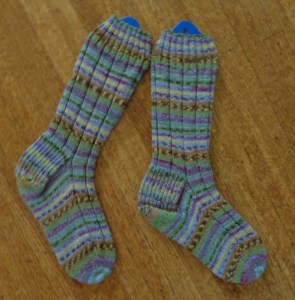
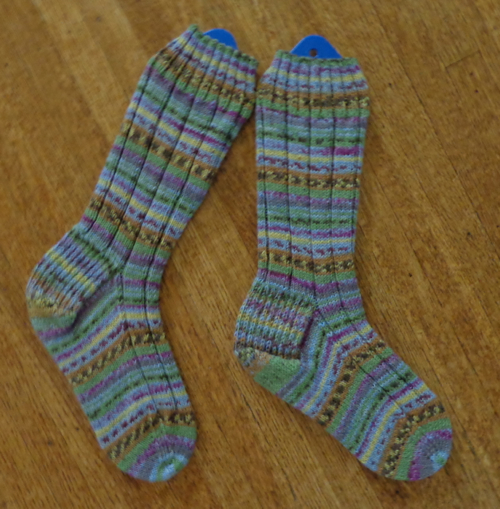
knee sock knit in Fleece Artist Trail Sock by Deborah CookeThe second of this pair of socks is currently on my needles. It’s knit in another yarn from the Maritimes: Fleece Artist Trail Socks in the Hercules colorway. Because it’s a handpainted yarn, the repeat on the stripe sequence isn’t precise, as it tends to be on commercial yarns. The color increments are also much smaller, which makes swirls instead of bands.

You can hide the decreases by changing gradually from a 6×2 rib to a 4×2 rib.

Decrease round #1: *SSK, K4, P2, K4, P2, K4, P2, repeat from * to end of round.

Work 9 rows.

Decrease round #2: *K5, P2, SSK, K4, P2, K4, P2, repeat from * to end of round.

Work 9 rows.

Decrease round #3: *K5, P2, K5, P2, SSK, K4, P2, repeat from * to end of round.

Work 9 rows.

Decrease round #4: *K3, K2tog, P2, K5, P2, K5, P2, repeat from * to end of round.

Work 9 rows.

Decrease round #5: *K4, P2, K3, K2tog, P2, K5, P2, repeat from * to end of round.

Work 9 rows.

Decrease round #4: *K4, P2, K4, P2, K3, K2tog, P2, repeat from * to end of round.

Done! You have 72 stitches. Now, work in 4×2 ribbing for the rest of the sock, following the basic instructions.

Create a Gusset:
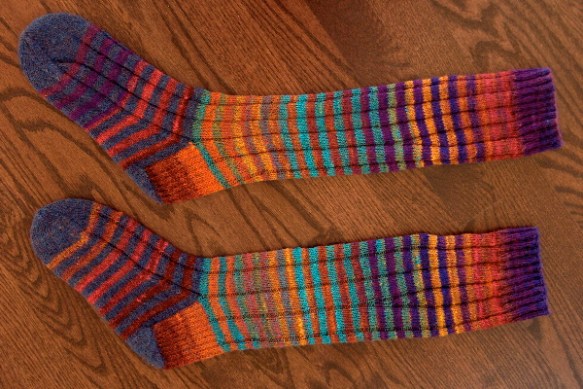
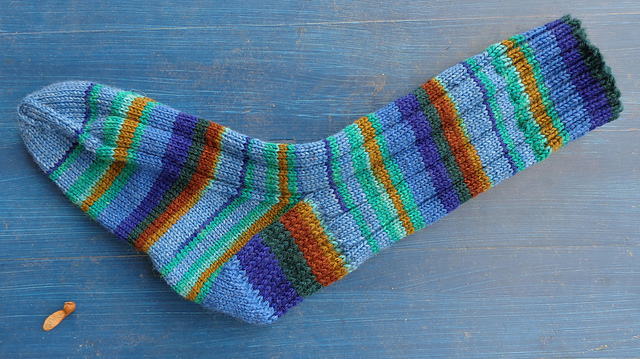
Dr Seuss Socks knit by Deborah Cooke in Noro Kureyon SockThis pair of socks are knit in Noro Sock yarn. Although this is a yarn from a big commercial mill, there’s a deliberate wabi-sabi attitude toward self-striping repeats in Noro yarns. Sometimes a color is missing from the sequence. Often the color segments are of different lengths. The repeat is less perfect and more organic, which I like a lot. These socks are knit from alternating balls – 2 rows from ball A, then 2 rows from ball B, then back to ball A for two more rows etc. This is one of my favorite ways to show off self-striping yarns.

You can see that I still had the matchy-matchy disease badly enough to start both colourways at the same point of the repeat. (There is no cure.) On the foot, I changed out one ball of Noro Sock for Briggs and Little Durasport, which is about the same weight but wears better. That’s the solid denimy-blue.

These socks were a bit skinnier than the pair I’m currently knitting. They were my first knee socks and I cast on 88 stitches. They’re a bit more snug and more likely to fall down. That’s why I now start with 96 stitches. In this picture, you can see one of two gussets on each sock. Essentially, one of the 6×2 rib repeats is decreased until it disappears into the next rib. The gussets are also centered over the heel – on this pair, there are three plain ribs between the gussets. There are two gussets in these socks, but if I cast on 96 stitches, there would need to be three. I’d eliminate the rib in the center back in addition to the two shown here – like this:

Work as above to the decrease row.

Decrease round #1: SSK, K4, P2, K6, P2, SSK, K4, P2, K6, P2, SSK, K4, P2, continue in 6/2 rib to end of round.

Work 3 rows.

Decrease round #2: SSK, K3, P2, K6, P2, SSK, K3, P2, K6, P2, SSK, K3, P2, continue in 6/2 rib to end of round.

Work 3 rows.

Decrease round #3: SSK, K2, P2, K6, P2, SSK, K2, P2, K6, P2, SSK, K2, P2, continue in 6/2 rib to end of round.

Work 3 rows.

Decrease round #4: SSK, K1, P2, K6, P2, SSK, K1, P2, K6, P2, SSK, K1, P2, continue in 6/2 rib to end of round.

Work 3 rows.

Decrease round #5: SSK, P2, K6, P2, SSK, P2, K6, P2, SSK, P2, continue in 6/2 rib to end of round.

Work 3 rows.

Decrease round #6: K1, P2 tog, K6, P2, K1, P2tog, K6, P2, K1, P2tog, continue in 6/2 rib to end of round.

Work 3 rows.

Decrease round #7: SSK, P1, K6, P2, SSK, P1, K6, P2, SSK, P1, continue in 6/2 rib to end of round.

Work 3 rows.

Decrease round #8: SSK, K5, P2, SSK, K5, P2, SSK, K5, P2, continue in 6/2 rib to end of round.

From here, just carry on with the basic sock instructions. Make sure when you set up your heel that the gussets are centered over it.
 

Basic Socks

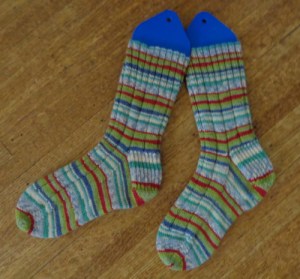
socks knit in Patons Kroy stripes by Deborah CookeI had an email earlier this week from my niece, who wanted to know how to knit socks. For some reason, she thought I might know. (Ha.) Since she lives far away, I can’t sit down and show her. I need to explain how to do it. I knit socks so often that I don’t pay a lot of attention to what I do (and don’t use a pattern anymore) so I got out my needles, cast on, and wrote down what I was doing as I went. The result is here, for my niece and anyone else who wants to knit socks.
Here we go.

Start with the yarn.
Picking the yarn for a project is probably the most fun part. So many possibilities! For socks, you’ll want a sock yarn – which means that the fiber is mixed with nylon so the socks wear better. Also, new knitters tend to have uneven tension, so wool is a good choice – it’s the most forgiving. (Cotton is merciless because it has no stretch. If you want cotton socks, knit them as your second pair – or maybe your tenth!) So, a yarn that is wool blended with 10 or 15% nylon is a great choice.

The yarn you choose will either come in 50g balls or 100g balls. The 100g balls will usually have 400m or more, which is perfect for two socks, pretty much independent of what choices you make. With 50g balls, two balls might not be enough. I have some Lorna’s Laces Shepherd Sock here, for example, which has 215m in 50g. Lots for a sock. I’m casting on with Kroy Socks, though, which is a four ply yarn. It’s a little thicker so there’s only 152m in 50g. That’s a bit short for a sock. I buy a third ball with this yarn, just to be sure. Once you’ve knit a few pairs of socks and have ends leftover, you can always knit the toes in a contrasting color.

socks knit in Patons Kroy FX by Deborah CookePick your needles.
You’ll need a set of double-pointed needles (DPNs) or a pair of short circular needles in your needle size of choice. It’ll be between 2.0mm and 2.5mm, depending upon the thickness of your yarn and your own tension. Tension is personal. You might knit tightly and need to use a bigger needle to get a nice fabric. You might knit loosely and need to use a smaller needle to have a good result. The knitted fabric shouldn’t be so tightly knitted that it’s stiff, and it shouldn’t let too much light get through, either. There’s a balance to be struck. I’m going to cast on with my tried and true 2.25mm DPNs. (Thrift shops, btw, are great places to get needles cheap.)

Cast on.
There are two main ways to knit socks: “cuff-down” means that you start at the cuff and knit down to the toe; “toe-up” is the other way around. Let’s knit cuff-down. You want a stretchy cast-on so it’s easy to pull on the finished sock. I use the long tail cast-on. There are a ton of online videos demonstrating this, if you haven’t learned it already.

For socks, I cast on 72 stitches. Some people use 64, but I hate tight socks. Hate. Hate. Hate. (This is one of those choices that will affect how much yarn you use.) Distribute your stitches across 3 of the DPN’s (Yup, 24 on each one.) and join without twisting. If you’re using short circulars, put half of the stitches on each needle and join without twisting.

socks knit in Jawoll aktion by Deborah CookeFussy Knitter Tip – If you’re knitting with self-striping yarn that comes in 50g balls and you have the matchy-matchy disease, be That Customer and go through the selection until you find two balls that start at the same place in the stripe sequence. Commercial yarns (like Kroy Socks) have a striping sequence that repeats at precise intervals. If the ball starts in the same place, you cast on each sock from the new ball, you’ll get socks that match. This can be a bit of a mind-melting exercise as mills wind self-striping yarn in either direction of the color sequence. So, you can be looking for balls that start with B-C-D of an A-B-C-D-E sequence, and will come across ones that are D-E-A as well as those that are B-A-E. Remember that puzzle-solving is good for avoiding dementia. If you have the matchy-matchy disease badly, choose a point to make the cast-on knot that’s easily repeatable – maybe the point where one color changes to the next.

Ribbing.
You can rib a little or a lot. I hate socks that fall down almost as much as tight socks, and ribbed socks stay up. I rib all the way to the heel, then on the top of the foot to the toe. (Ribbing uses more yarn than stockinette stitch, so this is one of those choices.) You can rib 2/2 (K2, P2) or 4/2 (K4, P2) or 6/2 or any repeat that divides evenly into 72. You can rib for an inch or two inches, then change to stockinette. You can rib 2/2 for two inches then switch to 6/2 to the heel. This is my favorite combination because ribbing goes slowly. I knit the leg 6″ for my socks, and 8″ for Mr. Math’s socks. You can vary this, but as soon as the sock goes over the calf muscle (knee socks) you need to make some adjustments. We’ll talk about knee socks next week.

Fussy Knitter Tip – When you knit on multiple needles, it’s easy to get a gap in your knitting where you change from one needle to the next. This is called a “ladder” because it looks like one. To avoid ladders, try three tugs. When you change needles, give your working yarn a little tug. After you knit the first stitch on the next needle, give your working yarn a little tug. Third time’s the charm – after you knit the second stitch on the needle, give your working yarn another tug. Presto. No ladders. This tactic also works if you get a loose knit stitch right before you switch to purl in your ribbing. Give that knit stitch a tug, then the purl one, and no more loose stitch.

Turning the Heel.
This is the trickiest bit, and it’s not that tricky. (You can do it.) First, you’re going to knit a heel flap that goes down the back of your foot. Then you’ll do some decreases to turn the work so you’re knitting the bit that goes on the bottom of your foot. Then you’ll pick up stitches on each side of the heel flap so that you’re knitting in a circle again. You’ll decrease down to your original stitch count in gussets. After that, it’s straight on to the toe.

Knitting a heel flap by Deborah CookeIf you have a sock yarn that includes a spool of matching nylon thread (Lang Jawoll does this. The spool is buried in the middle of the 100g ball.) use it for this part. Just knit with it along with the sock yarn for the heel flap and the turning of the heel. It’ll help the socks to wear better.

1. The Heel Flap
A heel flap should be a little less than half the width of the sock. Half of 72 is 36, so we’ll make ours 34 stitches. After you’ve knit the leg as long as you want it to be, arrange your stitches so that there are 34 on the first needle. Slip 1, knit 1 across these 34 stitches. Turn. Slip 1, purl to end. Turn. Repeat this sequence, working only on these 34 stitches, until you have a heel flap that’s about two and a half inches deep.

turning the heel by Deborah CookeFussy Knitter Tip: I like when ribbing lines up, no matter what I’m knitting. Since I’m knitting these socks in 6/2 rib, there are nine repetitions around the sock. I chose to have four knit bands descend into the heel. To make it symmetrical, I didn’t work the last two purl stitches in the last round of the sock leg. Instead, I moved them on to the next needle and worked them as the beginning of the heel flap. That gave me (8 x 4 +2) 34 stitches for my heel flap.
2. Turning the Heel
This is a sequence of decreases which turn your knitting so that you’re knitting along the bottom of the foot instead of down the back of the heel.

Slip 1, K to 2 stitches past the middle of the row, SSK, K1, turn. Count how many stitches are left unworked. Add three. This is your magic number.
Slip 1, P your magic number of stitches, P2tog, P1, turn.knitting a heel flap by Deborha Cooke

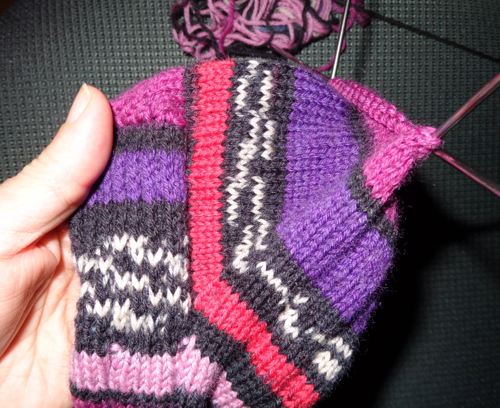
You’re creating a little wedge in the middle of the row. For each right side row, K to the stitch you slipped in the previous row (it’s the one before the little gap), SSK and turn. For every wrong side row, P to the stitch you slipped in the previous row (right before the little gap), P2tog and turn. Do this until all the stitches at the base of the heel are part of the wedge. (On this sock, the turning of the heel coincided with a color change in the striping sequence, so the turn is dark pink. I wish I’d done that on purpose because it’s very cool, but it was just dumb luck.)

If you aren’t at the end of a right side row, knit across the stitches to get there.

Fussy Knitter Tip

– Needle management is fiddly at this bit. You might need to use a stitch holder or extra needle to get all the picking up done. If you’re using two circulars, keep the top of the sock on one needle, and put everything else on the other one. If you’re using a set of four DPN’s, keep the top of the sock on one needle, and divide the bottom between two other needles. If you have a set of five DPN’s, keep the top on one, each side of the heel flap on one, and the bottom on one.

3. Picking up Stitches
All those slipped stitches up the side of the heel flap are screaming for you to pick them up. (Just listen.) Use a spare needle and pick them up. Pick up an extra one at the top of the sock, before the live stitches you still have on your other needle. Knit up the side of the heel flap, knitting together the last two stitches (to avoid a hole.)

Fussy knitter tip – Twist those stitches along the sides of the heel flap when you knit them, to avoid holes.

I keep ribbing on the top of the foot, so I rib across the top of the foot. (Knit the knit stitches and purl those purl stitches.) On the other side of the heel flap, you’ll pick up the same number of stitches as on the first heel flap—including an extra one at the top—SSK, and knit down to the bottom of the heel. Your row starts and ends at the middle of the row on the bottom of the foot. You’ve got all your stitches on your needles again, the heel is turned, and we’re almost home free.

4. Decreasing from the Heel
You have lots of stitches for the heel but too many for the foot. You need to get back to 72 stitches again. This is simplest if the top of the sock is on one needle all by its lonesome. Work across the bottom and up the side until there are three stitches on your needle. K2tog, K1, then work across the top of the sock. On the other side of the sock, K 1, SSK, then knit to the end of the round. Knit one round. Repeat these two rows until you have 72 stitches again.

I had, for example, 28 stitches on each of my side needles. I needed to decrease down to 17 on each needle to get back to the 34 I started with for the flap. Now that the decreasing is done, I have little triangular gussets on each side of my sock, and 72 stitches in total.sock gusset knit by Deborah Cooke

Ha. Told you it was easy.

Knit the Foot
You’re going to knit the foot until the sock reaches the joint below your big toe. (The one at the end of the first metatarsal.) Then it’s time to decrease for the toe. Keep knitting in the round for at least three inches, then try on the sock. When the sock covers your foot up to that bone, it’s time to decrease.

Decrease for the Toe
You’ll probably need to redistribute your stitches. The toe decrease happens on the left and right sides of the foot. If you’re using four DPN’s be sure you have exactly half of your stitches (36) on the top needle and 18 on each of the bottom needles. Consider the beginning of your row to be in the middle on the bottom of the sock, between those two DPN’s. Knit until there are three stitches left on the first needle. K2tog, K1. On the second needle, K1, SSK, K until there are three stitches left, K2tog, K1. On the third needle, K1, SSK, K to end. You’ve just decreased four stitches. K one row. Repeat until there are sixteen stitches in total. Break your yarn, graft your toe stitches (Kitchener stitch is your friend) and you’re done!

basic sock knit by Deborah Cooke

Now you just need to make another one to match. 🙂

Grey B&L Socks

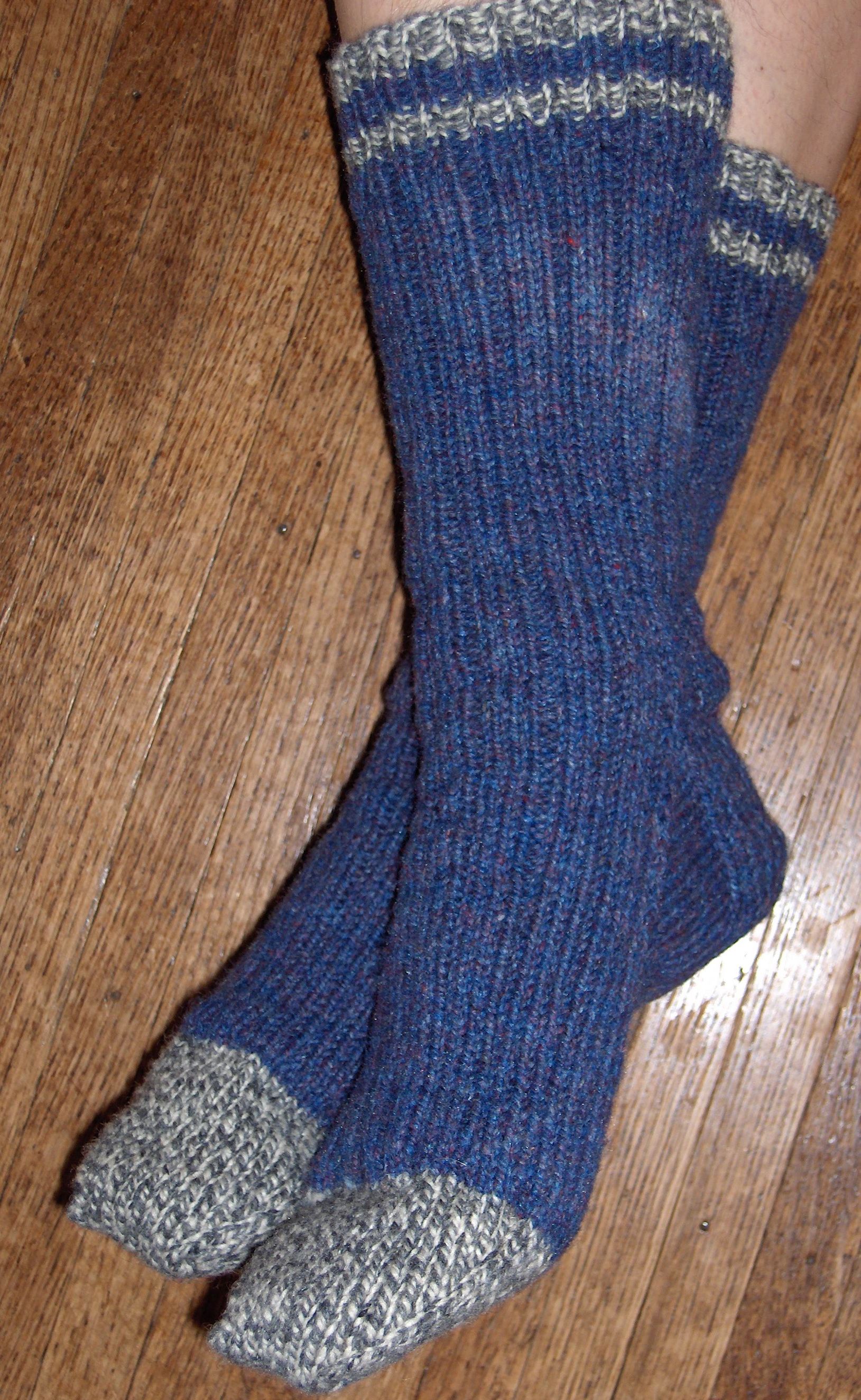
It’s Friday again, and time to show off some knitting.Ribbed Sport Socks knit in Briggs and Little Tuffy by Deborah Cooke

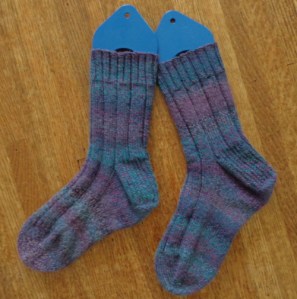
Here’s a new pair of socks I just finished for Mr. Math. The yarn is Briggs & Little Tuffy – I bought the grey, which is called Smoke, and used up the blue (Blue Jeans) from the ends in my stash. You can see that I miscalculated a little and didn’t quite have the same amount of blue for the left sock. That’s why it has a bit more grey on the toe. There wasn’t a pattern for these – I just cast on and knit. The yarn does want to felt a little over time (because I don’t hand wash socks) so the ribbing ensures that the socks maintain some stretchiness.

Briggs & Little is an old Canadian mill, located in the Maritimes. I like their sock wool a lot. It’s tough and wears well, plus it has character. Mr. Math was pretty glad to see these come off the needles, given how cold it is here right now. They went straight onto his feet!

I’m determined to use up the bits and ends of Tuffy in my stash, so there’s another thick sock on my needles now. What do you think?

Audiobook Socks

This past month, I’ve needed to listen to audio editions of my books to “proof” them. Taking a book to audio is a pretty interesting process, and one I hadn’t really thought about until I was already on the adventure. The narrator has to manage so many voices (especially in my books, which I’ve realized have lots of characters!) and keep them distinct from each other. He or she also has to show the emotional journey of the character, and pronounce all the words properly.

It turned out that I needed to follow along with the book on the first review of the audio files, just to make sure that no clauses or phrases were missing. This is a pretty intense process – the audio file for my first book taken to audio, The Rogue, is 13.5 hours long.

For the second listening, however, after the changes were all made and I was just checking the final version, I knit as I listened. I needed plain knitting, as I had to pay attention to the audio, so socks were the obvious choice. I don’t follow a pattern to knit socks anymore, since I’ve made so many pairs. I had some Patons Kroy FX in a yummy purple and blue set aside for new socks for myself, so I cast them on. I knit all but the second toe while “proofing” The Rogue, and here they are:socks knit in Patons Kroy FX by Deborah Cooke

Kroy Socks

I started to knit these socks on the drive to and from Lori Foster’s Reader-Author Get-Together in June. (I was riding, not driving!) I finished the second toe on the last pair, so cast these on. As usual, this is my own sock pattern, the one I don’t have to think about anymore, and as usual, I’ve used a self-striping yarn.

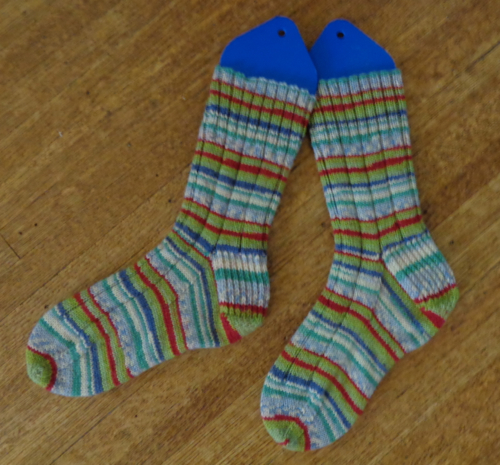
This yarn is Patons Kroy Socks. Once upon a time, Kroy was available in a 3-ply yarn in solid colours. Now it seems to all be 4-ply, whether it’s solid or self-striping. I like the thicker version better – it feels more squooshy, although it does make a thicker sock. This is one of my favourite colourways of Kroy Socks, Summer Moss Jacquard. (Although I see on the Patons’ site that there are colours I haven’t seen before and like a lot – I’ll have to keep a lookout for Meadow Stripes, Mexicala Stripes and Fiesta Stripes.) I actually have enough of this colourway stashed to make a cardigan – the trick will be ensuring that the pieces are narrow enough so that the stripes work out well. I’m thinking I’ll have to put a seam down the centre back to make it work. Hmm. I did knit a pair of socks for Mr. Math in this colour of yarn, as well. (Ewww, now we can match!)

And here they are:socks knit in Patons Kroy stripes by Deborah Cooke

Wow, I feel so lucky. I have two new pairs of socks for the fall!

What do you think?

Socks

We’ve done a couple of road trips lately, and in my universe, road trips mean sock knitting. I started this pair of socks for myself last year, and they’ve been stalled for a while. I finished them on the way to Lori Foster’s RAGT in Ohio, and now I have new socks! I also knit the first sock of another pair, although there’s no telling when the socks will be done. (We have no road trips planned right now.)

Here are the new socks:socks knit in Jawoll aktion by Deborah CookeThe yarn is a self-striping sock yarn called Lang Jawoll Color Aktion (yup, another German sock yarn) and it came with the dyed-to-match spool of reinforcement yarn. I used it in the heels and toes, as usual, but since my socks always wear out under the ball of the foot, I also wove some in there after the socks were done. We’ll see how that works out. The pattern  is my usual one – if it was ever in a book, I forget where. I bought this yarn on a stash enhancement day with Pam, the last time RWA National was in Dallas. I forget the name of the shop, but it was very cute.

It turns out that the new girl is a great liberator of knitting wool and knitted items. She doesn’t chew them or even lick them – she just relocates them. These socks have some miles on them already, and I haven’t even worn them yet!

Socks in Tuffy and Regia

I haven’t posted about my knitting for a while, mostly because I’ve been knitting gifts. Since they’re surprises, I don’t photograph or talk about them – that would spoil the fun!

But I’ve also been knitting socks for Mr. Math. I have this idea that I can clear out at least one corner of my stash. It’s a bit of a quixotic goal, but can’t hurt to try. He really likes these ones.

They’re ribbed socks knit from Briggs & Little Tuffy, one of my fave sock yarns (and spun right here in Canada). The dark grey is called Oxford, and I used up some bits for the red (also Tuffy) and the black (mmmm, something else from the stash!) to jazz them up.Ribbed Sport Socks by Patons knit in Briggs and Little Tuffy by Deborah CookeAlso, here are the socks for him that are currently on my needles – one is done. You might remember that I knit a vest for him from this yarn – it’s Regia six-ply, with colourways designed by Kaffe Fassett. Well, there were three balls left, so he gets matching socks. Here’s the first one – the second is knit to the heel and will be just the same (because I have fussy knitter disease).Sock knit in Regia Design Line by Kaffe Fassett 6-fädig by Deborah CookeI also have some lace on the needles (because winter is coming, and I knit lace in the winter) but right now, it just looks like a lump. I’ll show you after it’s blocked.

Purple Socks

I haven’t shown you any knitting for a while, but today, that changes. I’ve finished a shawl, but it needs to be blocked. I’m not sure how I’ll manage that with the house at sixes and sevens, but maybe I’ll manage it before next Friday. I’ve finished the knitting of a cowl and it’s been waiting to have its buttons sewn on. I started to sew together a sweater that’s been patiently awaiting my attention, only to discover that my suspicions about the sleeves were right – they’re too long and too narrow. (Clearly, there’s a sleeve troll loose in my knitting projects. Remember that I had to frog the sleeves on my Stripey Noro sweater, too. Until recently, I didn’t even know there was a sleeve troll, but you learn something new all the time.)

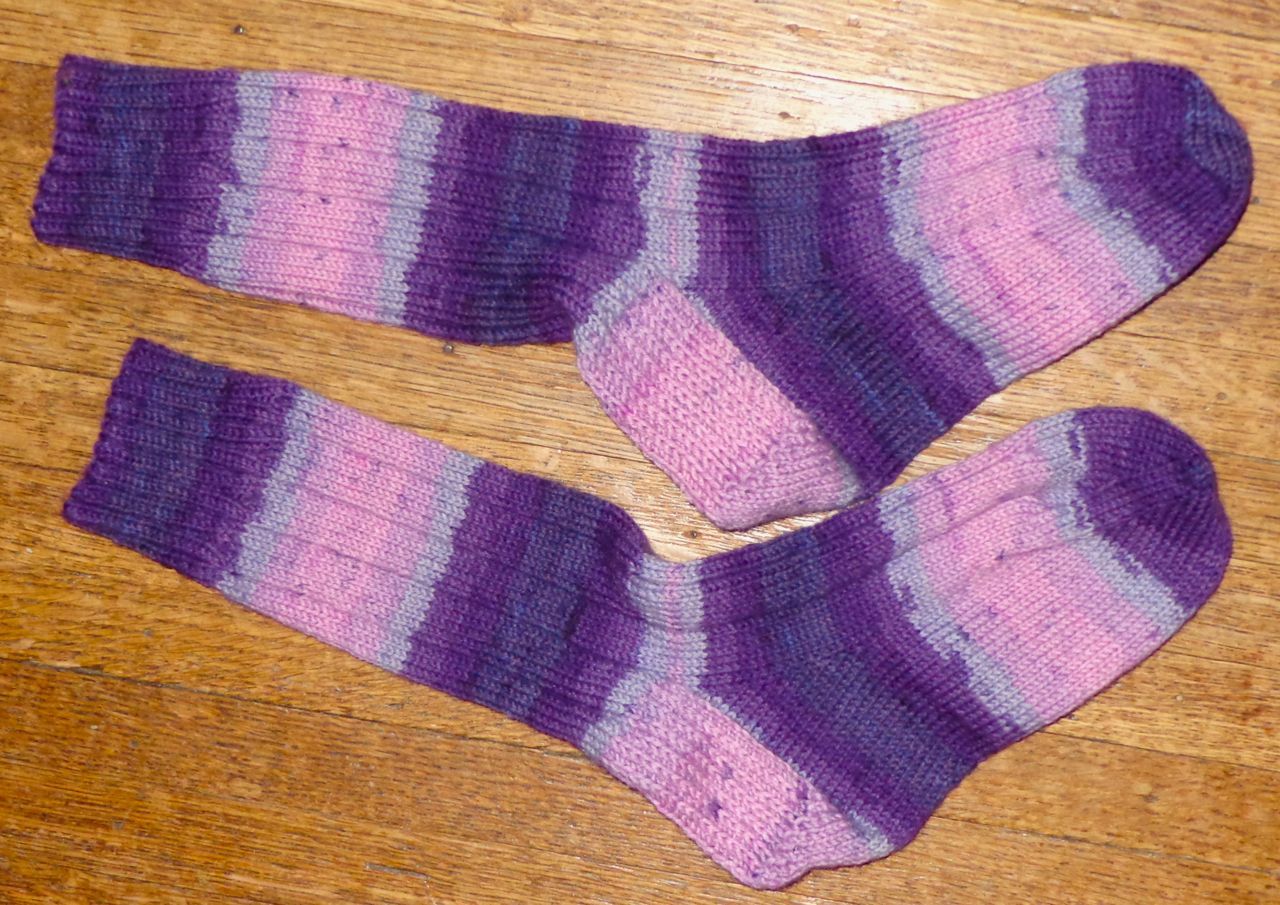
I did finish this pair of socks – and they’re purple, too. Ta da!socks knit in ONline Supersocke 6 fach/6 ply Wellness II Color by Deborah Cooke

Have you finished any knitting lately? I need to finish some more projects before I cast on anything new…

Green Socks for the Mister

Just off the needles – a new pair of socks for the man. These are knit of Patons Kroy FX in the Calla Lily colourway.socks knit in Patons Kroy FX by Deborah CookeAs usual, when I bought the yarn, I forgot that it’s thicker and has less yardage in each ball. (I always do this with the Kroy FX.) I bought only two balls, which isn’t enough to make a pair of socks for Mr. Math. I was going to go back for a third ball, but he decided he wanted contrasting toes. So, I used one ball for each sock, then switched to some leftovers of another colourway (I think it’s Clover) to do the toes.

He’s pleased, and it’s getting to be time for wearing socks anyway.

The big question is – why is everything I’m knitting this year GREEN?

Do you have a favourite colour? Does it change from year to year (or from season to season) or is it pretty constant?

Tuffy Socks and Easy Peter Vest

It’s been a while since we talked about knitting, so today is the day. I have a couple of things to show you. They are both man-knits.

First off, new thick socks for Mr. Math. These are knit from Briggs & Little Tuffy. He loves to wear these around the house in the winter and inside his rubber boots. The colour is a wonderful purpley blue with red flicks – it’s called Blue Jeans.Ribbed Sport Socks knit in Briggs and Little Tuffy by Deborah CookeSecondly, a bit of a surprise. I knit a vest for my FIL for Christmas. He’d lost a bit of weight over the past year – whereas once I would knit something to fit Mr. Math and know it would fit his dad, this time, I knit a bit smaller. It was snug for Mr. Math and I figured we were golden. No. My FIL has gained back some weight. This is all good, but the vest doesn’t fit him.

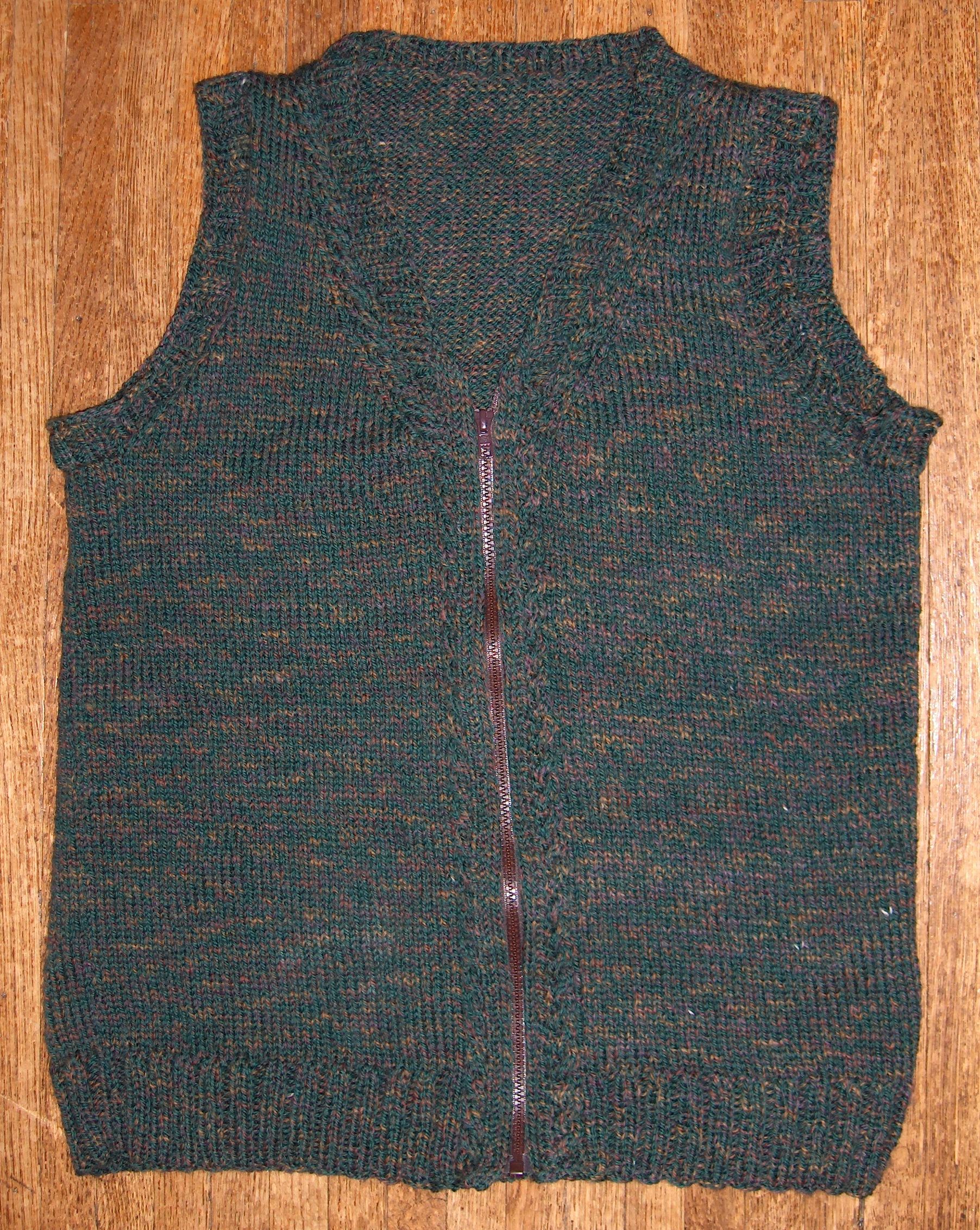
So, now I have a new vest, and I need to knit another one, in the next size bigger. 🙂Peter Easy by Berroco Design Team knit on Patons Classic Wool by Deborah CookeThis is the vest from the free Berroco pattern called Peter Easy. (The other Peter has some fair isle flash, which evidently makes it less-easy.) The pattern is for a pullover, but I split the front to add a zipper so it would be easier for my FIL to put on and take off. Then I decided I should add a 4-stitch cable on either side of the zip to fancy it up. They turn in opposite ways, to make a V. I also added I-cord on the zipper side of each cable, to ensure that there was a nice edge for sewing in the zip. (Thanks to my brilliant photography skills, what you mostly see here is the plastic teeth of the zipper. Yippee.) The vest came out well, and I’m not that disappointed to end up with it myself. The yarn is Patons Classic Wool in a nice flecky variegation that they only seemed to have at the mill. My Ravelry project page is here.

Another man-knit coming off the needles this weekend – a new sweater for Mr. Math. I should be able to show it to you next week, with all the ends sewn in. No seams with a top-down raglan, which works for me in a big way. Lots of plain knitting in the man-knits, which is good for tv knitting but makes for some pretty dull photos. I’m ready to work on one of my more adventurous projects. Winter is always a great time for knitting lace IMO and I have a shawl whispering that it wants to be finished.