Finally, some knitting! I had a sort through my incomplete knitting projects over the holidays and made a plan to get some things finished up. First to jump into my lap is this one, a mostly top-down pullover. The yoke is knit up and cast off at the neck, then the stitches at the bottom of the yoke are picked up to knit the rest down.
Of course, I’ve done the fun part of knitting the yoke, and now there’s just a million miles of stockinette stitch to be finished. This picture is from 2020 and is pretty much where I stopped, right after dividing for the armholes.
It’s been waiting on me for five years!
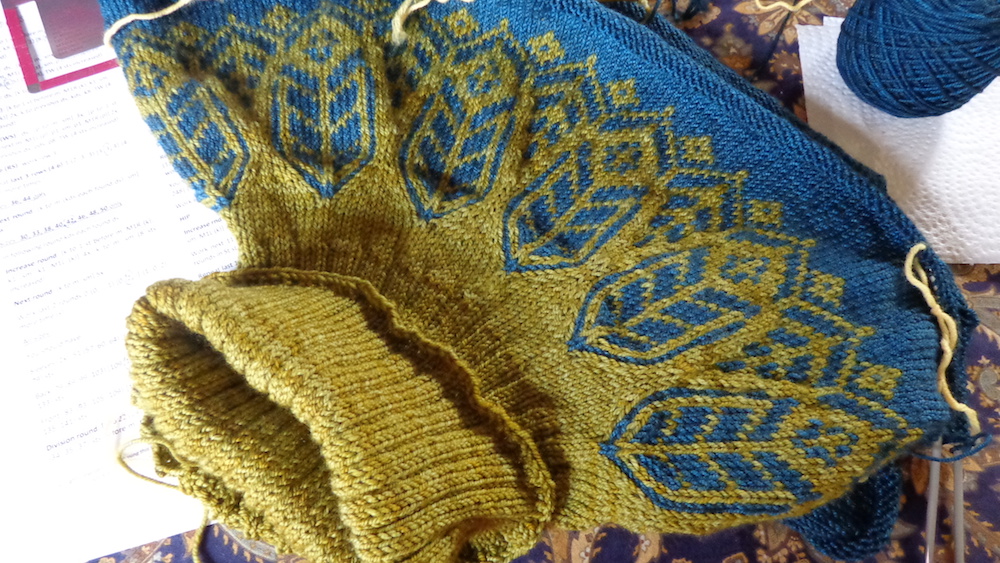
The pattern is Wild Grass by Asja Janeczek – here’s a Ravelry link for the pattern. My yarn is Swans Island Washable Wool Collection Sport, which I bought at Swans Island on our trip to Maine a few years ago. Here are the yarns on their website. It looks as if this one has been discontinued or possibly renamed. (?) It’s lovely yarn – the colours are very saturated and it’s very soft and squishy. The teal blue is a bit darker than it appears in this top picture. The fiber is merino wool.
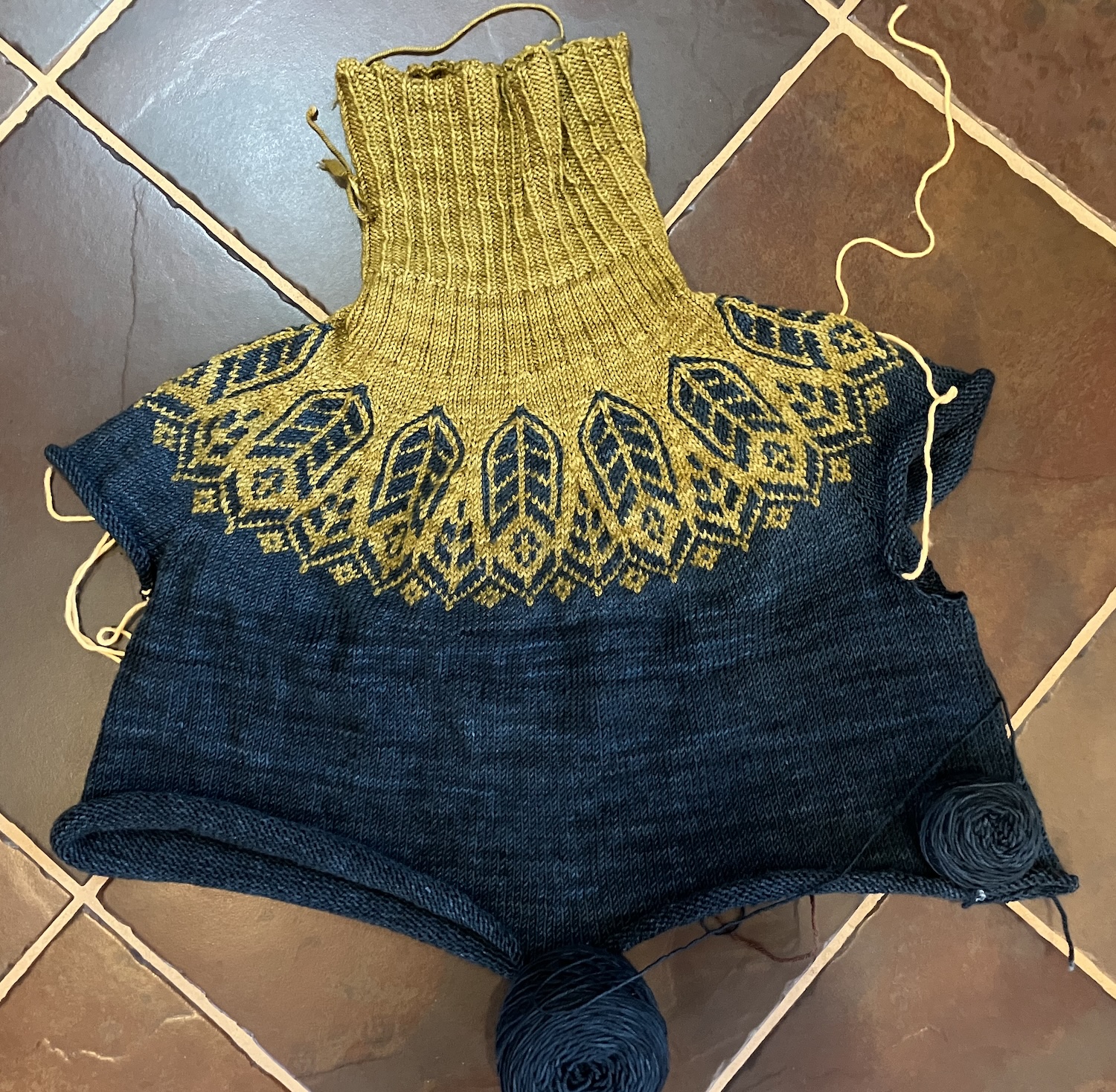
The yarn also has a kettle-dyed look, so I’m alternating between skeins for the body. It will be a bit stripey no matter what I do, but that’s part of the charm of hand-dyed yarn. This is my TV knitting this winter – round and round – and here’s how far I’ve gotten:
The colour of the blue is more true in this shot. You can see how I changed the ribbing pattern on the neck, so that when it’s folded over, it looks consistent. It’s a 3-1 ribbing, but I wanted the top edge to look like the bottom one when it was folded over. You can see that I reversed the stitching partway up the neck, before the fold, in the top picture.
Here’s how it looks folded over.
The edge of the turtleneck is a cast-off edge, so I cast off with a larger needle to ensure that it would stretch. I think I’m going to take it back and use a smaller one – right now, it’s a bit frilly, a good sign that I used TOO large of a needle.
I do love the colour combination.
Now that the body is off the needles, I’m going to knit the sleeves before putting those stitches back on the needles. That way, I’ll know how much yarn I have left for the body. Maybe I’ll be able to make it longer. We’ll see. In the meantime, ’round and ’round I go!
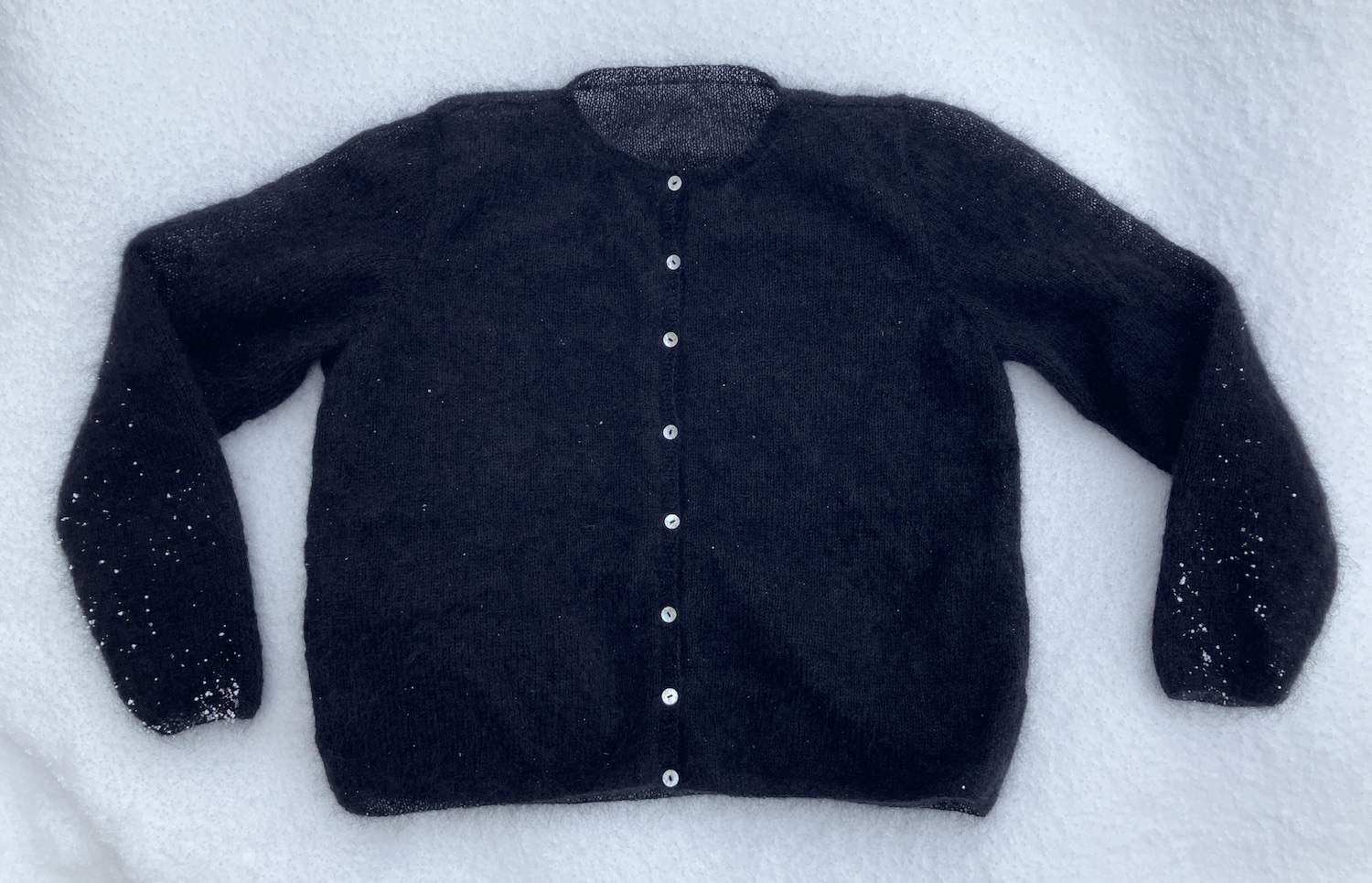
Finally, I finished my Hebrides in black Kidsilk Haze. I’d finished the pieces in October and it’s been waiting to be sewn up. On New Year’s Day, I thought “enough!”, turned on a bright light and threaded up my needle.
It’s done.
We’re having snow today, so the light in the house isn’t very bright. I tossed the sweater into the snow outside for this pic.
Hebrides is a pattern from Rowan 52 by Lisa Richardson. (That’s a Ravelry link.) It was originally knit up in Rowan Kidsilk Haze Stripe, and I’ve knit two in that yarn.
It’s a great basic jewel-necked cardigan. The Kidsilk Haze is both light and warm – that green and purple one has done a lot of travelling with me. It takes up almost no space in my carry-on and always looks great.
I’m not sure the pattern is available online anymore. Rowan changed the name of it at one point to Belle and the sample was in a solid colour of KSH. (Another Ravelry link.) The Ravelry link for the pattern on the Rowan site goes 404, but most of them do since the Rowan site was redesigned. It looks as if it’s available in more publications, though whether those are downloads or print editions is something you’d have to check out.
Will I be making another one? Hmmmmm. Maybe. But it won’t be black! LOL
Another post about the girls this week. I’m knitting for myself, too, but it takes a lot longer to finish up a project. Right now, I’m knitting the sleeves for a cardigan in black Kidsilk Haze, using the Hebrides pattern. I’ve knit it twice before, and it’s a gem. These little jewel-necked cardis aren’t terribly exciting, but I do get a lot of wear out of them. I’ve wanted a black one for a while, though this may be the last time for black Kidsilk Haze to jump onto my needles. I have the fronts and backs done, and will pick up the buttonbands in daylight on those 2.75mm needles.
I also finished the Storm at Sea quilt, which feels like a huge accomplishment. It’s been a finished top and unfinished quilt for so long. I’m working on the hand quilting for the Pineapple Star – just two corners to go, then I can bind it. It’s time to get all these unfinished tops done.
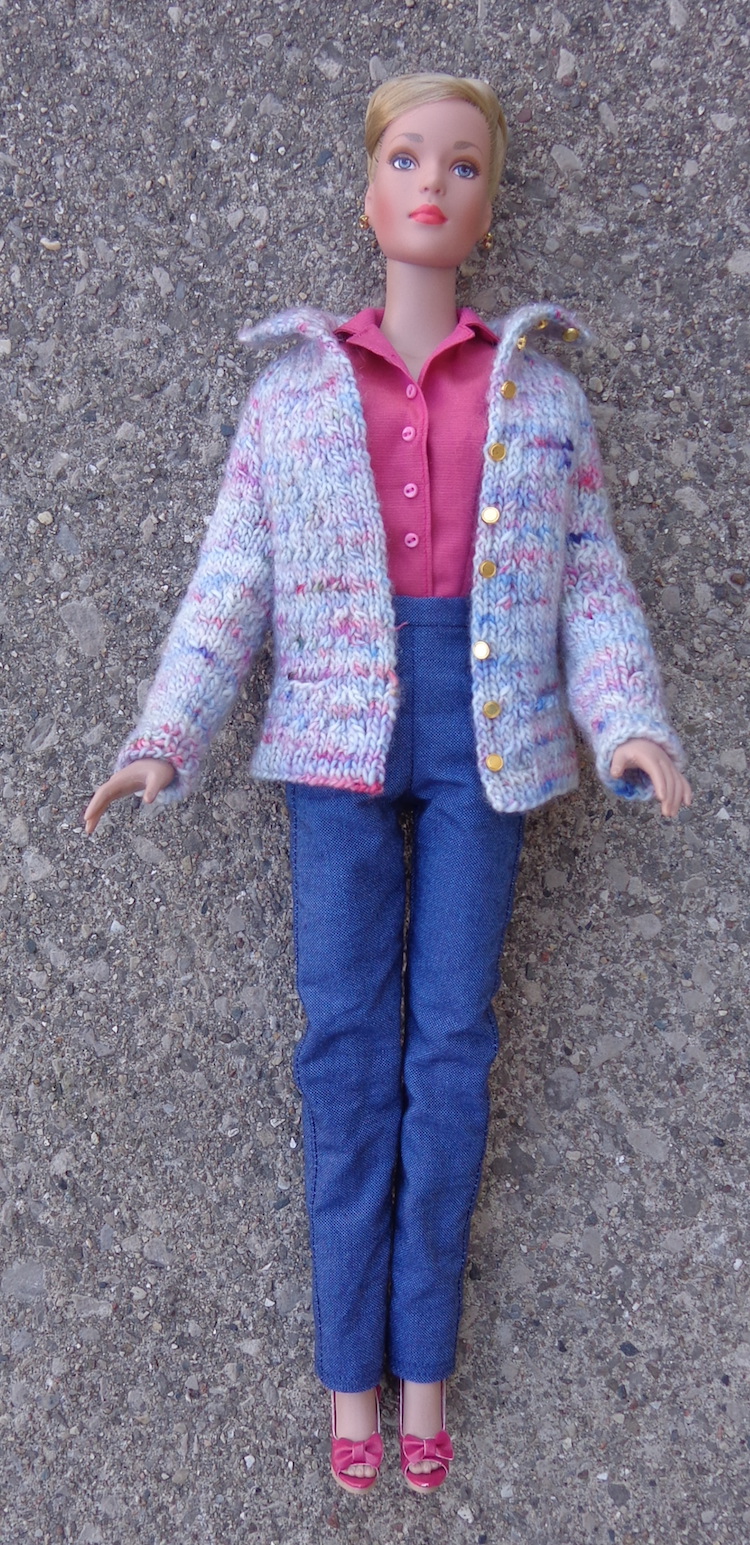
In the meantime, I finished a little top-down cabled cardigan for the girls and that’s what we’ll look at today. Here’s Tyler modelling it, along with the top from McCalls 3701 and pants from Tyler Wentworth 3522.
I didn’t have a pattern for this, just cast on with sock yarn and made it up as I went. I kept notes so I can do it again. I also kept the cables simple on this one – it’s a two-stitch cable with a purl stitch in between each one – so I could keep track of the counts better. Now that I’ve figured them out, the plan is to make another with more elaborate cables. Those are working buttons with buttonholes, though the small holes are tricky to find.
My favorite detail is the pockets in the fronts. You can just see the one on the left side (the doll’s right). I put the stitches on a holder where the pocket should go, then cast on the same number in the next row. That gave me a slit. I continued to the hem and finished the body of the sweater, then went back to those held stitches. I knit down to make a square, then sewed its edges to the inside of the sweater. Pockets!
You can see the cables better on the back of the sweater, as well as the single stitch on the raglan lines. I worked purl-knit-purl on each raglan line, and increased before and after it. As soon as I had two stitches for a new cable, I started one. The cables are turned in opposite directions on the left and right, then the center back cable is four stitches on each side of the central purl stitch.
The wool is some leftover sock yarn and I worked on 2mm needles. The only change I’ll make when I knit it again is to add a few rows to the collar – it wants to curl up – and I’ll play with the cable patterns, too.
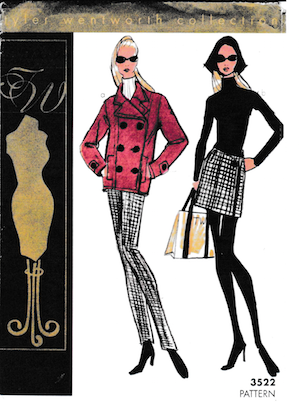
These are the patterns for the sewn garments.
McCalls 3701 for 16″ dolls
Tyler Wentworth 3522
The pink shirt is made of French shirting cotton, which is really lovely and fine. The weft is a slightly different colour, so it changes in the light. (Yes, I made a shirt for myself of this fabric once upon a time.) It’s actually a bodysuit but made of woven instead of knit. It was a little tricky to turn those collar points but a nice little project. Those buttons don’t work – there are snaps behind them to close the fronts.
The pants from 3522 are the ones I’ve made multiple times in pleather for the girls. This pair look a bit like jeans thanks to the fabric choice, but I’ll need to add pockets to the back of the next pair to complete that illusion. They are quick basic pants to sew.
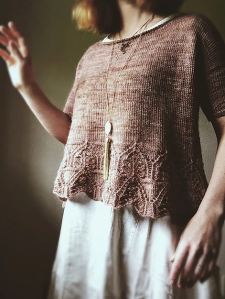
Tegna is a pullover designed by Caitlin Hunter – that’s the pattern picture on the right, which is linked to the Ravelry page.
I cast this on with Koigu KPPPM in colourway is 534 a long, long time ago, but this week, this story had its resolution.
The pattern is unusual in ways I didn’t anticipate.
First off, every size sets up with an odd number of repeats in the lace pattern at the hem. My size requires a cast-on of 340 stitches which means (20 sts per repeat) 17 repeats of the pattern at the hem. So, the front and the back will be different and the side seams – there technically aren’t any, but there is a midpoint on the side to divide for the armhole – will be in the midst of a pattern repeat. I knew this would drive me nuts, so I cast on 320 stitches, putting me between sizes. This way there are 16 repeats, which is 8 for the front and 8 for the back, a change that gives me joy.
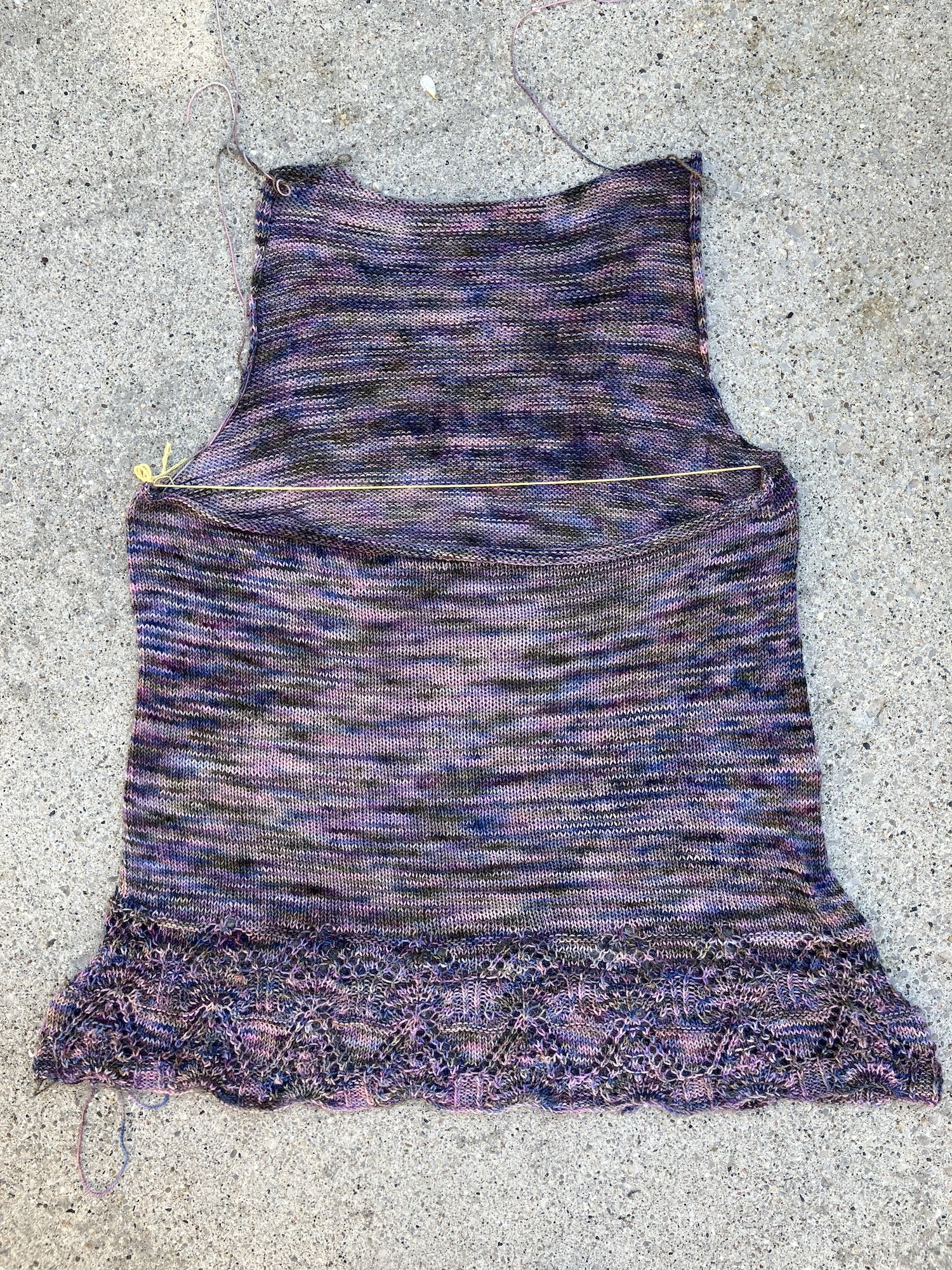
You might remember this pic of my Tegna on the needles after I completed the lace hem. I really wasn’t loving this colourway or its inclination to pool, so I began to switch between three skeins for the plain stockinette body.
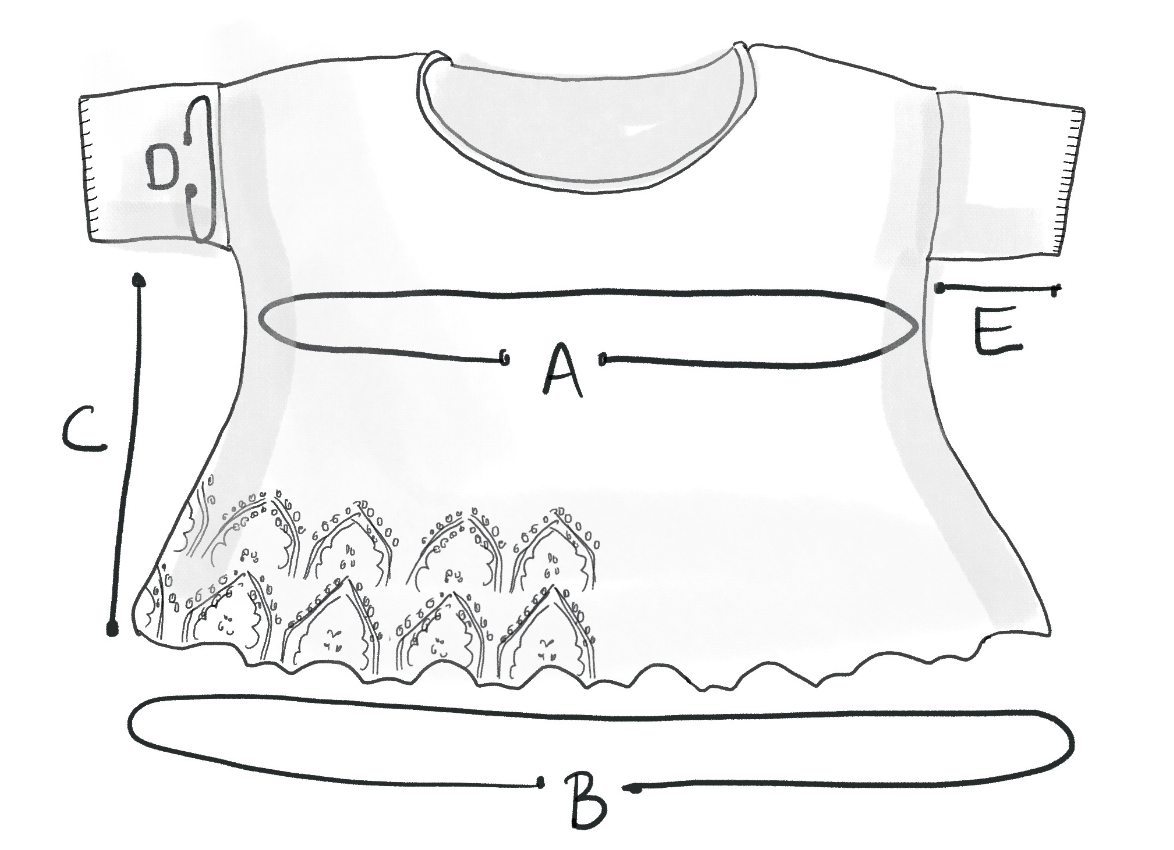
The biggest issue is that I thought the t-shirt had an a-line shape, but it doesn’t. There are decreases over the lace – I decreased from 340 stitches to 224 – but then the body of the sweater is knit straight to the underarms. So, it’s actually more like a straight shirt with a frill on the bottom.
Here’s the schematic from the pattern:
It’s also intended to be a cropped sweater, but that’s not for me. I knit three inches more before dividing for the underarms. This is when I began to really doubt my pattern choice.
When you split the work for the underarms, the instructions are to add stitches at each side, front and back, for several rows after the split is made. I’m not sure why this would be, as it’s already got a dropped shoulder. I knit this and frogged it back. (On Ravelry, some knitters say this made a little bulge at the underarm. Hmm.)
I don’t love sweaters with dropped shoulders as I feel they look frumpy on me. Instead, I had a look at my gauge and stitch counts, and dug out my Hebrides cardigan pattern. The needle and gauge is the same. I’ve used those decreases to convert this sweater to having a fitted shoulder.
I would need to use the sleeve pattern from Hebrides to figure out a sleeve for this modified Tegna, so that the sleeve cap fits into the shoulder. I could start just below the cast-off for the underarm in the Hebrides pattern. I could go with a plain sleeve that is more-or-less fitted, or put the lace on the hem so it flutters a bit more. I was thinking this would result in a swingy top with a fluttery hem.
At this point, I’d made enough changes that I began to doubt the outcome. Plus, the sweater looked small. Here it is, fresh off the needles with the back done.
What’s interesting is that switching skeins didn’t seem to avoid the pooling of the colours – each skein more or less lined up, light and dark, with the others, creating the swirl. That’s either a strange coincidence or some kind of magic.
I gave it a soak at this point and blocked it out to check the sizing after all my mods. It did stretch, as Koigu does, and you can see the lace pattern better even though I didn’t block it hard.
And here it is with a t-shirt that fits me well, for comparison.
It is a straight t-shirt with a frilly hem. I decided to chalk this up to experience and frog it.
I also have the pattern for Latitude, which is a swingy sweater with stripes. This Koigu might end up there, maybe alternating with a solid-ish dark blue that I have in my stash.
I’ve thought for a while that I might like Latitude, but without the long sleeves. Just with fronts and backs, it ends up with a kind of short sleeve. I’ll wind up this Koigu, have a look for that blue and think about casting on.
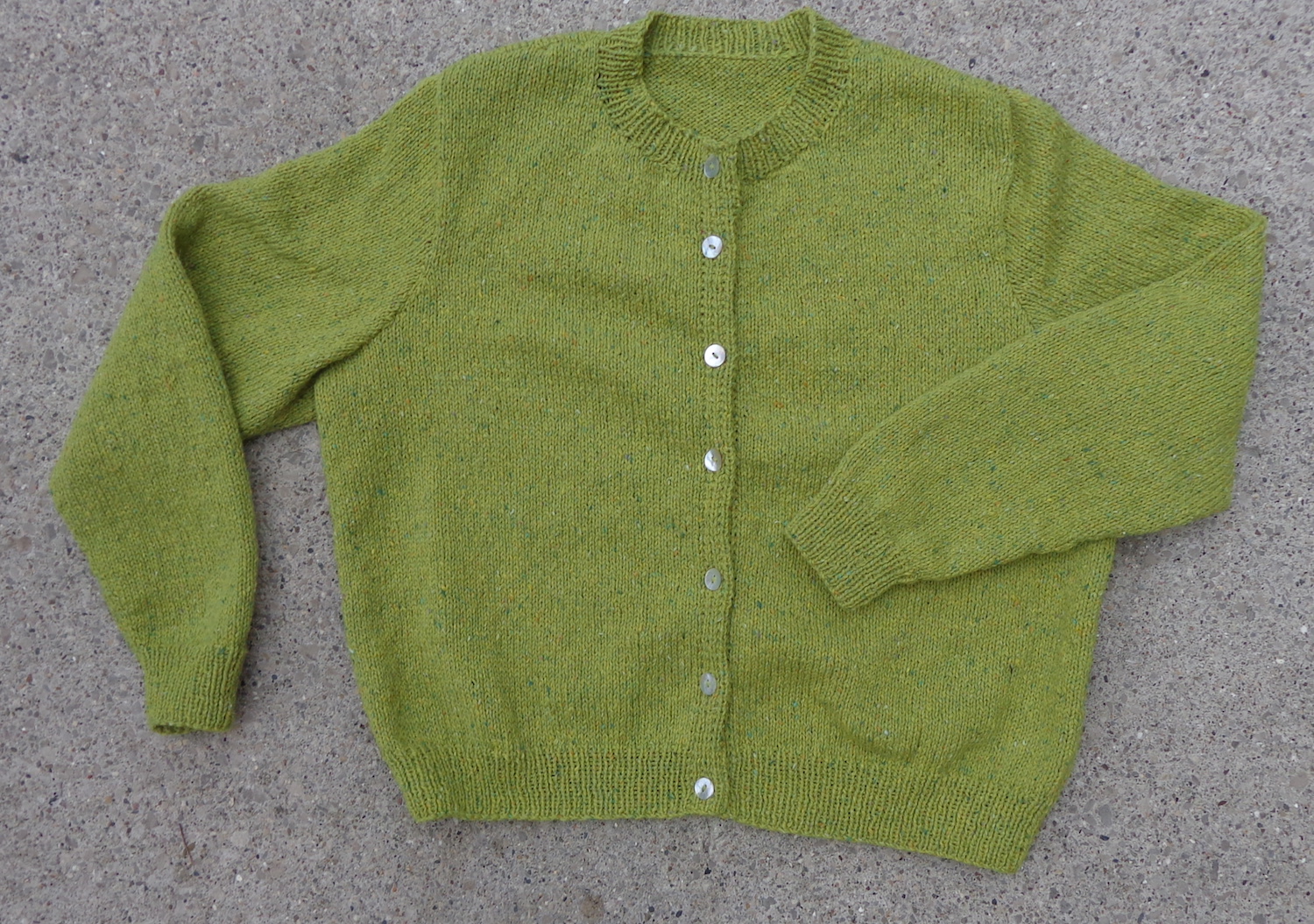
This was a kit of the Quintessential Cardigan designed by Churchmouse Yarns & Teas. The yarn is Jody Long Alba in the colourway, Moss. I knit the body two inches longer than the pattern specifies. (There’s another blog post about it here.)
I quite like the sweater and it fits well. The colour is great and I love the tweedy flicks in the yarn. It was a bit tedious seaming it up, but that’s always the way – and yes, this yarn was almost as inclined to snap as Rowan Felted Tweed. One great thing is that the sleeves fit perfectly into the armscyes. Yay!
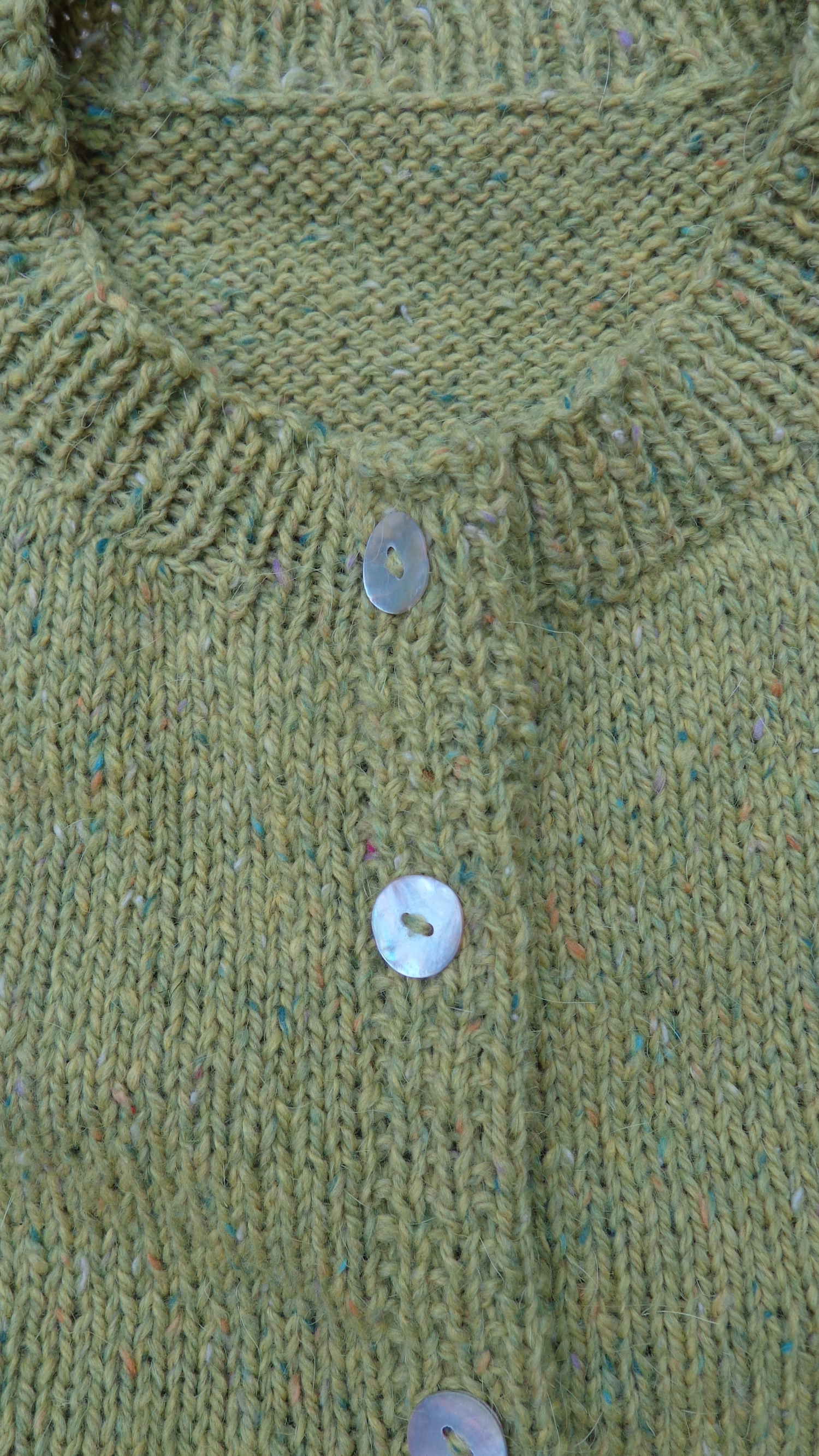
Here’s a detail shot of the front buttonhole band, which has slipped stitches on the wrong side.
The colour’s not very true in this pic – the wool really is that lovely lime shade. In this shot, though, you can see that my miscalculation, the one that made the last button before the collar band a little higher, isn’t really that bad once the buttons are sewn on.
I don’t love this slipped stitch on the band. It looks too different from all the other ribbing, although I understand that it’s intended to keep the button bands from being too long. Another way to avoid that is to pick up the stitches for the button band after the fronts are done and knit them sideways.
It took 3.4 balls of yarn or just under 1200 yards.
I do have another kit in Plum so will be making a second one, with a few changes. • Since I lengthened the sweater, the waist ribbing falls at my hip, which isn’t ideal. I’ll change that to a garter stitch hem or a moss stitch hem instead and let it be a bit swingy. • The cuffs are on the narrow side – it’s fine when they’re worn down, but I always push up my sleeves. I’ll make them a bit wider on the next one. I’ll work them in whatever stitch I decide to use instead of the waist ribbings, too. (I don’t love ribbing on my sweaters.) • Because of that slipped rib stitch on the button bands (which is over 7 stitches), the buttons aren’t centered on the band. You make the buttonhole on stitches 5 and 6. This kinda drives me nuts. 🙂 When I work the button bands in another stitch – to match the hems – I’ll put the buttonholes in the middle of the band, over stitches 3, 4, 5, which will also make them a little bit bigger. It’s snug to get these buttons through the holes, but I don’t think smaller buttons would look good.
Overall, I’m pleased. It’s a very basic sweater, but the colour keeps it from looking frumpy.
I really want to cast on the plum version immediately, but am trying to finish a project first. We’ll see how I manage with that goal!
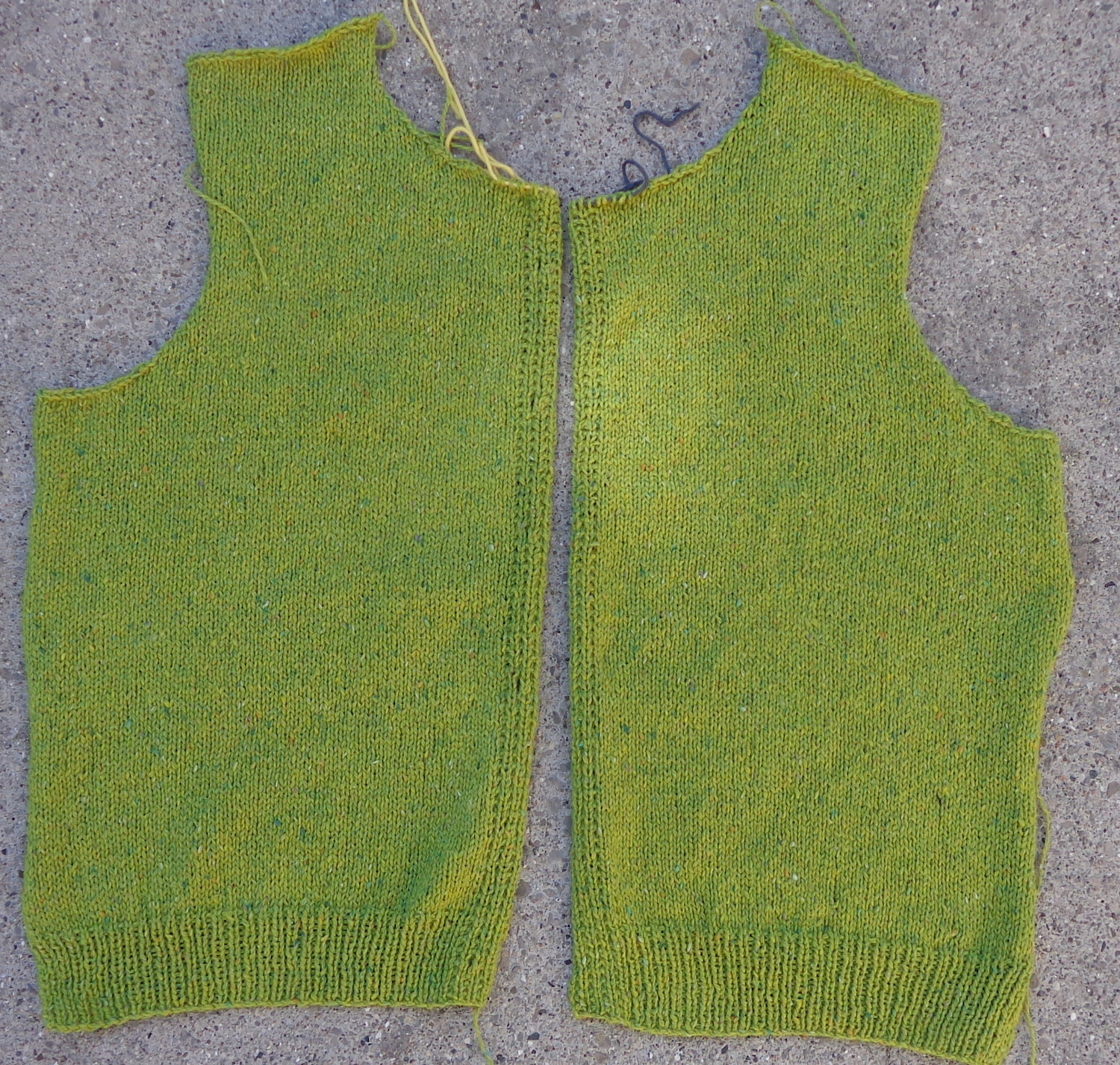
I told you about this one, a kit that I bought and cast on right away. It’s the Quintessential Cardigan designed by Churchmouse Yarns & Teas. The yarn is Jody Long Alba in the colourway, Moss. I’ve finished the fronts and the back, and made them 2.5″ longer than specified in the pattern.
I did muck up the calculations slightly. After knitting the left front, I counted the rows to space the button holes. (The pattern suggests that you place markers, then compare the right front as you knit it to the left front to choose where to make a buttonhole. I went with the strategy I know – but still messed it up. LOL) It worked out that they should be every 23 rows, but the buttonhole is made on a RS row. I decided to alternate 22 and 24 R between buttonholes, but my top bottonhole before the collar is a little higher than it should be. I should have just done 22R between each one. I’m not going to frog back to fix it. I bought the kit in another colourway – Plum – so will do the buttonholes right on that one.
This pattern has a lot of small touches that are interesting and some are new to me. They suggest, for example, some short rows immediately above the ribbing at the hem to keep the hem hanging straight. I’ve never had an issue with the hems of my cardigans, and actually, I was so busy with the buttonholes that I forgot to do it on the right front. (Not frogging back for that either.)
The front button bands are ribbed but have slipped stitches on the wrong side, again to keep the ribbing from hanging too long. It also changes the look of the ribbing, and I’m not sure I’d do that again. I might just knit the bands in seed stitch on the plum version.
So far, I haven’t found any jazzy buttons in the right size and colour, so it looks as if this one will have abalone shell buttons, which is pretty much my neutral answer to buttons.
I’m now working on the sleeves and am up to the elbow or so, knitting them both at the same time. I find that the easiest way to make sure my increases match. Progress is steady and this is good TV knitting. I should be finished soon. 🙂
Well, May vanished in a hurry, didn’t it? I have been crafting but not finishing many things – partly because the day-job has been busy. I’ll catch you up in another post, but today, let’s talk about an interesting conundrum.
I found a stash of yarn at the thrift store this week. It’s kind of a puzzle when this happens. The first thing I want to do – if I like the yarn and bring it home – is try to figure out what project the de-stasher had in mind when the yarn was originally acquired. In some instances, that’s easy; in others, not so much. Ravelry is such an awesome resource for that. You can use the Advanced Search to specify the yardage you have, the weight of the yarn, even the name of the yarn, then sort through the results.
Last winter, for example, I found a stash of Briggs & Little worsted, with the old label. No colour names or numbers, just dye lots. I think this weight would be called Regal now. (That’s a link to B&L’s website.) Briggs & Little is located in the Maritimes and the oldest yarn mill in Canada. I really like how sturdy their yarn is and particularly like the heathered colourways.
This stash was nine skeins when I found it: 1 red, 1 grey, 1 cream, 1 light blue, 1 navy and 4 medium blue.
Skald, a Järbo SE design
I think this last one might be Quoddy Blue. It has a lovely heather look to it. (As does the grey.) Someone likely planned an icelandic or fair isle sweater, so I had some fun looking at options on Ravelry. (There are lots.) The skeins are over 200m each, so this is a lot of yarn.
The mister likes blue, so I found this pattern called Skald (that’s a Ravelry link) which I think will work out. (Here’s the designer website, but it’s in Swedish.) There might not be enough of one colour to do the lice. We’ll see.
My inclination is to leave out the red, but it might make a nice pop if used as an accent. Hmm. That one’s waiting for me to finish up one of my projects on the needles.
This week’s thrift store find was eight skeins ofAllHemp3. (That’s a Ravelry link.)
My Ravelry search came up with this pattern, Flaming June from Knitting 2012 (that’s a Ravelry link – here’s the one on Knitty), as a likely candidate spurring the initial stash. The designer is Cheryl Niamath, who designed the Fetching fingerless gloves that I’ve knit a bunch of times. (That’s another free pattern from Knitty.)
Eight skeins is enough for the main colour in the middle sizes, in which case there would have been two or three skeins in a contrasting or coordinating colour, too. Someone might have grabbed those for string bags earlier. For a teeny size, eight skeins might be enough for the whole sweater.
I read the pattern and learned that hemp grows in blocking. My first swatch on the recommended needles had perfect gauge, but wasn’t blocked yet. I went down to a 3mm, which resulted in a much tighter fabric, then washed and blocked it. The hemp was interesting to knit, similar to cotton in that it has no boing at all, but even stiffer.
The hemp softened nicely when washed and this swatch now has perfect gauge. I read the project notes on Ravelry from others who had made this sweater and it seems that many of them found that the sweater grew a lot in length after blocking, when they wore it.
I’m between sizes and already know the sleeves as written will be too long either way. My inclination is to make the smaller size of those two. From the notes on Ravelry, I should maybe go down another size again. Hmm. I also know I need to watch the width of the shoulders, because mine are narrow.
One variable is the effect of weight upon the finished garment. My sweater coat knit following that Kaffe Fassett pattern gets longer all the time – just the weight of the garment pulls it down, making it grow. (I actually took a repeat off the bottom of that coat after it was done, because it had gotten too long for me. I was caught once in a drizzle, which just made it worse.)
The other wrinkle is the tightness of the knitting. The looser the stitches, the more likely the garment is to stretch in wearing. Only one person who specified their needle on Rav was using a small one (2.75mm in that case, while I’m using a 3mm) – most were using 3.75mm or so. Are they tighter knitters than me? Did they wash and block their swatches? It’s hard to be sure.
So, I’m going to knit a sleeve first as a big gauge swatch, maybe even wash and block it to see what happens before knitting the body of the sweater. It’s a weird plan, but I’m hoping it will save me frogging the whole thing and knitting it again.
I may have to buy another skein or two of the Allhemp3, but at least it’s still available. I don’t want a second colour, and with any luck, the black dye lots will be close, if I do have to add more to finish the project.
One thing about making a discovery like this at the thrift store is that it’s a good way to play with a new yarn or fibre.
The colour is pretty true in this picture. I really like this sweater: it’s light, warm and red! I’m swatching with another yarn (we can gasp in unison at that bit of news) to try the pullover version next.
Here’s a better shot of the buttons that don’t quite match.
They’re a little more pink than russet, but I like those two gold lines in them a lot. They’re staying. 🙂
I’m also embarked on a long-overdue sort of my fabric stash, which will continue to my yarn stash. It’s time to get organized, and time for some things to find new (more appreciative) homes.
I’ve noticed that the fabrics headed out the door fall into three groups: the first group is the biggest. My colouring was Autumn before I let my hair turn grey, so I had a lot of Autumn-favouring fabrics in my stash. I still like the russets and burgundies, the olive and some of the brown. The gold, taupe and beige, though, just don’t work for me anymore. I also used to wear white shirts a lot, and they don’t work for me anymore either —they’ve been culled from my clothing stash and are leaving my fabric stash, too. (There are compensations. Now I can wear black.)
The second group of fabrics are graphic prints. I like bold prints on the bolt and often admire them in the store. Some have come home with me over the years. I tend not to like them as much once they’re garments, or I like them but don’t wear them. They’re leaving, too.
Finally, there’s a shade of pink. Maybe it’s a pink that is supposed to work for Autumn colouring. (?) We used to call it dusty rose – it’s a mucky pink, not a clear clean one. Now it looks like Pepto-bismol to me, so out it goes.
It is very interesting to see how things pull together after my measuring, sorting and stacking. There’s a new cohesiveness in my stash, which I like — it makes me want to display it, not pack it away LOL — and which is also inspiring. I can see how things coordinate and work together, which gets me planning. It’s proving to be a useful exercise, though a time-consuming one. I expect I’ll be sewing more in the near future and not just for the girls. That makes me happy. 🙂
As promised, here’s a post about a sweater knit a while ago. First, let’s talk about the pattern. I used The Incredible Custom-Fit Raglan. I think it appeared in Threads magazine once upon a time and you can find it online now. It’s less of a pattern than a formula, so it can be used for any size of person and any yarn. Here it is on Ravelry with links to the Wayback Machine. It looks like you can download it from Rav, too.
I used this formula a couple of times to make sweaters for Mr. Math, including the Elrond Sweater. That’s the link to my Ravelry project page, and here’s my blog post. Below is the sweater. Ha. I knit it in 2009 and he still loves it. 🙂
The sweater I wanted to write about today, though, is this one, which was knit so long ago that it doesn’t even have a Ravelry project page.
My No. 9 sweater reminded me of it, so I dug it out. This sweater was knit from a huge ball of yarn that I bought at Lewiscraft, probably in the 1970’s. It was called A Pound of Mohair or something similar. (How fun. I found an article on Knitty about Lewiscraft upon its demise in 2006.) As you can see, it was gradient-dyed.
This is not the mohair of KSH but the older variant, which is more prickly and thicker, blended with a bit of synthetic. Hayfield 80 (80% mohair, 10% nylon 10% acrylic) which is an aran weight is more similar to this one. (That’s a Ravelry link.) The scary thing is that I have another 1 lb. cone of similar mohair in graduated tones in my stash, which I bought in NYC, but that’s another story.
So, this cardigan was knit maybe 40 years ago. I was so proud of myself for getting the gradient on the sleeves to match! That was only possible because I used a contrasting yarn for the ribbing, although I don’t remember what it was. It doesn’t have any detail on the ribbing increases – like the one for the mister, the increases are just made on either side of two stitches that define the raglan line. It would be easy to increase the stitch count there and do a little cable, or the P2K2P2 of the No. 9 sweater.
The other cool thing about this sweater are the buttons. They’re clear with bugle beads inside. They’re very sparkly and special – I bought them from a little button shop on Queen Street West in Toronto, which was gone the last time I went looking for it. It was one of those places with all the boxes of buttons, and you bought buttons individually. (Yes, I have a button stash. Don’t you?)
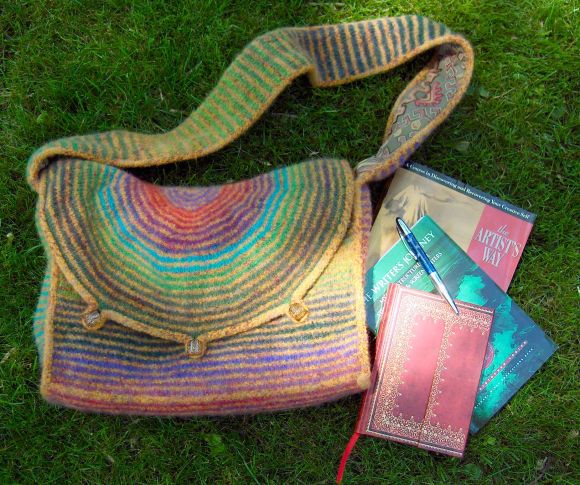
I used similar gold buttons that have metallic threads inside, bought at the same time, on my felted Stripey Noro messenger bag. (That link goes to the pattern page at Ravelry. This design of mine is a free pattern download.)
This button place reminded me of excursions with my mom when I was a kid – she would make the trek from suburbia on public transit to Dressmakers’ Supply on Avenue Road for notions like buttons. I thought it was an amazing place – all those boxes of buttons, sorted by colour! I also thought it was about six million miles north of Bloor St., but really it was maybe three blocks. We always walked that bit. Dressmakers’ Supply moved down to Queen St. West at some point and has since closed down.
There is another button store on Queen St. West now called Trillium Button – or maybe it’s the same place but on the other side of the street now – which I’ll have to check out the next time I’m downtown. Ha! I found a blog post from 2012 about the button store and it IS the same store, but moved west and to the north side of the street. Definitely worth a trip. (Here’s that blog post, which has some pix.)
And hmm. Now I’m wondering what to do with all that mohair in the stash…
Last year, I knit a lot for the girls as there’s something satisfying about finishing up a project quickly. It was time for a human-sized knit! This sweater for me really took a while, as I knitted it twice. Will I ever learn to knit a gauge swatch? Probably not. I just don’t like doing it and if the price is having to knit something twice, well, I don’t mind so very much. Usually, I realize what I’ve done sooner than I did this time. Often, I find other things I want to change in the sweater, anyway. That happened this time, too.
So, let’s take a look. The pattern is Sweater No. 9 by My Favourite Things. Here’s a Ravelry link and here’s the link to the pattern on the designer’s website. It’s a top-down sweater with some ribbing detail on the raglan lines, with two suggested lengths. Here’s one of the designer’s official pix:
I used some Rowan Kidsilk Haze Trio from my stash, in Loganberry. This yarn is wonderful and squishy as well as very light. It’s discontinued now, but you could replicate it easily by knitting with three strands of KSH (or similar) held together. The colourways have three different harmonious colours each – this one has a red, a burgundy and a more orangey-red hue.
Here’s a pic of the yarn, knitted up in green and in the ball in the red, as well as my Felix cardigan knit of a KSH-ish yarn held with a fingering weight merino. That gives a similar effect to the KSH trio but is a little bit heavier:
I had bought this yarn in two colourways, as you see above, and knit a sweater of the green colourway, called Fern, a while back. I used a Rowan pattern called Paige but turned it into a cardigan. Here’s my Ravelry project page and here’s my blog post. I don’t wear that one much, because the drop shoulders and the length make it seem like a droopy blanket. It is very light and warm, though. Here’s that sweater:
And here’s the new red cardigan – with one sleeve still on the needles. The pictures are less than ideal as it’s snowing and grey today. There’s not a lot of light, even with all the lights on in the kitchen.
I’ll finish it up this week – this yarn knits up quickly! – and when there’s a sunny day, I’ll take a pic of it outside.
The benefit of knitting something twice is that I can see what things I don’t love and change them out in my version. For example, I really dislike when ribbing doesn’t line up with the pattern in the body of the sweater. If you’re knitting a K2 P1 rib for the collar, as here, and there’s a K2 in the raglan rib, they should align IMO so that the K2 in the ribbing just continues on down into the sweater. That isn’t going to work in this case, since there’s only a P1 on either side of the K2 and the raglan lines are P2 K2 P2. So I changed the counts in my collar, plotting out the placement of the raglan lines from the outset and working P2 K2 P2 in the collar to line up with that. You can see the knit ridge in this photo, that continues up the collar.
My second change was also a result of that test knit. I tried on the sweater and oooooo, that yarn was itchy itchy on my throat. I know I can’t wear KSH against my skin but I had a moment of (unmerited) optimism. So, when I ripped it back, I split the front of the sweater, turning it into a cardigan with two moss stitch bands down the front. I wasn’t sure of my ultimate row count so I winged it with the buttonholes, but it worked out fairly well.
My third change was a result of comments on Ravelry. The fronts and the backs of a sweater should not be the same and interchangeable, since the neck should be lower in the front. I added four short rows between the back raglan increases before starting those raglan increases – I could see the P2 K2 P2 place in the ribbing – to make the back a little higher at the neck. It was an easy change.
Change number four was an inadvertent one. I finished the yoke and wasn’t sure what to do with the ribbing lines from the raglan once the body was joined in the round. Just stopping them looked silly to me, so I picked up an extra stitch to have another K stitch in the middle of the 4 purls, and carried them down the virtual side seam of the sweater. To my delight, everything matched up at the hem for the K2 P1 ribbing at the waist, just as I’d set it in the collar.
There are two suggested lengths in the pattern for the sweater and mine is in between. I tried it on, because there were a couple of Ravelry comments about the hem being in an unfortunate location and I wanted to be sure. I generally don’t like cropped sweaters as they seem too short for me, and as a shorter person, I often need to shorten a “regular” length sweater so I don’t look overwhelmed. 12.5 – 13″ from underarm to hem is good for me. That’s 32 – 33cm. This one is 22 cm from underarm to the top of the ribbing and the waist ribbing is 10 cm. It’s perfect for me.
The buttons aren’t a perfect match – a bit more burgundy than russet – but I like the bit of gold in them and they came from my stash, which is even better. (That is a fuzzy pic!) The funny thing about them is that the shafts aren’t all drilled at the same angle. I’m a little OCD about things lining up and buttons being at the same angle, so I may take these off and re-sew them so that the little gold swoosh has the same orientation on all of them. Right now, all the buttons are sewn on with the hole in the shaft at the same angle.
I really like this sweater. I like it so much that I’m thinking of ripping back the Ferny Paige and knitting a green version of this sweater of that yarn instead. I also have a sweater quantity of a tweedy yarn in the same weight, so will try the pullover with that first.
It also reminds me of a mohair sweater I knit a looooooong time ago, and I’ll tell you about that tomorrow.
















 Alive & Knitting