Side-To-Side Cardigan & Dress

Last summer, I showed you a top-down cardigan I’d designed and knit for the girls in many sizes, from Monster High to Barbie and finally to Tyler.

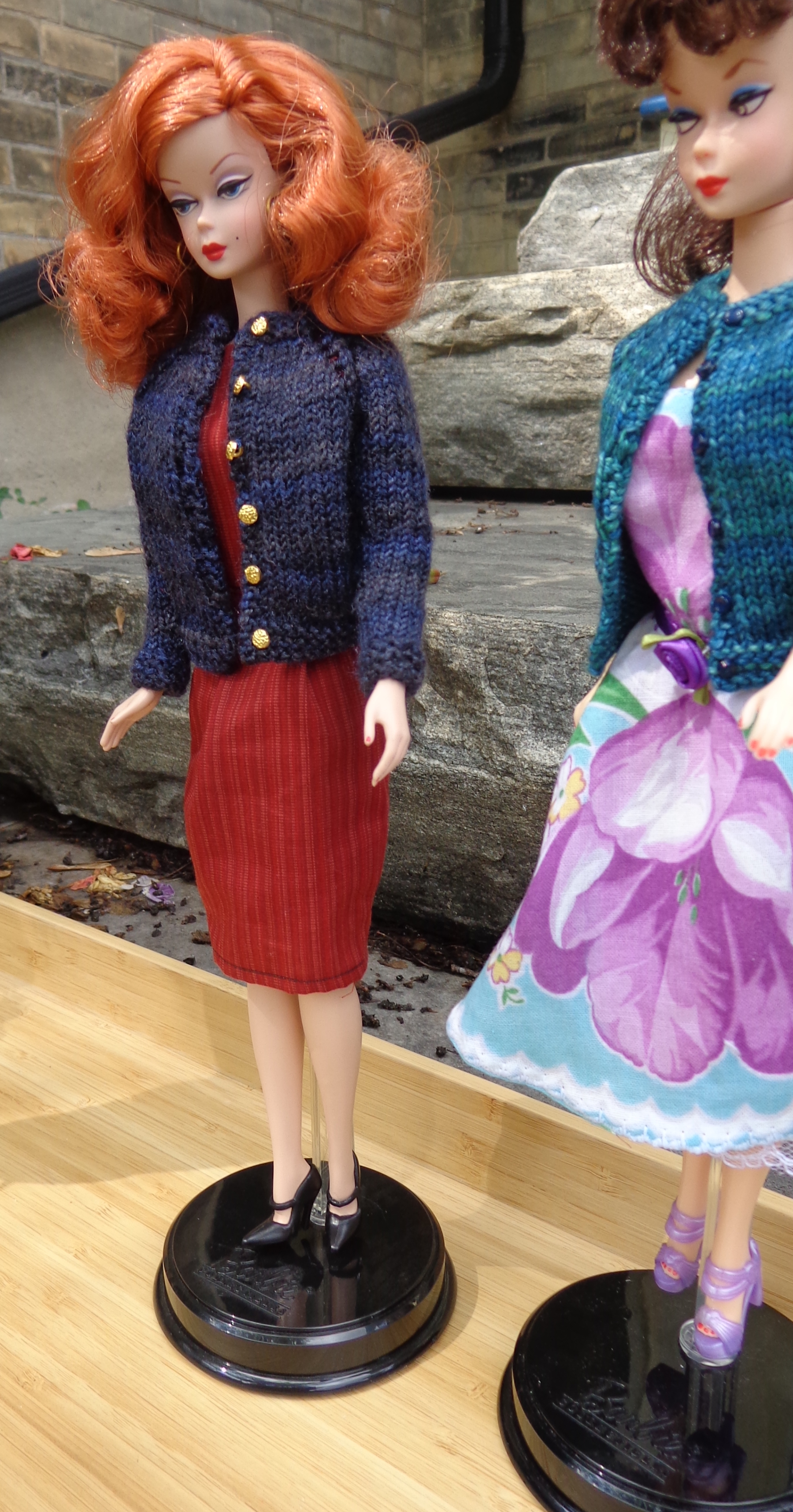
I’ve also showed you this Tyler-size version. It’s knit of Koigu KPPPM in colourway 513P – KPPPM is 175m for 50g. I knit this one a little longer and also did some back neck shaping to make the front of the collar sit better. It’s modelled by RTW Rouge Sydney Chase, with a matching dress.

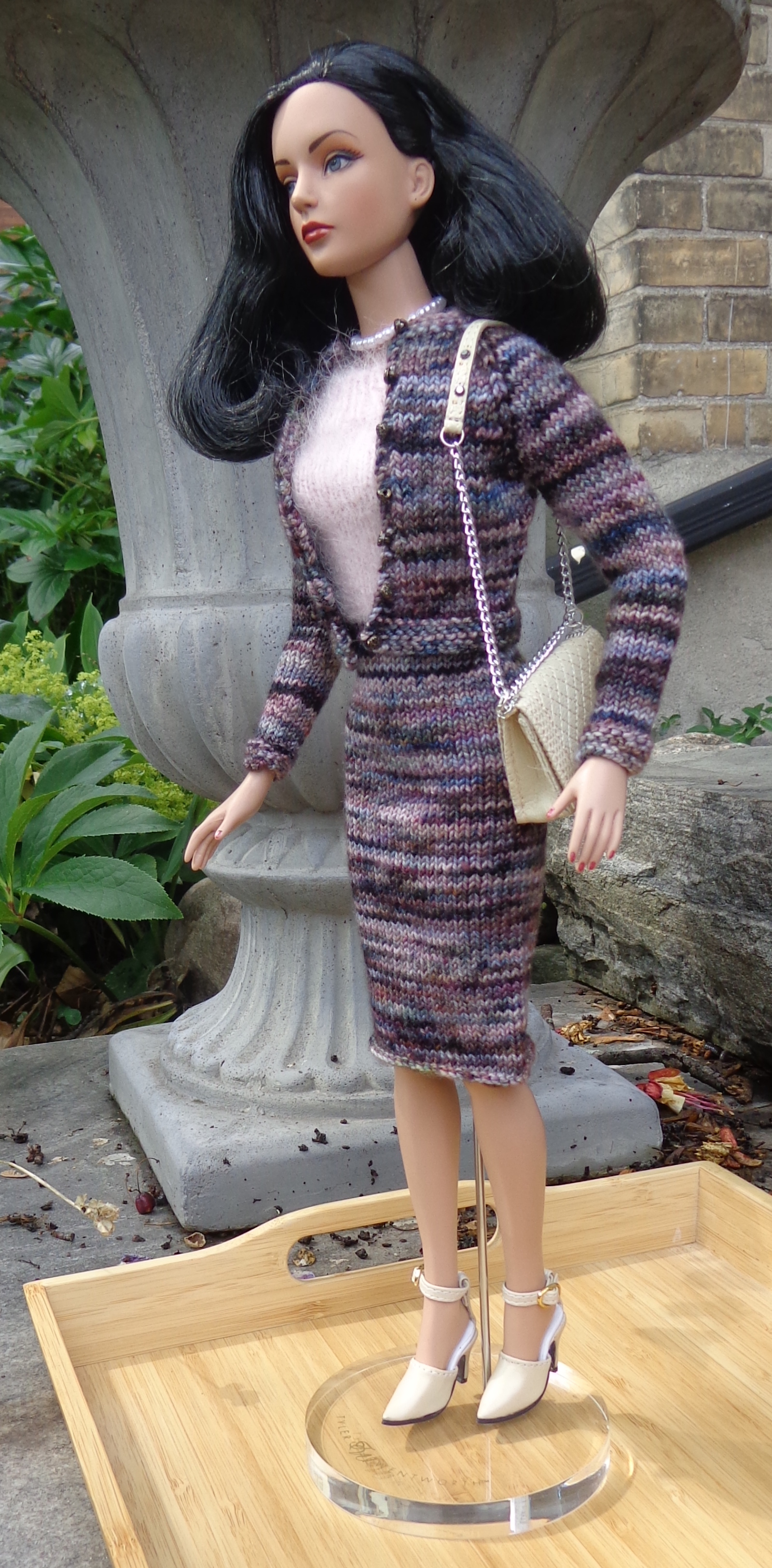
Top-down cardigan and dress knit for Tyler Wentworth in Koigu KPPPM and Sugar Bush Drizzle by Deborah Cooke

For the dress, I used the free pattern T-Shirt Dress for Tonner Dolls by Samira Jessica (that’s a Ravelry link) but divided the color. It’s a top-down knit with cap sleeves that are created when you cast off for the arms. I started with Sugar Bush Drizzle, held double, in Pink Puddle. At the waist, I changed to the Koigu KPPPM. I didn’t rib the skirt (as the pattern instructs) but just knit it in stockinette, then purled one row and cast off purlwise. I thought that might keep it from curling at the hem, but the hem still wants to roll up, even after blocking. I also added a little kickpleat at the center back. 🙂

I quite like this little dress, so I made a variation of it for Tyler in a different colourway. Here are the two of them together – Sydney is still wearing the first one – the light isn’t as good in my office this time of year as it was on the steps in the summer, but you can see the little kick-pleat on Sydney’s dress. Tyler has one, too. (Don’t you love Tyler’s shoes? They’re sling=backs, too. I want a pair myself.)
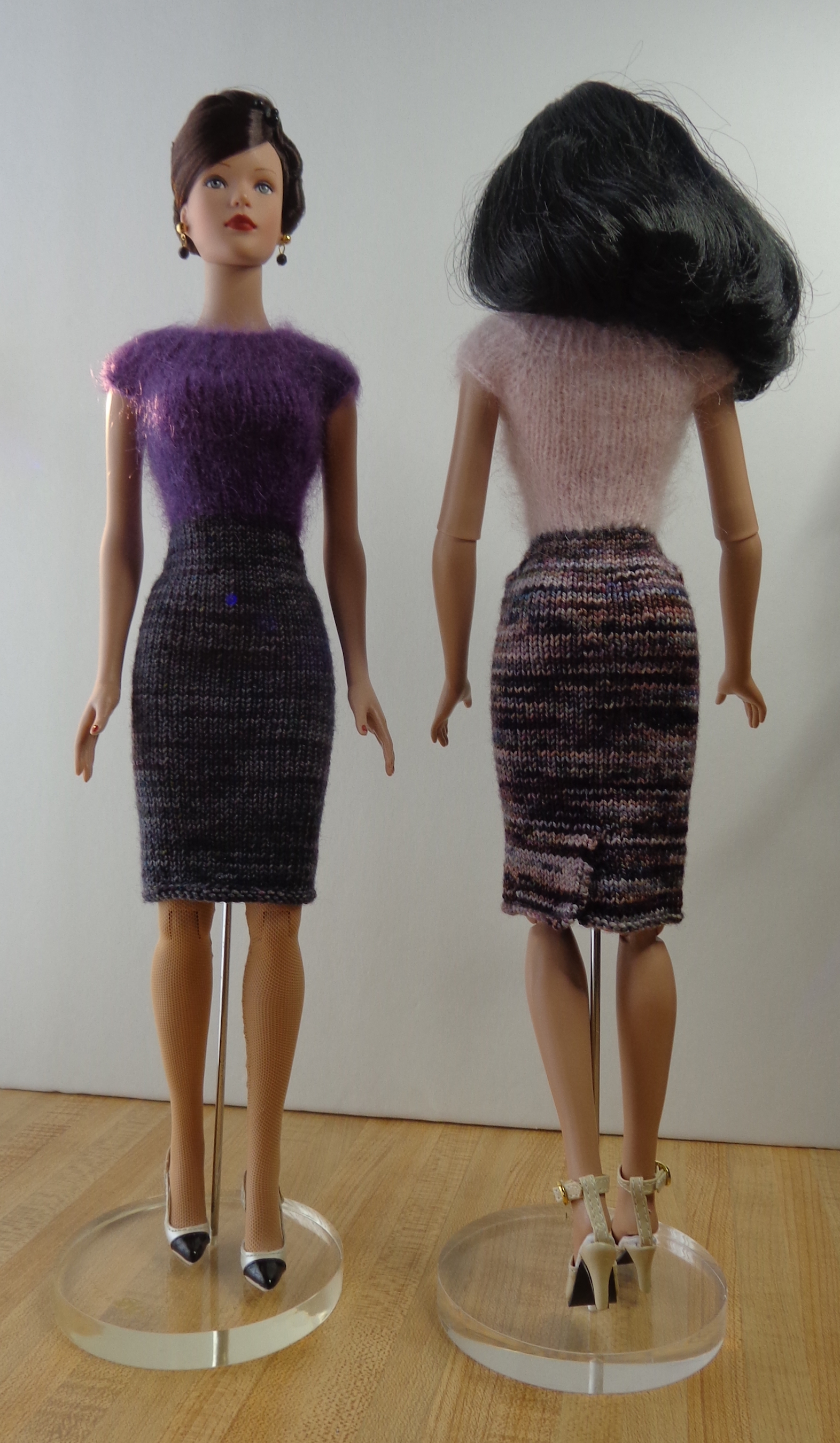
Dress and side-to-side cardigan knit for Tyler Wentworth by Deborah Cooke

The top of Tyler’s dress is Sugar Bush Drizzle held double – the colourway is Monsoon Mauve – and the skirt is a fingering weight yarn leftover from a sweater knit for me, The Loving Path Fibre Arts High Twist Sock. It came with a dyed-to-match Kidsilk Haze type yarn, The Loving Path Fibre Arts Aura Lace. I held the two together to knit a Felix for myself. (Those are Ravelry links., the last one going to my project page.) The colourway is Bewitched, a glorious mix of greys and blacks with flicks of purple and green. No photograph can do it justice.

I wasn’t so fussed about the way the top-down cardigan looked on Sydney. It makes her shoulders look quite broad, which wasn’t the feminine look I was after. So, for this one, I knit a side-to-side cardigan in the Aura Lace to coordinate with Tyler’s new dress.

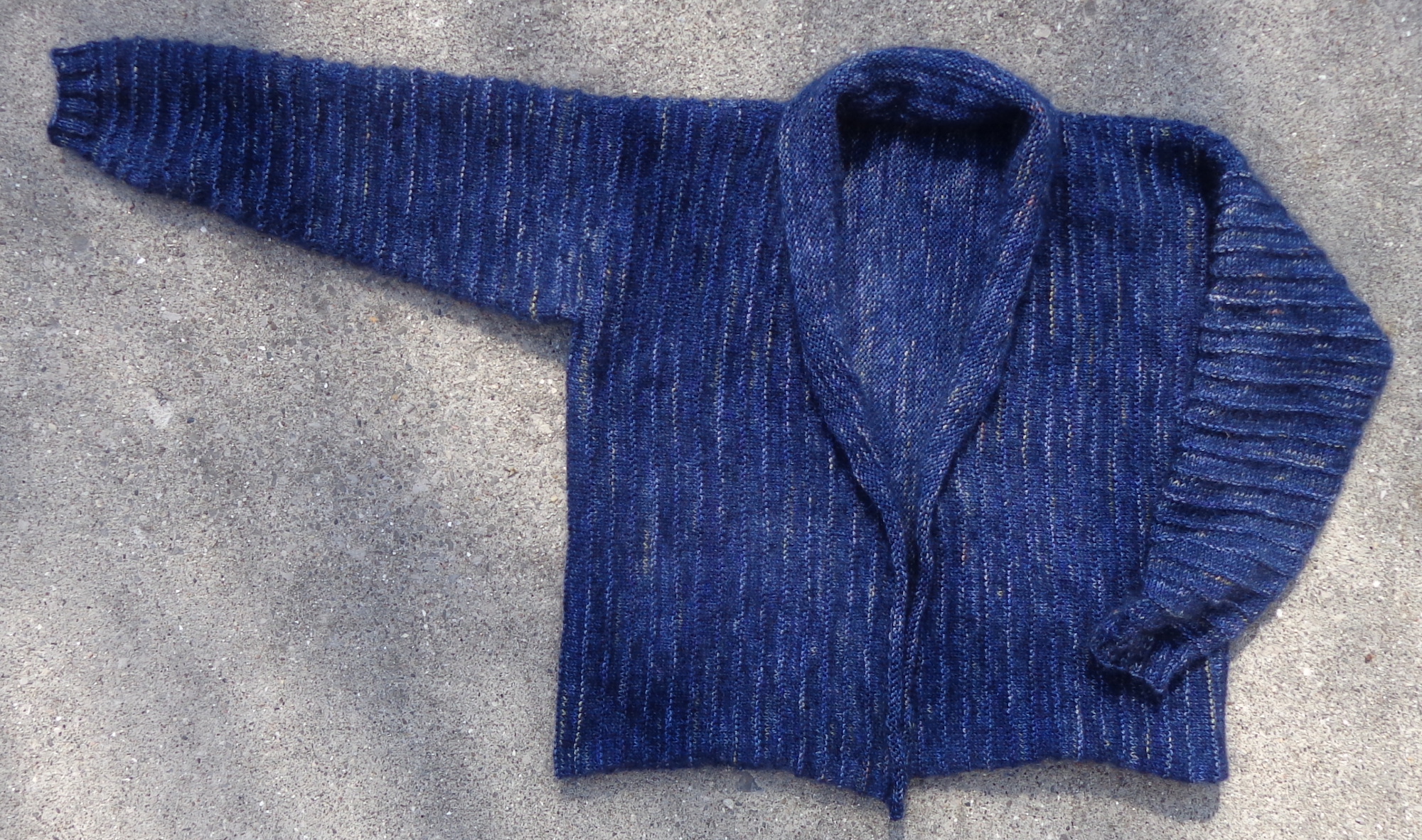
Here’s the sweater laid flat.
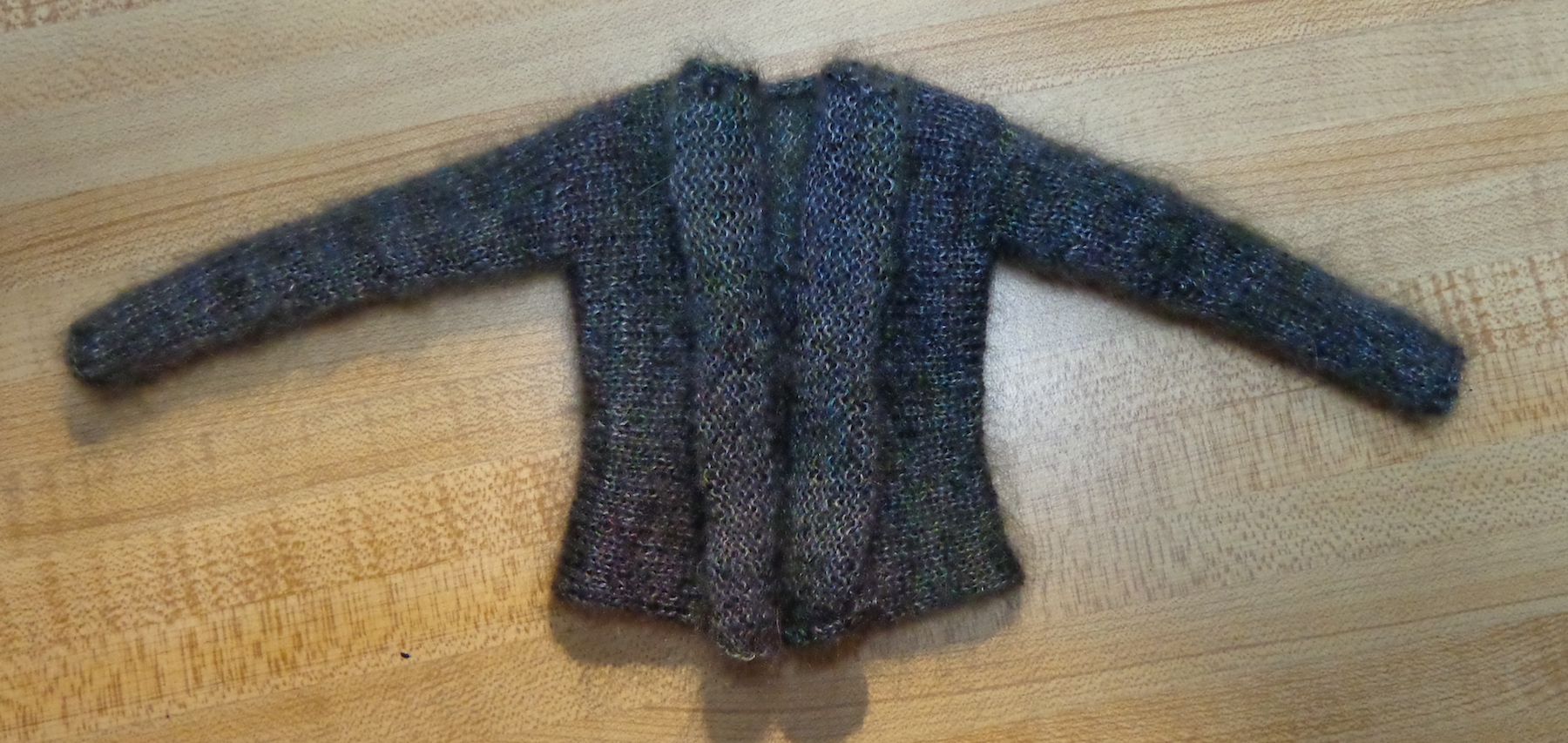
Side-to-side cardigan knit for Tyler Wentworth by Deborah Cooke

It has been blocked but those fronts want to roll. This was a bit of a surprise as I’d thought they might drape – sweaters knit like this in human size have cascading fronts. But on these needles, the fabric ends up too stiff to cascade, thus it rolls.

I knit the sweater from front to front – casting on at the front edge, knitting to the side seam, putting the sleeve stitches on a holder, knitting across the back, putting the other sleeve stitches on a holder, knitting to the front edge and casting off. I then sewed the shoulder seams, picked up the stitches for one sleeve in the round and knit down to the cuff, then repeated for the other sleeve. The only seams were the teeny ones at the shoulder.

Here’s the sweater on Tyler – I had to cover her hands to get it on, btw:
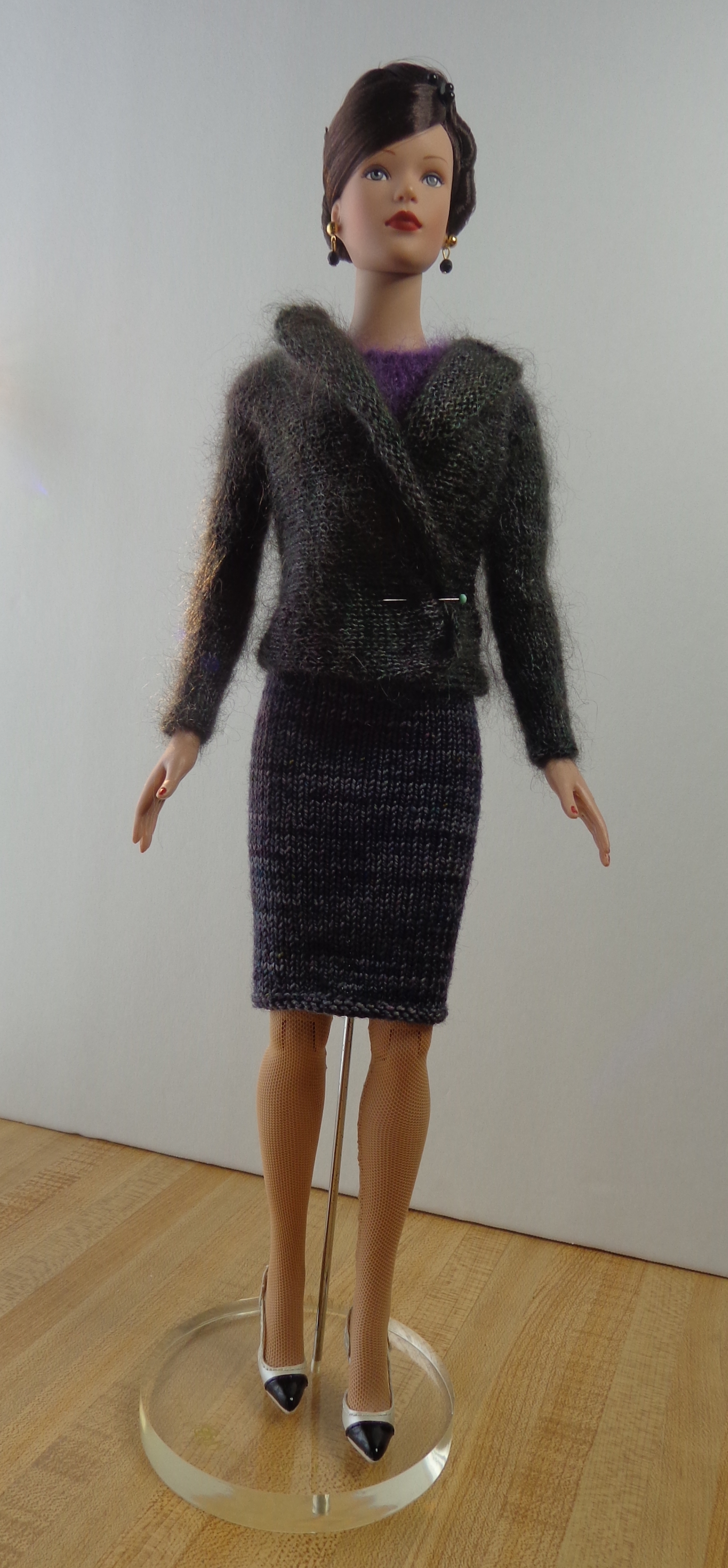
Dress and side-to-side cardigan knit for Tyler Wentworth by Deborah Cooke

I put a pin in it because I’m still thinking about the fastening, since it won’t cascade. It wants to be a double-breasted sweater jacket. With a pin at the waist, the fronts curl back like lapels. I put a clear snap at one side and three little black beads on the outside. The other side will stay tucked under when it’s closed. It’s a little more formal look than I expected, but this Tyler seems to like it.

I’m going to knit another version, but from cuff to cuff and without the extended fronts. I may pick up a collar afterward, and am thinking of adding a cable, too.

I have a sweater for myself to show you next week. 🙂
New Projects

There’s an unusual confluence of variables in my life right now, which means I’m starting both new writing projects and new knitting projects. It’s amazing to me how similar the two situations are. It’s not just about choosing the project—the bigger issue is getting the combination of variables right. Possibilities abound! I need to get some of them settled so I can start creating effectively.

Let’s talk about the knitting project here.

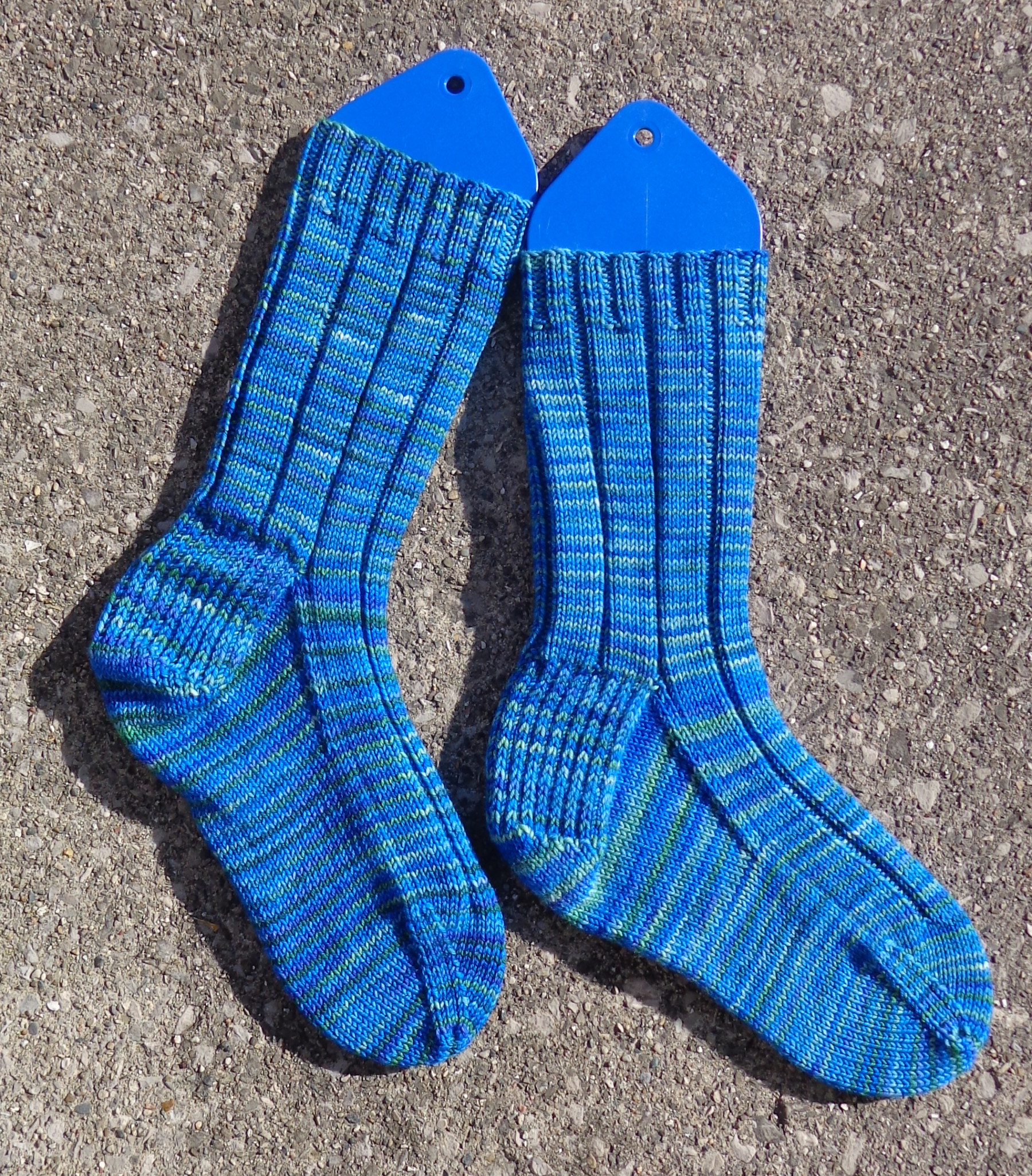
First off, I finished another pair of socks. These are knit in my usual pattern, the one I have memorized, in Fleece Artist Kiki. (That’s a Ravelry link.)

socks knit in Fleece Artist Kiki by Deborah Cooke

The tag says the colourway is Pansy but I think it’s really Nova Scotia (there’s no purple in this skein). I was excited to get this yarn on sale and realized later that it’s discontinued. It’s quite a thick sock yarn, so I went down to 64 stitches from my usual 72. I knit another pair of socks in another colourway of Kiki and showed them to you earlier this year. It’s a nice squishy yarn and good to have another pair of socks done for the winter. (I may have to cast on another pair of socks, just to have an anchoring project in my currently chaotic world.)

Water by Sylvia McFadden

I also cast on a new shawl. Water is a pattern I’ve wanted to knit for a while (that’s a Ravelry link) and I finally found the perfect yarn for it. The designer is Sylvia McFadden and one of the official pix of the shawl is at right. (Click through on the Ravelry link to see more.) You can see that it’s in garter stitch with lovely wavey insertions.

I bought a collection of her patterns and knit Waiting for Rain from it – that’s the Ravelry link for the pattern and this is my blog post about my shawl.

In case you don’t feel clicky, here’s my Waiting for Rain shawl.

Waiting for Rain shawl knit in MadTosh Dandelion by Deborah Cooke

In that pattern, the insertions were of a different lace pattern and they were knit in a contrasting color. There was a lot of stripe-y goodness in that design.

Waiting for Rain shawl knit in MadTosh Dandelion by Deborah Cooke

I’m knitting my Water shawl with Fleece Artist Anni (that’s a Ravelry link), a limited edtiion yarn that is also discontinued. It’s fingering weight and a blend of merino and mohair. It’s a bit more itchy for me than anticipated, so is a better choice for a shawl than a sweater. The colorway is called Frozen Ocean, which seems very apt.

Here’s how it looks so far:

Water designed by Sylvia McFadden knit by Deborah Cooke in Fleece Artist Anni in Frozen Ocean

The color is really not true in this image. It looks very green here, but is actually turquoise. I made good progress but am now at the first insertion and need to pay attention to the lace stitch. This bit isn’t TV knitting. 🙂

Portia deisgned by Norah Gaughran for Berroco

Which meant (inevitably) that I was casting around for a TV knit, since we’re binging mystery series these evenings. I’d been thinking of making an asymmetical sweater for the girls, which reminded me of this pattern. Portia is another sweater I always intended to make. (Yes, that’s a Ravelry link.) It was designed by Norah Gaughran for Berroco and has such an interesting design.

I actually have the specified yarn, Berroco Peruvia, but don’t have quite enough of it. I could make the smallest size, but that seems overly ambitious. It’s unlikely that I’ll lose a bunch of weight, sitting on the couch knitting. (That’s a Ravelry link because yes, Peruvia is discontinued.)

So I ended up auditioning yarn candidates from my stash – which is awfully similar to auditioning opening scenes for a book, my daytime task this week. The first candidate was some Rowan Felted Tweed Aran, which is exactly the same weight as Peruvia. (That’s a Rowan link as my colorway is discontinued but not the yarn itself.) Mine is a rosy colour, though, and I’m not sure I’ll wear a sweater coat in that shade. It’s a lot of pink. Beautiful yarn, though. I need to figure out what to do with it now.

Next up, some Debbie Bliss Donegal Luxury Tweed Aran in a scarlet shade. (Another discontinued yarn; another Ravelry link.) Very pretty but I thought the yarn looked too thin when knit to gauge. I could use smaller needles, but then the dimensions of the garment would be changed. Given the design of this sweater, it’s tough to anticipate how to adjust the fit.

#18 Shawl Collared Coat from Noro Magazine #1, designed by Mari Tobita

Next candidate: Noro Nadeshiko. This is lovely squishy yarn, an angora, silk and mohair blend. It’s a little heavier than Peruvia but I really like the firmer fabric when knit to gauge. I had bought this to make another sweater coat, this one from the original Noro magazine, designed by Mari Tobita, at left. It’s called #18 Shawl Collared Coat. (Yes, more Ravelry links. The problem with a well-aged stash is that everything is discontinued.) This coat has really pretty shaping in the back.

The colourway I have is less stripey than the one in this picture. It’s mostly shades of grey with a little bit of brick-red and a bit of white. I’m concerned that it might look too stripe-y in Portia, but am giving it a try. Here’s what I have so far:

Portia by Norah Gaughran knit in Noro Nadeshiko by Deborah Cooke

This is the centre-back braid, knit down from the back yoke, so it’s going to taper from here to that lowest point. The red looks more emphatic in the photo than in real life.

After this triangular piece is knit, you then pick up the side panels along the edges and knit toward the front. If I continue with the Noro, I’ll have to make sure that the stripes are symmetrical. I’m just too matchy-matchy to be happy with the result otherwise. I’ll see how it looks when the triangle is done.

With any luck, I’ll soon have both a knitting project and a writing project launched!

Tegna Pullover

Tegna by Caitlin Hunter

Tegna is a pullover designed by Caitlin Hunter. here’s the pattern picture – it looks like a lovely summer top, doesn’t it? I’ve linked the picture to the Ravelry page.

I cast this on with Koigu KPPPM bought at the tent sale last summer. The colourway is 534.

My “hmmm” comes from the colour of the yarn not the pattern. I’m just not sure I love it.

I’ve finished the lacy hem bit and am alternating between three skeins as I knit in the round.

Here it is, all bunched up on the needles:

Caitlin Hunter's Tegna knit by Deborah Cooke in Koigu KPPPM

Here’s the yarn in the skein – the top row are all the same colourway, but you can see the variation between them. I started with the lighter ones – this top is knit bottom-up – and will shift into the darker ones near the shoulders. I think that will be more flattering, but we’ll see.

yarn from the Koigu tent sale 2022

I suspect I had a fear of pooling, which was why I stopped. I’m going to carry on with this one and hope for the best. If it pools into a spiral, it’s going to be frogged!

And this year at the tent sale, I’m going to look for colourways that are closer to solid like those navy ones at the bottom left.

That’s the end of my on-the-needles review. Now I need to get knitting!

Update on My Noro Mitred Jacket

Noro Magazine #17, Fall/Winter 2020

I cast on this jacket, on the cover of the Noro Magazine, about two years ago – then stalled hard.

Here’s my first post about it.

Despite my doubts about the tightness of the foundation I-cord, I carried on.

Here’s the jacket so far, laid flat:

Mitered Jacket knit in Noro Ito by Deborah Cooke

I’m working to the left, which will be the left front when it mirrors the part on the right. The back is in the middle, those dips are for the sleeves, and that blue-green-pink square at the top of the mountain is the top of the center back.

The colours are pretty. I’m surprised that the colourway on each block wants to repeat itself – look at the pair on either side of the deep V for the sleeve on the right. There are two blue-green-pink squares right beside each other (although one is on the front and one on the back) then right above them pink-purple-pink, in a mirror image. That’s when I noticed this tendency so I made sure the next one didn’t mirror, by changing balls. I wanted the colour to look more random, but it isn’t. That I-cord is curling, but since it’s the foundation row, I’d need to frog everything to make it looser.

I have a suspicion that the cardigan is going to make me look like a hobbit. Here it is with the fronts folded in place. It’s bulky.

Mitered Jacket knit in Noro Ito by Deborah Cooke

I decided to remove the wooden needle at the front – where I’ve picked up and knit the stitches for the next square – then give the work-in-progress a good soak. I don’t usually block a project that isn’t done, but I need to check what that hem is going to do. I also want to confirm the fit before carrying on. I could add another row of squares to the top to make it longer, for example, if it’s going to fall at a cropped length. It’s unlikely that I could find more yarn in the same colourway and dye lot, but the sleeves are striped – I could do alternating stripes of Ito and another solid Noro colourway. (Maybe a purple.)

To my relief, the soaking made the points in I-cord easier to stretch out flat. I didn’t pin them since this isn’t the final block, but I’m more confident that I’ll be able to convince them to do that. (If I made it again – ha! – I would use a larger needle for the I-cord.) The dimensions didn’t change much, so I’ll carry on. I’ll update you when there’s more to share.

I do really like this colourway…

Peridot

Here’s another little cardigan from Martin Storey, originally designed for Rowan TrueSilk, a summer sweater called Peridot. (That’s a Ravelry link.) The pattern is in a book called the Rowan Truesilk Collection. Here’s Rowan’s picture of Peridot:

Peridot, a cardigan designed by Martin Storey in Rowan TrueSilk, picture from Rowan

The only thing I didn’t like about this was the multi-coloured buttons, but that’s easy to fix. I knit mine in Patons Silk Bamboo in Sapphire. (Also a Ravelry link since the yarn is discontinued.) It’s a pretty simple sweater, which means I have no explanation for its lengthy time-out. I cast on in July 2015 and stalled after the back and one front were knit. (Sometimes Ravelry is a little bit terrifying in the information it provides. 2015! Gah.)

Here’s my Ravelry project page.

Recently, I picked up this project again, determined to finish it up. Here’s the completed back.

Peridot by Martin Storey knit in Patons Silk Bamboo by Deborah Cooke

I really like this colour of the Silk Bamboo. You can see that this is going to be an a-line sweater – and the great thing about a traditional construction is that it’s easy to measure the pieces and check the fit before knitting the whole thing. This one is going to be a keeper. It has a lovely drape.

It obviously needs to be blocked after all its time in the project bag, but as usual when I pick up a stalled project, there’s less to do than I’d thought. I have most of one front done, and the sleeves are only 3/4 length. The plain knitting makes it great for TV knitting – even with the increases – so I’m working on this one again. I hope to have it done soon.

Top-Down Cardigans for the Girls

This post has been sitting here in draft for over a year. My original plan was to share the pattern for this little cardigan, but I never pulled it together. It’s time to show off some of the results, though. The yarn links in this post go to Ravelry, just FYI.

First, here are my little Monster High Girls in their wee sweaters.

tights for MOnster High Dolls sewn by Deborah Cooke using DGRequiem's Leg-cessories pattern

These cardigans were knit from the top down, in a variation of a pattern I made up for Barbie.

Because the sleeves are skinny, you have to take off their hands to put on a sweater. It’s cropped, so their belly-buttons show. (I could knit it longer but it’s kind of cute this way.)

Here are the sweaters:

Top-Down Cardigan for Monster High and Ever After High dolls, designed and knit by Deborah Cooke

The grey one has a ribbed collar and hem, ribbed button bands and ribbed cuffs. The raglan increases are done with make-one increases, which disappears more into the fabric.

The purple one has collar, hem, button bands and cuffs worked in reverse stockinette. The raglan increases are done with yarn-overs, which creates a little lacey pattern.

The front fastens with three snaps and the buttons are just for show.

As you can see, slight variations in yarn weight end up resulting in bigger differences. I knit both of these with the same needles and instructions. The purple one, though, is a teensy bit bigger because the yarn is a teensy bit thicker. The grey was knit with The Loving Path Fibre Arts High Twist Sock (that’s a Ravelry link) which has 424m in 100g and is classed on Ravelry as a light fingering. The purple was knit with Dragon Strings Sleipnir (another Rav link) which has 343m in 100g and is classed as fingering on Ravelry.

Here’s my Barbie version of this little cardigan in several variations:

Top-down cardigans knit for Barbie by Deborah Cooke

These ones all have working buttons – there are buttonholes in the right fronts. And I made the increases in all of them with YOs. Again, they’re all knit on the same needles with the same stitch counts and you can see the variation in size. Starting from the top left, the green one is knit in Malabrigo Sock (the colourway is Rayon Vert) and is the smallest. Malabrigo Sock is put up in 100g hanks which have 402m. This sweater has 3/4 sleeves, which works out well for Barbie since her hands don’t come off. (I wrap her hands to get the sweaters on.)

The russet one to the right is knit of MadTosh Merino Light (384m in 100g) in Cardinal also with 3/4 sleeves. It’s bigger – 20m less in 100g makes a difference even when you’re only using 7g or so!

The deep blue one, with long sleeves, is knit from leftover Unique Sheep Luxe from my Celestarium Shawl. It has 366m in 100g, which makes it a bit thicker. This one is pretty bulky on the girls.

The blue and grey one is knit of Rowan Kidsilk Haze Stripe (colourway Cool) which has 421m to 50g – it knits up as if it’s much thicker, though, because of the halo. I used the stitch counts for the Barbie size and it’s kind of fun how the striping came out.

Here are the girls modelling two of them. The redhead is Dusk to Dawn Silkstone, who is skinnier than repro Barbie. The navy one is particularly big on her.

Top-down cardigans knit for Barbie by Deborah Cooke - modelled by Dusk to Dawn Silkstone and Repro Barbie

Here are two more cardigans which were adapted to fit Tyler Wentworth.

Top-down cardigans knit for Tyler Wentworth by Deborah Cooke

The purple one is knit of Shibui Knits Sock, which has 175m in 50g. I used the stitch counts for Barbie and realized it would be enormous after knitting the body. I stopped working on this one before knitting the sleeves, because it was so big. Recently, I realized it would fit Tyler – even with the Barbie stitch counts. It’s pretty snug for Tyler, so it’s a sweater to wear without a blouse underneath. I knit the sleeves longer on this one. (Like B, Tyler has to have her hands wrapped to get her sweater on.)

Finally, I recalculated the stitch counts for Tyler for the last one in mixed brown shades. It’s knit of Koigu KPPPM in colourway 513P – KPPPM is 175m for 50g. I knit this one a little longer and also did some back neck shaping to make the front of the collar sit better.

Here’s the last one on RTW Rouge Sydney Chase, with a matching dress.

Top-down cardigan and dress knit for Tyler Wentworth in Koigu KPPPM and Sugar Bush Drizzle by Deborah Cooke

I used the free pattern T-Shirt Dress for Tonner Dolls by Samira Jessica (that’s a Ravelry link) but divided the color. It’s a top-down knit with cap sleeves that are created when you cast off for the arms. I started with Sugar Bush Drizzle, held double, in Pink Puddle. At the waist, I changed to the Koigu KPPPM. I didn’t rib the skirt but just knit it in stockinette, then purled one row and cast off purlwise. I thought that might keep it from curling at the hem, but the hem still wants to roll up, even after blocking. I also added a little kickpleat at the center back. 🙂 If I knit it again, I’ll do some moss stitch at the hem.

So, there are the girls with their new cardigans!

Halo is Done!

Another sweater freed from Sleeve Island. This cardigan is Halo, a pattern from Fleece Artist.

Mine is knit in Koigu KPPPM held with a strand of Rowan KidSilk Haze. Here’s my first blog post about it.

I started this project a year ago, in February 2022. (It was a free pattern then, but might not be so now.) I liked the design a lot but didn’t want to buy more yarn, so I shopped my stash. I came up with some Koigu KPPPM in a mixy blue and some Rowan Kidsilk Haze in Turkish Plum which matched. The resulting fabric is lovely and soft, with enough variation from the Koigu to make the colour interesting.

Mmm. Squishy goodness.

Halo Jacket by Fleece Artist knit by Deborah Cooke in Koigu KPPPM and Rowan Kidsilk Haze

The construction is interesting. You can tell by the ridges that it’s a sideways knit. You cast on provisionally at what might be considered a sideseam, knit across the back, cast off stitches for the sleeve, then knit across one front. You put those stitches on a holder. You go back to the provisional cast-on to pick up enough stitches for the other front, then when it’s done, put them on a holder. You sew the shoulder seams, then start knitting those front stitches, up one side, pick up stitches across the back for the collar, then down the other front. This makes a self-rolling shawl collar after you knit five inches of it. Then you go back to each sleeve opening to pick up stitches and knit in the round, decreasing down to each cuff.

By the elbow of the second sleeve, I was sure that I would run out of yarn. I stopped knitting so I could look for something matchy-matchy at the Koigu tent sale in August. The best I could do was some solid-ish navy (it looks kettle-dyed) so I decided to use it on the cuffs and the front edge of the collar, if necessary. I frogged a lot of the collar to be sure I had enough Koigu for the second sleeve. By this time, I’d lost momentum and the project sat. As is so often the case, I picked it up finally and finished it in a couple of evenings.

And – ha! – I didn’t run out of yarn. I took the remaining Koigu and knit on the collar until it was gone.

Here’s Halo completed.

Halo Jacket by Fleece Artist knit by Deborah Cooke in Koigu KPPPM and Rowan Kidsilk Haze

Morning sunlight through the tree branches makes for dappled light and shadow. 🙂

Mine came out a bit smaller than anticipated. I made the larger size, which meant it should have been 25″ long and 48″ wide. There’s no row gauge specified, probably because it’s stretchy, but the stitch gauge is 20 sts to 4″. Mine is right on, but my sweater is 22″ long and 42″ wide. So, if and when I make another of these cardigans, I’ll add 15 stitches to the length and 7 or 8 repeats to the width, probably 4 across the back and 4 on each front.

I’m thinking I might knit a second one of these rather than another Lunenberg-meets-Hebrides cardigan. I have more of the KPPPM in the teal colourway than I had of the navy, so that should work out well – plus I have KSH in Trance to knit with it. Or I might buy a Halo bundle from Fleece Artist and actually knit the sweater in the specified yarn. (Had to sit down for a minute there. Phew. What a concept.) We’ll see after I finish up a few projects still on the go.

In the meantime, here’s the link to my Ravelry project page.

The Turquoise Pullover

This is another one from the vaults, as they say. It began because I went to a spinners’ festival once upon a time at the Arboretum in Ann Arbor, Michigan. It must have been in the late 1980’s. I bought four yarns that day, just because they were beautiful, including two in bluey-greens. Then I didn’t know what to do with any of it.

The two blue-green yarns coordinated. One was a thick-and-thin mohair blend – I’ve since learned that I always like thick-and-thin yarns in the skein and never know what to do with them – and the other was a smooth silk blend, maybe aran weight. I had envisioned the two yarns together, even though their textures were really different, but couldn’t find a pattern. I also didn’t have that much of either of them.

When I found a commercial yarn that came in two shades that coordinated beautifully, this was the result:

turquoise pullover designed and knit by Deborah Cooke

The two handspun yarns are used for the top and the sleeves. I alternated them in 4-row stripes of moss stitch. Even the blue and green commercial yarns had blended colours, so they worked really well with the handspun ones.

Turquoise pullover designed and knit by Deborah Cooke

The cream contrast is another commercial yarn with a long variegation. It feels as if it’s part cotton, maybe part acrylic, but the label is long gone. I loved the gradation in it.

I have a vague recollection that the intarsia pattern was from a book, but I don’t know which one now.

This sweater is a cropped length because that’s how much yarn I had. It’s incredibly warm so I never wore it much. In fact, I haven’t worn it even once in over 30 years, so something needs to be done. The yarn is too beautiful to sit in the cedar box.

Here’s my Ravelry project page, although there isn’t a lot of detail there.

I tried this sweater on again and rediscovered another issue. The top is very thick and bulky, and it’s wide in the shoulders. It’s not a flattering fit. Also the contrast line above the intarsia used to be below my bustline. Now it isn’t. Ha. So, that’s not a good look either. I decided to unravel it and save the intarsia part as a cowl.

Wow. Did I ever do a good job of seaming up this sweater! It was a challenge, but I’ve taken apart the body and have what will be the cowl back on my needles. (I’m guessing what size they were.) The plan is to knit a ribbed backing and join it to the cast-on hem, so only the part between the contrast ridges will be on the right side. I’ll show it to you when it’s completed.

I dove into the stash in search of more of the blue and green commercial yarn. No luck but I did find more of the creamy one *and* the label. (Ha.)

What about the thick-and-thin mohair and the silk blend? Stay tuned for its new incarnation. I have a plan…

Scandinavian Family Cardigan

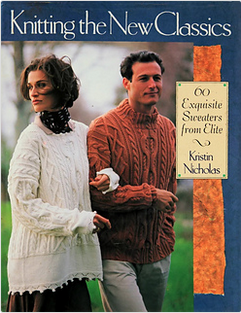
Knitting the New Classics by Kristin Nicholas

Now I’m digging out old sweaters that I’ve never blogged about. 🙂 Today I’m posting about my Scandinavian Family cardigan from Knitting the New Classics by Kristin Nicholas. (The title and the book cover are linked to the Ravelry page since this book is out of print. It was published in 1995.)

The Scandinavian Family sweater is stranded knitting, with contrast bands at the shoulders and hems. It’s a drop shoulder boxy design (more square pieces!) and I had some fun mixing up the colours.

One of the interesting changes in patterns is that many companies (like Rowan and Elite) once offered many size variations in each design, so you could make the same sweater pattern for every member of the family. (Rowan also used to offer sleeve and length variations.) Here’s the photo spread for this sweater from the book:

The Scandinavian Family sweater from Knitting the New Classics by Kristin Nicholas

The picture is dark so it didn’t photograph that well, but they’re all wearing a version of the same sweater.

And here’s my version:

The Scandinavian Family sweater from Knitting the New Classics by Kristin Nicholas knit by Deborah Cooke

I split mine up the front to make a cardigan, which meant I added facings all around. I started with the mixy gold blend in the borders, which had been in my grandmother’s yarn stash, and chose colours to coordinate with it. I have no idea what the content of it is – it was a huge handwound ball when I got it. The green and white yarns used in the main body are from a farm/mill that used to be near Ottawa called Belle Vallée Wools. (They might still exist. I’m not sure.) I bought the green and white in Carleton Place on a road trip to Ottawa in the mid-90s. The yarn is a lot like Briggs & Little Regal. Many of the colours in the yoke are actually fingering weight and I held them double. Again, I bought yarns all over the place, but mostly on that road trip.

A detail pic. I love this fair isle pattern and all the colours in the green tweedy wool:

The Scandinavian Family sweater from Knitting the New Classics by Kristin Nicholas knit by Deborah Cooke

This is a really warm sweater, probably because it’s knit tightly. No worries about the wind with this one! The other thing about this kind of wool is that it doesn’t change much over time. It doesn’t pill or show wear the way that softer yarns do. This sweatter looks very similar to the day it came off the needles, thirty years ago, and not because I haven’t worn it.

Here’s my Ravelry project page. I called this one my Snowflake Sweater.

The Beast – a.k.a. The Chinese Rose Coat

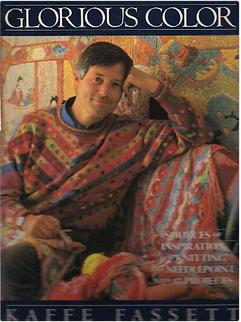
Glorious Color by Kaffe Fassett 1988 edition

My chat this week in the comments on Audrey with rontuaru (about Alice Starmore and Kaffe Fassett patterns and knitting in days of yore) got me to thinking about The Beast again. I knit this Kaffe Fassett design – which is really called The Chinese Rose Coat – around 1990. It’s in the book Glorious Color, sort of. (That’s a Ravelry link. This is the 1988 edition, which is the one that I have. The book was reprinted in 1990 with a different cover.) What’s actually in Glorious Color are instructions for The Chinese Rose Jacket, then there’s a note that you could make it into a coat by using the chart for the jacket and the pattern for the Jug Coat.

Before I get going, here are some Ravelry links for those patterns:
The Chinese Rose Coat.
The Chinese Rose Jacket.
The Jug Coat.

These sweaters are all big squares, which is great for intarsia designs but not so great for a flattering fit. (If you look on Ravelry, you’ll see that the Jug Coat is one-size-fits-all and finishes out at 44″ across the bust, so there have been other changes in pattern design in forty years, too.) The coat is a big T – you cast on at the bottom back hemline and knit up, adding stitches for the sleeves (to make that T), then continue up to the top of the shoulders. Then you split the work in the middle, continuing down the fronts, decreasing to end the sleeves at the underarm and casting off at the front hem. You sew the side seams, pick up stitches at the hem to add ribbing, then add ribbing to the cuffs too. I remember what a huge pile I had in my lap at the end.

Here’s the spread from the book with the coat on the left and the jacket on the right.

Chinese Rose Coat and Jacker in Glorious Color by Kaffe Fassett

Kaffe’s suggestion was that you should mix many yarns together for the coat, even twisting two lighter weight yarns together to get a thicker yarn. I did that. Mine is a big mixy-mixy of colours and textures, which is a lot of fun. There are even fringe yarns and sparkly yarns in there. I don’t remember what the fiber mix is, but it’s certainly not all wool or even natural fibres. I bought odd balls of yarn in yarn shops all over the place for this coat.

Here’s my coat:

Chinese Rose Coat designed by Kaffe Fassett and knit by Deborah Cooke

I’m not tall enough to even get all of it in one picture!

I didn’t use one black yarn for the background but mixed a bunch of them, including a fur one and some grey ones. The one thing that bugs me is that the chenille yarn I used for the collar and cuffs seems to be aging badly – each time I pull out The Beast, there are more loose loopy bits there. I guess there’s some content with elastic that’s losing its boing (?)

Chinese Rose Coat designed by Kaffe Fassett and knit by Deborah Cooke

I also wasn’t really good about checking gauge in those days. Most things I knit then were too big or too small. This coat was and is ginormous. It’s a bit shorter now because I took the ribbing and one repeat off the hem as soon as it was sewn together. I’m just not tall enough for how big it was. This also eliminated the ribbing at the hem, which isn’t a bad thing if you want to walk in the coat. I added facings down the front, knit my ribbed collar and cuffs in black chenille and ultimately added bias tap inside the collar (at the base of the ribbing) and from collar to cuff where the shoulder seam could have been to keep the monster from always getting bigger. Part of this is a gauge issue. Some of it is just weight. The original design was supposed to be worn open, more like a cape than a coat, but I added buttons and loops on the front. I also added pockets in the side seams, which are awesome.

Chinese Rose Coat designed by Kaffe Fassett and knit by Deborah Cooke

It is a sweater to wear on a perfect fall day with just the right temperature and no wind. As a result, it mostly gets action when the mister is very sick, which doesn’t happen very often. He’s the one who called it The Beast and he’s convinced that it’s the warmest possible blanket when he’s not feeling well.

There was one fun incident with this sweater. It used to be possible to fly from Toronto to New York City for the day – there were a lot of flights and it’s not that far, so you could catch the 7AM flight, be in the city by 9:30, meet someone for coffee, someone else for lunch, someone else for a coffee and maybe even a fourth person for a drink, then head back to the airport to catch the 6PM or 7PM flight home. At LaGuardia, the Air Canada people always put you on the next possible flight, if you were interested. I used to go down to meet with my editors. In 1998, I was going to hire an agent and had narrowed it to two possibilities but wanted to meet them both to decide. I flew down for the day. I also had appointments with both of my editors that day, so it was busy. It was in the fall, a gorgeous sunny day, and I wore The Beast. I was so excited when two women stopped me on the street to talk about it because they recognized it as a Kaffe Fassett pattern. Obviously they were knitters, and we had a lovely chat on 7th Ave. (or maybe 5th) in the sunshine. Their enthusiasm made my day.

I also made the Chinese Rose Jacket for my SIL in the mid-90s. I was a lot more careful with gauge and much more disciplined with my yarn choices. I used one yarn for each colourway and the same black tweed for the whole jacket. I remember that it came out really well but I don’t have any pictures of it. (Maybe I’ve embellished the memory. LOL!) Next time I’m at her place, I’ll try to remember to take a pic of it.

Here are my Ravelry project pages for The Beast and for The Chinese Rose Jacket.