Juicy Gloss Cardigan Done

Juicy Gloss is a top-down cardigan designed by Asja Janeczek, which I cast on in Koigu KPPPM in April 2018. (Here’s my project page on Ravelry.) Yup. Three years ago. I’ve blogged about this one a few times – Juicy Gloss in Koigu, and Juicy Gloss in Progress – but (as is so often the case) I stalled out when it was time to knit the sleeves.

Here’s what it looked like the last time I showed it to you:

Juicy Gloss by Asja Janeczek knit in Koigu KPPPM by Deborah Cooke

It’s a long cardigan, longer with my modifications to the front, and the colour variegation is very pretty. Here’s a detail shot of the Koigu – it still doesn’t do the color justice:
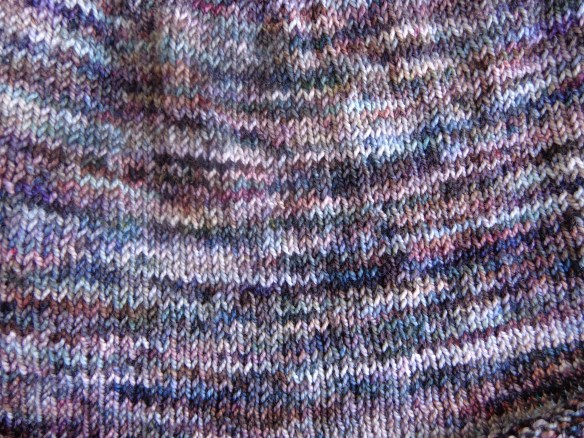
Juicy Gloss by Asja Janeczek knit in Koigu KPPPM by Deborah Cooke

This cardigan was marooned on Sleeve Island for a while. I think that happens because there’s always counting to do with sleeve decreases and I tend to knit while watching television – it’s easy to lose track and even easier to just pick up another project with a few thousand miles of stockinette to knit. In this case, I also realized after I knit the first sleeve to the elbow that it was too wide. Projects that need to be frogged and reknit often end up in time-out for me.

I frogged back to the armhole and decreased an additional 8 stitches from the sleeve at the underarm. The pattern specifies to knit two inches before beginning the sleeve decreases but on this version, I started the decreases right away. I was working four rows, then decreasing on either side of the marker (at the middle underarm) in the next row. I did that twelve times. If I’d wanted the elbow length sleeves like the pattern, I could have continued to the specified length and done the cuff, but I wanted long sleeves.

I continued, working 5 rows between the decrease rows. I did that fourteen times. The sleeve needed to be 34cm long, so I knit 62 rows to get the length then worked the I-cord cuff as specified.

Here’s one finished sleeve (although the ends still need to be sewn in):

Juicy Gloss Cardigan knit in Koigu KPPPM by Deborah Cooke

I could have continued the decreases and made the cuff fitted, but I know I’ll push up the sleeves.

When I blocked the sweater, the Koigu stretched like mad. It seems that the yarn loses its “boing” when wet. It’s freaked me out before, but I just had to let it dry as planned. When it was just a little damp, I put the sweater in the dryer on the Touch Up cycle. That’s 15 minutes on low heat on my machine, and I checked it every five minutes. It came out perfectly after ten minutes, then I left it overnight to be sure it was completely dry.

I still have to sew in the ends, but here’s the finished cardigan!

Juicy Gloss Cardigan knit in Koigu KPPPM by Deborah Cooke

It looks a little lighter at the top right because there was a bit of sunshine there.

Here’s my Ravelry project page with the modifications.

What do you think? I’m really pleased with this one.
Stripes!

I can never resist a new project, even when I have a lot of projects to finish up. There’s something very satisfying about casting on.

In November, Andrea Mowry published a new pattern called Stripes! which I liked a lot. (That’s a Ravelry link.) It’s a top-down pullover with lots of options to vary the results. It looked like a quick and easy project – plus I had the perfect yarn in my stash (or so I thought).

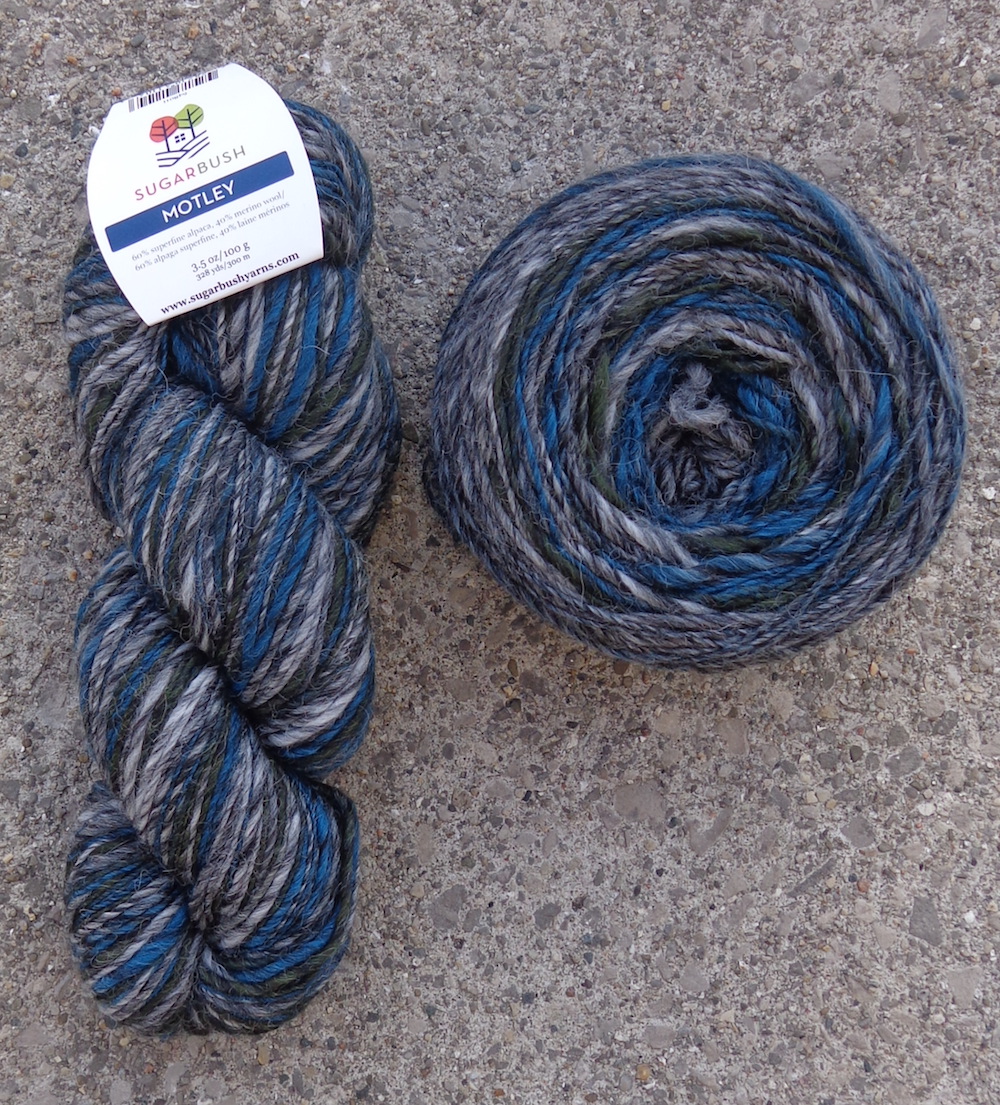
I bought some Sugar Bush Motley at Spinrite last year because I really liked how it looked in the skein. (That link goes to the Motley project page on the Sugar Bush site.) I was expecting it to create an all-over speckly pattern. Once it was caked up, though, it was clear that this yarn was dyed to make repeating stripes. (This colourway is called Peppered Teal.)

Sugarbush Motley in Peppered Teal

I set it aside then, but pulled it out again for this sweater. I’d have stripes without changing colours every 8 rows. Of course, the stripes would vary in width, depending on the number of stitches on my needles, but I thought it would be okay.

Here’s the sweater so far:

Andrea Mowry's Stripes top-down pullover knit in SugarBush Motley by Deborah Cooke

This yarn is a merino-alpaca blend, so it will be warm. I decided that I wanted a turtleneck on this sweater, so I did a provisional cast-on, then knit down the sweater yoke as instructed. When I had a few inches done on the yoke, I picked up the neck stitches and knit up in ribbing to create the turtleneck. I also inverted the colour sequence – starting from the other end of the skein – because I knew the collar would be folded down and I wanted it to match up with the body. I had a hard time assessing the depth to knit – I thought it was long enough because I tried it on before the yoke was done. Once I divided for the underarms, though, the neck pulled down a bit and I had to rejoin the yarn and knit a few more inches on the neck.

I like the yarn, even though it’s a single-ply, loosely spun and a bit splitty. I like it because of the result. The knitted fabric is soft and light, with a really nice drape. I think this will be a sweater I wear a lot.

I can hear you asking why I’ve only managed this much since November. As is so often the way with “quick” projects, I made a mistake. I had knit this sweater well past this point, almost to the waist ribbing, when I took it off the needles to check the size. I find it hard to assess the size of a top-down pullover, even when I try it on, until I knit past the bust. It was huge, way too huge – because (ugh) my gauge was off. I figured out that I needed 50 less stitches in the body and would still have a loose fit, so I ripped all the way back to the neck. I could have changed to smaller needles, but I liked the drape of the fabric I was getting, so I followed the instructions for the next smaller size. That made a difference of 30 stitches in the body. Then I added 20 less stitches at the underarm, 10 less on each side, and carried on. I’m quite happy with the fit now.

And I figured out a new trick. Instead of transferring all the stitches to a length of wool to try on the sweater, then putting them back on the needle, I knit half the body on one 80cm circular, and the other half on a second 80cm circular. That means I can put the sweater flat to measure it, and also that I can (carefully!) try it on, without transferring the stitches. 🙂

Onward with this one. Looks like it will be a sweater to wear next winter…

Another Finished Navelli

I finally finished my second Navelli. Even though it’s not blocked yet and the ends need to be sewn in, I wanted to show it to you. I love it so much!

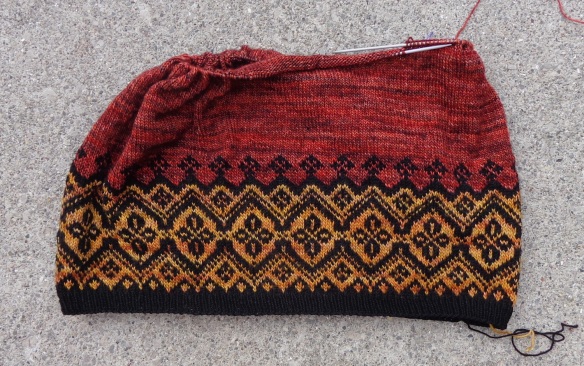
Navelli knit by Deborah Cooke in MadTosh Merino Light

The yarn is MadTosh Merino Light in Cardinal and Spicewood. The black is some Malabrigo Sock I had in my stash. This one fits more closely than my first Navelli, which is very boxy.

For contrast, I put them side by side – here they are:

Two Navelli knit by Deborah Cooke

The neck is a little higher on the red one so I must have done something differently. (?)

I don’t wear the teal Navelli, even though I love the colours. I thought it was too wide, but actually, it’s too short. I kind of like how loose and boxy it is. So, my current plan is to pick up the stitches all the way around just below the underarms, on two needles, take out a row to split the garment, knit two inches of teal, then graft it to the top of the sweater. I think I’ll wear the teal one then, and I won’t have to frog the sleeves and top.

If I make a third one of these (!!) I think I’d knit it between the two sizes. That would make for an odd number of repeats on the border pattern, which might be weird. I have to think about that.

In the meantime, I’ll make the teal one longer.

In other sad knitting news, I had to frog a top-down pullover. I’d knit eight inches of body, took it off the needles to check the fit (for the third time) and discovered it was way too big. Just a teeny bit off guage, but it added up. Off to frog pond.

What do you think of my new Navelli?

Finishing Audrey

Rowan Angora Haze

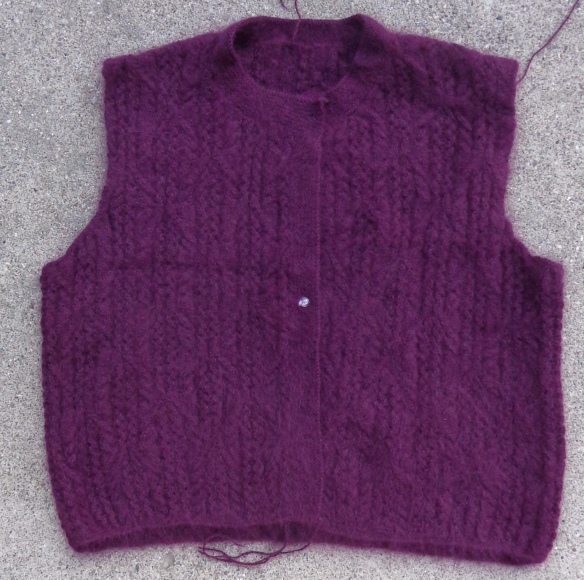
Audrey is a cardigan designed by Martin Storey in Rowan Angora Haze. It was the design featured on the cover of Rowan Angora Haze pattern book (that’s a Ravelry link, since the book is out of print). It’s another project that I cast on very soon after the pattern was published – in the specified yarn – but then lost my mojo. As usual, it was the sleeves that got me. The book is now out of print and the yarn is discontinued.

I started this one in February 2016, and blogged about my progress a couple of times. Knitting Audrey was the first post in 2016, then there was an update in 2019: Navelli, Nightshift and Audrey. I talked about the sleeves in this post about my Navelli.

Audrey by Martin Storey knit in Rowan Angora Haze by Deborah Cooke

I made a few modifications. In the book, the sweater is styled with a ribbon at the neck, like a bed jacket. The collar is actually a casing for the ribbon. I did a regular round collar instead. I omitted the increases in the body – the design is a bit 80’s with the shoulders being wider than the waist. Mine is just boxy.

This was my last progress shot of the sleeves:

Audrey by Martin Storey knit in Rowan Angora Haze by Deborah Cooke

And that’s pretty much where I stopped cold. I had a feeling the sleeves were too wide, so put the project aside to think about that. I took it out in January when my Starling Wrap was done and knew I was right. 5.5″ into the sleeves, they were 12.5″ wide, even though I was making the smallest size. So (sigh) I frogged the sleeves and cast on again. This pattern has a couple rows of garter stitch at the cast-on edge, then increases in R4. This time, I didn’t do the increases, but just switched to the larger needles and started the cable pattern. What a difference that made!

Here you can see the new sleeve, which is knit to the underarm. (Yup. There I go, tossing my knitting into the snow again. The light is so much better outside right not.)

sleeve for Audrey, designed by Martin Storey, knit by Deborah Cooke in Rowan Angora Haze

I’m much happier with these proportions – the top of my new sleeve is about the same width as I’d reached in a few inches, following the pattern directions. Now I need to figure out the sleeve cap since my stitch count is much lower. I’ve ended on the same row of the pattern repeat as for the body of the cardigan, so the pattern will line up. It’s just a case of working out the decreases. I have a plan, and we’ll see how it goes – I’ll put in a lifeline, just in case.

Another Felix – in Noro Cyochin

I had so many fingering-weight projects on my needles last year that it felt as if they were all taking forever. For a quick break, I cast on another Felix cardigan, this time in Noro Cyochin. (That’s a Ravelry link – Cyochin is discontinued now.)

Iced Blackberry designed by Claudia Wersing in Noro Cyochin

I bought this Noro when I fell in love with this poncho, called Iced Blackberry. It was designed by Claudia Wersing, specifically for Noro Cyochin, which is a blend of wool, mohair and silk. I bought the same colourway as shown in the pattern photo – that’s the picture from the Noro book, Sweet Winter.

Here’s Sweet Winter on the website of the distributor, Knitting Fever, so you can see all the patterns included in it. They were all designed by Claudia Wersing. This is her website, which is in German.

I love this poncho and bought the book for this one pattern, but partway through knitting it, I realized I’d never wear it. I love the look of ponchos, capes and stoles, but I never wear them. I didn’t want to waste the Cyochin, though.

Tithe by Jane Ellison knit in Noro Cyochin by Deborah Cooke

I ripped it out and then knit a Jane Ellison sweater called Tithe. (That’s a Ravelry link. My finished sweater is on the right.) This pattern is included in a book called Noro Unlimited – that’s a link to Knitting Fever – which includes all Jane Ellison designs. This is her website. I got gauge but the fabric was a bit stiffer than I wanted. I discovered that I don’t really like sweaters with 3/4 sleeves or floppy lapels. If it’s warm enough for a bulky sweater, I want long sleeves! And the lapels drove me a bit nuts. This one lasted long enough for a picture before it was frogged.

I have learned (alas!) that my taste in sweaters is deeply conventional.

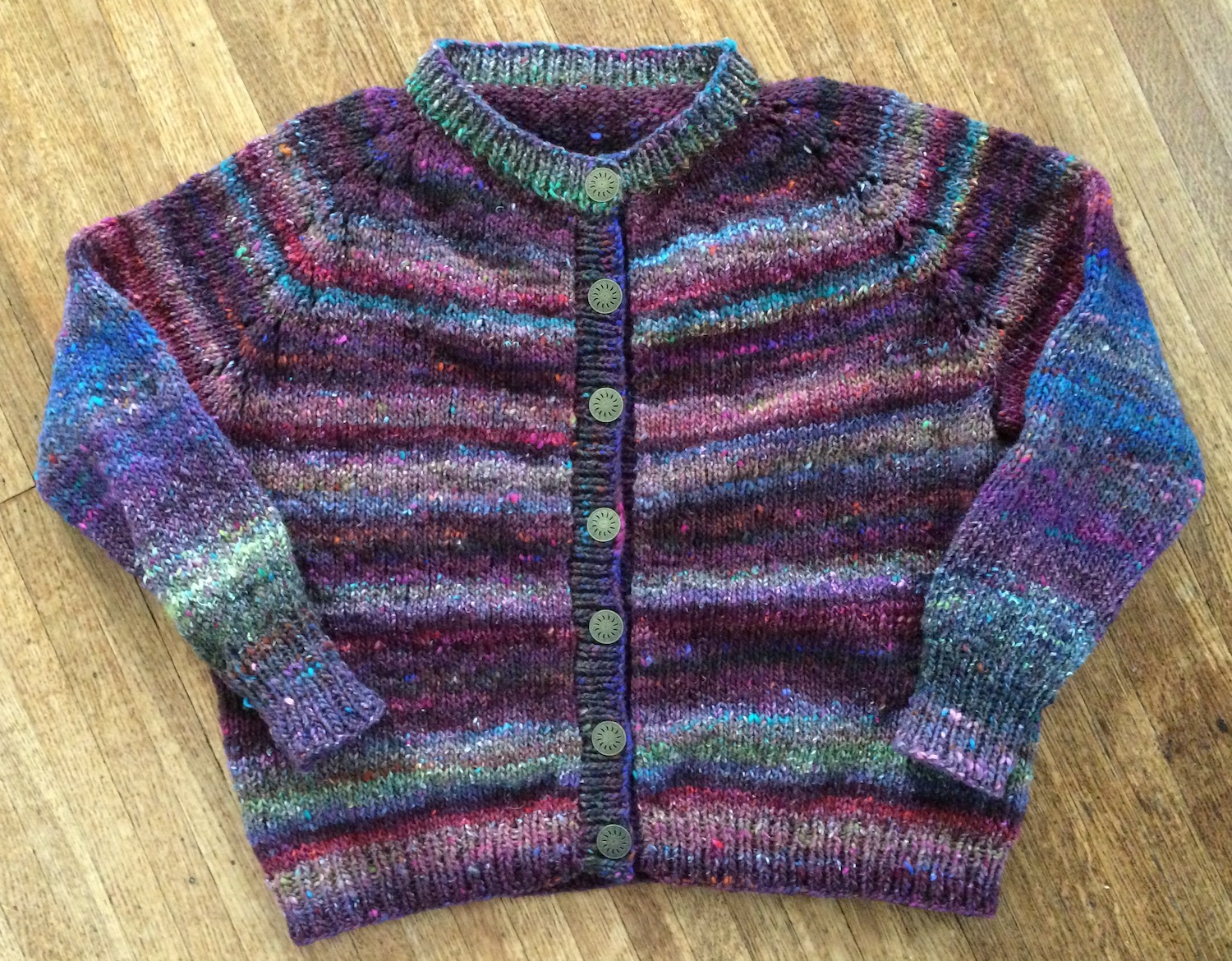
I really like both of my Felix cardigans (here’s the red one and here’s the green one) so last fall I cast on a third with my Noro Cyochin. It spent some time on Sleeve Island, as all of my sweaters do, but I finished it up last week. Here’s the finished sweater:

Felix knit in Noro Cyochin by Deborah Cooke

I like the fabric better than the Tithe sweater since it’s knit at a looser gauge. It’s nice and soft. I had lots of yarn but couldn’t get matchy-matchy – of all my skeins of Cyochin, I had only one run of those turquoise-y blues. The Cyochin seems to have more variation skein-to-skein than other Noro yarns I’ve used – that run of icy green doesn’t appear in every ball either. The sleeves couldn’t be matched – and yes, I thought about ripping it out for a while. I do like it, though – it’s comfy, warm and purple – so this one is a win.

I’m currently in the Land of Use-It-Up with my knitting wool leftovers, so next week, I’ll show you what I knit of the remaining Cyochin.

Wilhelmina, the Reindeer Sweater

Nordic Tweed pattern book from Rowan
Rowan Nordic Tweed

I can’t believe this sweater is finally done! This one has been on my needles for a long time. The scary thing about Ravelry is that your project pages will tell you exactly how long you’ve been working on something – I cast this one on in December 2016. As so often happens when I modify a pattern, I got myself into a corner (or two) and so it was put aside. And, as often happens when I lose interest in a project, when I finally pick it up again, what’s left to be done is no big deal. This sweater sat with one sleeve for the longest time, but I finished it up last week.

Rowan Colourspun for Wilhelmina knit by Deborah Cooke

The yarn is Rowan Colourspun, a discontinued yarn that I really like. (I knit the mister a vest of this – Skye – and Ice Cable Mitts in it, too. ) The colourways are Jervaulx (the red), Winterburn (the light grey) and Semer Water (the dark grey). I used Felted Tweed for the bit of blue, but really should have hunted down the Colourspun blue.

Wilhelmina designed by Marie Wallin

Wilhelmina is in the Nordic Tweed pattern book from Rowan. (That’s a Ravelry link.) I modified the pattern, though, because it has dropped sleeves and an angled shoulder. The original design also has no fair isle pattern on the sleeves. So, I used the stitch counts and basic shape from Bute (that’s a link to the one I knit here on the blog) with the reindeer and snowflake pattern from Wilhelmina. (That’s a Ravelry link, too.) Bute is fitted through the shoulders, a style I prefer.

This seemed like a good idea at the time, but was more complicated than I expected. The first issue is that Bute is knit with Rowan Colourspun and Rowan Felted Tweed. Since I wanted to use Colourspun, I thought it would work well. It did, but Bute is mostly Felted Tweed, which is thinner, and this sweater is almost all Colourspun – so my Reindeer sweater is bigger than my Bute, even on the same needles with the same stitch count. (And no, I didn’t swatch.) That part is okay. It’s kind of a teddy bear sweater this way.

Wilhelmina also has plain sleeves and I decided to put the snowflake pattern on them – then I decided the pattern had to match at the shoulder. More complication, more work, and really, in this yarn, the fair isle snowflakes are kind of lost. I shouldn’t have bothered – and if I hadn’t, it would have been done a lot sooner. I do like it, though, and the red is nice. It’s incredibly warm, too.

Below is the back of my Wilhelmina.

Back of Wilhelmina knit by Deborah Cooke

You can see that the Colourspun self-stripes a bit. I suppose I could have been strategic and started the red where it was darker and the grey where it was lighter, but since there are more red stitches than blue ones, that contrast wouldn’t have lasted anyway. I think the softness of the fair isle is inescapable – and kind of dreamy. I do like it. I made sure my reindeer started with light feet so their legs would be more visible.

And below is the finished cardigan. You can see what I mean about it being a teddy bear sweater!

Wilhelmina sweater knit by Deborah Cooke

The weather is dingy here, so even taking the sweater outside for a picture didn’t really show the detail well. Here’s a close up of my reindeer:

Wilhelmina sweater knit by Deborah Cooke

Another Navelli

I liked the Navelli pattern so well that I decided to knit a second one. This one is in MadTosh Merino Light.

The plan was to use up some of my stash. (Don’t laugh.) I chose both Spicewood and Red Phoenix, and put them with some leftover Malabrigo Sock in black. (I’d used it for my Gates of Moria mitts.) I like the Spicewood with the black for the fair isle, but I was less happy with the Red Phoenix. It looked a bit pink with the Spicewood. I visited a LYS (a new one for me) that stocks MadTosh Merino Light and it was obvious that the Cardinal was a much better choice.

This was also when the Simmer Pot jumped into my hands, insisting that I take it home. It goes with the Red Phoenix, and both of them have ended up in my Spector. I don’t mind the Spicewood and the Red Phoenix together in that one because they’re not right up against each other. The first blog post on that sweater was last week, and it’s right here. So, the skein of Spicewood came out of the stash, and the two skeins of Cardinal were added. One skein of Red Phoenix and the other of Spicewood came out of the stash for Spector, along with the skein of Saffron, but the Simmer Pot was added. That’s four skeins out of the stash and three added. Not exactly a win, is it?!

I think my teal Navelli is a bit too wide and too short, too, so I cast on a smaller size this time and I’m knitting an extra two inches before splitting for the arms. It’s possible that I’ll frog the first one and reknit it if I like the fit of this one better.

Here’s my progress so far:Navelli knit in MadTosh Merino Light by Deborah Cooke

Spector in Mad Tosh Merino Light

Spector is a pattern by Joji Locatelli, a top-down pullover with some stitch detail on the yoke. It also uses four different colours to create a gradient. The pattern is designed to use Madeline Tosh Merino Light and for once, I’m using the specified yarn.

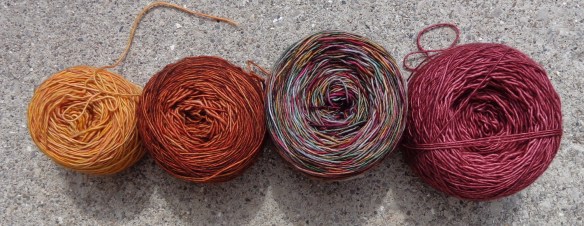
Here are my choices for the gradient. The colourways, from right to left, are Spicewood, Saffron, Simmer Pot and Red Phoenix. MadTosh Merino Light for Deborah Cooke's SpectorThat Simmer Pot is really something and the photograph doesn’t do it justice. I bought it on a whim. Here’s the page on Ravelry that shows it in stashes – because many Ravellers are much better photographers than I am. (I don’t see the colourway on the MadTosh website.)
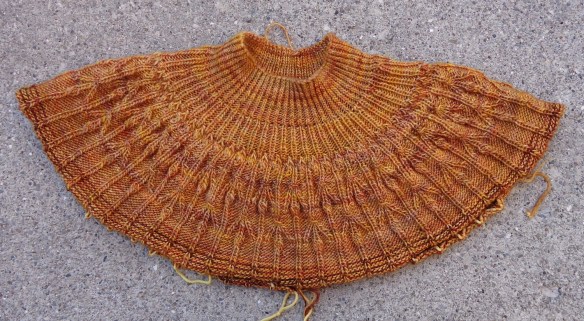
And here’s the beginning of my yoke. I’ve started the first gradient change and am supposed to split the yoke for the sleeves. I’ve put it on a thread to try it on first, which is the wonderful opportunity of knitting top-down sweaters.

Spector by Joji Locatelli knit in MadTosh Merino Light by Deborah CookeIt seems that this sweater is supposed to tug down, to make a scoop neck. When I tried it on at this point, it seems too soon to split for the sleeves as it’s challenging to tug it down enough for it to reach my underarms. My gauge is spot-on. On Ravelry, people have commented on how stretchy it is and how well it fits. Hmm. I’m small in the shoulders, so this should work. Hmm. I decided to knit a litte more before splitting for the underarms, since I prefer more of a round neck and I dislike tight sweaters. I ended up knitting another 3/4″.

I’d just started the change to the second colour in this picture and you can see a teeny bit of it at the bottom of the yoke. I did the first round of bud stitches incorrectly, just below the ribbing for the neck, but I did them consistently 🙂 so I’m not going to frog back.

When the yoke is split for the underarms, there’s a neat little trick to turn the work inside out, so the body is mostly knit instead of mostly purled. I’m not doing that, as I don’t mind purling and I think there might be a gauge difference.

I also did some recalculations for dividing the body and sleeves because the pattern warns that the rib stitch might not line up. Of course, I want it to so I made some changes. I’m making the L or the fourth size. Instead of beginning the division at the marker, I worked 2 stitches first (P2), then put 66 stitches on a holder instead of 68. I cast on 6 stitches, placed a marker, then cast on 6 more. (This is two repeats of the ribbing pattern. The instructions are to cast on 7 PM and co 7 more.) Then I worked 125 for the front instead of 122, put 66 on a holder, cast on 6 stitches, placed a marker, then cast on 6 more. I worked to the end of the row, then removed the end-of-row marker and worked to the middle of the underarm in pattern. That’s the new beginning of the round.

Because I was in the middle of a colour transition, I alternated between the two colours from the old marker to the new one, then continued in the specified transition.

Instead of 68-122-28-102, I ended up dividing my stitches 66-125-66-103 for the sleeve-front-sleeve-back. With 12 sts cast on at each underarm instead of 14, my total stitch count is still 252, as the pattern specifies. Ha.

Now, it’s TV knitting. Onward!

Mr. Math’s New Vest – and Hat!

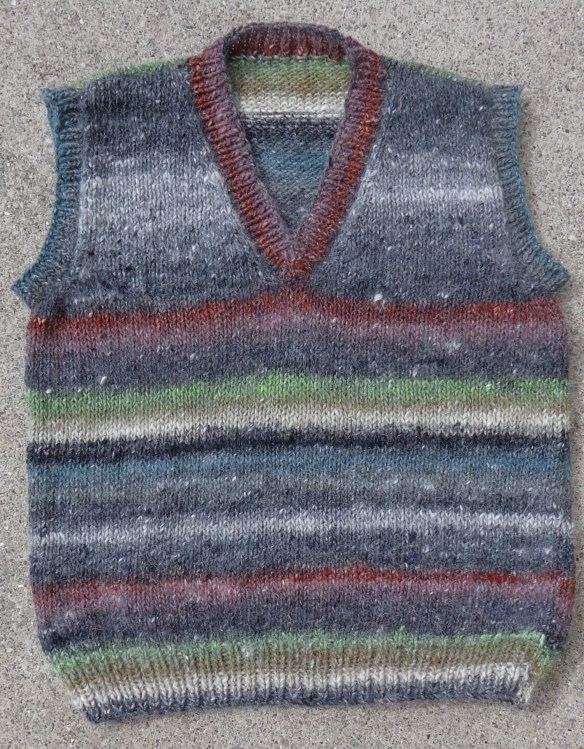
Sonny vest by Sarah Hatton knitted in Colourscape Chunky by Deborah CookeWhen I finished my Iced in Noro Kochoran, there was a bit of wool left over. I decided to knit a vest for Mr. Math because it turns out that Noro Kochoran knits to the same tension as Rowan Colourscape Chunky. I have a book for Colourscape Chunky called Rowan Colourscape Folk. (That’s a Ravelry link.)

I’ve knit the Sonny vest by Sarah Hatton from it for Mr. Math before. That’s it at right, using Rowan Colourscape Chunky:

And here’s the Noro Kochoran one, all finished:Sonny Vest in Noro Kochoran knit by Deborah Cooke

This was a much fuzzier knit—and not the kind of thing to knit in the summer at all—but I was able to match it all up just as I wanted. I like having the red around the neckline, too.

First Snow in Noro Kochoran knit by Deborah CookeThere was a little bit of yarn left so I made a hat.
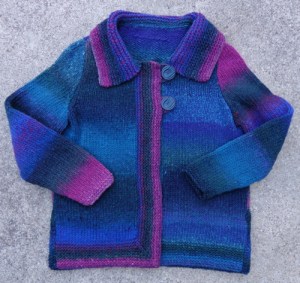
Jess by Sarah Hatton knit in Texere Olympia by Deborah CookeThis pattern is called First Snow and it’s one I use a lot. I was so busy concentrating on matching the colours that I forgot to do the increases after the ribbing: this one is a bit smaller than usual, but Mr. Math likes it better. It fits more like a watchcap. I had a pompom in dark grey, but he nixed that, so there it is.

The ten skeins of Kochoran are all used up. Yay! But, of course, I have another ten skeins stashed away in a different colourway. It has a bit of mauvey blue in it, but also a lot of grey like the first one. The Rowan book will give me some more ideas for using up the Noro. For example, I made this sweater for myself from the book, called Jess, in the same colourway as it’s illustrated in the book. I like it a lot, and am thinking I’d like a second one in the Noro Kochoran.

Iced in Noro Kochoran

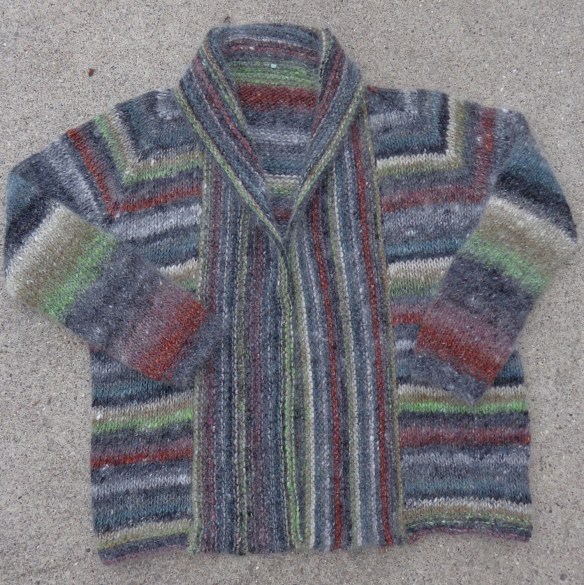
I haven’t shown you any knitting lately because I’ve been working on this beast. It’s heavy wool on big needles but still a lot of knitting. Here’s the sweater:Iced by Carol Feller knit in Noro Kochoran by Deborah Cooke

The pattern is Iced, which is a free pattern from Knitty and a top-down cardigan. Here’s the page on Knitty where you can print the pattern and here’s the Ravelry page.

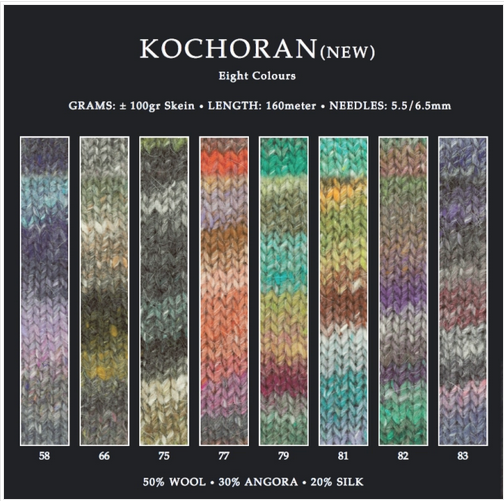
The yarn I used is Noro Kochoran, a discontinued bulky yarn that’s a blend of wool, angora and silk. I’ve had it in my stash for quite a while. (That’s the Ravelry page for the yarn, since it’s not on the distributor’s site anymore.) My colourway is #75. Here’s a shade card that I found online:

Noro Kochoran shade card#75 is third from the left. I also have #83 which is on the far right. It’s a really fuzzy yarn and was a bit of a splurge at the time. In the skein, it didn’t look so stripey, but (of course) it is. It shed a bit while I was knitting, but I hope it’s done with that.

I’ve been looking for a pattern for this yarn for quite a while, and was inspired by a Ravelry project of this sweater in this yarn. That knitter said that pattern and yarn were a perfect match, so away I went. On the needles, the tension looked a bit loose – it matched gauge for the pattern, but seemed too loose for the yarn. I knit a swatch and washed it and was much happier with it – the yarn fulled nicely when it was washed.

I did drop a needle size for the collar after knitting it on the specified needles and thinking it was too loose. I’m much happier with it now – even though it was three nights’ of knitting unraveled to redo it. I later unraveled the rows of garter stitch at the hem and reknit them on the smaller needles to match. I didn’t have 7mm needles small enough to do the same at the cuffs, so I knit their garter stitch cuffs on 6mm needles. I can tell the difference but I doubt anyone else will. Here’s the sweater with the fronts overlapped, which is how it would actually be worn. (I was just showing off my matchy-matchy! LOL)Iced by Carol Feller knit in Noro Kochoran by Deborah Cooke

The result is a very snuggly cardigan. It has that “bathrobe” look that shawl-collared cardigans so often have for me (maybe that’s because of the stripes) but I like it anyway. I haven’t put buttons on it yet and probably won’t.

Here’s my Ravelry project page.

Sonny vest by Sarah Hatton knitted in Colourscape Chunky by Deborah CookeI used about 6 skeins of the Kochoran so there are 4 left. I realized that the yarn has exactly the same weight/yardage as Rowan Colourscape Chunky – woo hoo! – which gives me another pattern stash. I’ve made this vest for Mr. Math of the Rowan yarn – it’s called Sonny and was designed by Sarah Hatton – which took 490 yards, so I have enough of the Kochoran, maybe even to be matchy. (Fingers crossed.) I’ve now cast on this vest in the Kochoran.

Here’s my Ravelry project page for the vest at right. I think it’s going to look really good in this yarn.