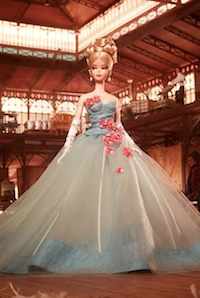
I’ve been sewing clothes for my dolls again recently – I’ll show you when something is done. There’s a lot of handwork on this particular couturier gown! – and went looking for a video I watched a long while ago. I found a trove of videos made by Mattel for Silkstone Barbies which show fantastic dioramas.
This one from 2012 is called Behind the Scenes of the Atelier. It features the five new dolls, but also a really terrific diorama. It’s like a visit to a Paris couturier in the 1950’s. This is a longer video with some behind-the-scenes commentary from the designer, Robert Best.
The 2015 video – again showcasing five new dolls – takes us to a runway show at a Paris couturier. There’s also a quick visit to the atelier again. I love the colour choices, how the backgrounds are all black and cream (hello, Coco Chanel) so that the dolls really contrast.
There are six dolls showcased in the 2013 video (there was a new Ken that year plus five Barbies) on a ship similar to the Titanic. This one has a fashion editor voiceover and is sepia-toned.
The 2011 video showcases five dolls, and the diorama setting is a train station – the train being the Trans Siberian Express. it reminds me of the opening scenes of the movie Murder on the Orient Express, the one with Michael York.
This video from 2014 spotlights one doll (Fiorella) in an Italian town. I like how it starts in black-and-white then changes to colour.
And this is the one I was looking for in the first place! It’s from 2016 and is the reason my girls now have a Vespa. (Who knew such a thing existed in 1/6 scale?) Again, there are five new dolls, photographed this time in a photographer’s loft – but check out the Paris streetscape! That’s a diorama. I would love the opportunity to explore it more closely.
I went hunting about information about the artist(s) who built the dioramas or any sites that show the dioramas in more detail. There is this video showing the artists building the Russian train diarama, which is huge!
I also discovered that the Silkstone Barbie Fashion Model Collection is coming back, according to Robert Best, which is awesome news. I can’t wait to see what he designs for the girls next.
There were four dolls in 2019, of which I bought only Best in Black, and three in 2020. I bought Best to a Tea. The Gala’s Best is usually listed as the last Silkstone Barbie, but she won’t be any longer. These two are also the only two articulated Silkstones in my collection – this body sculpt is thinner than the original Silkstone doll.
2019 Barbie Silkstone Best in Black
2020 Barbie Silkstone Best to a Tea
2020 Barbie Silkstone The Gala’s Best
Here’s a reference website showing an inventory of all Barbies. FYI, clicking on the images takes you to eBay instead of a larger version of the image. Here’s the Silkstone page.
I should have a finished ball gown to show you soon. 🙂
I have been AWOL lately and apologize for that. August was insanely busy with a Kickstarter campaign to fulfill and a book to finish and publish—plus the usual August garden and canning to be done. I did some crafting, but didn’t take pictures—until now.
The girls scored some new chairs recently, and today’s the day to share.
I started with this tutorial and free pattern at Resin Rapture (who creates the most amazing dioramas. Go on and look. I’ll wait.) which is for a 1:6 scale chair. I downloaded the pattern and followed the instructions to make the chair and pad it. (It’s a lot harder than you’d think to cut foamboard so the edges are perfectly square.)
There are two options presented for upholstery, gluing the fabric on or making a slipcover. The pattern creator preferred a slipcover. I wasn’t so fussed about having a slipcover as the final finish, though. I don’t like them in real life , so didn’t want them for my dolls—and while it’s removable and washable, I think the chances of my washing a slipcover for a doll chair to be pretty low. (Non-existent, actually.) I watched the video from Bentley House Miniatures linked in the tutorial (it’s right here) for making and upholstering a 1:12 scale chair. The fabric is all glued onto the chair for the final finish.
It seems that when it comes to minis and making for dolls, there are people who glue and people who sew. I wanted the finish of the Bentley House mini, but I shared Resin Rapture’s concerns about glue and fabric. They don’t always play well together. So, I made my own combination—for this first one, I tried to ensure that all the glue was where it wouldn’t be visible.
I didn’t take in-progress pictures, so here’s the 1:6 finished chair.
I made my own pattern pieces for the chair covering – I liked how BHI worked from a rough shape and trimmed once they were in place, so I left a lot of excess to be trimmed later. I glued the front piece so that the glue was on the seat and under the front of the chair. Then I pressed down the two vertical edges on the back piece, and sewed it to the side pieces on the machine. After pressing the seams, I positioned it on the back of the chair, wrapped the fabric over top and bottom, and glued it in place on the inside back of the chair and under the bottom of the chair. I pulled the sides around and folded under the front edge beneath the arm rest (the straight vertical that meets the front) and put a teeny bit of glue on the seam allowance to secure that edge in place. I also turned the bottom edges under and glued them on the underside.
I trimmed the curved edges so that the seam allowance was about 3/4″, then clipped the curves and folded the fabric over the chair. The glue is only on the inside of the chair. I clamped some of these bits until they dried.
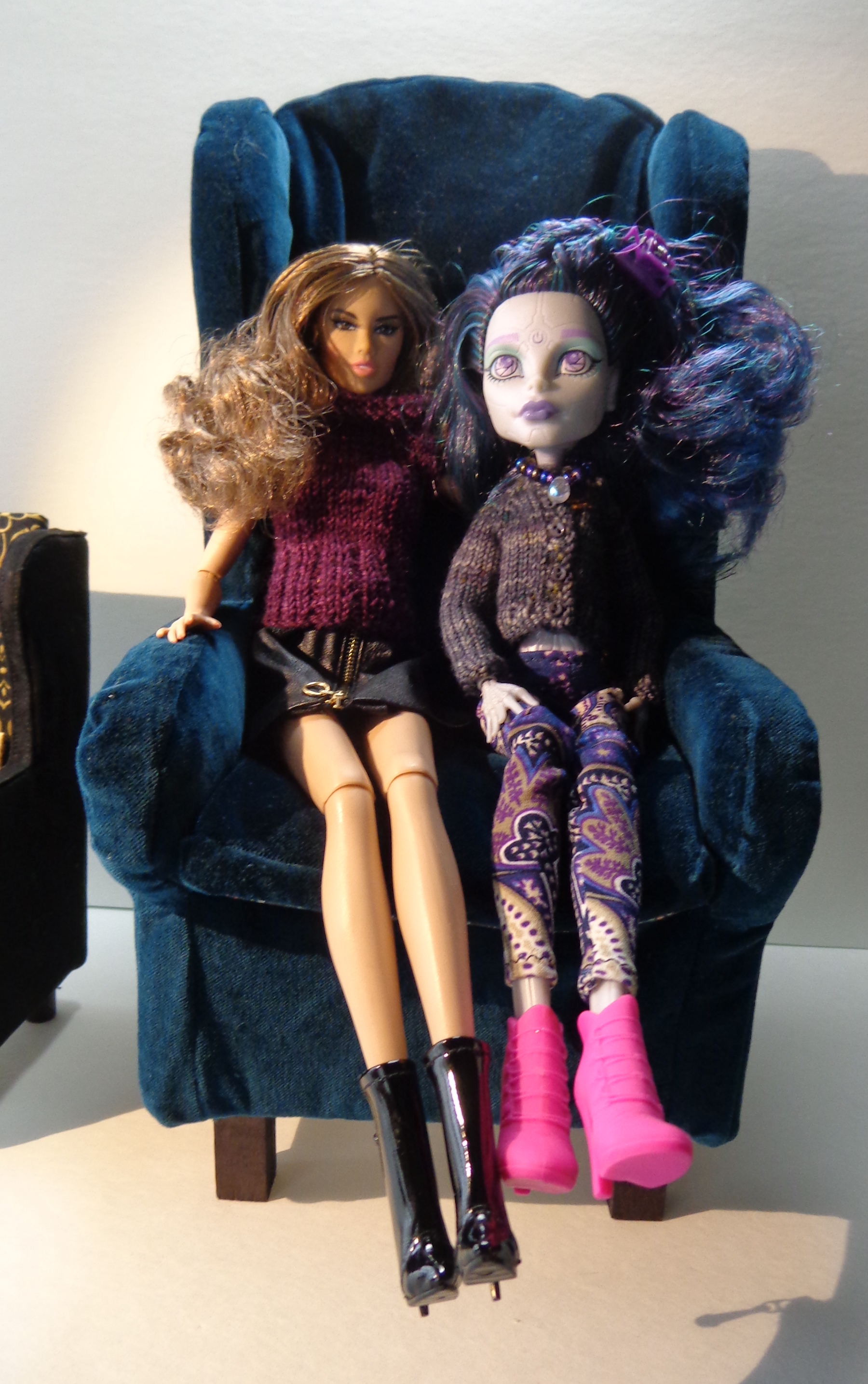
Here’s a Monster High doll in the chair with some mini-books. (That’s Elle Eedee, who arrived naked from the thrift store.)
I created a template for the inside of the sides, trimming it until it was the right height. The template is the size of the heavy fusible interfacing and the fusible webbing – for the fabric, I added 1/4″ all around. I fused the fabric (wrong side down) to the interfacing, then set the fusible webbing against the wrong side, turned in all the edges and pressed them in place. I had to be careful with this as there was fusible webbing exposed in the middle of each piece and you don’t want that stuff melted to your iron. I could have trimmed it so it was only on the edges and will do that next time. Then these two pieces were glued in place on the chair. Again, I used clamps until they were dry.
I modified the strips that run down each arm from the back of the chair, too. Once again, I used interfacing to make a finished strip of perfectly consistent width. I topstitched it on each side, turning under and topstitching one end. That one goes at the top. Then I glued it in place, counting on all those layers keeping the glue from seeping into view (and being pretty frugal with the glue, too.) I pushed pins into the foamboard down the length of these pieces – every 1/2″ or so, to hold each one in place – and left them until the glue was dry.
I made my two cushions – seat and back – but cutting them out of foamboard, then building them up with multiple layers of padding. I fussy-cut their upholstery from a contrasting fabric, glued it onto each cushion, then glued them in place. All the glue is between the cushion and the chair, where it will never be seen.
The legs are 1 cm dowels cut into 3 cm lengths, as specified in the original pattern, then “stained” with Sharpie marker. I did sand down the bottoms to give them a little shape. Because these legs are round instead of square, I added a bottom piece to the chair in foamboard to create more surface area for gluing the legs in place. (The pattern piece is the seat with the corners cut out of it.)
I added a little cushion, too. The Resin Rapture pattern also includes some book covers and a book template for the foamboard and I made these, but they’re not in the pic.
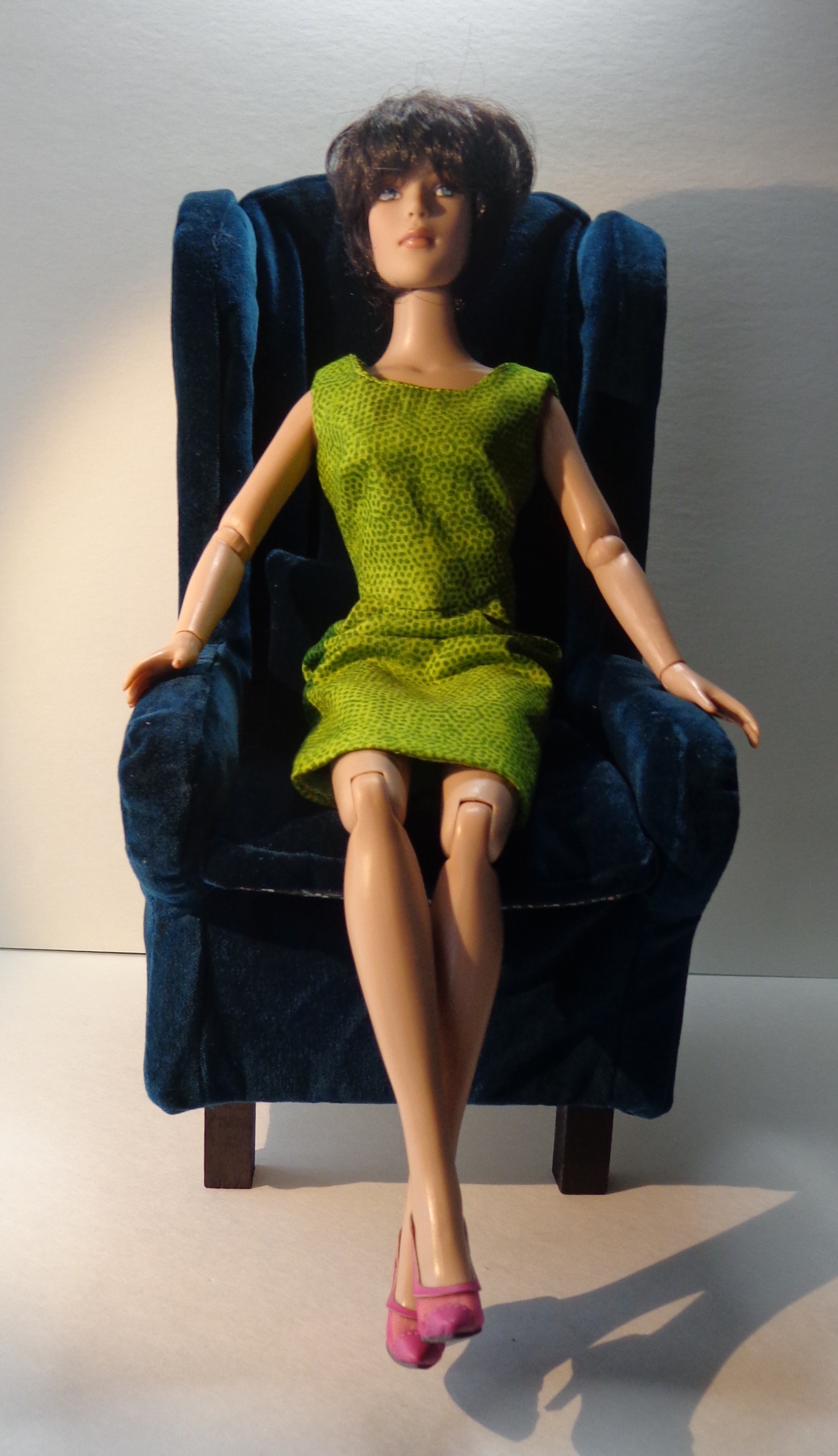
Here’s Jade Feelin’ Extra, enjoying some downtime in her new chair. (She’s my one and only Integrity Toys doll – I like her, but she’s very tall and skinny to me. She’s 12″ tall.) She’s nicked Elle’s books, which are these 1:12 scale fairy tale books (printable PDFs) from Etsy.
Next, modified the templates for my 1:4 girls and changed up my method.
I didn’t love the glue on the black chair since no matter how careful I was, I got some on the visible part of the fabric. (The solid black may have been a bad strategic choice.) It’s a water soluble glue, so I managed to get most of the offending bits off with a damp cloth. Still.
This time, I made the chair the same way and padded it the same way. I added some pieces inside the bottom of the chair to make a stop for the final piece that goes on the bottom. That also gives another edge for gluing it in place.
Then I made a slipcover our of teal velveteen, sewing it together on the machine but leaving the back piece unattached. That piece that runs down the top of the arms is tricky to fit in place, so I’m thinking about how it could be changed or simplified. I fitted it, adding more padding to the chair over the arms, then pinned it in place and sewed the back piece on by hand. (The foamboard is great this way as you can jab pins right into it to hold things in place.) The result is a lot like a slipcover, but more fitted and it’s never coming off. I then stretched the fabric tight over the bottom and glued it there, putting the glue on the inside bottom of the chair and using clamps to hold it until it dried. The legs are square this time, cut from a longer piece, sanded and stained with a Sharpie.
Here are the two chairs beside each other:
One mistake I made in my drafting of this variation of the pattern is that I didn’t trim enough from the width of the upholstery and cushions for the inside back and seat. They’re kind of fluffy and could have been trimmed down another 3/16″ or so.
This time, the cushions are actual fabric cushions, without any foamboard. Because velveteen doesn’t always love being against velveteen, I cut one side of each cushion from a cotton lawn with a teeny print that coordinates – turns out they’re reversible now, which is kind of neat. (And yes, there is a certain irony that I bought this lovely expensive lawn for a blouse for myself years ago, and the first cut out of it is for chair cushions for the girls. I need to start sewing for myself again!) And I made a little throw cushion of the velveteen. I’m thinking I might need to embeliish it.
The 1:6 girls wanted to try the big chair. (You can see that I could have padded the arms more.)
Here’s the completed chair, and here it is with Sydney, its rightful occupant in 1:4 scale.
I’m going to make another one upholstered in fake leather (because everyone loves a challenge, right?) but will make a few changes. I’ll cut the inside chair pieces narrower so they nestle in place better. I’ll also cut them of a plain cotton, maybe with fake leather pieces at top and bottom where that fabric might show. I’ll leave more fabric at the bottom of each piece for turning under, too. And I’m still thinking about how to modify that strip that goes down the arms. Hmm.
For now, though, the girls have somewhere to sit, although they’ll have to take turns.
I’ve also discovered that I really like making furniture for the girls out of foamboard.
I made a bookcase table (it doesn’t spin) and a bookcase, and have been making more books to fill it. Those books on the bookcase table and Sydney’s book are the ones from the Resin Rapture pattern, btw. I’m envisioning a library, so we’ll see how that goes.
My Monster High and Ever After dolls are mostly thrift-store finds, which means they usualy come to me naked or close to it. I buy shoes for them online, but make clothes for them otherwise. I had written a post about a dress I made for my dolls from a free downloadable pattern – I also made a cloak to go with it that I figured out on my own. – but realized this week that I hadn’t published it. (I sent the dress and cloak to Astro Jen as a gift for her girls and didn’t want her to see them before they arrived – then I forgot to queue up the post. Gah. That’s why it published yesterday.) It’s right here. I need to finish the variations of that dress and cloak that I’d cut out for my own girls, but will show you both when they’re done.
Today, we’ll have a look at some tights I made for the girls last weekend.
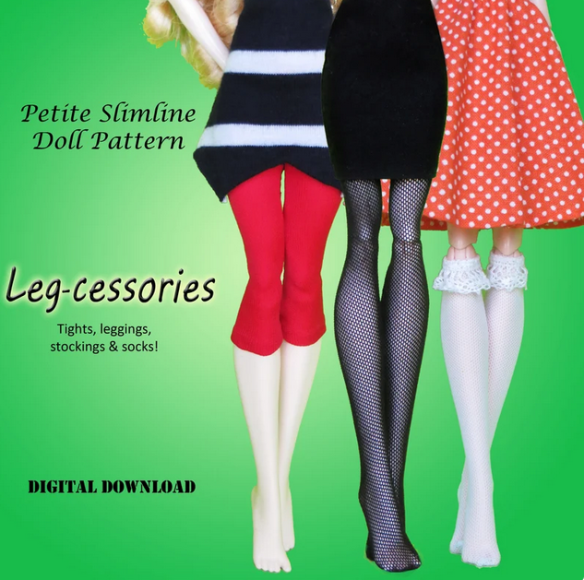
The pattern is Leg-cessories from DGRequiem – here’s the pattern on Etsy. It’s a PDF download that you print out.
Here’s the designer’s Etsy store, and here’s her website and store. She offers a lot (a lot, a LOT!) of cute patterns for different dolls.
So, yes, this is a paid pattern, but it offers many options. There are socks and stockings/pantihose, plus tights in four lengths. (I want to make knee socks with lace tops still. They’ll look great with those little knitted dresses.) Even better, the instructions are really good and filled with tips for getting good results. It includes instructions for both machine and hand-sewing, and also there’s a sizing chart for the dolls. I only made tights so far, but I think this pattern is a good deal.
These two pair are my favorites.
The girls seem to like them, too.
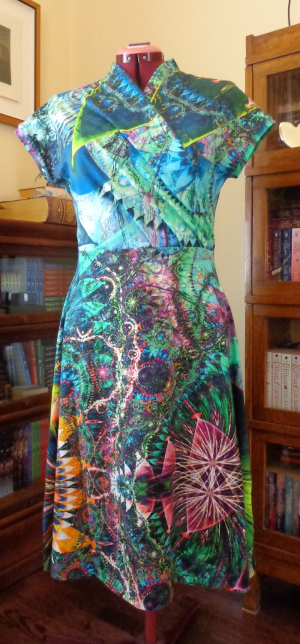
They’re both cut from scraps of a cotton knit with a really large-scale pattern and repeat, but lots of teensy detail. The repeat is about 45″ in length. Here’s the Mirri dress I made from this print (it’s also at left) and here’s the link to the product page of the online shop where I bought it. The product page is still live, even though the fabric is sold out. You can see better detail of the fabric there.
I did some strategic cutting from my scraps, to end up with two legs from the same area of the print. They don’t even look like they’re from the same fabric, and I could make a dozen more unique pair. (And, yes, I just might.) This was also the easiest fabric to sew. It’s a cotton with lycra and a bit thicker than the others.
Did you notice that the girls have cardigans, too? I’m writing out that pattern to share it with you as a free download. Frankie also has one of the purses from a 5-Surprise Mini Fashion by Zuru (That’s a Chapters link.) because yes, after Astro Jen sent me the two pink purses, I surrendered to temptation and bought a pair of surprises myself. This green bag was in one of them, and the homage Louis Vuitton tote that I was coveting was in the other, so that worked out well.
But back to those tights. Here are a few more pair that I made last weekend:
These are like potato chips: I can always go for one more pair. I could have fitted them tighter (there are instructions for that) but the girls like to share and the EverAfter High girls aren’t quite as thin as the Monster High ones. The pair on the left were fussy-cut from a knit with wide bands of patterned stripes. The repeat on it is about 18″ so it was possible to cut several (many!) pair, all of which came out differently. (My naked Skeleta is coveting these.) The purple pair were also fussy-cut from a large scale paisley print. (Clawdeen wants those.) The next two were the obvious choices, cut from small-scale prints that are closer to being in scale for the girls. (Although, again, the brown print has areas that are predominantly teal, which would give a different look.) The last pair were also fussy-cut – that starry pattern has a lot of variation over the repeat and some “suns” that could fill half a piece. I chose places with smaller stars and similarly coloured background. Lots of tights for the girls!
And they have a space to keep them, too. Look at those empty clothes racks.
This is another of my DIY wardrobes for dolls. (That link is to my first one, for Barbie.) I used a paper box with magnets on the lid flap, and stood it on end. The back wall of the wardrobe should be the bottom, and the box top lifts. Now it drops down to be the dressing room floor. This box has a floral print on the outside and gold foil on the inside, which I like a lot. For this one, I made a U-shaped insert of bookbinders’ board and “wallpapered” it with a pretty print paper. It’s held in the U shape by the two clothing rods, which are bamboo skewers glued in place. They have bamboo beads at each end as escutcheons and all the bamboo was coloured black with a Sharpie marker. There are some hooks on the right wall, too, made of bent headpins. The mirror is a bevelled one from Michaels, framed with beads and backed with gold paper. The dresser is a make-up organizer from the dollar store. The rugs are screenshots of carpets printed on cardstock and cut out. (The front one is glued down.) I didn’t make a handle for this one and might not bother. (I’ll be busy sewing more clothes.)
Back to the leggings pattern review – this is a good pattern with lots of customizable options, clearly written with great instructions. I’ve bought several more patterns from this designer and will show you the results soon. (The girls are excited.)








 Alive & Knitting