Finishing the Jumping Jax Flash Quilt

Jumping Jax Flash quilt designed by Judy Niemeyer

One more quilt has made its way to the shop with the long arm quilting machine and come home to be finished. This is Jumping Jax Flash, a Judy Neidemeyer design that I pieced at least twenty years ago.

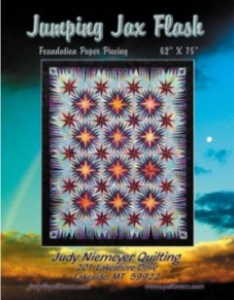
Here’s the pattern envelope at right – the pattern is discontinued. This link will take you to the Quiltworx page for this design. There are still some paper copies of the pattern around – I found one at Etsy and one in a US quilt store when I was looking for an image. If you want to make one, you can find the pattern!

Obviously, I made mine bigger, with 25 blocks instead of 12. I’m not sure whether I bought more paper piecing templates, or whether I traced them out myself. It’s been a loooooooong time since this one was pieced!

Here’s what it looked like when it went to the shop. Lots and lots of paper piecing for this one.

Jumping Jack Flash quilt by Judy Neidemeyer pieced by Deborah Cooke

I’m so chuffed that this one is finally finished. Here it is now – yes, another kitchen shot because the snow just keeps on coming.
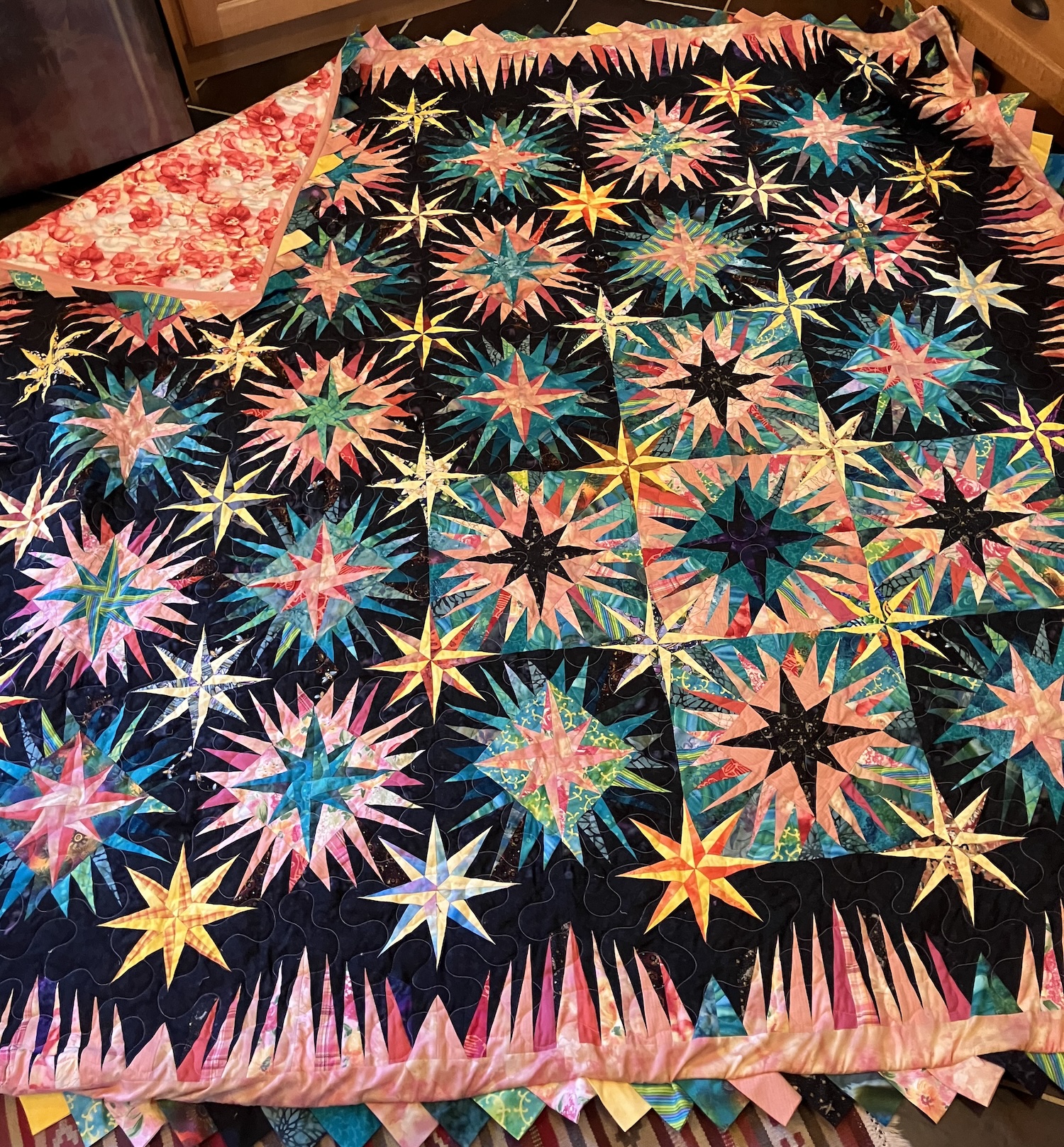
Jumping Jax Flash quilt designed by Judy Niemeyer and made by Deborah Cooke

As you can see, I inverted the colours for five squares, giving them black stars instead of black backgrounds. Four have green backgrounds and the central one has a peach background. I wanted it to be a focal point, that looked illuminated compared to the others. I’m not sure that was successful, but it is what it is at this point. I am glad that I broke up the rhythm of the colours a bit.
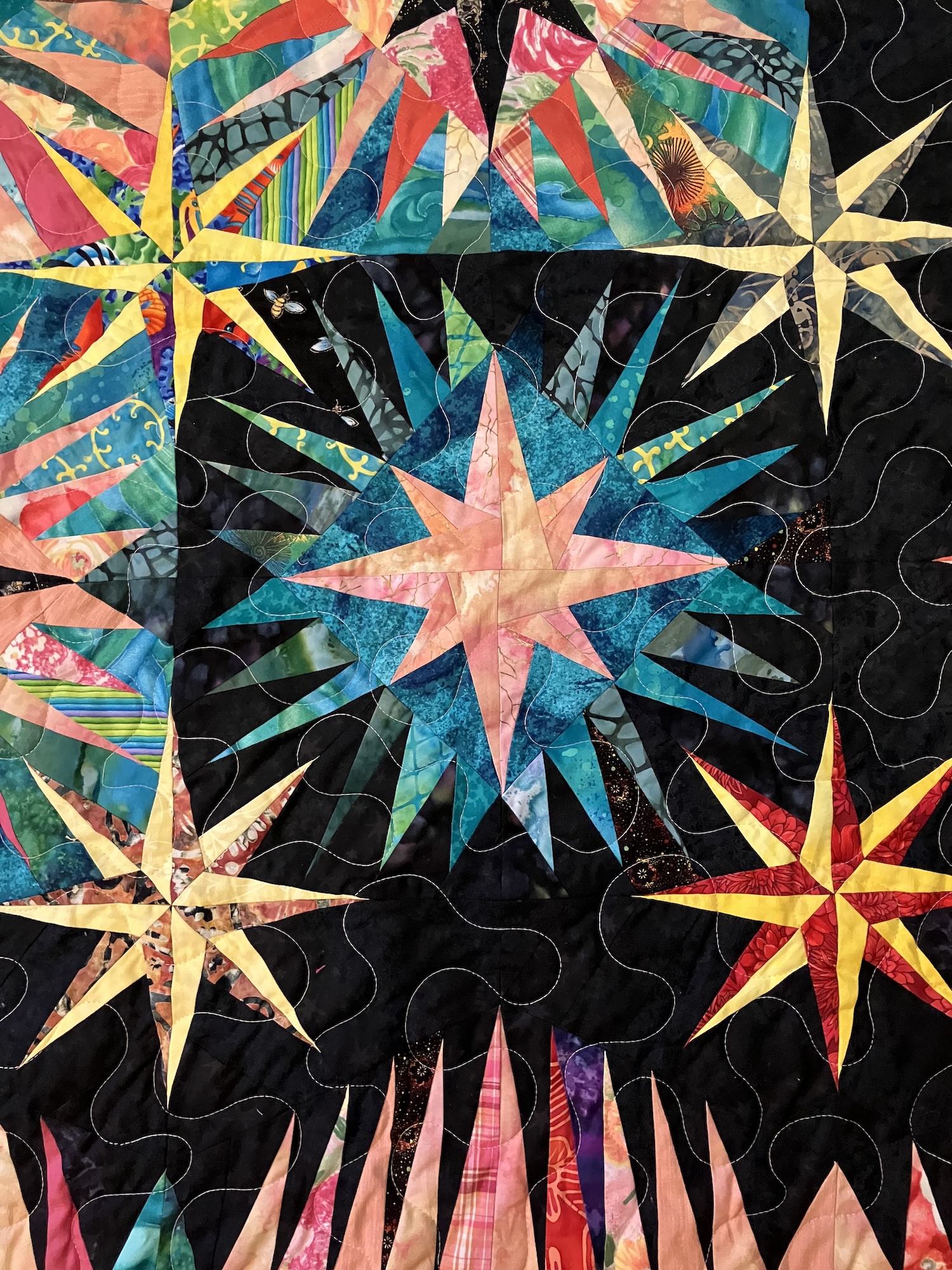
Jumping Jax Flash quilt designed by Judy Niemeyer and made by Deborah Cooke

I don’t have the highest level of restraint with colours and fabric selection, and this quilt proves it. There’s a lot of range in my definition of peach/orange and even more in my definition of turquoise. The blacks are pretty consistent (esp for me.) The smaller stars are all half-yellow, although the intensity of the yellow varies greatly, and the second colour in each one, which started out as a bright, ended up becoming just about anything not-solid-yellow.

Jumping Jax Flash quilt designed by Judy Niemeyer and made by Deborah Cooke

The other day, I told you how I’d already sewn on the prairie points and wasn’t sure how the binding would work out. In the end, I sewed on the binding just the way I always would, but instead of enclosing the seam allowance, I pressed the binding flat on the back. It’s more of a facing than a binding, though it’s doing the same thing. That peach French shirting (that I used for the bias binding) has a woven windowpane design and I did use it on the top, so it brings it all together. I might even have enough of it left for a short-sleeved shirt.

The machine quilting is in a meander pattern. Though it looks like white thread here, it’s actually a peachy pink that coordinates quite well. I decided against adding more quilting, as the binding is sewn down almost halfway through that unquilted border.

I’m SO excited to have this one finally finished!

And now, of course, I’m thinking about what’s next. I have unfinished projects calling my name but am still tempted by this Judy Niemeyer pattern. It’s called Crimson Poppy and that link will take you to the pattern page at Quiltworx.
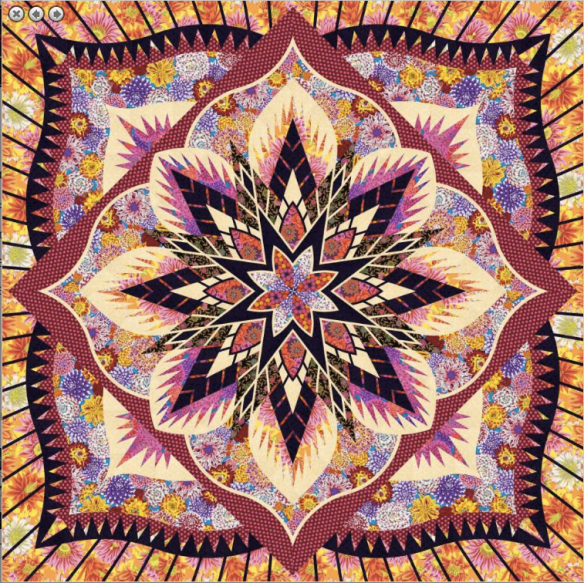
Crimson Poppy quilt design by Judy Niemeyer Quiltworx

Hmm. Not just paper piecing but curvy bits. I may have to hunt down a workshop for this one, as I’m not sure how you (I) would even begin to choose fabrics for it.
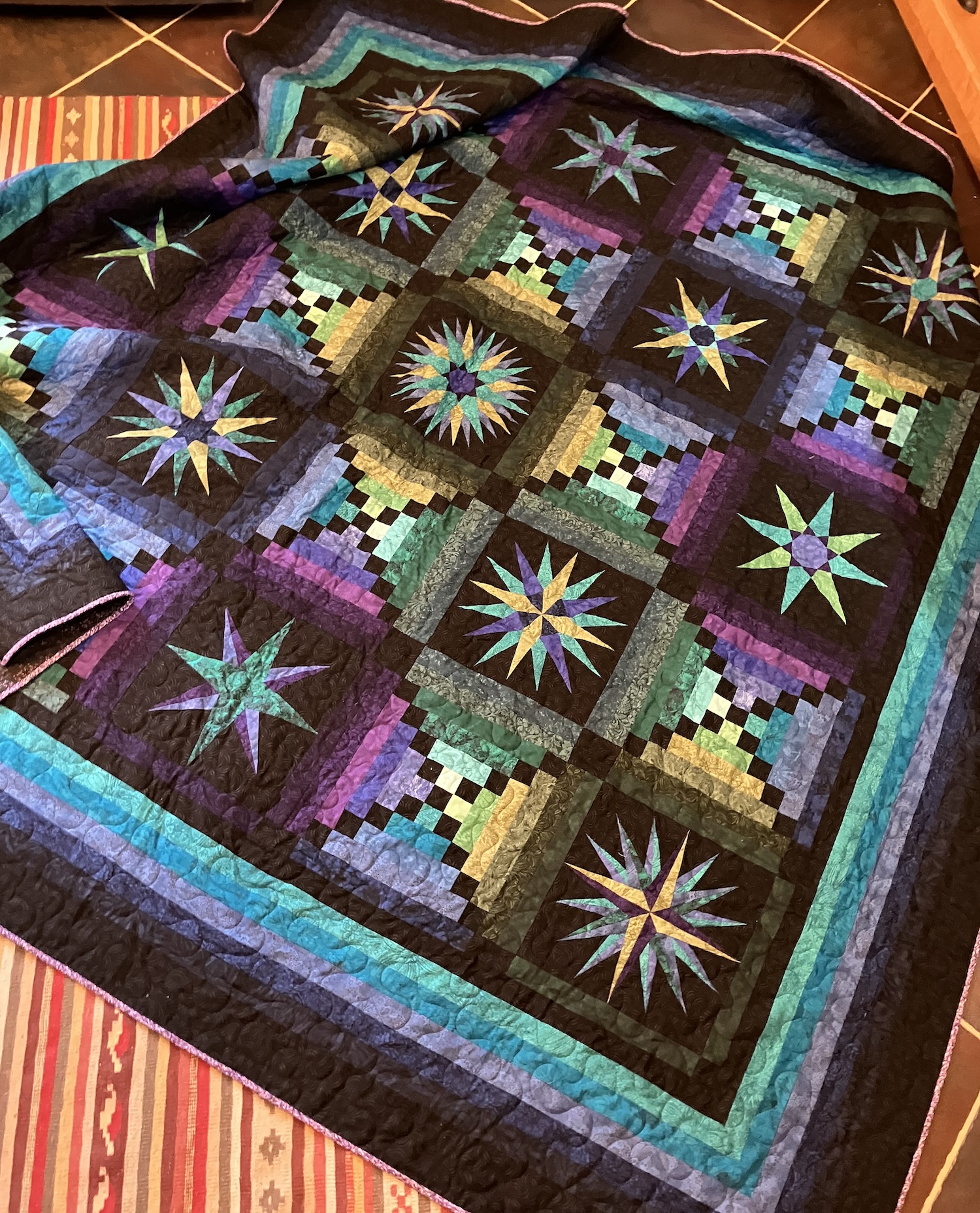
The Moonglow Quilt is Done!

Last week, I picked up two more finished quilts at the longarm quilting place. They both needed their edges bound, of course. For both quilts, I chose a meander quilting pattern and it proved to be the perfect choice. 🙂 It’s always so exciting to get a quilt back and have it almost finished. I end up trimming the edges right away.

For this one, I had the fabric for the bias tape already. I had it cut up and sewn onto the front of the quilt by the next morning. I’ve been handstitching it to the back ever since. It’s motivating to have a quilt almost done!

I meant to show you this Friday, but it was raining when I finished the binding on Tuesday. My plan was to take it outside then photograph it on the driveway, but no joy. Rain, rain, rain, and then Friday, the snow started. So, we get kitchen pix instead.

Here’s my finished Moonglow quilt.

Moonglow quilt made by Deborah Cooke

My first thought was that the binding could be black, but I thought that was a bit of a predictable choice. Instead, I chose this purple print and kept it very narrow. The backing is a black print with purple.

Moonglow quilt made by Deborah Cooke

I really like how this one came out.

There are a number of posts about piecing this one, which was a kit from Jinny Beyer. I began to piece it in April 2020, apparently.

Moonglow Quilt I

Moonglow Blocks

More Moonglow Blocks

Finishing the Moonglow Quilt Top

The other quilt that’s home to have its edges bound is my Jumping Jax Flash quilt, which has an edge that needs a bit of thought. Because I put prairie points on the outer edge, I asked them to leave the coral border unquilted. So, I’ll need to figure out a binding, then maybe add a bit more quilting myself to finish it up. As my friend, Terri, said, it will have more of a facing than a binding.

Here it is unquilted to show you what I mean.

Jumping Jax Flash quilt pieced by Deborah Cooke

It also has a bit of a ripple around the outer edge, as I added this coral border before I realized that strips cut crosswise will stretch a bit when sewn. Hmm. This one needs a plan – but first, I need to check in the attic to see if I have any of those fabrics still in my stash!

It has so many fabrics that it wouldn’t really matter if I used a new one for the border, but it would be more satisfying to use one that’s already in the quilt. There’s a coral French shirting that I think it in the stash – I just used a bit of it in the points, because I was planning to make myself a shirt with the rest, so I’m thinking there’s 1.5m or so stashed away.

Radiant New York Beauties

Radiant New York Beauties by Valori Wells

The other book I found on my shelf this week was Valori Wells’ Radiant New York Beauties.

Here’s an Amazon.ca buy link.

Here’s a buy link at C&T publishing.

And here is Valori Wells website.

I like her use of stripes and plaids, and also her playful freeform quilting. It’s a joyous little book. 🙂

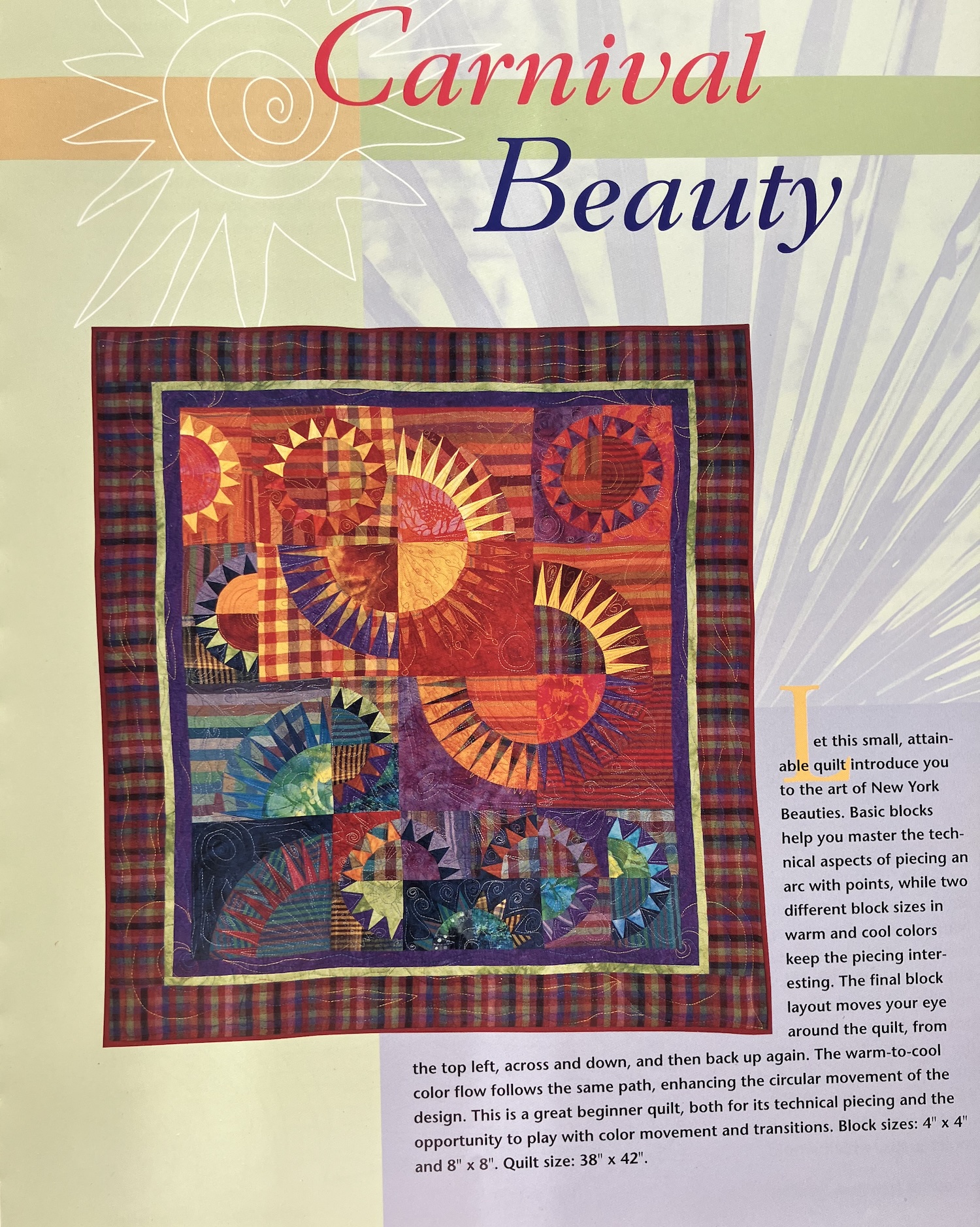
Carnival Beauty is the quilt on the cover, although that only shows part of it. Here’s a picture from inside the book that I took:

Carnival Beauty by Valori Wells

I like that there’s a kind of a gradient in her quilt top, with the bottom being darker than the top, although I didn’t manage to accomplish that myself.

I was very excited to realize how much I’ve finished on my quilt top. Here’s my progress so far:

Deborah Cooke's Radiant New York Beauty quilt top

You can see that I need three more little suns to finish the top in this layout. Looking at this photo, I have a feeling that I was going to move that top yellow sun up half a row so it didn’t line up with the pink one so well (they’re not sewn together yet) then add more little suns around it. (That would also explain why there are two more blue background squares cut.)

Clearly, I prefer my suns being whole. 🙂 I added rick-rack around a few of them (to make them more radiant) and that’s fun, too. In the project stash, there is also some trim with mini pom-poms, so that might end up in the finished top. (Maybe around the border. Hmm.) I really like it so far and am pleased with the fussy-cutting and piecing.

This one also requires me to dig back into the stash and search for fabrics to finish up this top. Sounds like a trip to the attic is on the agenda for this weekend! This top is an exciting find as it’s almost done, and the size means I’ll be able to quilt it myself. I’m also excited that many Kaffe Fassett yarn-dyed stripes are available again, so I’ll be able to add some of them into those little suns that need making.

Tomorrow, we’ll have a look at a finished quilt. 🙂

Cinco de Mayo – designed by Karen K. Stone

Yesterday, we talked about quilting inspiration and two unfinished projects in my stash. Here’s the first one.

Karen K. Stone Quilts

This book is Karen K. Stone Quilts and the quilt on the cover is called Cinco de Mayo. There are 36 quarter circle blocks, all with different paper piecing combinations.

Here is Karen’s website. It looks like she teaches workshops about making this quilt.

I couldn’t find a good picture of the complete quilt, so I took a picture of that page in my copy of the book.

Have a look.

Cinco de Mayo by Karen K Stone

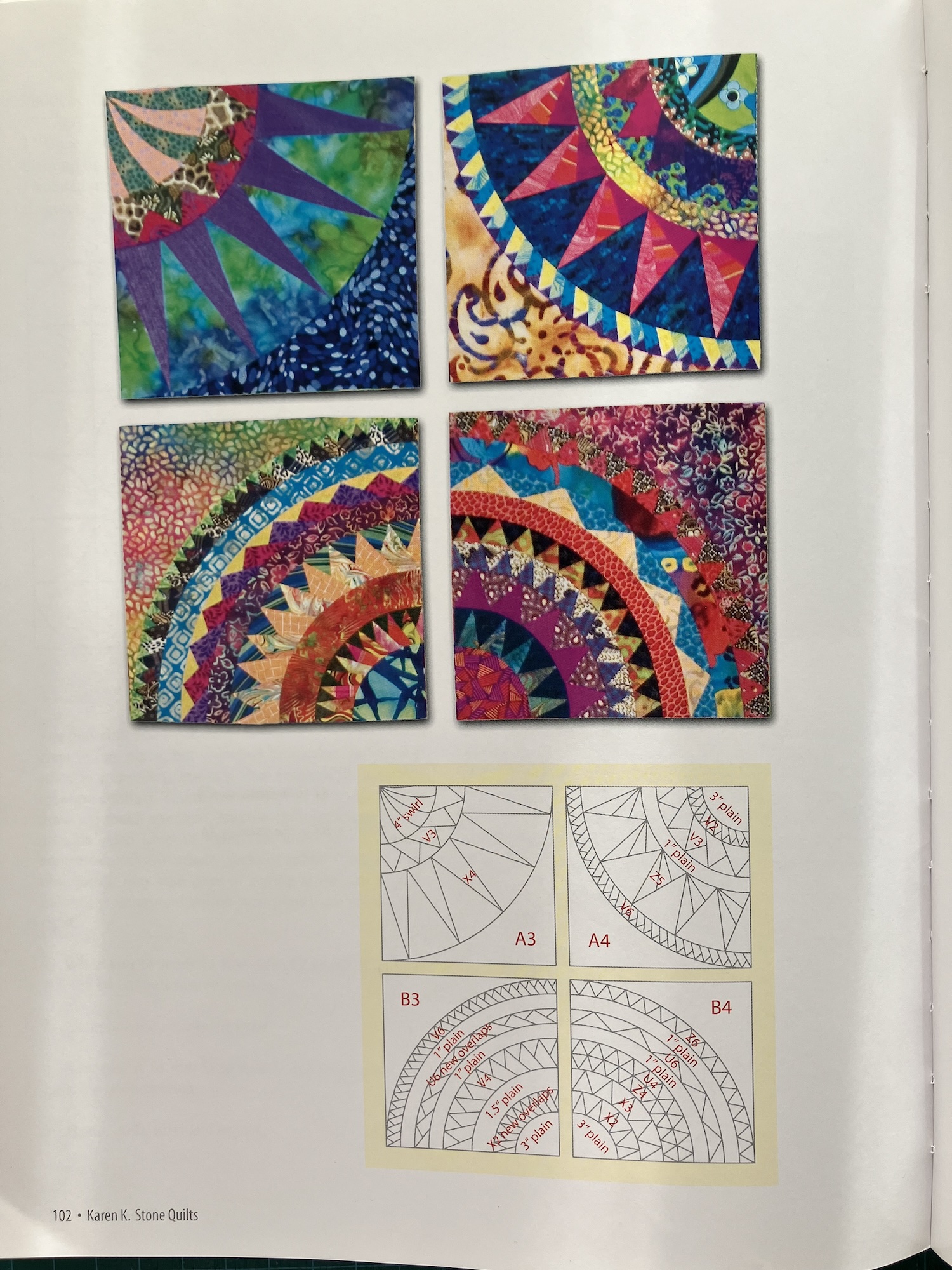
One thing I like about the book is that she shows you each group of four blocks in detail, both with a picture of each and a line drawing of the component pieces. There are (of course) pattern templates included in the book, too.

Cinco de Mayo by Karen K Stone - book details on construction

And here are my blocks so far.

My progress on my Cinco de Mayo designed by Karen K Stone

LOL. I remembered that I worked on it for AGES, but I only have four completed blocks!

After I took this picture, I realized I had sewn them together incorrectly. I picked them apart again. I didn’t start at the top left corner – these are blocks 3E, 3F, 4E and 4F. They should be rotated and positioned like this:

My first Cinco de Mayo blocks, designed by Karen K Stone

I did this mock-up digitally, which is why the carpet shows through in some places. A couple of these blocks can be swapped with others in the design, so I didn’t sew them together again yet. I see that I’ve used a turquoise print as the outside/background on all four of these blocks, so they shouldn’t be clustered together like this.

I will need to do is reassemble my stash for the project. One thing Karen teaches in her workshop is choosing a palette, then gathering fabrics that fit in each specific colourway – like that shade of turquoise, or the black with a floral print. They have to be pretty close in tone within the group, regardless of the pattern, to make the quilt cohere. (Although I will almost certainly stray too far, since chaos is how I roll.)

For this quilt design, she chose 11 colour groups. I’m using 8. I remember having trouble finding more of the particular bright yellow I used. Once your palette is gathered, you use at least one fabric from each chosen color in each block. I even kept track of what I used where in a chart – this was her suggestion to ensure that you use the colours throughout the blocks (instead of always using the turquoise for the background. I left the background off the chart, but that’s fixed now.)

You can see the palette pulling together a bit better in the quilt I made in her workshop because it used fewer colours and because you’re seeing 30 blocks together in this image. Each block has a bit of yellow and a bit of that red purple, a bit of indigo, etc. Even though the blocks are different, the whole comes together. I chose the gradient fabric for the inner border because it had both the yellow and the red-purple.

New York Beauty quilt pieced by Deborah Cooke

I need to get that one back on the quilting frame and finished up. I started the hand quilting and have done maybe 20% of it.

I still have the index card with swatches for the colours I chose for my Cinco de Mayo quilt. I’ll go through my stash and look for matches, maybe need to shop (for more yellow) then concentrate on finishing this quilt before dispersing the stash again.

In the meantime, I found another quilt top in the UFO stash that is much closer to completion. We’ll look at that one tomorrow.

Quilting Inspiration

Last weekend, I picked up two of my quilts from the long arm quilting place. I’m binding their outer edges now and will show them to you when they’re done.

New York Beauties and Flying Geese by Carl Hentsch

In the meantime, I’m already thinking about what to quilt next. 🙂

Here’s the book that’s teasing me right now: New York Beauties and Flying Geese by Carl Hentsch.

Here’s a buy link at C&T Publishing

Here’s an Amazon.ca buy link

And here is Carl Hentsch’s website.

I particularly love this design included in the book, which is called Pandemonium.

Pandemonium by Carl Hentsch

Isn’t that gorgeous? I’m currently on the hunt for a fat quarter pack of Kaffe Fassett shot cottons, including 36 colourways. That’s what he used in the rainbow sections, but it looks like they’ll be tough to find. (I could build my own spectrum of fat quarters, but I do love KF’s shot cottons. I’ll look for them first.)

In the meantime, in the spirit of finish-itis, I revisited my unfinished projects. Actually, putting this book on my shelf reminded me of several other books I have. I found two different paper piecing projects which are incomplete.

Karen K. Stone Quilts

First up, this one. A number of years ago, I attended a workshop with Karen K. Stone. The quilt I pieced there is still being handquilted (it was New York Beauty, from her pattern sold at the workshop), but I subsequently bought this book of hers – Karen K. Stone Quilts.

The quilt on the cover is called Cinco de Mayo and it is stupendously gorgeous. There are 36 quarter circle blocks, all with different paper piecing combinations.

This book is tougher to find since it’s from 2004. The AMZ link is for used copies at crazy prices, so you might have better luck at a used bookstore.

Here is Karen’s website. It looks like she teaches workshops about making this quilt.

I started a Cinco de Mayo of my own and dug it out to see where I’m at. I’ll show you its current state progress tomorrow.

Radiant New York Beauties by Valori Wells

The other book I found on my shelf was Valori Wells’ Radiant New York Beauties.

Here’s an Amazon.ca buy link.

Here’s a buy link at C&T publishing.

And here is Valori Wells website.

What’s fun about this book is that she uses stripes and plaids (lots of Kaffe Fassett yarn dyed stripes and plaids here!), and that she sometimes changes the central circle to an oval.

Her free motion quilting patterns are also fun. Lots of swirls and leaves, all the better to inspire me to get better at free motion quilting.

The pattern I found particularly inspiring is called Carnival Beauty. It’s the one on the cover, although that only shows part of it. I can’t find a picture of the complete quilt online, so will take a pic from my book when I show you my progress.

Tomorrow, we’ll look at my progress on Cinco de Mayo…

Quilting My Pink Pineapple Star

Around the beginning of the pandemic, I planned to get several of my tops quilted at the shop with the long-arm quilting machine. Since they were closed because of Covid-19, I popped this one onto the frame and began to hand quilt it. I don’t know if I’ve shown this one to you before.

Pineapple Star Quilts by Sharon Redroad

I love pineapple quilts and picked up this book some time ago – Pineapple Stars by Sharon Rexroad. It was published in 2005 and I’m not sure when I bought it, probably at least ten years ago. (I’m also not positive that I know where it is now.) I remember that it has clear instructions and lots of inspiration, although I could have read more about contrast and fabric selection before diving into the creation of mine. 🙂

This is the central medallion of mine:

Pineapple star quilt pieced by Deborah Cooke

I squared off the corners and added a border. It’s very bright and I love it.

That floral print is a Kaffe Fassett design called Kimono. By the time I realized I needed big squares of it for the corners, it had been discontinued, so I pieced those blocks. You can see the diagonal line in one big peony this corner where I seamed the two triangles. It’s not an absolute match.

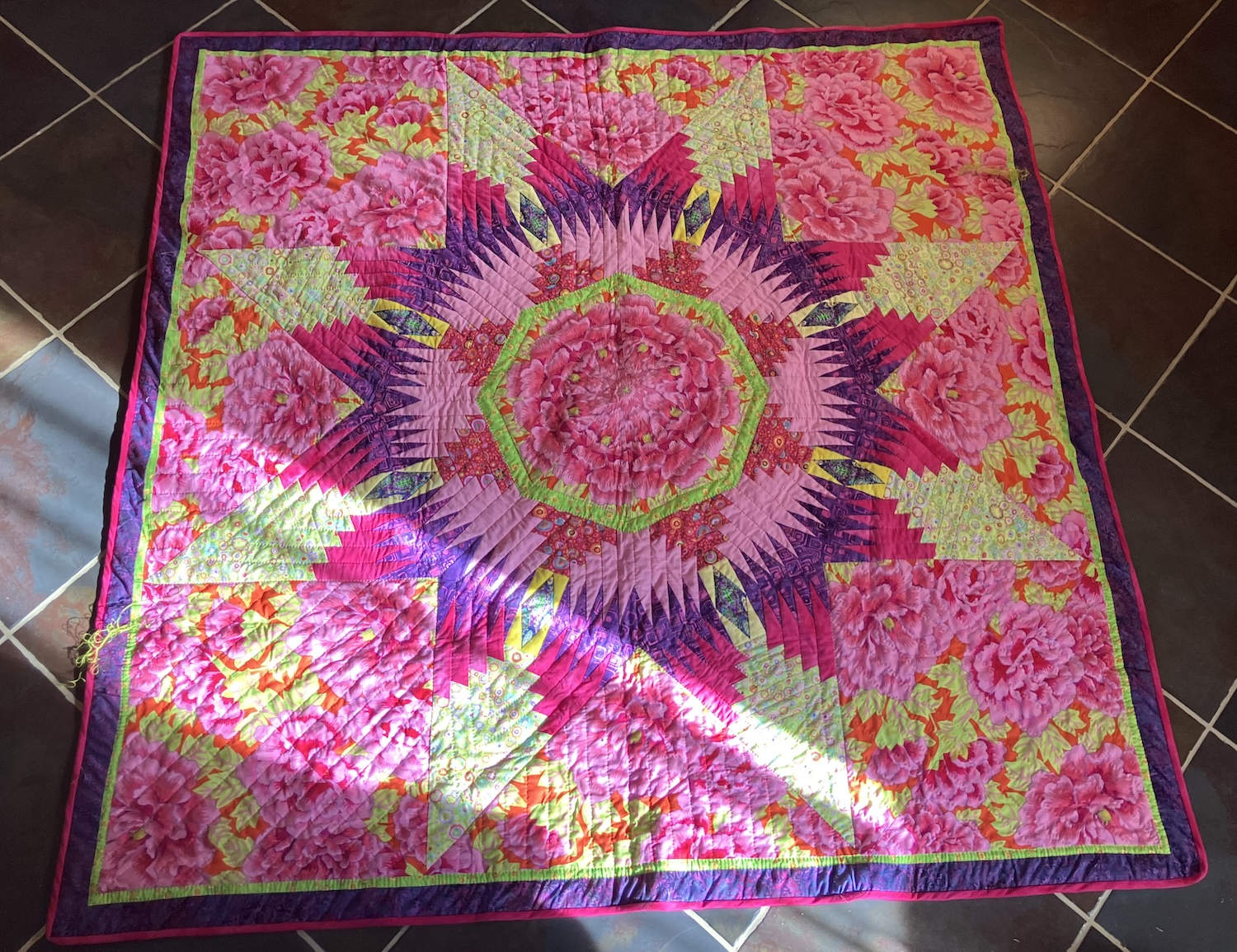
pineapple star quilt made by Deborah Cooke

I started to quilt in the center with lime embroidery thread and worked my way out past that lime hexagon. There are still two corner squares that need their quilting finished.

This past week, I bound the outside edge with self-made bias. I was amazed that I managed to find the dark pink from the middle of the star in my stash.

Here’s how it looks now:

pineapple star quilt made by Deborah Cooke

It’s interesting how the contrast looks different in the photo than in real life. The green star tips don’t fade out of view as much IRL, probably because the lime is more vibrant than it appears here, more like the octagon in the middle.

As I was taking this picture, my dog decided to lie down in that bit of sunbeam. She didn’t settle in, though, so I didn’t get a pic of her there – even with the quilt, the floor is harder than her bed on the other side of the room, but her opportunism made me laugh.

Finishing the Moonglow Quilt

I last posted about my Moonglow quilt in November 2020, so this project has been in limbo for a while. I started to post about this quilt in April 2020, and had been working on the piecing for about a year before that, so we’re at five years on this project.

It’s also been two years since I did any machine quilting myself. My goal this spring was to get some things done that have been languishing in my sewing room and this quilt top certainly made the list.

Moonglow Quilt by Jinny Beyer

Here’s that official image of the quilt again, just to remind you. 🙂

When I pulled the Moonglow out this time, I had five blocks left to piece – the four corners and the middle block, which are the most complicated ones. After that, there’s the assembly with the sashing and the final quilting. This one is going to a long arm quilter to be finished up – my plan in March was to keep at it until it was ready to go to the quilter. I did pretty well with that goal!

The idea behind the quilt is that it should take a year to piece. There’s a block assigned to each month, then in month twelve, you piece the intermittent blocks and assemble the quilt. Of course, I didn’t follow the sequence – I did the courthouse steps blocks that go in between the stars when I was tired of paper piecing, so they were done already.

There are two different designs for the corner blocks and you make two of each. I’d already cut out the pieces for the pair that are top right and bottom left, so finished them up first. These are month nine’s project.

Moonglow quilt kit by Jinny Beyer pieced by Deborah Cooke

It’s a dingy day today, so I had to take the pix inside, which means they’re a bit underexposed.

Then, top left and bottom right:

Moonglow quilt kit by Jinny Beyer pieced by Deborah Cooke

And finally, the central medallion – I need to hand-sew the central octagon, so it’s pinned in place here.

Moonglow quilt kit by Jinny Beyer pieced by Deborah Cooke

Next up, the assembly. I’m not going to repiece any of the blocks (I had thought I might, and there’s enough fabric leftover for that) but I am going to restitch one of those central octagons to make a neater job. I’m also going to change the borders on the star blocks so that the seam allowances all press outward. I did that on the central medallion and it makes for a flatter finish. Then I’ll put it all together and take it to the long-arm quilting place.

I’ve never had a quilt quilted at the long-arm place, so I’ll take the dragon quilt to be finished first. This one will make the trip second.

I am pleased with this top and am sure I’ll like the final quilt. It’s a beautiful design and the colour selection is magical. I wish there had been more explanation of why each hue was chosen for each place – I assembled the quilt, but I still don’t understand what makes it work so well.

I did learn in the piecing of this one to step back when I was getting tired instead of pressing on. That’s probably why I wasn’t enjoying it so much at first – I was product-oriented instead of process-oriented. When I slowed down and just sewed for as long as I found it satisfying, the process was much more enjoyable. So, there’s a lesson learned.

I’m also done with kits. Both this one and the dragon quilt top were kits including both the fabric and the pattern. While I like them, I don’t feel the same sense of satisfaction as with the quilts I’ve either designed myself, or the quilt patterns for which I’ve chosen my own fabrics. It certainly could be argued that the designers do a better job of selecting the perfect fabric for each section, but I prefer when my quilts are unique – even if they’re less than optimal!

This one, for example, was also paper pieced, and there are sections that I’d make another colour if I did it again, but I like it better than either of these kits. It’s one of a kind. 🙂

Jumping Jax Flash quilt pieced by Deborah Cooke

The pattern is Jumping Jax Flash by Judy Niemeyer. I pieced it probably twenty years ago. (Maybe thirty. Ha!) It’ll be heading to the long-arm quilter too, but it’ll be third and last to head there.

Three More Moonglow Blocks

Moonglow Quilt by Jinny Beyer

I haven’t been working on my Moonglow quilt for a while, so a few weeks ago, I pulled it out again. I’ve always loved this quilt design and thought that when I bought the kit, I’d be obsessed with it until it was all pieced. Not so. It’s been a very fits-and-starts project. I tried to figure out why. (The picture at right is of someone else’s completed quilt.)

I first posted about it in April of this year, although I’ve had the kit for at least a year. Here’s that first post, with the alternating blocks and the first three stars done. In my May post, with the next two stars, I admitted to not loving the process, even though I’d switched to paper piecing.

I figured out that I’m not having fun because I’m disappointed in my results. My blocks aren’t completely flat (they ripple) and the points don’t match as neatly as I’d like. There are a bunch of reasons for this, even though I’m a fairly accurate seamstress. You can paper-piece some parts of each block, but never yet has it been possible to piece the entire block on paper.

Moonglow Block, designed by Jinny Beyer

Many of the blocks have set-in corners, like this one. So, the corner quadrants are paper-pieced, but then have to be set into the central star.

Many (many) seams are on the bias of the fabric, so they stretch.

There are many slightly angled seams, and it’s tricky to pivot at the right point. Under the sewing machine foot, it’s hard to see the point.

So, I used some techniques from dressmaking to minimize the effect of these things. When I have paper piecing, for example, I’m leaving the paper on each piece until it’s sewn in on every side. That helps to stabilize the seams on the bias. I’m also pinning the beginning and the end of each of those seams, then using more pins in the middle, to make sure it doesn’t shift while being sewn.

When setting in a corner, I sew the seam that comes to the corner only as far as the seam allowance and backtack it. That means I can move the seam allowances more readily when insetting the other piece. I’m also sewing out from the point, doing the inset in two seams (instead of sewing in to the corner, pivoting, then sewing out). Lots and lots of pins on these insets, too.

Moonglow template, from quilt designed by Jinny Beyer

When there’s a slightly angled seam, I poke a pin through the paper at the pivot point, leaving a hole. That’s visible when I’m sewing so I know exactly where to pivot. I’m also clipping the paper at those points, which makes it easier to re-align the seams (when the needle is down in the turning point) to continue sewing.

(You can also see in this image how much fabric is wasted in the trims. I’ve been saving these pieces as they’re big enough to cut the corner squares in the sashing.)

And of course, pressing, pressing, pressing. I was pressing a lot before but now I’m doing it even more.

I’ve done three more stars and am much happier with the results. I also enjoyed sewing them more. They’re still not perfect, but they’re better. These three blocks allowed me to complete the second column and the fourth column of the quilt. Here they are:

block for Moonglow quilt, designed by Jinny Beyer and pieced by Deborah Cooke

They all look much better once pieced into the quilt. I have five more blocks to make – the four corners and the middle star. There are two blocks designed for the corners and you make each one twice. The centre star is kind of the big finish, the most complicated block of all.

All my borders are cut and the alternating squares pieced, and many of the fabrics won’t be used again. There’s a lot of fabric left over, which means I’ll be able to redo any of the blocks that really irk me. (And there will still be a lot of fabric left! The cuts in this kit are really generous.) I’m getting close!

In the meantime, I’ve been seduced by another beauty: look at this!

Crimson Poppy quilt design by Judy Niemeyer Quiltworx

This is called Crimson Poppy and was designed by Judy Niemeyer (the designer of Jumping Jax Flash, which I’ve made) and sold at Quiltworx. Here’s a link to buy the pattern for the central medallion – it ends with the red polkadot square. The central block is on point in this version. You can also buy a kit for this larger version, with the four corner extensions and all the fabric required at Quiltster, right here.

On this page, there are a number of colour options and corner additions displayed, also as kits including fabric. You can also (be still my heart) join Quiltster and change out the fabrics online, customizing your own version, then buy your own kit from them. Hello, timesink – but what fun!

Moonglow Quilt – I

Moonglow Quilt by Jinny BeyerMoonglow is a quilt designed by Jinny Beyer, using fabrics that she also designed. It was originally made available close to 15 years ago and I’ve always loved it. Last year, I treated myself to a kit, using some birthday money, and this year, I’ve started to cut, piece and sew it.

You can buy a kit from Jinny Beyer Studios, which includes the fabric and pattern, right here.

Mr. Math always laughs when I buy a kit. He builds ship models, so when he buys a kit, he gets little cast cannons and different kinds of wood, etc., as well as the plans. He can spend the better part of a day making sure he has all the bits and ends, and checking that he likes the quality and scale of them. Sometimes he buys different castings. He usually buys different (better) flags. He always looks at online galleries of other people building the kit, to get their tips and tricks. It’s very complicated and it can take weeks for him to get to the point of being ready to start. In contrast, I got a box of fabric and had a link in my receipt to download the PDF pattern to print it out. I put a new blade in my rotary cutter and was ready to go.

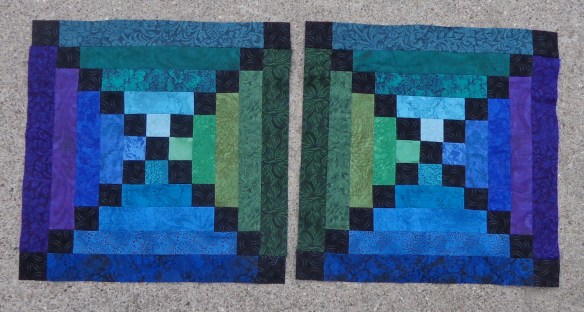
I did cut all of the outside borders first and have set them aside. If you look at the image, you can see that there are alternating blocks in a modified log cabin block – it might be courthouse steps. There are actually two different layouts of them, six of each. They look like this:

Moonglow alternating blocks sewn by Deborah Cooke

I took these pictures outside on a dingy day, which means the colours are fairly accurate but the images look less crisp.

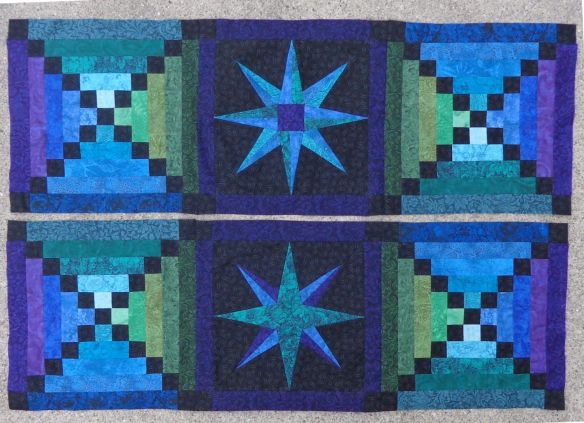
Next I started on the stars. Here are the first two, pieced with their neighboring blocks. The one at the top goes on the right edge in the middle, and the one at the bottom in my picture goes on the left edge of the finished top.

Moonglow blocks 1 and 2 sewn by Deborah Cooke

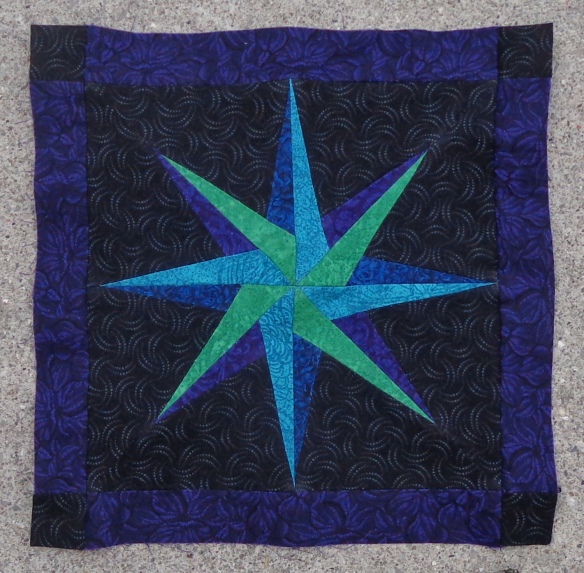
This is block three, which goes at the top center. I made a mistake in this one and cut the triangles with the right side up instead of the wrong side up, which means mine spins in the opposite direction.

Moonglow block 3 sewn by Deborah Cooke

It’s also not as square as I’d like it to be, but I want to make sure I don’t run out of fabric. If I finish the other blocks and have enough left, I’ll do it again. I’m also changing to using the paper piecing for the blocks – those diagonal seams on the bias are hard to get right.

Next up, star four, which goes at the bottom in the middle. I’m really enjoying the piecing of this quilt, even when it challenges me a bit, and I love the colours. What do you think?