Another Bag Finished

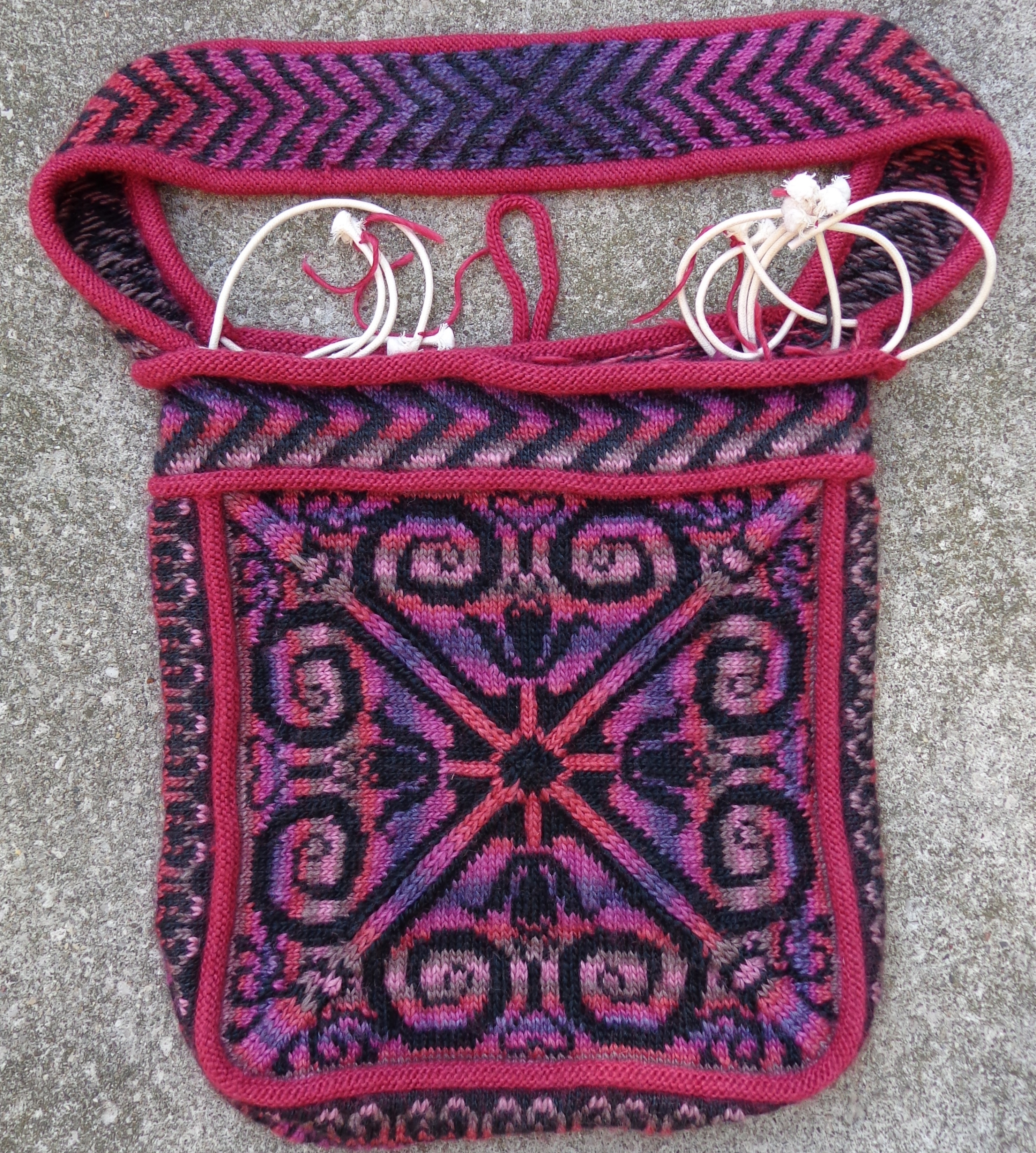
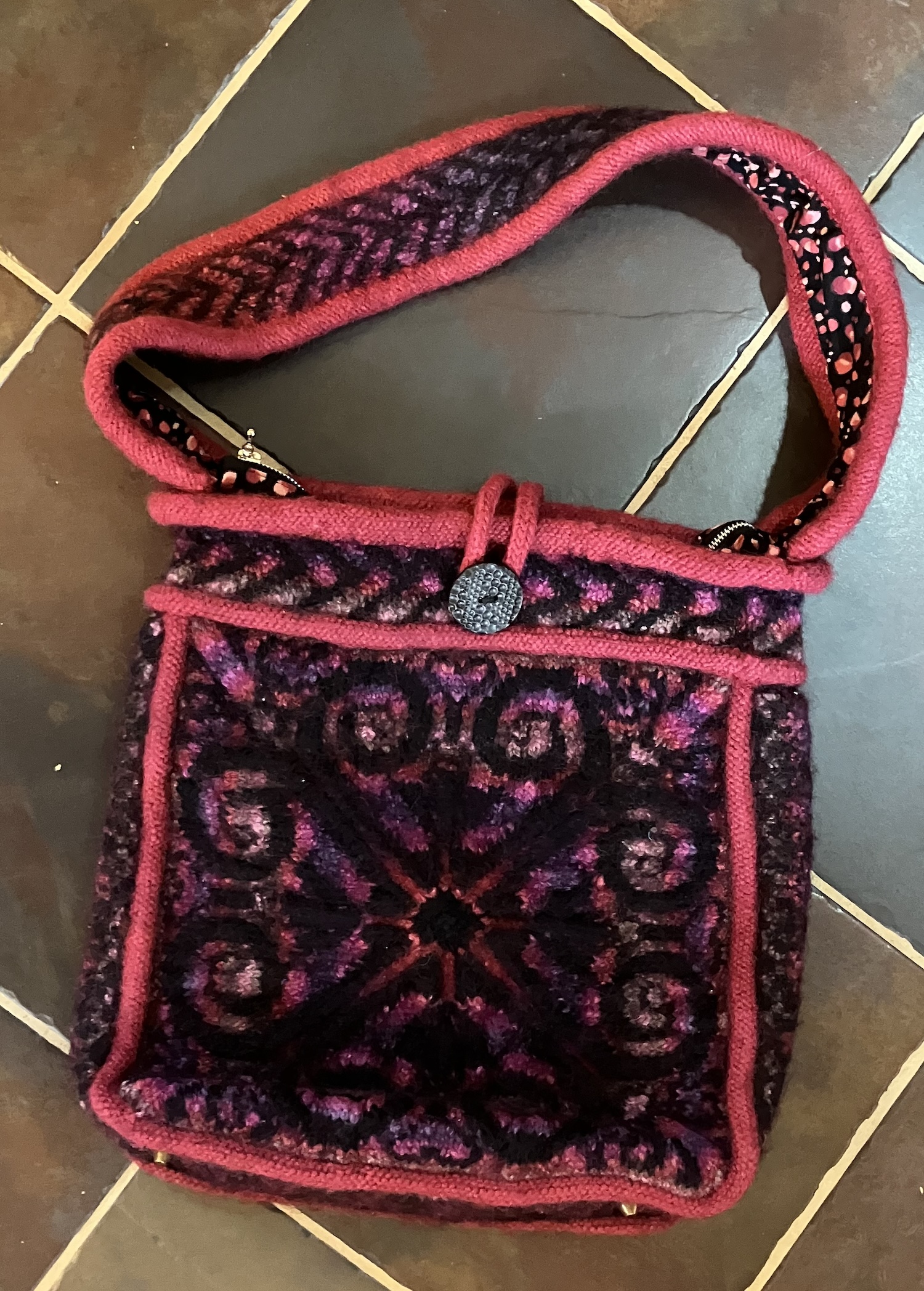
I found this bag partly completed in a stash of WIPs. The pattern is Sipalu and I knit it in Patons SWS. (That’s Soy Wool Stripes in the red mix and Soy Wool Solids in the solid red. I used another yarn with the same content for the solid black, Gjestal Garn Bris. I suspect that yarn is discounted. The SWS is.)

Sipalu Bag by Kerin Dimeler-Laurence knit in Patons SWS by Deborah Cooke

My Ravelry project page says I knit it in 2011 and finished it in 2013 – but that, alas, is not entirely true. It was completed this far – as above – but the lining pieces were only cut out and unassembled. They were stashed away with it.

Here’s my original blog post about it.

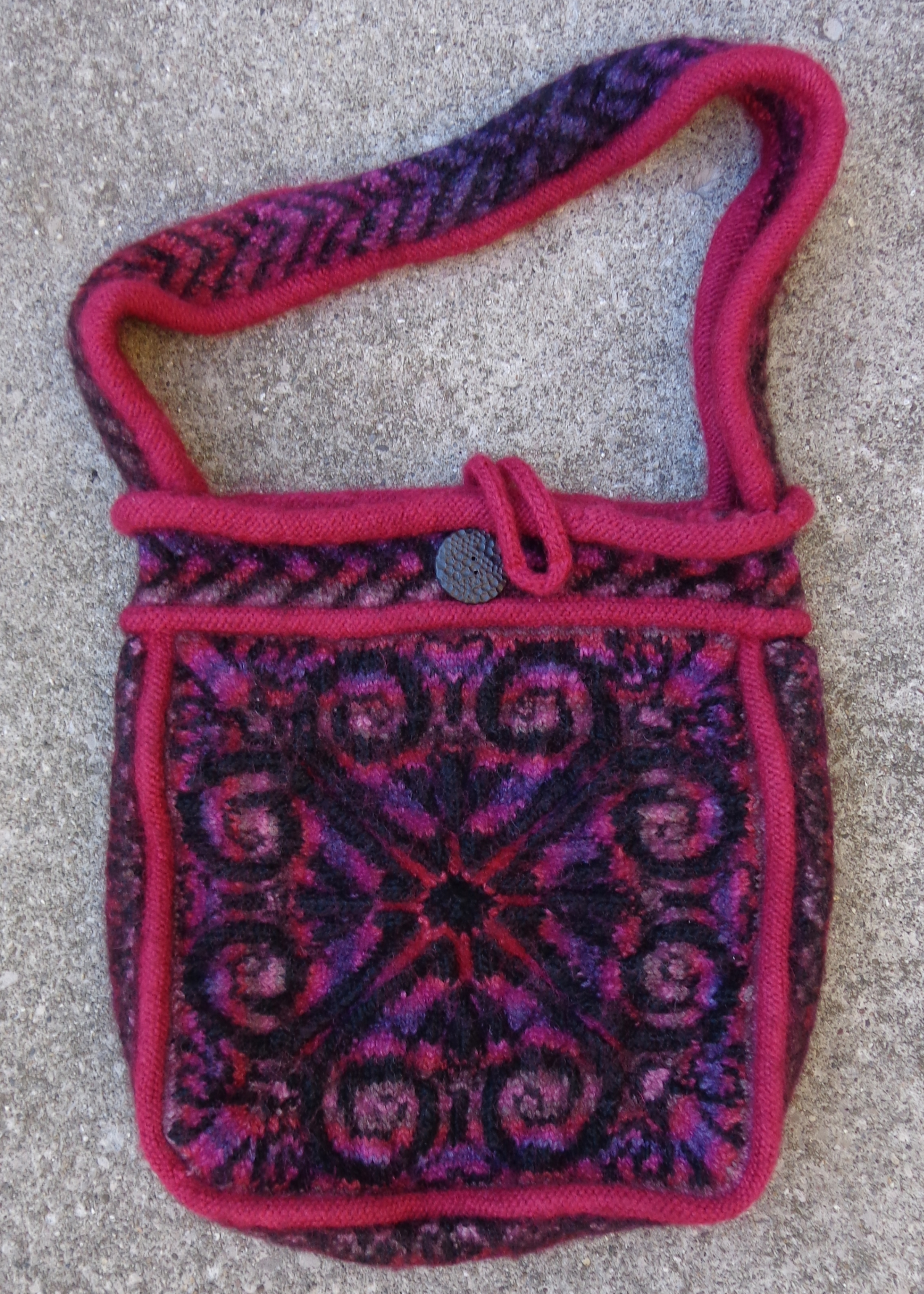
I added piping to the interior of the red bands and you can see them in the picture above. That one is a before-felting picture – the one below is after felting. That button is a porcelain one from a local maker and I just love it.

Sipalu Bag by Kerin Dimeler-Laurence knit in Patons SWS by Deborah Cooke

So, the lining. I suspect I put this aside because the construction of the zippered edge was a little complicated. I had assembled the lining for the body and put a pocket on it already.

Base of Sipalu bag knit by Deborah Cooke in Patons SWS

I’d also secured a plastic base in the bottom with some purse feet. Ikea makes these thin ones that come in packs of two, and you can cut them to size with a utility knife. The colours change with each new batch, but I always have a few in my materials stash.

Now that tricky bit. The bag is essentially a box and is maybe 3″ deep, so I needed to centre the zipper between two pieces across the top, between the handle ends. Once I got out my ruler and made a plan for that, the lining came together quickly. There was a good bit of handsewing, to line the handle and secure the bag lining, but it wasn’t that big of a job.

Lining of Sipalu bag knit by Deborah Cooke in Patons SWS

Why is it that these incomplete projects that sit waiting for years always take a very short period of time to finish up? It happens every time.

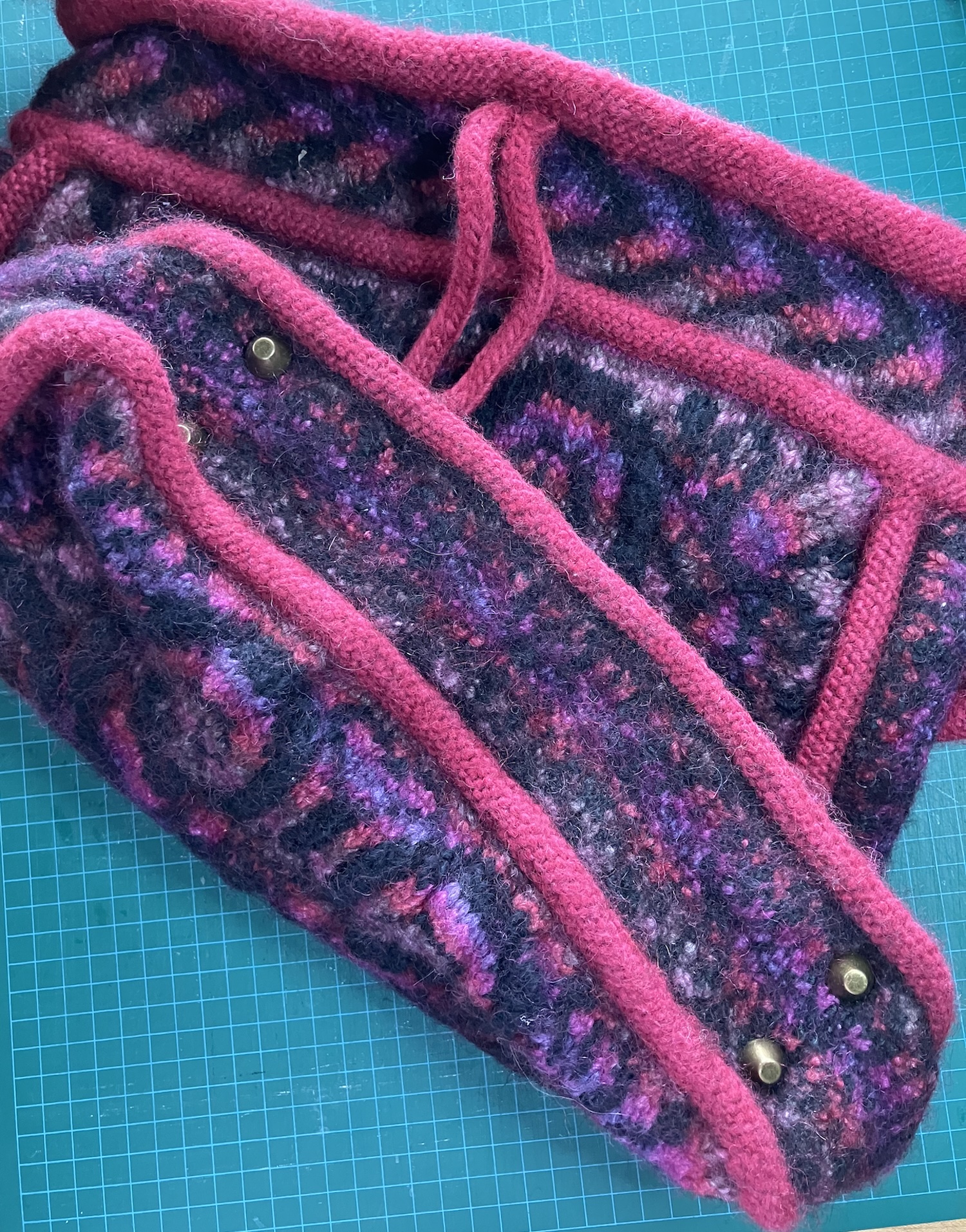
And here’s the finished bag. It looks a bit dark in this pic, thanks to a dingy day – but it’s DONE!

Completed Sipalu bag knit by Deborah Cooke in Patons SWS

Unfinished Purses & A Beet

There are more projects in this stash of UFOs. Here’s the next one in my finishing queue.

This was a kit from Knitpicks with instructions and wool for six fruity purses, called The Elegant Edibles kit. (That’s a Ravelry link – the pattern is no longer available.) I remember thinking these were so cute.

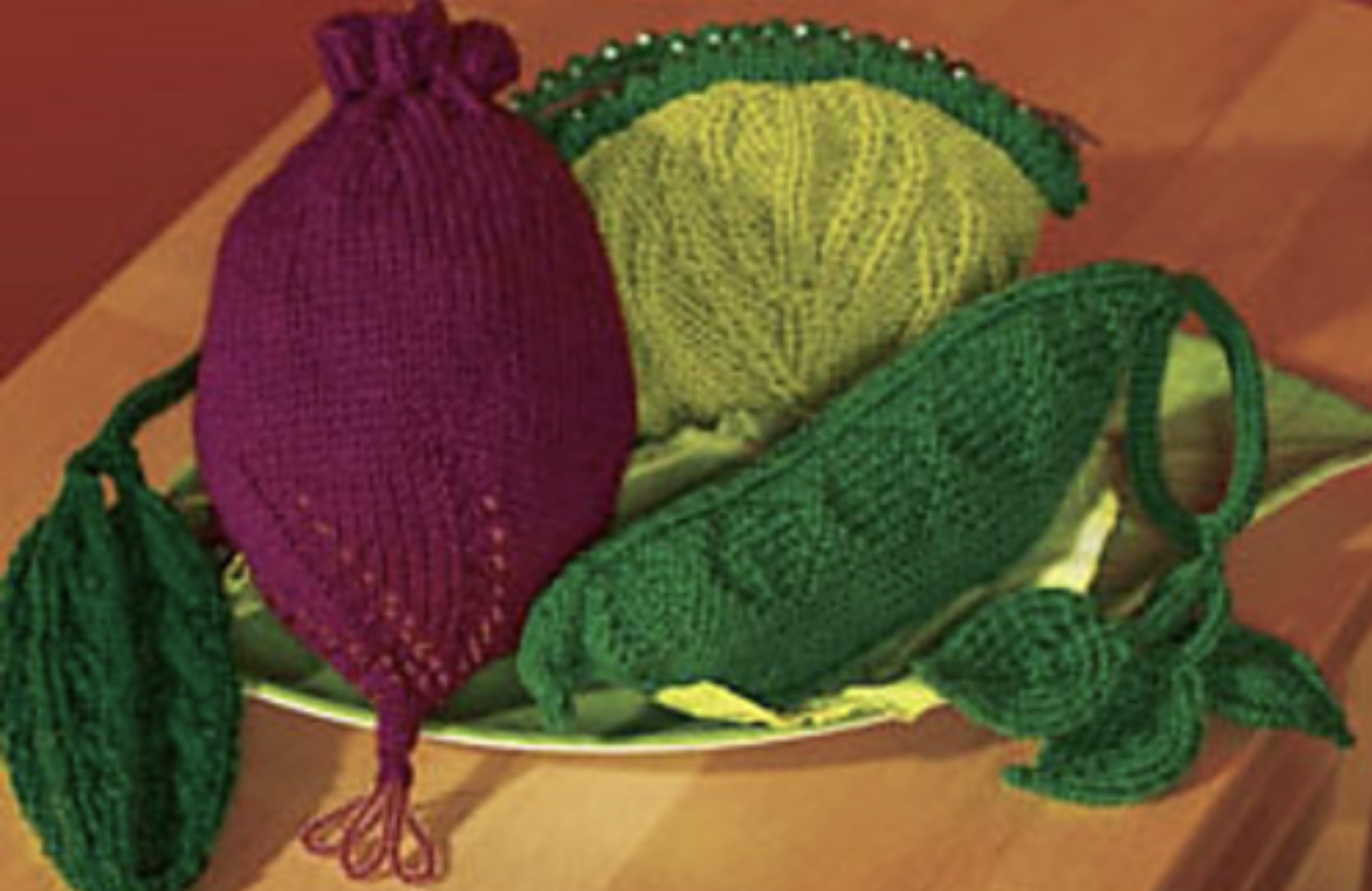
Here are the official pictures from Knitpicks:

Elegant Edibles purses from Knitpicks

I did not remember that it was 2008! I finished the kiwi and the orange purses by 2010, and they’ve been waiting patiently ever since to be finished up. Enough!

Here’s how I found them:

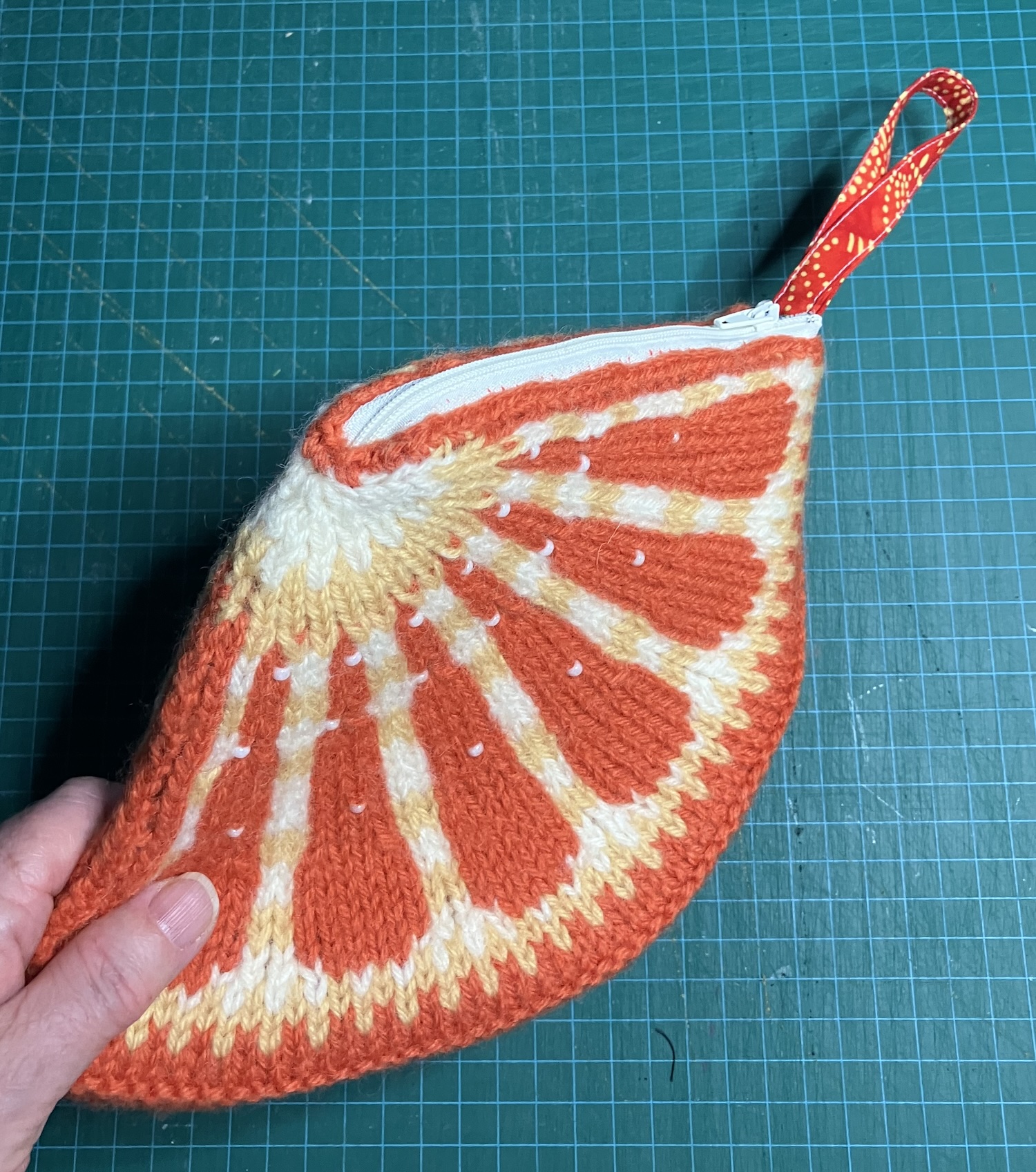
Orange purse from Elegant Edibles Knitpicks kit, knit by Deborah Cooke
Kiwi purse from Elegant Edibles Knitpicks kit, knit by Deborah Cooke

These are really cute knits and I like that there are beads for the ‘seeds’. I made some changes to the pattern, noted on my Ravelry project page here.

I suspect what happened was that I didn’t like how floppy they were and wasn’t sure what to do about it. In the KP pix, they look more like pillows than purses to me. I did felt them a bit, which gave them a little more substance. I also decided against the handles shown in the pattern and adapted the leaves from the bunch of grapes for the orange. Those leaves are felted as well.

And now to finish them up. I found some coordinating zippers (there were zippers in the kit, but who knows where those ones are now) and pinned them in. I also cut linings and interfacing for those linings – in fact, I’ve cut buckram for the outer curve on each one. The kiwi one doesn’t have a handle at all, but my Rav stash lists the bin (in the attic) where the remaining yarn is supposed to be. (It was there at some point. Is it still there? I’ll have to go up and see.) I’m thinking a long i-cord in the green would be a good choice for a handle on the kiwi bag. If the yarn is gone, I’ll do one in black.

The beet and the grapes are also cute, but I have no idea what I did with the pattern. Hmm. If I find the yarn, I’ll hunt down the pattern. I do remember that the brighter purple (for the beet) was called Fairy Tale. 🙂

Did I use up the KP yarn on this Norah Gaughran beet? Here’s my Rav project page, and yes, the purple is the KP yarn. The green is Patons Classic Wool Worsted, so the green from the kiwi purse might still be in the stash. I’ll have to go hunting…

Beet by Norah Gaughan knitted by Deborah Cooke

A Tale of Two Purses

A while ago, I bought several of these metal purse frames when they were discounted at my local fabric store. I liked the curved antique gold ones with the detail on the frames. I finally got around to thinking about them, and making a purse with one of them.

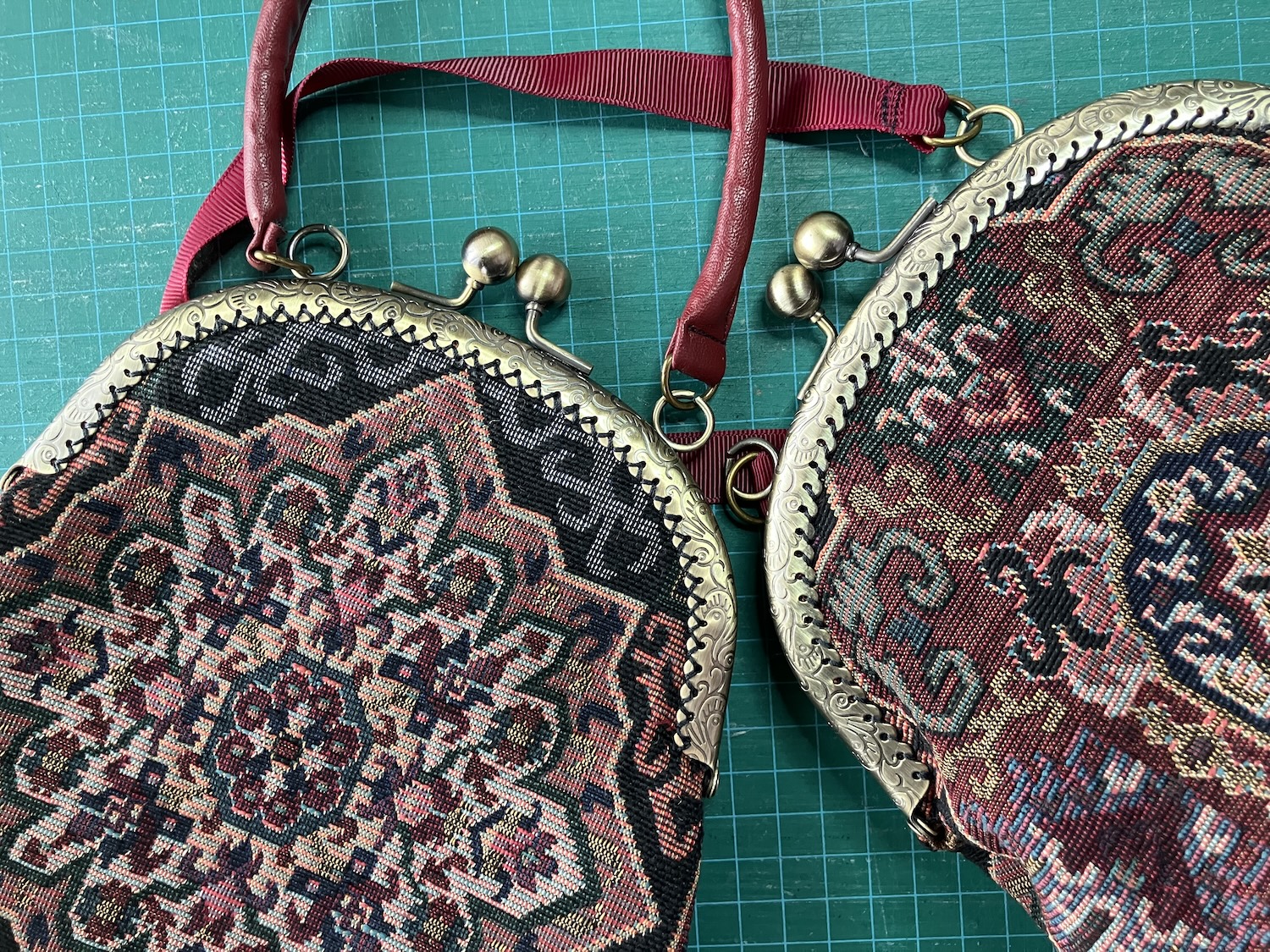
It turns out there are two kind of frames – as well as many styles. One kind has holes like this own, so the bag is sewn into the frame. The other is smooth, and the bag has to be glued into the frame. I’m not fussed about the glue option, so am glad that I inadvertently bought the kind I prefer. Here are my two bags, as a preview, then we’ll look at each one and the differences between them.

two finished purses made by Deborah Cooke

The one on the left is the purse I made first.

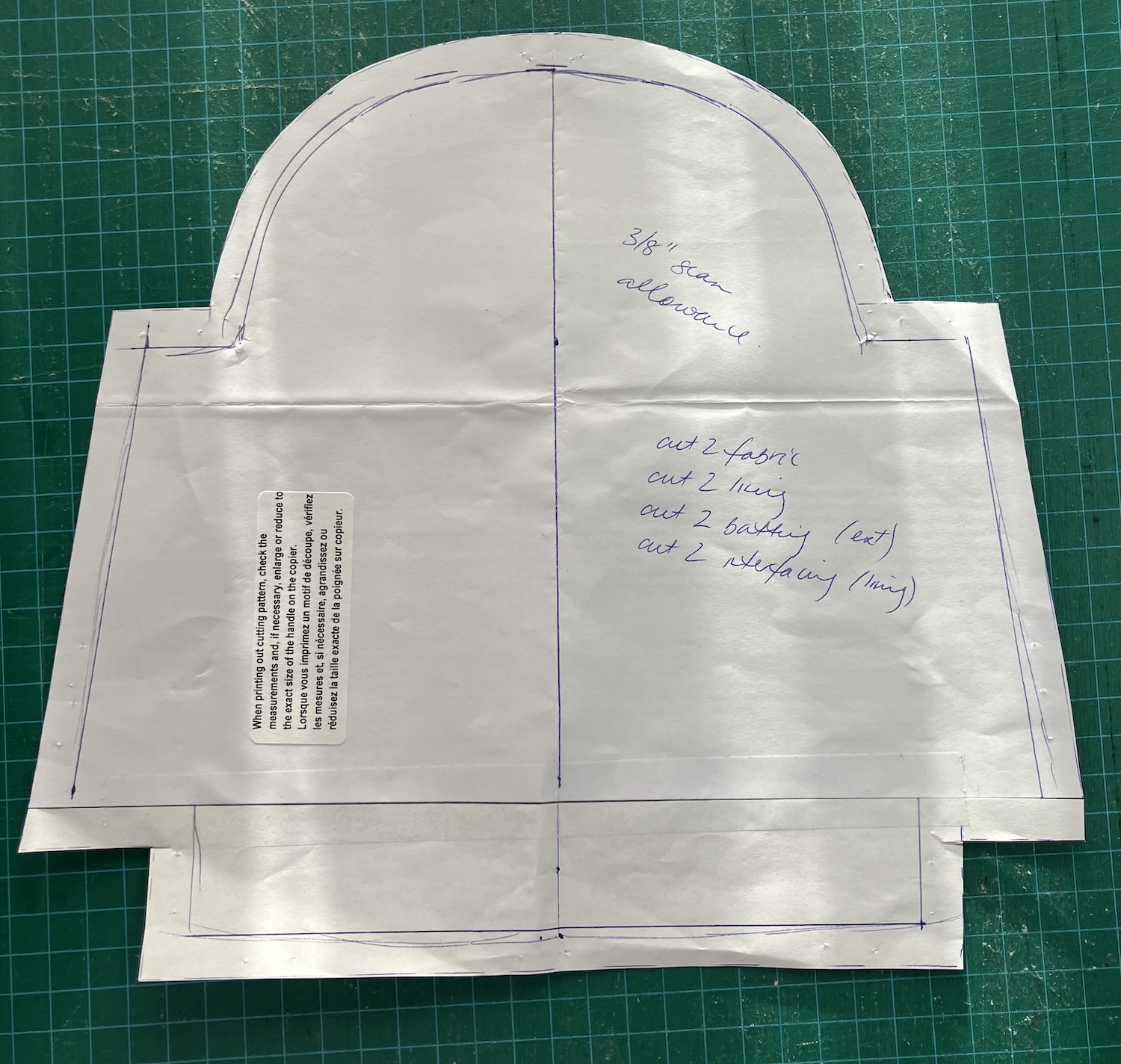
pattern for first purse made by Deborah Cooke

The package for the handle contains a template but is pretty minimalist in terms of instructions. I traced the curve of the handle and created a pattern, then cut it from a tapestry fabric that I love (there are pieces in the stash from some pillows) and a coordinated lining.

Featuring a motif from this tapestry fabric on each side of the bag determined the size of my bag. Since it’s a very heavy upholstery fabric, I didn’t use any interfacing or padding. I could have used some interfacing on the lining, but didn’t. I did add a small pocket to each interior, since I like having a little pocket inside my purse. (Perfect for a hotel key card that I don’t want to lose.)

I sewed the lining first, only sewing an inch at either end of the seam at the bottom. I then pressed that seam as if it was sewn, giving me a nice crisp edge for closing that up once the bag was done. When I sewed the outside of the bag, I top-stitched all three seams so that the seam allowances would stay put. The bag is boxed out by sewing across the bottom corners.

Once the bag was constructed, turned and the space in the bottom seam of the lining was sewed up, I gave it a good press, then top-stitched around the top curve that goes into the frame. This made it a little easier to jam that edge into the gap in the purse handle – when I could see the top-stitching on the inside, I knew it wasn’t pushed in far enough. I basted the handle in place, then stitched it all together with a topstitching thread.

Here’s that first purse:

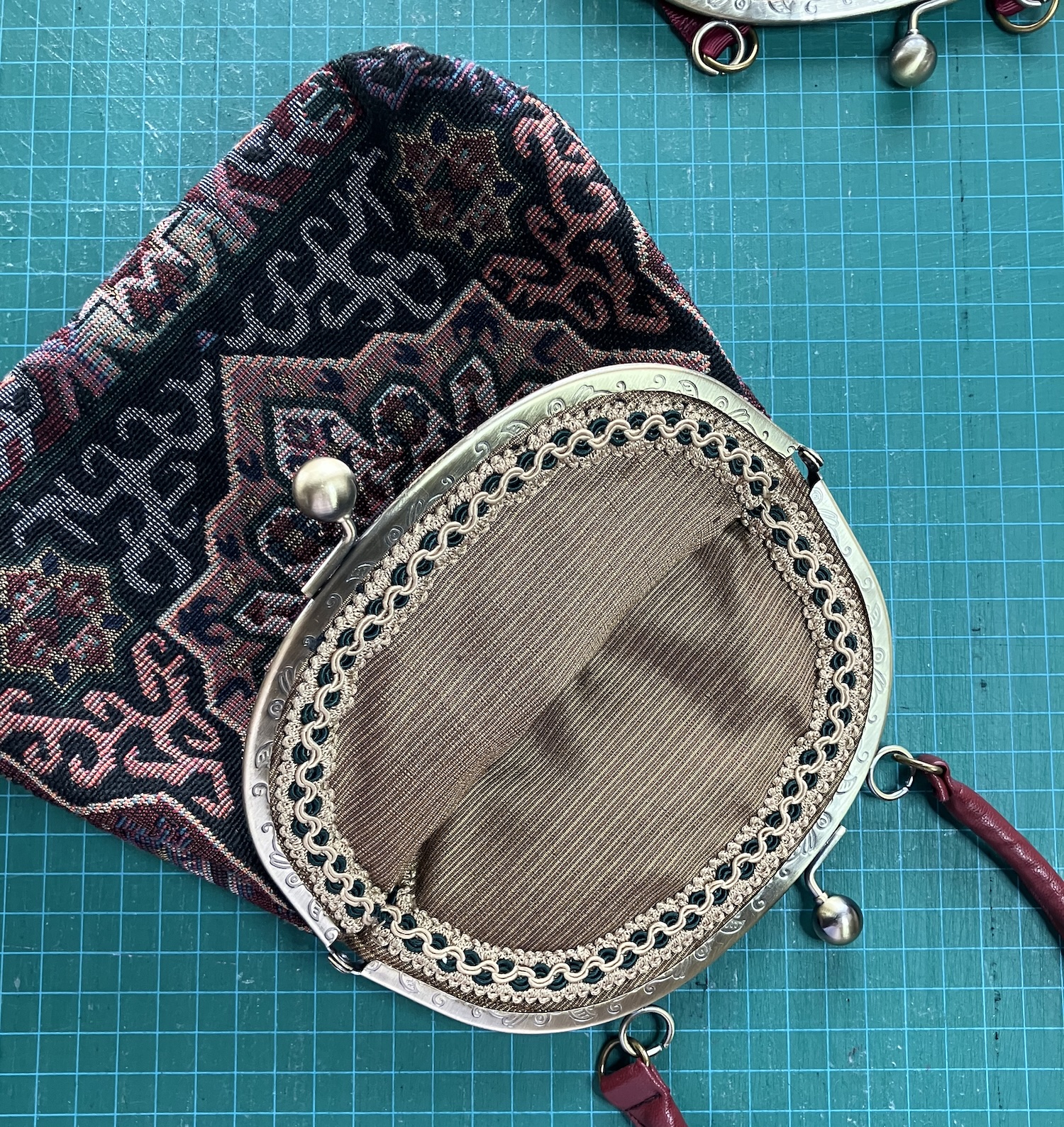
first purse with metal handle made by Deborah Cooke

The result is fine, but the finished bag doesn’t have much wiggle room at the top. The purse is very flat – I can just slide my hand inside. Hmm.

I did some searching online and came up with this tutorial at So Sew Easy. It’s for a different frame – there are so many styles available – but you can follow it to make a pattern to fit your frame. This tutorial shows how to adapt the tracing of the handle to create more fullness in the bag. Ha. Look at the difference between my two pattern templates:

pattern for first purse made by Deborah Cooke
pattern for second purse made by Deborah Cooke

The one on the right has been folded and didn’t want to lie flat for the picture. The bottom edge is straight.

Here’s the bag made from the second pattern:

second purse with metal handle made by Deborah Cooke

It’s much fuller. I’d even call it puffy. I would have loved to have included the top of that octagon shape beneath the handle – the yellow-ish outline – but there just wasn’t enough of the fabric for that.

When sewing the handle to the first purse, I used two stitches per loop, making a zigzag, but really, it doesn’t need this much reinforcement. And this sewing is hard on the hands – less is better! (You can see that I missed one zig on the left of the handle.) For the second (on the right) I just did one stitch per hole.

stitching on purse handles, purses made by Deborah Cooke

The stitches showed on the inside – I just couldn’t make them small enough to avoid that, as I was using a black buttonhole twist to sew in the clasp. I sewed in a bit of trim to cover that up. Here’s the second bag with the trim pinned in place.

inside of second purse sewn by Deborah Cooke

Here’s the first purse with the trim sewn in. It looks much neater. (You can also see how much flatter this one is.)

inside of first purse sewn by Deborah Cooke

The frame didn’t come with a handle – I think there were matching chain handles, but they were sold out by the time I wanted them. I cut a length of pleather, sewed the outside edges in place then folded the ends over a d-ring. I then fed a length of cording though it. For the second handle, I just hemmed a piece of grossgrain ribbon. The loops on the bag handle had to be coaxed open a little with a pair of plyers to join the handle, but it all worked out just fine.

Here are those two finished bags, side by side.

two finished purses made by Deborah Cooke

I may change the ribbon handle at some point, but for now, it’s just fine.

A New(ish) Resource for Sewers

I’ve been looking for years for a way to organize my sewing, similar to how I organize my knitting on Ravelry. I mostly want to inventory my patterns and be able to search through them – without digging through boxes in the attic.

Well, I’ve found it. Threadloop is a comparatively new online app, which lets you do just that. You can also inventory your fabric and notions there, and there are forums for discussion as well. I’ve only just dipped into it, but I like it a lot – and it’s free.

Learn more about Threadloop here.

Clematis Wristlet

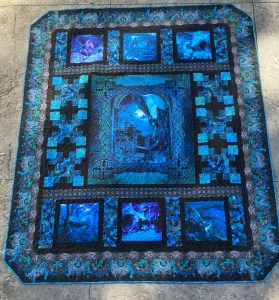
In the beginning dragon quilt in blue, assembled by Deborah Cooke, and completed.

I’ve gotten back into making bags this fall and here’s a completed one to show you. I’ve been waiting for a sunny day to take some pictures, but it’s raining raining raining, so we get some pix taken on my sewing table instead. The blog has been too quiet and I’m done with waiting for sun.

You might remember my blue dragon quilt, which was a kit (and is now FINISHED! HA!). That’s it at right.

I had some leftover of the various fabrics and used them for this, along with a shiny black pleather. They really were bits and ends, so it ended up a bit patchworky but everything coordinates well.

This is the Clematis Wristlet, a free pattern from Blue Calla Patterns. This little bag has fusible fleece on the outside pieces, which gives it a bit of substance, and more interfacing besides. I didn’t have a 9″ brass zipper, so I cut down a 14″ one for this project.

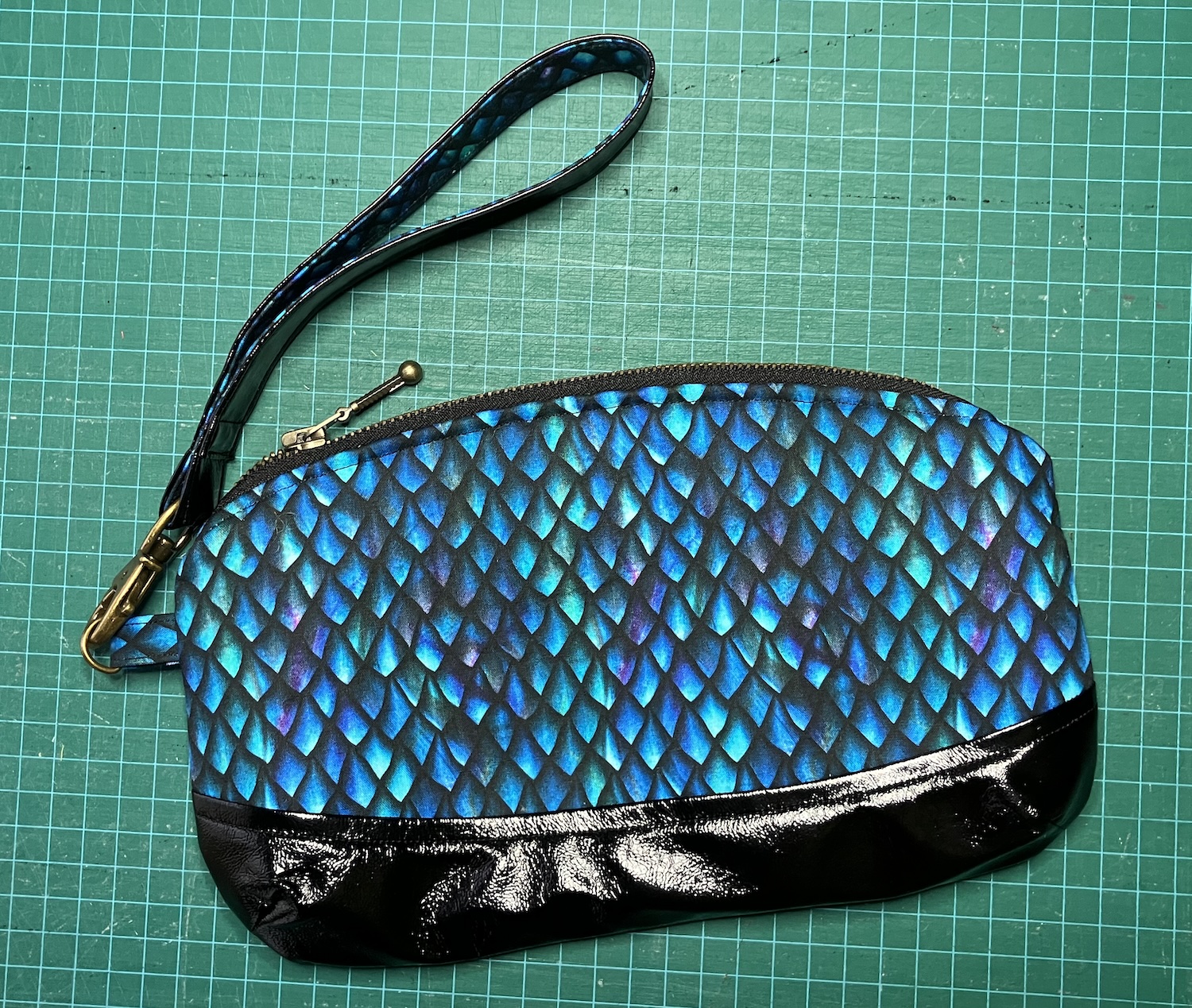
Clematis wristlet by Blue Calla patterns sewn by Deborah Cooke

On one side, I used the scales. I also had a strip of this print to use on the inside of the strap.

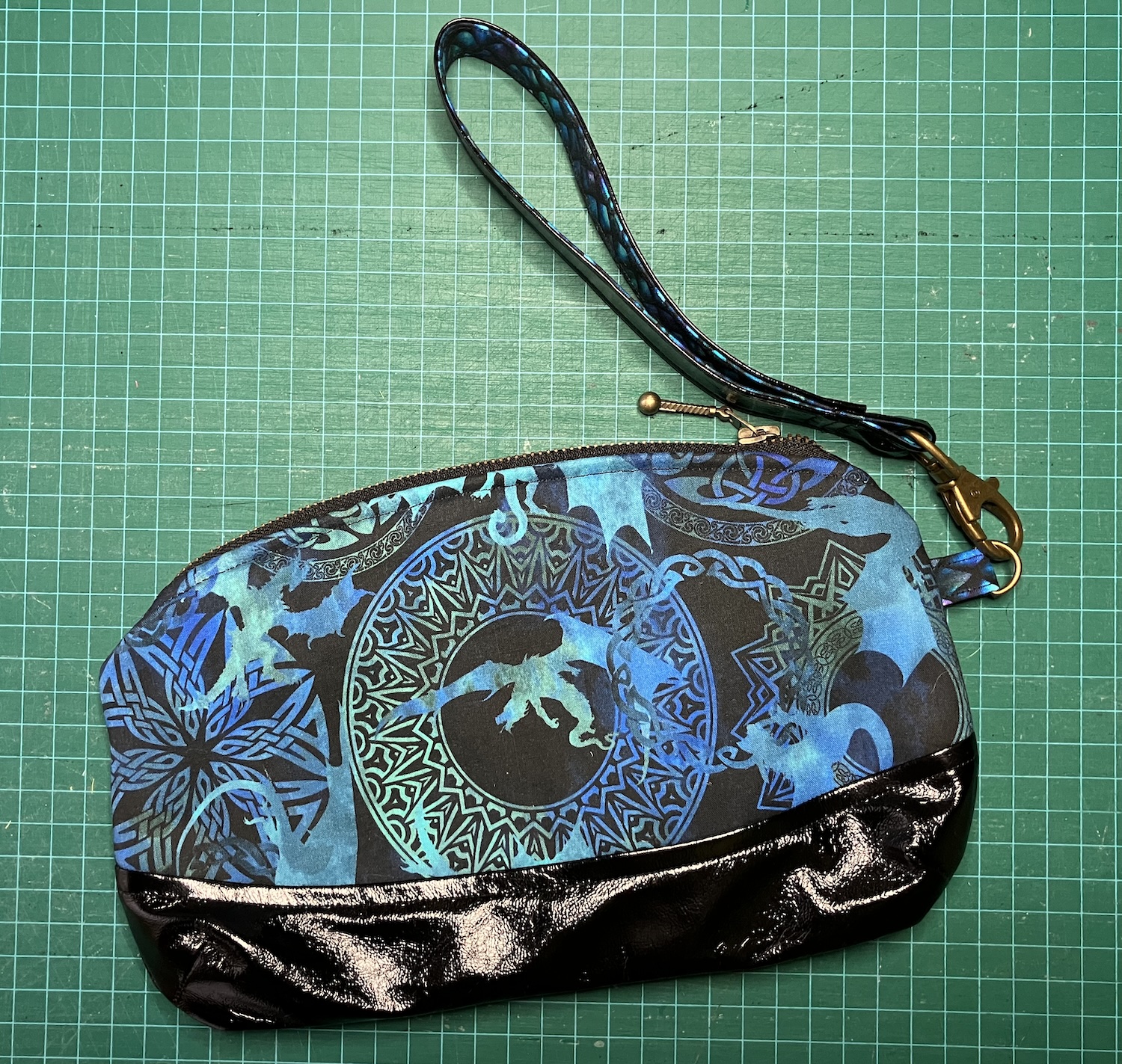
Clematis wristlet by Blue Calla patterns sewn by Deborah Cooke

On the other side, I used the background with dragons and circles.

Clematis wristlet by Blue Calla patterns sewn by Deborah Cooke

The lining is the Celtic/tattoo background fabric. (I see I picked up a thread on my cutting table and included it inadvertently in this shot.)

Clematis wristlet by Blue Calla patterns sewn by Deborah Cooke

And the pocket inside is made of the dragons from the border print. There are only scraps now, so they’ve gone into my bag for real patchwork.

This pattern is a pretty easy make, and the finished bag is a useful size. I’m always looking for something flat to hold my cash at bookfairs and this might just do the trick.

I like the idea of the dragons watching over my hoard!

Making Book Covers

I’ve been making a lot of book covers lately. Although I initially learned how to make them from a blog post (one with many video ads. Ugh.) I’ve figured out a few tips and tricks. Having this post here is as much for you as for me, as I keep having to figure them out all over again. 🙂

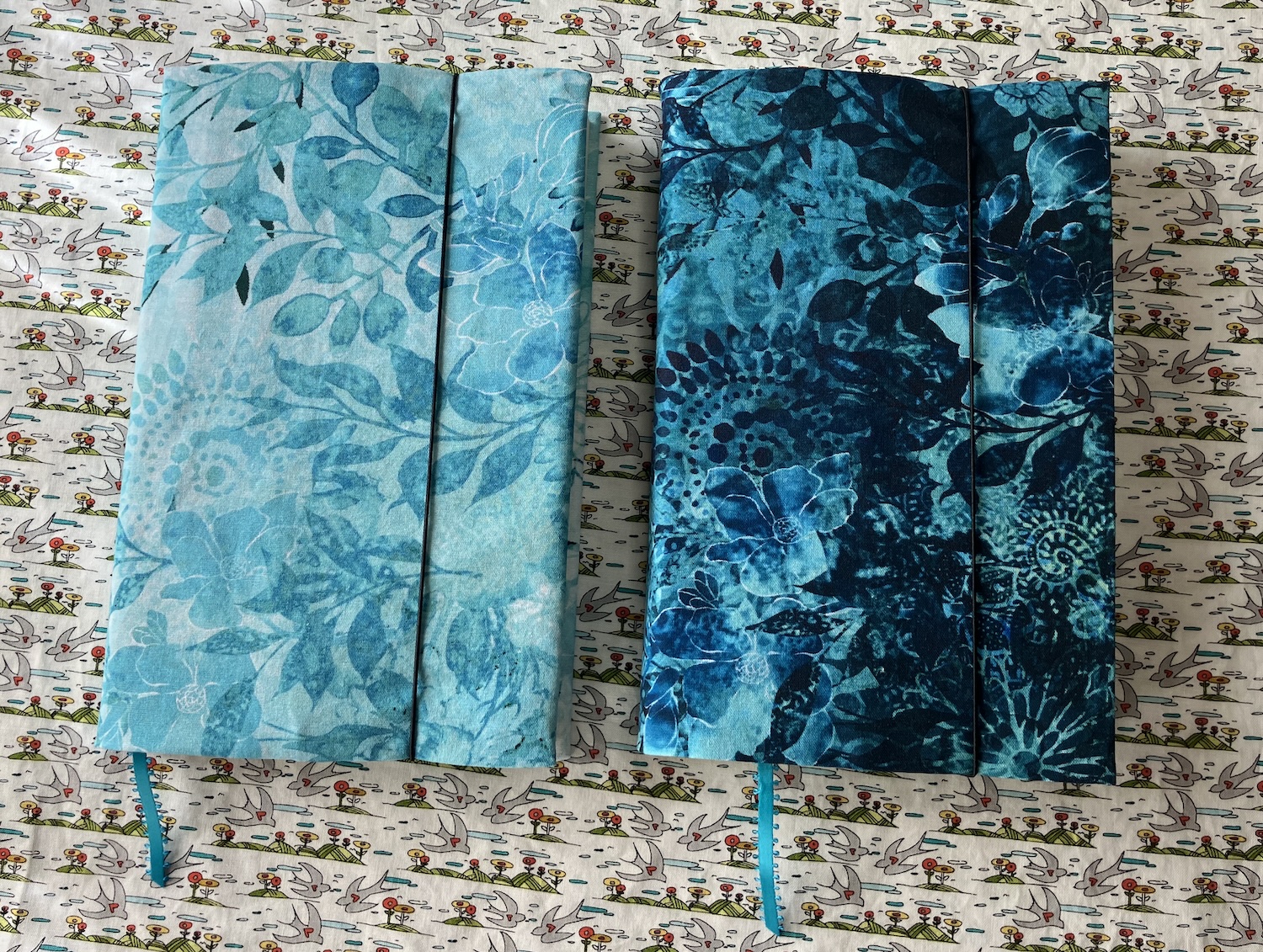
Here are the book covers I just made for a giveaway of my books at a reader conference:

book covers sewn by Deborah Cooke

And the one in the pictures below is for a reward tier in my most recent Kickstarter campaign.

First, assemble your materials. You’ll need two (cotton) fabrics that match or contrast, along with a length of ribbon and a length of elastic.

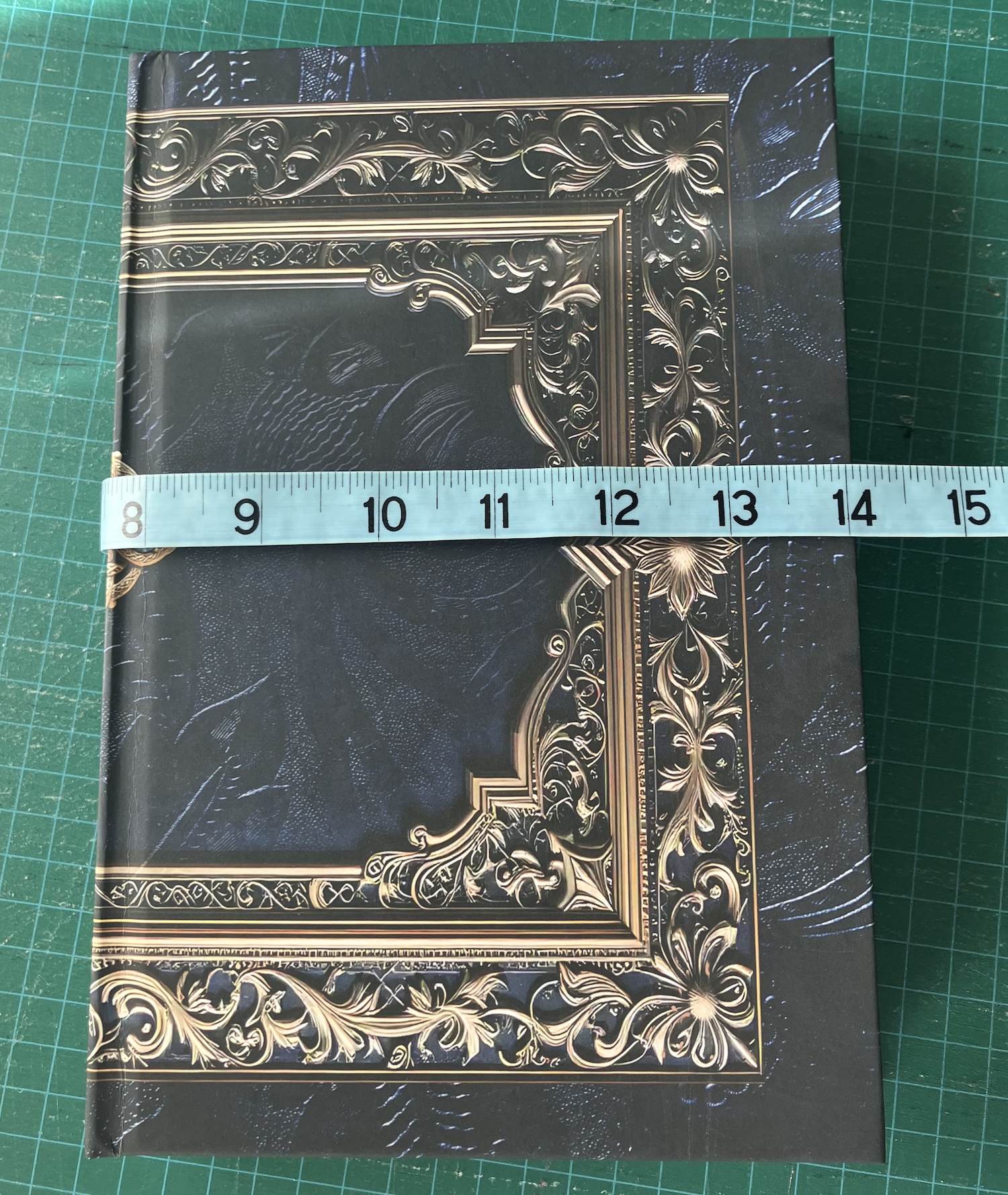
measure for a book jacket

Then, measure your book. The height of the book is the actual height. The width is the width of the entire cover, from the front edge, across the spine, and around to the back edge.

In this case, the book is 9.5″ and the width is 14″.

For the height to cut, we need to add a seam allowance top and bottom. I use 3/8″ inch seam allowances on these, which is 10cm. Two of them (2 x 3/8″) is 3/4″. We also need to add .25 to .5″ for ease – since this is a hardcover and a bit thicker, we’ll add .5″ So, our cut height will be 9.5 + .75 + .5″ or 10.75″.

For the width, we need to add a 3″ flap at each end plus the two seam allowances. We’ll also add that half inch for ease. So, the cut width will be 14″ + 6″ + .75″ + .5″ which will be 21.25″

Since the chosen fabric is 45″ wide, I can cut two from the width – each length of 11″ will give me two sides for a book cover. To make six book covers, I’ll need 33″ or so of two different 45″ wide fabrics.

I can also cut the elastic – each cover will need a 12″ piece – and the ribbon bookmark – each cover will need a 15″ piece.

The first seams to sew are the ends of the flaps. For the front edge, sew the entire seam. For the back, leave a gap in the middle for turning.

If it matters to you which way is up, then sew the front flap seam first. It’s the complete one so once it’s done, it becomes a reference. In this case, I wanted those pale tulips to grow upward, so I pinned and sewed the front flap seam with them properly oriented. The seam will be on the right and the pin is at the top.

sewing a book jacket 1

Turn and press, then topstitch where you’ve sewn (leaving the back gap open.) I placed the rotary cutter to show the open back seam. Look closely to see that I’ve only topstitched part of that back flap edge.

sewing a book jacket 2

The top and bottom are sewn next, but I find it easier to position the elastic and ribbon first. With the right side facing, mark the 3″ for each book flap with a pin on the top edge of the top fabric. Pin the ribbon at the top edge near the middle. If your elastic is round and hard to pin, put a bit of tape on each end so you can pin it in place. Pin it to the top fabric 2″ inside the pin for the back flap. Mark the flaps with pins on the bottom edge of the top fabric, then pin the elastic in place, as well.
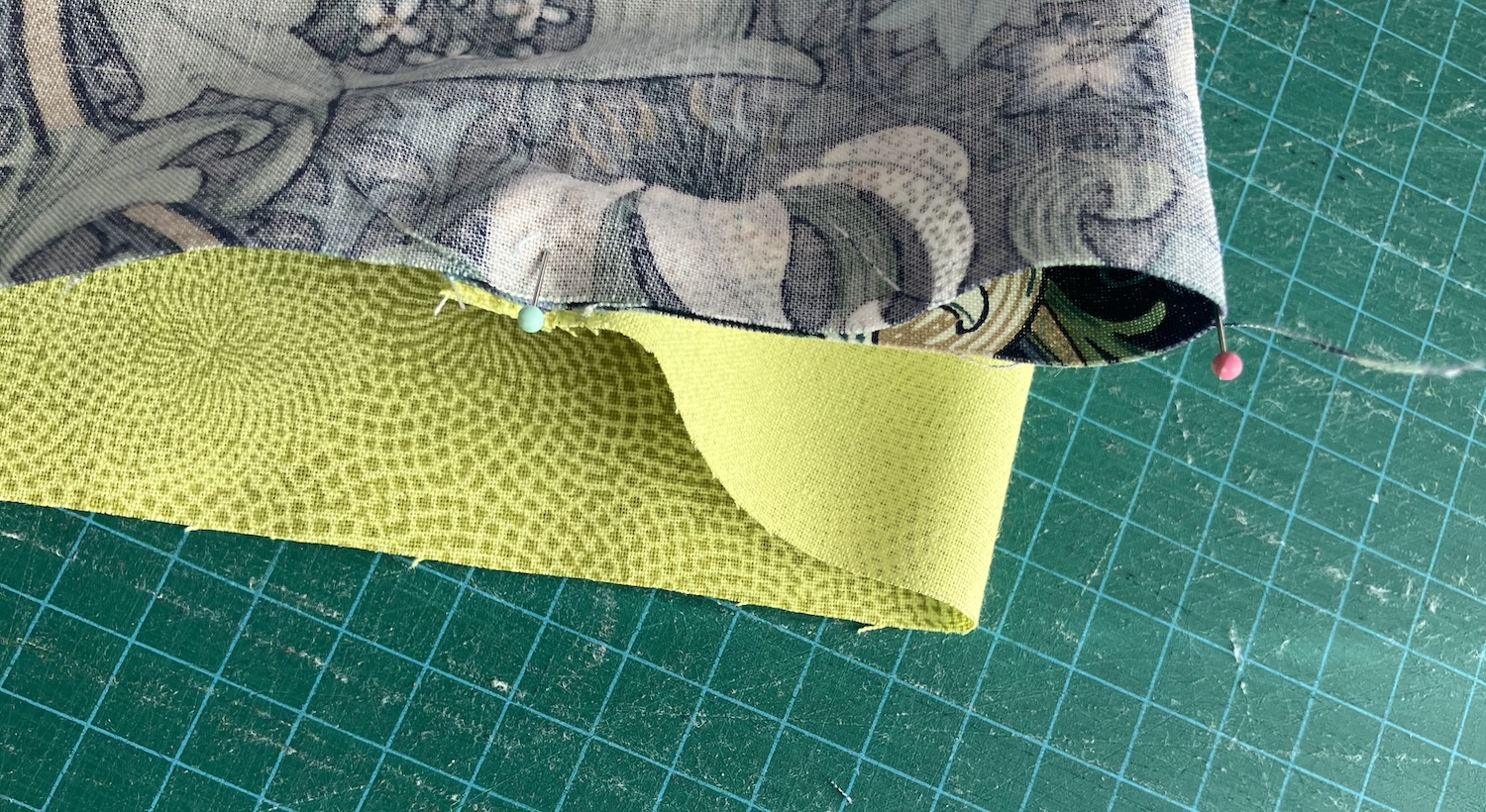
making a book jacket 3

Remember that the pins are only in the top (blue) fabric.

Turn the book cover so it is right sides together. This is the tricky bit. The flaps are folded in like an accordian, but it all comes out right in the end. At one end, pinch the fabric right sides together at the pin marking the flap. Pin the seam allowance in place, folding it inside the book cover, then fold the lining so that it aligns with the pin at the edge.

sewing a book jacket 4

Repeat for the other three corners.

This is inside the front flap with the edges pinned in place. The seam ripper is just holding the flap open so you can see the accordion fold. On the back flap, there’s an opening in the seam so you can turn the book cover right-side out.

sewing a book jacket 5

Sew right across the top, then right across the bottom.

Reach through the gap in the back flap and turn the book cover right side out. Since the cover is reversible, you can choose which fabric is on the outside. (Invariably, I get the fabric planned for the lining on the outside and have to think about it for a minute.) Push out those corners so that they’re nice crisp points.

Pin the opening of the back flap shut and top stitch it closed.

sewing a book jacket
the finished book cover

Press, press, press.

Insert the book, place the bookmark in the book, and wrap the elastic around the outside to hold the book closed. You can trim the ribbon bookmark or even add a charm to it, if you choose.

And there you go!

All Those Fabric Bits

Last time, I told you about watching Kate’s videos at her YouTube channel, The Last Homely House. I went back to her channel to watch more and chose a video about using up scraps – because it was first in the queue of her most popular videos. (It’s right here.) She shares her enthusiasm for Terry Rowland’s scrappy quilt. I was sufficiently inspired to see what I have in my bag of bits and ends.

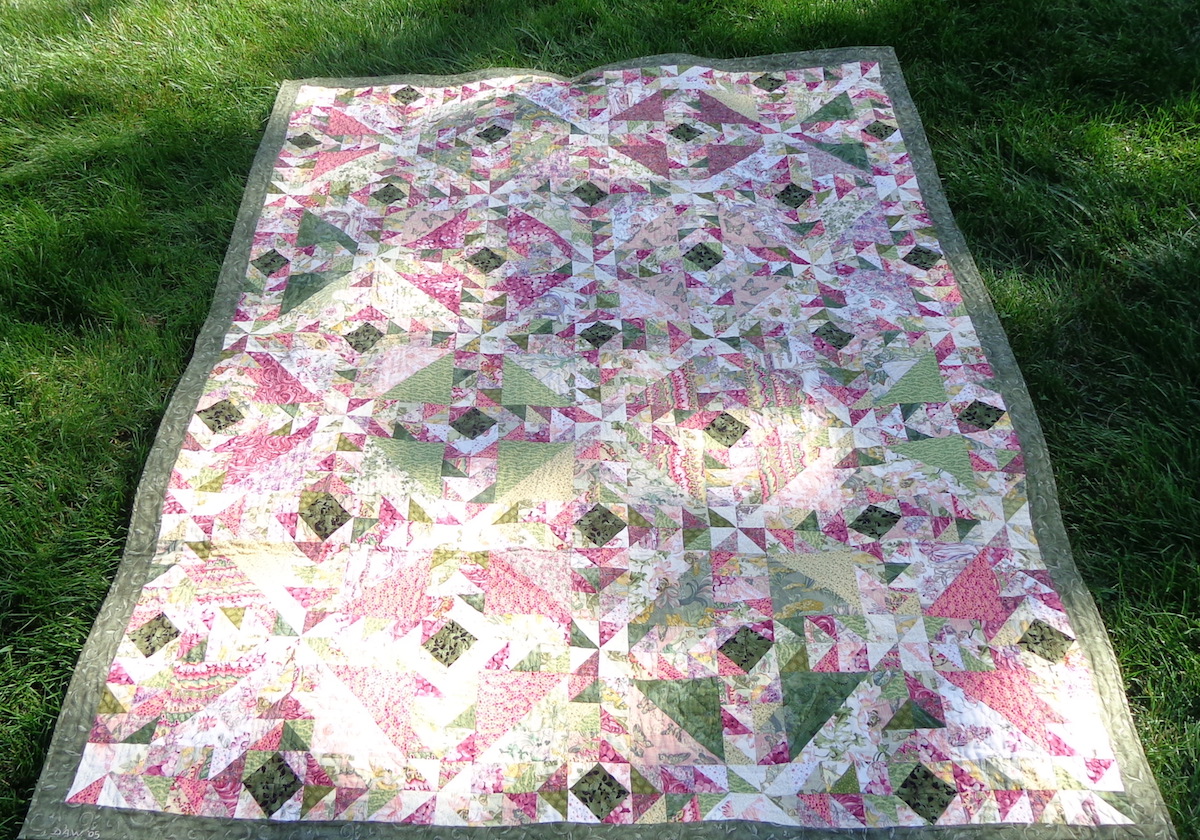
A lot of my bits are from specific quilts. For example, I had a bunch of half square triangles leftover from this Lady of the Lake quilt. The palette is pretty specific on this quilt, all olive greens, pinks and burgundies. The first fabrics chosen were a selection of fat quarters featuring Alphonse Mucha drawings, all Art Nouveau ladies. I just love those prints.

Lady of the Lake quilt pieced by Deborah Cooke

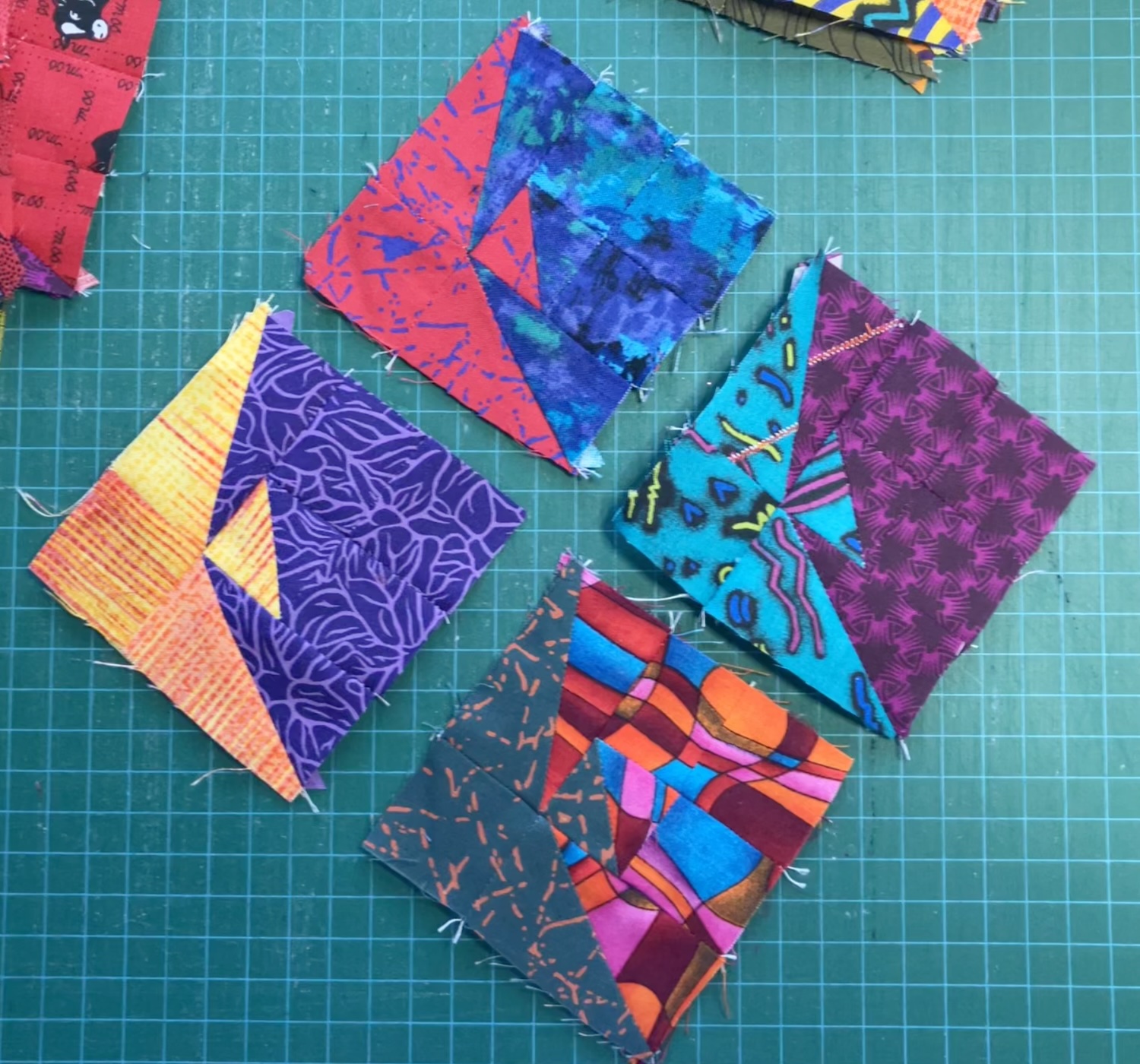
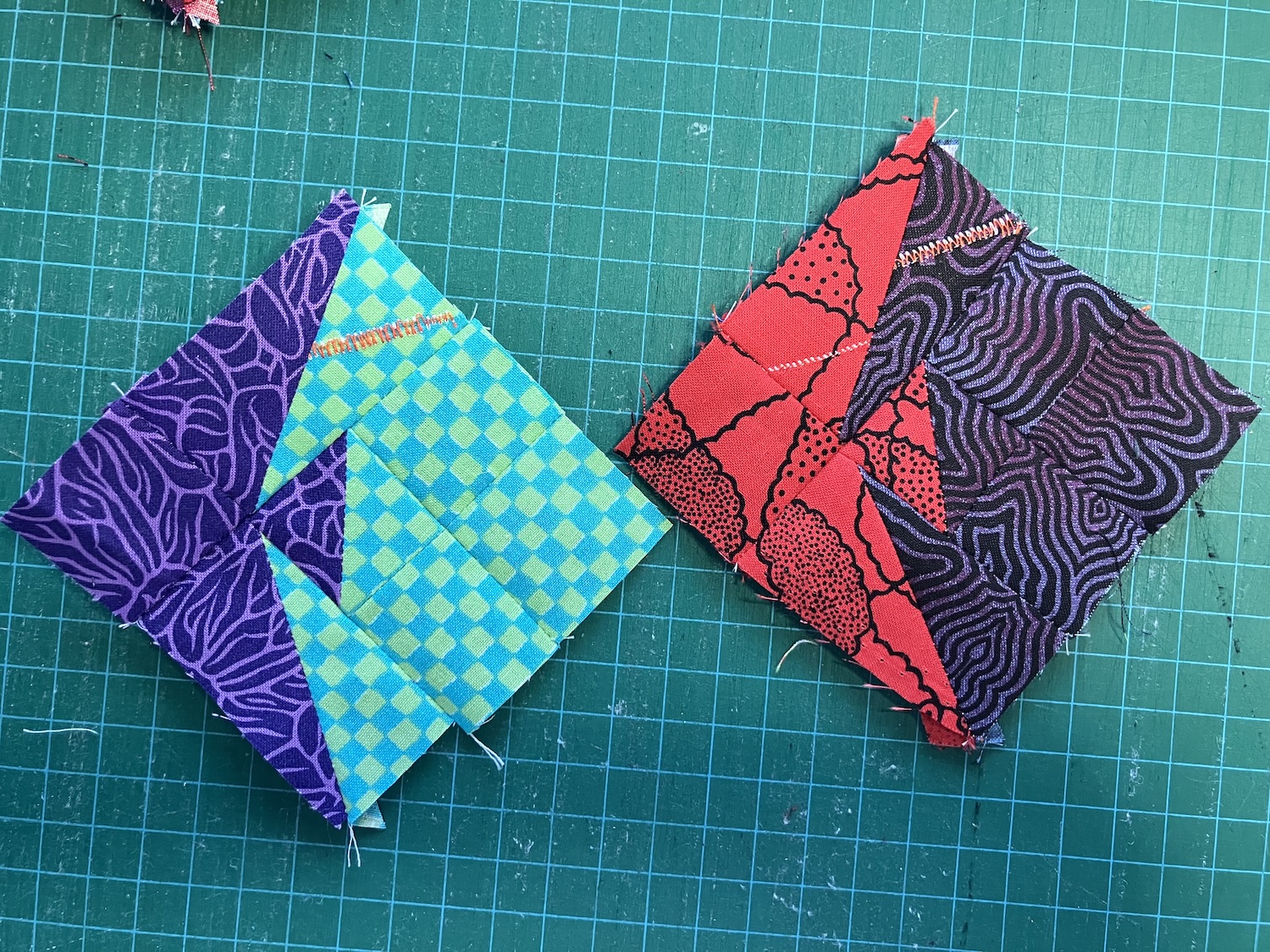
I started to piece the leftover bits into blocks:

leftovers from the Lady of the Lake quilt, pieced together for a mini quilt by Deborah Cooke

I have a few strips of fabrics from the quilt and will add as many borders as possible. This will be a mini quilt to practice my machine quilting – although it’s a good size to be a matching pillowcase. Hmm. I’ll show it to you when it’s done.

I also found the Franken Fish, long forgotten by yours truly.

fish pieced by Deborah Cooke

I called these the Franken Fish because I made a mistake and patched it up. These fish were cut from charm squares – each square was just enough for one set of pieces, so there’s a fish of any given fabric and a background of any given fabric. I made a cutting mistake though and because there was no extra fabric, I patched the pieces.

fish pieced by Deborah Cooke

Their scars are all in the same place. They are Franken Fish.

I must have seen the block somewhere and liked it. I have a vague memory of scribbling it on some random piece of paper in my purse. Now the Franken Fish need an ocean to swim in…

I found a lot of bias already cut. There’s a tremendous amount of the pink, which probably means I had plans for it. I wonder what they were.

cut bias in the stash

And I found these two pieced stars, fussy cut from Kaffe Fassett’s Kimono print.

Star cut from Kaffe Fassett's Kimono, fussy cut and pieced by Deborah Cooke

Interestingly, the camera reset itself on the second one and dimmed down the colours, as if it was saying ‘whoa. That’s a lot of fuschia and orange together.’ LOL It is!

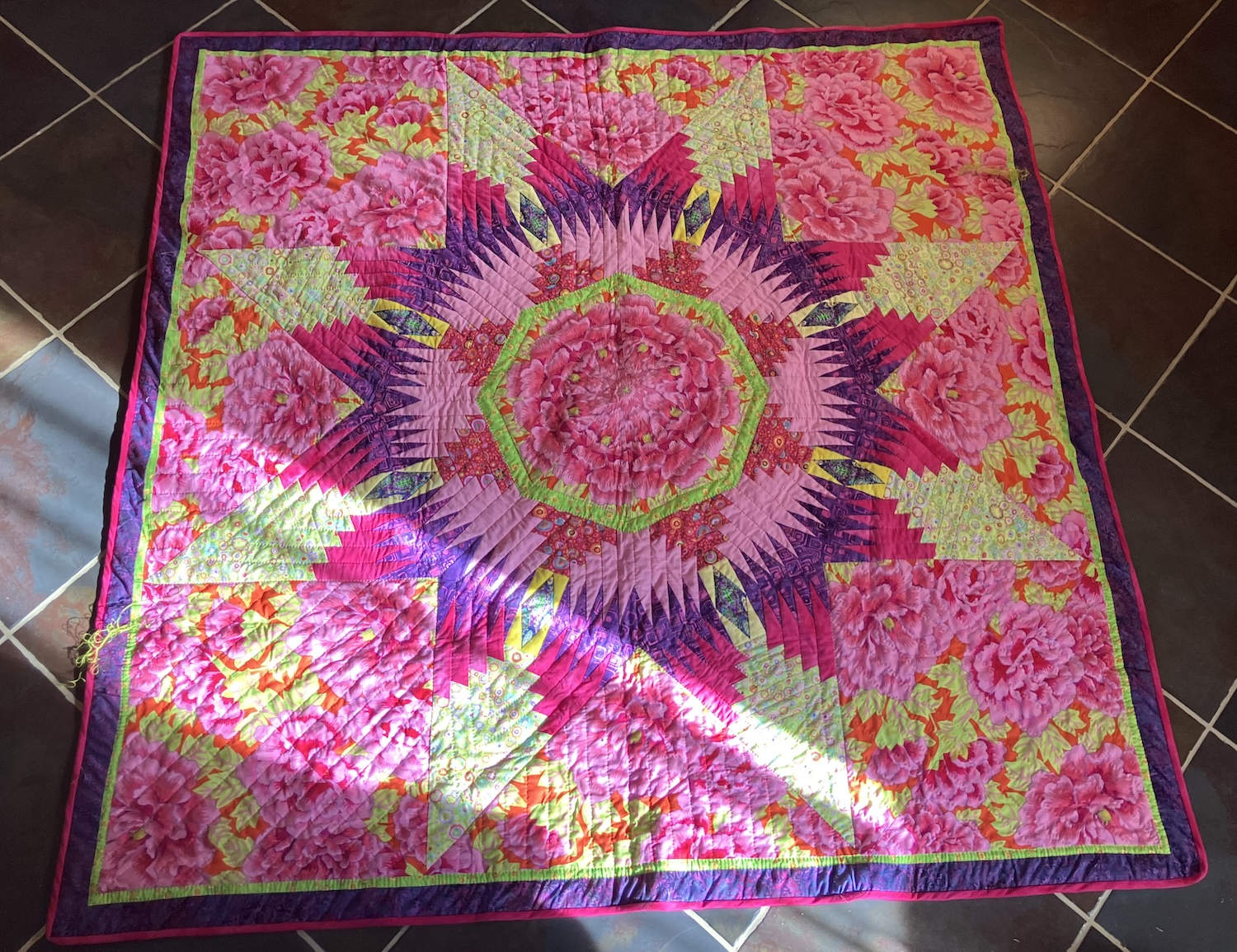
I must have made these while piecing my Pineapple Star, which used a lot of that Kimono print.

pineapple star quilt made by Deborah Cooke

Somewhere (ahem) I have many bits and pieces of Kimono in triangular shapes. I need to find them and make more of these smaller stars because I really like them.

There are more bits and ends, too, but let’s start with these. 🙂

This exercise proved to be more like poking about a hard drive of saved works-in-process than opening a dictionary. Instead of raw materials (bits and ends), I found all sorts of forgotten beginnings. I’ll be finishing these incompletes up first – then I’ll have a look at the remainder for a true scrap-busting project.

First one to be finished will be the Lady of the Lake scraps. Stay tuned!

Living Vicariously

Last week, I saw a post go by on FB with a link to a video from the Festival of Quilts show in the UK. I had a click through and a watch, and really enjoyed the video. It was posted by Kate at The Last Homely House and was just lovely. I felt as if I was at the show, too. (That link is to her YouTube channel.)

I won’t embed it here, but here’s the link if you want to watch it on YouTube. It’s 26 minutes long.

I so enjoyed this video that I ended up doing a bit of shopping!

Alice's Wonderland sampler quilt by Alice Caroline

About 11 minutes in, Kate talks to Alice Caroline in the Liberty booth about her book, Alice’s Wonderland Quilt Book. She talks about it as a block of the month kind of project, with instructions for beginners. They show the quilt in the booth and it’s so pretty.

I have to love the idea of making an entire quilt with Liberty Tana Lawn. Of course, I had a little hunt online and ordered a copy of the book from the big river. (The link on the book goes to Amz.ca.)

At 16 minutes in, Kate talks to Sally Kelly about her fabrics. Wow! Sally is wearing a dress of cotton lawn in her own design and I just loved it. She also shows her original drawings used for the designs.

That print. I knew I needed some, so I had a little hunt online. I found it for sale at a fabric store in Alberta called Along Came Quilting – here’s the link for Gardenia sold by the meter. (It’s so exciting to find more online stores in Canada.) I also bought a length of cotton with a double border design by Sally Kelly and am curious to see both when they arrive. I’ll make shirts for myself first, then use the leftover bits in quilts.

Ciara C in Liberty Tana Lawn

Just before seeing this video, I’d surrendered to temptation and ordered some Liberty Tana Lawn from another store in Alberta to make myself a shirt. I’ve bought fat quarters from Studio 39 before for the girls’ dresses, but decided I should get a nice shirt too. This print is called Ciara and it’s colourway C.

So, I’ll have some sewing to do for myself this month. 🙂

I went back to Kate’s YouTube channel and watched more, but will tell you about that next time.

Changes Out There

This week sees some more changes in the world of makers like me. I’m not in the States but was saddened to see Joann’s Fabric stores closing there recently. There’s nothing like a local store to finger fabrics, and pick up notions.

This week, there are two more changes. One is more local to me. The Spinrite factory in Listowel Ontario is closing down. It’s been there over seventy years and the retail store is a great place for mill ends and sales. They haven’t been spinning yarn there for a while, but they ball-and-band yarns for Patons, Bernat, Red Heart and various store brands (like Michaels). Their annual tent sale is a huge summer event. I like to drive up there (or have the mister drive me) when I’m thinking. It’s a lovely drive through farmland with yarn at the end. I will miss it.

Here’s an article in the Kitchener paper about the closure.

The second big change was announced yesterday – the parent company of the big four pattern brands (Simplicity, Butterick, Vogue and McCalls) was sold to a liquidator. It’s the same company that liquidated Joann’s. Curiously, it seems that the impact of tariffs on sewing product brands owned by the parent (Wrights trims and Boye needles, for example) was a driving factor in the decision, as well as the loss of distribution with the closure of Joann’s in the US. It seemed that they were struggling with the shift to digital in recent years, but it’s sad to see them go.

Here’s the article.

What happens from here? Are we shifting to smaller companies and boutique suppliers, or are we becoming a society of people who don’t make things themselves? I know which option I prefer. I’m not sure who I’d be if I wasn’t always making something.

I also feel vindicated for having my various stashes. If this is the apocalypse for makers, I’m all stocked up.

Tumbleweed Toiletry Bag

Tumbleweed Toiletry Bag from Blue Calla Patterns

This was a satisfying project. The Tumbleweed Toiletry Bag is a beautiful bag filled with lovely little details. I first saw it when the owner of Blue Calla Patterns did a presentation to our sewing guild, and knew I had to make one. Here’s the page on their site where you can buy the downloadable pattern. The pic at right is from from their site, also linked to that page.

I was hoping for a kit, like the one I bought from Blue Calla for the Foxtail Cross Body Sling, but there wasn’t one available. There was a kit for the hardware, which are always the toughest bits to find IMO. (It lives at that link, but availability of all the various options does vary.) They did have a sale running at the time, so I chose fabric and zippers etc., and essentially built my own kit. I did have to buy the fusible foam from my local fabric store as they were out of stock of that.

And here’s my finished bag:

Tumbleweed Toiletry Bag, pattern by Blue Calla Designs and sewn by Deborah Cooke

I love these fabrics and the little bird in the floral print. The construction was remarkably easy, once I stopped overthinking it and trying to figure out how it would all come together. I just needed to follow the instructions and let it happen.

I made only two changes. First, I used a fake leather for the base and the handles, instead of fabric or cork. Secondly, I inserted a piece of 1/4″ cord into the handles to make them round. In the pattern, they’re just flat.

I love this bag so much!

Here’s the inside of the bottom section. It has a zippered mesh pocket, which is on the bottom of the top section.

Tumbleweed Toiletry Bag, pattern by Blue Calla Designs and sewn by Deborah Cooke

And here’s a peek inside the top section:

Tumbleweed Toiletry Bag, pattern by Blue Calla Designs and sewn by Deborah Cooke

I picked the feather zipper tabs to coordinate with the lining fabric.

I had some trouble sewing the thicker areas with my domestic machine. For example, the stitching line around the top to hold the frame should meet below the hinge, but with those seam allowances, I couldn’t manage it. I left a gap and it’s fine. Similarly, I couldn’t do the topstitching on the top side of the lower zipper, for the same reason.

When I make it again, I’ll add some more topstitching – around the base, for example, and on the top side of that zipper, as well as in the base of the lining – just to manage the seam allowances better. I have a crazy amount of materials left over, so there will be more bags in these fabrics, as well as at least one in this design.

I’m not planning a trip so don’t really need a toiletry bag. I’m thinking I’ll use it as a knitting project bag – the yarn supply can go in the bottom, the needles and notions in that zippered pocket, then the project on the needles in the top section.