I’ve been meaning to sew myself a corduroy jumper for a while but finally have gotten around to it. When I’m thinking about a project, I keep buying fabric for it—I have four lengths of featherweight corduroy in my stash thanks to this bit of procrastination. At least they’re different colours!
I chose the teal and McCalls 8365. I had been thinking of using the Smock E pattern from the Stylish Dress book, but went for this old McCalls pattern instead. I thought Smock E might look too much like a maternity dress in the corduroy. It’s really a generous cut and I like it better in the rayon woven than the cotton for that reason.
You can see that I paid the princely sum of 49 cents for it at a thrift store—it was uncut. I did make quite a few changes though and included the instruction sheet in the image so you could see what I mean. There are four views, all of which have the same back: there are two variations of the neckline and two lengths. The deeper neck has box pleats and the straighter neck has tucks.
The back view shows that the jumper has a zipper, which I decided was unnecessary. The cut is wide enough that it can be just pulled over my head. You can also see that the neck and armholes have facings, and that they’ve been combined into a single facing for the front and backs. I know this is going to curl etc. when washed, so I eliminated those pieces—I’ll finish the openings with bias binding.
The design is described as semi-fitted, which means up to 4″ of ease in the bust. I cut for the full 4″, since I want to wear a cotton turtleneck underneath. If I was using the pattern for a sundress, I’d cut closer to 2″ ease. I checked the length and one option was too short (38″ from back neck) and the other too long (51″ from back neck). I cut one in between (44″ – don’t forget the hem allowance!) that will be just right.
In the end, I cut the front and backs from the corduroy as well as the ties. I then found a coordinating cotton print in my stash and cut some 1.5″ wide bias strips. The fiber is the same as the corduroy (100% cotton) so both fabrics should behave the same way when washed.
I don’t want to fuss with these pleats each time the jumper is washed, so I used an old trick: once the pleats were sewn and ironed, I secured them, by sewing through all layers in the ditch of the pleat. I’m counting on this stitching line disappearing in the wales of the corduroy. With another fabric, I might have done two lines of topstitching, one on each side of the pleat, and made it a more decorative element.
I felled the seams to finish the edges. I also topstitched down one edge of each tie, to keep them from becoming tubes. I pressed a 3.5″ hem, then turned under the raw edge so that the hem was 2″. Then I finished the neck and armholes with my bias binding, topstitching it in place.
And there we go. A new jumper in an afternoon!
The photo doesn’t show the colour well. It’s actually teal.
What would I do differently? Well, I sewed the bias binding to the neck and armholes at the original seam line, which had a 5/8″ seam allowance. I didn’t trim that at the neck because I thought a wider bias facing would look nice. It doesn’t lie as flat on the curve at the front as would be ideal, because of the bulk of the corduroy. (Even featherweight.) I trimmed the seam allowance back to 3/8″ on the sleeves and it’s better. If I sewed this again, I’d trim it back to a scant 1/4″ and cut the bias binding narrower. I also would use a darker print for the binding so there wouldn’t be little glimpses of white at the edges.
If I wanted to use this as a sundress pattern – i.e. without wearing anything under it – I’d cut a smaller bodice and maybe raise the armholes. This gapes too much to wear alone, but I plan to wear a blouse or turtleneck under it, so the extra ease is a good thing.
I really like the weight of the hem and the way the jumper hangs so overall, this one is a win.

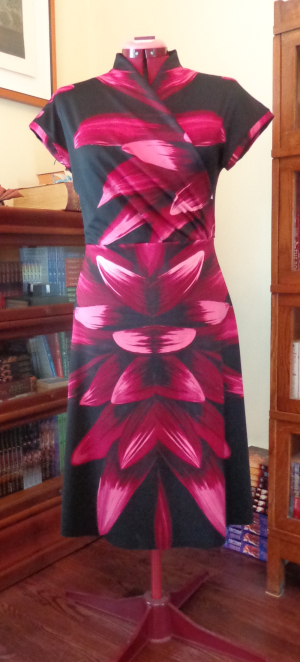 I cut out a second Mirri in a scuba knit, which is heavier than the first knit fabric, that I also found in the sale bin. The image on the scuba knit was printed in 80cm panels, and also mirrored on the center fold. I pushed this around a bit and decided that there was no ignoring that mirroring so I should work with it. I centered the skirt pieces and the bodice back on the center fold. Each skirt piece used the better part of one 80cm panel, then the bodice pieces all came out of the third one.
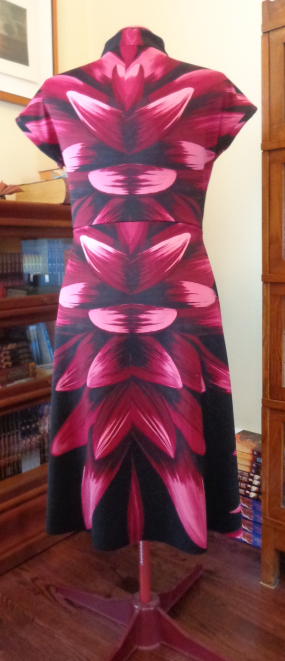 The side seam on the skirt mirrors similarly to the center front and center back.
 Finally, I graduated to more expensive fabric. I’d been saving this piece of cotton and lycra knit until my skills improved. It’s from the Netherlands and is really amazing. I loved it as soon as I saw it, but wasn’t sure what to make with it. Mr. Math always hums Go Ask Alice when I pull it out to look at it and it is a bit wild. (That’s why I love it.) I should have taken a picture of it uncut, but you can see it at EmmaOneSock where I bought it –
 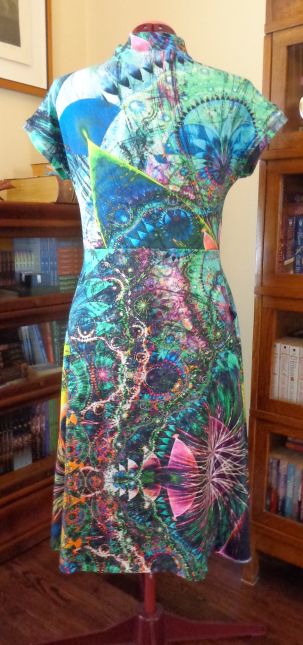 It still needs a good pressing, and to be hemmed, as well, but Nellie really wanted to try it on:
 I’ve been sewing again lately, which I really enjoy. Part of what made me get back to it was the gift of a new-to-me serger. Oooo, what a wonderful thing! I could sew all those knits that had intimidated me before! I bought some patterns and scoured the discount bins of my local fabric stores for knits. I haven’t had much luck with patterns for woven fabric in recent years – nothing seems to fit, despite my efforts – so I wanted to test the knit patterns first.
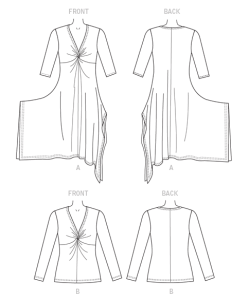 as a plunge back into the pond.
 I cut my size and held my breath as I sewed it up.
 I also bought about 3 meters of a russet and black print. It feels like it belongs in t-shirts but is more cottony than the first one. So, I cut another of the Sandra Betzina tops from it and sewed it up.
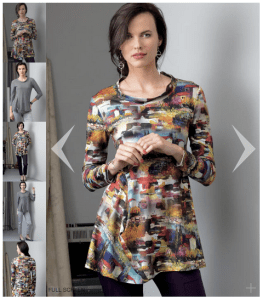 Next, I cut a Marcie Tilton swing top out of the russet and black fabric. This is a fun t-shirt with a bit more style. The pattern is
  I cut the shorter version, but because I’m short 🙂 it probably looks like the longer version on me. The neckline is a little deeper than I wanted, but I followed the pattern the first time.
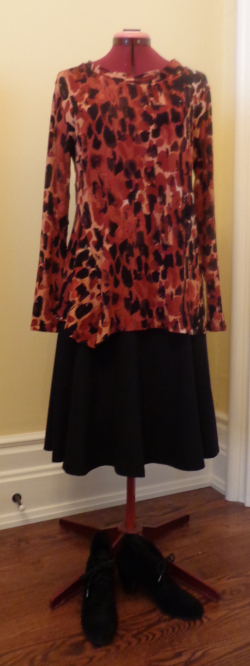 I liked this top enough that I started to think about variations. (I also discovered Marci Tilton’s blog, which has
 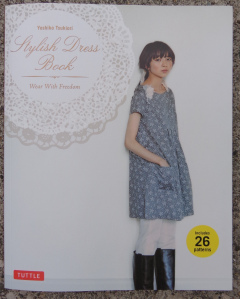 Time for more reports about sewing from Japanese pattern books. Today’s feature is a sleeveless dress pattern (A) from Stylish Dress Book.
 It came out beautifully, although I found it a little tough to roll the narrow bias hem with the linen. The pattern calls for a lighter fabric and the weight made a difference on that narrow bias. If I used linen again, I’d cut the bias strip 1/4 wider.
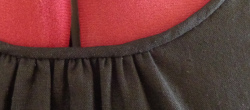 Here’s the neat neckline. It’s a little detail that gives the dress the perfect interest, I think.
 The stripe was on the selvedges, so I cut the dress crosswise to have the stripes at the hem. This meant that it took very little fabric to make the dress: I only had 2m of this because I bought the end, and it was just 42″ wide. I was excited to be able to get a dress out of it. I matched the position on the hem and let the height fall. You can see that there is more of the stripe on the opposite selvege at the shoulder on the front than on the back—that’s because the bodice darts make the front slightly longer than the back. That’s an excellent reason to match the borders at the hems rather than at the shoulders.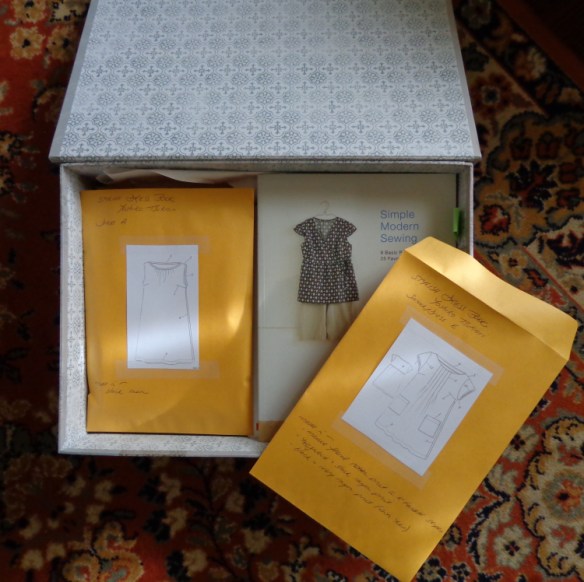
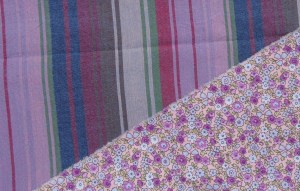 This floral print was in my stash. I bought it for $1 a meter because it’s a nice weight of cotton. It’s not really my style, though, so it’s been waiting. For this dress, I used a Kaffe Fassett stripe as contrast to keep it from being too sweet.
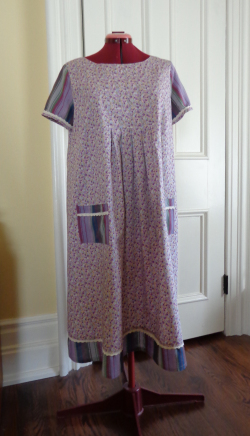 This turned out to be one of those comfy summer dresses to wear on a hot day. I wore it a lot last summer and will probably make another for next summer. The cotton lace insert proved to be a bad choice because the lace wasn’t prewashed – it shrank in the wash and now there’s a bit of gathering wherever there’s lace. It’s quite full. I’d take some of the width out of the back if I made it in cotton again.
 What’s funny about this fabric is that the turquoise photographs as a medium blue. The fabric also came in this color combination, but I didn’t like it as much. This one is actually a vivid turquoise.
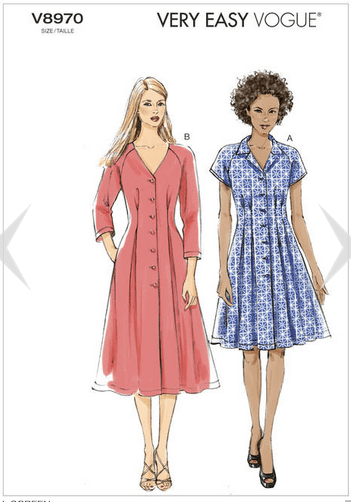
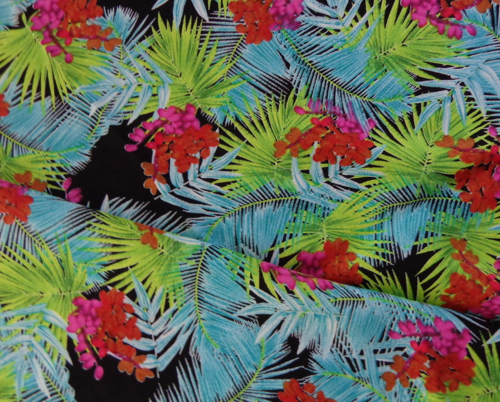 I cut out the short version of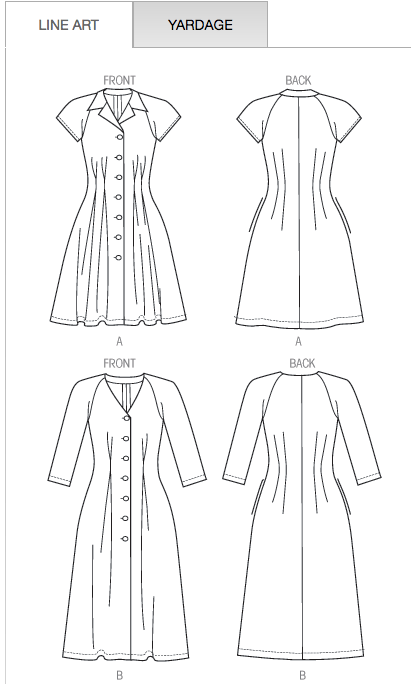
 Here’s my lovely assistant Nelly, showing off the result
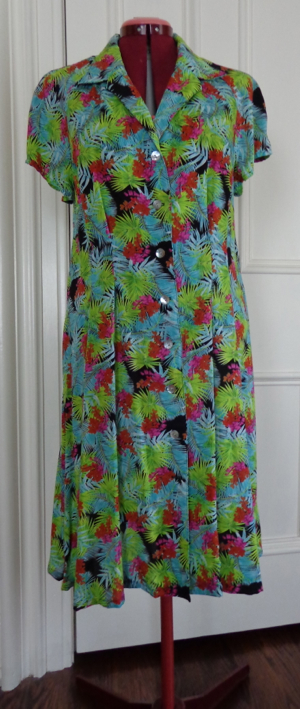 It fits perfectly! I’m so happy with this dress. The fabric is a little sheer, so I’m going to cut out an underdress in black cotton voile. The skirt has a nice flare, which is tough to see since Nelly needs to work on her modelling skills.
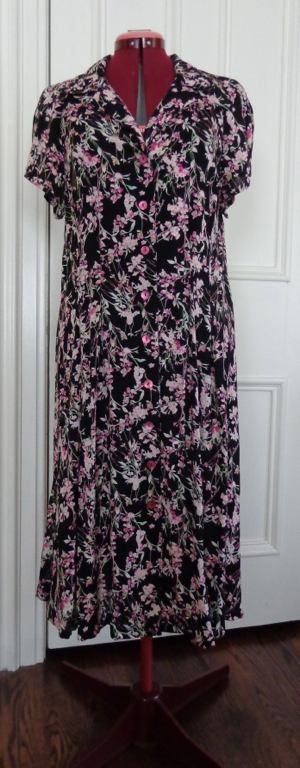 I’ve already worn this one a few times.
 Alive & Knitting