Mr. Math’s New Vest – and Hat!

Sonny vest by Sarah Hatton knitted in Colourscape Chunky by Deborah CookeWhen I finished my Iced in Noro Kochoran, there was a bit of wool left over. I decided to knit a vest for Mr. Math because it turns out that Noro Kochoran knits to the same tension as Rowan Colourscape Chunky. I have a book for Colourscape Chunky called Rowan Colourscape Folk. (That’s a Ravelry link.)

I’ve knit the Sonny vest by Sarah Hatton from it for Mr. Math before. That’s it at right, using Rowan Colourscape Chunky:

And here’s the Noro Kochoran one, all finished:Sonny Vest in Noro Kochoran knit by Deborah Cooke

This was a much fuzzier knit—and not the kind of thing to knit in the summer at all—but I was able to match it all up just as I wanted. I like having the red around the neckline, too.

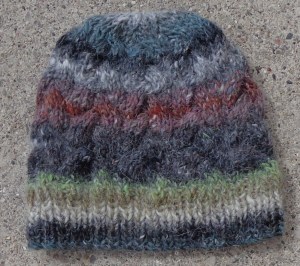
First Snow in Noro Kochoran knit by Deborah CookeThere was a little bit of yarn left so I made a hat.

Jess by Sarah Hatton knit in Texere Olympia by Deborah CookeThis pattern is called First Snow and it’s one I use a lot. I was so busy concentrating on matching the colours that I forgot to do the increases after the ribbing: this one is a bit smaller than usual, but Mr. Math likes it better. It fits more like a watchcap. I had a pompom in dark grey, but he nixed that, so there it is.

The ten skeins of Kochoran are all used up. Yay! But, of course, I have another ten skeins stashed away in a different colourway. It has a bit of mauvey blue in it, but also a lot of grey like the first one. The Rowan book will give me some more ideas for using up the Noro. For example, I made this sweater for myself from the book, called Jess, in the same colourway as it’s illustrated in the book. I like it a lot, and am thinking I’d like a second one in the Noro Kochoran.

In the Beginning Dragon Quilt – 3

In the Beginning Dragon Quilt in blueMore dragon quilt!

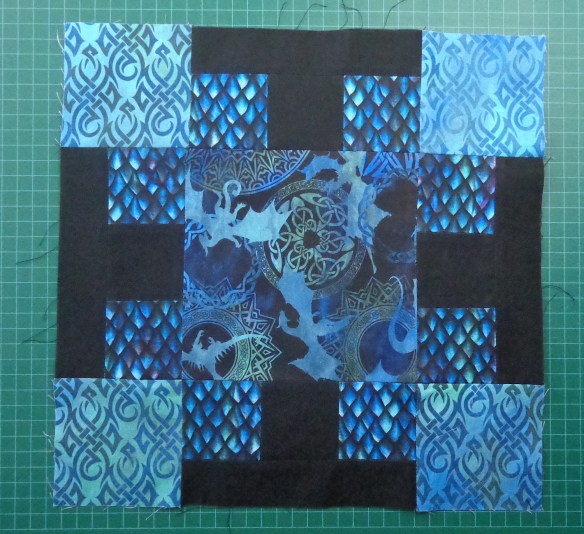
Last week, I was piecing the six blocks with the scales in this design—the ones that are stacked on either side of the central panel—and getting the scales oriented the right way. As mentioned then, I took apart my second pieced strip—the one with two strips of scale fabric with a strip of black sandwiched in the middle—and sliced it into squares. I then sewed the squares together with the scales the right way to make the units for the top and bottom of each of these blocks.

Here’s one of my finished blocks:In the Beginning Dragon quilt pieced by Deborah Cooke

All the scales are aligned!

The print called Flames is the one in the corners of this block. The instructions say to cut two 3.5″ widthwise strips out of the fabric, then cut each one into 12 squares. Because I pre-washed my fabric, I only got 11 out of the width, but there was plenty of fabric left to cut the remaining two. This print is also a one-way design: it doesn’t matter which way you think is “up” but it looks better to have the blocks all oriented the same way IMO. I sewed a couple “upside down”, so my stitch ripper got another workout, just because I wasn’t paying attention. After these blocks were done, I pieced them into vertical rectangles by adding a bit of black sashing.

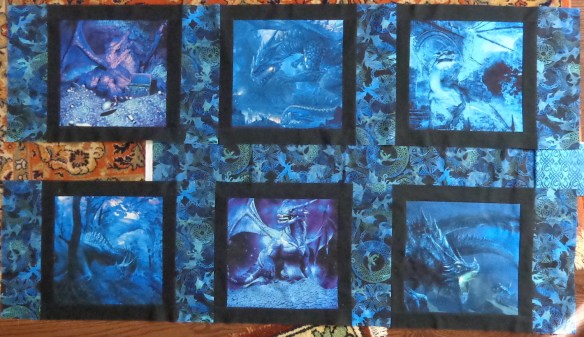
Next, I pieced the dragon squares into horizontal rectangles with those rectangles of the dragon print. (I did play around with the placement of these, then ended up using the same arrangement as the illustration.) When I had the two horizontal panels on the floor, I realized what a nice quilt you could make with just these blocks. Look:In the Beginning Dragon quilt panels pieced by Deborah CookeI put some of the leftover fabric between the rows—it ran out at the left, because these bands are 58″ or so wide—and put a little bit of the flames at the right. I like it better with the background all the same colour, but even one panel of these six-dragon-panels would make a fun quilt.

Next I cut the two rows of Emblems that go between the dragon blocks and the central section. I wanted to have the round medallions centered in both horizontal strips. I cut for the image not the grain. There’s extra fabric included for matching, but the design was printed slightly off-grain (as grid patterns often are). This is where the shrinkage from pre-washing almost got me. I needed more than three widthwise strips to get enough repeats, and managed to get another half width. Phew! It was just enough.

Here’s the top at this point:In the Beginning Dragon quilt panels pieced by Deborah Cooke

The sun was bright, so it’s a bit washed-out—and even with a step ladder, we didn’t get the whole thing!

I’m pleased to see that the joins in the Emblems bands are invisible. I matched the pattern between the circles as I thought it would be less obvious. You can see the print through the back of the fabric, though, so it was pretty easy to match.

Finally, the borders. The border print runs lengthwise on the fabric and there are four repeats across the width. The kit includes plenty, but I wanted prettier corners than shown in the illustrated quilts. This is going to be tough. The border print has a 23.75″ repeat after washing, which doesn’t divide neatly into anything. You already know I have matchy-matchy disease and this border print is going to make me work for it.

In the Beginning Dragon Quilt – 2

In the Beginning Dragon Quilt in blueI told you a while ago about ordering this quilt kit and (yay!) it finally arrived. Despite all the other things in progress on my worktable, I immediately dove in because, well, dragons.

I was worried that the fabric might feel too much like ink, but it’s quite nice. It’s very smooth and seems a bit lighter than other quilting cotton. The instructions say not to pre-wash the fabric, as it might shrink and the panels might be too small to cut to size. The issue for me is that the fabric wouldn’t be able to be washed ever if I did that. I like to pre-wash so the worst case scenario has already happened before I sew, so into the washing machine it went.

It shrank, of course, as it’s 100% cotton. I like the feel of the fabric much better – it’s a bit thicker now and not as smooth. The unexpected thing was that it shrank in the width and not so much in the length. I measured those six square dragon panels before washing. They have a 1/4″ black border around each image and were 12 1/8″ square at the inside of the black border. After washing, they were 11 1/8″ wide and 11 3/4″ tall. The instructions are to cut them 12.5″ square with .25″ going in the seam allowance, so, exactly as warned, I couldn’t cut them to size.

I’d expected this and had two contingency plans.

The second contingency plan was the tougher one: that I’d make the entire quilt slightly smaller overall and have to recalculate everything. (Gah.) Fortunately, the first contingency plan worked. I checked the black fabric and there’s a lot in the kit, mostly because they included some for the quilt binding. They instruct you to cut the binding on grain, though, which I won’t do – I always cut binding on the bias – so those 9 X 2.5″ crosswise strips of black are now extra fabric. (Actually, that’s 22.5″ by 43″ or so, maybe more if the kit is generous, so it might be enough to cut binding on the bias. We’ll see.)

Each of the six dragons are bordered in black: the instructions call for 1.5″ strips of black for those borders, and the squares end up being 14.5″ square. Once they’re sewn in, they’ll have a 1″ black border. I cut my shrunk dragon panels so that the black border was the seam allowance on the width and made them square. Then I cut my black strips 2″ wide. After sewing on the black borders, I trimmed them up to be 14.5″ square. A teeny bit of the dragon image in the height was lost – less than .25″ – and the black borders are a little bit wider than specified – mine will be about 1 3/8″ wide once the blocks are sewn in – but my finished measurements are all good. (It doesn’t look square in this image because I had the camera at an angle. 🙂 It IS square!)Dragon quilt block sewn by Deborah Cooke

There is a lot of extra fabric around the image in the central panel. Mine just has a little more background than the one in the picture. I’m good with that.

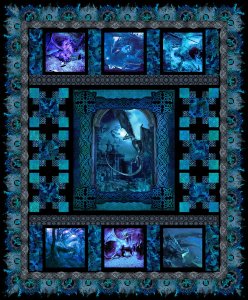
Detail of In the Beginning Dragon QuiltWhen I started to piece the other blocks, things got interesting. The scale print is a one-way design: the scales are shaded at one end and not at the other. It seems to me that I’d want them all to be in the same direction. To my relief, the person who made the sample quilt thought the same thing, because they are aligned that way. At right is a close-up of the side panel from the image on the kit: you can see that the scales are all aligned. I apologize that it’s not really crisp but I wanted it big enough that you could see the scales.

If you follow the instructions, this isn’t the result you’ll get. That’s because of the one-way design. Let’s look at that. There’s a little unit of three squares created by cutting crosswise strips of black and the scale fabric. You sew them together, then cut the blocks from them, like this:Dragon quilt sewn by Deborah Cooke
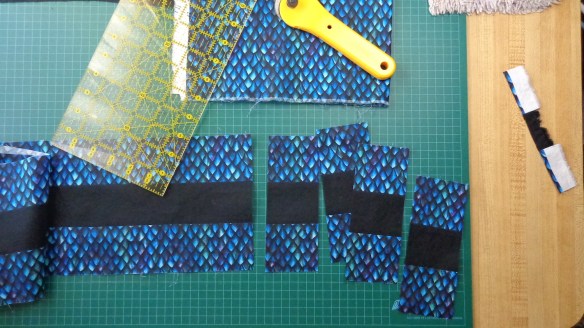
You join them to an outside rectangle of black then put them around the central square in the block. But look what happens when you change their orientation by placing them around the square:Dragon quilt sewn by Deborah Cooke

The implication of the one-way design strikes! Cutting the strips as instructed will only create the units to be placed vertically, if you care about the scales being oriented the same way. I do, so I’ll take apart the other pieced strip (there are two), cut the strips into squares, and piece them individually with the scales aligned the way I want them for the horizontal blocks.

It also means that I need to divide my units into groups, to make sure the black rectangle is sewn on the outside edge. I’ve split this first group of twelve with vertical scales into two groups: I’ll put the black rectangle on the left side of six of them, and on the right side of the other six. Dragon quilt sewn by Deborah CookeSimilarly, when I piece the units for the horizontal scales, I’ll put the black rectangle on the top of six of them and on the bottom of the other six. That got a bit more complicated, didn’t it?

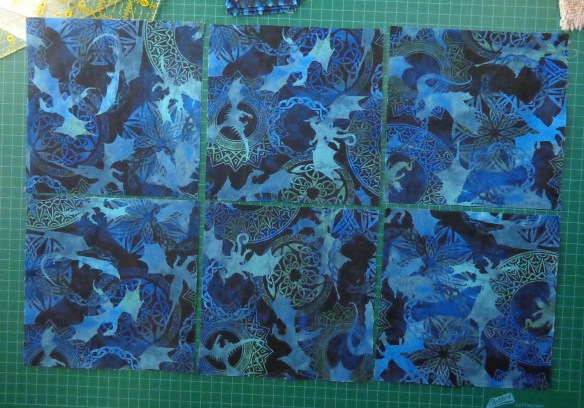
This also means (hmm…) that I won’t be able to rotate the blocks when I arrange them for the quilt. Their orientation will be set, because of the scales. Prints often repeat across the width of the fabric as well as down the length, so I laid out the six central blocks to check:Dragon quilt sewn by Deborah CookeI’m thinking I might notice the similarities, particularly between the two on the left and also on the two in the middle. Those light-coloured dragons draw my eye! I rotated the blocks before sewing on the pieces with the scales:Dragon quilt sewn by Deborah CookeThe similarities are less obvious this way. Now, I’m ready to piece those six blocks!
What about the quilt in the picture provided with the kit? Either the person who pieced it didn’t follow the instructions and did as I did, or it might be a computer-generated image. That’s interesting, and it means I’ll be keeping my eyes open for other tweaks as I work.

This quilt is a lot of fun! I can’t seem to leave it alone, so I’ll show you more next week.
BIPOC Designers

If you’re thinking of supporting some black, indigenous and/or artists of color in your knitting endeavors, here’s a wonderful resource. This list on Ravelry includes free patterns and patterns enrolled in Ravelry’s in-store sales program. There’s over 20 pages of serious eye candy to tempt you to grab a pattern and get out your needles.

BIPOC Designers Bundle by ChaseClark

Nightshift Update

Nightshift is a gorgeous shawl pattern by Andrea Mowry (Drea Renee Knits). Hers is knit in a beautiful self-striping yarn called Spin Cycle Yarns Dreamscape. It’s an aran weight yarn, though, and I was worried about the shawl ending up like a blanket. I decided to use up some of my Koigu KPPPM, which is a fingering weight, for my Nightshift. Of course, using a thinner yarn means knitting twice as many stitches to make a shawl of decent size. I cast on last July with these skeins.

Nightshift shawl by Andrea Mowry knit in Koigu KPPPM by Deborah Cooke

I’ve blogged about this shawl a couple of times already: Nightshift in Koigu KPPPM and Navellia, Nightshift and Audrey.

I’ve been working on this while sheltering in place, and am making steady progress. It’s not done, but I thought I’d show you today how it’s coming out. Here it is on the needles – it’s big enough that I can’t stretch it out to its full width:Nightshift shawl knit in Koigu KPPPM by Deborah CookeI’m on the 11th repeat and am hoping to do 15. I’ll see how the yarn lasts.
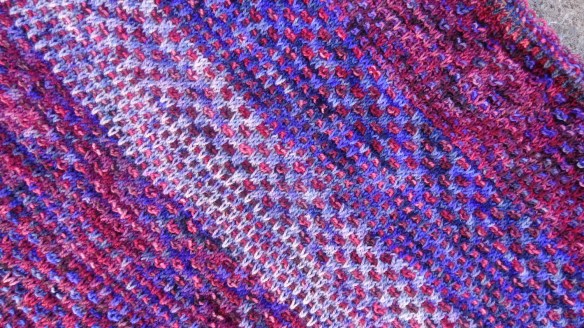
Here’s a detail shot:Nightshift shawl knit in Koigu KPPPM by Deborah CookeI like how the colourways mix and mingle with each other, because several of the same reds appear in both my red main colour and several of the contrast ones.
How is your knitting during Covid-19?

In the Beginning Dragon Quilt Kit

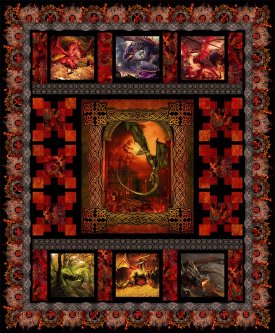
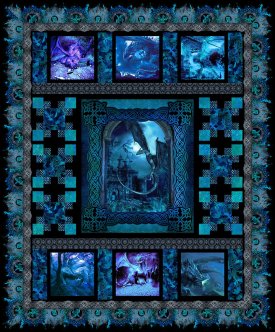
I was looking for some dragon fabric to make masks a few weeks ago and discovered this quilt kit and pattern. I found the individual fabrics first, several of which are fabulous. Here’s the quilt kit using all of them. It comes in orange or blue:
In the Beginning Dragon quilt pattern in orange In the Beginning Dragon Quilt in blueHere’s the page about it on the website of the designer and manufacturer, In the Beginning.
The collection includes a large central panel, then a panel with six smaller dragons, a border fabric, and four all-over prints (scales, circles, a Celtic knot and a wonderful mix of circles and dragons). You can see the individual fabrics in blue on the designers’ site, right here. The quilt requires all of the fabrics in the collection. I think it might include some solid black, too.

I spent a lot of time looking at this on various sites, trying to decide whether I love it or not. The short answer is that I love the coordinating fabrics but am not so wild about the panels – but then, the panels are kind of the point. The palette reminds me of the original covers for the first two of my Dragonfire novels, Kiss of Fire and Kiss of Fury, which is also part of the appeal. The finished quilt is a big piece – 72″ by 92″.

In the end, I surrendered to temptation. 🙂 Even though the dragons show up better on the orange version, I ordered the blue one. I’m curious to see how the fabric feels on the panels, whether it’s stiff with ink or not. Is there metallic ink on the panels and borders? I’m not entirely sure. It would be lovely to see it in person before deciding, but I didn’t find a local stockist, even if stores were open. It should be comparatively quick to piece – it looks as if all the blocks are squares – but we’ll see. (I’ve already noticed that I prefer how the borders are pieced and the corners mitred on the orange sample, so there’s something to watch.)

I’ll tell you more when the kit arrives, whenever that might be.

Taking Refuge in the Familiar

There is so much going on in the world these days, and not much of it seems very encouraging. I’ve been returning to the tried-and-true, instead of taking a chance on something new, and maybe you’ve been doing the same. I’m re-reading many favorite books from my keeper shelf, and sharing them on my main blog starting this week. With my knitting, I’ve returned to socks, my perfect mindless-yet-satisfying knit.

Last week was hot here, really hot and unseasonably so. With perfect timing, our air conditioner needed a repair, and the repair people need a part, and with coronavirus changing all the schedules, they don’t know when they’ll get it. We lived here for years without air conditioning so the mister has his systems for cooling the house, but it still got pretty hot. And what was I knitting? Another pair of thick winter Snowshoe socks. Of course.

The irony is that I finished them up just as the temperature dropped and I actually ended up putting them on once the second toe was grafted. We’re having such wild weather.

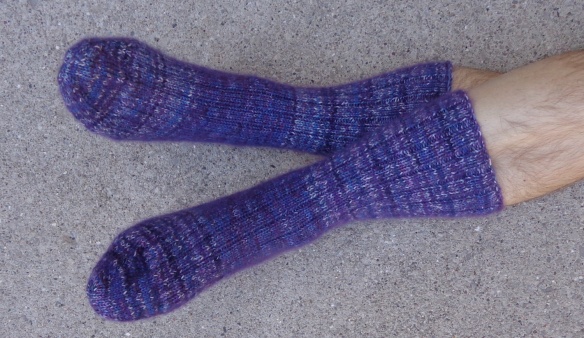
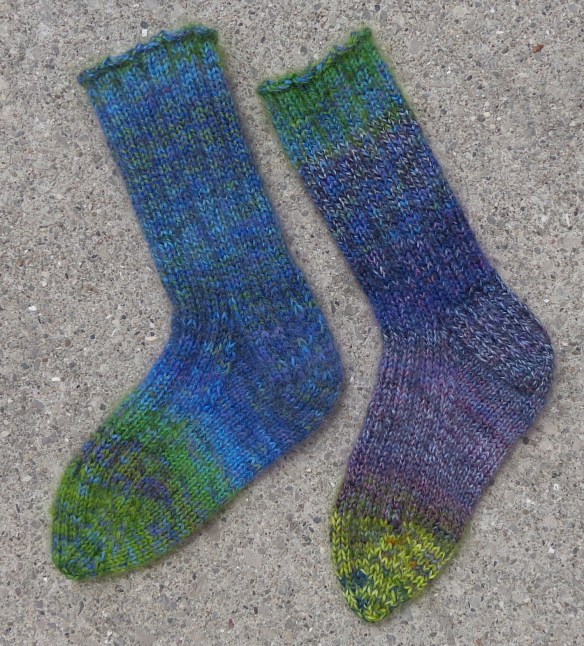
This pair of Snowshoe Socks are knit with odds and ends of sock yarn, held double, along with a strand of Kidsilk Haze Stripe. They’re a little bit more chaotic than the pair I knit for the mister, but it’s the bits and ends. Here they are:Snowshoe Socks by Emily Fogen knit by Deborah Cooke

I decided not to try to make them match this time. The right one looks narrower, even though it has the same number of stitches, because both the Crazy Zauberball and the Viola Sock are thinner sock yarns and I was knitting them together.

And here’s the pair I made for the mister, which DO match:Snowshoe Socks by Emily Fogen knit by Deborah Cooke

I really like these with the KSH. It makes the socks extra squishy and soft, and very warm. I knit the first size this time – they fit but are a bit more snug than I like socks to be. I’ll knit another pair in the second size for myself soon.

This pattern is a very satisfying knit. It feels almost that the socks are free, since they’re from those leftovers – although knitting them also means fewer leftovers for squares for my sock yarn afghan.

Iced in Noro Kochoran

I haven’t shown you any knitting lately because I’ve been working on this beast. It’s heavy wool on big needles but still a lot of knitting. Here’s the sweater:Iced by Carol Feller knit in Noro Kochoran by Deborah Cooke

The pattern is Iced, which is a free pattern from Knitty and a top-down cardigan. Here’s the page on Knitty where you can print the pattern and here’s the Ravelry page.

The yarn I used is Noro Kochoran, a discontinued bulky yarn that’s a blend of wool, angora and silk. I’ve had it in my stash for quite a while. (That’s the Ravelry page for the yarn, since it’s not on the distributor’s site anymore.) My colourway is #75. Here’s a shade card that I found online:

Noro Kochoran shade card#75 is third from the left. I also have #83 which is on the far right. It’s a really fuzzy yarn and was a bit of a splurge at the time. In the skein, it didn’t look so stripey, but (of course) it is. It shed a bit while I was knitting, but I hope it’s done with that.

I’ve been looking for a pattern for this yarn for quite a while, and was inspired by a Ravelry project of this sweater in this yarn. That knitter said that pattern and yarn were a perfect match, so away I went. On the needles, the tension looked a bit loose – it matched gauge for the pattern, but seemed too loose for the yarn. I knit a swatch and washed it and was much happier with it – the yarn fulled nicely when it was washed.

I did drop a needle size for the collar after knitting it on the specified needles and thinking it was too loose. I’m much happier with it now – even though it was three nights’ of knitting unraveled to redo it. I later unraveled the rows of garter stitch at the hem and reknit them on the smaller needles to match. I didn’t have 7mm needles small enough to do the same at the cuffs, so I knit their garter stitch cuffs on 6mm needles. I can tell the difference but I doubt anyone else will. Here’s the sweater with the fronts overlapped, which is how it would actually be worn. (I was just showing off my matchy-matchy! LOL)Iced by Carol Feller knit in Noro Kochoran by Deborah Cooke

The result is a very snuggly cardigan. It has that “bathrobe” look that shawl-collared cardigans so often have for me (maybe that’s because of the stripes) but I like it anyway. I haven’t put buttons on it yet and probably won’t.

Here’s my Ravelry project page.

Sonny vest by Sarah Hatton knitted in Colourscape Chunky by Deborah CookeI used about 6 skeins of the Kochoran so there are 4 left. I realized that the yarn has exactly the same weight/yardage as Rowan Colourscape Chunky – woo hoo! – which gives me another pattern stash. I’ve made this vest for Mr. Math of the Rowan yarn – it’s called Sonny and was designed by Sarah Hatton – which took 490 yards, so I have enough of the Kochoran, maybe even to be matchy. (Fingers crossed.) I’ve now cast on this vest in the Kochoran.

Here’s my Ravelry project page for the vest at right. I think it’s going to look really good in this yarn.

More Moonglow Quilt Blocks

I showed you a bit of this quilt already, which I’m making from a kit. (Here’s my earlier post on the Moonglow Quilt.) I’ve been making slow progress on this quilt top. I switched to paper piecing for these two blocks and am happier with the results. Here are blocks #4 and #5:Moonglow blocks 4 and 5 sewn by Deborah Cooke

The strange thing is that I’m not really enjoying the process of creating this quilt. I’ve admired it for years and wanted to make it since first glimpse. I’ve done paper piecing with Judy Niemeyer’s quilts, like this one, Jumpin’ Jack Flash (which still needs to be quilted):

Jumpin' Jack Flash quilt by Judy Niemeyer pieced by Deborah CookeMoonglow Quilt by Jinny BeyerBut I’m not feeling the love with the Moonglow. It feels like a chore, which is disappointing. I think it’s because the blocks are hard to sew together. I paper-pieced the star of #4, for example, but the octagon in the middle had to be appliqued in by hand.

For #5, only the four outer quadrants could be paper pieced and it wasn’t a lot of fun getting that green star in the middle so that the center laid flat. I did the middle three times and finally stitched it by hand. It’s still not perfect but I’m done with it. #6 is a star with a star in the middle – it’s the second one from the top in the fourth column – so we’ll see how that goes.

Instead of savoring every moment, I’m kind of glad to have only 7 blocks left to piece. :-/ Next are the two in the second column, then the four corner blocks (there are actually two designs and you make two of each), and finally the middle block. My mood will probably change when I start assembling the top together, since I’m likely to get excited about the result when I see it coming together. I’ve cut the outer borders but haven’t sewn them yet, and haven’t decided how to quilt this one.

In the meantime, onward….

Moonglow Quilt – I

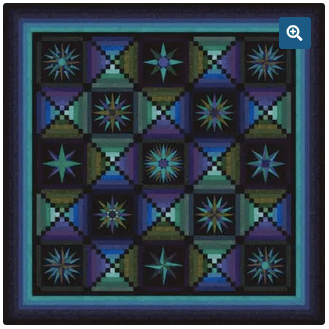
Moonglow Quilt by Jinny BeyerMoonglow is a quilt designed by Jinny Beyer, using fabrics that she also designed. It was originally made available close to 15 years ago and I’ve always loved it. Last year, I treated myself to a kit, using some birthday money, and this year, I’ve started to cut, piece and sew it.

You can buy a kit from Jinny Beyer Studios, which includes the fabric and pattern, right here.

Mr. Math always laughs when I buy a kit. He builds ship models, so when he buys a kit, he gets little cast cannons and different kinds of wood, etc., as well as the plans. He can spend the better part of a day making sure he has all the bits and ends, and checking that he likes the quality and scale of them. Sometimes he buys different castings. He usually buys different (better) flags. He always looks at online galleries of other people building the kit, to get their tips and tricks. It’s very complicated and it can take weeks for him to get to the point of being ready to start. In contrast, I got a box of fabric and had a link in my receipt to download the PDF pattern to print it out. I put a new blade in my rotary cutter and was ready to go.

I did cut all of the outside borders first and have set them aside. If you look at the image, you can see that there are alternating blocks in a modified log cabin block – it might be courthouse steps. There are actually two different layouts of them, six of each. They look like this:

Moonglow alternating blocks sewn by Deborah Cooke

I took these pictures outside on a dingy day, which means the colours are fairly accurate but the images look less crisp.

Next I started on the stars. Here are the first two, pieced with their neighboring blocks. The one at the top goes on the right edge in the middle, and the one at the bottom in my picture goes on the left edge of the finished top.

Moonglow blocks 1 and 2 sewn by Deborah Cooke

This is block three, which goes at the top center. I made a mistake in this one and cut the triangles with the right side up instead of the wrong side up, which means mine spins in the opposite direction.

Moonglow block 3 sewn by Deborah Cooke

It’s also not as square as I’d like it to be, but I want to make sure I don’t run out of fabric. If I finish the other blocks and have enough left, I’ll do it again. I’m also changing to using the paper piecing for the blocks – those diagonal seams on the bias are hard to get right.

Next up, star four, which goes at the bottom in the middle. I’m really enjoying the piecing of this quilt, even when it challenges me a bit, and I love the colours. What do you think?