Meet Bart

Earlier this month, I wanted to knit something cute to cheer up my sister-in-law, who is in isolation. (We took her a box of goodies and did a contact-less delivery, waving to each other through the glass.) I remembered this cute Rowan pattern, which I found again on Ravelry: Esther, Ernie and Enid Easter Chickens.

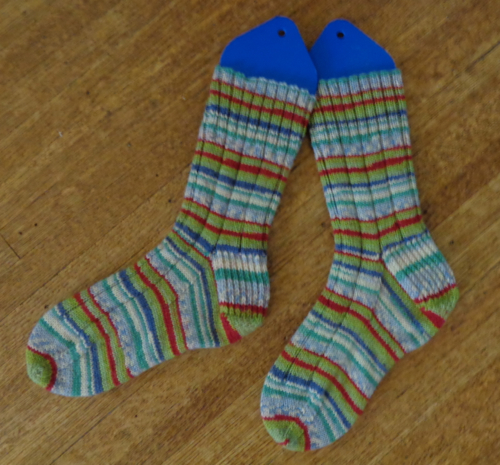
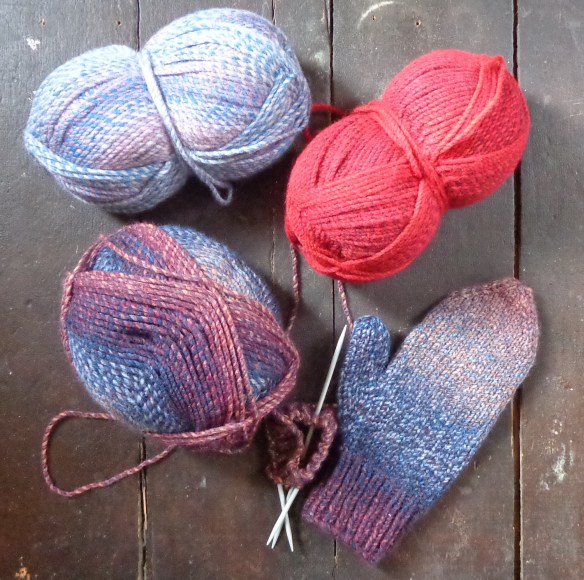
I chose some Sugar Bush Itty Bitty from my stash of leftovers (the colourway is Sailor’s Sky Delight) and cast on. I made socks of this yarn a while back. The leftovers seemed like a good choice for a cheerful chick.Basic socks knit by Deborah Cooke in Sugar Bush Itty Bitty

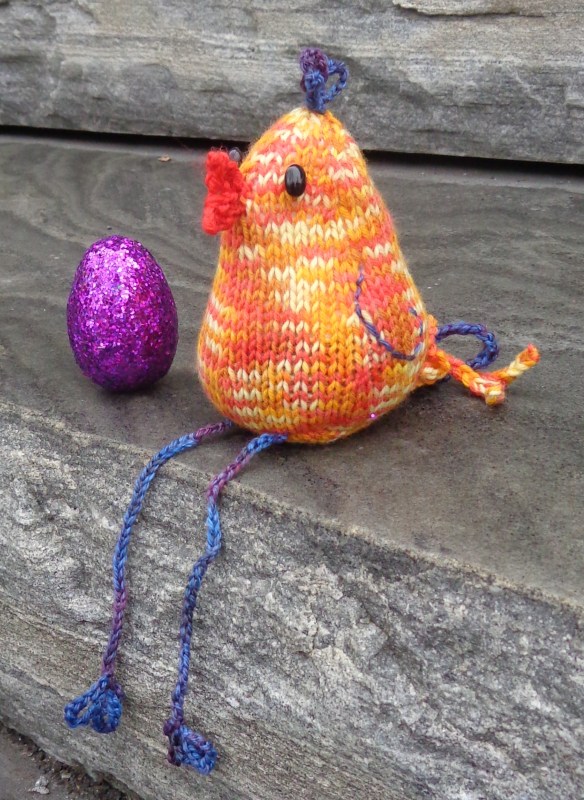
The chick is named Bart because Mr. Math said it looked like a bartlet pear when it was first stuffed. I used lentils to weight the base and some other yarns from my leftover sock yarn stash for the details.

Here’s Bart.Bart the chicken, knit by Deborah Cooke Bart the chicken, knit by Deborah Cooke

Of course, Bart was leaving 😦 so I cast on another one for Mr. Math. I used the same Itty Bitty, but this time I knit it with a strand of Kidsilk Haze in Essence, which is a pale yellow.I thought a fuzzy chick would be a good thing.

I also made two changes to the pattern, both in the base, for Bart II. First, I didn’t cast on the stitches for the base as instructed: I picked them up from the middle of the main piece, saving myself a bit of seaming. The base is a triangle, but shaped with K2tog on both the left and right side. Here’s Bart’s base to show you:

Bart knit by Deborah Cooke

The lack of symmetry irked me. For Bart II, I did the first decrease as an SSK. Here’s the base of Bart II to show you the difference.Bart 2 base with SSK at right edge and K2tog at left edge, knit by Deborah Cooke

You can see how much fuzzier the chick ended up with the KSH, too.

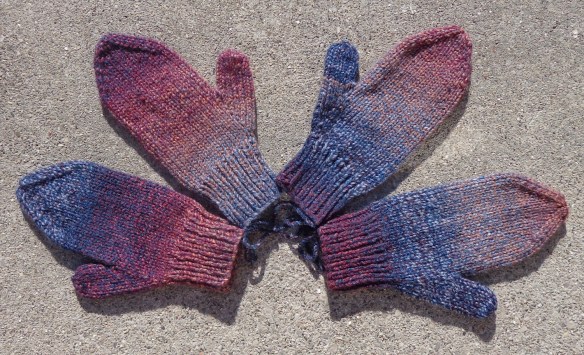
I had to make three. They’re Bart’s Band and here they are:

Bart's Band knit by Deborah Cooke Bart's Band knit by Deborah CookeWhat do you think?

Sewing Masks

I suspect that many of you, like me, have had your sewing plans revised this month. I’ve been sewing masks out of my stash of quilt fabric.

I’ve used this free online pattern.

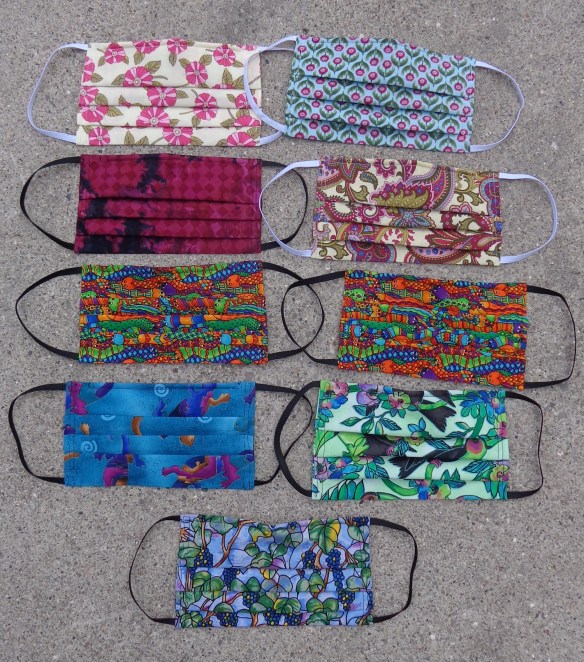
And here are some of my masks:Face masks sewn by Deborah Cooke

I’ve made more than the ones shown. There are two in the car, so we can’t forget, and I’ve given away six or eight others. I have seven more toucan ones on my sewing table, waiting to have the pleats sewn, and more cut out.

One of the changes I’ve made is for the mister’s masks – he found the elastic so tight on the first one that he couldn’t put it on. I cut the elastic pieces an inch longer for his masks. The resulting mask is still snug to his face, so I guess it’s just further between his ears. 🙂 The three at the top left have longer elastics.

People say these are quick to make, but I’m slow at it. I suspect it’s because I don’t have many big pieces of fabric – if I did, I could do assembly line production. This way, I’m cutting most masks individually. I wanted to help with a local program to sew surgical caps for the hospital, but I’m still making masks for friends and family, and that request has been completed. I am slow! OTOH, this process lets me choose fabrics that I think the recipient will like, and makes most of the masks one-of-a-kind.

Here are some more:

Msks sewn by Deborah Cooke

The mister and I wear ours on our supply runs.

Have you been sewing fabric masks?

Snowshoe Socks

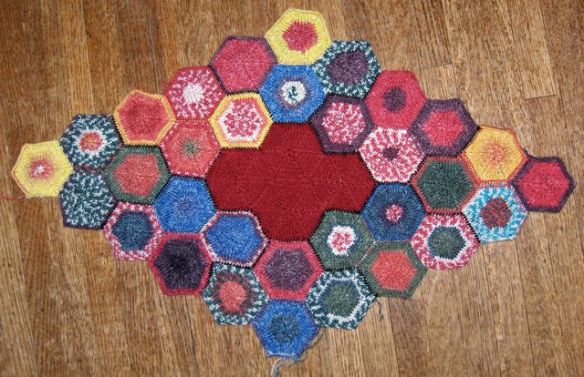
After mending socks, reclaiming a lot of my Kidsilk Haze last week and updating my stash on Ravelry, I had a look at my bits and ends of sock yarn. Knitting a pair of socks never takes all of the yarn in the skein, even when I knit a pair for the mister. There’s always some left over. I have two afghans in progress with these bits – the older one is with sock yarn hexagons:

Sock Yarn Hexagons knit by Deborah Cooke

You can find the pattern for knitting these hexagons right here on my blog.

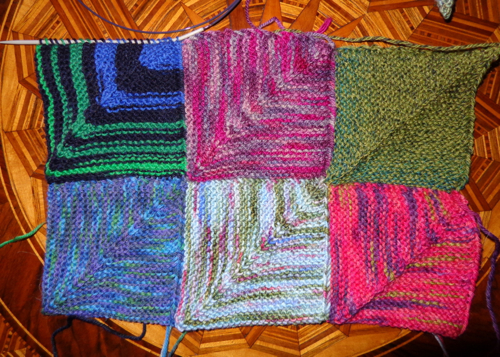
The second is with mitred squares, like this:

Mitred squares knit of leftover sock yarn by Deborah Cooke

Sometimes I have a lot leftover – for example, knitting socks for the mister often takes part of a third 50g ball, leaving most of it when they’re done. I have some sock yarns that I loved in the skein but find less thrilling knit up. And there’s the issue of the mister walking through his heavier socks, which he wears in the house in the winter instead of slippers.

The Snowshoe socks look like a good answer. Here’s a link to the pattern on Ravelry. These socks are knit with two strands of sock yarn held together. Even better, part of the fun of the pattern is mixing more than two yarns together. If you haven’t looked at this book, btw, you really should – Knits About Winter is truly lovely, with many great patterns. (That’s a Ravelry link, where you can see all the patterns in the book.)

I added one more twist to this combination – I once knit a pair of bedsocks out of Kidsilk Haze with two strands of that yarn held together. They are the lightest, softest and warmest socks ever. I decided to add a strand of KSH to the two strands of sock yarn in these socks for the mister.

Here’s my first yarn combination:

yarn for Deborah Cooke's first pair of Snowshoe Socks

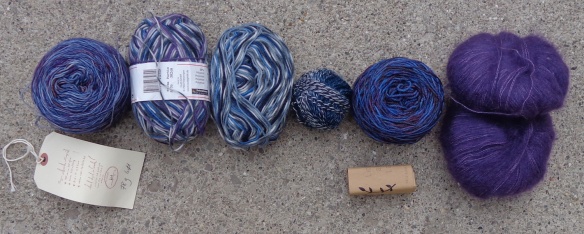
Left to right, 78g of Viola Sock in Blot, 45g of Regia 4-ply sock yarn, 31g of Regia 4-ply sock yarn in a different colourway, 16g of Crazy Zauberball, 55g of Lichen and Lace Sock in Huckleberry, and 50g of Sugarbush Drizzle (which is like KSH).

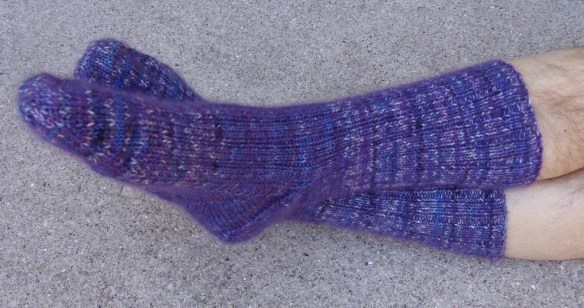
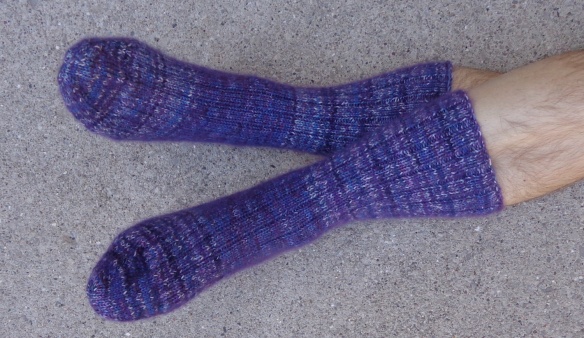
In the end, I used all of the Viola Sock, 43 g of the purple Regia, 43 g of the Lichen & Lace and 40 g of the Drizzle. Here are his finished socks:

Snowshoe Socks by Emily Fogen knit by Deborah Cooke Snowshoe Socks by Emily Fogen knit by Deborah CookeThey’re wonderfully thick, soft and squishy. Now I need to make myself a pair!


Ripping Out Projects

Sometimes, the best-laid knitting plans go wrong. Sometimes pretty projects stall. I have a habit of zooming along on a sweater until I get to the sleeves, then putting the project aside, sometimes for years. I used to think this was because I dislike knitting sleeves, but the truth is far simpler—when the body is done, I can try on the sweater, and if I don’t love it, I lose the motivation to finish it.

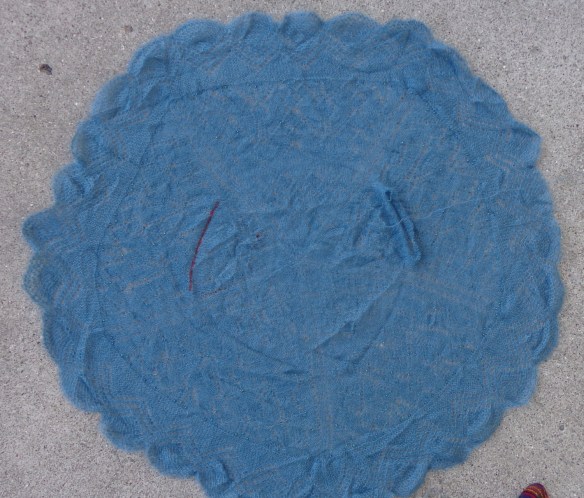
I’ve been sorting through my stash, my patterns and my projects, and these two are being ripped back. First is a lace circle cardigan designed by Brooke Nico which was in Vogue Knitting’s Fall 2010 edition. (Here’s the Ravelry link.) It’s knit in Kidsilk Haze, which I adore. I cast on in a hurry, using Trance, a colour I love, and even added beads. I did this despite the awareness that I never ever like or wear circle sweaters once they’re done. I’ve frogged every single one of them. They look good on some people but not yours truly.

I got to the sleeves. I tried it on. It’s been waiting for me to knit the sleeves for at least 9 years. Since that time, there’s been an explosion of patterns that use KSH held together with another yarn, to make a squishy, soft, fabulous fabric. I want these six skeins of Trance back!

Here’s the commemorative picture of the sweater so far. I’ve even knit the lace edging.Vogue Knitting cardigan by Brooke Nico knit in Rowan Kidsilk Haze by Deborah CookeYou can see that I had one sleeve on the needles. The red is the waste yarn holding the other sleeve’s stitches. And yes, that is my toe.

Here’s a detail image so you can see the beads.Vogue Knitting cardigan by Brooke Nico knit in Rowan Kidsilk Haze by Deborah CookeThe second project to come out of the project stash so it can be ripped out and returned to the yarn stash is also knit of Rowan Kidsilk Haze. This is my version of Belarus, a pattern by Kaffe Fassett that was published in 2014. (That’s a Ravelry link.) I loved the stripes in this design but was less happy with the design. Dropped shoulders don’t suit me, so I had planned to modify this pattern and make it a raglan. I also charted my own colour combination, which I liked better than the oranges and pinks of the original. I actually knit the entire body, realized it was too long, and frogged back to this.

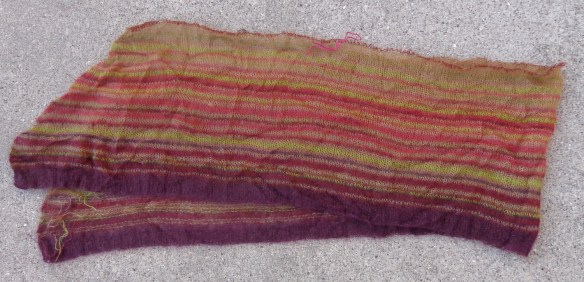
Ironically, since I’ve let my hair go grey, the oranges and pinks would have suited me better than these golds and reds.Kaffe Fassett Belarus cardigan knit in Rowan Kidsilk Haze by Deborah CookeRip, rip, rip. Back it all goes to the stash. I’ll have to weigh the various colours of KSH to update how much I have.

It’s hard to make these decisions, but once they’re made and the ripping begins, I actually feel relieved. KSH has to be frogged slowly – un-knit, really, not ripped – so it will be a bit of a meditative process too.

And then that Trance KSH can join forces with the teal Koigu, the one I used in my Navelli, for a wonderful squishy soft sweater. 🙂 I can’t wait!

Darning Socks

Although I know how to darn socks – my mom taught me – I haven’t done it much. I tend to wear my handknit socks until they have holes, then chuck them out. This all changed when the mister had holes in four pairs of handknit socks he really loves. I had a look and decided it would be faster to fix them than knit him another four pair. (Although I’ll do that, too.)

This is the first pair of socks, when they were new.socks knit in Patons Kroy stripes by Deborah CookeThey’re knit of Patons Kroy stripe. I think the colourway is Summer Moss.

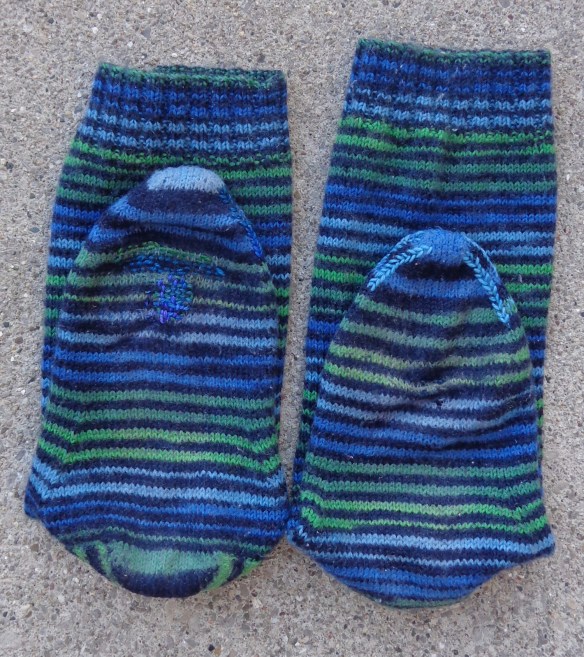
And here they are (four years later!) with the holes darned in the soles:
Sock darning by Deborah CookeI actually still had some of the same yarn, but you can see that the colour had faded a bit. To repair these holes, I stitched a line of running stitch around each hole, about 1/8″ from the hole. Then I created a warp of yarn, back and forth across a hole. Finally, I wove a weft perpendicular to the warp, using the warp threads to weave a patch. I thought it might be more bulky, but the mister says it’s all good.

Here’s the second pair, which had a different challenge:
Socks darned by Deborah CookeI don’t remember the yarn I used for these, but think it was a Regia sock yarn.

This pair have been around for so long that I don’t even have a picture of them newly knitted. The one on the left had a hole like the ones above, which I patched the same way. It also had an area that was getting thin, closer to the toe. You can see that I made running stitches back and forth there to reinforce it. The yarn I used to patch that sock was the same content but not the same yarn.

The toe of the right sock was developing a line of holes beside the decrease stitches for the toe, where the yarn was thinning. I did a chain stitch up the right edge of the toe, worked the yarn across the back, then down the left side, back up again (you can’t see that part so well) and down the other side again. It’s the same yarn as the sock but the bit with the brightest turquoise stripe. That made the patch feel like embroidery or embellishment. I still have to fix the hole in the sole of that sock.

I removed the pills on both pairs, which made them look refreshed as well. The top pair is back in the sock drawer and the second pair will be there soon.

More Mittens in Gemstone

Remember those three balls of Red Heart Gemstone I found in the mill ends at Spinrite? Here they are again:

Seconds of Red Heart Gemstone

The three balls are all a little light. They should be 200g each and are closer to 140g each, which would be why they were in the mill ends. I’m knitting mittens with the free pattern from Tin Can Knits called The World’s Simplest Mittens. I finished up the ball of Flourite and got two pairs of the second largest size out of it, with a bit of yarn left over.

World's Simplest Mittens by Tin Can Knits, knit in Red Heart Gemstone by Deborah CookeThe repeat on the colour was longer than the amount of yarn needed for one ball. I just knit the four, then matched them up the best I could.

Last week, I finished up the Amethyst ball. I made two pairs of the third size, then one pair in the second size – with some stripes of Flourite, just for fun. Here they are:
World's Simplest Mittens knit in Red Heart Gemstone by Deborah CookeIt’s interesting how the mitts matched more easily, even though this was the smaller size. The repeat on the gradation must be shorter in this colourway.

Next up, the red ball – Fire Agate!

Large Rectangle with Center Diamond Pattern

Today, we’ll talk about another stole from Victorian Lace Today that I knit (this time in 2008) but never added to the blog. The pattern is Large Rectangle with Center Diamond Pattern by Jane Sowerby and I knit it in a handpainted yarn from Wellington Fibres. The base yarn is their 3-ply fingering.

Wellington Fibres is a small mill and also raise angora goats themselves. They’re near Elora, Ontario and well worth a road trip. They have a shop attached to the mill where they sell both tops for spinning and finished yarn. They have a spring open house, when there are lots of baby goats, too.

Mohair is a glorious fibre with a wonderful sheen. It also takes dye very well. The rich jewel tones of the yarn at Wellington Fibres makes their shop feel like Aladdin’s Cave.

Here’s the shawl:
Diamond Lace Shawl from Victorian Lace Today knit by Deborah Cooke in Wellington Fibres 3 plyThis one finished out at 65″ by 19″. I think it was the first time I knitted on a border. I did change out the specified border for the Cyprus edging.

There’s a slight striping effect from the handpainted yarn, but I like it:

Diamond Lace Shawl from Victorian Lace Today knit by Deborah Cooke in Wellington Fibres 3 ply

What I like about the patterns in Victorian Lace Today is that I can memorize many of them, especially ones like this. That means I don’t have to sit over a chart as I knit, but can watch television or talk to other people. I like charted lace patterns, too, but VLT is distinctive in that for me.

Here’s an old picture of the shawl, which shows the pattern stitch a bit better. This one is closer to the actual colours, too.Large Rectangle with Center Diamond Pattern by Jane Sowerby knit in Wellington Fibres 3-ply by Deborah Cooke

Now, I’m thinking about knitting another shawl from Victorian Lace Today!

Navelli – Finished!

It’s done! Here’s my finished Navelli:

Navelli knit in Koigu KPPPM and Shibui Sock by Deborah CookeThere are some previous posts about this sweater – Navelli is the main post, which talks about the challenges (and shortcomings) of my first choice of yarn colour; Update on Navelli is about my progress in the new main colour.

I didn’t knit the sleeves as specified. They’re supposed to have essentially a contrast facing – mine would have been purple – but instead I did five rows of 1/1 ribbing in purple and cast them off.

I made the fifth size, which gives me 11″ of positive ease. (The pattern suggests 4 – 15″ of positive ease.) It is a fun boxy fit, but I’m narrow in the shoulders. After blocking, I felt that I was losing the sweater, so I frogged back and changed the neck to be the smallest size. That made the shoulder seam a little bigger, but it’s a more comfortable fit.

This is a better shot of the colours.

Koigu KPPMI had been a little concerned that the fair isle section was narrower than the body of the sweater, even though I knit it on larger needles. That was all fixed in the blocking. My gauge is dead-on with this one – it’s EXACTLY the measurements of the schematic. Ha.

I love this sweater so much that I want to cast on another one. I dipped into the stash over the weekend and discovered some Madeline Tosh Merino Light, in Red Phoenix and Spicewood, plus Malabrigo Sock in black. I think I’ll go down a size and cast on the fourth size, but I’ll keep the neck in the smallest size. I have a plan, but I want to finish another project that’s already on the needls before I cast on a new sweater…we’ll see how that plan goes!

Visible Mending and Patchwork

Last week, the New York Times had an article Patchwork as Protest about mending clothes and making the repairs visible. I’m not sure if you can read the article without a subscription. Here’s a salient point: “Americans generated 17 million tons of textile waste in 2017, which included carpets, footwear, sheets and towels but was mostly clothing….Only about 15% of textiles were recycled, meaning landfills received 11.2 million tons of municipal solid waste textiles that year.”

Wow. That’s a lot of fabric, and it’s not including waste from manufacturing of garments, which mostly occurs in Asia. I wish I could find the video I saw a few years ago. It was for a T-shirt company that foraged for textile ends in (I think) Viet Nam, then washed the fabric and made T-shirts out of them. The video showed their scout scaling massive hills of fabric waste, seeking lengths that were of good quality and useful. The size of those hills was incredible.

So, the idea behind mending is that clothing gets repaired instead of tossed into the trash—with visible mending, the repairs become an artistic expression.

This article led me on a wonderful morning of browsing, including a visit to the site, Visible Mending, mentioned in the article. Check out the mends illustrated on their Techniques page. The article also mentions Ace & Jig and Tom of Holland, if you’re looking for more inspiration.

I find this all very inspiring. I’m old enough to remember everything being mended, but also that the mends were often ugly, even if practical. How many of us in the 1960’s had pants that were lengthened to accommodate a growth spurt by the addition of a band of some other fabric at the cuff? I remember the hand-me-down cycle between my mom and aunt (her sister) – two of my cousins were older than me, so some of their gently-used clothes came to me, and some of mine went back to my younger cousin. Do people even do that anymore?

Celebrating mending is interesting and I think it’s smart to reclaim those practical skills of making-do.

Visible mending also opens new possibilities for thrifting. To date, I’ve passed by the sweaters with holes at the thrift stores, or worked around the holes when upcycling those sweaters into bags—like these ones:
upcycled bags made from felted vintage wool sweaters by Deborah CookeThose patches on the brown bag to the right cover the armholes and also a few holes. I felted that man’s sweater and used it upside down – the waist ribbing is at the top. The left one didn’t felt (probably a superwash wool) and the grey fabric is from the scraps left when the tailor made a jacket for the mister from the Harris Tweed we bought directly from the weaver in Scotland.  Felted bag made from an upcycled sweater by Deborah CookeThis one is a Gap sweater that was felted at the thrift store already. I felted it a bit more. It had a raglan sleeve. I cut straight across the front for the bag front, and the flap is the back up to the neckline. I gave this one away, but found another just like it at the thrift store. Same issue. (Apparently people who buy wool sweaters at the Gap are inclined to toss them into the washing machine rather than read the instructions.) I like the colours, but haven’t done anything with the second one yet.

I also worked around the holes for this tote bag. This bag is made of socks I knit of Noro Kureyon Sock, a yarn I loved for its colors but one that wasn’t very sturdy. I walked holes in the feet of those socks in record time, which annoyed me. So, I cut the socks at the top of the heel, then sliced those tubes open. I also saved the top half of the foot section, then patched them all together into this tote bag:As you can see, I ended up cutting the pieces smaller—I think there are quarters of leg sections—to make all the patches work together. I love this bag, even though it’s a bit lumpy. (I used a zigzag stitch to join the pieces. It might be smoother if they were serged.) There are pink squares with a bit of purple which are clearly not Noro anything – that was a sock yarn that felted the very first time I washed the socks. Also a pretty color. Also annoyed me. (I don’t wash knit socks by hand. They go in the washer on a gentle cycle then are hung to dry. The label said that was okay for this yarn but the label lied.)

I have a whole bin of socks to be mended—they all have holes in the soles—and recently bought a darning egg to get that job done. Fortunately, I still have bits and ends of many of the yarns. I’ve been (slowly) working on an afghan of mitred squares in sock yarn, but will rummage in the bag of scraps for matches. I need to brush up on my darning technique.

Do you do any visible mending or darning?
Alpine Knit Scarf

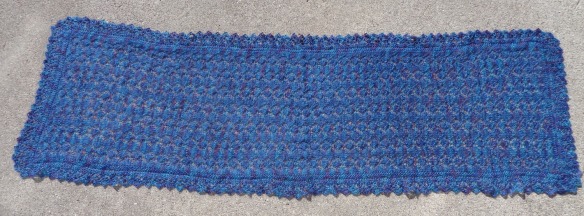
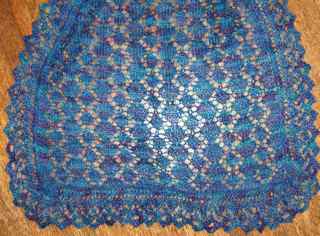
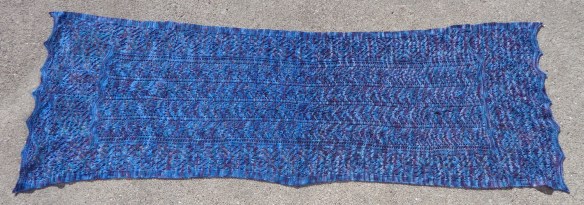
Here’s a project from Victorian Lace Today that was never documented on the blog. It’s a wide scarf—really, it’s a stole—and I knit it in Malabrigo Lace in the colourway Whale’s Tale. The pattern is the Alpine Knit Scarf with Double Rose Leaf Center Pattern and Diamond Border by Jane Sowerby.

Alpine Lace shawl from Victorian Lace Today knit in Malabrigo Lace by Deborah Cooke

My finished shawl is about 55″ long and 18″ wide.

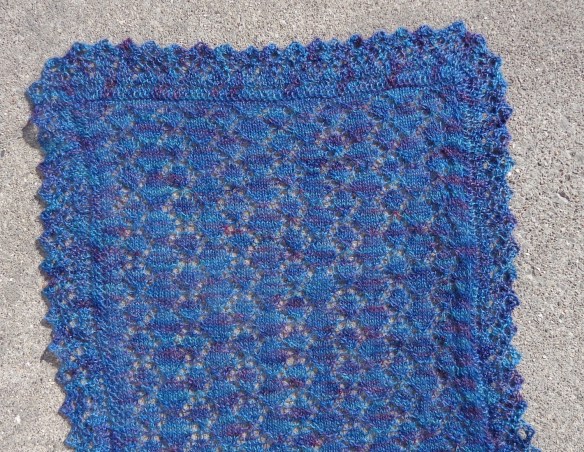
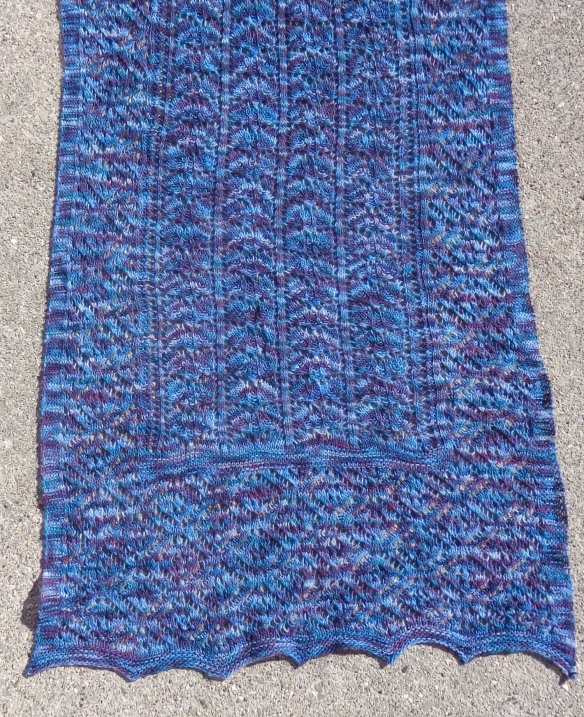
There are several interesting details here. One is that photography often reveals colour shifts that aren’t as noticable in real life. Malabrigo Lace, like many handpainted yarns, has colour variations between skeins. I didn’t know anything about alternating skeins when I knit this and you can see, just a little past halfway and to the right, where I changed from one skein to the next. The left skein is a little bluer and the colours in the right skein are a little less blended.

You might also agree with the idea that lace shouldn’t be knit in yarns with color variations because it hides the detail of the lace. I kind of like it.

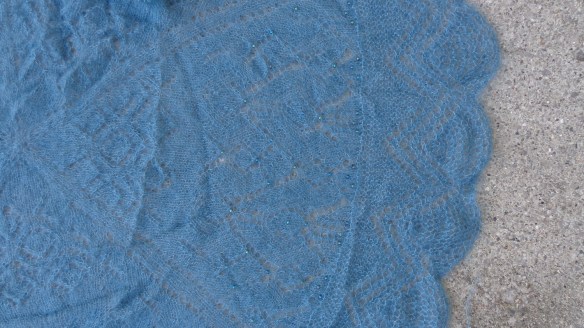
Here’s a shot of about half of the shawl (the right half above). Even in the handpainted yarn, you can see that this pattern has a border with a central panel in a different lace pattern, and that they’re separated (and edged) with garter stitch. The Malabrigo didn’t really pool in this knit, which was a nice bonus.

Alpine Lace shawl from Victorian Lace Today knit in Malabrigo Lace by Deborah CookeThis is a beautiful pattern and I loved knitting it. Malabrigo Lace is very (very!) soft, too. I would like to knit it again in a more solid colour, just to see the difference.
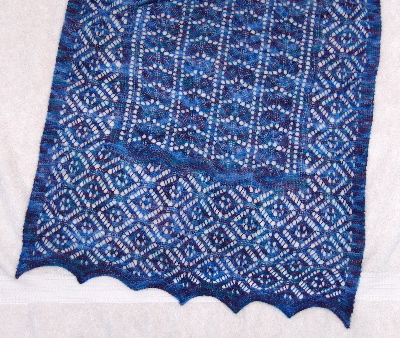
You can see the pattern stitch a bit better in this older photo:

Alpine Lace Shawl knit by Deborah Cooke

My Ravelry project page says I knit this in 2007! It’s been living in the cedar chest ever since. One of the good things about digging it out for a new photograph is that I’ve kept it out and am (finally) wearing it.