Lined Stargazer Mittens

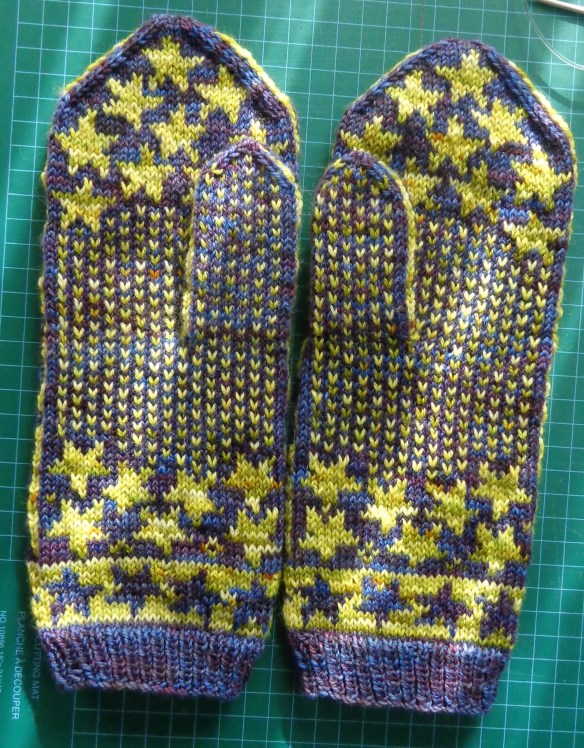
I showed you my Stargazer Mittens a few weeks ago. These are knit from Natalia Moreva’s Stargazer Mitten pattern, in Lichen & Lace 80/20 sock. Here they are again:

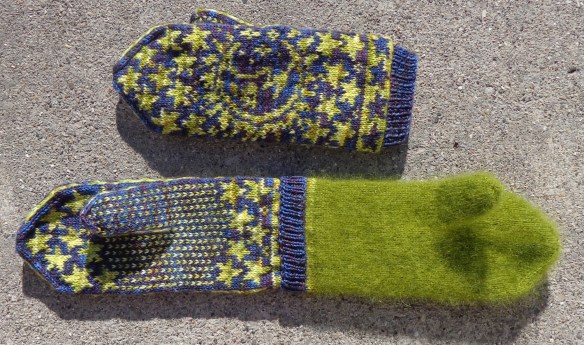
Stargazer Mittens by Natalia Moreva knitted in Lichen & Lace 80/20 Sock by Deborah CookeI decided to line these mittens with Rowan Kidsilk Haze. I had Jelly in my stash, which is a little more green than the Citron sock yarn, but it works. Here are the lined mittens, one with the ilning tugged out:

Stargazer Mittens knitted by Deborah Cooke and lined in Kidsilk HazeI used the same size needles for the lining, but picked up the stitches at the end of the ribbing. When knitting the mitten, you increase four stitches at the end of the first band of stars, so this means that my lining has four stitches less than the mitten. I figured that would help it slide inside more easily. Similarly, for the thumbs, I put 11 stitches on a holder instead of 13, so my thumbs in the lining have 4 stitches less than the mitten thumbs. I also knit the linings a little bit shorter: 4 rows shorter for the mitten and 2 rows shorter for the thumb. When the lining is pushed inside the mitten, it puffs a bit at the cuff as a result.

The cool thing about lining mittens like this is that there are no ends visible or even carried threads in the fair isle that can be snagged. Everything is sealed between the mittens. To do this, I finished all the ends on the mitten, then knit the main body of the lining. I pulled the tip of the mitten through the hole for the thumb once the top had been sewn with Kitchener stitch, and wove in the ends. After the thumb was done, I worked the end in from the right side, then pushed the needle through the work to leave the end inside.

This lining is lovely and squishy, but maybe a bit thicker than it needs to be. You can see that when I picked up the stitches at the cuff, I first knit with a strand of Citron and a strand of Jelly held together. That seemed too thick and was a bit stiff. I tried with a single strand of the Kidsilk Haze and thought it was too thin, so used the KSH double. In hindsight, the single strand probably would have been fine.

I used just over a ball of KSH for the linings, which mean that I could have lined the mittens with a little over half a ball if the yarn had been single. That’s good to know!

Gemstone Mittens

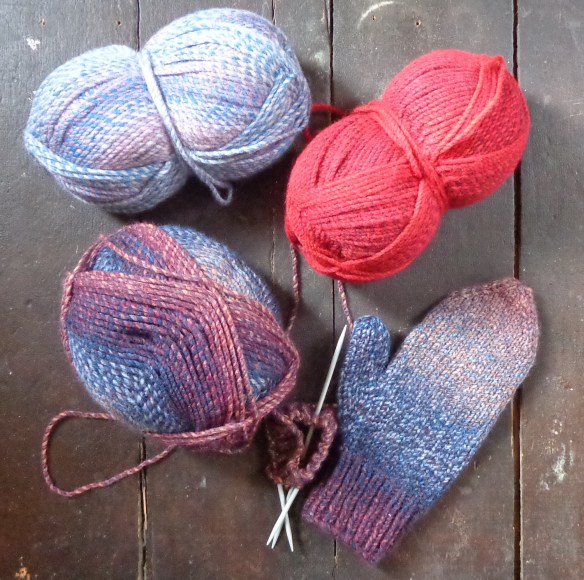
A few weeks ago, I bought some yarn in the mill ends at Spinrite, and later identified it as Red Heart Gemstone. It looked like this:Seconds of Red Heart GemstoneI had knitted one mitten from it when I took this picture, but now have finished that first ball of Flourite. I used Tin Can Knits’ World’s Simplest Mittens pattern. I got two pair of mittens out of it, in the second-largest size:

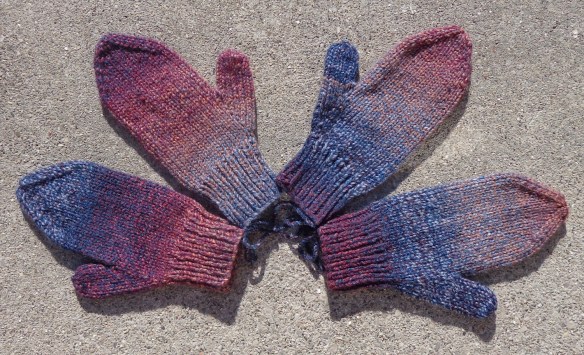
World's Simplest Mittens by Tin Can Knits, knit in Red Heart Gemstone by Deborah CookeThe repeat on the colour gradation was a bit more than the amount used in one mitten, so they don’t match. I knit as many as I could and made the best matches possible. You can see that I couldn’t match the thumb on the second one from the right. Hmm. Looking at the pattern picture, I might have knit fewer rows than specified for the ribbing. I get bored with ribbing and often end it early.

I have 13g of yarn left, but remember that these balls were underweight. They were between 140 and 145g, instead of 200g. From a full ball, then, it would be possible to get three pairs of mittens in this size.

I’ve cast on the smaller size in the Amethyst and am hoping to get three pairs out of that ball. We’ll see!

My Ravelry project page for these is right here.

McCalls 8365 Jumper

I’ve been meaning to sew myself a corduroy jumper for a while but finally have gotten around to it. When I’m thinking about a project, I keep buying fabric for it—I have four lengths of featherweight corduroy in my stash thanks to this bit of procrastination. At least they’re different colours!

I chose the teal and McCalls 8365. I had been thinking of using the Smock E pattern from the Stylish Dress book, but went for this old McCalls pattern instead. I thought Smock E might look too much like a maternity dress in the corduroy. It’s really a generous cut and I like it better in the rayon woven than the cotton for that reason.McCalls 8365

You can see that I paid the princely sum of 49 cents for it at a thrift store—it was uncut. I did make quite a few changes though and included the instruction sheet in the image so you could see what I mean. There are four views, all of which have the same back: there are two variations of the neckline and two lengths. The deeper neck has box pleats and the straighter neck has tucks.

The back view shows that the jumper has a zipper, which I decided was unnecessary. The cut is wide enough that it can be just pulled over my head. You can also see that the neck and armholes have facings, and that they’ve been combined into a single facing for the front and backs. I know this is going to curl etc. when washed, so I eliminated those pieces—I’ll finish the openings with bias binding.

The design is described as semi-fitted, which means up to 4″ of ease in the bust. I cut for the full 4″, since I want to wear a cotton turtleneck underneath. If I was using the pattern for a sundress, I’d cut closer to 2″ ease. I checked the length and one option was too short (38″ from back neck) and the other too long (51″ from back neck). I cut one in between (44″ – don’t forget the hem allowance!) that will be just right.

In the end, I cut the front and backs from the corduroy as well as the ties. I then found a coordinating cotton print in my stash and cut some 1.5″ wide bias strips. The fiber is the same as the corduroy (100% cotton) so both fabrics should behave the same way when washed.

I don’t want to fuss with these pleats each time the jumper is washed, so I used an old trick: once the pleats were sewn and ironed, I secured them, by sewing through all layers in the ditch of the pleat. I’m counting on this stitching line disappearing in the wales of the corduroy. With another fabric, I might have done two lines of topstitching, one on each side of the pleat, and made it a more decorative element.

I felled the seams to finish the edges. I also topstitched down one edge of each tie, to keep them from becoming tubes. I pressed a 3.5″ hem, then turned under the raw edge so that the hem was 2″. Then I finished the neck and armholes with my bias binding, topstitching it in place.McCalls 8365 sewn in featherweight corduroy by Deborah Cooke

And there we go. A new jumper in an afternoon!

The photo doesn’t show the colour well. It’s actually teal.

What would I do differently? Well, I sewed the bias binding to the neck and armholes at the original seam line, which had a 5/8″ seam allowance. I didn’t trim that at the neck because I thought a wider bias facing would look nice. It doesn’t lie as flat on the curve at the front as would be ideal, because of the bulk of the corduroy. (Even featherweight.) I trimmed the seam allowance back to 3/8″ on the sleeves and it’s better. If I sewed this again, I’d trim it back to a scant 1/4″ and cut the bias binding narrower. I also would use a darker print for the binding so there wouldn’t be little glimpses of white at the edges.

If I wanted to use this as a sundress pattern – i.e. without wearing anything under it – I’d cut a smaller bodice and maybe raise the armholes. This gapes too much to wear alone, but I plan to wear a blouse or turtleneck under it, so the extra ease is a good thing.

I really like the weight of the hem and the way the jumper hangs so overall, this one is a win.

Stargazer Mittens

These are my new mittens!

Stargazer Mittens by Natalia Moreva knitted in Lichen & Lace 80/20 Sock by Deborah Cooke

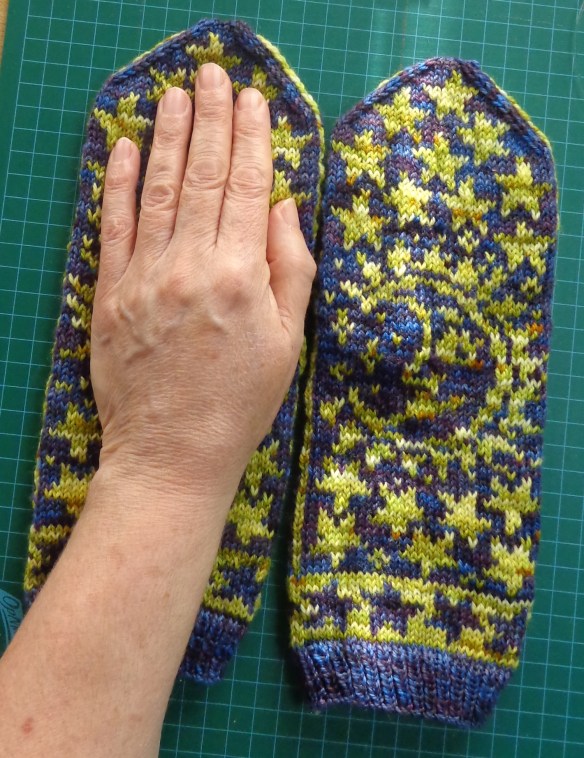
The pattern is Stargazer Mittens by Natalia Moreva – that’s a Ravelry link, but here’s the pattern on her website. She provides charts for both mittens with the two options on the colours – either dark background with light detail, or light background with dark detail – which is great. I’ve knit her Gates of Moria mittens, too. These mitts are a close fit and I have small hands. They’re long, too.Stargazer Mittens by Natalia Moreva knitted in Lichen & Lace 80/20 Sock by Deborah Cooke

Ha. Morning picture without my wedding ring. 🙂

The thumbs are long, as well. If I made them again, I’d make the thumbs four rows shorter. I didn’t do that on the second mitt because I didn’t want to rip back the first one.Stargazer Mittens by Natalia Moreva knitted in Lichen & Lace 80/20 Sock by Deborah Cooke

I didn’t have a good yellow in my stash when I decided to knit these, and I wanted to use the same yarn for both colours. I bought Lichen & Lace 80/20 Sock in two colours, Huckleberry and Citron, at my LYS. It’s 80% merino and very squishy. I would have liked the green to be more of a sunny yellow or the blue/purple to have been closer to black. There are flicks of olive and copper in the Citron, and once it’s knit with the Huckleberry, those bits “read” as having a similar value to the blue and purple. The photograph maximizes the contrast, but in real life, I wish there was a bit more.

I do love these mitts. 🙂

I’m going to line them, so they aren’t done. My first idea was to knit a Citron cuff to extend beyond the existing one, but they’re already so long that I’ve decided against that. I knit my Gates of Moria mittens with one strand of Rowan Kidsilk Haze and one strand of fingering yarn held together, which made them thick, soft and very warm. In this case, I’m going to knit a liner in just Kidsilk Haze – that will keep it thin, since these mitts are already a close fit. Even though I never carry a yarn more than a few stitches when knitting fair isle, that will also ensure that no threads are ever caught in pulling the mittens on.

This pattern has two increases in the row count. You add stitches at the end of the ribbing, then 4 stitches more at the end of the first band of stars. I’m going to use the same size needles for the lining, so to have it fit more readily inside, it needs to have fewer stitches. I’m picking up stitches at the top of the ribbing, like this, so the lining will have 4 stitches less than the mitten:Stargazer Mittens by Natalia Moreva knitted in Lichen & Lace 80/20 Sock by Deborah CookeOn the right side, that row of Huckleberry will just pull a little bit tighter. Mitten and liner will be joined forever. I’ll probably also make the lining a few rows shorter, maybe just two, in both the mitten and the thumb. I’ll show the finished and lined mittens to you when they’re done.

Shirts in Liberty of London Prints

This is a tale of ready-to-wear inspiring my sewing. (This will probably become a theme.) I love Liberty of London prints in their Tana Lawn and I love print shirts. These two came together a few years ago when I spotted women’s shirts for sale. They were produced under the Lord & Taylor label but available in Canada at The Bay. Here’s the first one I bought, in green, modelled by the lovely Nelly. (She’s always a bit tippy, but she’s cute.) There’s a second coordinating print facing the collar band, button band and cuffs.green Lord & Taylor shirt in Tana Lawn
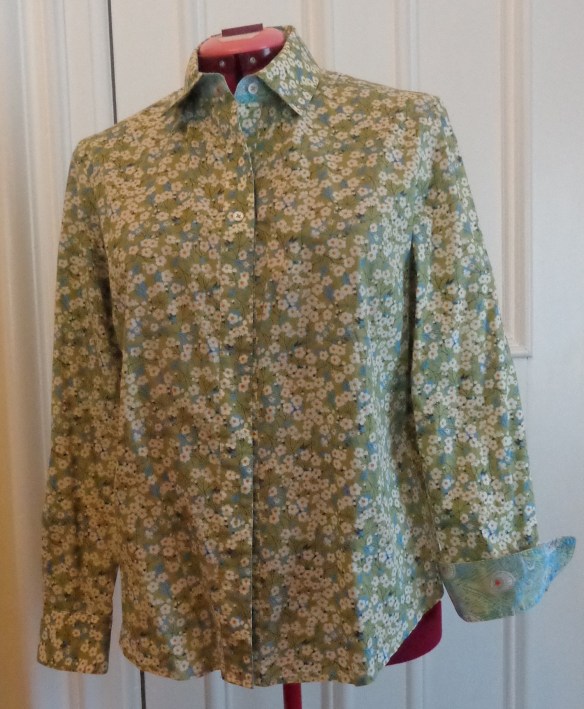
green Lord & Taylor shirt in Tana LawnThe fabric is Liberty Tana Lawn and the main floral is Mitsi. The contrast is Hera.

I love this shirt. The bust dart is a bit high, but that’s the way it goes. It has about 2″ of positive ease in the bust and after I started to wear it, I realized a little more ease would be better. I like to wear a tank top under a shirt in the summer, and I need to leave this one open to do that.

The next year, they had more of these shirts at The Bay when I happened to be there, in different prints. This is Tana Lawn in a pattern called Ros, again with Hera as the contrast. I bought this one in the next size up, thinking that would give me more ease in the bust. I didn’t try it on, which was my big mistake – they’d changed the cut. Here it is:pink Lord & Taylor shirt in Tana LawnThere is a breast pocket in this version—they didn’t match the print, but it’s still hard to see. Plus there’s a little contrast insert at the side seam at the hem: pink Lord & Taylor shirt in Tana Lawn
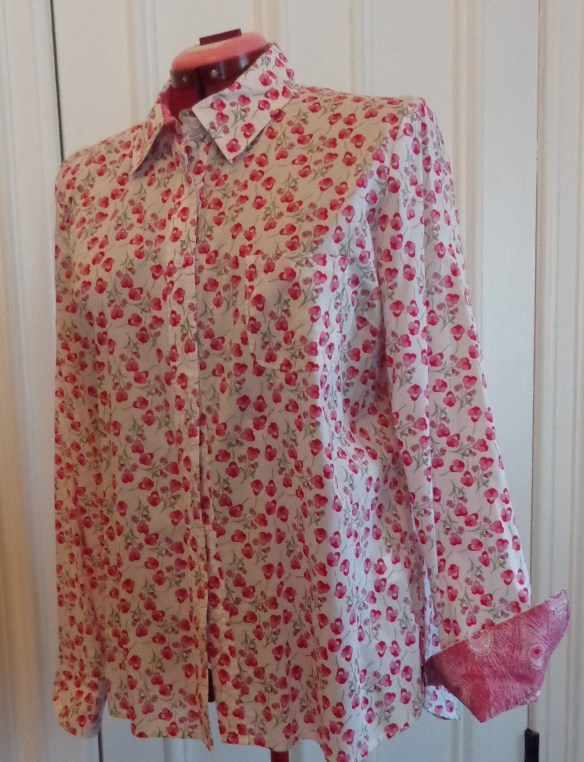
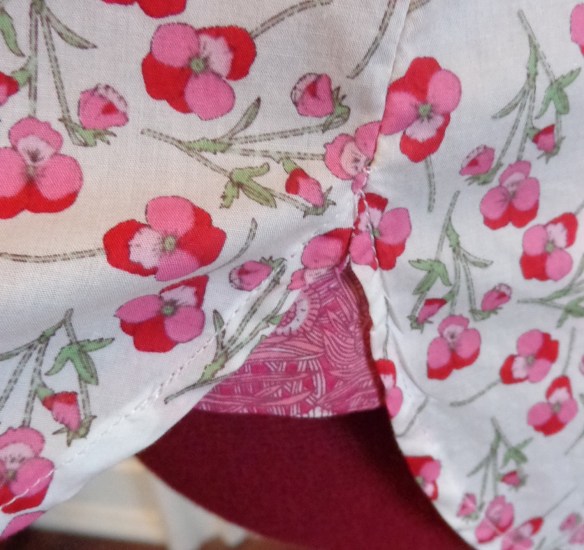
This could have been cool visually but there are too many layers of fabric and it’s too thick. This one has 8″ of positive ease in the bust, so my regular size would have been just fine. The sleeves are more than 2″ longer than the green one, and overall, the quality of the workmanship isn’t as good. Here’s a close-up of the topstitching so you can see what I mean.To be fair, I’m a much bigger fan of edgestitching than of topstitching.

In looking at pix online of these shirts, I’ve discovered that they also made the inverse versions, with Hera as the main print and the other as the contrast. I remember the pink Hera, because I thought it was too much pink, but not the green Hera. It must have been sold out or I would have been indecisive.

The pink shirt vexes me. I’ve debated the merit of shortening the sleeves a dozen times. I need to roll them up or let them dangle over my hands. For the moment, it just hangs in the closet. Inevitably, I decided to try to make my own shirt, in a Liberty print – or maybe more than one.

Here’s the first contender. This is a voile from Westminster Fibres (well aged in the stash), which was part of a line of fabrics they produced in cooperation with the Victoria & Albert Museum. This one was Ikat Damask in the navy colourway, on their Bromley voile. (Their fabrics are now made and distributed by FreeSpirit.) I bought it at a wonderful fabric store called the Greenwood Quiltery in Guelph, which has since closed. 😦 It was a road trip for me, so I didn’t go often, but oh, I could spend hours there. What a selection they had! The contrast is Kaffe Fassett shot cotton, also acquired at the same store. Here it is:Vogue 8927 made in Westminster Fibres V&A Ikat Damask navy Bromley voile

The pattern is Vogue 8927:Vogue 8927

I cut B, which looks a lot like a Liberty shirt. Vogue 8927 view BThis pattern has a one-piece cuff, which is folded during construction. I could have split the pattern piece into two to have the contrast fabric on the back, but I didn’t. I’m pleased with how this shirt came out, with the caveat that I never thought to check the bust dart and it is (alas) too high. In fact, it fits a lot like the green L&T shirt, being a little more snug in the bust than would be ideal. It’s likely that I checked the pattern against the L&T shirt before cutting.

This one has been waiting a while for buttons, because I had some issues with the fit. The shoulders were too broad for me, something I’m realizing is so common for me that I should anticipate it and fix the pattern before cutting, and that made the sleeves too long. I had to take out the sleeve, trim the top of the shoulder and set the sleeve in again. The bust dart is unfixable. :-/Vogue 8927

Interestingly, in taking the pic, I’ve discovered that the bust dart isn’t too high for Nelly – that shows how she and I have grown apart over the years. Other differences between this pattern and the readymade shirt are 1/ the buttons – the pattern specifies larger ones, set further apart. This invariably means that the second button is right between the breasts (or even a little lower for Nelly) and not above it, as is usually the case with a readymade shirt – and more modest. 2/ The button band and cuffs are slightly wider than the readymade shirts – about 1/4″ – and 3/ the hem is straight instead of being shirt tails.

One thing at at time. I modified the pattern slightly to correct the bust dart first. I cut this version in another Liberty print, again with Kaffe Fassett shot cotton for the contrast. Liberty of London Tana Lawn in Ros

The base fabric is Liberty Tana Lawn (100% cotton) and the design with the pansies is called Ros. Liberty’s website says it was designed in 2002. They’ve made it in a number of colours, including the pink in the ready-made shirt above, but I love this colourway with the black background. I’ve bought it twice – once at B&J Fabrics in New York and once online from Jones & Vandermeer. I’ve only bought from J&V the once, but it went well. I think B&J does online sales, too, but if you’re ever in Manhattan, it’s a wonderful store to visit.

I’m thinking of trimming the width of the button band and the cuffs slightly, since the buttons I have for this one are smaller in diameter. Hmm. If I do that, in order to ensure that the collar still fits the assembled neckline, I’ll need to use a smaller seam allowance between the fronts and button bands. Hmm.

I’ll show you the next shirt when it’s done!
Fabric Stores

Here’s an interesting article about changes in the market, specifically the decreasing number of fabric stores at the same time that sewing is becoming popular (at least with some people) again. The big issue for me is finding fabric, which is mentioned by some of the people interviewed for this article.

I’m in my 50’s so I’m not that old 🙂 but I do remember the resources that were available to my mom, almost all of which are now gone. My mom sewed a lot of my clothes and her own. In the sixties and seventies, every mall had a fabric store, as well as fabric and wool in the department stores that anchored the mall. When she was looking for something special, we’d go down to Queen Street in Toronto on a day trip, so she could shop at the flagship stores of Eatons and Simpsons, two big Canadian department stores. (That meant grilled cheese sandwiches for lunch at the Rainbow Cafe.) They both had huge fabric departments downtown.

We’d often go to Dressmakers’ Supply in Yorkville for buttons and I loved that place. I know they had a lot of things but all the boxes of buttons sorted by colour made me happy. They’ve been gone for years. (Yelp shows a Dressmaker Supply on Queen West but the original one was on Avenue Road north of Bloor, I think in a converted house.) It’s not a huge surprise that my second job ever was in a fabric store – a chain called Lizanne’s that (yup) doesn’t exist anymore.

I later discovered the fabric stores of Queen Street West, mostly Designer Fabrics, which closed in 2018. There was a guy in a little shop on the south side of Queen with buttons in boxes, just the way they’d had them at Dressmakers’ Supply. I don’t think I ever knew the name of the store – it was narrow and on the south side, so I’d always walk along until I found it, instead of looking at the signs. He’s gone, too. I love buttons and I love going through the possibilities for buttons for any garment, but that’s increasingly difficult.

At the same time, similar trends have happened in ready-made clothing. About 25 years ago, I used to go to the store in Mr. Leonard’s factory at King and Spadina. They sold new garments there, and I bought several suits, among other things. There was an elevator but I liked taking the stairs and hearing the sewing machines. They closed down in 1999. (They have a Wiki entry, though.) There used to be designers and pop-up fabric stores on Queen West and King West, where designers would sell off their bolt-ends. My mother-in-law would go fabric shopping with her dressmaker, then tell me where they’d gone. I bought a gorgeous piece of red silk from a pop-up store. The last time I was down on Queen West, it was pretty much all condos and retail chain stores. It’s great that people can live close to the core, but less great that it’s hard to buy quality garments made in Canada and quality fabrics for making our own.

I don’t want this blog to be all about nostalgia and woe over change. Change happens. But as I delve into my stash and remember where I bought lengths of fabric or skeins of yarn, it’s a bit sad to realize that so many of those retail outlets are gone. It’s also  frustrating to shop. There was a time when I knew where to go for what, or where to look first. Quilting fabric is often easier to find than garment fabric. I don’t love shopping online because I want to feel the drape of the fabric or test the spring of the yarn. I want to see the colours as they will appear to me, not as they photograph. All the same, online shopping has become a necessity. I love to buy fabric when I travel, too, but that’s also harder than it used to be.

But this is going to be the sum of my complaint on this subject. The article linked above makes me think that a lot of other makers share similar frustrations, so I’ll include the source of any fabric or yarn that I’ve used in my blog posts, and links when I can find them. I do have some new finds that I’m loving and will share their links when I sew from whatever I’ve bought from them. If you have suggestions for stores online or bricks-and-mortar, then please share them in the comments, and maybe we can all find some new places for supplies.

Red Heart Gemstone

Last week, on a beautiful sunny day, I drove up to Spinrite. Spinrite is in Listowel, Ontario. It’s a former mill for Patons, and has an outlet store. I don’t know how much yarn they spin there anymore – it seems that mostly they ball and band yarn for Patons, Bernat, Caron, Red Heart, Sugar Bush and other brands owned by Coats, which owns the mill. (You can see their yarns on the Yarnspirations site.) The outlet store has first quality yarns – mostly Patons and Bernat – for sale, as well as a lot of seconds and discontinued yarns/colours. I’ve bought a lot of seconds there over the years and quite often the issue is the weight of the ball: it’s too big or too small. One of the ladies there told me that these balls are the result of setting up the balling machines. They also stock an excellent range of needles in the brand I like (Prym) so when I need needles, I’ll often go up there and have a poke around the seconds bins while I’m there.

I found three balls that looked interesting on the seconds table on that last visit. Part of the fun (for me) is figuring out what the seconds yarns are. They don’t have bands, although they’re broadly separated by fiber – there’s a table for acrylic (although some blends slide in there) and one for cottons. The wool is usually in a box under one table since the ladies separate it out as they’re adding yarn to the tables. These three balls were all the same type of yarn – it was a marl spun of two gradient plies, bulky weight, a big ball and probably acrylic. I couldn’t find it in the store, but found it on the website when I got home.Seconds of Red Heart Gemstone

As if often the case, the colours are a bit off in the image. The red is much richer and deeper (for some reason, red always skews pink in pictures with this camera) and the mauve is deeper, too. The colour of the bottom ball is pretty true. It’s Red Heart Gemstone, which should be a 200g ball. These balls are all between 140g and 145g. I’m guessing that these colourways are Amethyst, Fire Agate and Flourite.

You can see that I’ve already knit one mitten from the Flourite. The second one isn’t going to match perfectly, which is making me twitch a bit (but not enough to break the yarn and discard this rosy section.) Mittens are my comfort knitting. I like knitting mittens when I’m thinking about other things because I don’t have to think about my knitting much. Also, mittens are finished faster than socks, especially when I use a bulky yarn like this one. I often to use an old Patons pattern, but it’s for worsted weight yarn. A couple of years ago, I found this fabulous pattern on Ravelry – The World’s Simplest Mittens by Tin Can Knits. This pattern has instructions for basic mittens in five sizes in four weights of yarn (fingering, DK, worsted and bulky). It’s a good clear pattern and it’s free. Here’s the Ravelry link and here’s the Tin Can Knits website.

Here are the first of my mittens:

If you’re interested in visiting Spinrite, you can find more information about the store and their tent sales, as well as directions, on their website right here. You can see the mill from the store, but I don’t think they offer tours. The stock of seconds and discontinued yarns changes all the time, so you never know what you’re going to find. That’s part of the adventure.

Fair Isle Sweaters on the BBC

There’s an article on the BBC website this week about Fair Isle sweaters, including wonderful photographs taken 50 years ago on the island, wearing their sweaters. It’s well worth a look.

I was surprised to see so many vertical designs in the sweaters, like the ones worn by Stewart and Triona Thomson. That’s a design element I don’t see as often as the round yokes or the horizontal bands.

And I liked seeing the knitting machines, then and now.

Have a look!

Update on Navelli

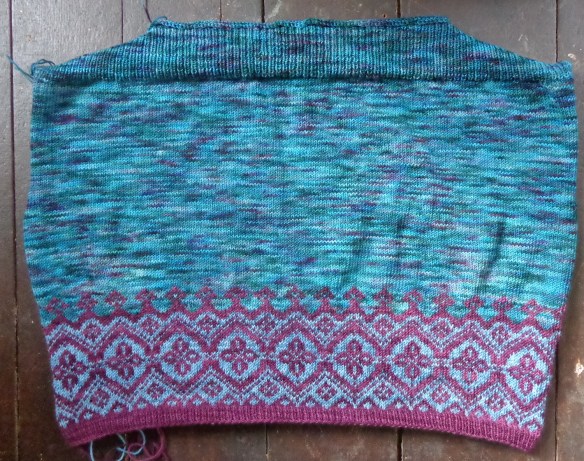
I feel as if I’ve knit this sweater three or four times, all due to knitter error, but it’s finally coming off the needles. Navelli is a short sleeved boxy pullover. I started knitting it last summer. There are two blog posts about it already: Navelli, Nightshift and Audrey, and Navelli in Koigu. I had initially started with a handpaint for the body of the sweater, which pooled in a way I didn’t like. I switched out to a more tonal handpaint, which I liked better. Then I messed up my row counts a couple of times, did a lot of frogging and reknitting, and now, the body is off the needles. Here it is!Navelli in Koigu KPPPM and Shibui Knits Sock knit by Deborah CookeIt’s very boxy and short. I’m surprised by how much I like the look of it on, since I’m a bit boxy and short! In a way, I want it longer, but I think it’s most flattering if that fair isle band is at the waist. The neckline is softer than I’d feared it would be – boat necks sometimes can be too tight, but this one is perfect. I’m not in love with the blue in the fair isle band, but I’ve made my peace with it.

It still needs sleeves – the pattern has short cuffed ones with ribbed edging. I think I’ll make mine shorter, since there’s already a lot of drape there, and will do the ribbing in the same purple as the hem. That’s the Shibui Knits Sock.

I do love the colours of the Koigu in the body. Here’s a close-up that shows the colours well if a bit darker than IRL:Koigu KPPMI’m starting to feel as if this one will be done in time for spring!
Treasure from the Thrift Store

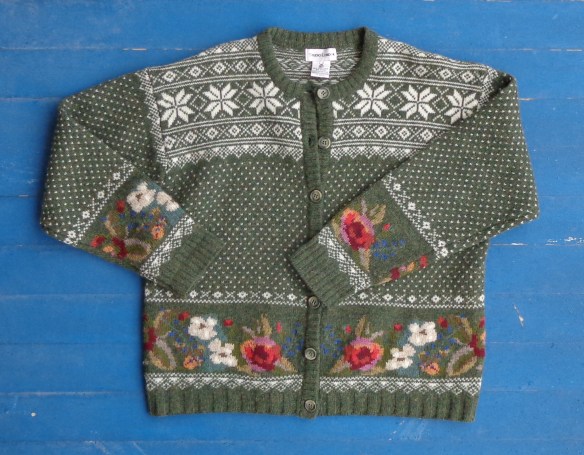
I found this sweater at the thrift store for a couple of bucks. It has a floral border around the hem – which matches at the side seams and must have been handknit – then a Scandinavian-style top. (You know that the white flicks in that stitch pattern are called “lice”, right?) It’s 100% wool and in good shape (no moth holes). It was made in Hong Kong and was sewn for the finishing – the button bands are sewn on and the button holes were worked by machine. So, it’s partly machine made, but very pretty IMO:

I washed and blocked it. Then because I am the way I am 🙂 I changed the buttons to give it a new look.

The buttons cost me more than the sweater, but I like them. What do you think?