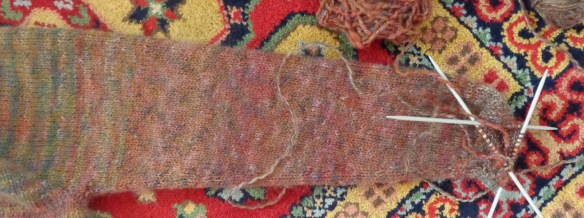
The Red Koigu Cardigan Completed

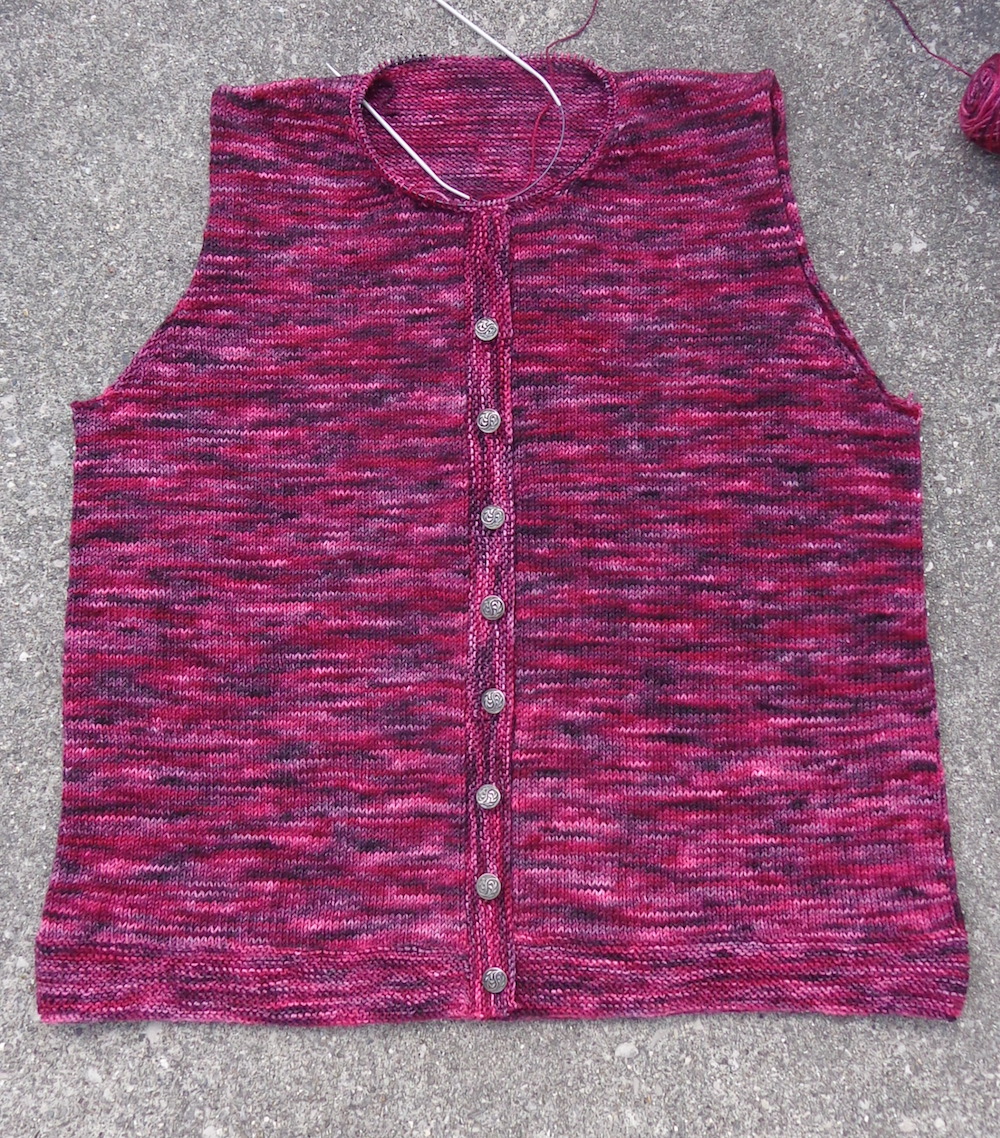
I finished my red Lunenberg cardigan (that’s a Ravelry link) and I just love it. This is a basic cardigan but using the Koigu KPPPM really made it spectacular.

Lunenberg Cardigan by Andrea Hungerford knit in Koigu KPPPM by Deborah CookeOnce again, the colour isn’t true in the pictures. It’s a cherry red, but seems to photograph pink.

I was really pleased that the colours didn’t pool at all. The sleeve caps ended up looking a bit lighter than everything else, but it was just the way the colour worked out.

I showed this sweater to you earlier, without the sleeves, in this post.

I changed out the ribbing for garter stitch, because I really like how KPPPM looks in garter stitch. I used just over 8 skeins of KPPPM, so there could be another of these in my future. Here’s the link to my project page on Ravelry.

What do you think?

The Wingspan Shawl

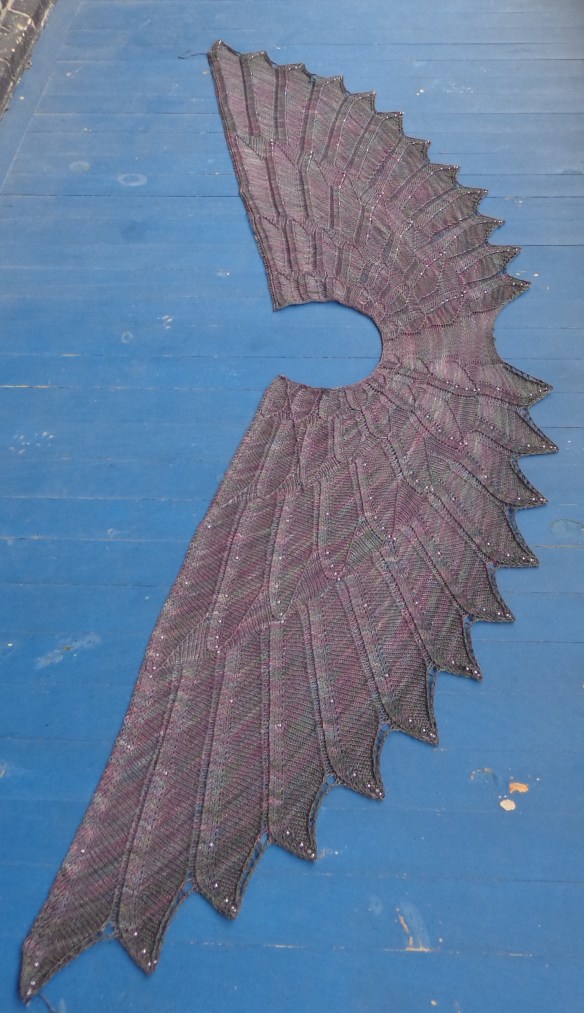
It’s finally finished and here it is:Wingspan shawl by Kyle Vey knit in Briar Rose Fibers Sea Pearl by Deborah CookeIt’s so big that it was hard to take a picture!Wingspan shawl by Kyle Vey knit in Briar Rose Fibers Sea Pearl by Deborah Cooke

This is the Wingspan shawl, a pattern that was released this past spring. I substituted a yarn from my stash – Briar Rose Fibers Sea Pearl – because I thought it had a shine like raven’s wings. One skein was also the right quantity for the shawl. This stash-busting plan went awry, though, because I ran out of yarn and bought another skein to finish the wing tips. So, now, instead of having one skein of Sea Pearl in my stash, I have .9 skein in another colourway. C’est la vie.

I also went up a needle size, because I thought the fabric was too tight. That might be why the shawl is so big. I blocked it hard in a slight V and it’s 78″ from wingtip to wingtip.

Although it’s an amazing and unusual shawl design, it’s was less difficult to knit than I’d expected. If you’ve ever knit a chevron stitch, this is similar. I found it a little tricky at the beginning to get my bearings, but stitch markers were a big help. Once I got the hang of the pattern and could read my knitting, it became a bit repetitive (but not a TV knit for me.) The transitions – between each tier of feathers – were the challenging part for me and I had to follow them very closely. I don’t love the transitions, btw, and wish the spine of each feather started sooner in the transition, as soon as the stitches are available instead of all feathers beginning at the end of the transition, but it would be a lot more complicated that way. The transitions blocked out better.

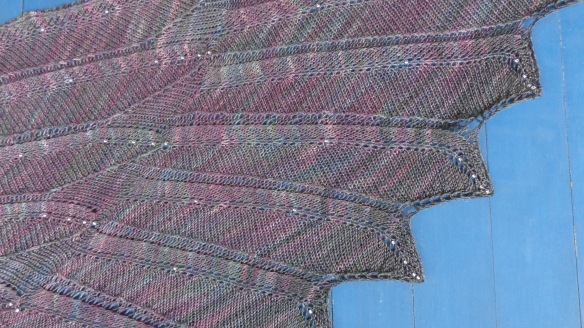
Here’s a detail shot. It’s hard to capture the subtlety of the colours in this yarn. It really is lovely.Wingspan shawl by Kyle Vey knit in Briar Rose Fibers Sea Pearl by Deborah Cooke

You can see the transitions I’m talking about, below the tier of feathers on the left and before the ones that hem the shawl (and fall to the right). They’re triangles of stockinette stitch, filling the space between each feather on the previous tier.

You can see that I added some beads, too. I really should have used a lot more of them.

Phew. I’m glad to have that one off the needles! What do you think?

Progress on the Red Cardigan

I haven’t had any knitting to show you for a while, because I’ve been knitting away on a couple of big projects. I’ve almost finished the Wingspan shawl – I’ve knit the wing tips and cast off half of the shawl width. I have to do the other side, then block it, so I should have that to show you soon.

Here’s a progress report on my red cardigan in Koigu KPPPM. I’m working on the collar right now – you can see my needle in the stitches – then have just the sleeves to knit.

Lunenberg Cardigan by Andrea Hungerford knit in Koigu KPPPM by Deborah CookeOnce again, the colour looks a lot more pink in this image than it actually is. The yarn is a wonderful rich red and not very pink at all. (I talked about that in my last post about this project.) It actually matches the currant jelly I made this week. 🙂

The pattern is the Lunenberg cardiganhere’s a Ravelry link. The pattern is included in By Hand Serial #9 – you can see more about that publication on their website, here.

I’ve made some changes. Instead of ribbing on the hem, button bands and collar, I’m using garter stitch – mostly because I love how garter stitch shows off the colours of Koigu. I made a mistake in my calculations for the button band – there are supposed to be 8 buttons on the button band and one in the collar, but the way I figured it out, there are 9, plus the one in the collar. I’m not going to rip it back because I have another card of these buttons. Here’s my project page on Ravelry.

I am loving the softness and the colours of this yarn – which means, yes, we’ll be making another trip to the Koigu tent sale this August.

What do you think?

Red Koigu KPPPM Cardigan

It’s Fibre Friday again, and time to peek in on my knitting projects. Progress on my Wingspan shawl came to shuddering halt this week, when I realized I would run out of yarn. You might remember that I went up a needle size and wondered if I’d run out. Well, I will. So, I stopped knitting and ordered another skein of the same yarn – it’s Briar Rose Fibers Sea Pearl. The yarn is 50% merino and 50% tencel, and has a lovely sheen. I didn’t think that mixing in another yarn even for the border would look right.

The colour and dye lot aren’t marked on mine and it’s been aging in the stash for so long that there’s no way the colour would match anyway. I had a look at their website and think mine might be colour 1841. (It’s also possible that it’s a colour they don’t dye anymore.) I ordered a skein of 1901 (it’s on the second page of colour samples) which is a grey. It looks quite similar to mine but without the pink, which should make the hem look a bit darker. And the grey is probably the same dye.

While that project is on hold, I wanted to knit something other than socks. I had another poke through my needle stash and found a pair of 3.5mm circulars. Yay! They’re only 60 cm long, but that’s plenty for a cardigan knit in pieces. You know what happened next – I cast on the Lunenberg Cardigan in my red Koigu.

Here’s what it looks like so far:

Lunenberg Cardigan by Andrea Hungerford knit in Koigu KPPPM by Deborah CookeIt’s interesting how pink this shot looks on my computer. The yarn is actually a gorgeous variegated cherry red and I just love it.

The colour number is 329. I had a look at the colours on Koigu’s site, and it looks even more vividly pink there. It looks more like #859 on this page.

This cardigan is knit top down but in pieces – this is the back from the shoulders down. I have a few more inches to go before doing the ribbing (which will give me time to decide whether to knit ribbing or another edge) but I’m very happy with how it’s coming out.

What do you think?

Starting the Wingspan Shawl

If you’ve been conscious over the past two weeks in the knitting world, you’ve probably seen the Wingspan shawl. This is an incredible design that looks like a bird’s wings. The original is very striking because it’s knit in a hand-dyed ombré yarn that shades once over a colour progression in 800 yds or so. The kit went on sale last Saturday at the Knitter’s Frolic in Toronto, and the pattern went on sale on Ravelry the same day.

You know I bought both. 🙂

Here’s the Wingspan pattern on Ravelry.

Here’s the kit at Blue Brick Yarns.

There’s (predictably) a backlog on yarn orders – this pattern has gone viral – so I cast on the shawl in Briar Rose Sea Pearl, a yarn in my stash which comes in an 800 yd skein of fingering, just like the specified yarn. This is a handpaint, not an ombré, so the wings won’t shade. Sea Pearl is 50% merino and 50% tencel, so it has a shine. This skein has always made me think of a bird’s feathers, so it seemed the perfect choice. I’m not sure what colourway mine is as it’s not marked on the tag and there seem to be a few contenders on the Briar Rose site – if they even dye this colourway anymore. My skein has been well-aged in the stash.

Here’s the skein before I caked it up:And here’s my progress on the shawl.Wingspan shawl by Kyle Vey knit in Briar Rose Fibers Sea Pearl by Deborah CookeYou can see that I’ve finished the second row of feathers. (There are four rows altogether.) I’m really pleased that there’s no pooling of the colour. My beads have arrived (they’re pewter with silver linings) so I’ll be adding them to the rest of the shawl.

This is a really lovely knit. It’s quite addictive. Although the instructions are written, not charted, once I got the hang of what is going on, I didn’t need to read every line anymore. (I’m not sure that this pattern could have been charted.)

What do you think?

Easy as Mirri 1-2-3

I’ve been learning to sew with knits lately, which has proven to be a lot of fun. Today, I’ll show you three versions I made of a dress pattern called Mirri, from Wardrobe By You. It looks like a wrap dress but actually isn’t—the bodice is sewn in place, which is how I prefer wrap dresses. (They can’t come unwrapped this way.)

Here’s my first Mirri, modelled by the ever-lovely Nellie:Mirri dress from Wardrobe by Me knit by Deborah Cooke

This is sewn from a knit fabric that I found in the sale bin at my local fabric store. It’s probably a polyester and lycra blend. The idea was that the test-sew would be cheap—and disposable, if it didn’t work out, but pretty enough to wear, if it did work out.

This pattern has a minimum of pieces—left front, right front, back bodice and the skirt, which is the same for front and back. The fronts have self-facings, and there are two bands to finish the sleeves. No zipper or fastening. You just tug it over your head.

The dress is quick to cut out and quick to sew—the only note I made on the instructions was to finish the edge of the self-facing on both fronts before sewing the dress together. (Because you know what I did the first time.) I used the serpentine stitch on my machine to do that, then the overlock stitch for the seams. I sewed down the collar with the twin needle and top-stitched the sleeve band with it, too.

For the hem, I pressed on a narrow strip of fusible knit interfacing to stabilize the hem, pressed it into place, then sewed it with the twin needles, too. I like how polished that finish looks.

The fit is perfect and the length is just right. No fitting changes! Yay!
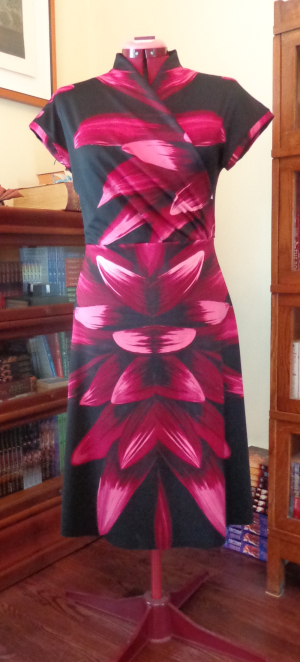
Mirri dress from Wardrobe by Me knit by Deborah CookeI cut out a second Mirri in a scuba knit, which is heavier than the first knit fabric, that I also found in the sale bin. The image on the scuba knit was printed in 80cm panels, and also mirrored on the center fold. I pushed this around a bit and decided that there was no ignoring that mirroring so I should work with it. I centered the skirt pieces and the bodice back on the center fold. Each skirt piece used the better part of one 80cm panel, then the bodice pieces all came out of the third one.

This one is a bit bolder, but I like it a lot:
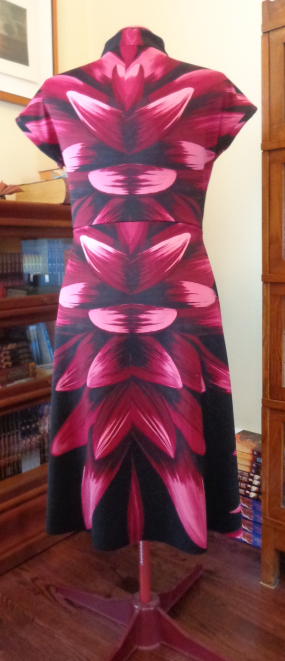
Mirri dress from Wardrobe by Me knit by Deborah CookeThe side seam on the skirt mirrors similarly to the center front and center back.

This version of the dress taught me a lot about the differences between knit fabrics. The scuba knit is a lot thicker so I made a few changes as I was sewing. On the first dress, I pressed both waist seams down, but to avoid bulk at the side seams in the scuba knit, I pressed one up and one down.

By this time, I also had a system for the collar. You sew the bottom of the collar (on the fronts) to the back neck, then the shoulder seams after that. This is the only tricky bit, as there is a nice 90 degree corner at the end of the collar seam where it meets the shoulder seam. I had the best luck sewing the shoulder seams from the sleeve toward the neck on each side. I pressed the collar seam up (towards the collar) and the shoulder seams back. I had turned under the seam allowance on the back neck facing on the first dress, making a neat inside collar with no visible seam allowances. On this one, I finished the facing and didn’t turn it under, which reduced the bulk of the seam. It still looks neat, and I like the look of the twin needle stitching to hold the facing in place.

This dress fits more snugly and the collar stands up higher. The scuba knit just has less stretch and drape. (I think it’s going to be warmer, too.) In future, I’ll cut a little more ease when using a scuba knit.

You can also see that while I was sewing the second Mirri, Nellie’s corner got a little more crowded. Now, she has to share the space with a bookcase to hold my stock for booksignings, as well as (inevitably) some dragons.

Mirri dress from Wardrobe by Me knit by Deborah CookeFinally, I graduated to more expensive fabric. I’d been saving this piece of cotton and lycra knit until my skills improved. It’s from the Netherlands and is really amazing. I loved it as soon as I saw it, but wasn’t sure what to make with it. Mr. Math always hums Go Ask Alice when I pull it out to look at it and it is a bit wild. (That’s why I love it.) I should have taken a picture of it uncut, but you can see it at EmmaOneSock where I bought it – this link will take you to their product page for this fabric, if they still have any of it left. I actually used the pieces cut of the scuba knit as my pattern when cutting this out—then I used the first cut skirt as a pattern to cut the second, so I could make sure the pattern matched up.
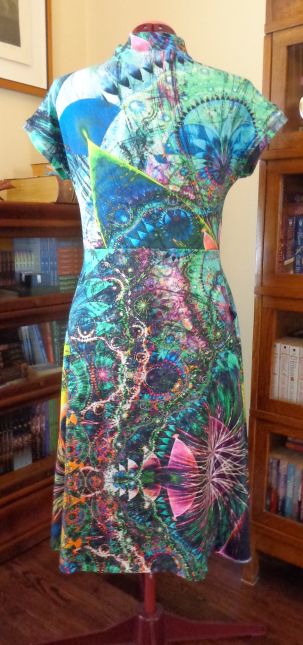
Mirri dress from Wardrobe by Me knit by Deborah CookeIt still needs a good pressing, and to be hemmed, as well, but Nellie really wanted to try it on:

Since I only had two panels, I didn’t have many options for placement of the pieces. In hindsight, I don’t know why I was convinced that the two skirt pieces had to be identical. There really is no matchy-matchy with this fabric and more chaos might have been more interesting. Also, if I’d used another zone for the second skirt piece, the two front bodices would have been more different than they are.

This knit is stretchier than the scuba knit, but still a bit thicker than the first knit fabric. The fabric is fabulous – very soft. It does have a little more tendency to stretch in the cross wise direction – and ripple – so I’ll stabilize the shoulder seams with interfacing the next time I knit with it. The fit is (no surprise) right in between Mirri 1 and Mirri 2.

I feel as if my choices for pattern placement didn’t do justice to the fabric and might have to buy another panel of it to make a T-shirt.

I’ve cut out (yet) another Mirri, but will show you that in another post. It’s in a lighter knit than the first one so I’m going to line at least the bodice. (New challenges abound!) Also, I’ll play compare-and-contrast between it and a wrap-front dress that I’ve cut using a pattern from one of the big pattern companies.

And yes, I love wearing dresses. 🙂

What do you think of my Mirri‘s?  The more, the Mirri-er?
Comfort Fade Cardigan 2

I’ve been working away steadily on my Comfort Fade Cardigan and have an update – it’s almost done!

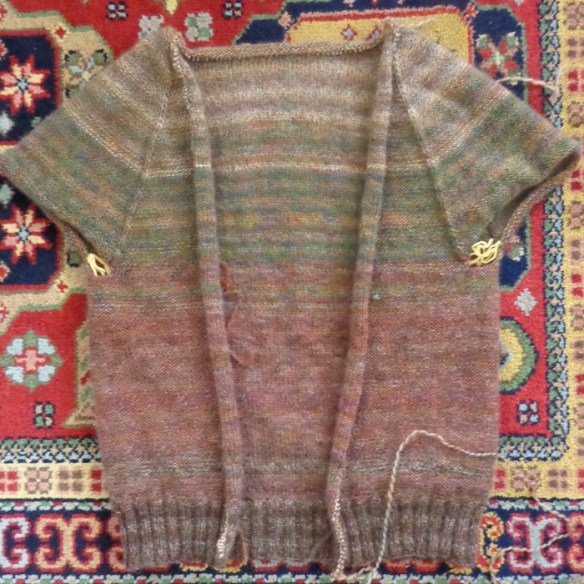
The previous post on the sweater is here. I had finished the yoke and was comparing the fit to other sweaters in my closet. Here it is after I finished the body. (This one is top-down, so I did the bottom ribbing last.) It was tough to confirm the fit because the collar ribbing is so wide – at this point, when I tried it on, it seemed to be falling off my shoulders.Comfort Fade Cardi by Andrea Mowry knit in Rowan Colourspun by Deborah CookeI picked up the stitches to do the neck next (before the sleeves) to manage my yarn. I didn’t have enough of all the colourways, so decided to do the neck, then use half of whatever was left for each sleeve.

When I picked up the stitches for the neck, I forgot that the right side of the cardigan shows the purl side of the reverse stockinette. I also followed the directions and picked up with the first colour, which is my lightest one. At the bottom is my pick-up from the wrong side, which doesn’t look good on what will be the right side. At the top is my pick-up from the right side, which looks better.

Comfort Fade Cardi by Andrea Mowry knit in Rowan Colourspun by Deborah CookeI did decide to frog and reverse the order of the colourways on the collar, picking up with my last colour, which is the brown. It blends in better and looks neater. See?Comfort Fade Cardi by Andrea Mowry knit in Rowan Colourspun by Deborah Cooke

The collar is shaped with short rows for this sweater and it’s huge. In the picture above, you can see the wedges of short rows that add to the depth of the collar. It’s quite squishy and luxurious.

I cheated on the sleeves and knitted them inside out. (Ha. This makes me feel so clever.) This way, I could knit them in the round instead of having the purl them. The only thing is that I had to remember to leave the ends on the side facing me, not the opposite side as usual.Comfort Fade Cardi by Andrea Mowry knit in Rowan Colourspun by Deborah Cooke

The sleeves are a little long and I didn’t finish all of the decreases as specified. Here’s the almost-completed sweater – I balled up the other sleeve in the shoulder and you can see one of my DPNs peeking out there:Comfort Fade Cardi by Andrea Mowry knit in Rowan Colourspun by Deborah Cooke

I couldn’t crop out that wonderful beam of sunlight. It’s so nice to see the sun again!

I’ll take some more pictures when the sweater is done. All I have to finish is that cuff. What do you think?

Comfort Fade Cardigan 1

There is a new(ish) knitting trend to knit with colours dyed in a progressing, fading from one to the next. For me, this started with Andrea Mowbry’s shawl Find Your Fade, which was published in December 2016 and is enormously popular. There are over 8000 projects on Ravelry! Andrea has designed other knitwear that features this kind of colour shift, and I’m knitting one right now.

Her Comfort Fade Cardi is an open-front, shawl collar cardigan, which is knit from the top down. It has raglan sleeves and requires four colours to fade into each other over the length of the cardigan. Since I always find it a bit dull to knit cardigans in stockinette stitch, I thought that watching the colours might motivate me. (It worked for my Hebrides cardigan, knit in striped KidSilk Haze.)

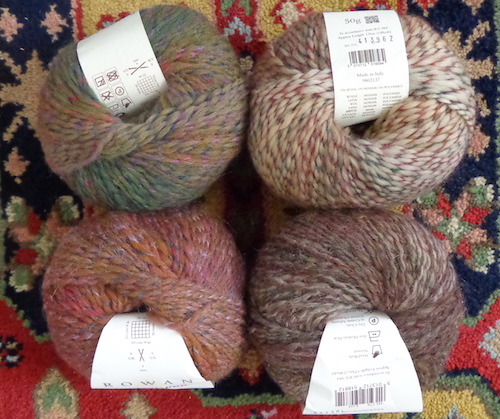
Rowan ColourspunFor this project, I raided my stash and chose my leftovers of Rowan Colourspun. I had knitted Mr. Math a vest in this yarn, then bought more to make myself a sweater when it was discontinued. Here’s a post about his vest. The pattern is called Skye.
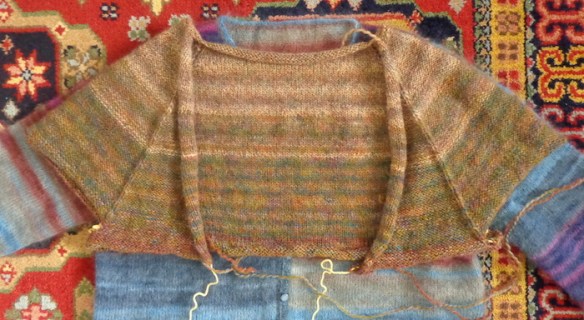
So, in my stash, I have a russet, a brown, a green and a taupe in the Colourspun. This yarn has a gradual gradation and is kind of heathered. I thought it would be a good choice for a fade. I don’t have the right quantities that the pattern calls for – I have enough yardage, but more russet than I need and less brown. The yarn is discontinued, so I’ll work it out.

Comfort Fade Cardi by Andrea Mowry knit in Rowan Colourspun by Deborah CookeHere’s the cardigan as of last Sunday. I’d just divided for the arms. You can see that the ribbing for the neckline has a good bit of space to fill – this sweater is designed to be worn open, so the fronts with the ribbing will just meet. It’s also designed so that the purl side is worn out, which makes it look even more blended.
I used the taupe first, then the green and have just started to fade into the russet. think it’s funny that the brightest bit of the taupe fell in the last two rows of it after fading into the green. 🙂

Here’s a look at the many colours in this yarn – I’ve been knitting more since the other pix were taken on Sunday, so it’s longer now:Comfort Fade Cardi by Andrea Mowry knit in Rowan Colourspun by Deborah Cooke

At the right is the taupe, fading into the green – which you can see is striping on its own – then into the russet. At the left, I’ve just started to transition to the brown.

I have a hard time getting a good fit with top-down raglans, but I think I’ve finally figured out why – which means I know what to do about it in future. I hadn’t finished the specified increases but it looked big, so I took it off the needles to try it on. (This is a very cool thing about top-down raglans – you can try them on as you go.) Then I compared it with a sweater I already have, which fits – in this case, one of my Hebrides in KSH. The Hebrides has a closer fit and is in a finer yarn, but you can see that it was definitely time to break for the sleeves. If I’d knit those remaining 12 rows, the sweater would have been droopy.Comfort Fade Cardi by Andrea Mowry knit in Rowan Colourspun by Deborah Cooke

And here’s where I had my Eureka moment. See how wide the neckline is compared to the other sweater? Of course, the style is different, but when I try it on, it’s trying to fall off my shoulders. I’m narrow in the shoulders and when I sew, I always cut a smaller size above the bust to accommodate that. I should be casting on a smaller size than the one specified for my bust when I knit a raglan sweater for exactly the same reason. Aha!

I’m not going to frog this and start over, though. It’ll be a little slouchier than the original design, but I really like it. I have a feeling I’ll be knitting this pattern again, and will incorporate my changes then. In the meantime, I can fix another sweater that’s been waiting on me because I know what to do.

What do you think of this cardi so far?

My Escher Quilt

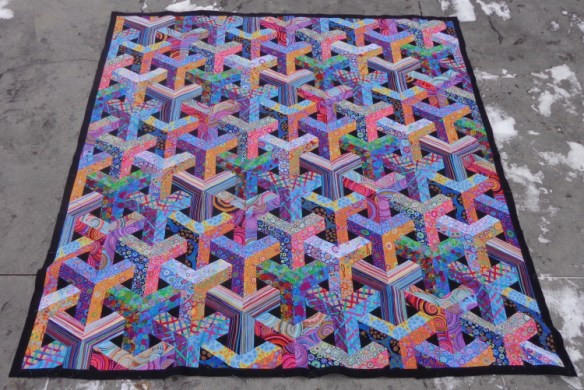
Last fall, I told you about a quilt kit I’d ordered. (That post is here.) The pattern is called Escher and the kit came with Kaffe Fassett fabrics to piece the top. I pieced it in December and here’s what it looks like:Escher quilt from kit pieced by Deborah Cooke

It’s much MUCH more vivid in real life.

This pattern was pretty easy to sew and the instructions were clear. I enjoyed putting it together. There was extra of every colour, so when I made a mistake in the final piecing (I cut a block that I shouldn’t have) I had enough to remake that block. The black was used for the little triangles at the center of each block: I cut up what I had left to make the widest black border possible. It’s not very wide but I like how it frames the bright colours. The top is about 62″ by 64″. I tried a couple of borders but thought they made it too busy, so it will be a bit of a small finished piece.

Mr. Math loves the finished top, but it’s a bit too wild for me. I think I might do this again, with solids or with a more restricted palette. This will be the first top that I take to be quilted on a long-arm machine, and I’m curious to see how that works out.

What do you think?

A New Quilt Top

I told you a few weeks ago about the Escher quilt pattern I’d bought, and mentioned that I needed to finish another quilt top before starting that one. Today you get to hear about the quilt in progress. It took me a bit longer than expected because I had to rip back the borders and redo them.

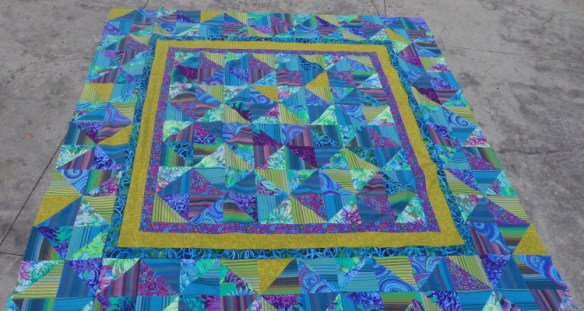
I saw a quilt made in this pattern during the summer (it was red and white) and I thought it was pretty, so I doodled down the pattern. I don’t know the name of the pattern, but here’s my version:Green and purple quilt pieced by Deborah Cooke

It’s just half square blocks sewn into larger blocks. I chose to make the central diamonds in each block darker in the middle section, then also alternated florals and stripes all the way around. On the outside borders, that protocol doesn’t quite hold. 🙂 I sewed the outside blocks on and ran outside to get a picture before the sun was gone, so it still needs a good pressing. It’s a bit more green than it looks here, and it needs another outside border. I think I’ll use that dark blue/green batik that is in the last border before the outside blocks. It’s about 72″ on a side right now.

I like it, and that it ended up with a contrast between stripes and florals. As usual, I was more concerned with pattern than value, and I did let the pattern placement fall randomly, but I still am pleased with the result. Many of the fabrics are Kaffe Fassett fabrics – all of the stripes and many of the florals, too. Those mustard dots and the blue/green batik are rogue. 🙂 Once the borders are on, I’ll need to quilt it.

What do you think?