Vogue 1477 and Vogue 9300

I’ve been sewing again lately, which I really enjoy. Part of what made me get back to it was the gift of a new-to-me serger. Oooo, what a wonderful thing! I could sew all those knits that had intimidated me before! I bought some patterns and scoured the discount bins of my local fabric stores for knits. I haven’t had much luck with patterns for woven fabric in recent years – nothing seems to fit, despite my efforts – so I wanted to test the knit patterns first.

This was a plunge back into the pond.
There are two funny things about the results:
1. I haven’t used the serger yet. It intimidates me, so I’ve been using the overlock stitch on my favorite machine.
2. Every single garment I’ve sewn of knit fabric fits. Really.
First time.
Every. Single. Garment.

This is incredibly exciting!

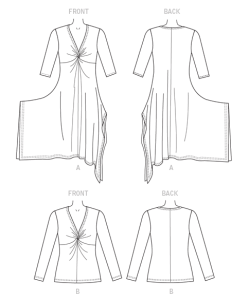
So, let’s look at some of the results. First up, a Sandra Betzina pattern, Vogue 1477, which has a va-voom gathered front. Apparently, it’s also out of print.

I bought a remnant of this olive green print. I don’t know all the names of the various kinds of knits: this one feels like a silky t-shirt knit.

Vogue 1477 sewn by Deborah CookeI cut my size and held my breath as I sewed it up.

The body was a bit long. I shortened it by almost 3″ before hemming. The v-neck plunges a bit deeper than is my usual style, but I like it (and I have no idea how to modify it.) Here’s the result – the ever-stylish Nell is wearing it with a favorite black wool 8-gore skirt of mine from Daniel Hechter Paris.

You can see that the neck plunges deeply, but it still looks good.

Vogue 1477 sewn by Deborah CookeI also bought about 3 meters of a russet and black print. It feels like it belongs in t-shirts but is more cottony than the first one. So, I cut another of the Sandra Betzina tops from it and sewed it up.

Another great fit!

I’m going to cut a dress from this pattern in a green abstract knit, extending the lines for a flared skirt instead of the squared-off one shown in the tunic pattern. I believe this knit fabric is called a scuba knit. I’m pretty excited about this, and will show it to you once it’s done. It’s still on the dining room table right now. 🙂
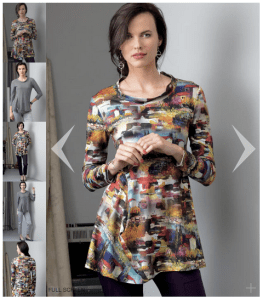
Next, I cut a Marcie Tilton swing top out of the russet and black fabric. This is a fun t-shirt with a bit more style. The pattern is Vogue 9300. The line drawing doesn’t really show that there’s a little horn on that diagonal seam at the front.

I cut the shorter version, but because I’m short 🙂 it probably looks like the longer version on me. The neckline is a little deeper than I wanted, but I followed the pattern the first time.

Here’s my test swing top.You can just barely see that Nell decided my little black suede boots would be perfect with this combo.
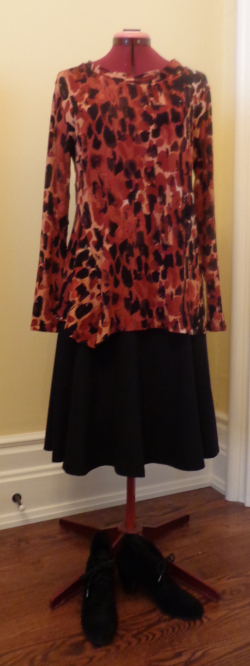
Vogue 9300 sewn by Deborah CookeI liked this top enough that I started to think about variations. (I also discovered Marci Tilton’s blog, which has a post about this pattern and possible variations. It would have been good if I’d found this before I started sewing the pattern but there you go.)

In my treasure hunt for knits, I found a fuzzy knit in the discount bin, which is very soft, in black with cream. I’ll call it a sweater knit, because it makes me think of cozy dresses, although that might not be technically what it’s called. I changed the neck to more of a cowl and extended the length to make a dress. I also went down a size in the bodice – even though I made my size in the orange top, it seemed a bit generous. I thought negative ease might work better, especially as this softer knit was more drapey.

This post is getting a bit long, so I’ll show you that dress, and the green one from the Sandra Betzina pattern, in another post. What have you been sewing lately?
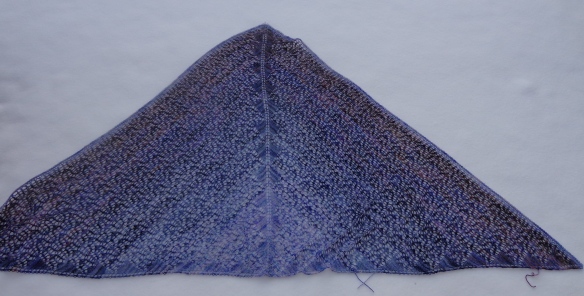
Charlotte’s Web Shawl Finished

Today’s Fibre Friday post is a little late, because I needed to wait for some light to take pictures. We had snow, so that made a good backdrop, but it wasn’t sunny yet so the colours are a bit dull compared to real life.

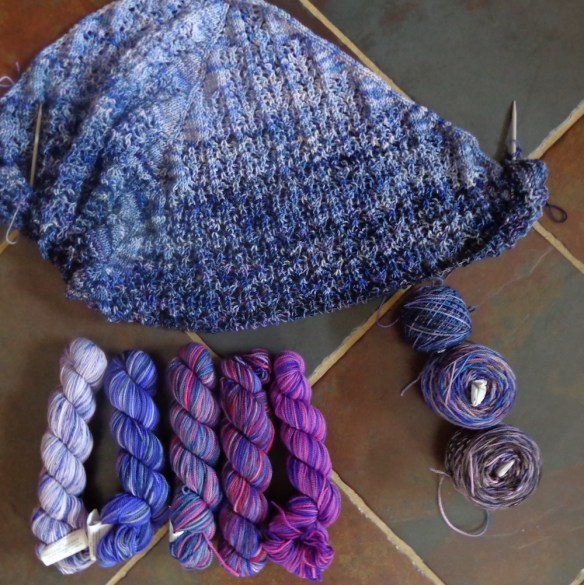
This is my Charlotte’s Web shawl, knit in Koigu KPPPM. I bought a kit with ten skeins in shades of purple and the pattern book. Here are the skeins and the shawl in progress:Charlotte's Web Shawl by Maie Landra knit in Koigu KPPPM by Deborah Cooke

I’m using the progression at the lower right corner. The other five skeins are the remaining ones from the kit that I didn’t use in this shawl. You can see that the lace pattern is bunched up. I knew it would blossom when it was blocked, and wow, I was right.Charlotte's Web Shawl by Maie Landra knit in Koigu KPPPM by Deborah Cooke

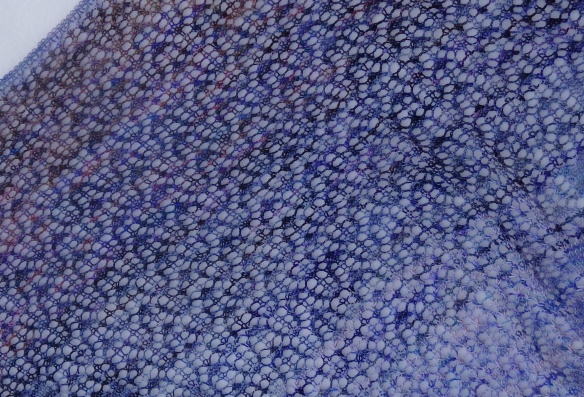
The blocked shawl is over a meter deep. I really like the colour gradation in it. I was worried about the fifth colour, that it might be too inky, but IRL it picks up the rosy and inky tones of #4.

As mentioned before, I decided against the fringed edge and tried to use up all the yarn instead in the shawl. I knit the last four rows with the first colour, then did an I-cord bind-off with it.

Here’s a close-up of that lace pattern:Charlotte's Web Shawl by Maie Landra knit in Koigu KPPPM by Deborah Cooke

What do you think?

Fingerless Gloves in Sock Yarn Free Pattern

I work in Mr. Math’s office when I format book interiors and upload content to the retail portals. It’s colder in there than in my office, and my hands get chilled. Recently, I decided to solve that. I dove into the stash and found two colours of Koigu, then knit myself a pair of fingerless gloves.Fingerless Gloves by Deborah Cooke knit in Koigu KPPPM by Deborah Cooke

The two colourways coordinate so well that it’s hard to see that there are two colours. The second one had that darker aubergine in it and a brighter chartreuse.

I knit the cuff in the first colour, striped them through the hand, then did the fingers in the first colour again. This is a pattern that I just made up as I went. The directions are below, mostly in case I need them again to knit another pair. 🙂

I do like the thumb gusset.Fingerless Gloves by Deborah Cooke knit in Koigu KPPPM by Deborah Cooke

• Wool: 55g of sock yarn in one colour, or 30g colour A and 25g colour B for stripes
• 2.75mm needles. (I used DPN’s but a pair of short circulars would also work)
• markers
• stitch holders

• Cast on 60 stitches in A and join in round. PM at beginning of round.
• Work 2/2 rib for 24 rows.
This is the cuff.
• For the hand, if making stripes, work 6 rows of B, 2 rows of A, 6 rows B. If not making stripes, work 14 rows.

Begin thumb gusset, continuing in stripe pattern:
• work to first knit ridge. M1 before the knit ridge, PM, K2, M1, then finish the round. Work 1 round, knitting the new stitches.
You now have a 4-stitch knit ridge. The outside stitches (which you just made) will be the outer boundary of the gusset and new stitches will be made on either side of that same central knit ridge. The marker will stay before the two central knit stitches and indicates the place for the first increase.

• Next row,  work to the 4-stitch knit ridge. K1, M1, keep marker here, K2, M1, K1, continue to end of round. Work one row, knitting the new stitches.

• On R13, work to the 6-stitch knit ridge. K1, M1, K1, keep marker here, K2, M1, K2, continue to end of round. Work one row, purling the new stitches.

• Continue, increasing 1 stitch before and 1 stitch after the central 2 knit stitches to 84 stitches. You will have increased twelve times for a total of 24 new stitches, and the 2/2 rib will be complete all the way around.

• Keep the 26 stitches of the thumb gusset on your needles and place the stitches for the rest of the hand on a stitch holder. Work once around in A in 2/2 rib, making two new stitches in the gap that will be the base of the thumb. On the second row, purl these stitches. Work 3 more rows and cast off thumb.

• Put the remaining stitches back on your needles. Work 1 round, picking up two stitches at the base of the thumb from those two cast-on stitches. They’ll be knit stitches on the next round. Work 6 more rounds in B, finishing the last stripe, and break B.

• For index finger, put 16 stitches on your needles (8 on either side of the thumb), make two stitches on the side opposite the thumb, join in round and work 8R in A, then cast off.

• For middle finger, put the next 8 stitches from the back of the glove on the needles, using A, pick up two stitches from the two created on the side of the index finger, knit the next 8 stitches from the front of the glove, make two more stitches in the space that will be between the middle and the ring finger, join in round. Work 8 rows, then cast off.

• For the ring finger, repeat, picking up 8 stitches from the front and back, and two on each side.

• For the small finger, work on the remaining 12 stitches, picking up two between the small finger and ring finger. You might want to only knit 6 rows before casting off.

Sew in the ends and be warm!

Stylish Dress Book – Sleeveless Dress A

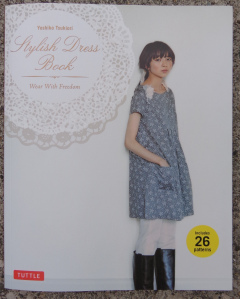
Time for more reports about sewing from Japanese pattern books. Today’s feature is a sleeveless dress pattern (A) from Stylish Dress Book.

Pattern A  is an A-line sleeveless dress. I made it first in black linen – since I’d had such success with the smock, I decided not to do a practice dress.

Sleeveless Dress A from Stylish Dress Book sewn in linen by Deborah CookeIt came out beautifully, although I found it a little tough to roll the narrow bias hem with the linen. The pattern calls for a lighter fabric and the weight made a difference on that narrow bias. If I used linen again, I’d cut the bias strip 1/4 wider.
I love how it looks. It’s a great layering piece.

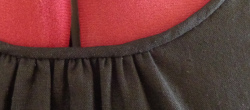
Sleeveless Dress A from Stylish Dress Book sewn in linen by Deborah CookeHere’s the neat neckline. It’s a little detail that gives the dress the perfect interest, I think.

I made another one of these in a red cotton border print. This is a lot more flashy, but also a fun simple dress.

Sleeveless Dress A from Stylish Dress Book sewn in cotton by Deborah CookeThe stripe was on the selvedges, so I cut the dress crosswise to have the stripes at the hem. This meant that it took very little fabric to make the dress: I only had 2m of this because I bought the end, and it was just 42″ wide. I was excited to be able to get a dress out of it. I matched the position on the hem and let the height fall. You can see that there is more of the stripe on the opposite selvege at the shoulder on the front than on the back—that’s because the bodice darts make the front slightly longer than the back. That’s an excellent reason to match the borders at the hems rather than at the shoulders.
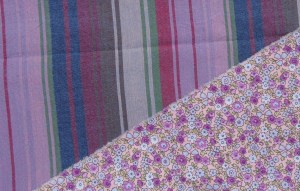
This cotton is a little bit stiff, although it may soften over time. The next one of these I make will be in a fabric with more drape, just to see the difference. I suspect that it works best in fabric that has more body, but we’ll see.

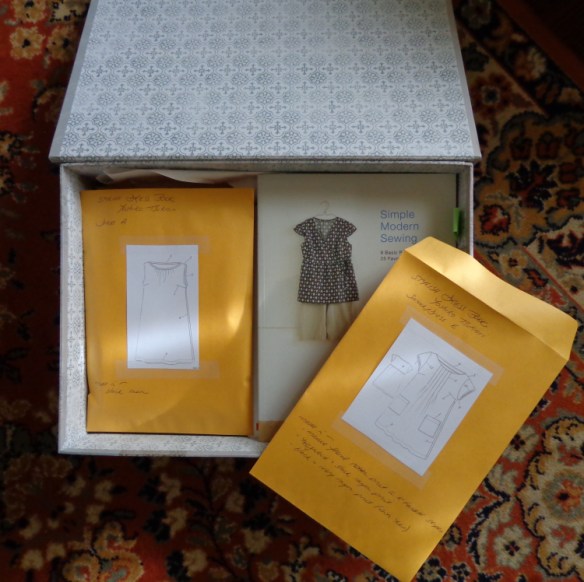
I needed to get organized with these patterns, too. Because you trace them out yourself, there’s no neat way to store them away when you’re done with each piece. I decided to mimic store-bought patterns and bought some envelopes as well as a pretty box at Michaels (they were on sale). The envelopes fit perfectly and there’s one for each pattern. The books also fit in the box.

Here’s where my patterns live now:
Deborah Cooke's pattern box

Stylish Dress Book – Smock E

I told you a while back about my fascination with Japanese sewing pattern books. Well, I’ve been drafting and sewing – not as quickly as I’d like, but still there are new dresses. I thought I’d finally show you some of them today.

First up is a smock pattern from Stylish Dress Book. I think this book is my favorite of all the pattern books I’ve bought. The smock is on the cover and is pattern E. I don’t wear smocks much, though, or tights, so I lengthened it into a dress.

I made a test version in cotton.

This floral print was in my stash. I bought it for $1 a meter because it’s a nice weight of cotton. It’s not really my style, though, so it’s been waiting. For this dress, I used a Kaffe Fassett stripe as contrast to keep it from being too sweet.
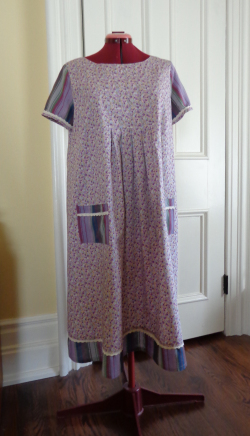
Smock E from Stylish Dress Book sew in cotton by Deborah CookeThis turned out to be one of those comfy summer dresses to wear on a hot day. I wore it a lot last summer and will probably make another for next summer. The cotton lace insert proved to be a bad choice because the lace wasn’t prewashed – it shrank in the wash and now there’s a bit of gathering wherever there’s lace. It’s quite full. I’d take some of the width out of the back if I made it in cotton again.

Next, I tried the same pattern in a turquoise and black rayon print. This version also came out really well, and because of the fabric, it hangs very differently. I’ve already worn this one a lot. It has a better drape and flow, but is a little bit sheer. It’s a good cover over a bathing suit, or a layering piece.

What’s funny about this fabric is that the turquoise photographs as a medium blue. The fabric also came in this color combination, but I didn’t like it as much. This one is actually a vivid turquoise.
I thought it would be good if this dress had tie backs at the waist, in case I didn’t want it to be so wide and floaty. So, I cut a second rayon print version, in black and cream. I want this one to be sleeveless, so I didn’t cut out sleeves and I deepened the armhole slightly. I also added tiebacks to it.

Next up, I’m planning to cut another sleeveless one in corduroy to wear as a jumper. I’ll cut it shorter than the rayon ones so it falls just below the knee.

Have you been doing any sewing lately? Have you sewn with Japanese patterns? Tell me about your latest crafting adventures!

Road Trip to the Koigu Tent Sale

Almost two weeks ago, we took a day trip to the Koigu Tent Sale. I promised last week to show you my acquisitions, and here they are!

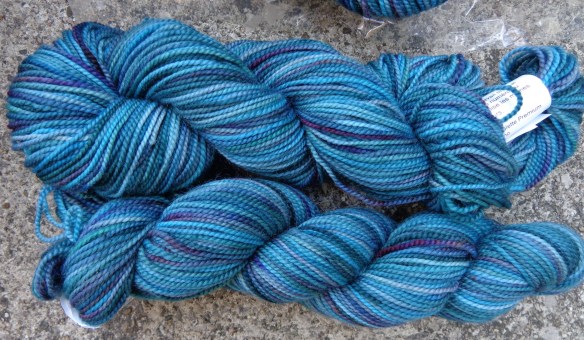
Koigu is famous for their handpainted yarns in beautiful colourways. Their base yarn is called KPPPM, which means Koigu Painter’s Palette Premium Merino. The first thing I bought was a beautiful shade of KPPPM:

Here’s a detail shot of the colour, but it doesn’t begin to do it justice. There are so many subtle variations of blue, green and purple in this yarn. It’s amazing.

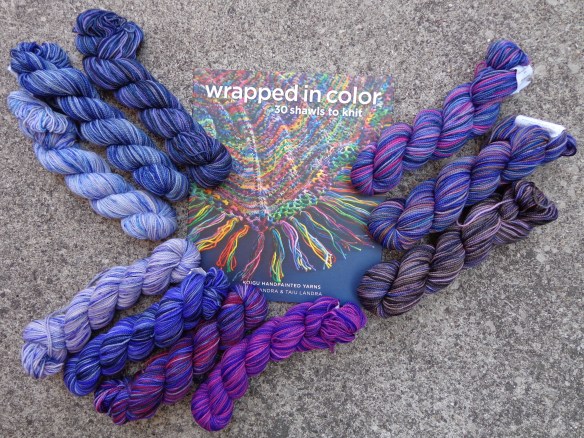
The second thing I bought was kind of a kit. There were ten skeins of KPPPM in a similar colourway along with the book Wrapped in Colour. I had a peek through the book and liked several of the shawls—the two I like each take 5 skeins. Looks like someone planned that out! Again, the picture doesn’t do the colours justice. I’m having fun just putting them in different order to knit gradations: the three at the top left obviously go together, but the other combinations are less obvious.  

I’m determined to finish my Earth Stripe shawl before I cake up this Koigu and cast on another shawl.

What do you think of my choices?

Update on the Earth Stripe Wrap

Last week, I showed you the beginning of my Earth Stripe wrap. Well, I got a little further and made a choice, so this week, you get a progress report!

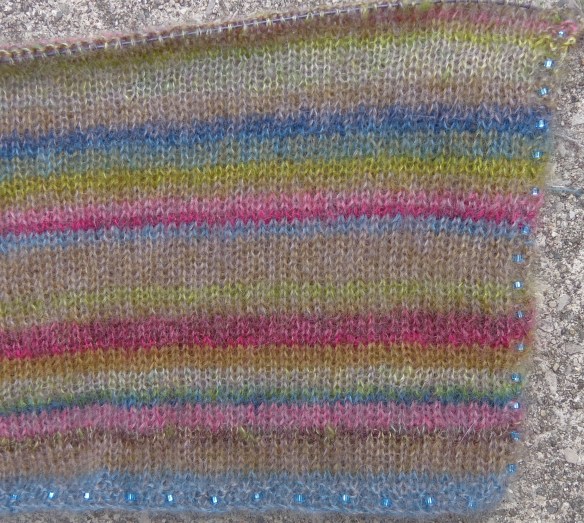
Here’s where I was when I decided there was an issue. The whole thing looked too brown to me.Earth Stripe Wrap by Kaffe Fassett knit in Rowan Kidsilk Haze by Deborah Cooke

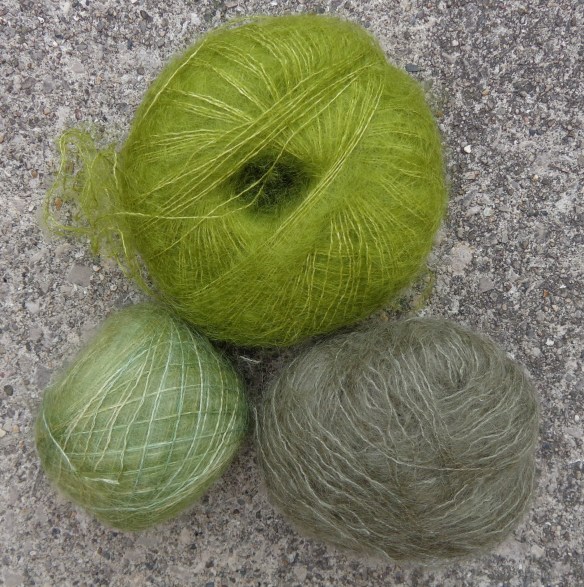
I went back to the original colours and reconsidered my substitution for Meadow. I used the Aloe at the bottom right in this picture. The top call is KSH in Jelly, which is also one of the colours in the shawl. Meadow was a pale silvery green, so I dug into the stash and found the yarn at the bottom left. It’s not KSH but another kid mohair and silk blend of similar proportions and a handpainted yarn from Capistrano Fiber Art Studio in a colourway called Irish Moss. I decided to use it instead of the Aloe. (I bought this yarn in New York at Habu Textiles on one of my trips to Manhattan.)shades of green kidsilk haze

The needle in the first picture shows how far I needed to frog back the shawl. I actually had to go a little further, since the first dark brown stripe is also knitted with the yarn I was changing out.

Kidsilk Haze isn’t the nightmare to frog that many knitters think it is – you just have to take your time. When I have to unravel KSH, I think of it as unknitting, not as ripping or frogging. Slowly, slowly, and all will go well. 🙂

Here’s a shot of the reknit shawl, up to the same point – of course, the needle wanted to curl:Earth Stripe Wrap by Kaffe Fassett knit in Rowan Kidsilk Haze by Deborah Cooke

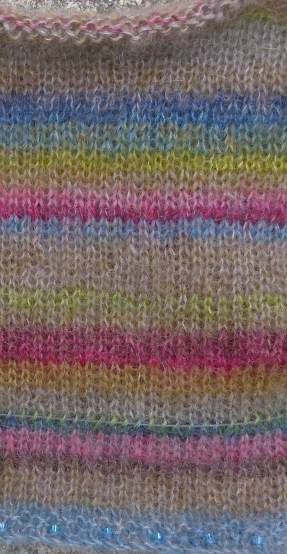
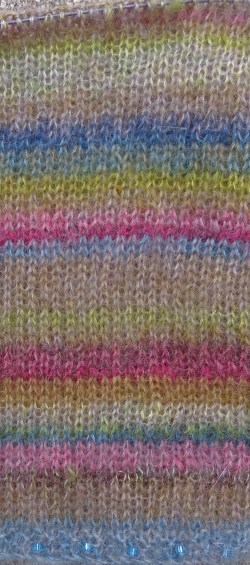
Can you see the difference? There isn’t a lot of colourway F in this section, so the difference is subtle, but I’m much happier with it. Let’s take a couple of slices and line them up:

Earth Stripe Wrap by Kaffe Fassett knit in Rowan Kidsilk Haze by Deborah Cooke Earth Stripe Wrap by Kaffe Fassett knit in Rowan Kidsilk Haze by Deborah Cooke

Where are the differences? Starting at the bottom, the first dark brown stripe is knit with Bark and F – on the left, F is Aloe and on the right, it’s Irish Moss. Continue up to the second difference – it’s the greyish band above the needle on the left picture. In the right picture, you can see a brighter green with the grey in that band. You have to look way up to find the next use of F – it’s above the 3R blue band near the top. There’s a row with dark blue and turquoise, followed by two rows of dark blue with grey, followed by two rows of bronze with grey. Above that are four rows of grey and F, then a row with the two greens knit together. This is the section that prompted me to make the change. Everything above the blue looked brown to me on the first version, so that new silvery-green stripe makes me happier.

The beads are more interesting than I’d expected. They’re the Rowan beads made by Swarovski and are particularly sparkly. The holes aren’t just silvered. They seem to be faceted inside. In real life, they’re adding a wonderful glimmer to the sides of this shawl.

And onward I go! I’ll show you the shawl again when I’ve completed one entire repeat.

The Earth Stripe Wrap

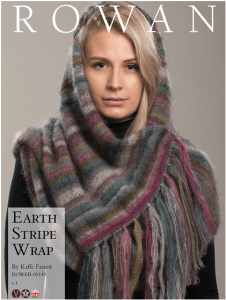
Earth Stripe Wrap by Kaffe Fassett in Rowan Kidsilk HazeThe Earth Stripe Wrap is striped shawl designed by Kaffe Fassett and knit in ten shades of Rowan Kidsilk Haze. It was published in Rowan magazine #42 (Autumn/Winter 2007/2008). The image to the right is from the original magazine – I found it online but the copyright on the image belongs to Rowan.
Given my love for KSH and my admiration for Fassett’s use of colour, I’ve always wanted to knit this piece. This week, I finally cast on.

The biggest challenge with this piece is that some of the colours of KSH specified in the pattern have been discontinued and are no longer available. (Whenever a knitter is DISO (desperately in search of) KSH in Jacob, you can make a good guess that he or she plans to knit the Earth Stripe Wrap.) Rowan has published an updated version of it as a free download on their website, which substitutes new colours, but I wasn’t that crazy about all of their changes. Let’s have a closer look.

The original pattern specifies the following colours:
A – Hurricane #632 – available
B – Jacob #631 – discontinued
C – Elegance #577 – discontinued
D – Drab #588 – discontinued
E – Candygirl #606 – available
F – Meadow #581 – discontinued
G – Majestic #589 – available
H – Trance #582 – available
I – Jelly #597 – available
J – Blushes #583 – available

This wrap is knit with two colours held together in a stripe pattern that repeats over 186 rows. The way the colours are combined changes the appearance of each colour in each stripe, which is part of Kaffe’s magic.

The discontinued colours aren’t shown on the Rowan website anymore, and here’s where Ravelry completely rocks. Knitters photograph their stash yarns and post the pictures to Ravelry. Even given the inevitable differences in lighting, over 50 images of the same yarn, you can get a good idea of its colour. You’ll need to log in to Ravelry to follow these links, but it’s free to set up a Ravelry account. Here’s the Rav link for stashes of Meadow, for example, which proves to be a pale silvery green. (There are 600 pix, but you don’t need to look at them all!) Three of the discontinued colours – Jacob, Elegance and Drab – are muddy browns or greens. Elegance might be called bronze. Drab is a medium greyed brown. Jacob is a bit elusive, as it seems to be particularly changeable in various lighting. (That’s probably what KF liked about it.) It’s similar to Drab but also a greyed brown, maybe a little warmer in tone.

Earth Stripe Wrap by Kaffe Fassett in Rowan Kidsilk HazeIn the new version of the pattern, Rowan has made these substitutions:
B – Anthracite #639, which is a medium cool grey
C – Bark #674, a medium to dark brown
D – Drab #611 (apparently reintroduced with a new shade number, which suggests that the colour is slightly different. I don’t actually know.)
F – Ghost #642, which is a pale silver.

You can see the current shades of Kidsilk Haze on the Rowan site, right here.

Anthracite and Ghost are unexpected suggestions, to my thinking. To use cool greys instead of a mucky warm brown and a green is going to change the overall hue of the wrap. The newly photographed version does look more cool in colour. It’s still pretty, but it doesn’t have that “moors in the mist” look of the original to my eye.

So, I dug in the stash.

It turns out that I had some Elegance in my stash, which was a complete bonus. I didn’t have any Drab, but I had some Putty, which looks pretty similar to me. I couldn’t quite envision the green of Meadow with the other colours, so I used another company’s silk/mohair blend: Elann’s Silken Kydd in Aloe, which is a silvery green but more green than silver. I had a chat with a yarn store owner about Jacob and she remembered it well, suggesting Bark as the closest substitute.

So, my colour combination is:
A – Hurricane
B – Bark
C – Elegance
D – Putty
E – Candygirl
F – Aloe
G – Majestic
H – Trance
I – Jelly
J – Blushes

A quick peek through the projects on Ravelry also revealed that many people needed an additional ball of Majestic, using three balls instead of the specified two. Since I had to buy this colour, that was good to know in advance.

I put each colour of yarn in its own ziplock with one corner snipped off the bottom and the end of the yarn fed through that gap. Each ziplock is labelled with the letter of the colour, so I don’t have to try and figure out which mucky brown I should be using. In bright light, I can see the differences, but I often knit in the evening, so this works better. I think it’s imperative with a project like this to have a system for dealing with ends as you go. Weaving them all in at the end would be a nightmare (and for me, a job that just wouldn’t happen). I’m weaving mine in as I go, but some Ravellers used Russian Joins as they went. I find that a join makes KSH a bit stiff, so would rather weave them in as the soft fluidity of the finished piece is part of what I like so much about knitting with KSH. That’s a personal choice.Earth Stripe Wrap by Kaffe Fassett knit in Rowan Kidsilk Haze by Deborah Cooke

The wrap is designed to be knit entirely in stockinette stitch, then a round of double crochet is worked all around the perimeter. This is probably to keep it from curling. There’s also a lavish fringe added to each end. I’m not much for fringes and don’t want to do the crochet round. I decided instead to work the first three rows in moss stitch, as well as the first three and last three stitches on each row. And to give the shawl edges some weight, I’m adding beads. These are Rowan/Swarovski beads in the turquoise that matches Trance.

Here’s my progress so far.Earth Stripe Wrap by Kaffe Fassett knit in Rowan Kidsilk Haze by Deborah Cooke

What’s fun here is that you can see the blending that results from using two colours at once. The lowest pink stripe is Blushes with Majestic, a rose with the blue-grey. The next pink stripe has two combinations – there’s one row of the bright pink, Candygirl, with the dark brown, Bark, then three rows of Blushes with Bark. The two three-row bands with Blushes are different pinks, because of the second colour used with it. It’s fascinating. There are two combinations with Jelly, which is a vivid apple green – in the lowest one, it’s knit with Trance for a single row, which is a light teal (right above a single row with Trance and Hurricane, a darker blue). Right below the needles, Jelly is knit with Elegance for two rows–that’s one of those golden browns. Again, we get two very different shades of green. I’m finding this an addictive knit because it’s so fascinating to watch the colour combinations develop.

What do you think?

Pretty Little Shawl

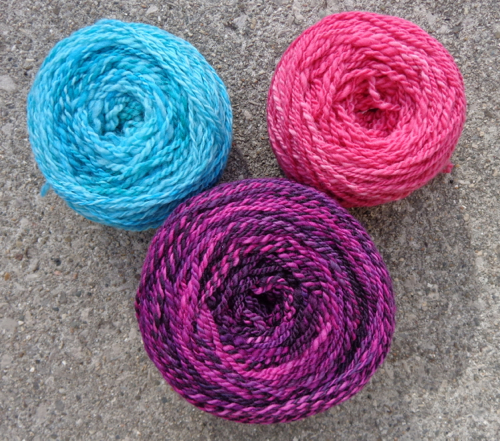
Last year, at the readers’ conference Romancing the Capital, Carol gave me some of her beautiful merino handspun. She’d dyed it, too, and I spent a lot of time looking at the (very soft!) yarn, trying to figure out how to show it off.handspun marl

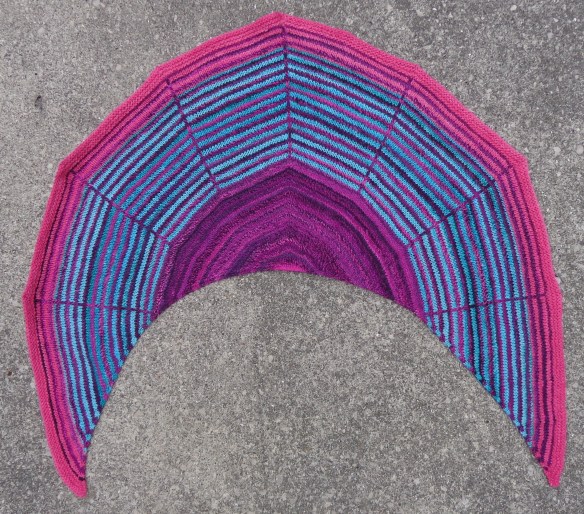
I finally decided on a pattern called Daybreak by Stephen West. It’s written for fingering weight yarn and this was heavier, so I just winged it. I started with the purple, then striped in the turquoise. When I ran out of purple, I switched to the pink, then did the edging in pink when the turquoise was gone.  I’m very happy with how it came out:Daybreak shawl by Stephen Wesst knit in handspun by Deborah Cooke

It’s just the perfect size to sit over the shoulders and falls to my elbows. I love shawls of this size as they keep my back warm but stay out the way.

The pattern was great and I’ll definitely knit another.

I’m heading to RTC again next week, and I’m going to wear the shawl. I’m hoping that Carol will be there.

What do you think?

Waiting for Rain Shawl

This week, I finished knitting a shawl. These are unusual colours for me, but I really like the result.

The pattern is called Waiting for Rain (that’s a Ravelry link) and it features lace inserts in a garter stitch crescent-shaped shawl. The construction is really interesting, plus it’s easy to play with the colours and the design.

I knit mine in Madeline Tosh Dandelion, which has 10% flax. It’s interesting because the different fibers take the color in different ways. I used two skeins of Chickory and one of Whiskey Barrel. I decided to do the lace inserts in Whiskey Barrel, as well as some extra stripes and the bind-off. This yarn is discontinued so it’s gone from the MadTosh website, but here’s a Ravelry link.

This meant that I had too much yarn – the pattern calls for 700 to 800 yds, and I had over 900 – but I wanted to use it up. The pattern has three lace inserts. Once I’d followed the directions, I continued in a similar way and added two more lace inserts, then knit in garter stitch until the Chickory was gone. I liked the yarn. It’s smooth and cool, and I like the colour gradations in each colourway. There were long fibres, presumably of flax, and it was tempting to tug them out but I knitted them in. The pattern was well-written and clear. I bought the collection and will knit another shawl from it.

Here’s a detail shot, showing off the yarn:

Waiting for Rain shawl knit in MadTosh Dandelion by Deborah Cooke

There are stripes in the Whiskey Barrel, but the Chickory has some of the same greyed brown tone in it so it’s hard to tell which yarn is where. I like that! If you’re curious though, all the garter stitch below the lowest lace insert is in Chickory, then the bind-off is in Whiskey Barrel. You can just barely see it. Also, the garter stitch is all Chicory down to the first lace insert. (The shawl is knit from the top of the picture.)

My only disappointment is that I wasn’t sure how much Whiskey Barrel to leave for the cast-off, and I left too much. 😦 That means leftovers for the stash, about 8g. It turns out that I could have knit a couple of rows of garter stitch in the contrasting colour before casting off, but that’s how it is and that’s how it will stay. There’s no need to frog back a 500 stitch cast-off!

Here’s the complete shawl:

Waiting for Rain shawl knit in MadTosh Dandelion by Deborah Cooke

I was debating whether to block this shawl. I don’t usually block garter stitch shawls because I like the squishy texture they have right off the needles. It’ll get bigger if it’s blocked, though, and I was thinking it’s just a nice size. While taking the pictures, though, I can see that the ripple on the increasing edge is too much. I’ll give it a good block it this weekend.

What do you think?