Kroy Socks

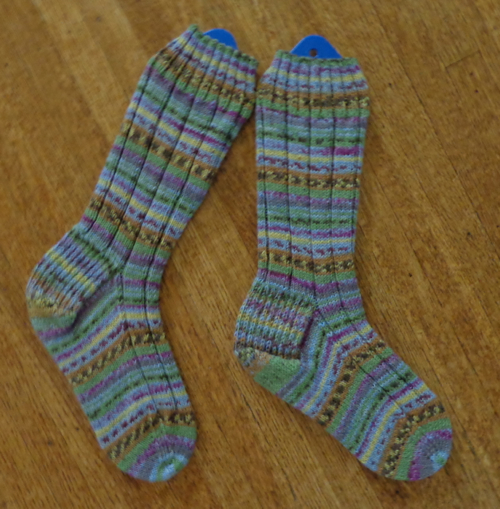
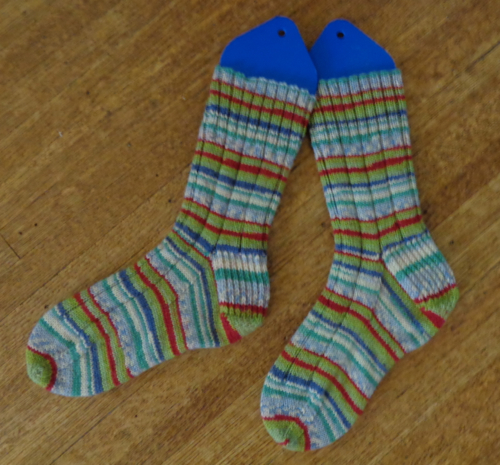
I started to knit these socks on the drive to and from Lori Foster’s Reader-Author Get-Together in June. (I was riding, not driving!) I finished the second toe on the last pair, so cast these on. As usual, this is my own sock pattern, the one I don’t have to think about anymore, and as usual, I’ve used a self-striping yarn.

This yarn is Patons Kroy Socks. Once upon a time, Kroy was available in a 3-ply yarn in solid colours. Now it seems to all be 4-ply, whether it’s solid or self-striping. I like the thicker version better – it feels more squooshy, although it does make a thicker sock. This is one of my favourite colourways of Kroy Socks, Summer Moss Jacquard. (Although I see on the Patons’ site that there are colours I haven’t seen before and like a lot – I’ll have to keep a lookout for Meadow Stripes, Mexicala Stripes and Fiesta Stripes.) I actually have enough of this colourway stashed to make a cardigan – the trick will be ensuring that the pieces are narrow enough so that the stripes work out well. I’m thinking I’ll have to put a seam down the centre back to make it work. Hmm. I did knit a pair of socks for Mr. Math in this colour of yarn, as well. (Ewww, now we can match!)

And here they are:socks knit in Patons Kroy stripes by Deborah Cooke

Wow, I feel so lucky. I have two new pairs of socks for the fall!

What do you think?

Socks

We’ve done a couple of road trips lately, and in my universe, road trips mean sock knitting. I started this pair of socks for myself last year, and they’ve been stalled for a while. I finished them on the way to Lori Foster’s RAGT in Ohio, and now I have new socks! I also knit the first sock of another pair, although there’s no telling when the socks will be done. (We have no road trips planned right now.)

Here are the new socks:socks knit in Jawoll aktion by Deborah CookeThe yarn is a self-striping sock yarn called Lang Jawoll Color Aktion (yup, another German sock yarn) and it came with the dyed-to-match spool of reinforcement yarn. I used it in the heels and toes, as usual, but since my socks always wear out under the ball of the foot, I also wove some in there after the socks were done. We’ll see how that works out. The pattern  is my usual one – if it was ever in a book, I forget where. I bought this yarn on a stash enhancement day with Pam, the last time RWA National was in Dallas. I forget the name of the shop, but it was very cute.

It turns out that the new girl is a great liberator of knitting wool and knitted items. She doesn’t chew them or even lick them – she just relocates them. These socks have some miles on them already, and I haven’t even worn them yet!

Jess

I seem to always have a lot of knitting projects on the go, and last winter I figured out part of the reason why that is: I tend to take on big projects. They’re either really detailed or take miles of yarn, or both, which means they take a long time to knit. In March, I decided that I needed a little break from those epic knits and planned for some instant gratification.

Of course, it didn’t quite work out that way.

This sweater is from a book called Colourscape Folk – that’s a Ravelry link – which features a Rowan yarn called Colourscape Chunky. It’s a single-ply yarn, spun in the UK, with self-striping colourways designed by Kaffe Fassett. The yarn is currently discontinued. I’ve used this book and yarn before: here’s a long vest in shades of pink that I made for myself (it’s not so hot a pink as the flash makes it look), and here’s a vest I made for Mr. Math, also from this book and in this yarn. Both of those projects were quick knits and came out well.

When this yarn was discontinued by Rowan, a very similar yarn appeared in the inventory of another British company Texere, called Olympia Chunky. British knitters on Ravelry who had fingered both yarns suggested that Olympia Chunky might really be Colourscape Chunky with new ball bands. I had knit Mr. Math’s vest from Colourscape Chunky and had stashed more for him for another cardigan, but the colourways I wanted for myself were gone. I bought Olympia Chunky for the pink vest and couldn’t tell the difference between the two yarns. I also bought Olympia Chunky for the project I’m talking about today.

Here it is:Jess by Sarah Hatton knit in Texere Olympia by Deborah CookeThe cardigan pattern is called Jess, and it’s from that same Rowan book. I’ve even knitted it in the same colourway as shown in the book. While I’m quite happy with the finished vest, it was a nightmare to knit and far from the instant gratification I’d expected. This batch of yarn was filled with knots. The problem with a knot in a self-striping yarn is that the two ends knotted together invariably don’t match. In order to match the colour gradation, you have to sift through the other skeins, trying to find the match, then break and join the yarn there. You can see how this ends up being an inefficient use of yarn. While Colourscape Chunky did run thicker and thinner (as do many single ply yarns) this batch varied more wildly. Some stretches were less than half the thickness the yarn was supposed to be, and those stretches went on for a long time. The parts knit in that thinner yarn actually looked lacy. I knew the yarn would full some in washing, but not that much, so I had to break out those parts and seek matches, etc. etc. In the end, I used parts of 6 skeins for a cardigan that required less than 4, and ended up with mounds of bits.
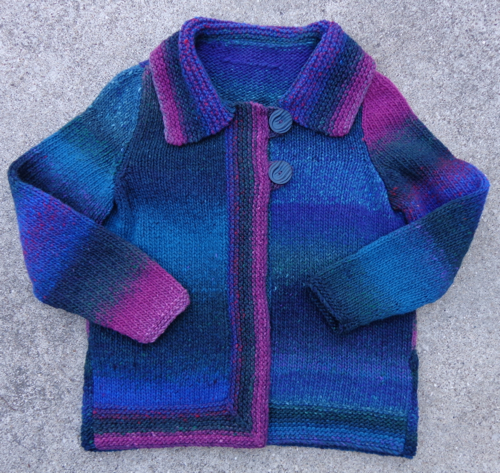
I had some issues with the fit through the shoulders, too, both in terms of the sleeve cap being too short to fit well into the armhole and the armhole being too shallow for me. I think I knit the sweater from the armholes up at least three times. The interesting thing is that it feels huge, even though it has finished out to the correct size (and the correct size for me.) I think that’s because those wide garter stitch bands at the front are designed to overlap, but since the front of the cardigan hangs open, they seem to be extra width. The collar is larger and lower than I’d expected, but it’s staying the way it is now.

Of course, I finished this winter cardi just as summer is beginning! I think I’ll stick with my epic projects for a while.
Mystery Afghan KAL – 2

You might remember me posting about the Rowan yarns Mystery Knit-A-Long a few weeks back, which is an incremental pattern for an afghan. Each week, there’s a pattern published for a new afghan block, and each week, you’re supposed to knit six of that week’s block. After 8 weeks of this, knitters will each have 48 blocks. The subsequent weeks include instructions for the border and for assembling the afghan.

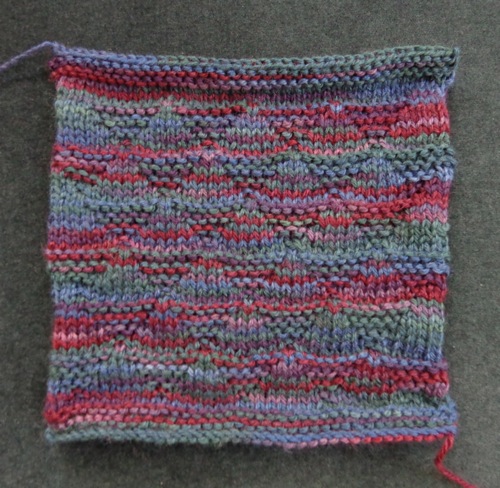
Here are the first four block patterns in my substitution yarn. (Knitters are only eligible for prizes from Rowan if they use the specified yarn, Rowan Pure Wool Worsted, which is available in 50 solid colours. I chose to stash-dive instead.) My yarn is Patons Decor and it is variegated, which adds some spice to the blocks.Pure Wool Mystery Afghan by Martin Storey knit by Deborah Cooke in Paton's DecorThese aren’t blocked to size. I block lace, but am not going to bother with afghan blocks. If I did block them, they’d all be perfectly square and the exactly the same size—blocking means that the damp or wet squares are gently stretched to shape and left pinned until they dry.

The variegated yarn definitely obscures the stitch pattern in the blocks and makes them more visually busy—but it’s also pooling in a very predictable pattern. “Pooling” refers to the way that the colours in a variegated yarn come together in a knitted piece. Some pooling is beautiful (see Dayana deliberately playing with pooling here – as well as explaining a lot about it) and some is ghastly. What works is also a question of personal taste. Knitters tend to get excited about pooling—if you’re on Ravelry, you might want to check out this thread for thousands of examples. The thread is six years old and still active, a sign of how much pooling can agitates knitters. (Some call pooling “clown barf” which is another hint.)

The pooling is similar in each block here because the blocks are the same number of stitches in width and the variegation—done by a machine—occurs at fixed intervals. Even so, it’s more regular than I anticipated it would be. I’d thought I would have to cast on at the same point to make the pooling match, but didn’t do that because I thought the stitch pattern would also influence how the colours fell. Apparently not. I’m curious to see whether the eye dismisses the pooling when all 48 blocks are assembled. If so, the stitch pattern might appear to be more evident. We’ll see. (This afghan is an experiment, and it will be warm and useful either way. My opinion of it will determine only its final location: living room, television room or dog bed.)

This pooling pattern also means that unless the border is the same number of stitches in width, the pooling in the border will be different from everywhere else in the afghan. That might be distracting, and I’m considering the possibility of making the border in a solid colour—either the teal or the burgundy, depending upon which I can match. Again, we’ll see.

As anticipated, I’m behind on my squares already. I need to do three more from week 3 (the one with the zigzag) and five from week four (the XOX’s). Since there will be a new clue on Monday, I’ll probably fall farther behind. C’est la vie!

Knitting Mittens

When things are really busy, knitting helps me to organize my thoughts. I don’t think directly about anything, but just knit along and To Do lists organize themselves in my mind, like magic. This is a wonderful and useful thing, and you can believe that with the publication of Thorolf’s book last week, I’ve been knitting a lot.

This trick works best when I knit a familiar pattern, so invariably, very busy periods of my life lead me back to a basic mitten pattern. It’s a free Patons pattern that I was given when I first learned to follow a pattern. My copy has been folded and refolded so many times that Mr. Math ran me a few copies of it before it disintegrated forever. It provides basic mitten instructions in worsted weight yarn, with variations for a number of sizes, all on a single 6 by 9 sheet of paper.

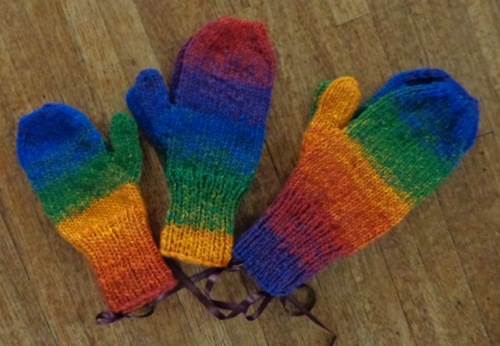
I have modified the pattern slightly over the years. It’s designed to be knit on two needles, then seamed up the outside of the hand. I don’t like seaming much, so I now knit these in the round. This free pattern from Coats looks like an updated version of mine, with the addition of a hat. They’ve made the change to knitting in the round, as well. I also knit the mitts for charity, building up a bag of them to give away each fall. I usually buy some new yarns to try them out, then use up odds and ends from my stash. Changing the yarns and using stripes makes them more interesting to knit.

This year, I tried a yarn from Bernat called Mosaic. It looks a bit like Noro Kureyon, but is acrylic so it feels different. It’s actually been discontinued now. Although it’s an aran weight, I still used the same pattern and needles. They’re just thicker mitts.

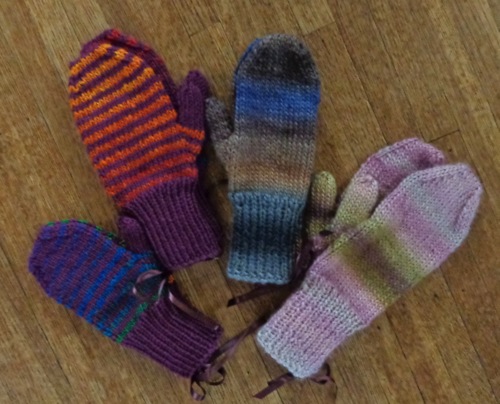
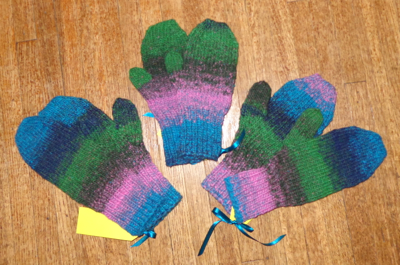
These first mittens are in the colourway Calypso. I bought two balls, and got three matching pairs.mittens knitted in Bernat Mosaic by Deborah CookeHere are the stripey ones with the leftovers, mixed with some Bernat Satin. There are also two pair here of odds and ends of Patons SWS from my stash, a wool and soy blend that self-stripes. I have another pair in the same colourway as the pink ones on the right that are nearly done. SWS is also discontinued (even stash ages!) so here’s a Ravelry link for SWS.mittens knit in Patons SWS, Bernat Mosaic and Bernat Satin by Deborah CookeAnd here are another three pair in Bernat Mosaic, in the Aura colourway. I’m down to bits of this now, so will make some stripey mitts with the leftovers. mittens knitted in Bernat Mosaic by Deborah CookeWhat do you do to organize your thoughts? If you knit, do you have a pattern you return to, over and over again? Do you knit for charity?

Mystery Afghan KAL

This spring, I’ve also been participating in a Mystery KAL. “KAL” stands for Knit-A-Long. The idea is that a lot of people knit the same thing at the same time. Social media are great for this, because people chat about the project as it goes. A mystery KAL means that you don’t see the final project until the end: the instructions are released as clues, each of which guides you to completing the next phase of the project. New patterns for lace shawls are sometimes revealed as mystery KAL’s, but this one is for an afghan.

The pattern is from Rowan Yarns and designed by Martin Storey. It’s free – you just have to register as a member at their website to be able to download the PDF files with the clues. It’s designed to highlight their new yarn, Pure Wool Worsted, and if you knit it in that yarn, you can register for the KAL and be eligible to win prizes. If you knit it in another yarn—as I”m doing—you can still join in the chitty chat around the internet, and knit something pretty.

I decided to stash-dive for this project and remembered that I’d bought a “tangle” of Patons Decor years ago. A tangle is a huge skein sold by the mill. It’s not really tangled, but it’s big. This one weighed more than 5 lbs. Patons Decor is a wool and acrylic yarn specifically intended for afghans and household items – because it feels like wool but is machine washable. It’s also close to the weight of the PWW used in the pattern, and certainly close enough to substitute. My plan when I bought it was to make an afghan, but I didn’t enjoy knitting the pattern I’d chosen, so all the many (many) cakes of yarn went into the stash. This yarn is variegated instead of a solid colour, which adds another dimension to knitting this pattern. It might end up being too much visually, but I kind of like it. Maybe I have a high chaos tolerance. Here’s my first block in the first clue:Pure Wool Mystery Afghan by Martin Storey knit by Deborah Cooke in Paton's Decor

I’m already behind, as I’d anticipated. Each week, you’re supposed to knit 6 blocks in the provided clue. I finished clue 1 on time but right now have only 2 of the clue 2 blocks finished. Clue 3 won’t be out until Tuesday, so maybe I’ll catch up in time.

If you’d like to join the KAL, there’s more information on the Rowan website. There are also some YouTube videos with the designer, Martin Storey, as he talks about the project. The wonderful thing about this KAL is that it’s planned for the blocks to become gradually more challenging—the KAL is designed to help knitters learn new skills. To aid in that, there are lots of links provided with each clue for videos about techniques. Rowan has more info and chat on their Facebook page, and of course, there’s a lot of chatter on Ravelry in the Rowan yarns forum(s) about the KAL.

Are any of you participating in this mystery KAL? Have you ever participating in a KAL, mysterious or otherwise?

Icicle Mittens

I subscribe to Rowan‘s knitting magazine, partly because I love the patterns and partly because I love the photography. These “magazines” are really beautiful books.

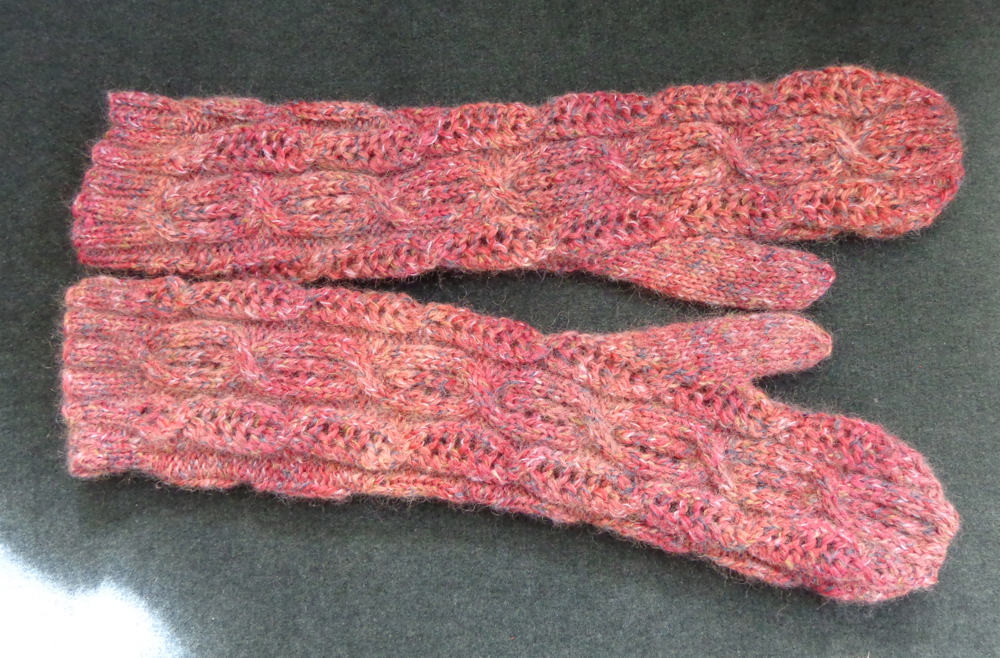
Each year, magazine subscribers receive a gift from Rowan. It’s usually yarn with a pattern, and is a good way to try out their yarns. Usually, I don’t quite knit the pattern supplied with the yarn. Sometimes, it just goes into the stash and doesn’t get knit at all. This year, I decided to just do it, and knit the supplied pattern. Here’s the result:Icicle Mittens by Martin Storey knit in Rowan Colourspun by Deborah CookeThe pattern is called Icicle Mitts (although it’s Ice Cable Mitts in this Ravelry link), and it’s by Martin Storey. The yarn is Colourspun in Jervaulx – you can see that there’s variation in the colour of the yarn as it goes. The colour is fairly true in this picture, and not as vividly red as shown on their website. These were a pretty easy and quick knit, and are surprisingly warm, even with all the holes in the lace. They come up to my elbows, so I’m not sure when I’ll wear them, but they’re pretty. Here’s my Ravelry project page with some notes.

And they’re one project that was finished this winter!

Another Cameo

Last year, I knit a small shawl called Cameo. That’s the Ravelry link for the pattern, and here’s the post about the other shawl, which is still on the old website.

I started to think about knitting this pattern in self-striping yarns, and finally just had to try it. I had two different colourways of Mille Colori Socks and Lace, so I cast on. Here’s the result:Cameo by Paulina Popiolek knit in Lang Yarns Mille Colori by Deborah CookeThis picture is a teensy bit blurry because I took it without the flash and didn’t hold quite still enough. The one with the flash made the colours look all wrong. You can see how the first yarn striped in those wide bands, and that they got narrower as the rows became longer. Then there’s the alternating stripes between the two colours, but what surprised me was that when I continued in the second colour to the hem, the rows were long enough that it kept striping like the alternating section. You can see the striping better in this detail shot:Cameo by Paulina Popiolek knit in Lang Yarns Mille Colori by Deborah CookeThat top point is on the right and you can clearly see where the alternating rows of stripes begin. It’s a lot tougher to tell where they end. (It was at the green stripe, just to the right of the grout line in the floor.)

I didn’t do the lace on this one, as I thought it would be too much. It’s pretty and bright, a cheerful scarf for a dull winter day.

What do you think?

Nevis Sweater and Entrelac Bag

I recently finished a sweater knit in Noro yarn. I’m trying to both stash-down this year, and also to finish what I start (instead of having dozens of projects on the go). Also, it’s really cold this winter, so a new warm sweater seemed just the thing – with the weather to inspire me to finish. I remembered that I had a bag of Noro Hitsuji, a bulky single ply wool, which seemed to be the perfect choice. I used an older Rowan pattern by Kim Hargreaves called Nevis – it’s in a pattern book called A Season’s Tale. It reminds me of Mary Maxim sweaters, but with more of a trim fit. Knit in the self-striping Noro, I think it’s fun.

Here it is: Nevis by Kim Hargreaves knit in Noro Hitsuji by Deborah CookeI did make some modifications to the pattern. The waist shaping is supposed to be done at the side seams, but I moved it into the body of the sweater. I positioned the decreases like darts in a tailored shirt, halfway between the centre and the side seam. I lucked out on the matches of the colours: I began both fronts and the back at the same point in the variegation, knowing that the fronts would match (so long as there were no knots). The back matches at the top and the bottom – it’s really twice the width of one front, which makes sense even though I didn’t think of that in advance. I figured the sleeves were about the same width as the fronts but longer, so started earlier in the variegation – I guessed, then decided blue cuffs would be nice. The matches worked out surprisingly well.

The front button band is supposed to be knitted afterward in its entirety. I wanted the hems to match so cast on an extra six stitches for each front. When it was time to start the stockinette stitch for the body, I put those six stitches on a safety pin. When I knit the button bands, I just matched the colour in the yarn and carried on. In the pattern, the buttoms were placed higher without one at the hem – I respaced them because I thought it looked as if one had been lost. I found some buttons with fun swirls on them which I like a lot.

The Hitsuji was a bit stiff while knitting and almost like a pencil roving for spinning. It softened up very well when soaked for blocking (like most Noro yarns). The finished sweater is very warm, which is just about perfect when it’s 20 degrees below zero outside.

Here’s the link to my Ravelry project page, if you’re interested in more detail.

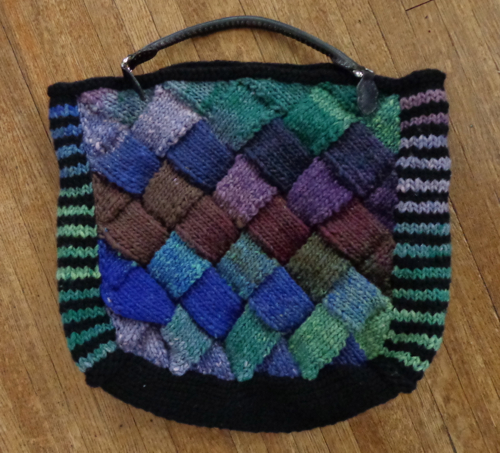
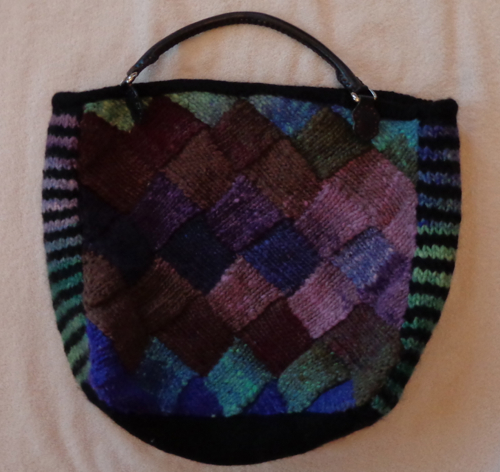
Now, I had a bag of 10 balls of Hitsuji and this sweater only used 6.5 of them (although I did break into three more, seeking matches.) I was determined to not send the rest back to the stash, but to use it up. I also had a pair of black leather handles in my stash, bought for a purse that I didn’t like knitting so frogged. So, I decided to knit an entrelac tote bag and felt it, using up the Hitsuji and also some black roving from the stash.

Here’s the bag before felting:Entrelac Bag knit in Noro Hitsuji by Deborah CookeAnd here it is afterward, still in need of a lining:Entrelac Bag knit in Noro Hitsuji by Deborah CookeThe black felted much faster than the Noro, so I’m thinking I’ll stop felting now. Here’s the project page for the entrelac bag on Ravelry.

What do you think?