Noro Cropped Jacket in Progress

There is something about Noro yarn that speaks to my knitter’s soul. I love the colour variegations in these yarns, and – unlike many knitters – I love the texture of the yarn. I love that it’s a single ply, spun loosely, that it runs thick and thin, and that it’s a “yarn that remembers the barn”. I don’t mind sticks in my string.

Earlier this summer, I started a jacket in Noro Silk Garden. Here’s the first post about it. I could call it a cardigan, but the shaping is so structural and the finished fabric so firm that it feels more like a jacket to me. I’ve almost finished the knitting now and love it even more.

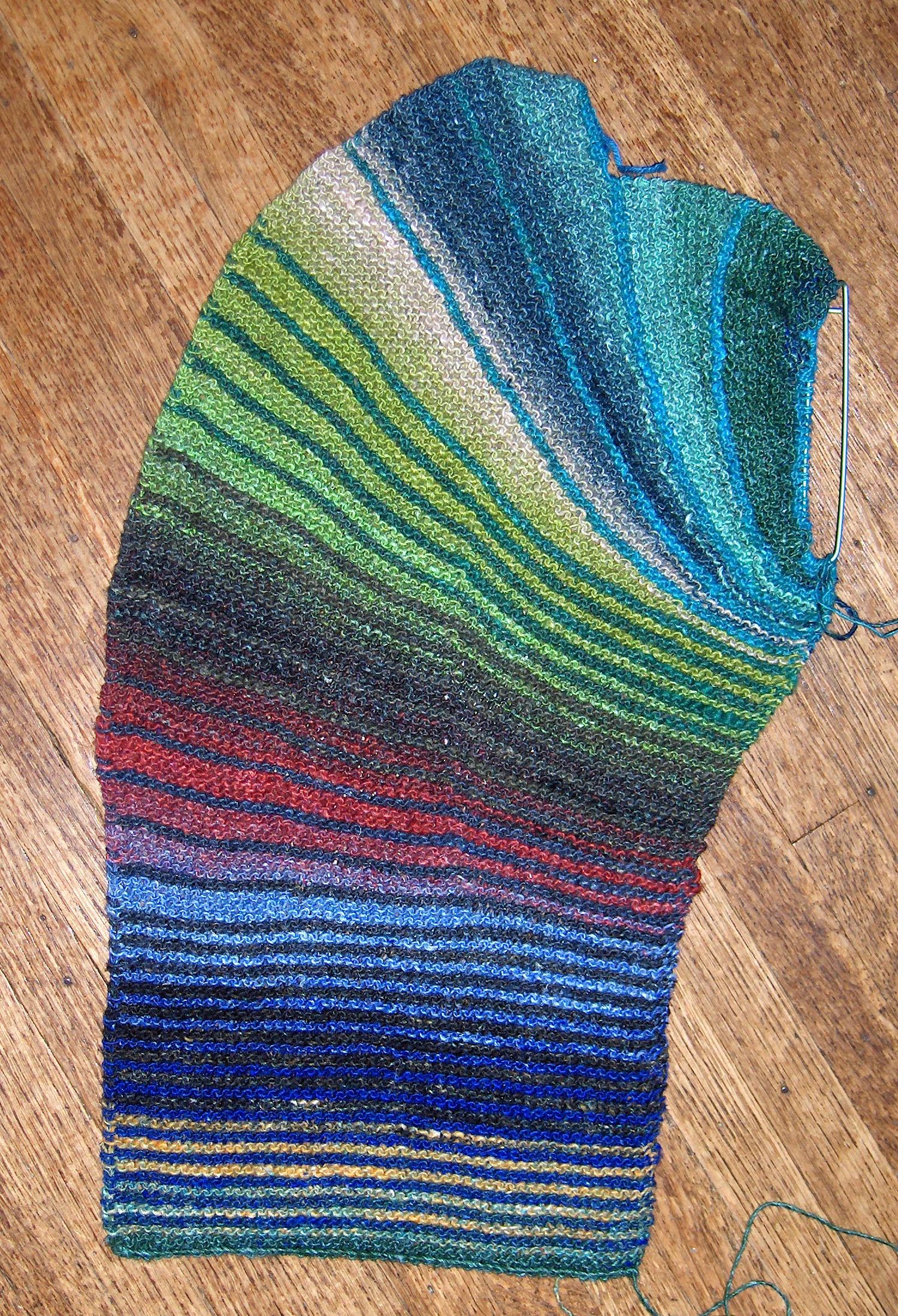
Here it is, with one sleeve not quite done:Cropped Jacket by Irina Poludnenko knit in Noro Silk Garden Sock by Deborah CookeThat’s the back of the sweater at the top, with the back hem at the very top. Sleeves on either side, fronts at the bottom. (And my foot! That sock is knit in Lorna’s Laces, btw.) The shoulder seams are still open and the notched bits are the collar, which will be joined. Then the whole thing will be folded down the length of the sleeve, so I can seam the sleeves and each front to one side of the back.

Although I was very matchy-matchy, I don’t think the mirroring will be perfect. Oh well. You can see on the back, for example, that I didn’t have a second run of that black through gold bit, so I had to fake it. The sleeves are slightly different from each other – the one still on the needles will probably end before it gets to the bit of green at the cuff of the other one.

Cropped Jacket by Irina Poludnenko knit in Noro Silk Garden Sock by Deborah CookeIt’s funny how the blue looks so prevalent in the picture. In real life, it looks very green.

I did make a few modifications to the pattern:

1/ I left the stitches live instead of binding them off when instructed, and used a provisional cast-on where there would ultimately be a seam. That means my seams will be grafted instead of sewn. The shoulders have no seam at all – I just picked up stitches and kept knitting. I’m curious to see whether this affects how stretchy the finished garment is – it might well be that the sleeves get droopy without that seam.

2/ I rewound the yarn multiple times to try to keep the colour variegation consistent. I did do one goofy thing. When starting the first sleeve, I misread the colour progress from the front and inverted the order of colours on the sleeve. Instead of the shoulder of the sleeve beginning with that beige, it should have started with the deep and ultramarine blues.

3/ I slipped the first stitch on each row while knitting the fronts and the backs to keep the edge neater. I really didn’t need to slip the first stitch on the edge of the fronts that goes into the side seam, but it was easier to slip every row and not think about it.

4/ I think there is an error in the instructions for the larger size, because the two wedges at the top of the sleeve aren’t centred over the sleeve if you follow the directions. I recalculated and centred them. I made a mistake on the first sleeve and didn’t start the decreases right away after finishing the wedges – those instructions that give lots of details for striping or whatever, then say “at the same time…” get me every time! – but began them after the third repeat of the 6 rows A and 2 rows B stripe. I decided this might work out better for ease in the underarm, so just carried on and did the same on the other sleeve.

Now I have to wash it, block it and sew up the seams. I’ll show it to you again next week, once all that nitty gritty work is done. I do love it, though. It’s amazing how all those colours blend into a coherent whole. Here’s my Ravelry project page, btw.

What do you think?

Sneaky Trick

Here’s an interesting thing about knitting that a lot of people – even knitters – don’t know. You can add or subtract to the length of a knitted piece by working upside down.

If you think about it, the loops that make knit stitches are just loops. They look the same right-side-up and up-side-down. Instead of always working from the top of the loop, you can work from the bottom of the loop.

Here’s an example of why you might want to do that. Mr. Math has this gorgeous cabled alpaca sweater which he bought in South America. It’s wonderful, but it was too long. (Incredible. Mr. Math is tall, but evidently the knitting ladies in South America expected tourists to be even taller.) He didn’t wear this sweater because he thought it looked sloppy. It fit him perfectly, except that it was about 3″ too long.

So, in service to fabulous sweaters and their need to be worn, I intervened.

First, I cut off the cast on edge of the sweater, at the hem. You can never unravel this, so just surrender it. Then I unraveled the sweater. I unraveled the 2.5″ of ribbing at the hem, balling the yarn as I went. I unraveled another 3 inches of the aran body of the sweater. This is the tricky part – I then picked up the loops all across the row.

If you think of knitting stitches as hills and valleys, when you knit upward, you knit the hills. To knit down, I picked up the valleys on my needle. Doing this means that the vertical rows of stitches are off by half a stitch, so it’s best to do this where there’s a change in the stitch patterns. If you do it in the middle of stockinette stitch, it will show. If you do it where the aran meets the ribbing, no one will notice.

Once the stitches were all happily on the needle, I knit 2.5″ of ribbing and cast off the hem. Presto! The sweater is 3″ shorter, Mr. Math is happy and the sweater will be worn.

You could do this to make a sweater longer, but you’d need to do something to disguise that half-stitch step-off. Maybe you’d add ribbing to the hem. Maybe you’d work in a different stitch or a different colour. It’s pretty easy to do, either way.

Isn’t that a nifty knitting trick to know?

Cable Front Capelet

This is a project that I finished this fall – and started this fall, too. It went quickly because the yarn is so thick. In the winters, my back gets cold when I’m at my desk writing. I’ve knit vests and shawls and cardigans, but nothing has been just right. When I saw this cable front capelet in Vogue Knitting, I thought it might be just the thing. I already showed you the yarn and the knit back in this post.

Here’s the Ravelry link to the pattern. The designer is Sarah Hatton, who designs a lot for Rowan, too.

I substituted the yarn, using a new yarn that I found at Spinrite called Patons Delish. It has an interesting chain construction and is a wool/acrylic blend, with a gradual self-striping effect. Mine is the Kale colourway. They had mill ends on sale at Spinrite – 5 unlabelled skeins in a bag for $19.99 – so I decided to try it out. My capelet took 7.5 skeins.

And here it is:Cable Front Capelet by Sarah Hatton knit in Patons Delish by Deborah CookeThe green is much darker than it appears in this picture, even though I took this outside with no flash.

Modifications were minor. I didn’t want the cast-off edge at the top of the collar, so I knit 15 cm (instead of 7) and rolled the collar, seaming that edge to the inside. I haven’t added the five clasps to it – I might put one just at the base of the collar, if I can find one I like. I’m such a lazy toad that I didn’t even block it – I just seamed it up and started to wear it. It’s very warm and just perfect for writing – the elbow-length sleeves stay out of my way when I’m typing and having the front open keeps it from getting too hot. (It is a bad choice in the kitchen as the hems want to drag through everything, but that’s okay.)

This is one project that came out just right!

Green Socks for the Mister

Just off the needles – a new pair of socks for the man. These are knit of Patons Kroy FX in the Calla Lily colourway.socks knit in Patons Kroy FX by Deborah CookeAs usual, when I bought the yarn, I forgot that it’s thicker and has less yardage in each ball. (I always do this with the Kroy FX.) I bought only two balls, which isn’t enough to make a pair of socks for Mr. Math. I was going to go back for a third ball, but he decided he wanted contrasting toes. So, I used one ball for each sock, then switched to some leftovers of another colourway (I think it’s Clover) to do the toes.

He’s pleased, and it’s getting to be time for wearing socks anyway.

The big question is – why is everything I’m knitting this year GREEN?

Do you have a favourite colour? Does it change from year to year (or from season to season) or is it pretty constant?

Bacall in Kidsilk Aura

I’m not sure how this happened, but I ended up knitting the fuzziest and warmest sweater this summer – during a record heat wave. It’s done now, just as the weather is getting a bit cooler, so maybe there was a greater plan at work.

It still need to be blocked to make that garter-stitch border lie flat, but here it is:Bacall by Sarah Hatton knit by Deborah Cooke in Rowan Kidsilk Aura

The pattern is called Bacall – specifically the Long-Sleeved Bacall – from Rowan Magazine 44. Wonder of wonders, I used the specified yarn this time: it’s Kidsilk Aura, which is like KSH but thicker and fuzzier. It’s also discontinued. The colour is Pistachio.

I had some issues with the sizing on this pattern. Many of those on Ravelry who have knitted it mention that it is generously-sized – and it looks that way on both of the models in the patterns, too. I’m narrow through the shoulders and really wanted it to fit properly there. In fact, if you multiply out the number of stitches by the gauge, the finished piece will come out larger than the schematic indicates. I made the specified gauge of 4.5 stitches per inch. The back for the medium required 111 stitches, which would give a finished width of 24.5″. The schematic says that the back of the medium size will be 20″. Not with 111 stitches! So, I followed the directions for the small to get the size I wanted. It fits perfectly.

My other modifications include adding three inches to the length. It’s still a bolero jacket but it would have been too short otherwise. I’m glad it’s this long. Also, I knit the neckline edge in one piece – it’s supposed to be knit in two and seamed at the back waist, then again at the back neck. I seamed it at the waist at the left side seam and knit it all the way around.

I’m very pleased with this sweater and the way it fits. The colour is great and I’m sure I’ll wear it a lot – once it’s cooler outside!

What’s been on your needles this summer?

Cable Front Capelet in Delish

A bit late today with my knitting post. I was hoping to take pictures outside to show the colours better. Yesterday, it was drizzling so I waited. Today, it’s pouring, so you get inside pix.

This is a new yarn from Patons, called Delish. I saw it at Spinrite and was intrigued – it’s super bulky weight but has a chain construction. See?

Patons DelishThis makes it light and squishy. Hmm.

I bought some of the green because I’d been wanting to make a poncho or capelet for the fall. The pattern I’m using is from Vogue Knitting, called Cable Front Capelet. Because it has raglan sleeves, I thought it might stay on – or stay put – better than a poncho. Here’s the Ravelry link to the pattern. Here’s the back:Cable Front Capelet by Sarah Hatton knit in Patons Delish by Deborah CookeIt’s not blocked yet and the flash did make it look darker, but you can see the graduating stripe that the yarn makes. The chain construction isn’t that evident in the finished knitting, and it feels so wonderfully soft. I’m quite happy with how it’s working out so far. It’s a fast knit, too – I might really be done in time for fall!

What do you think? Have you tried any new yarns lately?

Noro Striped Cardigan

This past year, the first Noro magazine was published. As you might expect, it’s full of wonderful patterns that show the colours of Noro yarn to great advantage. I had to get a copy when I saw this jacket, the cropped jacket by Irina Poludnenko. This link for the jacket is a Ravelry link.

It’s a very clever piece of business, using short row in garter stitch to tailor the jacket. It also uses two colours of Noro Silk Garden Sock, so you get that wonderful alternating stripe thing going on. That’s really striking in Noro yarns because they self-stripe, so the striping pattern is constantly in transition. The jacket  is cropped and fitted, with a shawl collar and long sleeves.

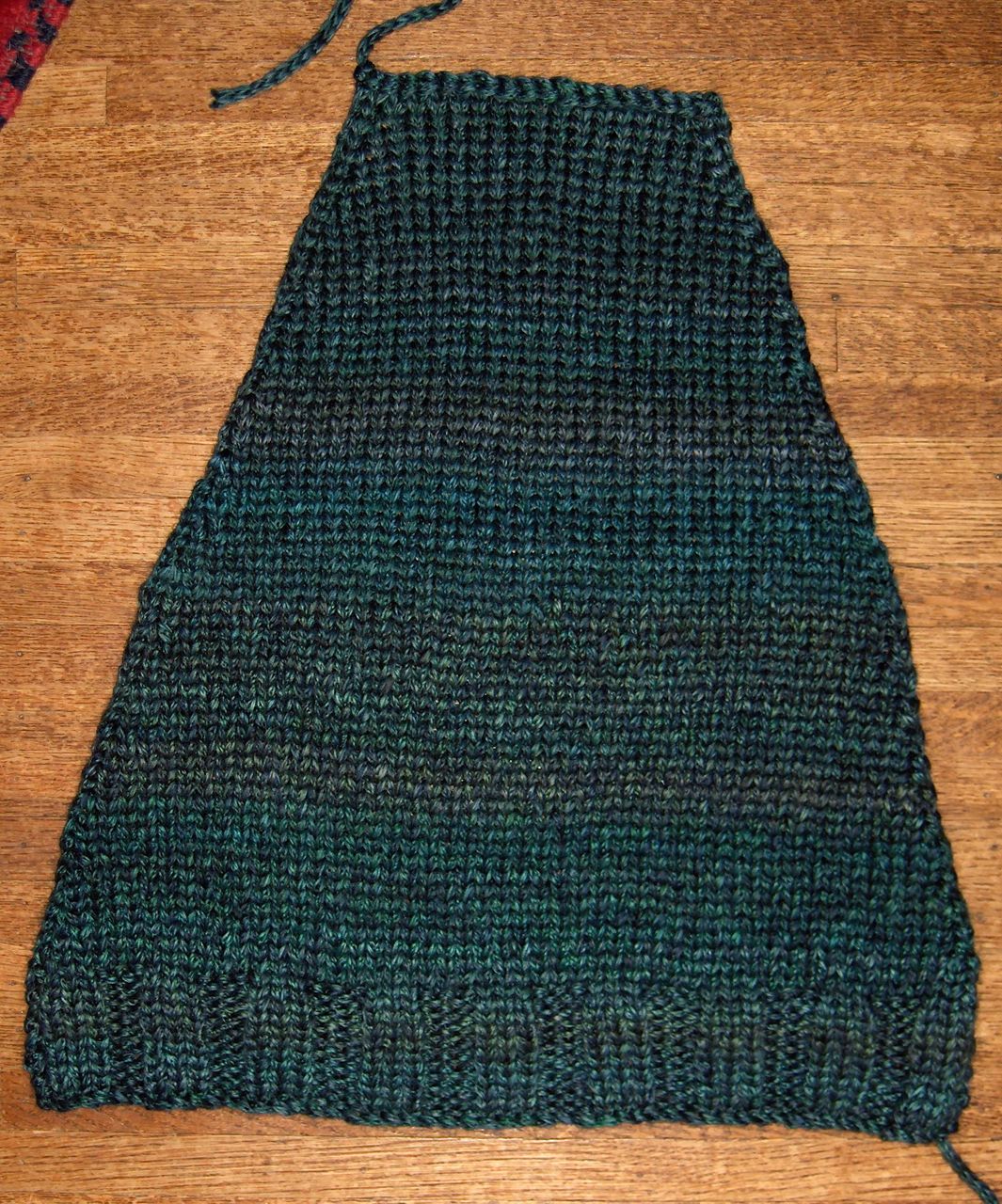
Here’s the left front of mine:Cropped Jacket by Irina Poludnenko knit in Noro Silk Garden Sock by Deborah Cooke

This is the left front, so the edge on your left is at the centre front, then forms the collar. The edge on your right is the side seam. The notch at the top is where the collar of the front meets the collar of the back and the shoulder seam is beside it. The stitches on the stitch holder are the front side of the shoulder seam – even though the instructions say to cast off this edge, I left the stitches live so that I can simply pick them up along with the back shoulder stitches and keep knitting. After the fronts are done, the back is knit side to side, then the shoulder seams joined. The sleeves are then knitted down from the shoulder to the wrist, and the side seam – from wrist to waist – joined last. I thought it would be better to eliminate that shoulder seam. The two colourways I’m using are 289 for the main colour and 313 for the contrast. Of course – because I’m fussy like that – I rewound the yarn so that the colours in the right front will mirror the left one. I’m deciding how fussy I’ll be about matching the backs and sides – you can see that I didn’t cut the yarn at the shoulder, just in case.

Self-striping yarns are always addictive to knit – using two colourways at once seems to be even more so! I’m really enjoying this knit.

A New Blue Vest

I’m not really sure how this happened, but I ended up knitting a wool vest for Mr. Math in the hottest July I can ever remember enduring. It was a comparatively quick knit and is done now.

That makes two vests I’ve knit for him this summer. Impetus for this was the zipper breaking in his polar fleece vest last winter. He decided not to buy another one, because he wanted to wear handknits instead. (Yay!) But he didn’t have any vests, which are a winter favourite. So, out came the books and the stash to find out what he liked and why.

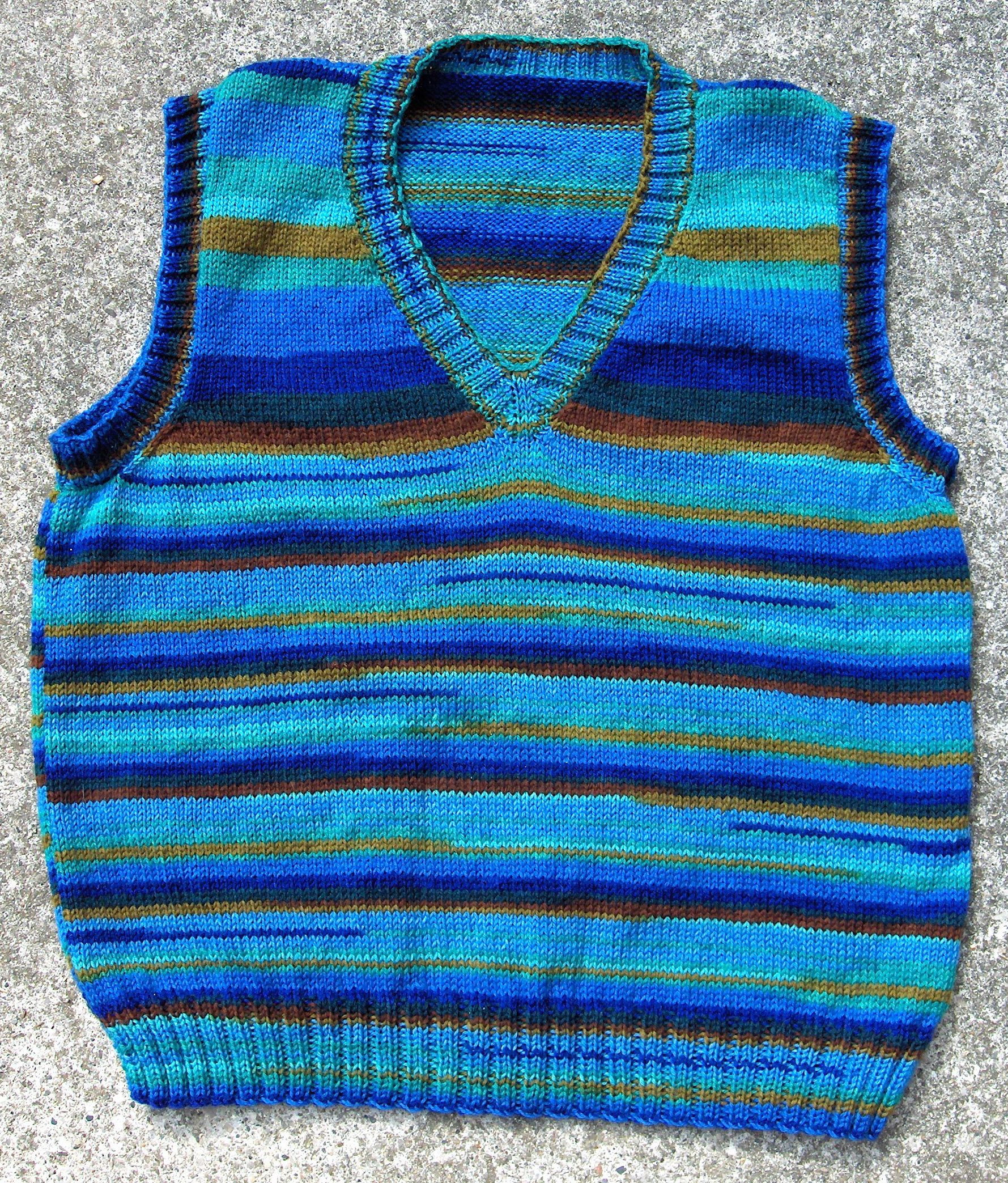
This is a free pattern, available on Ravelry, called Conservative (but Pretty) Dad Vest. (That’s a Rav link, but you can create an account there for free.) Mr. Math isn’t a dad, but he liked the vest and I liked that the instructions were in the right gauge for the yarn he chose. The yarn is a Kaffe Fassett sock yarn – Regia 6 ply – which self-stripes. Here’s the finished vest:Conservative (but Pretty!) Dad Vest by Julia Trice knit in Regia Kaffe Fasset Design Line by Deborah CookeIt fits him perfectly and he likes it, so all is good. It could stand to be blocked, but I’ll do that when the weather cools off.

On to the next project!

Conservative Dad Vest

Here’s another project that I’ve been working on. Strange but true – it’s wool.Conservative (but Pretty!) Dad Vest by Julia Trice knit in Regia Kaffe Fasset Design Line by Deborah CookeThis is the back of another vest for Mr. Math. It’s knit of a heavy sock wool – Regia Design Line 6-ply – in a colourway designed by Kaffe Fassett. The yarn is doing the striping, all by itself. The pattern is Conservative but Pretty Dad Vest, which is a free pattern – here’s the Ravelry link and here’s the designer’s link. (It’s the pattern in the bottom left corner of this display – if you click on it, you can download the pdf.) The pattern is great – very easy and straightforward, and also easy to modify. Mr. Math is leaner and taller than the designer’s dad, but I’ve got it covered.

These socks are knit from the 4-ply variant of this same yarn, in the same colourway, but in the variegation that doesn’t stripe. Here’s my post on the socks – I can see now, though, that there are slight differences in the colours. There’s no brown or dark green in this variant.Socks in Schachenmayr Regia Design Line by Kaffe Fassett 4-fädig knit by Deborah Cooke

Why knit with wool in the summer? Well, because it’s my favourite. Wool isn’t frustrating to knit with. It doesn’t shed. This is unlike the KSH projects I have on my needles right now – I have no patience for finding mohair fibres everywhere when it’s hot! Wool has elasticity, too, so tension comes out beautifully even. I have a cotton sweater on my needles right now, too, but knitting with cotton is never my favourite. Also, this vest is mostly plain stockinette – I just knit a row and purl a row and repeat. Self-striping yarn is a good choice for this weather because I find it entertaining. It keeps me knitting, just to see how the colours come out next.

Which is why I’ve knit the back of this vest in less than a week, in a heat wave.

What do you knit in the summer, and why?