Calienté

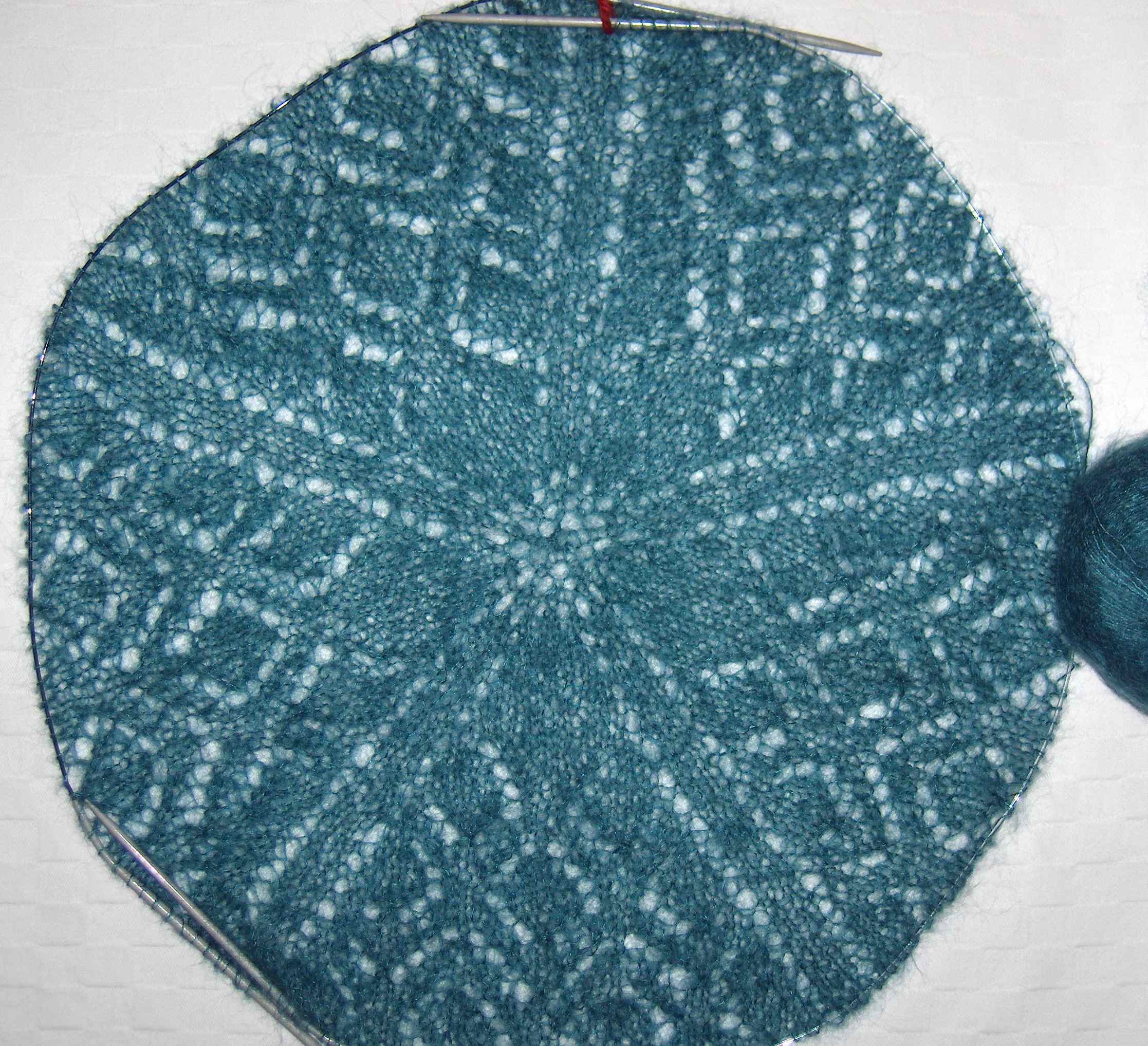
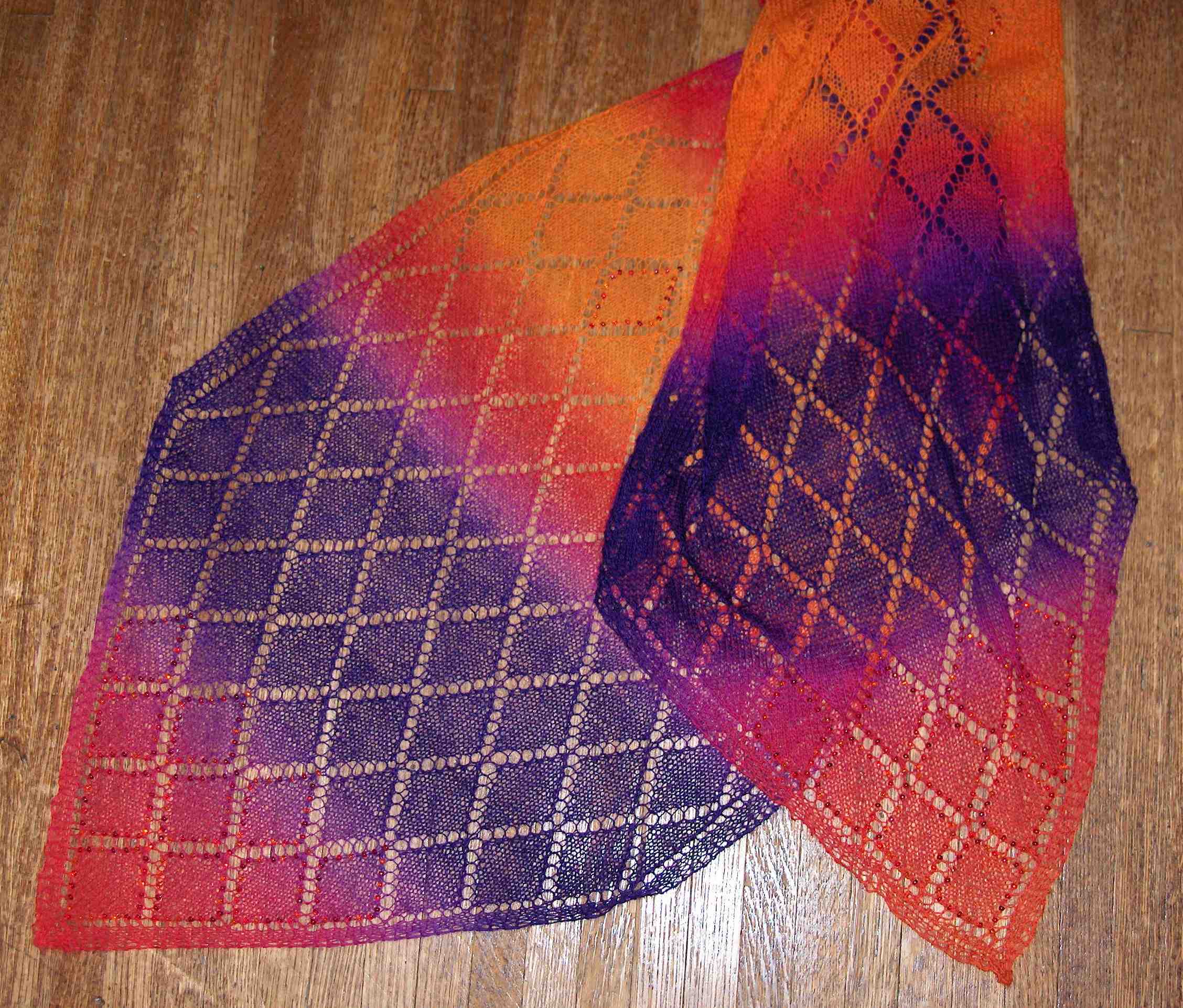
This is the stole I made with my Zauberball Lace, which is the Fuschienbeet colourway. The symmetry was pure luck, but it makes me very happy.Caliente shawl by Deborah Cooke knitted in Zauberball Lace by Deborah Cooke

My initial idea was to make a stole with pointed ends and a fairly simple pattern to show off the colour changes in the yarn. I thought immediately of Miriam Felton’s Juno Regina, but a quick look at the pattern revealed I’d have to follow the charts. I was in a chart-free frame of mind. I reasoned that I could adapt the Diamond Centre pattern from Victorian Lace Today to my purposes, and that’s what I did. It used almost exactly one ball of Zauberball Lace – I had less than 2 metres left. And beads – of course, it had to have beads.

The pattern is available as a free Ravelry download (do we love Rav? Yes we do!) right HERE.

Thrummed Mittens

This past week, I needed some knitting that wouldn’t bend my brain – or require me to follow charts. (It has been a pretty intense week, writing-wise.) So, I put my lace projects away for a few days, and opened a mitten kit I’d bought. My husband is always complaining that mittens aren’t warm enough, because the wind goes through the little holes. When I saw these kits for thrummed mittens, I knew they’d be just the thing.

A thrum is a bit of roving, tucked inside the mitten. It’s actually knit into the mitten, and there are bunches of them in a thrummed mitt, stitched in at intervals. You end up with an insulated mitten. The story is that these kinds of mittens were invented in Newfoundland and Labrador, where people are motivated to keep their hands warm.

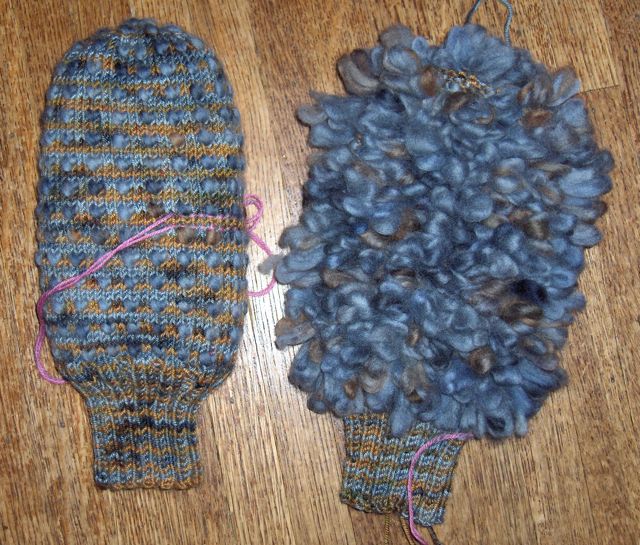
Here are mine – they don’t have thumbs so far, but they have thrums!

Thrummed Mittens in Waterloo Wools (kit) knit by Deborah CookeThe one on the left is right side out, just the way you’d wear it. The one on the right is turned inside out, so you can see the thrums. It looks as if it would be good for dusting, doesn’t it? The pink wool is a lifeline where the thumbs need to be knitted in. The yarn is handpainted and I like how the variegation came out in both the knitted part and the roving inside.

These were fun to knit, once I got the hang of making thrums. I’ve raided my stash for mitten yarn for myself, and I’m going to buy some more roving to make thrummed mittens out of that.

Have you ever knit thrummed mittens? Worn them? Or have you tried something new in your knitting lately?

Kidsilk Haze & Lace

I’ve ended up with two lace projects, both in Kidsilk Haze, on my needles. (Good thing I have too many needles.) No sooner did I cast on the Lady’s Circular Cape from VLT – which is proving to be an addictive knit – than the KSH for the Lace Cardigan in VK arrived. So, I cast it on, as well. Since I’m in the midst of a revision that is bending my brain (all good) I’m getting lots of knitting done as I think.

Here’s my progress so far on the Lady’s Circular Cape from Victorian Lace Today. (Which is a truly amazing book.) This one is cast on at the neck, then you work back and forth to the hem. At the end, you knit an edging around the whole thing. The colour of this one is Black Currant and it’s a very deep purple. I’ve worked about 25 rows of the pattern – of course, it’s lace so it looks like a lump right now. The little bits of sock yarn are my stitch markers – they indicate the pattern repeats: Lady's Circular Cape in Shell Pattern by Jane Sowerby knit in Rowan Kidsilk Haze by Deborah CookeThe other project is a Lace Cardigan from the current issue of Vogue Knitting. This one is knit outward from the centre back in a pentagon. I’ve used the colour Trance, which is a smokey blue. I’ve done about 30 rows from the first chart and again, it looks like a lump.Lace Jacket by Brooke Nico knit in Rowan Kidsilk Haze by Deborah CookeSo tell me – what’s on your needles?

Socks and Tension

This is just weird.

I knit half of a sock on my trip to RWA National, working on it in airports and on airplanes. I used my short Brittany birch needles, because airport security people don’t take those away. When I got home, I switched back to my longer metal DPN’s which are exactly the same size (2.5mm) and finished the sock. So far, so good.

When I cast on the other sock at home, I thought I’d just use the metal ones. They are my faves. I zipped through the ribbing, only to discover that it was half an inch shorter, even though it had the same number of rows. Evidently, I knit more loosely on wood needles. Who knew?

So, I frogged it back, cast on again on the wooden needles, and reknit the cuff. I figured I’d knit to the heel flap with the wooden needles, then switch to the metal, just as I had done for the first sock. That way, they’d match, right?

No. Evidently I also knit more loosely in airports. How bizarre is that?! See? The right – in process – sock is narrower, especially in the ribbing.Socks knit in Kroy FX by Deborah Cooke

It makes no sense because I’m always somewhat disheveled about traveling – which I’d think would make me knit more tightly – plus it’s colder in airports than in my house in the summer. Again, I’d think that would tighten the work. But no. I had to knit three extra rows for the leg to be the same length as that of the finished sock. It’s not a huge difference, but I’m amazed that there’s any difference at all.

I am, in fact, mystified.

The yarn, for those of you who care about such things, is Patons Kroy FX in the colourway Clover Colors. I quite like this yarn. It has one more ply than regular Kroy which makes it thick. It feels wooly and warm. I’m even resigned to the fact that you can’t match the stripes at all – because all four plies have a gradual colour change, I don’t think there even are repeats in the colourway. What doesn’t thrill me is that the two balls look as if they are from different dye lots, even though they’re not – the right one has a lot more orange in it. And I’m not thrilled by the yardage – there are 152m in a ball, and yes, I had to join another ball to make the toe on the first sock. I think a 50g ball of yarn should make one woman’s sock – if not, make it a 55g ball – but that’s just me. Next time, I’ll knit the legs an inch shorter than my usual 8″ and it should work out okay.

But still, I’ve only ever had gauge issues over long periods of time – as in, picking up a UFO after years and not having my gauge match because my knitting has changed over that time. Over a week or two is something entirely new to me. Have you ever had this kind of gauge issue with your knitting?

Stripey Noro Messenger Bag

Well, this week we have kind of a re-useable bag theme going on here, at Alive & Knitting. First there were bags we could make from reclaimed or vintage sweaters, that had been felted to make them tough. And now, here’s a bag knitted from scratch, ready to be used again and again and again.

But first, a bit of a saga. Remember the sweater I made from Noro Kureyon? Well, I had some leftover yarn and wanted to use it. (Stash management is key, right?) Remember my Dr. Seuss Socks? There’s just something about using a self-striping yarn like Noro in stripes that works for me in a big way. Noro Kureyon is said to felt wonderfully, so I decided to make a felted stripey messenger bag with those leftovers.

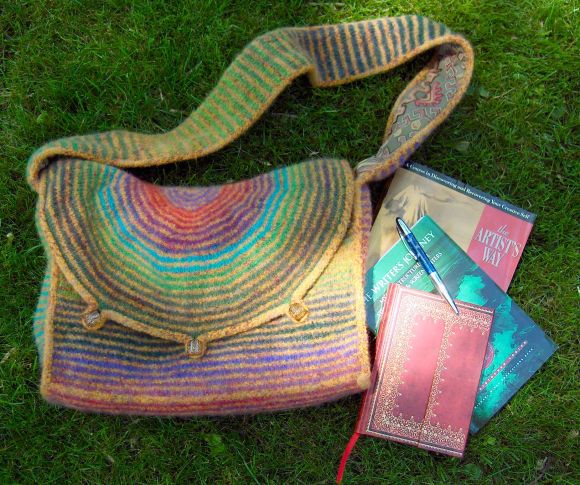
I paired the Noro with a colourway of Patons Classic Wool that I bought on a pilgrimage to Spinrite – thus, yes, doing some responsible stashbusting while pursuing a responsible project. This must have been a test colour because it’s not on their site. ($9.99 C for 8 x 100g balls. That’s not temptation. That’s inescapable acquisition.) Actually, there were a number of colours available at the mill, all of which had one ply that had a long graduated colour change. This is a mustard with the coloured ply changing through reds and purples. It worked well with the greens in the Noro Kureyon.Patons Classic WoolThis is the massive project that has been taking up my needle time. After all the knitting was done, I wanted to add I-cord. Ugh. There are about 10,000 miles of applied I-cord on this bag. It’s not strictly necessary, but it does make the edges look so much better. Here’s a shot of the I-cord in progress – it’s done on the left but not on the right:Stripey Noro Messenger Bag by Deborah Cooke knit by Deborah CookeSee how the I-cord neatens up those edges, and makes the bag look more crisp? I get really bored knitting I-cord, but I love the results.

I found some amazing buttons in my stash – I bought these because they were so wonderful, but never found a project for them. (Until now.) They look like pieces of amber, but have little lines inside them – Mr. C. says they look like rutilated quartz. I’m taking his word on that.

And here’s the finished bag before felting:Stripey Noro Messenger Bag by Deborah Cooke knit by Deborah CookeIt’s HUGE. The edges wanted to roll so I pinned them down – here’s hoping they just stay flat once it’s felted.

And here it is, after felting and finishing. Of course, it has a zipper and a lining, because I’m kind of compulsive like that.

Stripey Noro Messenger Bag by Deborah Cooke knit by Deborah CookeI LOVE this bag! What do you think of it?

My Ravelry project page is here.

The pattern is posted as a free download on Ravelry right here.

Easy Triangular Shawl

I knit the green version of this shawl last winter. I’d been knitting up a pattern that didn’t work out – I ran out of yarn before the border, and didn’t love it anyway – so I frogged all 750m. Then I was annoyed, so I just started to knit, making up a pattern as I went. I really liked the result – here it is:Easy Triangle Shawl by Deborah Cooke knit in Fleece Artist Nyoni by Deborah Cooke

The yarn is Fleece Artist Nyoni, which I like a lot. It has a bit of mohair in it – goat mohair – so is springy, and the colours are gorgeous.

Things didn’t go any further until I wore it – and someone asked me about the pattern. Oh. I couldn’t find my notes – at least none that were very coherent – so I sat down with graph paper to reverse-engineer the pattern. It was easier to make it up as I went than to figure out later what I’d done! Needless to say, I wasn’t enormously confident in my instructions. I hit the stash, found this blue sock yarn, and knit the shawl again, following my instructions.

Easy Triangle Shawl by Deborah Cooke knit in Diamond Fancy Free by Deborah CookeA good thing too, as there were a few mistakes. I knit a second version in garter stitch, while the first was in stockinette. Same pattern instructions – the only difference is whether you knit or purl the wrong side rows. The garter stitch one came out a bit smaller, a combination of smaller needles and the tendency of garter to pull together. I also added some stitches into the mesh bit in the middle of the shawl – it’s a bit tight on the green version – and added beads to the blue one. You can see the blue version and the beads in a detail shot posted on Ravelry with the pattern.

I like them both, though, and the corrected pattern is now available as a free download on Ravelry. What do you think?

Amazing

Here’s something that happened last week, which just amazes me.

On Monday last, I posted my Stripey Noro Messenger Bag pictures and pattern on Ravelry. I also queued up a post about it for my blog, for Wednesday. On Ravelry, people can mark a project or pattern as a favourite – it’s kind of like bookmarking it – which puts little hearts on the project or pattern in question. So there were little hearts showing up on my bag project and the pattern, people downloading the pattern, people sending me comments. It was quite fun to see that people liked my bag. (The first download was minutes after I posted the pattern. Talk about instant gratification!)

The amazing thing was that on Thursday, a knitter and Ravelry member on the other side of the world let me know that her knitting group had decided to have a KAL (knit-a-long) with my bag pattern. I think this is so cool!

And I can’t wait to see their finished bags. 🙂

Upcycled Bags

Another day on the re-useable bag theme. Today’s bags aren’t vintage bags in themselves – although it can be fun to score an oldie but a goody. I saw airline totes from the 1970’s the other day in a thrift store. So cool!

These bags are made from old sweaters.

It’s one thing to felt a piece of new knitting. But you can also felt a piece of old knitting. Or machine knitting. Or make use of a wool sweater that you might not use otherwise – one that doesn’t fit anymore, one you don’t like anymore, or one you bought for $2 at the thrift store.

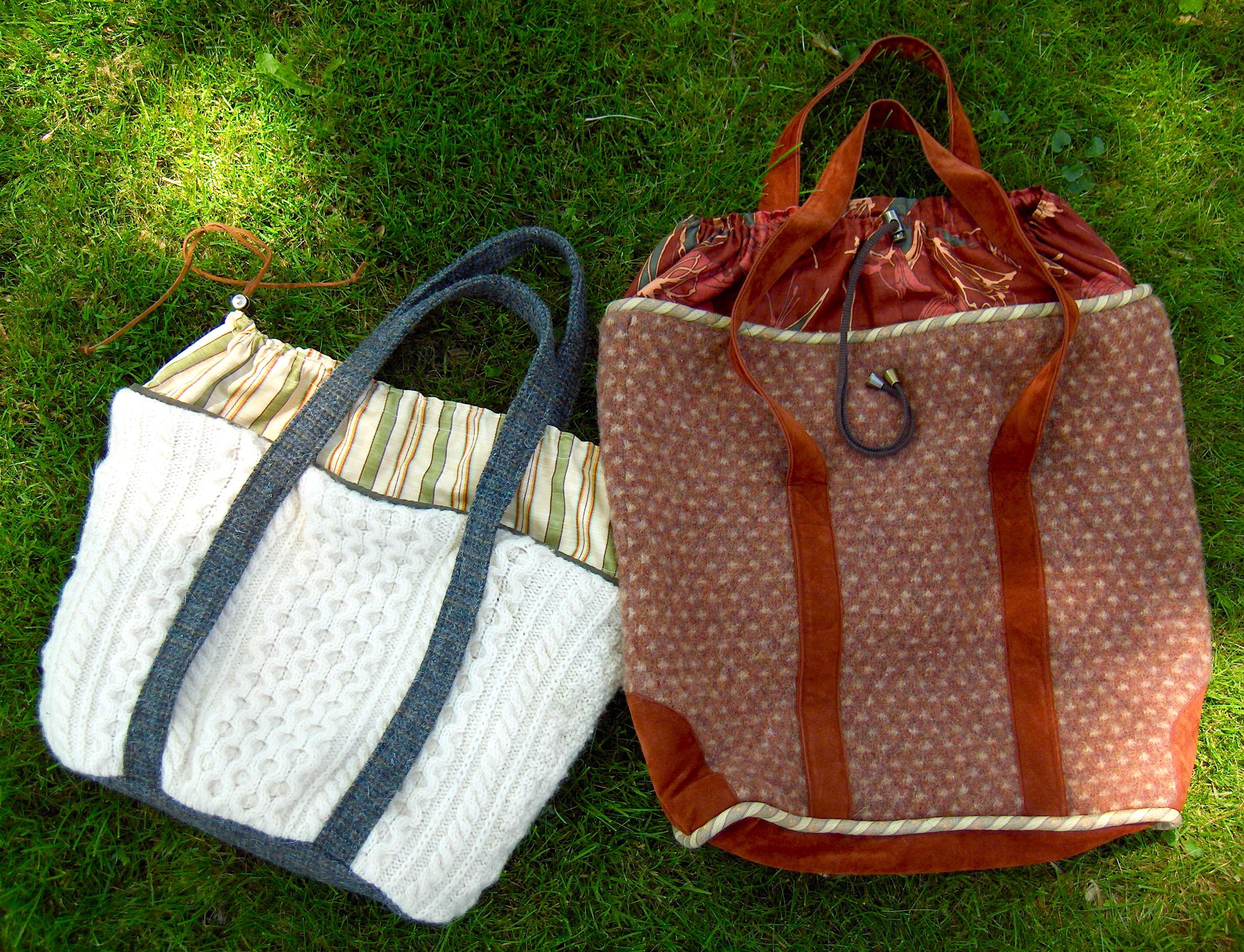
Like this:upcycled bags made from felted vintage wool sweaters by Deborah Cooke

The first thing you need is a 100% wool sweater. Ideally, it will also be a colour (or pattern) that you like.

The second thing you need to do is felt the sweater. Knot it up in a pillow case and toss it into the washing machine, with some towels and/or jeans to balance the load. If it doesn’t felt enough to lose stitch definition – i.e. if you can see the individual stitches – put it in for another round. Heat and agitation make wool felt. Front loading washing machines are more gentle and will require more repeats to felt an item. Hot water works faster. You can also fill the tub with hot water, toss in the sweater, put on your rubber boots, grab a plunger and get in there to agitate it. Your choice.

Once the sweater is felted, you need to decide which part to use. You can cut felted knitting without worrying about it unravelling. The bag on the left was the simplest kind – I cut it off straight at the underarms. The bottom ribbing became a seam allowance (a big one) in the base. The base is oval, just eyeballed from the size of the bottom plus a seam allowance. I edged the top with some piping from my fabric stash, made matching handles and a lining, and that’s that. I’m not much for open bags, but that would have been even easier.

The one on the right was one I wanted to be as big as possible. Those fake suede patches at the base actually cover the armscye from where I cut away the sleeves. The waist ribbing from the sweater is at the top, underneath that piping edge. This one has a square bottom which was a little bit trickier to sew. To cut the right size rectangle, I flattened the bag, then measured the whole width. The sum of the narrow side of the rectangle base and the long side of that base had to be the same as the width of the flattened bag. The other thing with this one was that I discovered after getting home that it had one little moth nibble. I unravelled some yarn from the cuff (which I knew I was going to cut off anyway) and darned the hole with the same wool. After felting, I couldn’t even find the repair again.

Have you made any bags from recycled or thrifted materials?

Easy Top Down Raglan Cardigan

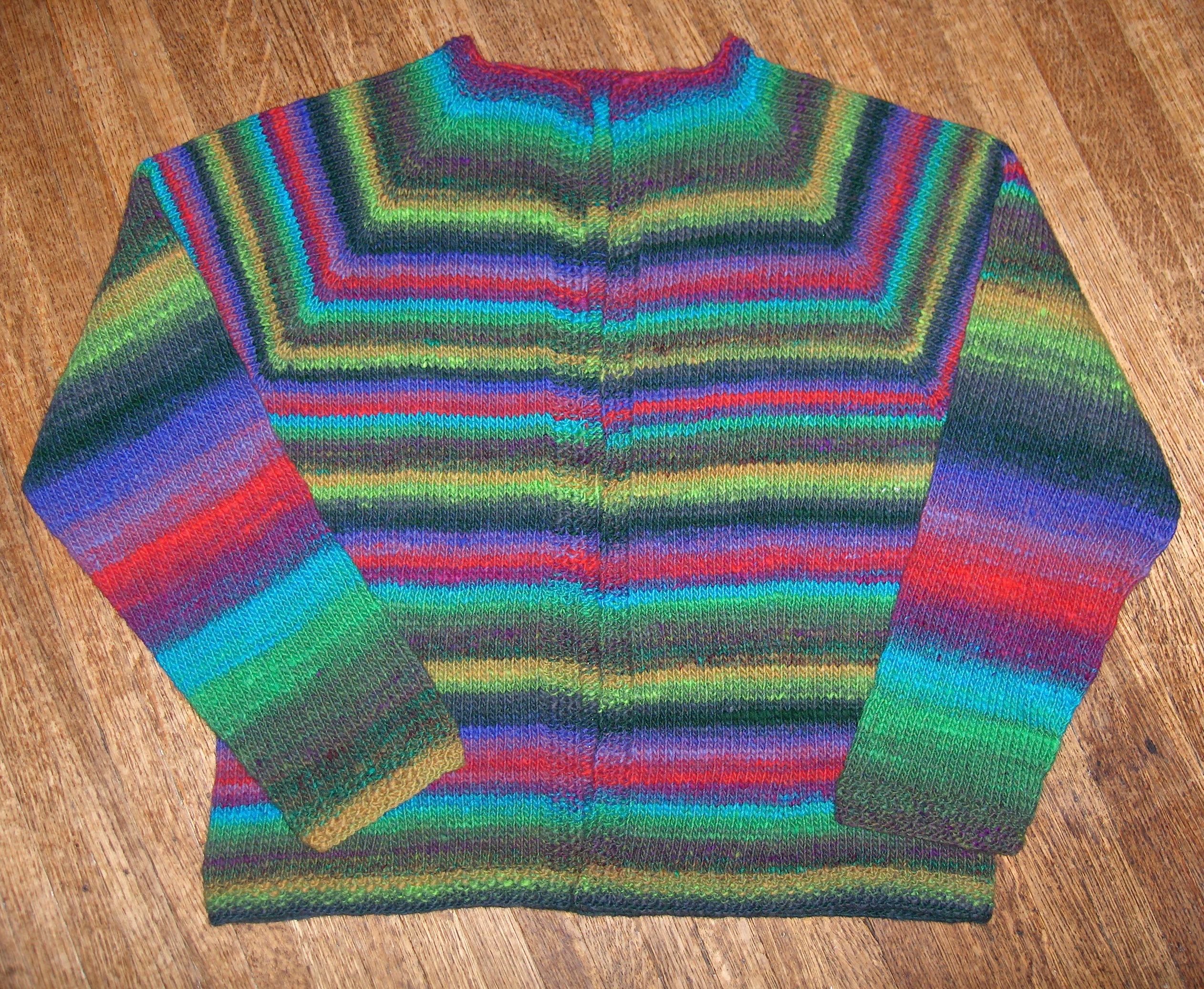
I seem to be convinced that I need cardigans, because I cast them on all the time. And I LOVE self-striping yarns. They entertain me enormously. I saw some Noro Kureyon on sale and could not resist.

On Ravelry, in the listing for Noro Kureyon, it says that “Kureyon” is the way that Japanese speakers pronounce “Crayon”, so the yarn is named for its bright colour combinations. Noro, of course, is a Japanese manufacturer. This is such a good story that I hope it’s true.

Top down raglans are insanely easy to knit and to fit – you can just try on the sweater as you go and adjust the fit accordingly. And there’s no sewing at the end! No seams! It’s all one piece. You just have to sew in the ends.

I used Laura Chau’s (a.k.a. CosmicPluto Knits) free pattern for an Easy Top Down Raglan, partly because she had knit it with the same weight of yarn. I did use smaller needles, though – 4mm instead of her 5.5mm – because I wanted a denser fabric. The only difference that made (because you do try it on as you go) was that it took more increases to get to the underarms. Laura suggests 24 but I did 30. Instead of ribbing, I worked the edges in seed stitch. I left out the buttonholes for a cleaner front. I did some waist shaping, but mostly I wanted a big loose cardi in pretty colours. I also was (big surprise) pretty compulsive about keeping the self-striping in sequence, even when changing balls of yarn.

It’s had a good soak (and is much softer for it), then a block. Here’s the result:Top Down Raglan by Laura Chau knitted in Noro Kureyon by Deborah Cooke

You can see that the sleeves aren’t a perfect match. I had to change balls in the light green near the top of the sleeve on your right, and it looks like I didn’t break off enough green. See the dark green line in the middle? The dark green band should have started there, not three or four rows down. That’s what threw off the match, but by the time I saw it, I didn’t want to rip back. It did become more out-of-step as the sleeves became more narrow, but I’ll live with it.

A couple of notes:

• From the 12 balls of Noro Kureyon, I used parts of 11 balls in my matchy-matchy fussiness. There’s a little more than 150 g left, though – so if I hadn’t been fussy, but had just knit it as it came off the balls, I would have needed 9.

• I did change the method of increasing at the raglan seams. The pattern instructs you to knit to one stitch before each marker, then KFB, move marker, KFB and continue. I don’t like how knitting front and back into the same stitch looks. Because each stitch is made into two, a knit stitch and a purl stitch, it makes a purl stitch right where the marker is and again to the left of the stitch after the marker.

I prefer when there is a neat line down the length of the raglan. So, I kept the increases outside of the two stitches that bracket the marker, leaving those two stitches to make that line. To do that, I knit to one stitch before the marker, make 1, knit 1, move the marker, knit 1, make 1, and continue.

Here’s a picture of different styles of increases so you can see what I mean. KFB is near the bottom of the sample. I’m not sure which of the M increases is the one I use, as these are the poster’s assigned names – it’s either M1A or M1L/F (and the corresponding M1T and M1R/B). It’s amazing to see how many ways there are to make a new stitch, isn’t it?

Of course, I’ve finished this winter cardi exactly as summer starts. This is pretty funny. It’s done just in time to be stashed away – while all the cotton ones linger on the needles. OTOH, in September, I’ll have a new sweater to wear. Look at the yummy colours!

Top Down Raglan by Laura Chau knitted in Noro Kureyon by Deborah CookeHave you ever knit a top down raglan? What did you think of the method? And the result? Is your knitting “in season”? Or do you finish things at the wrong time to wear them, like me?
Half Hexagon Fichu Shawl

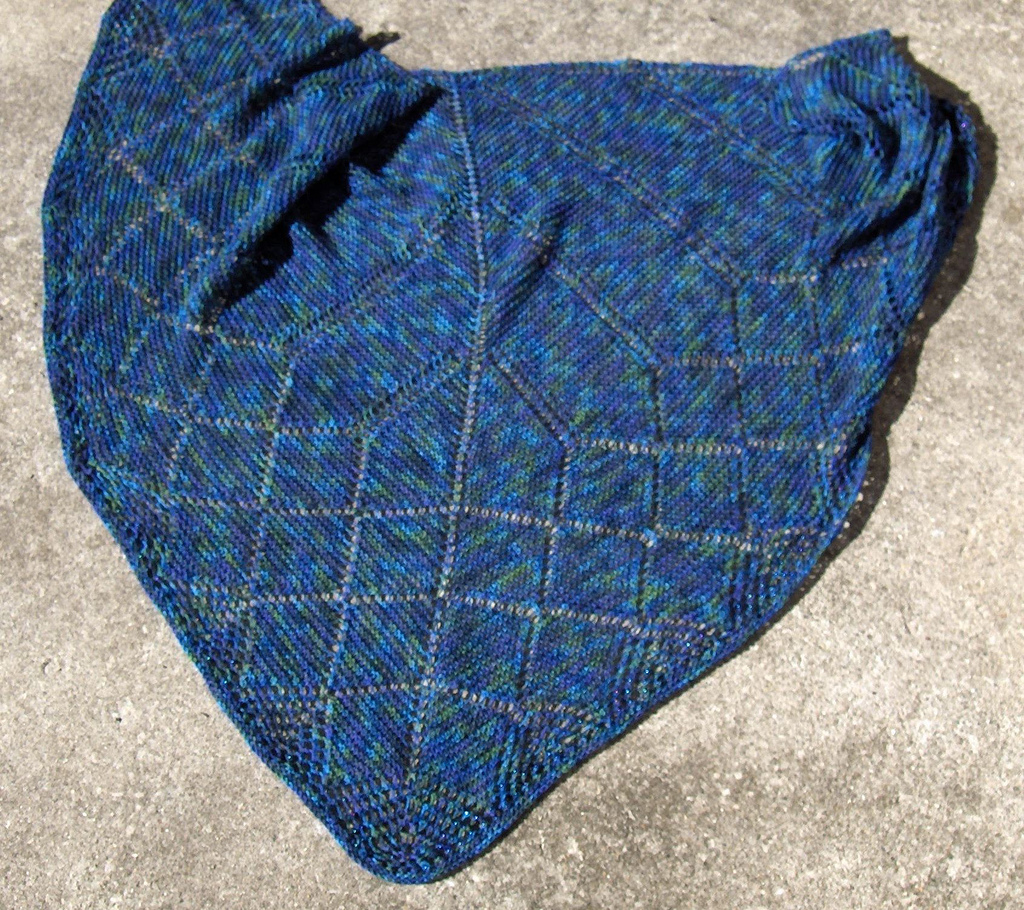
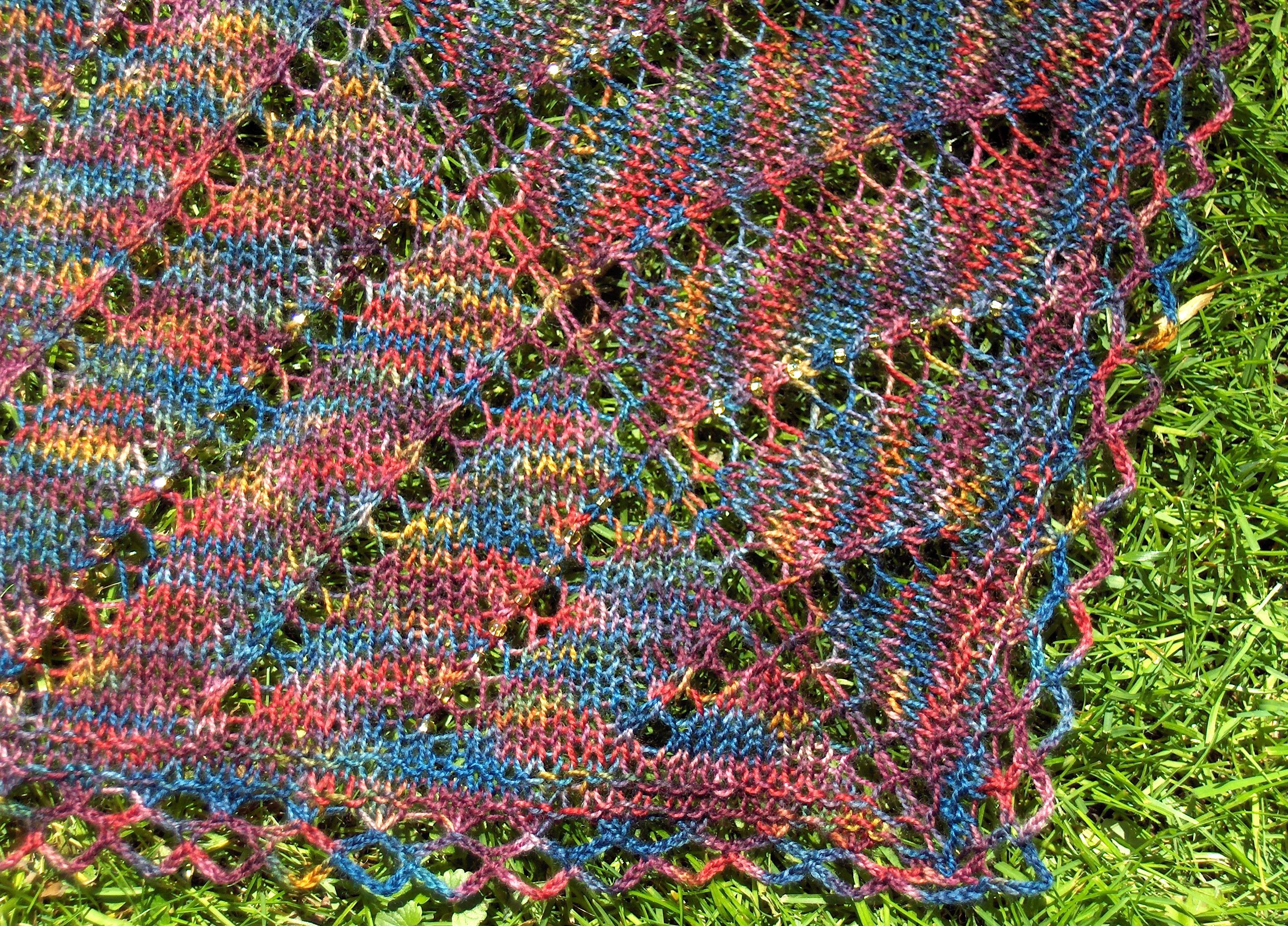
I just finished blocking this shawl, but still need to weave in the ends. I’m trying to decide whether to give it away or keep it! Here it is:Half Hexagon Fichu Shawl by Jane Sowerby knit in handpainted sock yarn by Deborah CookeWow. That shot is even out of focus! A new low in my photographic efforts!

It’s the fichu of the Spiders’ Web Shawls from Jane Sowerby’s VICTORIAN LACE TODAY. I used a skein of handpainted sock yarn – the pictures don’t do the colours justice. It looks purple from a distance, but up close has many different (and unexpected) shades in it. The gold beads aren’t showing up too well in the photos either – they’re on every second row, right above the YO holes.

Essentially, I knit until the yarn was almost gone (the skein was about 400m) then did a quickie edging. Theoretically, these are half circle shawls – well, half hexagon – but in reality, they always want to block to be more than half of a circle. This is a nice size, though – it hangs just to the elbows.

Here’s a detail shot:Half Hexagon Fichu Shawl by Jane Sowerby knit in handpainted sock yarn by Deborah CookeThis one shows the colours better, but not the beads.

So, what do you think? Should I keep it (remember that I already have two Spiders’ Web shawls, but in different yarns – one in Noro sock yarn and a bigger one in Fleece Artist yarns) or give it away?