Sorbetto by Colette

Sorbetto by Colette

The pattern for Sorbetto, a sleeveless top, is a free download from Seamwork. You can get yours here.

There are three views: a sleeveless top, a longer sleeveless top and a top with short sleeves:Sorbetto by Colette

I thought it would be great to have a basic blouse pattern and like the simplicity of this one.

First I made version 1 in a woven rayon print, and here’s the result:Sorbetto by Colette sewn by Deborah Cooke

This top was easy to sew and fairly quick to make. It fits me reasonably well. (The bust dart is in the right place – kind of a surprise since I’ve been lowering bust darts on everything – so if your girls are perky, you might want to double-check its location before you cut.) You can see that the front pleat kind of disappears when you use a print fabric.

I don’t love the top, though, and had to think about that. Why does it feel frumpy?

I went back and looked at the pattern pictures from the Colette website. The orange top actually looks a bit snug at the underarm on the model and the top definitely is more narrow in the shoulders than mine, especially across the back. I bound the seams instead of turning under the seam allowance, but that only adds 1/4″. The shoulders on my blouse are too wide, even for Nell.

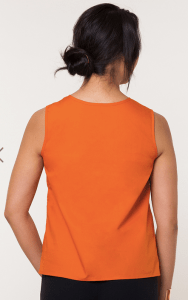
Sorbetto by Colette Sorbetto by Colette

Cutting for my bust size and ending up with a top that’s too wide in the shoulders is a familiar issue for me. It isn’t a huge deal with a sleeveless blouse, but means I don’t want to make the version with sleeves until I work that out. The top also catches me a bit across the hips when I sit down, which means it needs to be either wider at the hem or shorter overall.

One issue at a time. I decided to try a version with a shirt tail hem. I chose another woven rayon print from my stash. Both of these rayon prints came from Fabricland, and I think they were both included in a huge feature of rayon prints at $5/m last year. I love woven rayon prints and bought a bunch of yardage then. I’ve cut a dress out of each of these prints, so cut these blouses from the remnants, using the rayon as muslin. This rayon, though, is much softer than the navy one, which is more crisp, and wow, what a difference that made. There is nothing that can make you regret a million miles of bias binding like a soft, floaty fabric! After much gnashing of teeth, here’s the result:Sorbetto by Colette sewn by Deborah Cooke
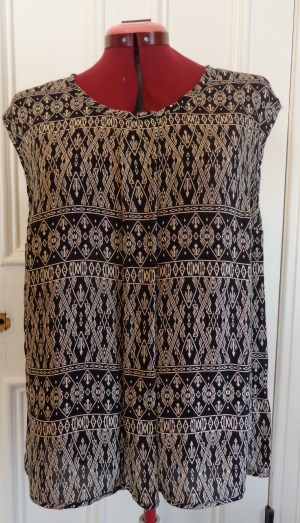
It turns out that I don’t love the shirt tail hem, plus I had some issues getting it right at the side seams – because I’d felled the seams. One side is great; the other, not so much. (grrrr.) There is a tech article in this month’s Threads magazine about that very challenge, so I’ll have a look and learn.

Oops a one way designThis is a top of many errors – I was sure the print wasn’t a one-way design but I was only looking at the wider stripes. Look how the narrow ones between those wider ones alternate. Oops. It IS a one-way design, but I had to invert the back to cut it out of the remnant.

I also inverted the front pleat by mistake. (No pix. I forgot.) And I originally sewed the front pleat as a tuck at the neck and didn’t sew it down. This made a floaty top, but also made me look a LOT more buxom than I am by creating a deep shadow at center-front between the girls. (You could do that on purpose if you wanted to look more curvy.)

That look was a non-starter for me. I took the neck apart, fixed the direction of the pleat and sewed it down for just 8″, leaving the lower part of it open. This was mostly because I didn’t want to re-do the hem, but actually, it works well with the fabric this way.

In comparing the two test tops, I much prefer the crisper rayon. The shoulders are still too wide, but I didn’t want to just trim them back because the neckline is a bit wide, too. (That explains the frump factor.) Instead, I pinned in the center back seam, as if I’d trimmed off 3/4″ and tried it on (to make sure it would go over my head). It did and fits much better through the neck. I don’t want to redo that bias binding, but that gave me a modification for future tops.

Sorbetto by Colette sewn by Deborah Cooke in Kaffe Fassett Exotic StripeI went back to my pattern and modified it. I cut an inch off the hem, cut 3/4″ off the center back of the back pattern piece, and re-angled the side seams so that they’re 3/8″ wider at the hem. The additions to the side seams make up the 1.5″ taken out of the center-back so the hem is the same finished width.

Then I cut another Sorbetto in Kaffe Fassett cotton in one of his yarn-dyed stripe fabrics. I hemmed this one with self-bias because I thought it needed some structure at the hem to hang properly. It also would be better in a crisper fabric than the Exotic Stripe, but here it is!

I’m pleased with this version. 🙂 And now, I have a pattern to make LOTS of quick summer tops in a hurry. Ha.

Another Navelli

I liked the Navelli pattern so well that I decided to knit a second one. This one is in MadTosh Merino Light.

The plan was to use up some of my stash. (Don’t laugh.) I chose both Spicewood and Red Phoenix, and put them with some leftover Malabrigo Sock in black. (I’d used it for my Gates of Moria mitts.) I like the Spicewood with the black for the fair isle, but I was less happy with the Red Phoenix. It looked a bit pink with the Spicewood. I visited a LYS (a new one for me) that stocks MadTosh Merino Light and it was obvious that the Cardinal was a much better choice.

This was also when the Simmer Pot jumped into my hands, insisting that I take it home. It goes with the Red Phoenix, and both of them have ended up in my Spector. I don’t mind the Spicewood and the Red Phoenix together in that one because they’re not right up against each other. The first blog post on that sweater was last week, and it’s right here. So, the skein of Spicewood came out of the stash, and the two skeins of Cardinal were added. One skein of Red Phoenix and the other of Spicewood came out of the stash for Spector, along with the skein of Saffron, but the Simmer Pot was added. That’s four skeins out of the stash and three added. Not exactly a win, is it?!

I think my teal Navelli is a bit too wide and too short, too, so I cast on a smaller size this time and I’m knitting an extra two inches before splitting for the arms. It’s possible that I’ll frog the first one and reknit it if I like the fit of this one better.

Here’s my progress so far:Navelli knit in MadTosh Merino Light by Deborah Cooke

Stylish Dress Book – Sleeveless Dress A

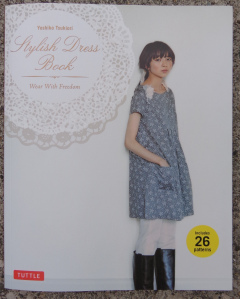
Time for more reports about sewing from Japanese pattern books. Today’s feature is a sleeveless dress pattern (A) from Stylish Dress Book.

Pattern A  is an A-line sleeveless dress. I made it first in black linen – since I’d had such success with the smock, I decided not to do a practice dress.

Sleeveless Dress A from Stylish Dress Book sewn in linen by Deborah CookeIt came out beautifully, although I found it a little tough to roll the narrow bias hem with the linen. The pattern calls for a lighter fabric and the weight made a difference on that narrow bias. If I used linen again, I’d cut the bias strip 1/4 wider.
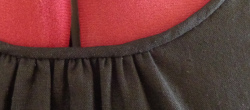
I love how it looks. It’s a great layering piece.

Sleeveless Dress A from Stylish Dress Book sewn in linen by Deborah CookeHere’s the neat neckline. It’s a little detail that gives the dress the perfect interest, I think.

I made another one of these in a red cotton border print. This is a lot more flashy, but also a fun simple dress.

Sleeveless Dress A from Stylish Dress Book sewn in cotton by Deborah CookeThe stripe was on the selvedges, so I cut the dress crosswise to have the stripes at the hem. This meant that it took very little fabric to make the dress: I only had 2m of this because I bought the end, and it was just 42″ wide. I was excited to be able to get a dress out of it. I matched the position on the hem and let the height fall. You can see that there is more of the stripe on the opposite selvege at the shoulder on the front than on the back—that’s because the bodice darts make the front slightly longer than the back. That’s an excellent reason to match the borders at the hems rather than at the shoulders.
This cotton is a little bit stiff, although it may soften over time. The next one of these I make will be in a fabric with more drape, just to see the difference. I suspect that it works best in fabric that has more body, but we’ll see.

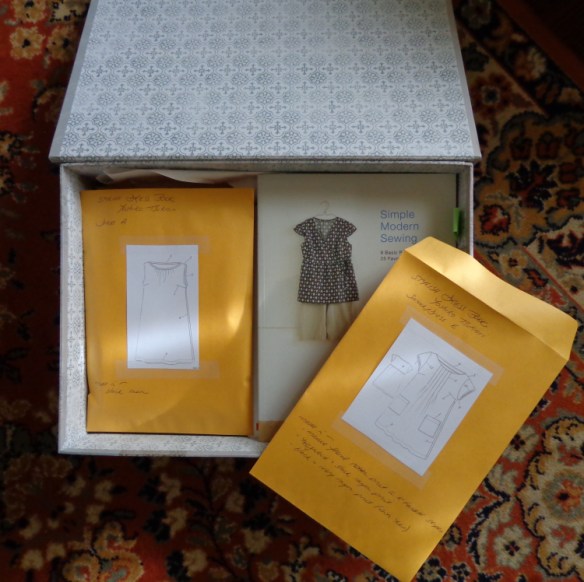
I needed to get organized with these patterns, too. Because you trace them out yourself, there’s no neat way to store them away when you’re done with each piece. I decided to mimic store-bought patterns and bought some envelopes as well as a pretty box at Michaels (they were on sale). The envelopes fit perfectly and there’s one for each pattern. The books also fit in the box.

Here’s where my patterns live now:
Deborah Cooke's pattern box

Nevis Sweater and Entrelac Bag

I recently finished a sweater knit in Noro yarn. I’m trying to both stash-down this year, and also to finish what I start (instead of having dozens of projects on the go). Also, it’s really cold this winter, so a new warm sweater seemed just the thing – with the weather to inspire me to finish. I remembered that I had a bag of Noro Hitsuji, a bulky single ply wool, which seemed to be the perfect choice. I used an older Rowan pattern by Kim Hargreaves called Nevis – it’s in a pattern book called A Season’s Tale. It reminds me of Mary Maxim sweaters, but with more of a trim fit. Knit in the self-striping Noro, I think it’s fun.

Here it is: Nevis by Kim Hargreaves knit in Noro Hitsuji by Deborah CookeI did make some modifications to the pattern. The waist shaping is supposed to be done at the side seams, but I moved it into the body of the sweater. I positioned the decreases like darts in a tailored shirt, halfway between the centre and the side seam. I lucked out on the matches of the colours: I began both fronts and the back at the same point in the variegation, knowing that the fronts would match (so long as there were no knots). The back matches at the top and the bottom – it’s really twice the width of one front, which makes sense even though I didn’t think of that in advance. I figured the sleeves were about the same width as the fronts but longer, so started earlier in the variegation – I guessed, then decided blue cuffs would be nice. The matches worked out surprisingly well.

The front button band is supposed to be knitted afterward in its entirety. I wanted the hems to match so cast on an extra six stitches for each front. When it was time to start the stockinette stitch for the body, I put those six stitches on a safety pin. When I knit the button bands, I just matched the colour in the yarn and carried on. In the pattern, the buttoms were placed higher without one at the hem – I respaced them because I thought it looked as if one had been lost. I found some buttons with fun swirls on them which I like a lot.

The Hitsuji was a bit stiff while knitting and almost like a pencil roving for spinning. It softened up very well when soaked for blocking (like most Noro yarns). The finished sweater is very warm, which is just about perfect when it’s 20 degrees below zero outside.

Here’s the link to my Ravelry project page, if you’re interested in more detail.

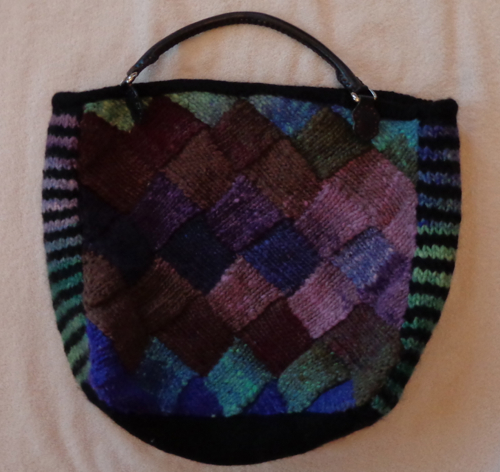
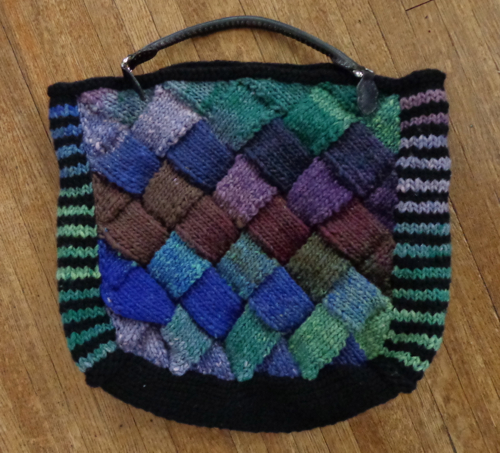
Now, I had a bag of 10 balls of Hitsuji and this sweater only used 6.5 of them (although I did break into three more, seeking matches.) I was determined to not send the rest back to the stash, but to use it up. I also had a pair of black leather handles in my stash, bought for a purse that I didn’t like knitting so frogged. So, I decided to knit an entrelac tote bag and felt it, using up the Hitsuji and also some black roving from the stash.

Here’s the bag before felting:Entrelac Bag knit in Noro Hitsuji by Deborah CookeAnd here it is afterward, still in need of a lining:Entrelac Bag knit in Noro Hitsuji by Deborah CookeThe black felted much faster than the Noro, so I’m thinking I’ll stop felting now. Here’s the project page for the entrelac bag on Ravelry.

What do you think?

Sipalu Felted Bag

I’ve finished another felted bag – is it possible to have too many of them? – and although it still needs to be lined, I thought I’d show it to you today. It won’t look any different from the outside once it’s lined, after all. 🙂

The Sipalu bag was available from Knitpicks as a kit, including the wool, but I didn’t like that it wasn’t felted. I knew the result would be less sturdy unfelted, particularly knit of a fingering weight yarn (the kit came with Palette.) The pattern for the Sipalu bag was and is available on its own, so that’s what I bought. The pattern specifies knitting with a number of colours, but I decided to use a self-striping yarn with a contrasting solid instead. I dug into my stash and came up with my felting standby, Patons Soy Wool Stripes and Soy Wool Solids. I used Black and Natural Plum.

I did run out of black. Since the SWS yarn is discontinued, I couldn’t find any more. (I tried.) I then substituted solid red SWS, but didn’t like it in the fair isle – there wasn’t enough contrast with the self-striping Natural Plum – so I frogged that back but used the red on the garter stitch edges. The bag sat, unfinished, in my knitting basket while I tried to figure out what to do. One day I saw a very similar yarn to SWS balled with another company’s label, which gave me the idea of using the Ravelry search engine to find a substitute. Ravelry has a great search engine that lets you specify many variables – I used the content (soy and wool) and the weight (aran) , then looked for single ply yarns in solid colours. I found Gjestal Bris, with a buy link, so ordered some of that. It’s a bit thinner than the SWS, but since I was felting the end product, it worked out just fine.

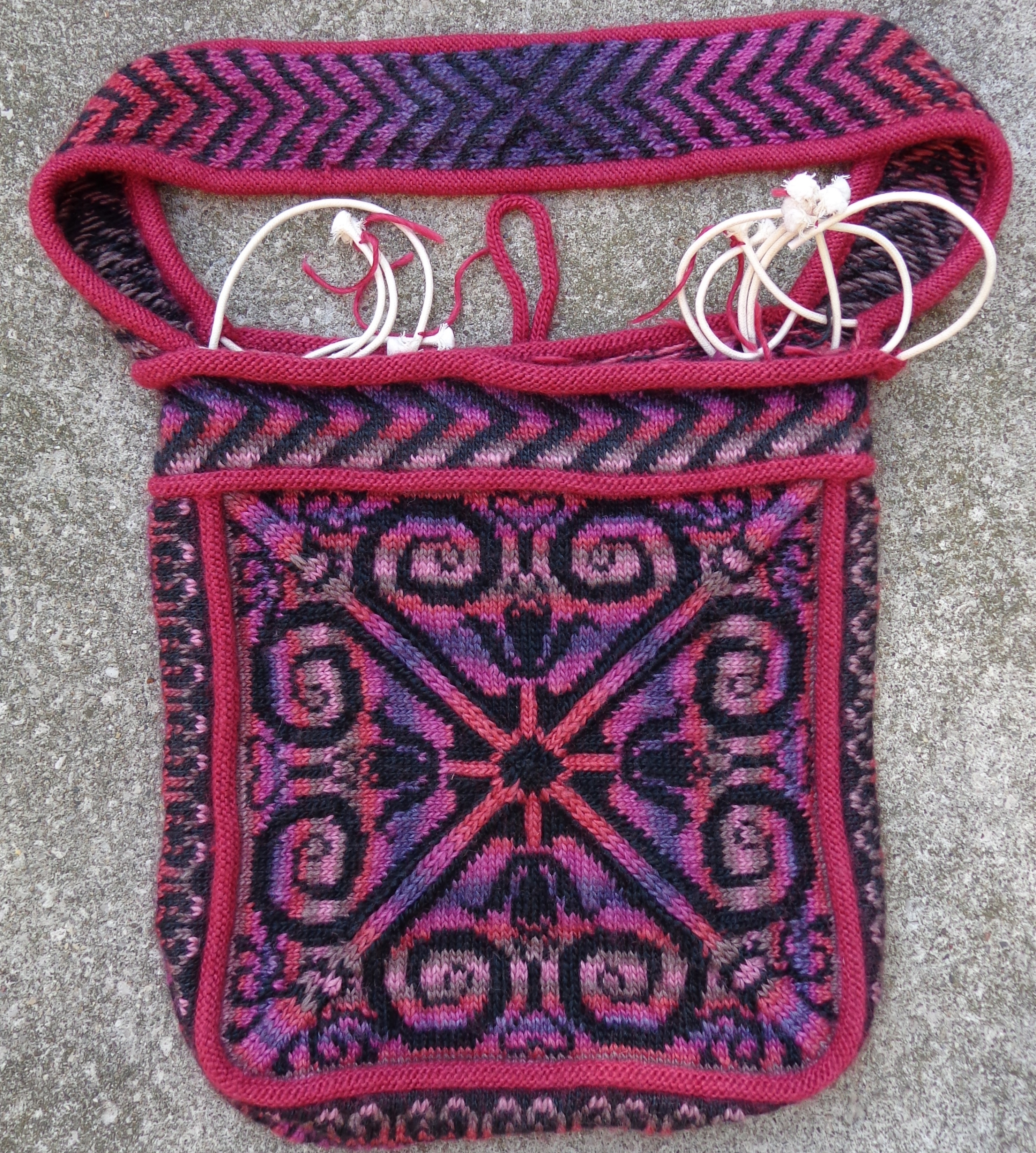
Here’s the unfelted version of the bag: Sipalu Bag by Kerin Dimeler-Laurence knit in Patons SWS by Deborah CookeYou’re probably wondering about the white cording. I decided that I wanted the edges of the bag to be more round than the garter stitch alone would make them. I wanted them to be like piping around the edge. So, I bought some cotton cord at the fabric store, the kind that’s used to make piping (!), and sewed it in to all the edges. (I slip-stitched the garter stitch ridge closed on the inside of the bag, with the cord trapped inside.) Because I wasn’t sure if the cord would shrink – or whether it would shrink at the same rate as the SWS – I left the ends long. After the felting was done, I tugged the cords so that the piping was smooth on each edge, then trimmed them and secured the ends inside the bag.

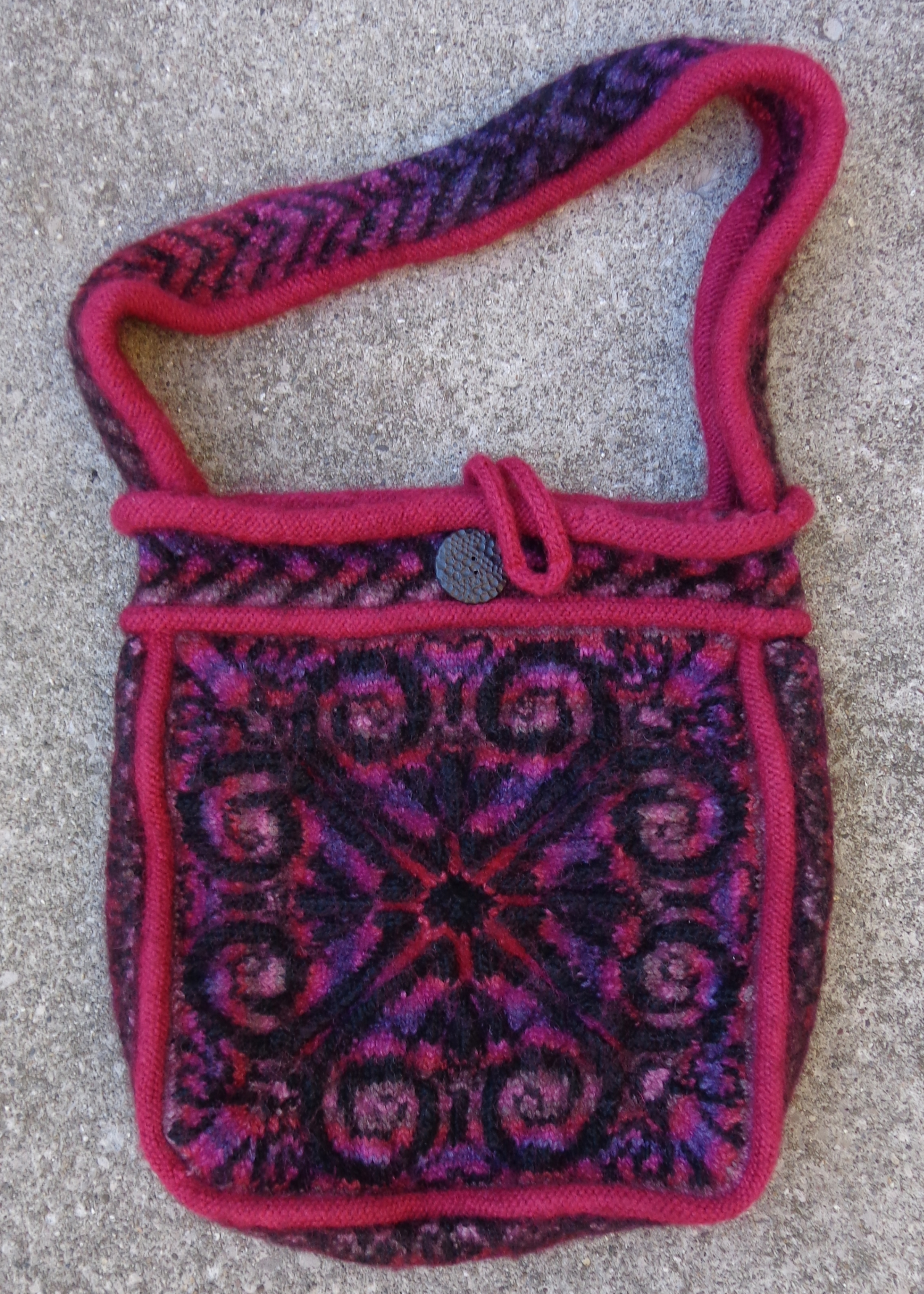
Here’s the bag felted and ready for its lining. It could have been felted just a little bit less, but felting is an inexact science. The button is handmade of porcelain. Sipalu Bag by Kerin Dimeler-Laurence knit in Patons SWS by Deborah CookeHere’s my project page on Ravelry, if you want to see more nitty gritty details.

What do you think?


Damask Bag in SWS – 4

Well, you probably remember me going on and on (and on) about this fair isle messenger bag. Happy to say that it is DONE and you won’t have to hear anymore about it after today. I finally finished the knitting after abandoning that double knitted strap that wasn’t going to get knitted in my lifetime.

The most recent post on the bag is HERE, and it has links to the earlier posts. Unfortunately, the nifty black I-cord I was showing you in that picture is no more. After finishing the strap, I decided that all of the I-cord had to be in the variegated violet — so I ripped out the black I-cord. I’m not a huge fan of knitting I-cord, so it nearly made me weep to tear out three feet of it. BUT it looks much better with the I-cord all the same colour.

Here it is, ready to be felted:Kauni Damask Understated Bag by Karen Stelzer knit in Patons SWS by Deborah Cooke

It’s about 24″ wide and 22″ deep in its unfelted state. My hope was for a bag more like 18″ wide and 13″ deep. I’ve felted a lot of SWS and that seemed about reasonable to expect in terms of shrinkage. I was a bit worried about it being so humungous – would this be the felting project that finally finished off my trusty (ferocious) top-loading washing machine?

Nope. But it didn’t felt the way I expected. Felting is, by nature, somewhat unpredictable, at least the way I do it. Putting the piece into a pillowcase then chucking it into the washing machine and coming back in half an hour leaves lots of opportunity for variation. I just don’t have it in me to stand guard over a felting piece though, pulling it out of the machine at regular intervals, much less to felt by hand in the tub with a plunger. I have made my peace with unpredictability.

Sometimes. On the first ride through the washer, the bag felted quite a bit. The flap and strap hardly felted at all. The design was starting to lose definition on the bag, but the bag was still pretty big. I had to leave it on the top of the washing machine and visit it regularly – poke it, prod it – to come up with a plan. Mostly I had to accept that I was past the point of no return – it was useless as it was; there was no going back; I might as well risk another run through the washer.

Before putting it back into the pillowcase, though, I tried to figure out how to make the strap and flap felt more than the bag on this run. The front of the bag had also felted more than the back on the first pass. So, I rolled up the bag and tied it into a big roll, with the back of it on the outside, much the way a butcher ties up a roast. It seemed that less exposure to hot water and less agitation could make the bag felt less. (Remember that I make stuff up for a living.) The flap and strap were free to move around inside the pillowcase. Back into the machine it went.

This worked pretty well. I made progress. But now, I have to get down to regional felting. Ugh. This is the handwork, in the sink, rubber gloves and hot water, just to get the flap and the strap to felt consistently with the rest. I have doubts. For the moment, I have to let it sit, maybe visit it, poke it and prod it once in a while. It’s still huge – about 18″ by 18″, but mostly I’m not loving it as much as I did (although this photo might change my mind.) Here it is:Kauni Damask Understated Bag by Karen Stelzer knit in Patons SWS by Deborah Cooke

What do you think?

Another Citron

Here’s a shawl I just finished last week. There was an idea that it might be a Christmas gift, but it was running so late that the planned recipient got something else. Now, I guess it’s mine!

It’s a free pattern from Knitty, called Citron.

I made a Citron last year in Noro Kureyon Sock yarn, but it came out much smaller than this one. There’s a post about it, back here. Here’s the new one:Citron by Hilary Smith Callis knit in Waterloo Wools Kirkland and Malabrigo Lace by Deborah CookeThe yarn is a handpaint that I bought at the Kitchener Knitters’ Fair last fall, and (incredibly) it didn’t need to age in the stash before I cast on. It’s from Waterloo Wools and is called Kirkland. The colour is a bit more burgundy than it appears in the pictures – the flash seems to have made it look pinker. The base yarn is very similar to Malabrigo Lace. I used smaller needles than the pattern says, because I like the look of Malabrigo Lace on 3.5mm needles.

This time, I wanted the shawl to be bigger, so I did seven rounds of the pattern before the ruffle. (Yup, I had to figure out the increases myself, but it wasn’t that hard.) The skein had 840 yards and I used most of it – if the hem had been in the same red, I would have used it all up. It’s a good size, though – it comes down to my elbows.

I also added beads to the last four repeats, putting them in the flat part with greater density each round. I wanted them to get more dense toward the hem.

Citron by Hilary Smith Callis knit in Waterloo Wools Kirkland and Malabrigo Lace by Deborah CookeSince the beads were dark (black with red linings) and the yarn is very much like Malabrigo Lace, I dug into the stash of leftover bits and pulled out some Malabrigo Lace in black. I worked two rows of stockinette in black at the hem of the ruffle, but then it curled when casting off – so I added a row of purl on the RS, then cast off on the WS. There are some beads in the black as well. It still curls a bit, but I have mixed feelings about blocking it – the ruffles flattened out when I blocked that last Citron and didn’t really ever come back. Maybe I’ll live with the curl.

It makes me think of flamenco dancers. Fortunately, I don’t have any castenettes!

Inky Spider’s Web Fichu Shawl

As you know, I’m very fond of Jane Sowerby’s book VICTORIAN LACE TODAY and have knit a few projects from it. Here’s another. This is the fichu variation of the Spider’s Web Shawl, knit in Noro Silk Garden Sock. I love this inky colourway and added some iridescent beads to it, too.Spiderweb Fichu shawl by Jane Sowerby knit in Noro Silk Garden Sock by Deborah CookeTechnically, this should block out as a half a hexagon, but mine came out more like 3/4 of a square. It’s a nice size and just falls to the elbows. Here’s a detail shot of the edging with the beads:Spiderweb Fichu shawl by Jane Sowerby knit in Noro Silk Garden Sock by Deborah CookeI love the colours and the texture of this one and know I’ll wear it a lot. What do you think?