A Shrug for Barbie

I was tempted into knitting for dolls by my friend, Jen, and this is dangerous territory. It’s really addictive to knit teeny tiny projects – the assumption is that projects will be finishing quickly, but I’m discovering that my need to get it “just right” means these little sweaters take a while. (We’ll talk about sewing for dolls later. I’m further down that rabbit hole.)

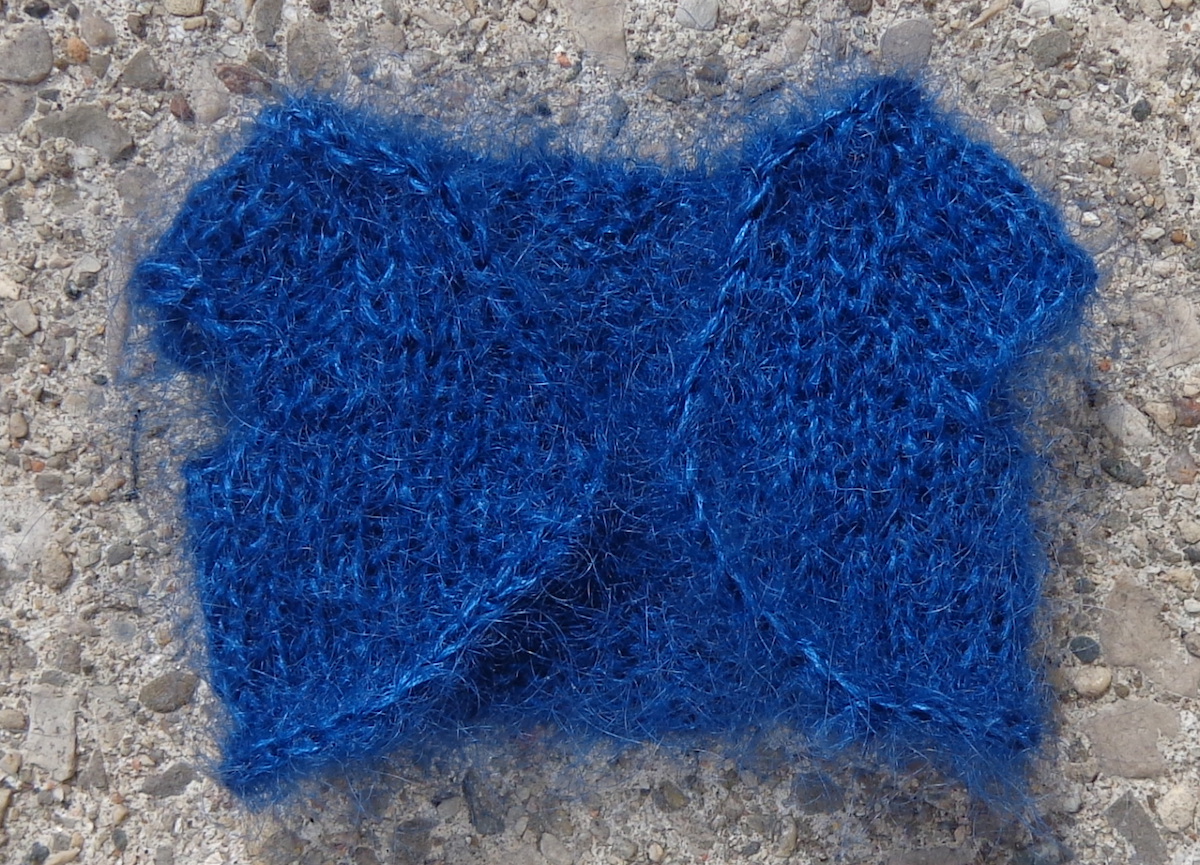
Jen has a Blythe doll and I knit this little shrug for her.

Shrug for Blythe knit by Deborah Cooke in Kidsilk Haze

This is extremely teeny and I wish I’d put something in the photograph for scale before sending it off. It’s maybe 2″ wide. The pattern is a free pattern on Ravelry called Shrug for Blythe, and it’s a great pattern. I found the instructions very clear and the results adorable – with no seaming! I knit it in some leftover Elann Silken Kydd, which is discontinued (that’s a Ravelry link) and a lot like Rowan Kidsilk Haze.

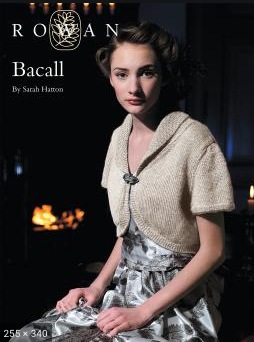
Bacall, a shrug pattern from Rowan designed by Sarah Hatton

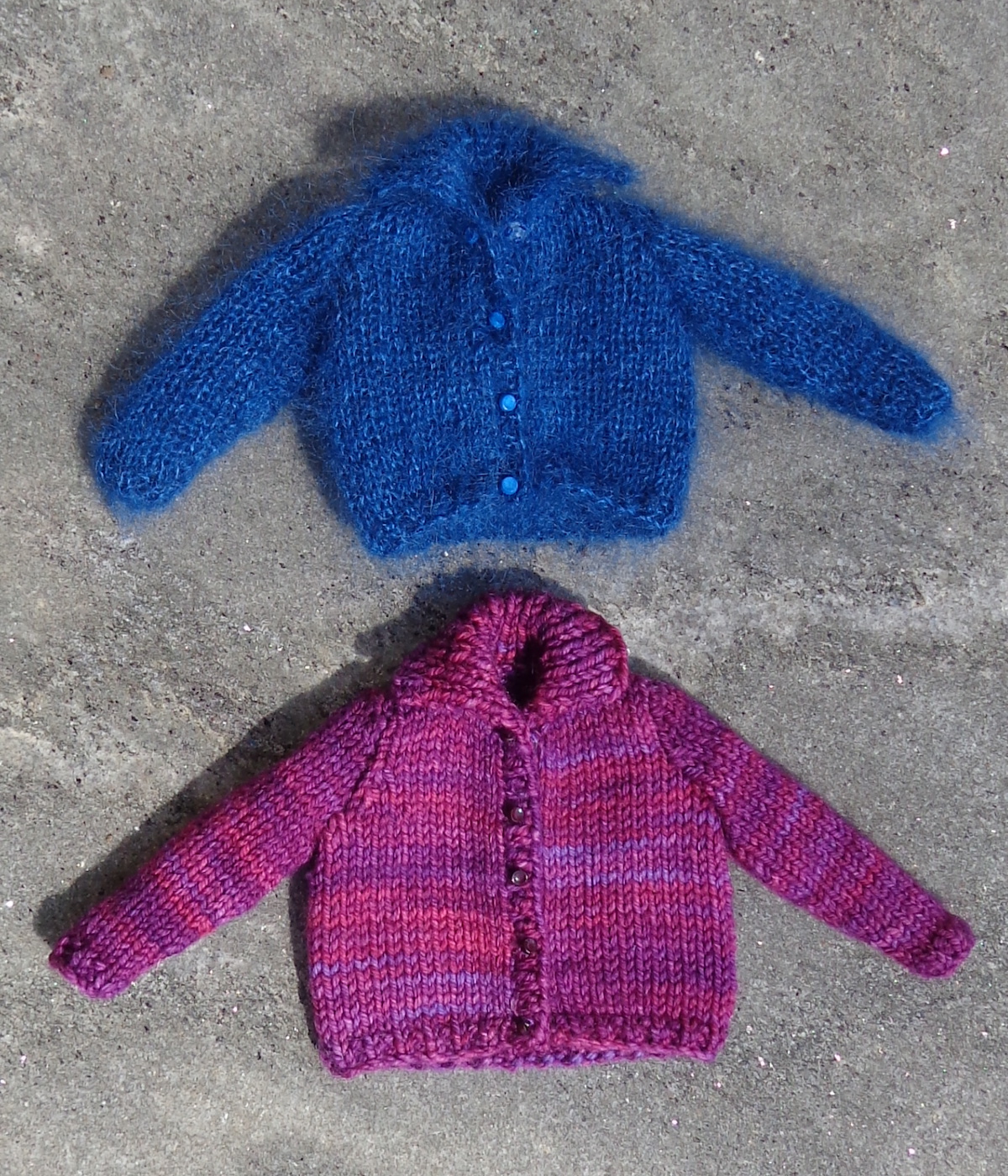
I tried this sweater on Barbie, because I don’t collect Blythe dolls, and it was too small. The length was good and the back width, but the fronts were small. Barbie definitely has more of a bust than Blythe! I played around with the stitch counts and made a few more changes, too – I wanted a shrug king of like Bacall, a Rowan pattern for actual people. (The Rowan site has been redesigned and I’m not sure this pattern is even there anymore, so that’s a Ravelry link. It was originally published in Rowan 44, and was a free download for a while.)

This shrug was designed by Sarah Hatton – I think the sample garment is too broad in the shoulders for the model shown here (or maybe too wide in the neck), but I love the roll collar.

I knit the long-sleeved version of it in Kidsilk Aura for myself, and it’s a wonderful squishy soft warm sweater. (Yes, I actually used the specified yarn. It happens sometimes.)

Here’s my finished sweater and here’s my Ravelry project page.

Bacall by Sarah Hatton knit by Deborah Cooke in Rowan Kidsilk Aura

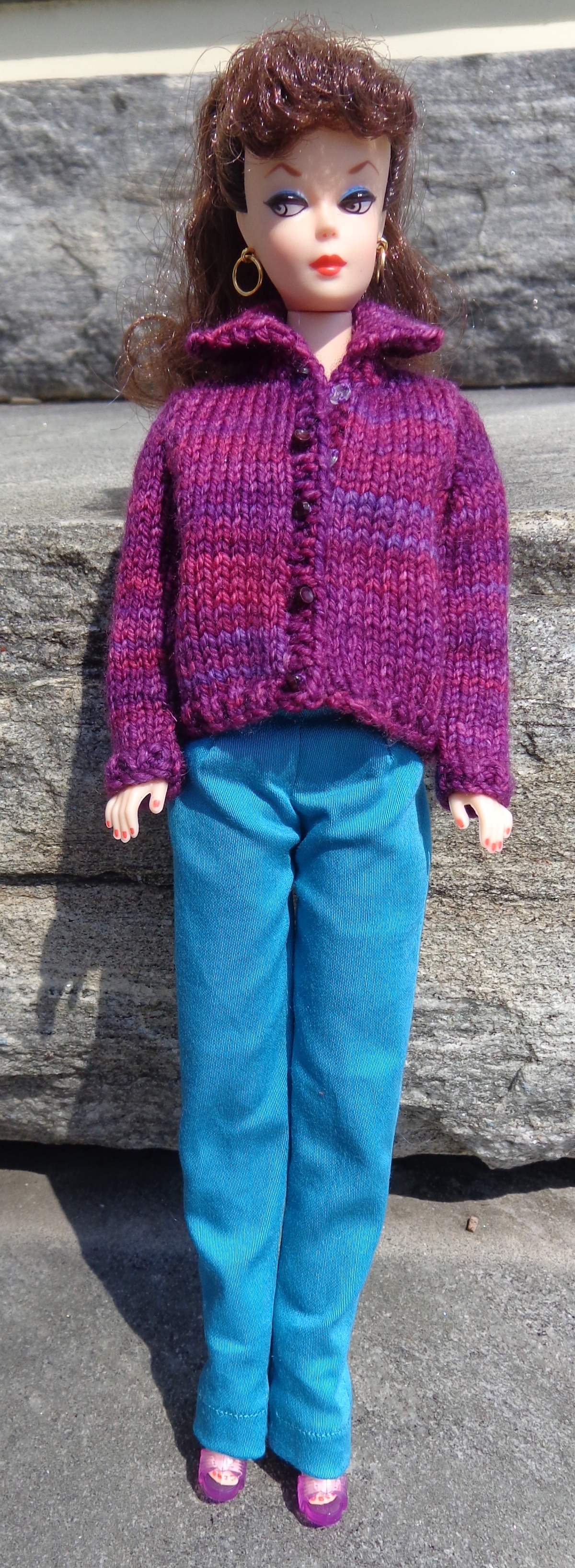
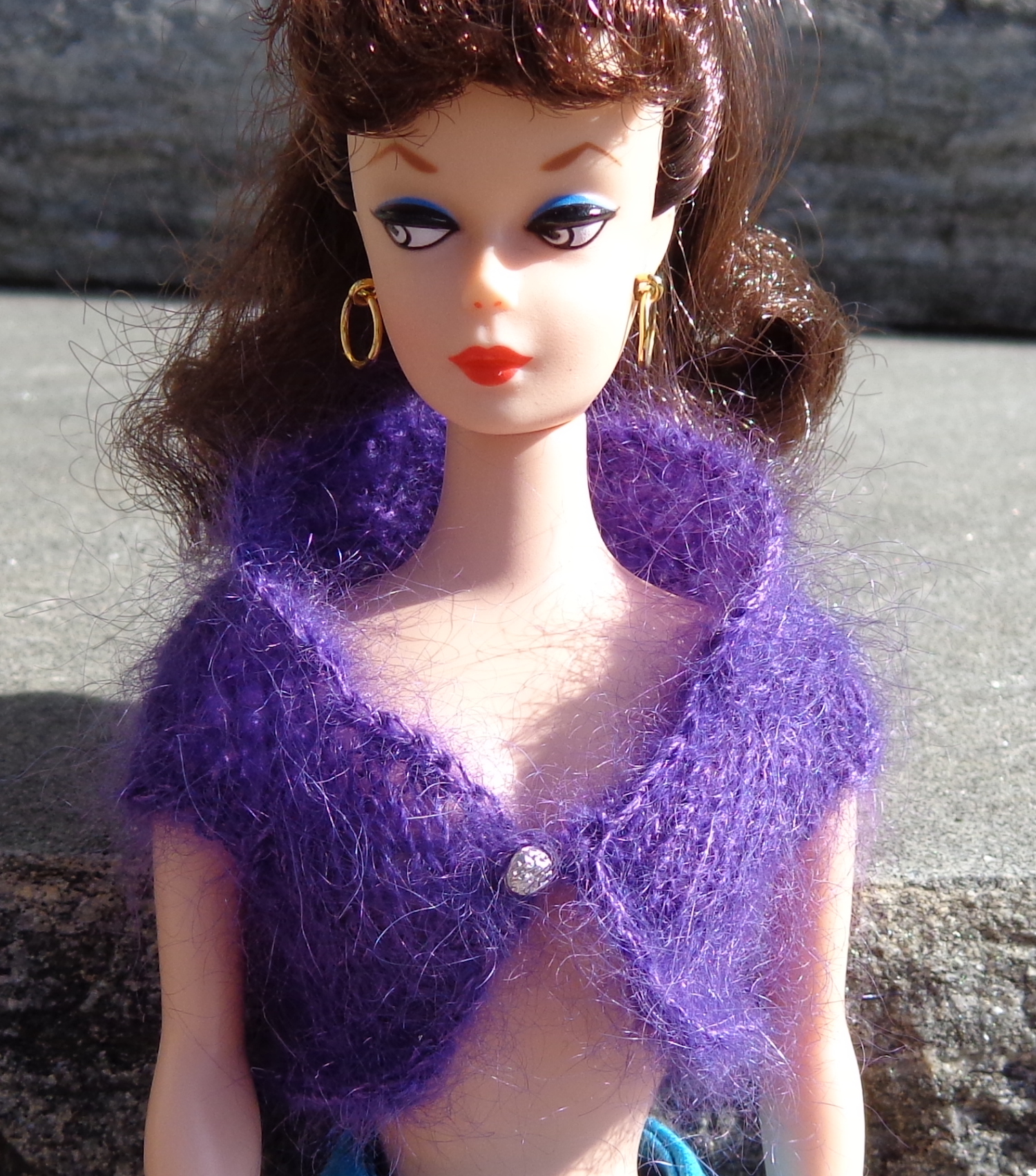
And here’s my modified shrug in Rowan Kidsilk Haze, adjusted to fit Barbie:

Shrug knit for Barbie by Deborah Cooke in Rowan Kidsilk Haze

It has cap sleeves and a garter stitch collar. There’s also a loop and button closure at the front. The collar can be rolled as above, or lifted so it makes an opera collar. See?

Shrug knit for Barbie by Deborah Cooke in Rowan Kidsilk Haze

My model, btw, is the 35th Anniversary Reproduction Barbie from 1993, the brunette version. I bought her on eBay NIB, and removed her from the box. (Yes, I am an un-boxer.) The plastic tie in her hair had disintegrated so I had to redo her hair, and the adhesive from her strapless bathing suit had also dried into a sticky mess, but I got her cleaned up. (I think she looks happier after 28 years in a box.) She’s a bit cheeky, wearing this shrug with nothing underneath, but she needs some tops and dresses. The Kidsilk Haze is really soft…

I still have a couple of tweaks to make to the pattern and will knit another one to be sure I have it right. (See how this goes?) Then she’ll need the perfect dress to wear with it…

Three More Moonglow Blocks

Moonglow Quilt by Jinny Beyer

I haven’t been working on my Moonglow quilt for a while, so a few weeks ago, I pulled it out again. I’ve always loved this quilt design and thought that when I bought the kit, I’d be obsessed with it until it was all pieced. Not so. It’s been a very fits-and-starts project. I tried to figure out why. (The picture at right is of someone else’s completed quilt.)

I first posted about it in April of this year, although I’ve had the kit for at least a year. Here’s that first post, with the alternating blocks and the first three stars done. In my May post, with the next two stars, I admitted to not loving the process, even though I’d switched to paper piecing.

I figured out that I’m not having fun because I’m disappointed in my results. My blocks aren’t completely flat (they ripple) and the points don’t match as neatly as I’d like. There are a bunch of reasons for this, even though I’m a fairly accurate seamstress. You can paper-piece some parts of each block, but never yet has it been possible to piece the entire block on paper.

Moonglow Block, designed by Jinny Beyer

Many of the blocks have set-in corners, like this one. So, the corner quadrants are paper-pieced, but then have to be set into the central star.

Many (many) seams are on the bias of the fabric, so they stretch.

There are many slightly angled seams, and it’s tricky to pivot at the right point. Under the sewing machine foot, it’s hard to see the point.

So, I used some techniques from dressmaking to minimize the effect of these things. When I have paper piecing, for example, I’m leaving the paper on each piece until it’s sewn in on every side. That helps to stabilize the seams on the bias. I’m also pinning the beginning and the end of each of those seams, then using more pins in the middle, to make sure it doesn’t shift while being sewn.

When setting in a corner, I sew the seam that comes to the corner only as far as the seam allowance and backtack it. That means I can move the seam allowances more readily when insetting the other piece. I’m also sewing out from the point, doing the inset in two seams (instead of sewing in to the corner, pivoting, then sewing out). Lots and lots of pins on these insets, too.

Moonglow template, from quilt designed by Jinny Beyer

When there’s a slightly angled seam, I poke a pin through the paper at the pivot point, leaving a hole. That’s visible when I’m sewing so I know exactly where to pivot. I’m also clipping the paper at those points, which makes it easier to re-align the seams (when the needle is down in the turning point) to continue sewing.

(You can also see in this image how much fabric is wasted in the trims. I’ve been saving these pieces as they’re big enough to cut the corner squares in the sashing.)

And of course, pressing, pressing, pressing. I was pressing a lot before but now I’m doing it even more.

I’ve done three more stars and am much happier with the results. I also enjoyed sewing them more. They’re still not perfect, but they’re better. These three blocks allowed me to complete the second column and the fourth column of the quilt. Here they are:

block for Moonglow quilt, designed by Jinny Beyer and pieced by Deborah Cooke

They all look much better once pieced into the quilt. I have five more blocks to make – the four corners and the middle star. There are two blocks designed for the corners and you make each one twice. The centre star is kind of the big finish, the most complicated block of all.

All my borders are cut and the alternating squares pieced, and many of the fabrics won’t be used again. There’s a lot of fabric left over, which means I’ll be able to redo any of the blocks that really irk me. (And there will still be a lot of fabric left! The cuts in this kit are really generous.) I’m getting close!

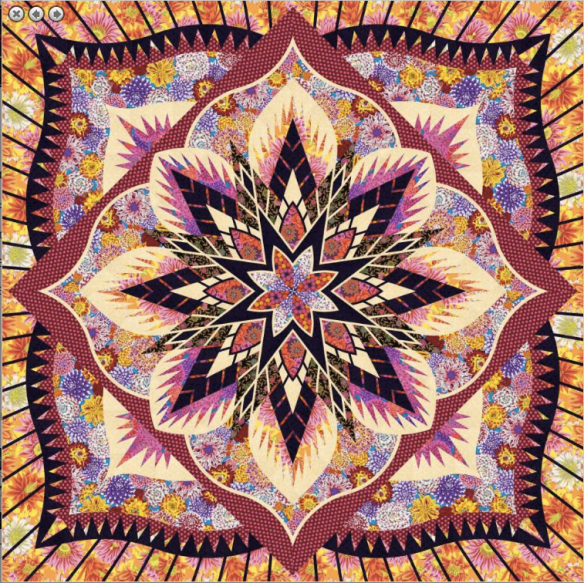
In the meantime, I’ve been seduced by another beauty: look at this!

Crimson Poppy quilt design by Judy Niemeyer Quiltworx

This is called Crimson Poppy and was designed by Judy Niemeyer (the designer of Jumping Jax Flash, which I’ve made) and sold at Quiltworx. Here’s a link to buy the pattern for the central medallion – it ends with the red polkadot square. The central block is on point in this version. You can also buy a kit for this larger version, with the four corner extensions and all the fabric required at Quiltster, right here.

On this page, there are a number of colour options and corner additions displayed, also as kits including fabric. You can also (be still my heart) join Quiltster and change out the fabrics online, customizing your own version, then buy your own kit from them. Hello, timesink – but what fun!

In the Beginning Dragon Quilt – 3

In the Beginning Dragon Quilt in blueMore dragon quilt!

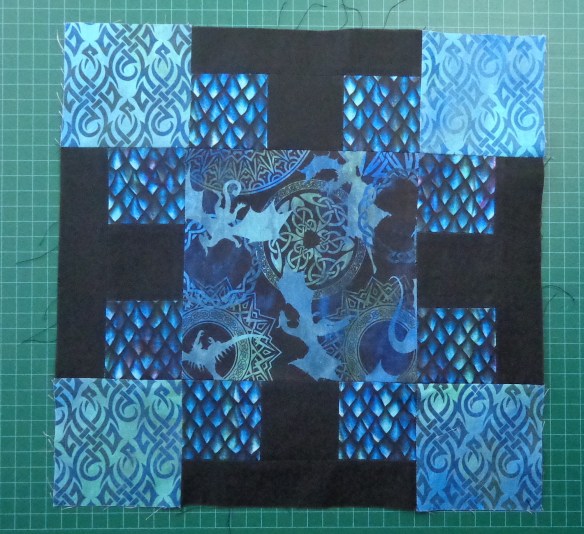
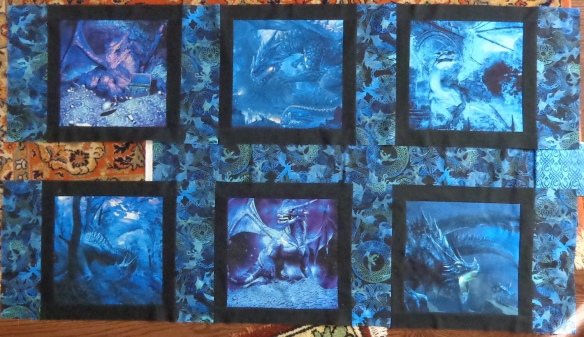
Last week, I was piecing the six blocks with the scales in this design—the ones that are stacked on either side of the central panel—and getting the scales oriented the right way. As mentioned then, I took apart my second pieced strip—the one with two strips of scale fabric with a strip of black sandwiched in the middle—and sliced it into squares. I then sewed the squares together with the scales the right way to make the units for the top and bottom of each of these blocks.

Here’s one of my finished blocks:In the Beginning Dragon quilt pieced by Deborah Cooke

All the scales are aligned!

The print called Flames is the one in the corners of this block. The instructions say to cut two 3.5″ widthwise strips out of the fabric, then cut each one into 12 squares. Because I pre-washed my fabric, I only got 11 out of the width, but there was plenty of fabric left to cut the remaining two. This print is also a one-way design: it doesn’t matter which way you think is “up” but it looks better to have the blocks all oriented the same way IMO. I sewed a couple “upside down”, so my stitch ripper got another workout, just because I wasn’t paying attention. After these blocks were done, I pieced them into vertical rectangles by adding a bit of black sashing.

Next, I pieced the dragon squares into horizontal rectangles with those rectangles of the dragon print. (I did play around with the placement of these, then ended up using the same arrangement as the illustration.) When I had the two horizontal panels on the floor, I realized what a nice quilt you could make with just these blocks. Look:In the Beginning Dragon quilt panels pieced by Deborah CookeI put some of the leftover fabric between the rows—it ran out at the left, because these bands are 58″ or so wide—and put a little bit of the flames at the right. I like it better with the background all the same colour, but even one panel of these six-dragon-panels would make a fun quilt.
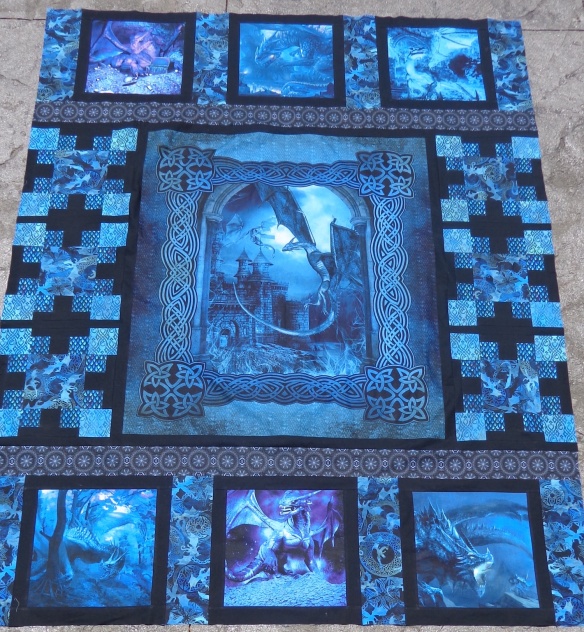
Next I cut the two rows of Emblems that go between the dragon blocks and the central section. I wanted to have the round medallions centered in both horizontal strips. I cut for the image not the grain. There’s extra fabric included for matching, but the design was printed slightly off-grain (as grid patterns often are). This is where the shrinkage from pre-washing almost got me. I needed more than three widthwise strips to get enough repeats, and managed to get another half width. Phew! It was just enough.

Here’s the top at this point:In the Beginning Dragon quilt panels pieced by Deborah Cooke

The sun was bright, so it’s a bit washed-out—and even with a step ladder, we didn’t get the whole thing!

I’m pleased to see that the joins in the Emblems bands are invisible. I matched the pattern between the circles as I thought it would be less obvious. You can see the print through the back of the fabric, though, so it was pretty easy to match.

Finally, the borders. The border print runs lengthwise on the fabric and there are four repeats across the width. The kit includes plenty, but I wanted prettier corners than shown in the illustrated quilts. This is going to be tough. The border print has a 23.75″ repeat after washing, which doesn’t divide neatly into anything. You already know I have matchy-matchy disease and this border print is going to make me work for it.

A New Quilt Top

I told you a few weeks ago about the Escher quilt pattern I’d bought, and mentioned that I needed to finish another quilt top before starting that one. Today you get to hear about the quilt in progress. It took me a bit longer than expected because I had to rip back the borders and redo them.

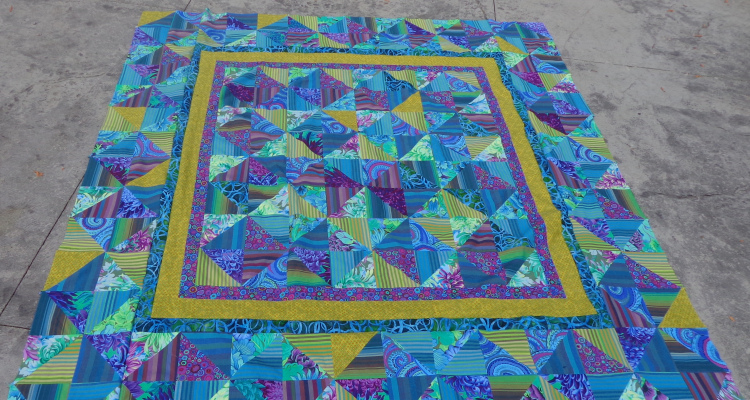
I saw a quilt made in this pattern during the summer (it was red and white) and I thought it was pretty, so I doodled down the pattern. I don’t know the name of the pattern, but here’s my version:Green and purple quilt pieced by Deborah Cooke

It’s just half square blocks sewn into larger blocks. I chose to make the central diamonds in each block darker in the middle section, then also alternated florals and stripes all the way around. On the outside borders, that protocol doesn’t quite hold. 🙂 I sewed the outside blocks on and ran outside to get a picture before the sun was gone, so it still needs a good pressing. It’s a bit more green than it looks here, and it needs another outside border. I think I’ll use that dark blue/green batik that is in the last border before the outside blocks. It’s about 72″ on a side right now.

I like it, and that it ended up with a contrast between stripes and florals. As usual, I was more concerned with pattern than value, and I did let the pattern placement fall randomly, but I still am pleased with the result. Many of the fabrics are Kaffe Fassett fabrics – all of the stripes and many of the florals, too. Those mustard dots and the blue/green batik are rogue. 🙂 Once the borders are on, I’ll need to quilt it.

What do you think?

Lizard Ridge Afghan 1

This past week, I cast on yet another knitting project. It’s funny how no matter what is on the needles, I crave something else. I realized that I needed something to knit in the car, a portable project on larger needles (than socks) that didn’t require a lot of attention. Summer is the season of road trips, after all! I wanted to use yarn from my stash, too.

The Lizard Ridge afghan is one that I’ve admired for years – this is the Ravelry link and this is the link to the pattern on Knitty, where it was originally published in 2008. It’s a free pattern. Lizard Ridge is designed to showcase Noro Kureyon, one of my favorite yarns, and does that brilliantly.

Here my first few blocks – this is the colourway 254 from my stash.Lizard Ridge by Laura Aylor knit in Noro Kureyon by Deborah Cooke

I had seven skeins of Kureyon in my stash, but the pattern calls for twenty. I played with mixing and matching, but really, the Kureyon makes the project. I was compelled (alas!) to buy more Kureyon in coordinating colorways. 🙂

What do you think?

Noro Braided Cowl

There’s a great cowl in the newest Noro magazine, which I’ve just knitted. The technique is so clever!.

The newest Noro magazine is issue 7 – you can see a preview of the designs on the NoroMagazine website, right here. The pattern is #16 and is called Braided Scarf (that’s a Ravelry link.) It’s supposed to be knit in Noro Silk Garden, but I’ve used Noro Kureopatora – since my yarn is a little lighter, I’ve also dropped the needle size. Mine came out a bit narrower than the one in the magazine – it’s 6 inches wide – but that’s okay by me.

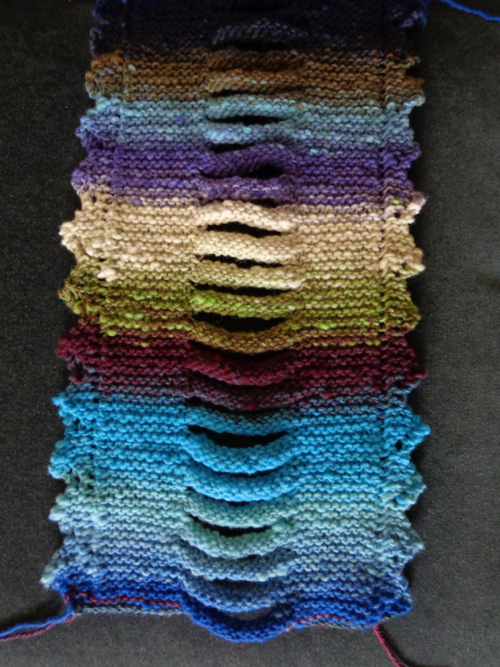
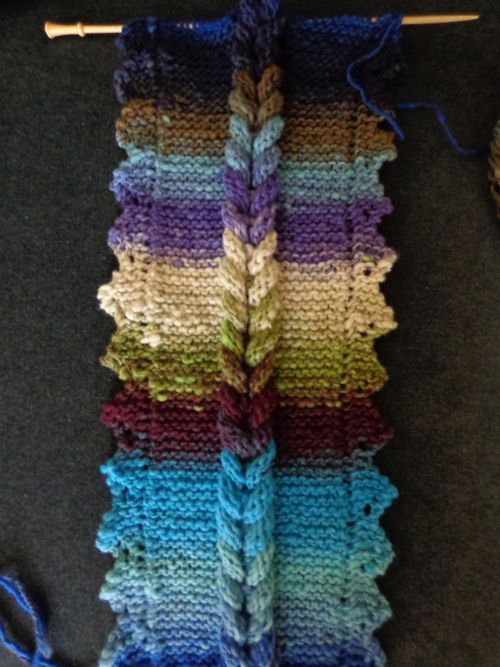
The scarf is knitted with a picot edge on either side and crosswise slits – every so many rows, you cast off the middle stitches, then cast them on again in the next row. Like this, it reminds me of spinach pastries a local bakery made in our old neighbourhood – they slit the top of the pastry like this so it vented. 🙂

Braided Scarf by Jacqueline van Dillen knit in Noro Kureopatera by Deborah CookeBut then, here’s the cool bit. You pull the piece together a bit, turning those strips into loops, and link them together to make a braid down the middle of the cowl. Here it is after it’s braided:Braided Scarf by Jacqueline van Dillen knit in Noro Kureopatera by Deborah CookeIsn’t that brilliant? I keep braiding it and unbraiding it, just to see the magic happen.
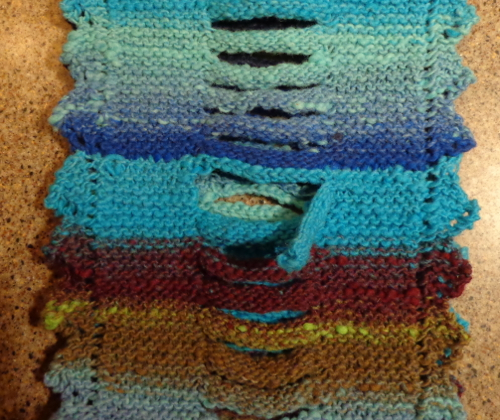
I did a provisional cast on, and grafted the cowl into a loop when it was completed to avoid having a seam. I also wanted the braid to be continuous. The instructions say to braid the middle of the finished cowl, then tack down the last loop. I wanted it to hook around the first loop. The only way to do that (which I could see) was to break the loop, like this:

Braided Scarf by Jacqueline van Dillen knit in Noro Kureopatera by Deborah CookeThis is the cowl grafted together – you can see that the colours didn’t match up. (Boo. I had a knot in the ball, otherwise it might have come out perfectly.) I ended with the bright turquoise and had started with the ultramarine blue. The line where they meet is the line of the graft. The first loop, then, is turquoise on the bottom half and ultramarine on the top half. The loop before that, though, is broken. I did this by casting on the stitches in Row 5 of the pattern, then turning, leaving the last 15 stitches of that row on the other needle, unworked. I worked on the front part of the row through Row 11, then left it on the right needle after the cast-on stitches. I worked the intervening rows on those left stitches that had been waiting on me, then finished Row 11. At the end of that repeat (Row 12) I grafted the two edges together.
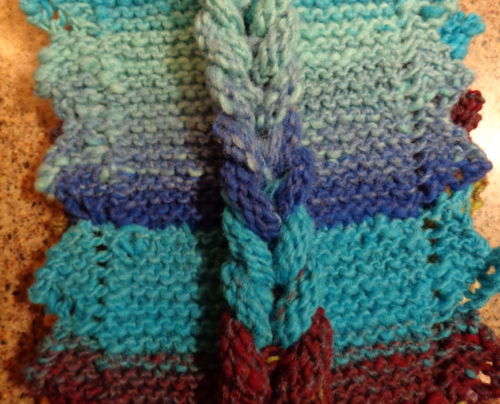
So, I had a broken loop. When I braided it all up, I tucked that loop around the first loop, then sewed it down from the back, as if it had been joined up all along. The finished braid looks like this:

Braided Scarf by Jacqueline van Dillen knit in Noro Kureopatera by Deborah CookeNo one can ever unbraid it again. 🙂

I’m very happy with this one. What do you think?

Another Hebrides

I finished this sweater last week and just love it:Hebrides by Lisa Richardson knit in Kidsilk Haze Stripe by Deborah CookeThis is the Hebrides cardigan pattern (a free download from the Rowan yarns website) knit in Kidsilk Haze Stripe. This is the Cool colourway. (The pink isn’t quite as bright IRL as it appears in the photograph above, btw. ) When you look at the pattern on the Rowan site, you can see from the styling that the ease is calculated for you to wear the sweater right against the skin. Because I knew I’d wear this as a cardigan over top of blouses or t-shirts, I knit one size larger and left out the waist shaping. I knit one of these before in the Twilight colourway and knew immediately that I’d wear it all the time. (I do.) It was clear that I needed another one. For my size, it took about 2.5 balls of KSH Stripe.

I also found some perfect buttons in my stash – these were harvested from a Ralph Lauren skirt I made years ago. The skirt wore out (it was loved to death) but I liked the buttons so much that I kept them. Now they’ve finally found a new home. They’re exactly the right tones of blue – they’re a bit stripey, but that didn’t show up as well as I’d hoped.Hebrides by Lisa Richardson knit in Kidsilk Haze Stripe by Deborah CookeI’m going to cast on yet another of these cardigans, this time in a solid colour.

What do you think?

The Mermaid Shawl Puzzle

The Mermaid Shawl has had me puzzled. Last week, I figured out what was going on. Even though I’m using my own pattern, Undine, I didn’t follow the directions. In Undine, the ruffle is created with short rows at the outer edge of the shawl, and this ruffle remains the same width across the shawl. Any changes to the total width of the shawl are made in the body of it, right before the ruffle. (The increases are between the ruffle and the main part of the shawl.) This means that the rows in the body of the shawl are perpendicular to the lead edge, like this:Undine by Deborah Cooke knit in Noro Kureyon Sock by Deborah CookeWhen I began to knit the Mermaid Shawl, though, I didn’t read my own directions! I made my increases at the lead edge (i.e. the beginning of the right side row). This skewed the knit rows. Because of the location of the increase stitch, the rows fall at an angle to the lead edge, like this:Undine shawl by Deborah Cooke knit in Crazy Zauberball by Deborah CookeThe gussets that make the ruffles don’t appear to be in a separate band either. They just flow from the main shawl – in a way that would definitely please a mermaid.

This is pretty interesting. I had no idea this would happen. I would have expected my mistake to make very little difference. I was wrong about that!

If I had just continued, following the rest of the directions for Undine, the stripes would have been at an angle for the entire shawl. But, I had decided to make an inverted V in the back, again with short rows, to emulate the shawl in the Jane Eyre movie. The finished V looks like this:Undine shawl by Deborah Cooke knit in Crazy Zauberball by Deborah Cooke

My revised plan had been for the inverted V to be the middle of the shawl, BUT the knitting still doesn’t line up. In fact, it’s only this new part that is perpendicular to the lead edge, and that means that the picture above is actually the midpoint of the shawl.

I need to knit another inverted V of short rows before decreasing to the end of the shawl to make the shape come out right. The finished shawl will have three triangles. This means that I’ll run out of yarn – I’m half done, but have only 30% of my yarn left. I’m going to have to buy a third ball to finish. I do like it, though, and it will bug me if I don’t finish it so that the rows are straight.

What do you think?

More Progress on the Mermaid Shawl

I’ve been knitting and thought it time to show you my progress on that stripey shawl.Undine shawl by Deborah Cooke knit in Crazy Zauberball by Deborah CookeI’m just past the midpoint. I made a variation to the pattern on a whim. I decided to do some short rows in the middle, so there will be an inverted V down the centre back. This will make the shawl narrower but will also give it a slightly different shape. I worked two stitches less for every second row from about the lime stripey bit until I got down to just a few more stitches than the godets require. (There are more details on my Ravelry project page.)

Look at the ruffled edge at the top and you can see the green godet which is the middle point of the shawl. (It’s the top green godet.) From that point, I’ve been adding back two stitches every second row and will continue until I’m working all of the stitches again. Once there, I’ll carry on with the decreases in the pattern to finish the shawl.

I’ll show you another picture of the turns once I’ve made more progress and you can see the inverted V more clearly. I’m quite happy with this one. What do you think?

Progress on the Mermaid Shawl

I thought I’d show you my progress on my Undine striped shawl today. I really like what the self-striping yarn is doing:Undine shawl by Deborah Cooke knit in Crazy Zauberball by Deborah CookeYou can also see how the hem is beginning to flutter. If I held that top edge (the one on the right) straight, it would ripple even more.

I’ll start to decrease the width of the shawl once I’ve used half of the yarn. The easiest way to determine that point is to weigh the balls of yarn. (I use the kitchen scale.) They were each 100g when I started. Now they’re both around 75g. When they get to 52 g or so, I’ll start to decrease. I want to make sure the shawl is symmetrical, so might do something different at the midpoint. We’ll see when I get there.

In the meantime, what do you think?