More Comfort Knitting

I haven’t knit a shawl in a while, lace or otherwise – well, I’m still plugging along on my Water shawl, but it’s not a very fun knit at this point. I don’t think it counts anymore. 🙂

A LYS had Freia Handpaints yarns on sale, and I simply can’t resist gradient dyed yarns. I ordered some and cast on.

I chose a pattern by BooKnits. I wanted to knit a lace shawl with some beads and I had The Close to You Collection of patterns already. (That’s a Ravelry link.) I had knit Snow Angel from this pattern collection, also in Freia Handpaints yarn, but in their Wool/Nylon Lace which is discontinued. The colourway was Autumn Rose.

Here’s my Ravelry project page for the project.

And here’s that Snow Angel shawl:

Snow Angel by Boo Knits knit by Deborah Cooke in Freia Ombre Wool/Nylon Lace

There’s a blog post for it, which is right here.

This time, I’ve chosen the pattern Heaven Scent, which is in that same collection but also available on its own. (That’s a Ravelry link.) I’m knitting the smallest size, with the stockinette stitch top.

This yarn is Freia Handpaints Ombré Shawl Ball Merino. The colourway is Vamp. Here’s the Ravelry yarn page.

Here’s my progress so far:

Heaven Scent shawl by BooKnits knit by Deborah Cooke in Freia Handpaints Ombré Shawl Ball Merino

The camera is really emphasizing that hot pink. The colourway ends in a bright red.

Of course, it’s curled on the circular needle in the opposite direction of its shape – the shawl will be a crescent curved the other way when it’s off the needles and blocked. (Much like Snow Angel, shown above.)

The yarn is a loose single ply. It’s very soft but tougher than expected – there is the usual thick-and-thin of single ply yarns but it hasn’t been splitty to knit and it hasn’t broken.

And here’s a detail view. I’m using 6/0 purple Czech glass beads in dark purple, which match the beginning of the gradient pretty well.

Heaven Scent shawl by BooKnits knit by Deborah Cooke in Freia Handpaints Ombré Shawl Ball Merino

I did make a slight change to the pattern. The shawl grows quickly in width because you add four stitches on every right side row and two on every wrong side row. The additions are at the beginning and the end of each row, and the pattern uses make-one (slanting left or right). I found that two M1s with just a knit stitch between them, then another M1 on the purl side pretty close by made for a tight edge. I switched out the two M1s on the purl side for YO’s, then the outer M1 on the right side rows to YO’s as well. I’m curious to see how this blocks out. It feels better to me.

I’m almost halfway through the second repeat of the main chart, then have the border chart to knit. I’m thinking I might run out of yarn (the pattern notes that 400m is close) so if I do, I’ll have to find something matchy to finish.

Another Planetarium

This hat is a free pattern in the most recent Knitty online magazine. I knit one of these right away for the mister – here’s that blog post.

Planetarium designed by Cissy Yao and knit by Deborah Cooke

I folded it in quarters for this picture.

The pattern is called Planetarium (that’s the Ravelry link – here’s the Knitty link) and it’s knit in two colors of a fingering yarn. These two are from my stash. I had a skein of a zingy purple Koigu KPPPM and some leftovers of Lichen and Lace sock in Citron. (I used it for my Stargazer Mittens.)

I made the same changes to the pattern as the last time. This one doesn’t feel like it’s going to pill, so that’s a good thing.

Planetarium

This hat is a free pattern in the most recent Knitty online magazine. I thought it was so pretty that it jumped right onto my needles!

Planetarium designed by Cissy Yao and knit by Deborah Cooke in KnitPicks Chroma

I folded it in quarters for this picture.

The pattern is called Planetarium (that’s the Ravelry link – here’s the Knitty link) and it’s knit in two colors of a fingering yarn. I used KnitPicks Chroma for mine, because I had it in the stash. The colourways are Black and GoGo Boots, which is a gradient yarn. it’s a very clear pattern and an easy knit IMO.

I made a couple of changes to the pattern. I knit it exactly as written the first time, but the mister doesn’t like slouchy hats so much. My gauge was also a bit tight. Rather than changing needles, I knit a larger size (actually one repeat larger than the largest size) and I left out one of the three star bands to make the hat shorter. It fits more like a watchcap, which makes him happy.

As much as I like the colours, I think the yarn is going to pill – it’s a single ply, loosely spun. If I make a second one for myself, I’ll use a yarn with more of a twist, maybe Koigu KPPPM. Hmm. Time to check the stash!

Spector in Mad Tosh Merino Light

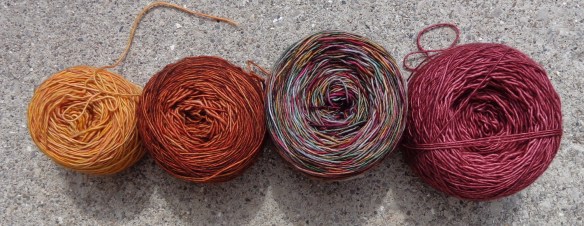
Spector is a pattern by Joji Locatelli, a top-down pullover with some stitch detail on the yoke. It also uses four different colours to create a gradient. The pattern is designed to use Madeline Tosh Merino Light and for once, I’m using the specified yarn.

Here are my choices for the gradient. The colourways, from right to left, are Spicewood, Saffron, Simmer Pot and Red Phoenix. MadTosh Merino Light for Deborah Cooke's SpectorThat Simmer Pot is really something and the photograph doesn’t do it justice. I bought it on a whim. Here’s the page on Ravelry that shows it in stashes – because many Ravellers are much better photographers than I am. (I don’t see the colourway on the MadTosh website.)
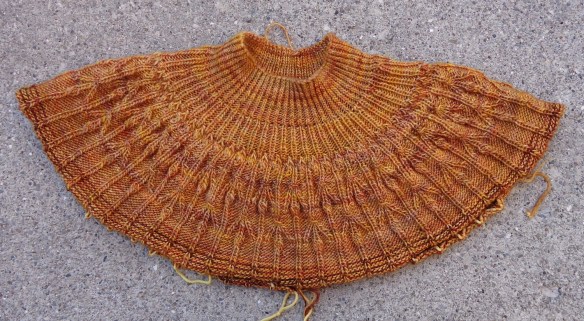
And here’s the beginning of my yoke. I’ve started the first gradient change and am supposed to split the yoke for the sleeves. I’ve put it on a thread to try it on first, which is the wonderful opportunity of knitting top-down sweaters.

Spector by Joji Locatelli knit in MadTosh Merino Light by Deborah CookeIt seems that this sweater is supposed to tug down, to make a scoop neck. When I tried it on at this point, it seems too soon to split for the sleeves as it’s challenging to tug it down enough for it to reach my underarms. My gauge is spot-on. On Ravelry, people have commented on how stretchy it is and how well it fits. Hmm. I’m small in the shoulders, so this should work. Hmm. I decided to knit a litte more before splitting for the underarms, since I prefer more of a round neck and I dislike tight sweaters. I ended up knitting another 3/4″.
I’d just started the change to the second colour in this picture and you can see a teeny bit of it at the bottom of the yoke. I did the first round of bud stitches incorrectly, just below the ribbing for the neck, but I did them consistently 🙂 so I’m not going to frog back.

When the yoke is split for the underarms, there’s a neat little trick to turn the work inside out, so the body is mostly knit instead of mostly purled. I’m not doing that, as I don’t mind purling and I think there might be a gauge difference.

I also did some recalculations for dividing the body and sleeves because the pattern warns that the rib stitch might not line up. Of course, I want it to so I made some changes. I’m making the L or the fourth size. Instead of beginning the division at the marker, I worked 2 stitches first (P2), then put 66 stitches on a holder instead of 68. I cast on 6 stitches, placed a marker, then cast on 6 more. (This is two repeats of the ribbing pattern. The instructions are to cast on 7 PM and co 7 more.) Then I worked 125 for the front instead of 122, put 66 on a holder, cast on 6 stitches, placed a marker, then cast on 6 more. I worked to the end of the row, then removed the end-of-row marker and worked to the middle of the underarm in pattern. That’s the new beginning of the round.

Because I was in the middle of a colour transition, I alternated between the two colours from the old marker to the new one, then continued in the specified transition.

Instead of 68-122-28-102, I ended up dividing my stitches 66-125-66-103 for the sleeve-front-sleeve-back. With 12 sts cast on at each underarm instead of 14, my total stitch count is still 252, as the pattern specifies. Ha.

Now, it’s TV knitting. Onward!

Charlotte’s Web Shawl Finished

Today’s Fibre Friday post is a little late, because I needed to wait for some light to take pictures. We had snow, so that made a good backdrop, but it wasn’t sunny yet so the colours are a bit dull compared to real life.

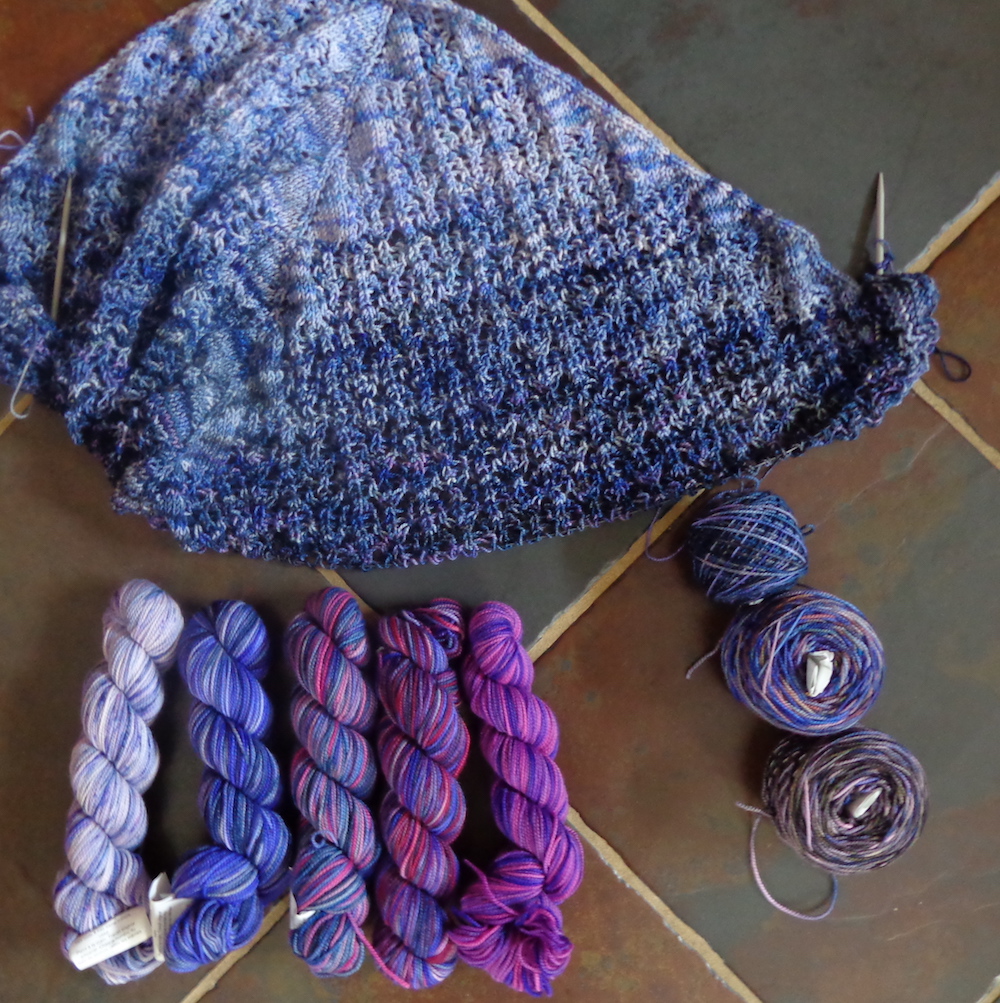
This is my Charlotte’s Web shawl, knit in Koigu KPPPM. I bought a kit with ten skeins in shades of purple and the pattern book. Here are the skeins and the shawl in progress:Charlotte's Web Shawl by Maie Landra knit in Koigu KPPPM by Deborah Cooke

I’m using the progression at the lower right corner. The other five skeins are the remaining ones from the kit that I didn’t use in this shawl. You can see that the lace pattern is bunched up. I knew it would blossom when it was blocked, and wow, I was right.Charlotte's Web Shawl by Maie Landra knit in Koigu KPPPM by Deborah Cooke

The blocked shawl is over a meter deep. I really like the colour gradation in it. I was worried about the fifth colour, that it might be too inky, but IRL it picks up the rosy and inky tones of #4.

As mentioned before, I decided against the fringed edge and tried to use up all the yarn instead in the shawl. I knit the last four rows with the first colour, then did an I-cord bind-off with it.

Here’s a close-up of that lace pattern:Charlotte's Web Shawl by Maie Landra knit in Koigu KPPPM by Deborah Cooke

What do you think?

Noro Braided Cowl

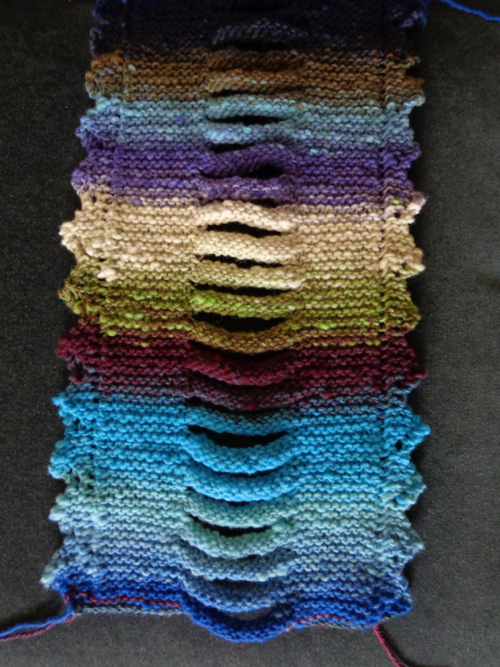
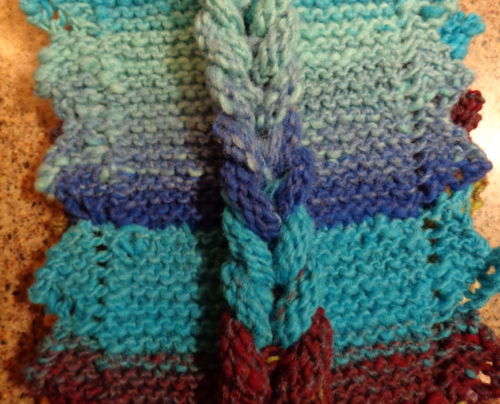
There’s a great cowl in the newest Noro magazine, which I’ve just knitted. The technique is so clever!.

The newest Noro magazine is issue 7 – you can see a preview of the designs on the NoroMagazine website, right here. The pattern is #16 and is called Braided Scarf (that’s a Ravelry link.) It’s supposed to be knit in Noro Silk Garden, but I’ve used Noro Kureopatora – since my yarn is a little lighter, I’ve also dropped the needle size. Mine came out a bit narrower than the one in the magazine – it’s 6 inches wide – but that’s okay by me.

The scarf is knitted with a picot edge on either side and crosswise slits – every so many rows, you cast off the middle stitches, then cast them on again in the next row. Like this, it reminds me of spinach pastries a local bakery made in our old neighbourhood – they slit the top of the pastry like this so it vented. 🙂

Braided Scarf by Jacqueline van Dillen knit in Noro Kureopatera by Deborah CookeBut then, here’s the cool bit. You pull the piece together a bit, turning those strips into loops, and link them together to make a braid down the middle of the cowl. Here it is after it’s braided:Braided Scarf by Jacqueline van Dillen knit in Noro Kureopatera by Deborah CookeIsn’t that brilliant? I keep braiding it and unbraiding it, just to see the magic happen.
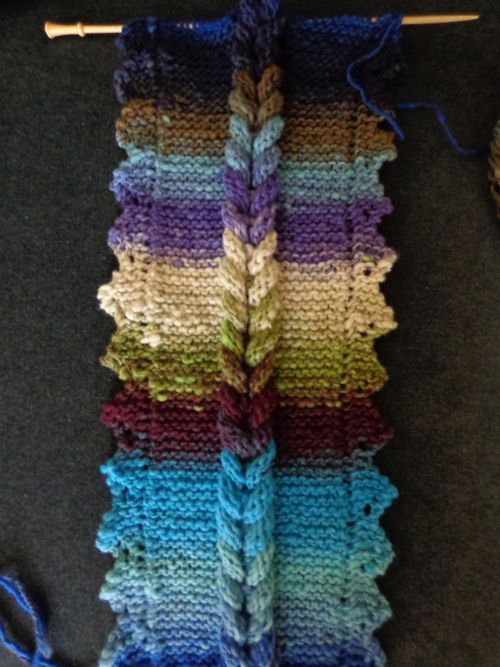
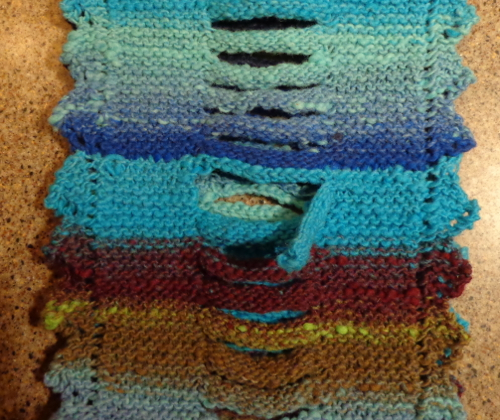
I did a provisional cast on, and grafted the cowl into a loop when it was completed to avoid having a seam. I also wanted the braid to be continuous. The instructions say to braid the middle of the finished cowl, then tack down the last loop. I wanted it to hook around the first loop. The only way to do that (which I could see) was to break the loop, like this:

Braided Scarf by Jacqueline van Dillen knit in Noro Kureopatera by Deborah CookeThis is the cowl grafted together – you can see that the colours didn’t match up. (Boo. I had a knot in the ball, otherwise it might have come out perfectly.) I ended with the bright turquoise and had started with the ultramarine blue. The line where they meet is the line of the graft. The first loop, then, is turquoise on the bottom half and ultramarine on the top half. The loop before that, though, is broken. I did this by casting on the stitches in Row 5 of the pattern, then turning, leaving the last 15 stitches of that row on the other needle, unworked. I worked on the front part of the row through Row 11, then left it on the right needle after the cast-on stitches. I worked the intervening rows on those left stitches that had been waiting on me, then finished Row 11. At the end of that repeat (Row 12) I grafted the two edges together.
So, I had a broken loop. When I braided it all up, I tucked that loop around the first loop, then sewed it down from the back, as if it had been joined up all along. The finished braid looks like this:

Braided Scarf by Jacqueline van Dillen knit in Noro Kureopatera by Deborah CookeNo one can ever unbraid it again. 🙂

I’m very happy with this one. What do you think?

Snow Angel Shawl

I started to work on a lace shawl in a yarn that’s gradation-dyed to change from one colour to another over its length. I bought this yarn originally to make a cowl, but didn’t like the lace stitch so switched out for this pattern. It’s called Snow Angel by BooKnits, a new designer for me, but I’ve admired her designs for a while. The shawl blocks out to a crescent with lace dripping from the outside edge. This pattern is very well-written, both written out and charted so there’s a choice of which kind of directions to follow.

Here’s a peek at the lace so far. It looks like a lump because it isn’t blocked yet, but I think it will be very pretty. It starts with the green and will end with pink. Of course, it has beads.Snow Angel by Boo Knits knit by Deborah Cooke in Freia Ombre Wool/Nylon Lace

Another Hebrides

I finished this sweater last week and just love it:Hebrides by Lisa Richardson knit in Kidsilk Haze Stripe by Deborah CookeThis is the Hebrides cardigan pattern (a free download from the Rowan yarns website) knit in Kidsilk Haze Stripe. This is the Cool colourway. (The pink isn’t quite as bright IRL as it appears in the photograph above, btw. ) When you look at the pattern on the Rowan site, you can see from the styling that the ease is calculated for you to wear the sweater right against the skin. Because I knew I’d wear this as a cardigan over top of blouses or t-shirts, I knit one size larger and left out the waist shaping. I knit one of these before in the Twilight colourway and knew immediately that I’d wear it all the time. (I do.) It was clear that I needed another one. For my size, it took about 2.5 balls of KSH Stripe.

I also found some perfect buttons in my stash – these were harvested from a Ralph Lauren skirt I made years ago. The skirt wore out (it was loved to death) but I liked the buttons so much that I kept them. Now they’ve finally found a new home. They’re exactly the right tones of blue – they’re a bit stripey, but that didn’t show up as well as I’d hoped.Hebrides by Lisa Richardson knit in Kidsilk Haze Stripe by Deborah CookeI’m going to cast on yet another of these cardigans, this time in a solid colour.

What do you think?

Those Wyrd Sisters

I was going to tell you about a new shawl project today, but instead, I’m going to show you another one that I finally finished. (Yay!) That post about the new project has been bumped to next Friday.

When I was writing the Dragon Diaries, I did a lot of research on the Wyrd sisters in Norse mythology, also called the Norns (or sometimes the Nairns). These three immortals decide the fate of all living beings – in the myths, they’re spinners, but in Zoë’s books, they’re knitters too. Around about the same time, I was intrigued to discover that a knitting designer had created a trio of shawls to celebrate these three sisters. I had this idea that I’d knit them all to commemorate the publication of Zoë’s story.

I finally cast on in 2013.

I did finish the first one, Verdandi, pretty quickly. Verdandi is the sister who governs the present, so I called my project “Is”. This is a triangular shawl, and I knit mine in Fleece Artist Nyoni. This mohair, wool, silk and nylon blend is discontinued (so that’s a Ravelry link), which is too bad because it’s a scrumptious yarn. I still have a bit in the stash in another green colour. 🙂

The post about my completed Verdandi is right here.

Then I cast on the second shawl, Urdr. Urdr is the sister who governs the past, so my project is called “Was”. That was in September 2013. This is a huge round shawl knit in very fine laceweight yarn. The idea behind the design is that this shawl is supposed to represent the well at the root of the world tree, Yggdrasil, which the sisters tend. I used a gradient colourway from the Unique Sheep called Brigid, which made me think of copper cauldrons and ancient goddesses. (You can see Brigid on this page of the Gradiance colourways. It’s in the middle of the fourth row. Mine didn’t look quite like this sample, but each base yarn takes colour differently. Mine was very teal at the one end and quite a warm grey gold at the other with no mauve or blue bits—actually it has colours like the two middle skeins in the sample.) The base yarn is Ling, which is a silk and merino blend.

Knitting this shawl became a bit of a slog, as the rows at the end had more than 1200 stitches, and I added rows to use more of the yarn. Also, knitted lace looks like nothing until it’s blocked. I was losing heart because I had what looked like a lump in my lap each time I picked up the needles. I told Mr. Math about two weeks ago that I had to finish it, and he said “What’s the rush? You’ll just cast on another one.” Such was my mood that I wasn’t so sure of that. Maybe this would be The Last Shawl.

I should have anticipated that blocking would change everything. it’s such a magical process. Imagine my surprise when my lump stretched out to look like this:Urdr by Anna Dalvi knit in Unique Sheep Ling with beads by Deborah CookeIt’s at least six feet in diameter and so lovely that I can’t stop looking at it. The yarn is dyed in gradients, which means that there are six skeins in the set, and you change from one to the next as you knit.

Here’s a detail shot, after blocking, on the couch. You can see the colours better in this shot, although IRL, the gradation is more subtle and the middle is less blue than it looks here:Urdr by Anna Dalvi knit in Unique Sheep Ling with beads by Deborah CookeIt’s supposed to have nupps (which are little knitted knots) but I don’t like knitting nupps so I put beads in those places instead. Because I didn’t make nupps, I used less yarn. I wanted to have the entire gradation of colour, though, so I added repeats to the border. I also added more beads to the outside edge. Details are on my Ravelry project page.

It was totally worth it, and I’m ready to cast on another shawl, if not two! I’ll tell you next week about my nerd knit in that raw silk and merino blend (in another gradient colourway from the Unique Sheep, also with beads). There’s also the third Wyrd sister’s shawl to knit. It’s called Skuld, for the third sister who controls the future. My project will be named “Might Be” and I have some lovely Fleece Artist yarn set aside for it. I’m going to try to be good, though, and finish the lace stole that’s on my needles and only one third knitted before casting on another. (Ha.)

Urdr by Anna Dalvi knit in Unique Sheep Ling with beads by Deborah CookeUrdr by Anna Dalvi knit in Unique Sheep Ling with beads by Deborah CookeWhat do you think of my Urdr?

Bitterblue in Progress

Time to show you some knitting again!

I had lots of plans to finish more of my projects on the go, but so much for good intentions. I had ordered a kit for the Bitterblue Shawl from Earthfaire in the Magic Carpet colourway, and when it turned up in the mailbox, I just had to cast on right away.

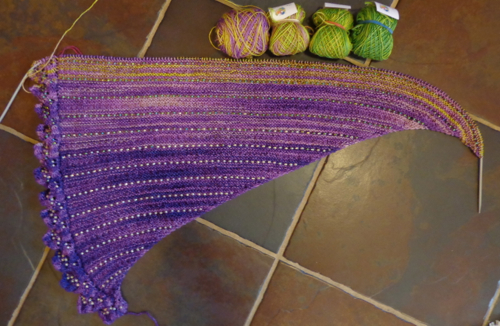
I inverted the order of the colours and am approaching the halfway point. This shawl uses yarn that has been dyed in gradients, each skein slightly different from the previous one so that the end project shades from one colour to the another. In this case, it shades from plum to green. Unique Sheep Gradiance is the name of the company and the line of these meticulously dyed yarns: you can see some of the other colourways on their site, right here.Bitterblue by Barbara Benson knit in Unique Sheep Luxe (kit from Earthfaire) by Deborah CookeIf you looked at the pattern on Earthfaire’s site, you will have noticed that my shawl looks different – and not just because I inverted the colours. The pattern has a larger cast-off after every third repeat of the border pattern. When I tried that, though, I didn’t like the look of it. I thought I’d prefer the shawl if the line between the border and the body of the shawl was smooth, instead of stepped off, so that’s what I’ve done.

The result of that choice will likely be that the shawl will come out a bit shorter – because mine will be wider and there’s a finite amount of yarn. When you use gradient yarns, you’re supposed to ease the transitiion into each colour change, alternating between the old and new colour, before changing completely to the new colour. (Here’s the Unique Sheep tutorial.) This always gives me stress when the rows are of different length, because I fear I’ll leave the wrong amount of yarn and run out in the middle of a row. OTOH, I don’t want to have yarn left over when I’m concerned about the overall size of the shawl. So, I’m just changing from one skein to the next, without easing into the change, and using a Russian join between them. I think it looks good.

You can’t see another change I’ve made: on every row knitting back toward the border, the first stitch is to be knit according to the pattern. I thought the edge was too tight that way, so began to slip that first stitch instead. (And actually you can see it if you know what you’re looking for. The shawl begins at that lower point, where the purple end of yarn is showing. You can see that the right edge curls more in those first few rows – I changed to slipping the stitch before that row of 5 beads.)

And YES, this shawl had beads. A lot of beads. The beads change colours too. I started with yellowy ones on the purple, then shaded into greenish ones. I’ve just changed to the ones called Root Beer and will finish out with purple beads. You can see the beads better in the image below:Bitterblue by Barbara Benson knit in Unique Sheep Luxe (kit from Earthfaire) by Deborah CookeThe wool in this kit is really lovely. I’m not often a fan of silk blends, but this is wool and tussah silk, which is sometimes called wild silk. I love the feel of tussah silk in fabric, and also love it in this yarn. I’ll be wearing this one a lot when it’s done! I might not even block it because I like the look of the garter stitch. We’ll see.