Chullo Hats

Here’s another UFO found in that stash – an unfinished chullo hat.

chullo hat knit by Deborah Cooke in Knitpicks Palette

This hat is knit of Knitpicks Palette and was a kit. Here’s the Rav page for the Andean Chullo Hat pattern, which is still available. Here it is at Knitpicks. The kit, which isn’t available any longer, came with several balls of Palette – I’m thinking maybe 8 colours. Palette is a fingering weight wool, which comes in a lot of colours.

I remember the pattern being a bit of fun, as there were numerous motifs that you could place on any of the sections and knit in any combination of the colours to make your hat your own. Have a peek at the projects on Rav to see the many variations. Of course, I had to march the llamas around the hat, though they might have shown up better if I’d knit them in the white in the kit. It’s also possible I mucked up the decreases at the crown because the circumference does diminish very quickly. (?)

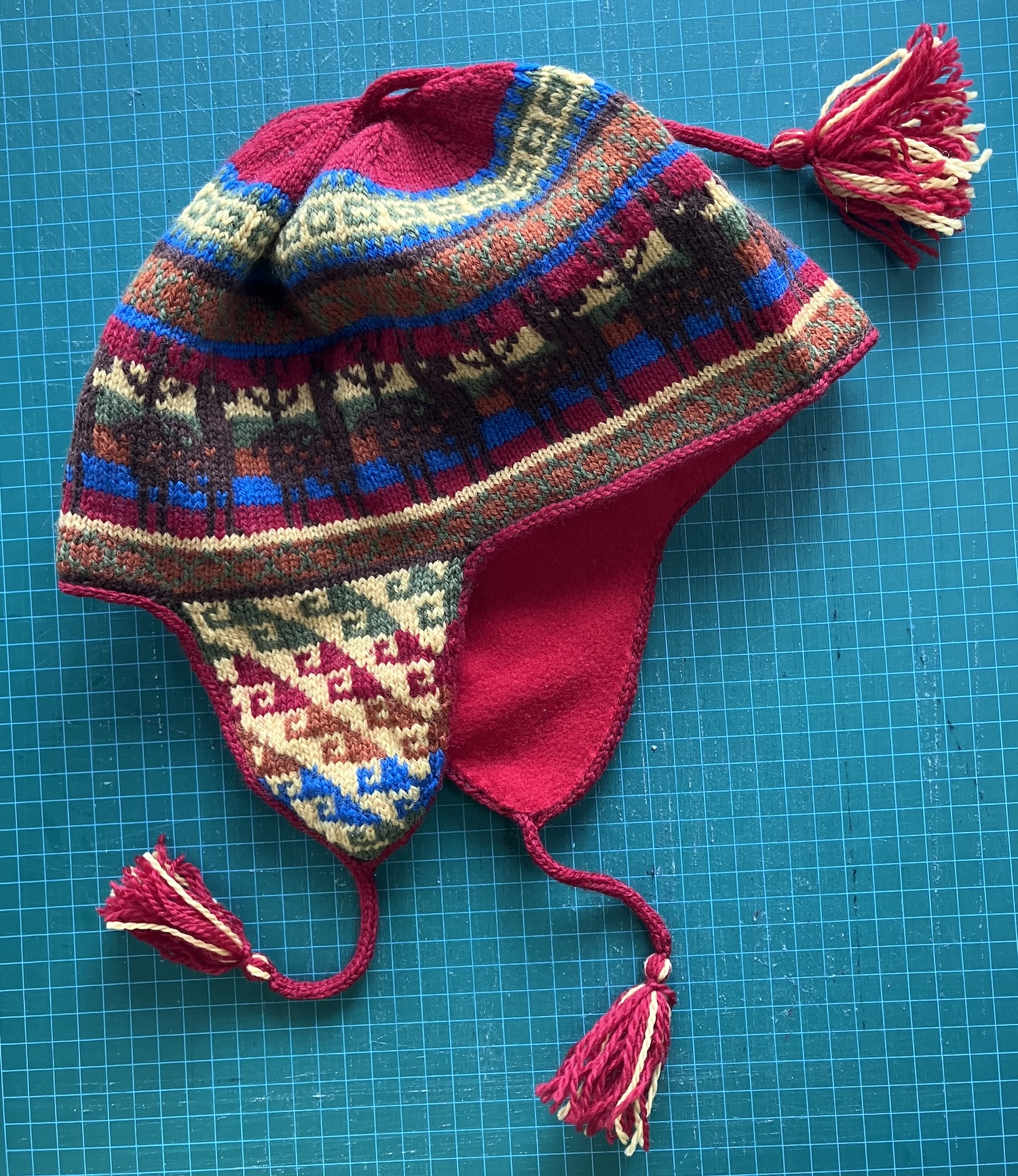
This hat stalled without the tassels, partly because of the chullo hat shown below. I didn’t knit this one – I bought it at the Mountain Equipment Co-op a billion years ago (give or take). (In the 90s there were a lot of South American knits available for sale.)

South American chullo hat from the Mountain Equipment Coop

It’s knit of a yarn that seems a lot like Lopi Alafoss – but its special magic is that it’s lined with polar fleece. The mister grabs this hat whenever it’s really cold.

inside of South American chullo hat bought at the Mountain Equipment Coop

I meant to do the same with my chullo hat, but was stymied as to what shape to cut the pieces for the crown. Now I realize that the creator of this hat avoided that challenge by only lining the main part of the hat and the flaps. I’ll do that with mine.

We also have a couple of chullo hats from one of the mister’s trips to South America. He hiked the Inca Trail back in the day (to end up at Machu Picchu at dawn) and it was so cold that he bought two hats from the local knitters. Both are chullos. He wore this navy one.
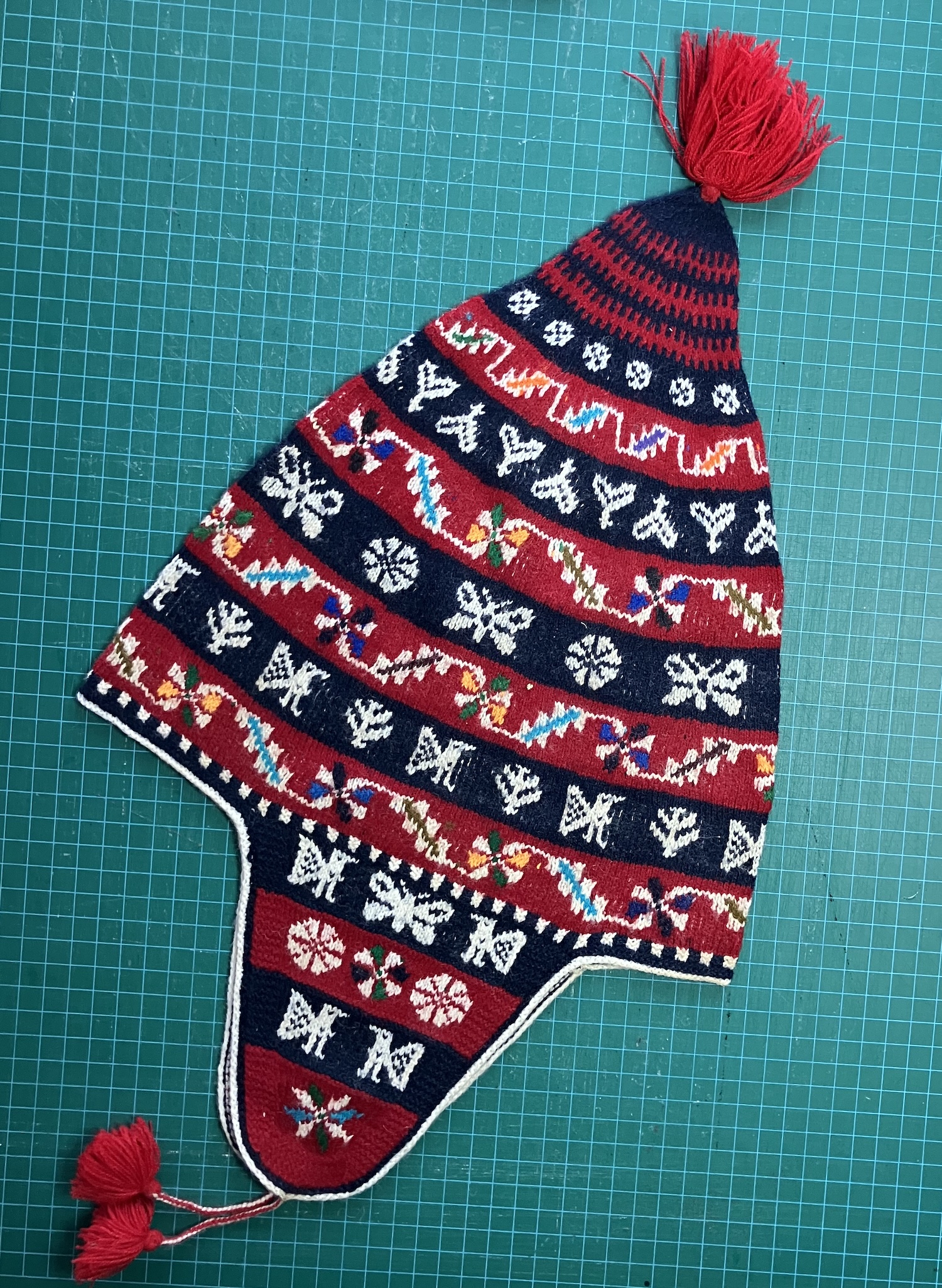
South American chullo hat

He bought this second hat just because, and I’m glad he did. It’s so beautiful.
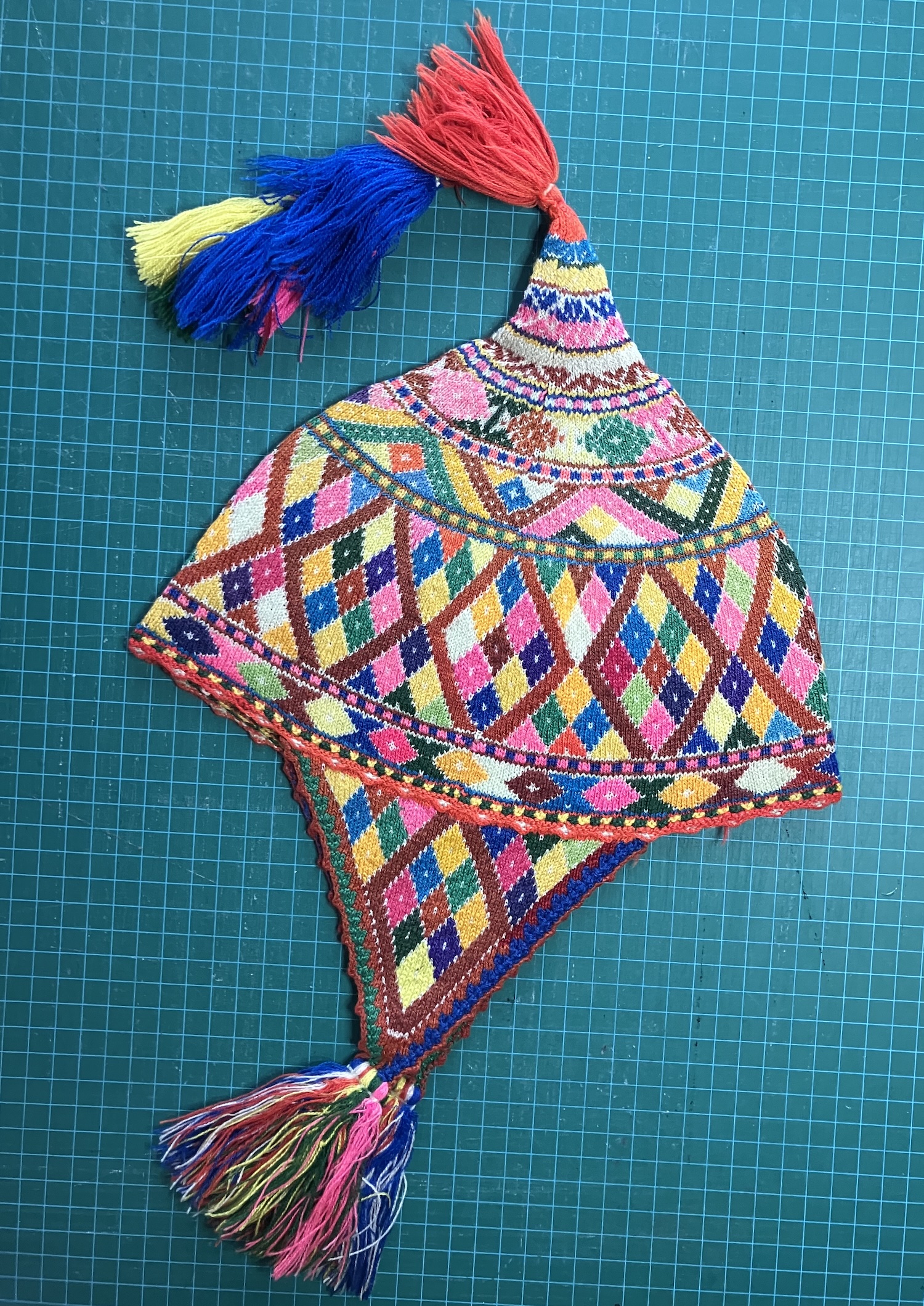
South American chullo hat

The wool is so fine, it’s almost thread. Look at the detail.

detail of South American chullo hat

Someone had a very fine set of needles! I love that the colour placement is apparently random. It’s such a lovely piece of work – and very inspiring.

And here, finally, is my own lined and finished chullo.
chullo hat knit by Deborah Cooke in Knitpicks Palette

Knitting Dragons

Two Tarragons knit by Deborah Cooke

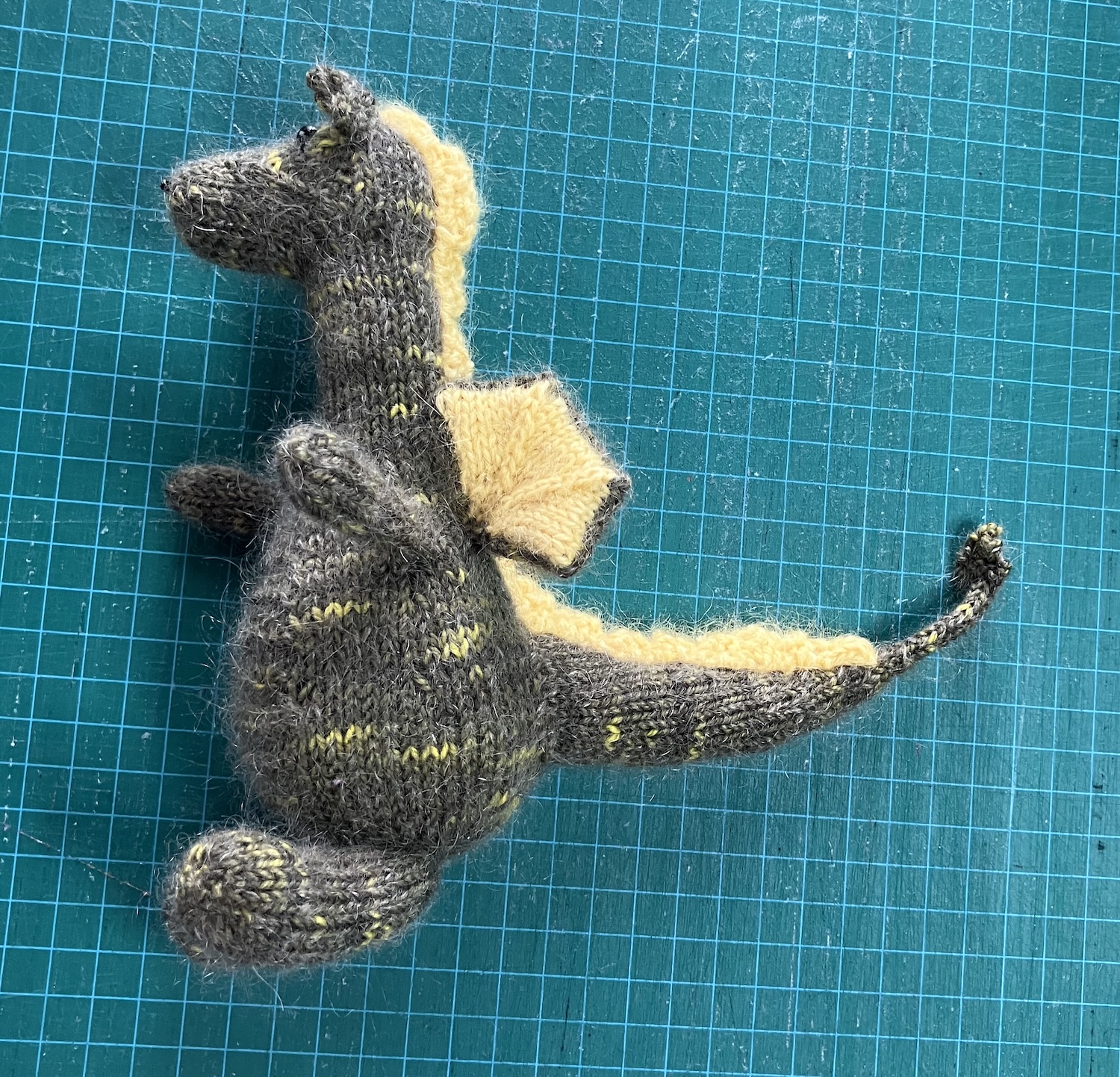
You might remember these two little dragons I knitted. The one on the left (Cedric) sits on the bookshelf in my office and the one on the right has gone on to live on a different bookshelf. I started to knit a few more.

The pattern is Tarragon, a free download. (That’s the Ravelry link.) There are a lot of projects on Ravelry with additions and changes to the pattern – I’ve added ears as in one of those projects. I knit mine with a strand of fingering weight or sock yarn – in this case, it’s Koigu KPPPM – held double with a strande of KSH or similar. This time, it’s Elann Silken Kydd.

Here’s the new dragon on the block:

green dragon knit by Deborah Cooke from Tarragon pattern

This time, instead of knitting four wings and sewing them together in pairs, I knit the green wings, then picked up the stitches for the yellow “lining”. The wings are knit from the outer edge in, and this saved some sewing. I think outer edge looks neater too.

green dragon knit by Deborah Cooke from Tarragon pattern

I think he’s cute!

green dragon knit by Deborah Cooke from Tarragon pattern

Aileen’s Petite Fashions – 82 Easter Parade

Aileen's Petite Fashions #82

You don’t have to buy many patterns for doll clothes to come across Aileen’s Petite Fashions. These patterns are hand-drawn and clearly vintage. The title is hand-printed and the instructions look as if they’ve been typed. There’s usually a drawing of the doll and garment. At right is part of the one I’ll show you today.

Something about them reminds me of “ditto” copies, which our teachers made in the 1960’s and 70’s. (Dittos were made on spirit duplicators and characteristically were purple copies. The machines were hand-cranked and had a specific sound, and the process produced a memorable scent.)

I don’t know the history of these patterns, but they seem to date from the early sixties. There are a number of APF patterns reproducing original Barbie outfits. I found a list of them, here, though the site is old and it’s not clear whether the patterns are still being sold from this site. I’ve mostly come by mine via Etsy purchases, though often the finished garment is shown in the picture and I don’t realize it’s an APF pattern until I’ve downloaded it.

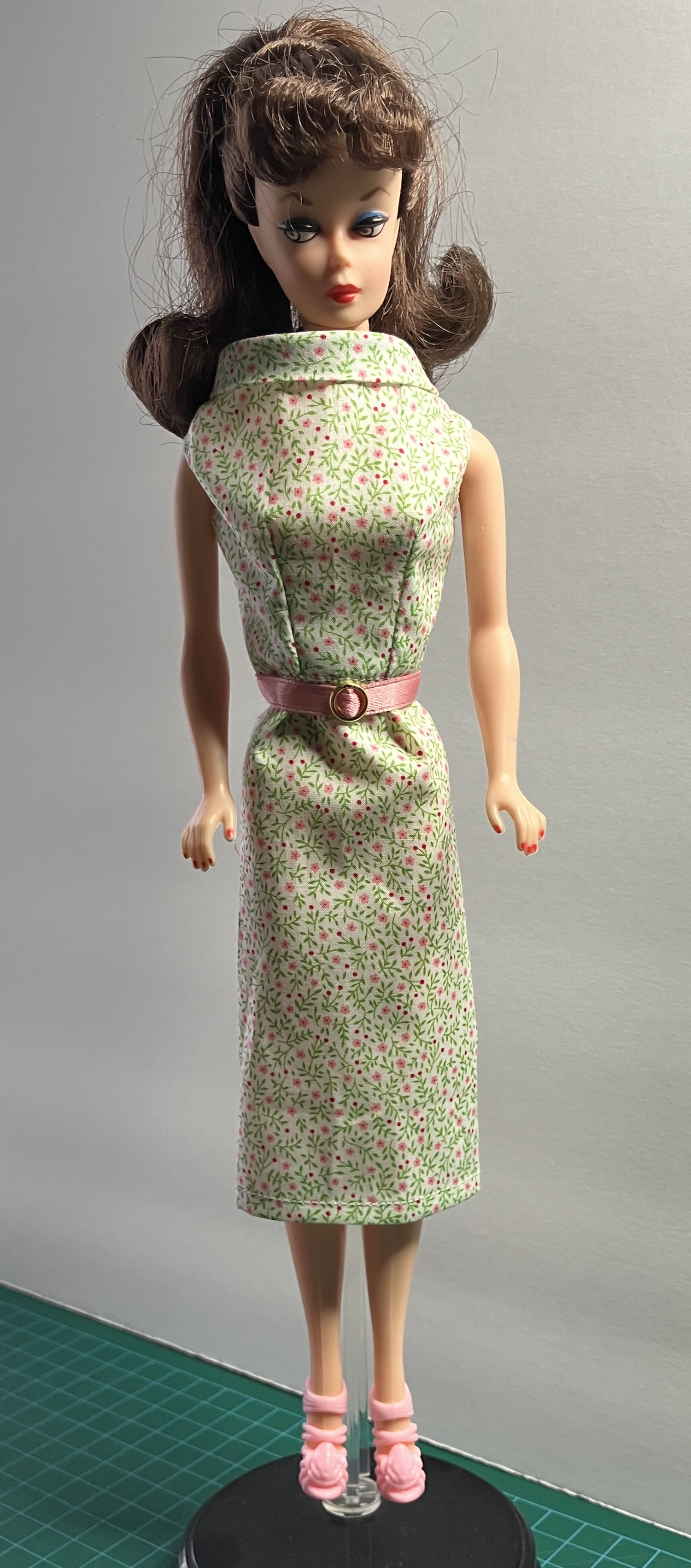
I recently made my first APF pattern. It’s APF 82 – Easter Parade, a reproduction of a 1959 Barbie fashion from Mattel. It included a black unlined coat, a print sleeveless dress, a purse and a “hat” (which is kind of a hairband, made with a “garbage tie”. Hmm.) Here’s a description on the Barbie Wiki with a picture of the Mattel original. I got this pattern on Etsy somehow, probably in a bulk pattern purchase.

And here’s my first attempt.

Aileen's Petite Fashions #82 Easter Parade sewn by Deborah Cooke

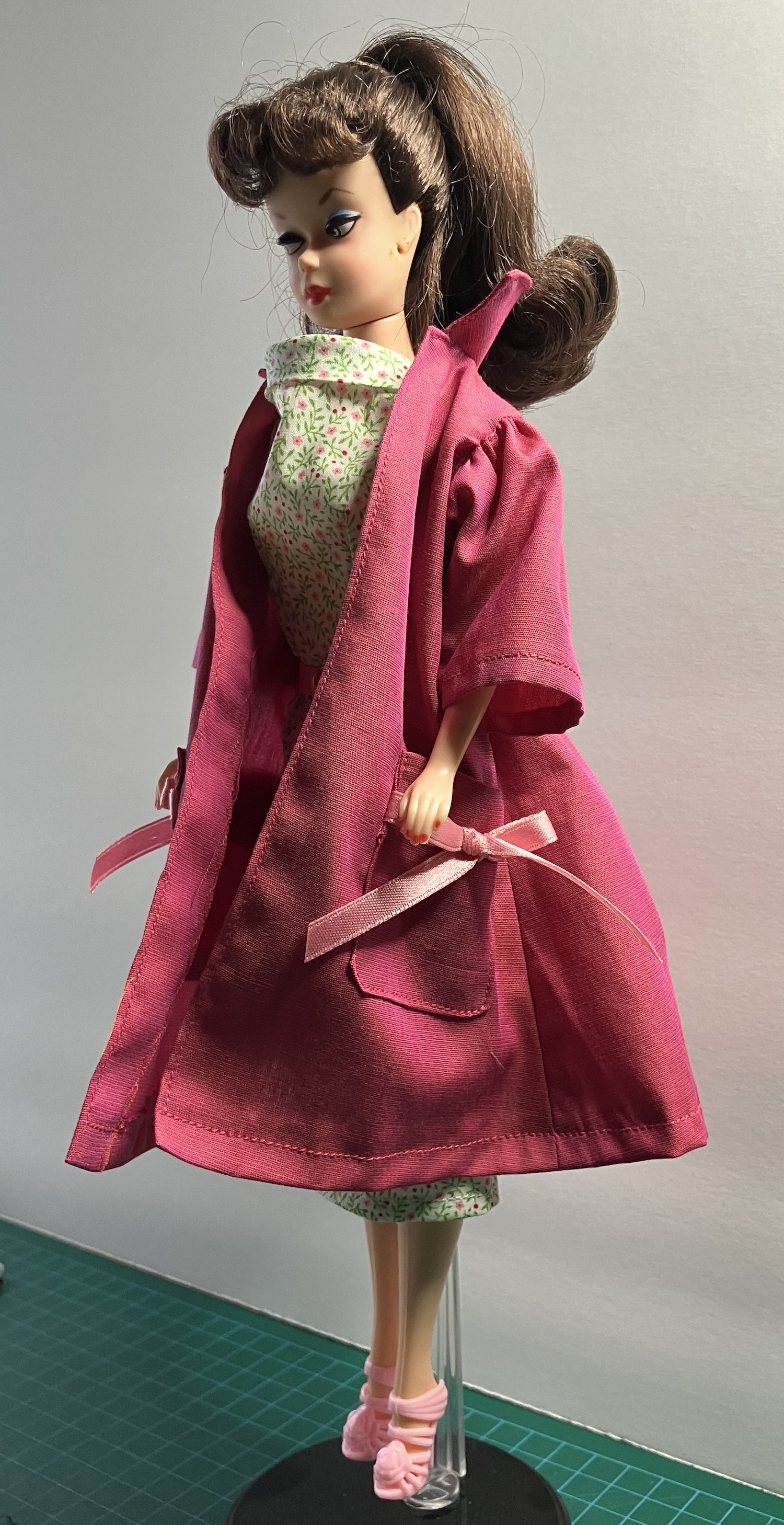
I made the coat of black Kona cotton. The instructions, like those on many older patterns, seem to assume that you already know what you’re on about. I used ribbons for the bows on the pockets, because I had no idea how big to cut the bias strip to make them, and couldn’t see them well in the picture to mimic the original. The coat has no front fastening because it’s pretty full. I did finish more edges than instructed and it came out reasonably well. I think it would benefit from a lining as the back collar bit does not give me joy but there you go.

silk pillbox hat for Barbie made by Deborah Cooke

Vintage B is wearing it here with a sheath of emerald satin and a pillbox hat with two feathers. (I love this little hat!) I’ll show you the sheath in another post, once I work out some kinks in the pattern.

I also made the dress from the pattern, using a teeny-tiny cotton floral print that I bought on Etsy. This one seems very generous in bodice, particularly in the upper front. I think if I made it again, I might curve down the neckline that takes the bias band. Overall, the fit is generous, more suited to “little fingers” than sleek couture.

Aileen's Petite Fashions #82 Easter Parade sewn by Deborah Cooke

The black seemed a bit austere for an Easter coat, so I cut another of bright pink. This is a French shirting cotton with two shades of pink that gives it a pretty crosswise stripe. (I originally made myself a shirt of this fabric. What happened to that shirt???) I added 1/4″ to the length of the sleeves to allow for a doubled hem, and again used ribbon on the pockets. You can see that this kind of collar doesn’t fit under a coat very well.

Aileen's Petite Fashions #82 Easter Parade sewn by Deborah Cooke

And here’s an interesting detail. I recently bought Kenneth King’s book on sewing for dolls and was intrigued that he used bridal tulle as a lining on some garments. It’s very thin, as he notes. Well, Aileen was using bridal tulle sixty years ago – the top of the dress is lined with it. It does work out quite well, making a very thin lining. The skirt of the dress is unlined.

Tulle lining in dress from Aileen's Petite Fashions #82 sewn by Deborah Cooke

Wild Grass Pullover

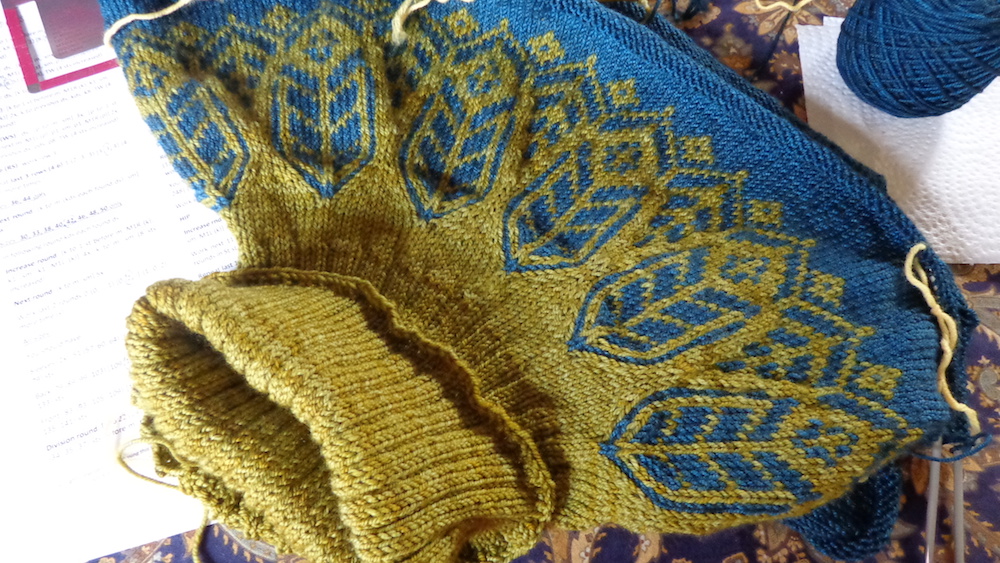
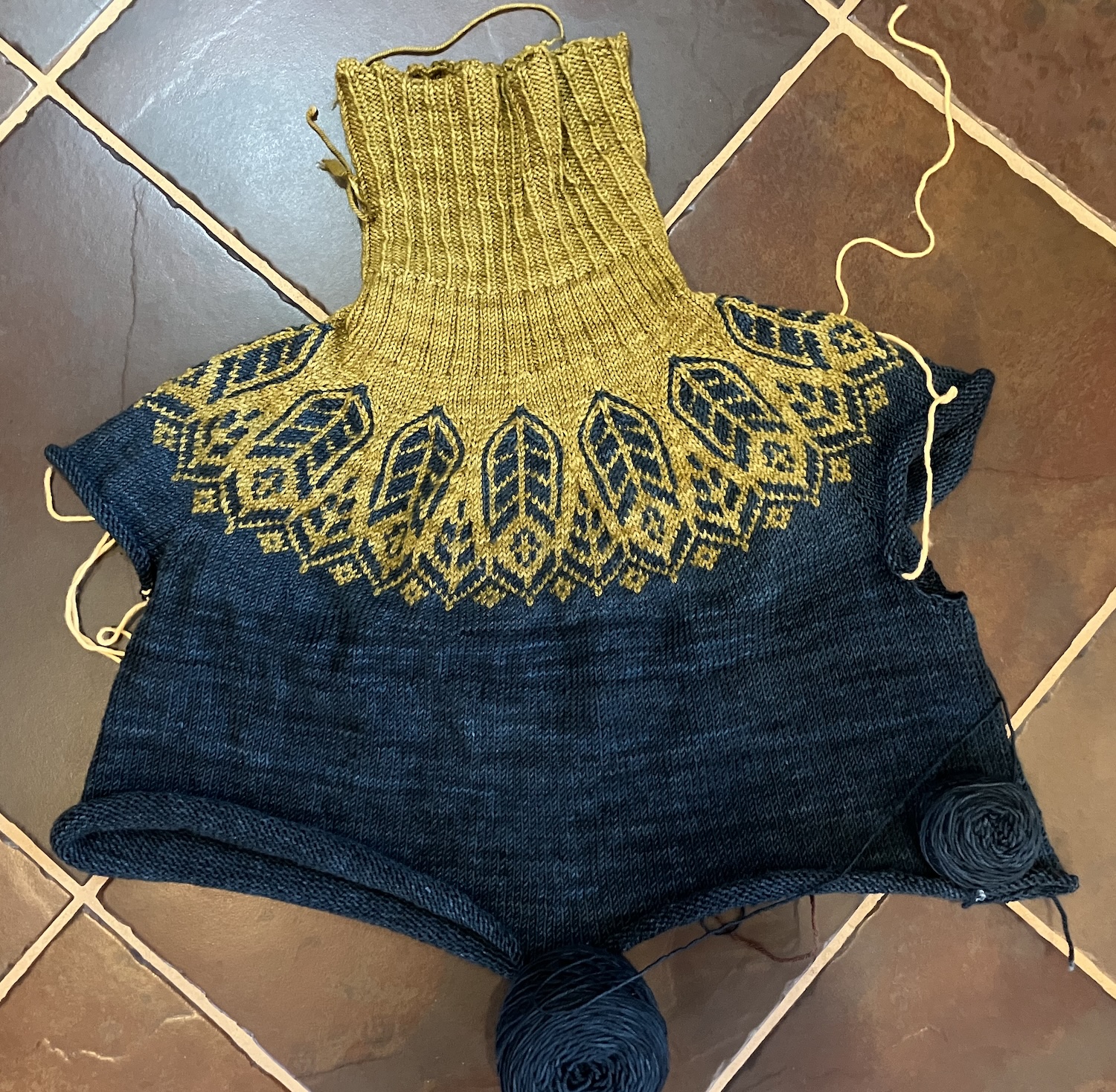
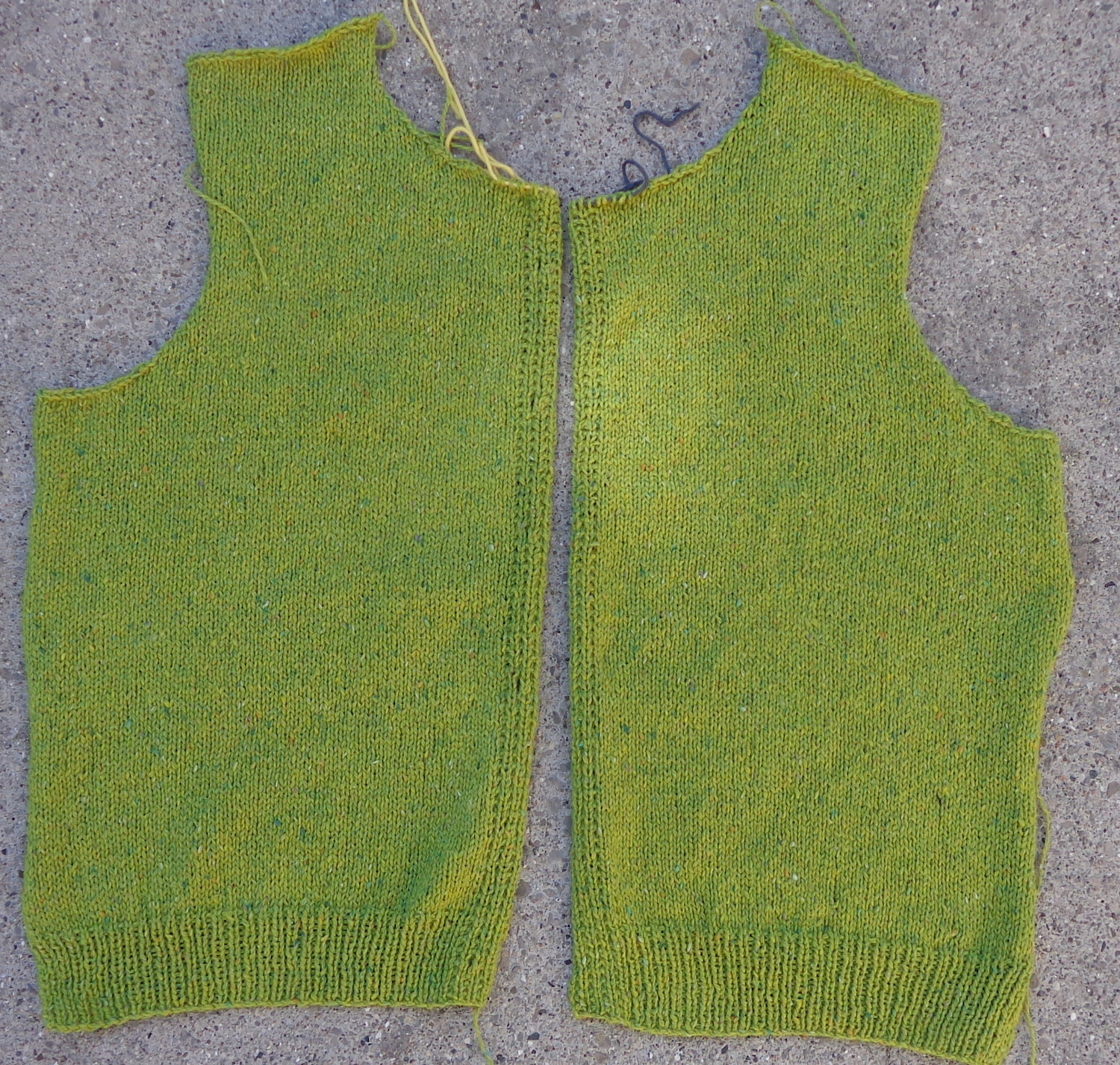
Finally, some knitting! I had a sort through my incomplete knitting projects over the holidays and made a plan to get some things finished up. First to jump into my lap is this one, a mostly top-down pullover. The yoke is knit up and cast off at the neck, then the stitches at the bottom of the yoke are picked up to knit the rest down.

Of course, I’ve done the fun part of knitting the yoke, and now there’s just a million miles of stockinette stitch to be finished. This picture is from 2020 and is pretty much where I stopped, right after dividing for the armholes.

Wild Grass Pullover by Asja Janeczek knit in Swans Island Washable Wool by Deborah Cooke

It’s been waiting on me for five years!

The pattern is Wild Grass by Asja Janeczek – here’s a Ravelry link for the pattern. My yarn is Swans Island Washable Wool Collection Sport, which I bought at Swans Island on our trip to Maine a few years ago. Here are the yarns on their website. It looks as if this one has been discontinued or possibly renamed. (?) It’s lovely yarn – the colours are very saturated and it’s very soft and squishy. The teal blue is a bit darker than it appears in this top picture. The fiber is merino wool.

The yarn also has a kettle-dyed look, so I’m alternating between skeins for the body. It will be a bit stripey no matter what I do, but that’s part of the charm of hand-dyed yarn. This is my TV knitting this winter – round and round – and here’s how far I’ve gotten:

Wild Grass pullover in progress, knit by Deborah Cooke

The colour of the blue is more true in this shot. You can see how I changed the ribbing pattern on the neck, so that when it’s folded over, it looks consistent. It’s a 3-1 ribbing, but I wanted the top edge to look like the bottom one when it was folded over. You can see that I reversed the stitching partway up the neck, before the fold, in the top picture.

Here’s how it looks folded over.

Wild Grass pullover in progress, knit by Deborah Cooke

The edge of the turtleneck is a cast-off edge, so I cast off with a larger needle to ensure that it would stretch. I think I’m going to take it back and use a smaller one – right now, it’s a bit frilly, a good sign that I used TOO large of a needle.

I do love the colour combination.

Now that the body is off the needles, I’m going to knit the sleeves before putting those stitches back on the needles. That way, I’ll know how much yarn I have left for the body. Maybe I’ll be able to make it longer. We’ll see. In the meantime, ’round and ’round I go!

Quilting My Pink Pineapple Star

Around the beginning of the pandemic, I planned to get several of my tops quilted at the shop with the long-arm quilting machine. Since they were closed because of Covid-19, I popped this one onto the frame and began to hand quilt it. I don’t know if I’ve shown this one to you before.

Pineapple Star Quilts by Sharon Redroad

I love pineapple quilts and picked up this book some time ago – Pineapple Stars by Sharon Rexroad. It was published in 2005 and I’m not sure when I bought it, probably at least ten years ago. (I’m also not positive that I know where it is now.) I remember that it has clear instructions and lots of inspiration, although I could have read more about contrast and fabric selection before diving into the creation of mine. 🙂

This is the central medallion of mine:

Pineapple star quilt pieced by Deborah Cooke

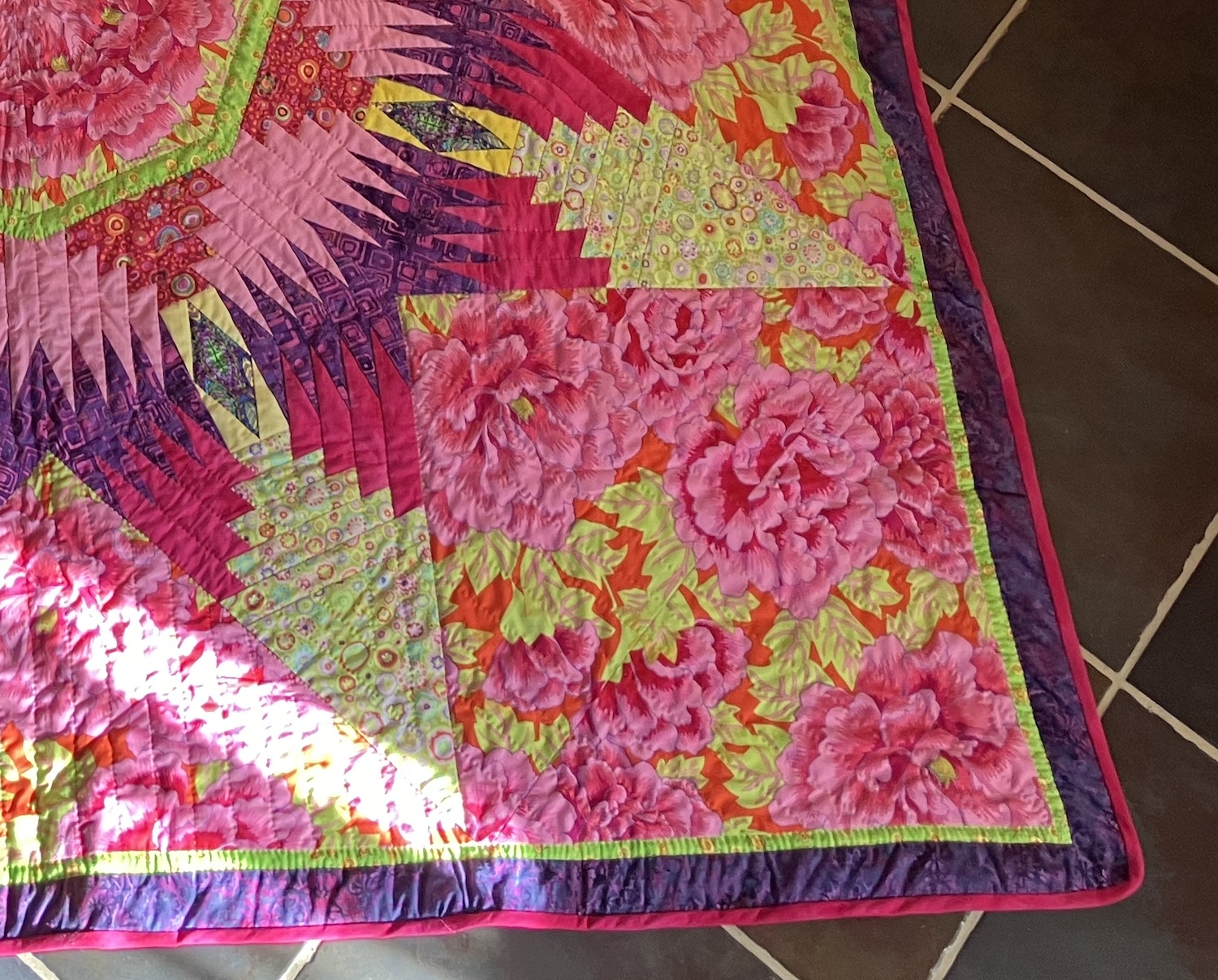
I squared off the corners and added a border. It’s very bright and I love it.

That floral print is a Kaffe Fassett design called Kimono. By the time I realized I needed big squares of it for the corners, it had been discontinued, so I pieced those blocks. You can see the diagonal line in one big peony this corner where I seamed the two triangles. It’s not an absolute match.

pineapple star quilt made by Deborah Cooke

I started to quilt in the center with lime embroidery thread and worked my way out past that lime hexagon. There are still two corner squares that need their quilting finished.

This past week, I bound the outside edge with self-made bias. I was amazed that I managed to find the dark pink from the middle of the star in my stash.

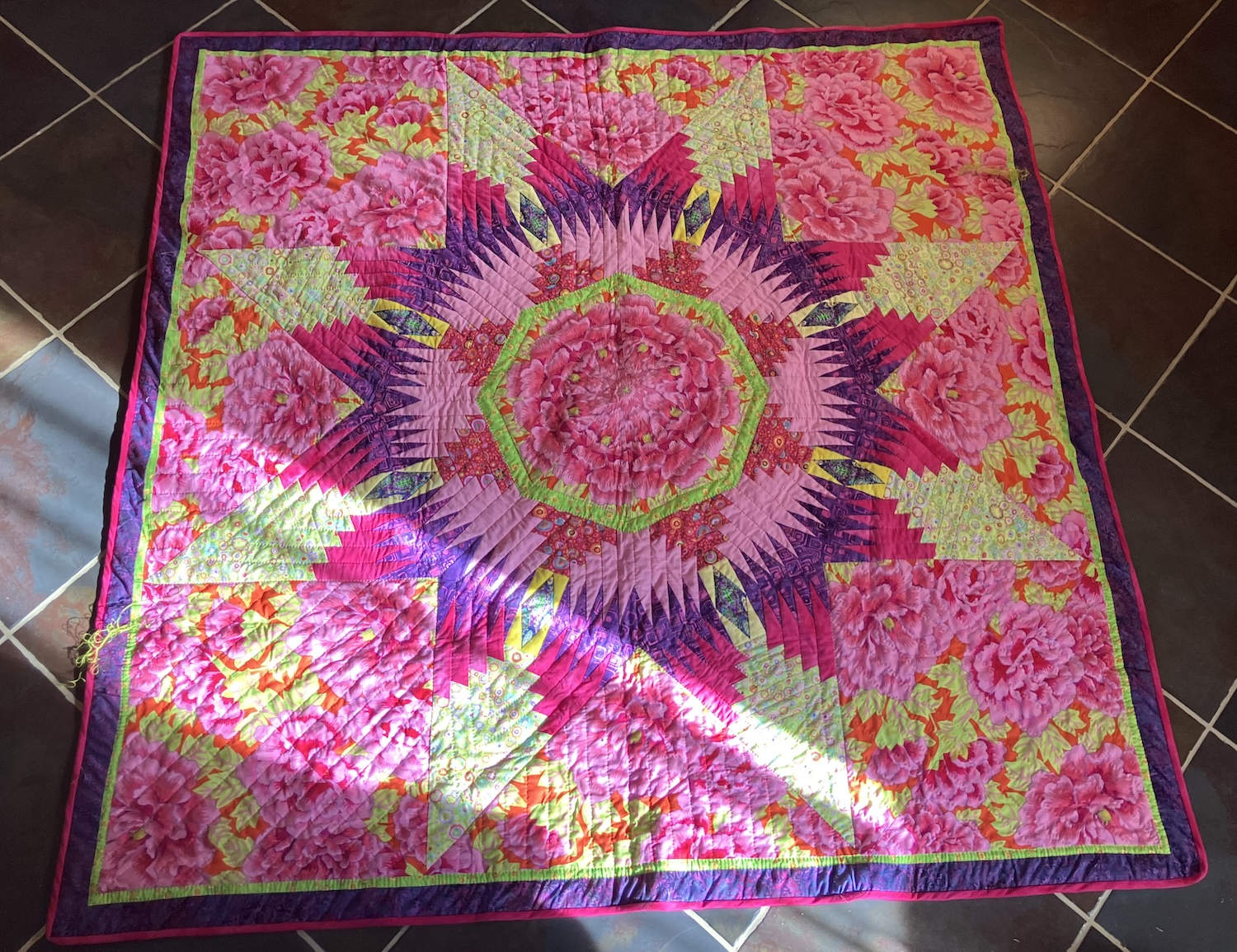
Here’s how it looks now:

pineapple star quilt made by Deborah Cooke

It’s interesting how the contrast looks different in the photo than in real life. The green star tips don’t fade out of view as much IRL, probably because the lime is more vibrant than it appears here, more like the octagon in the middle.

As I was taking this picture, my dog decided to lie down in that bit of sunbeam. She didn’t settle in, though, so I didn’t get a pic of her there – even with the quilt, the floor is harder than her bed on the other side of the room, but her opportunism made me laugh.

Phoebe Suit

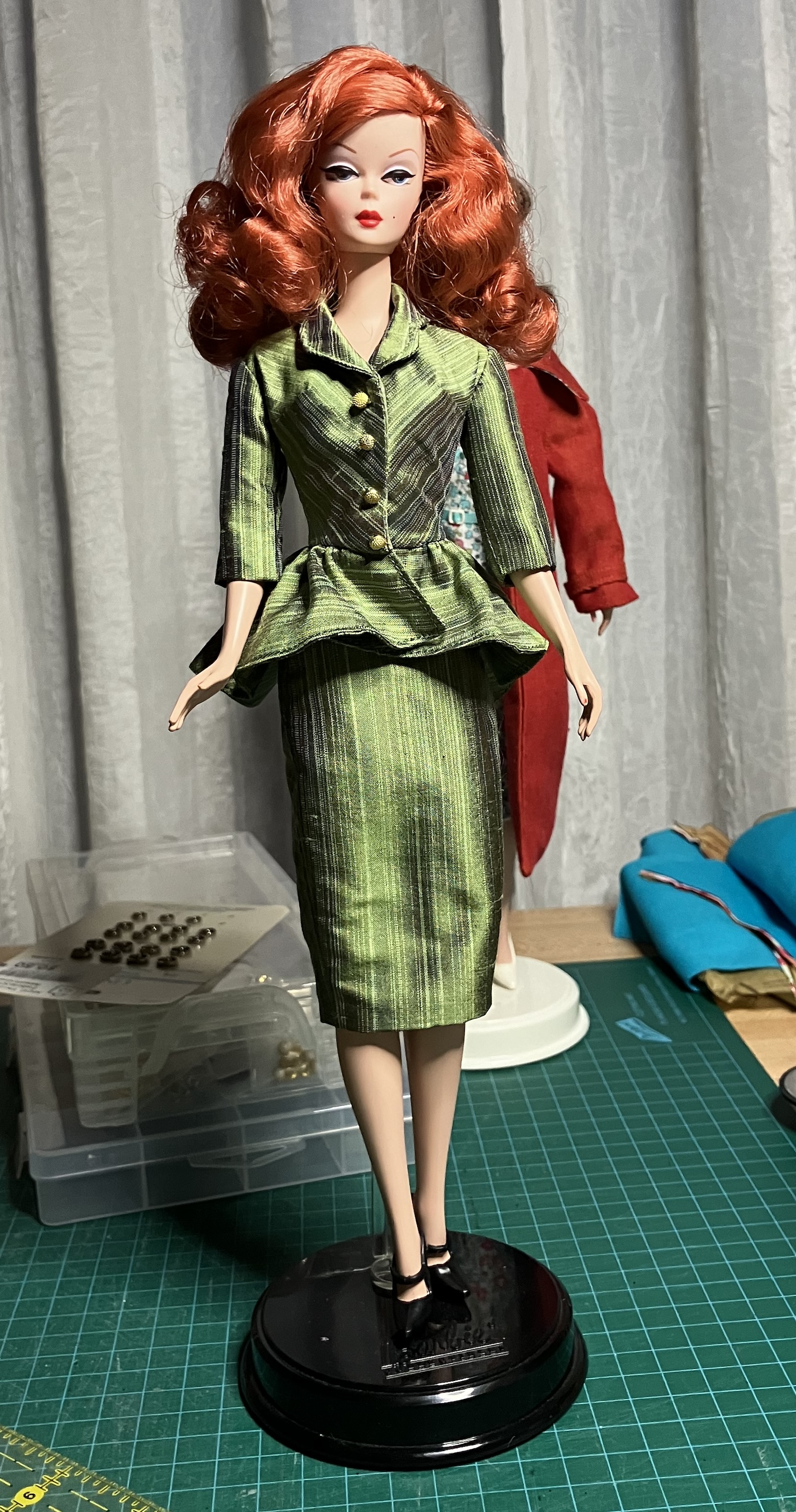
I’ve had a disappointing run of making this fall, with more failures than would be ideal, but here’s something that came out well. It’s a silk suit for the girls.

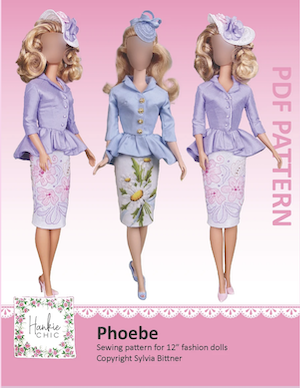
Phoebe by Hankie Chic

The pattern is Phoebe from Hankie Chic. You can buy the pattern right here. The pattern is for a two-piece suit, with a straight skirt and a fitted jacket with a peplum that opens at the front. The jacket has a small collar and 3/4 sleeves and is lined.

I cut mine of that striped silk in green. I thought the back was too wide – the instructions say to put the back edge of the pattern on a fold, but I subsequently seamed it. This made the back 1/2″ narrower. The jacket is a very precise fit for the Silkie girls (and will be looser on the articulated Silkies) but I’d need at least half of that seam allowance back for it to fit the vintage B girls better. Right now, it goes around the doll and the front edges match, but they don’t overlap.

Here’s the suit on Dusk to Dawn:

Phoebe by Hankie Chic sewn in green striped silk by Deborah Cooke

Those are little gold shank buttons from I Sew For Doll. I love this shade of green on her!

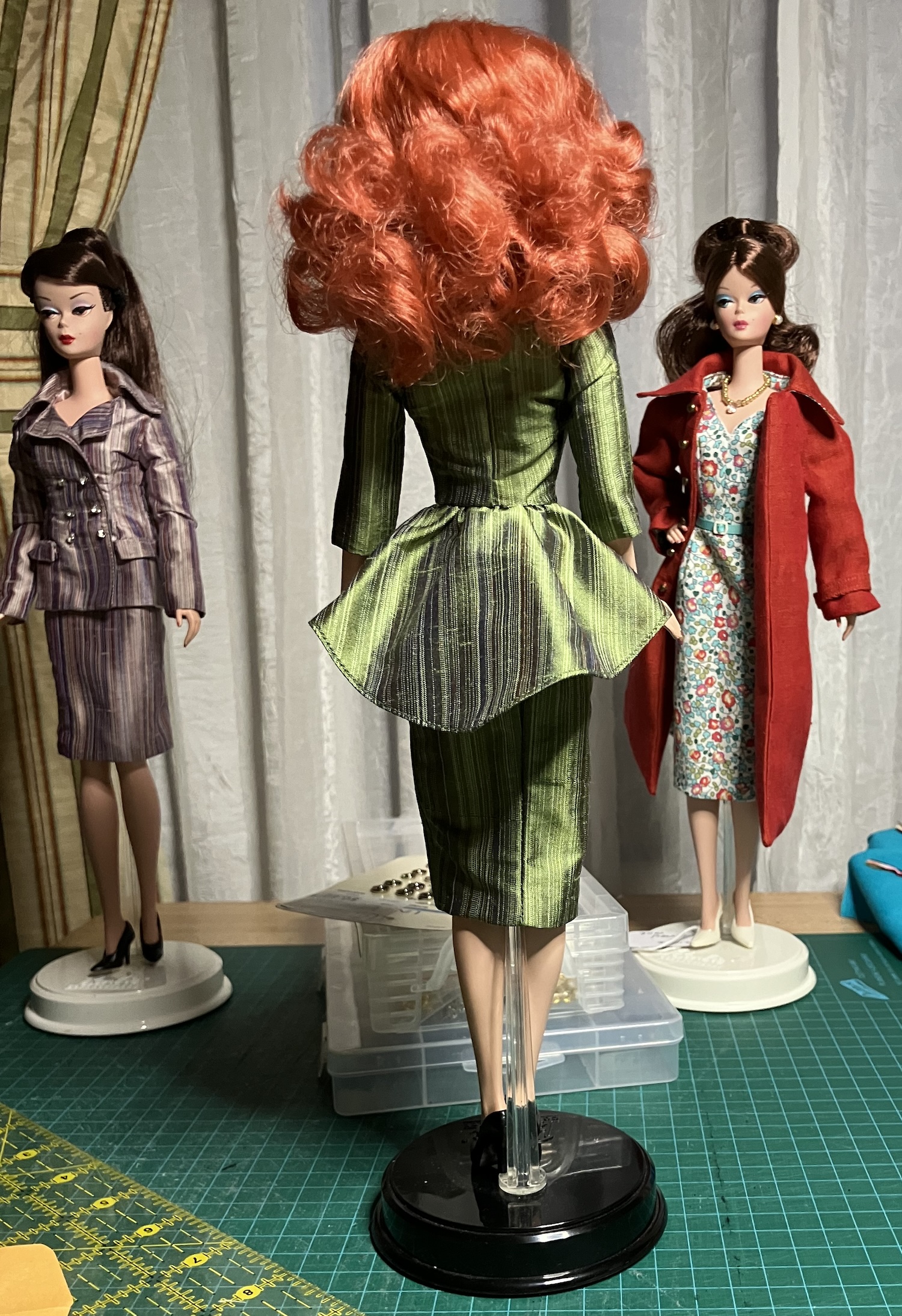
Because it’s a lengthwise stripe, the direction of the stripe changes in the garment. The bodice top is cut in one piece, without a shoulder seam, so ended up on the bias at the front. I like this construction a lot, as it’s less bulky. I cut the peplum lengthwise and crosswise, planning to use the one for the facing that I liked least. The grain on the center back ends up perpendicular to the front edges – I liked it best when that was lengthwise at the back (even though it means the peplum is crosswise at the front.)

Phoebe by Hankie Chic sewn in green striped silk by Deborah Cooke

The peplum is much longer in the back than I’d expected. It’s almost like a frock coat. It’s also a lot more full – it was tight to jam in all of those gathers and I’m not sure they’re all needed.

I topstitched the collar and the hem of the peplum. I also understitched the sleeve lining and the skirt lining, all at the hems, but that’s not visible. It stabilizes the hem, though.

There are no grainlines on the patterns from this company, so you have to guess how to lay out the pieces. I put the center back seam on the straight of the grain, which is why the fronts ended up on the bias. It might be interesting to try a variation with the center front on the straight of the grain, which would put the CB seam on the bias. I’ll also likely try one with a shorter peplum, perhaps one that is less full than this one.

I have ideas for many variations and experiments, but the suit came out well as it is and I’m very glad to have a small triumph!

Quintessential Cardigan – Done!

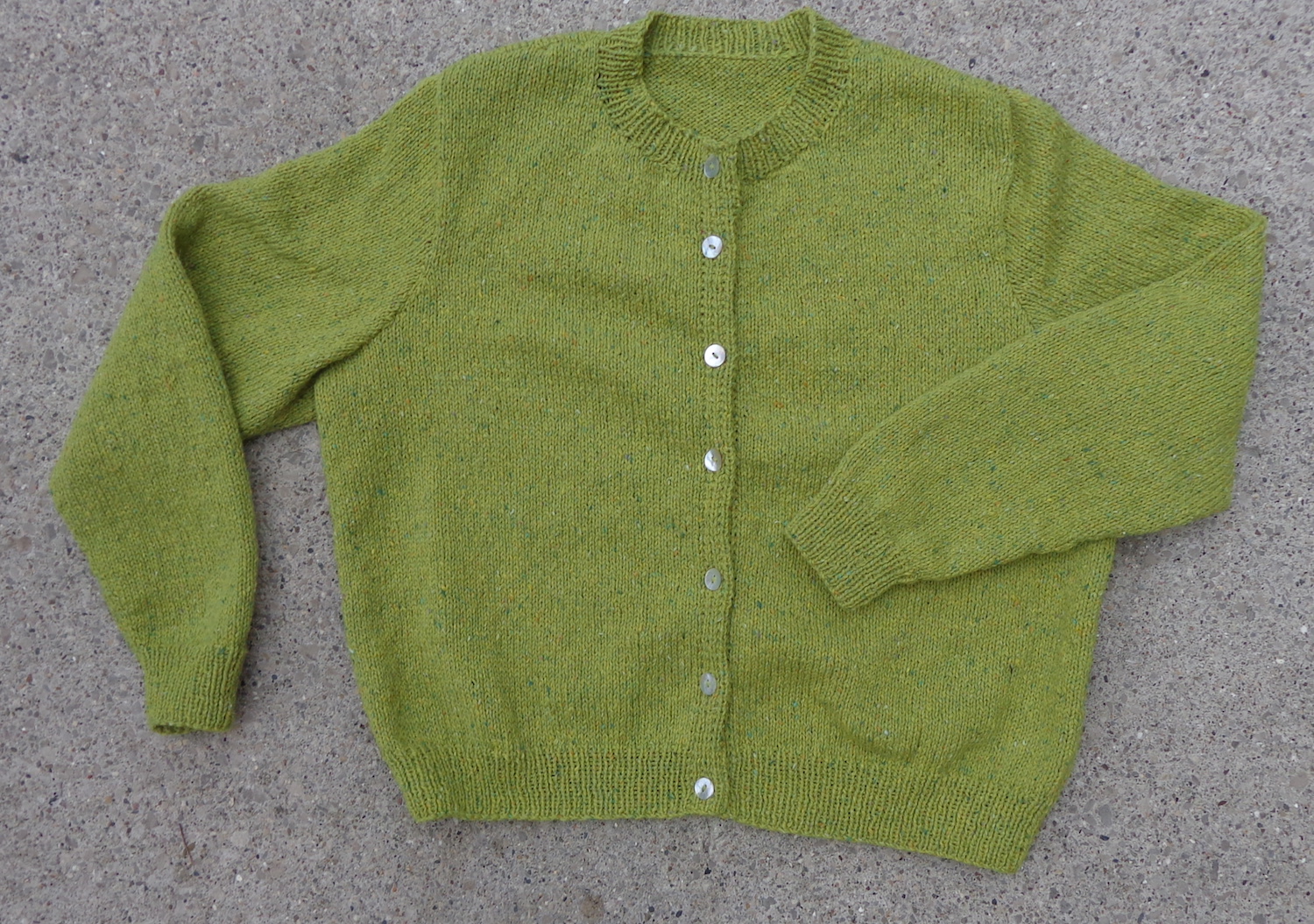
And it’s finished! (Not blocked, but finished.)

Quintessential Cardigan knit by Deborah Cooke in Jody Long Alba

This was a kit of the Quintessential Cardigan designed by Churchmouse Yarns & Teas. The yarn is Jody Long Alba in the colourway, Moss. I knit the body two inches longer than the pattern specifies. (There’s another blog post about it here.)

I quite like the sweater and it fits well. The colour is great and I love the tweedy flicks in the yarn. It was a bit tedious seaming it up, but that’s always the way – and yes, this yarn was almost as inclined to snap as Rowan Felted Tweed. One great thing is that the sleeves fit perfectly into the armscyes. Yay!

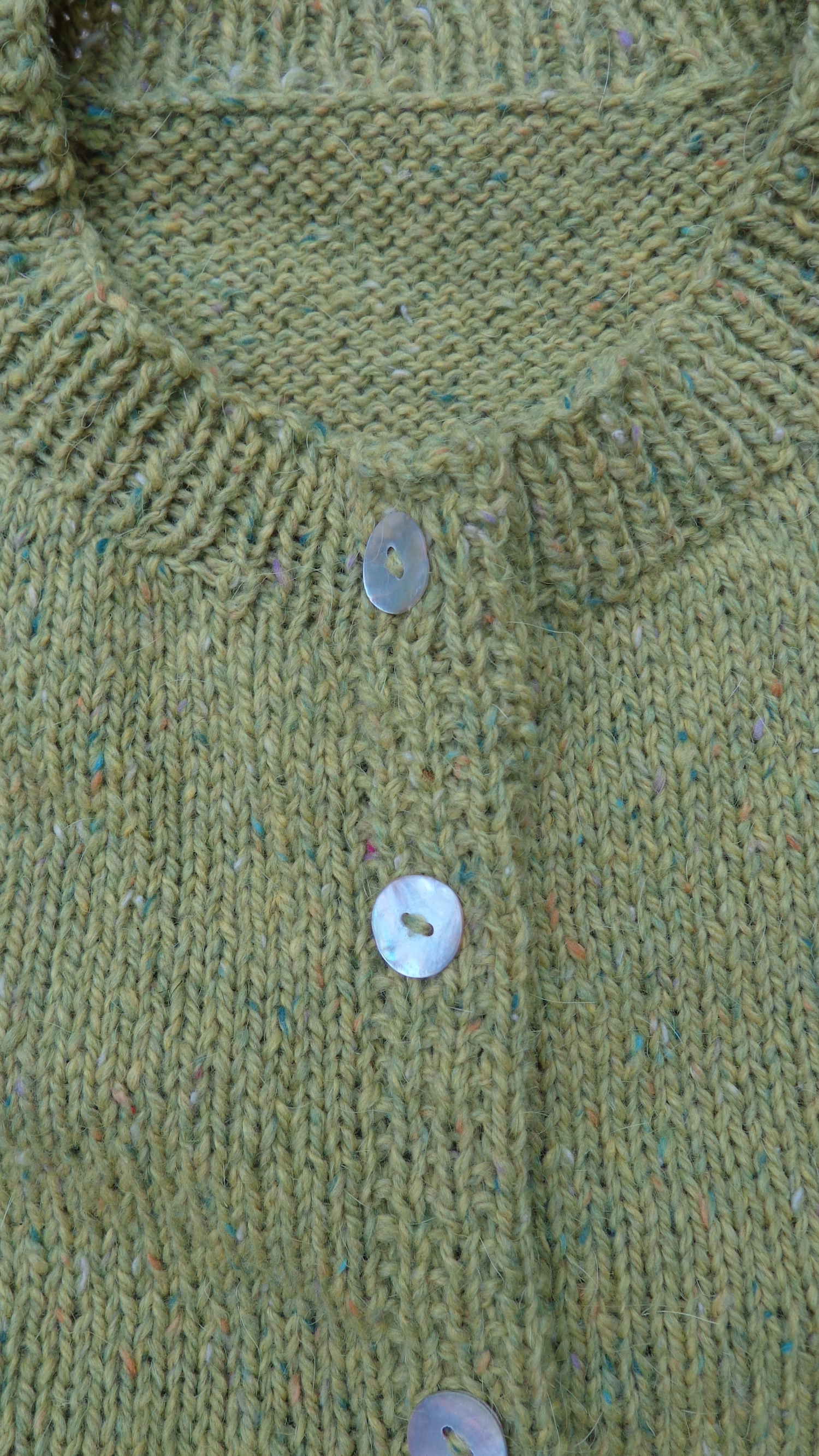
Here’s a detail shot of the front buttonhole band, which has slipped stitches on the wrong side.

Quintessential Cardigan knit by Deborah Cooke in Jody Long Alba

The colour’s not very true in this pic – the wool really is that lovely lime shade. In this shot, though, you can see that my miscalculation, the one that made the last button before the collar band a little higher, isn’t really that bad once the buttons are sewn on.

I don’t love this slipped stitch on the band. It looks too different from all the other ribbing, although I understand that it’s intended to keep the button bands from being too long. Another way to avoid that is to pick up the stitches for the button band after the fronts are done and knit them sideways.

It took 3.4 balls of yarn or just under 1200 yards.

I do have another kit in Plum so will be making a second one, with a few changes.
• Since I lengthened the sweater, the waist ribbing falls at my hip, which isn’t ideal. I’ll change that to a garter stitch hem or a moss stitch hem instead and let it be a bit swingy.
• The cuffs are on the narrow side – it’s fine when they’re worn down, but I always push up my sleeves. I’ll make them a bit wider on the next one. I’ll work them in whatever stitch I decide to use instead of the waist ribbings, too. (I don’t love ribbing on my sweaters.)
• Because of that slipped rib stitch on the button bands (which is over 7 stitches), the buttons aren’t centered on the band. You make the buttonhole on stitches 5 and 6. This kinda drives me nuts. 🙂 When I work the button bands in another stitch – to match the hems – I’ll put the buttonholes in the middle of the band, over stitches 3, 4, 5, which will also make them a little bit bigger. It’s snug to get these buttons through the holes, but I don’t think smaller buttons would look good.

Overall, I’m pleased. It’s a very basic sweater, but the colour keeps it from looking frumpy.

I really want to cast on the plum version immediately, but am trying to finish a project first. We’ll see how I manage with that goal!

Quintessential Cardigan

I told you about this one, a kit that I bought and cast on right away. It’s the Quintessential Cardigan designed by Churchmouse Yarns & Teas. The yarn is Jody Long Alba in the colourway, Moss. I’ve finished the fronts and the back, and made them 2.5″ longer than specified in the pattern.

modified back of Quintessential cardigan designed by Churchmouse Yarns, knit by Deborah Cooke in Jody Long Abla in moss colourway

I did muck up the calculations slightly. After knitting the left front, I counted the rows to space the button holes. (The pattern suggests that you place markers, then compare the right front as you knit it to the left front to choose where to make a buttonhole. I went with the strategy I know – but still messed it up. LOL) It worked out that they should be every 23 rows, but the buttonhole is made on a RS row. I decided to alternate 22 and 24 R between buttonholes, but my top bottonhole before the collar is a little higher than it should be. I should have just done 22R between each one. I’m not going to frog back to fix it. I bought the kit in another colourway – Plum – so will do the buttonholes right on that one.

modified fronts of Quintessential cardigan designed by Churchmouse Yarns, knit by Deborah Cooke in Jody Long Abla in moss colourway

This pattern has a lot of small touches that are interesting and some are new to me. They suggest, for example, some short rows immediately above the ribbing at the hem to keep the hem hanging straight. I’ve never had an issue with the hems of my cardigans, and actually, I was so busy with the buttonholes that I forgot to do it on the right front. (Not frogging back for that either.)

The front button bands are ribbed but have slipped stitches on the wrong side, again to keep the ribbing from hanging too long. It also changes the look of the ribbing, and I’m not sure I’d do that again. I might just knit the bands in seed stitch on the plum version.

So far, I haven’t found any jazzy buttons in the right size and colour, so it looks as if this one will have abalone shell buttons, which is pretty much my neutral answer to buttons.

I’m now working on the sleeves and am up to the elbow or so, knitting them both at the same time. I find that the easiest way to make sure my increases match. Progress is steady and this is good TV knitting. I should be finished soon. 🙂

Green Bouclé Scarf

A few weeks ago, I decided to take apart a sweater that I’ve never worn, one knitted some thirty years ago. The post about that was The Turquoise Pullover.

Here’s the first repurposing of the yarn.

Scarf knit from green bouclé handspun wool/mohair blend by Deborah Cooke

I took all the bouclé and knit a scarf in garter stitch. This isn’t a fancy or complicated project, but the garter stitch—and the larger needles—really show off the yarn, I think. You can see all the colours at this looser gauge.

It’s about 10″ wide and 54″ long, and used every inch of the yarn – I just wove in the ends until they vanished and carried on. Where the yarn was thin, I doubled it up, which diminished the thick-and-thiness of it a bit. You can see that there’s inconsistency but this isn’t a reflection of the spinner’s skill – when I frogged this yarn, the loose single ply structure worked against me and this yarn pulled out to be thinner. I tried to be careful, but the yarn’s consistency still suffered. You can see that the boules were stretched out to the vanishing point in some places.

The uneven texture makes it look like a first project to me, which is kind of funny. Why? Because the needles were wooden ones, actually the ones my grandmother gave me when she taught me to knit. I was four. They’re bigger than 6.0mm and smaller than 6.5mm, so maybe someone made them for her. I like the patina on them and the memories they stir up.

Come to think of it, she taught me to knit with a pink yarn that was slightly thick and thin. I knit a scarf for one of my dolls that was about four inches wide, if memory serves, in garter stitch.

Scarf knit from green bouclé handspun wool/mohair blend by Deborah Cooke

For this one, I cast on and cast off with the coordinating silk blend to make a neater edge, and did a couple of rows at each end in garter stitch with that yarn.

It’s a very thick and warm scarf, but not too long. Crossed in front, it covers my neck right up to my chin. It’ll be perfect under a coat next winter. I thought about a fringe or tassels in the contrasting yarn, but it’s all kinky from being frogged right now. I’ll see how much of it is left after I finish the cowl and may embellish this scarf then.

Scandinavian Family Cardigan

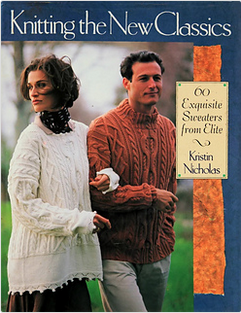
Knitting the New Classics by Kristin Nicholas

Now I’m digging out old sweaters that I’ve never blogged about. 🙂 Today I’m posting about my Scandinavian Family cardigan from Knitting the New Classics by Kristin Nicholas. (The title and the book cover are linked to the Ravelry page since this book is out of print. It was published in 1995.)

The Scandinavian Family sweater is stranded knitting, with contrast bands at the shoulders and hems. It’s a drop shoulder boxy design (more square pieces!) and I had some fun mixing up the colours.

One of the interesting changes in patterns is that many companies (like Rowan and Elite) once offered many size variations in each design, so you could make the same sweater pattern for every member of the family. (Rowan also used to offer sleeve and length variations.) Here’s the photo spread for this sweater from the book:

The Scandinavian Family sweater from Knitting the New Classics by Kristin Nicholas

The picture is dark so it didn’t photograph that well, but they’re all wearing a version of the same sweater.

And here’s my version:

The Scandinavian Family sweater from Knitting the New Classics by Kristin Nicholas knit by Deborah Cooke

I split mine up the front to make a cardigan, which meant I added facings all around. I started with the mixy gold blend in the borders, which had been in my grandmother’s yarn stash, and chose colours to coordinate with it. I have no idea what the content of it is – it was a huge handwound ball when I got it. The green and white yarns used in the main body are from a farm/mill that used to be near Ottawa called Belle Vallée Wools. (They might still exist. I’m not sure.) I bought the green and white in Carleton Place on a road trip to Ottawa in the mid-90s. The yarn is a lot like Briggs & Little Regal. Many of the colours in the yoke are actually fingering weight and I held them double. Again, I bought yarns all over the place, but mostly on that road trip.

A detail pic. I love this fair isle pattern and all the colours in the green tweedy wool:

The Scandinavian Family sweater from Knitting the New Classics by Kristin Nicholas knit by Deborah Cooke

This is a really warm sweater, probably because it’s knit tightly. No worries about the wind with this one! The other thing about this kind of wool is that it doesn’t change much over time. It doesn’t pill or show wear the way that softer yarns do. This sweatter looks very similar to the day it came off the needles, thirty years ago, and not because I haven’t worn it.

Here’s my Ravelry project page. I called this one my Snowflake Sweater.