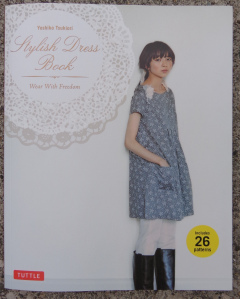
 Time for more reports about sewing from Japanese pattern books. Today’s feature is a sleeveless dress pattern (A) from Stylish Dress Book.
Pattern A is an A-line sleeveless dress. I made it first in black linen – since I’d had such success with the smock, I decided not to do a practice dress.
 It came out beautifully, although I found it a little tough to roll the narrow bias hem with the linen. The pattern calls for a lighter fabric and the weight made a difference on that narrow bias. If I used linen again, I’d cut the bias strip 1/4 wider.
I love how it looks. It’s a great layering piece.
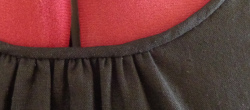 Here’s the neat neckline. It’s a little detail that gives the dress the perfect interest, I think.
I made another one of these in a red cotton border print. This is a lot more flashy, but also a fun simple dress.
 The stripe was on the selvedges, so I cut the dress crosswise to have the stripes at the hem. This meant that it took very little fabric to make the dress: I only had 2m of this because I bought the end, and it was just 42″ wide. I was excited to be able to get a dress out of it. I matched the position on the hem and let the height fall. You can see that there is more of the stripe on the opposite selvege at the shoulder on the front than on the back—that’s because the bodice darts make the front slightly longer than the back. That’s an excellent reason to match the borders at the hems rather than at the shoulders.
This cotton is a little bit stiff, although it may soften over time. The next one of these I make will be in a fabric with more drape, just to see the difference. I suspect that it works best in fabric that has more body, but we’ll see.
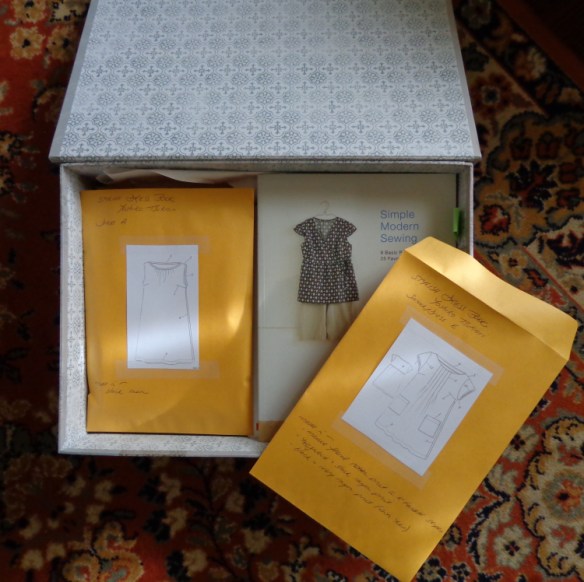
I needed to get organized with these patterns, too. Because you trace them out yourself, there’s no neat way to store them away when you’re done with each piece. I decided to mimic store-bought patterns and bought some envelopes as well as a pretty box at Michaels (they were on sale). The envelopes fit perfectly and there’s one for each pattern. The books also fit in the box.
Here’s where my patterns live now:
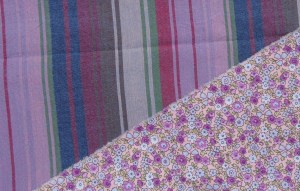 This floral print was in my stash. I bought it for $1 a meter because it’s a nice weight of cotton. It’s not really my style, though, so it’s been waiting. For this dress, I used a Kaffe Fassett stripe as contrast to keep it from being too sweet.
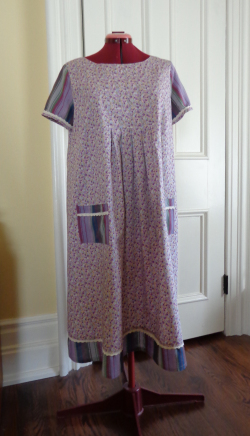 This turned out to be one of those comfy summer dresses to wear on a hot day. I wore it a lot last summer and will probably make another for next summer. The cotton lace insert proved to be a bad choice because the lace wasn’t prewashed – it shrank in the wash and now there’s a bit of gathering wherever there’s lace. It’s quite full. I’d take some of the width out of the back if I made it in cotton again.
 What’s funny about this fabric is that the turquoise photographs as a medium blue. The fabric also came in this color combination, but I didn’t like it as much. This one is actually a vivid turquoise.


 I’m not sure how I’ll be able to place the border pattern on the blouse, but I know it will look great.
 Alive & Knitting