I’ve been showing you my progress on the In the Beginning Dragon quilt kit – here’s my first post and my second – and today, it’s border time. The kit comes with a dragon border print, which has four rows of the border printed lengthwise. After pre-washing, the repeat lengthwise is just under 24″, with dragon circles alternating with dragon profiles in flames. Widthwise, the repeat is 9 7/8″. The instructions say to cut borders 9.5″ wide, but I wanted the maximum ability to play with positioning at the corners. Cutting four lengthwise strips 9 7/8″ wide will leave 3/4″ of black, at one selvedge or the other. Hmm.
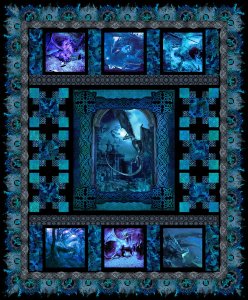
Here’s the orange quilt illustration from the kit: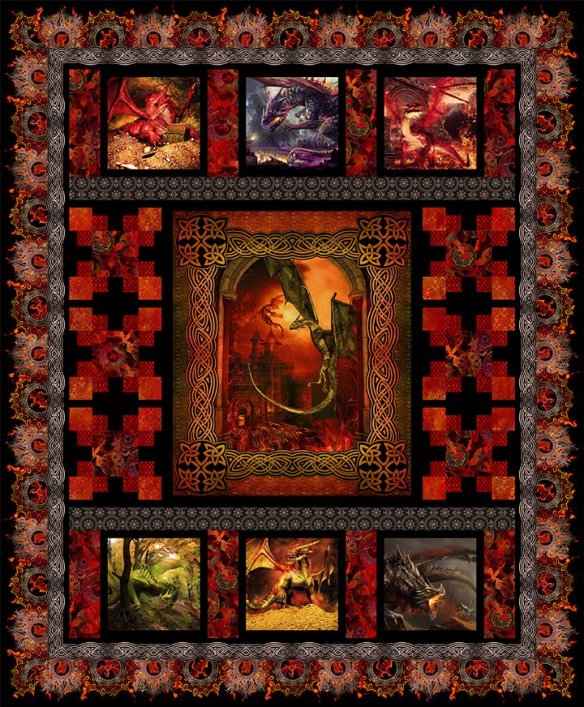 The instructions say to center a dragon circle on the width of the quilt and a dragon in flames on the lengthwise edges. The quilter who made this orange quilt did that, which is why we’re looking at this image this week. (The one who made the blue quilt didn’t.) The corners are mitered, and you can see that with this positioning, you get mirrored corners which is all good, but they each have a slice of dragon circle in them. I don’t love that, so I wanted to explore alternatives.
That extra 3/4″ of black in the border fabric can be either on the outer edge of the border or the inner edge, depending which selvedge you choose to start cutting. It looked to me like this quilter cut pretty close to that Celtic braid, moving the extra black to the outer edge. I cut the other way around, trimming the white from the selvedge closest to the braid, then cutting my 9 7/8″ strips from there.
I tried many options: dragon circle centered on both the length and width, dragon in flames centered on both the length and width, dragon circle centered on the length and dragon flame on the width, then vice versa. I moved the Celtic braid closer to the edge of the quilt, too. None of the results make my little matchy-matchy heart go pit-a-pat.
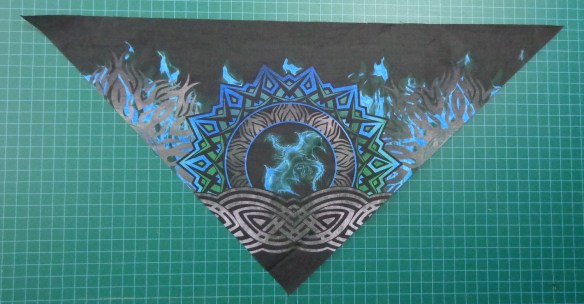
Then I had an idea: fussy cutting. Here is a bias cut corner, a square with its sides the same width as the border, with a dragon circle centered in it. It’s cropped at the top because that’s diamonds cut out of rectangles.
It’s less than ideal that it’s on the bias, but look at the corner I got with it: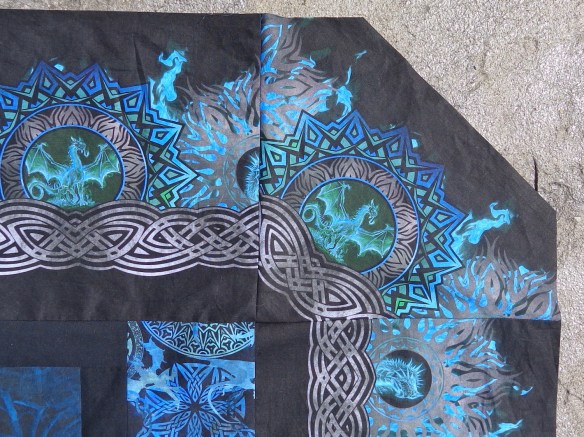
Oooooo! I like that! No mitering either. There are always compromises in matching up a detailed border like this one, but this compromise pleases me. The circle around the dragon is almost whole, and the inside of the Celtic braid lines up. This also means that my quilt is slightly octagonal, but I like that, too. I could have patched the corner with some of the leftover solid black fabric, but it’s darker than the background on the border print. I thought it would show.
I cut two each of the borders shown above. I laid out the side borders to have the dragon in flames centered on the long edge and centered a circled dragon on the shorter edges. I couldn’t quite alternate circled dragons around the perimeter as there are six on the long edges and five on the short ones, but I alternated which dragon was in the corner. In two corners, I have the dragon with the spread wings between one the same on the left, and the dragon that’s more in profile on the right. On the other two corners, the profiled dragon is between two dragons with spread wings.
Voilà! Here’s my finished quilt top:
It’s huge! Mr. Math used a ladder to take the picture and the edges are still cropped.
Initially, I was disappointed that I hadn’t ordered fabric for the back of the dragon and circles print, but I found a textured black print in the discount bin at Fabricland. It was $5/m and 54″ wide, so that was an economical solution. I’ll put a strip of the emblems along the seams—there’s some left from cutting those six dragon panels apart, as it was between them—and a dragon in flames where the strips meet, just for fun. It definitely needs to be bound with a color. I’m going to find out about the long arm machine quilting done at a local shop and maybe have this one quilted that way.
And the bonus? The leftover fabric makes really cool masks.
 More dragon quilt!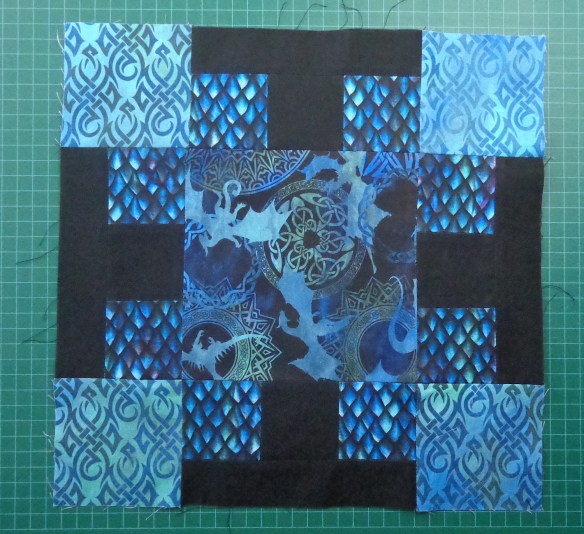
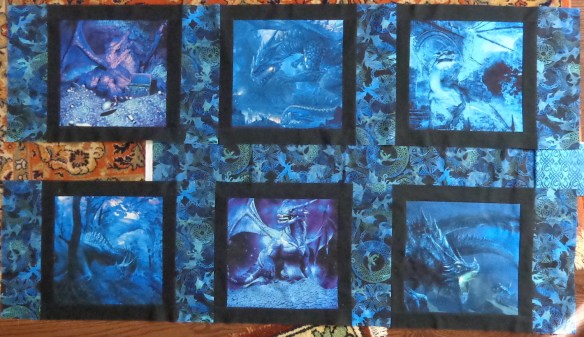 I put some of the leftover fabric between the rows—it ran out at the left, because these bands are 58″ or so wide—and put a little bit of the flames at the right. I like it better with the background all the same colour, but even one panel of these six-dragon-panels would make a fun quilt.

 When I started to piece the other blocks, things got interesting. The scale print is a one-way design: the scales are shaded at one end and not at the other. It seems to me that I’d want them all to be in the same direction. To my relief, the person who made the sample quilt thought the same thing, because they are aligned that way. At right is a close-up of the side panel from the image on the kit: you can see that the scales are all aligned. I apologize that it’s not really crisp but I wanted it big enough that you could see the scales.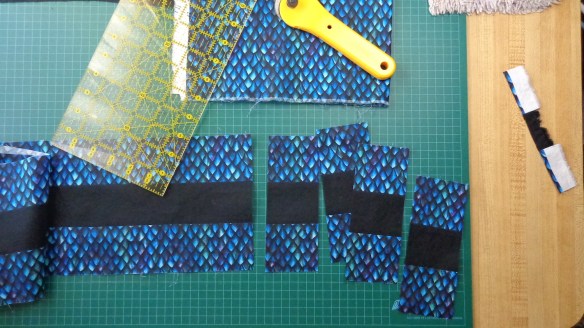

 Similarly, when I piece the units for the horizontal scales, I’ll put the black rectangle on the top of six of them and on the bottom of the other six. That got a bit more complicated, didn’t it?
 I’m thinking I might notice the similarities, particularly between the two on the left and also on the two in the middle. Those light-coloured dragons draw my eye! I rotated the blocks before sewing on the pieces with the scales:
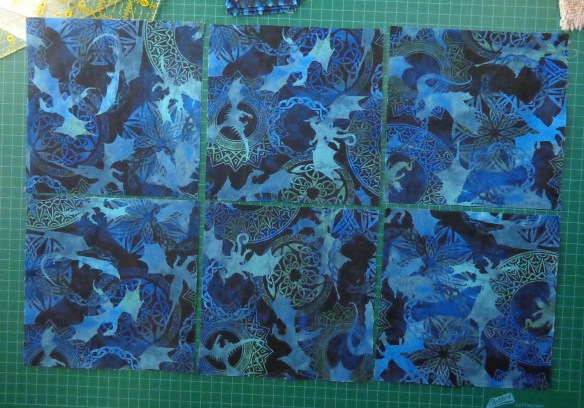 The similarities are less obvious this way. Now, I’m ready to piece those six blocks!
 Alive & Knitting