All Those Fabric Bits

Last time, I told you about watching Kate’s videos at her YouTube channel, The Last Homely House. I went back to her channel to watch more and chose a video about using up scraps – because it was first in the queue of her most popular videos. (It’s right here.) She shares her enthusiasm for Terry Rowland’s scrappy quilt. I was sufficiently inspired to see what I have in my bag of bits and ends.

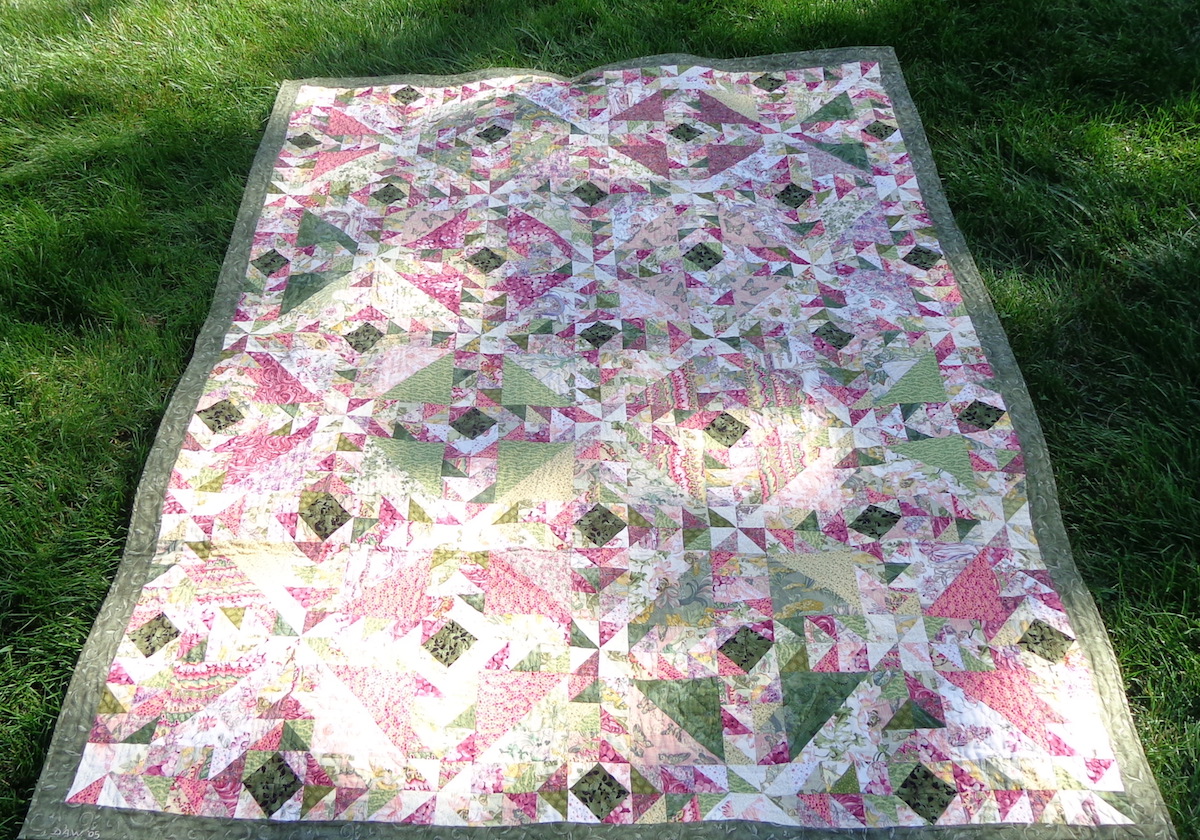
A lot of my bits are from specific quilts. For example, I had a bunch of half square triangles leftover from this Lady of the Lake quilt. The palette is pretty specific on this quilt, all olive greens, pinks and burgundies. The first fabrics chosen were a selection of fat quarters featuring Alphonse Mucha drawings, all Art Nouveau ladies. I just love those prints.

Lady of the Lake quilt pieced by Deborah Cooke

I started to piece the leftover bits into blocks:

leftovers from the Lady of the Lake quilt, pieced together for a mini quilt by Deborah Cooke

I have a few strips of fabrics from the quilt and will add as many borders as possible. This will be a mini quilt to practice my machine quilting – although it’s a good size to be a matching pillowcase. Hmm. I’ll show it to you when it’s done.

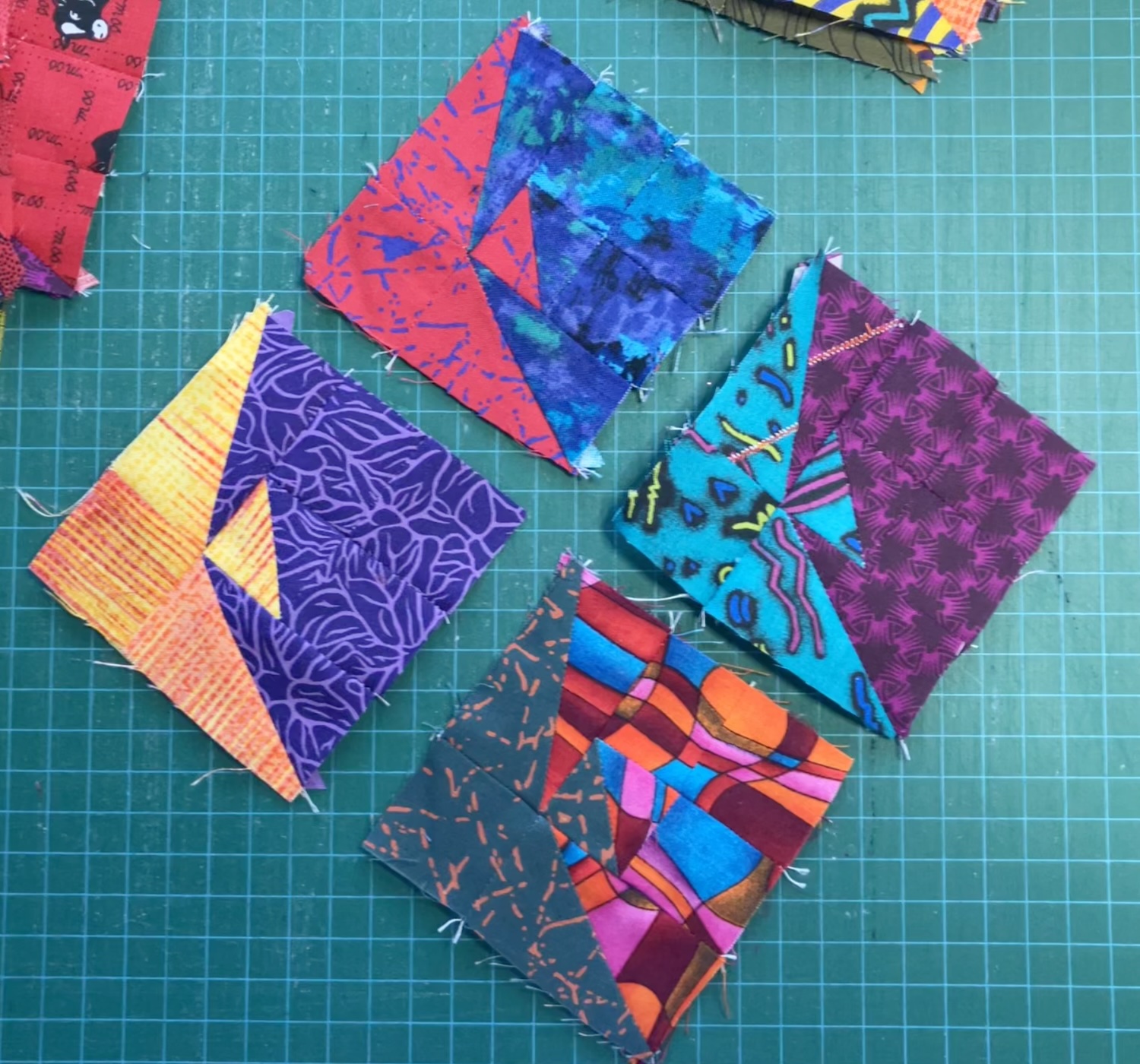
I also found the Franken Fish, long forgotten by yours truly.

fish pieced by Deborah Cooke

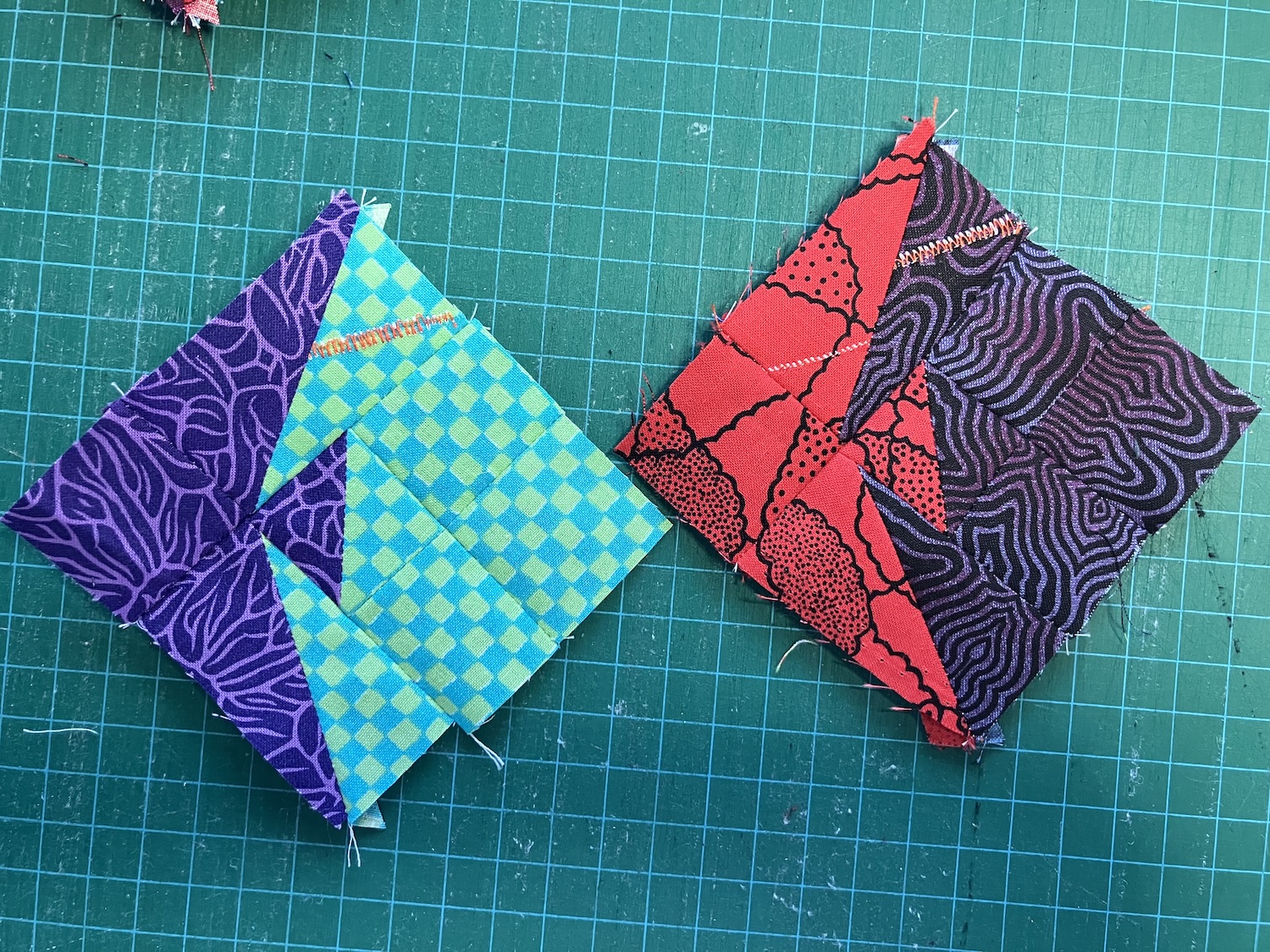
I called these the Franken Fish because I made a mistake and patched it up. These fish were cut from charm squares – each square was just enough for one set of pieces, so there’s a fish of any given fabric and a background of any given fabric. I made a cutting mistake though and because there was no extra fabric, I patched the pieces.

fish pieced by Deborah Cooke

Their scars are all in the same place. They are Franken Fish.

I must have seen the block somewhere and liked it. I have a vague memory of scribbling it on some random piece of paper in my purse. Now the Franken Fish need an ocean to swim in…

I found a lot of bias already cut. There’s a tremendous amount of the pink, which probably means I had plans for it. I wonder what they were.

cut bias in the stash

And I found these two pieced stars, fussy cut from Kaffe Fassett’s Kimono print.

Star cut from Kaffe Fassett's Kimono, fussy cut and pieced by Deborah Cooke

Interestingly, the camera reset itself on the second one and dimmed down the colours, as if it was saying ‘whoa. That’s a lot of fuschia and orange together.’ LOL It is!

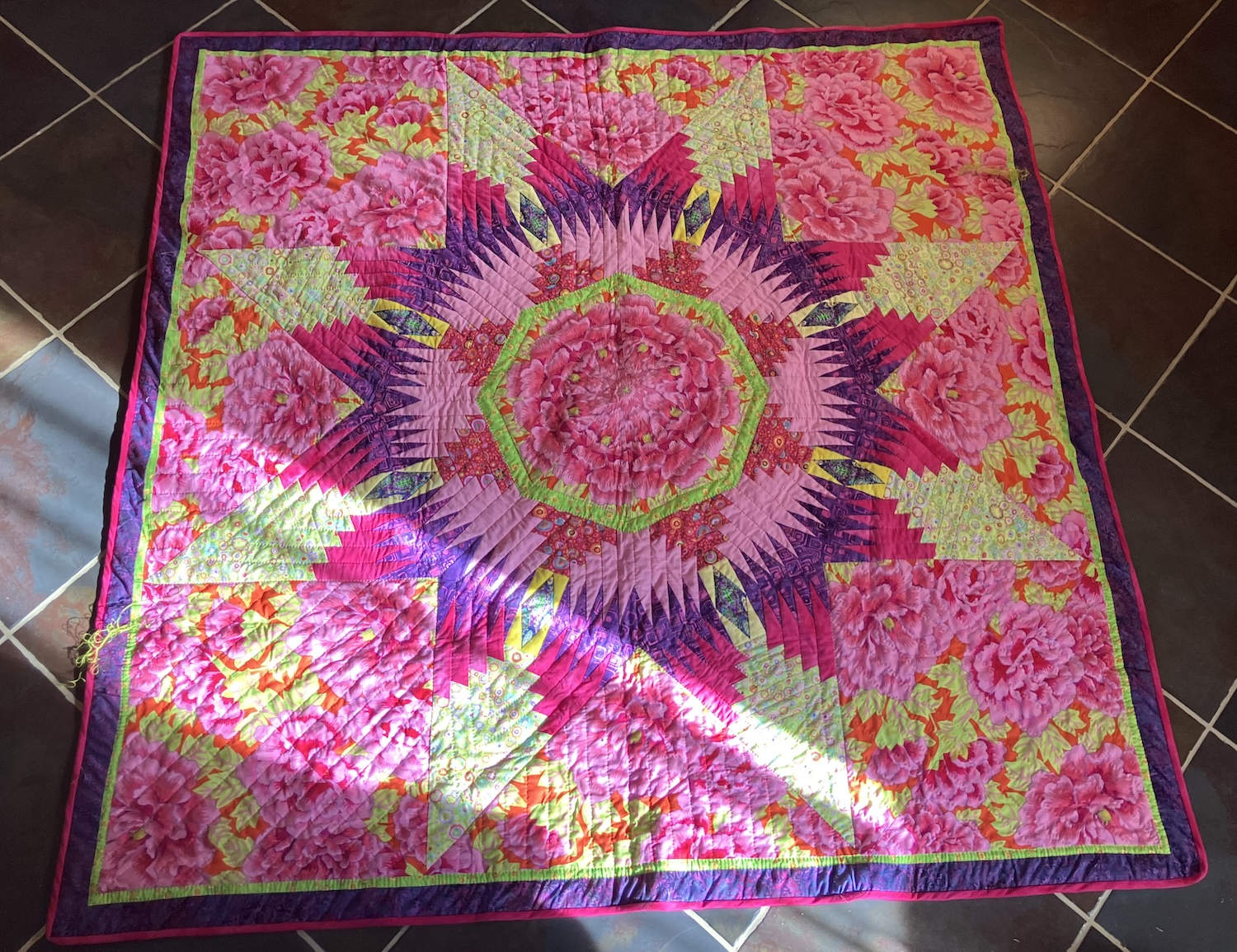
I must have made these while piecing my Pineapple Star, which used a lot of that Kimono print.

pineapple star quilt made by Deborah Cooke

Somewhere (ahem) I have many bits and pieces of Kimono in triangular shapes. I need to find them and make more of these smaller stars because I really like them.

There are more bits and ends, too, but let’s start with these. 🙂

This exercise proved to be more like poking about a hard drive of saved works-in-process than opening a dictionary. Instead of raw materials (bits and ends), I found all sorts of forgotten beginnings. I’ll be finishing these incompletes up first – then I’ll have a look at the remainder for a true scrap-busting project.

First one to be finished will be the Lady of the Lake scraps. Stay tuned!

The Beast – a.k.a. The Chinese Rose Coat

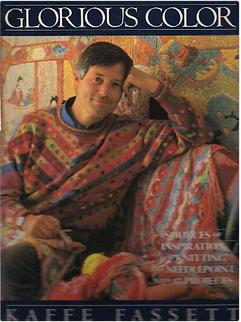
Glorious Color by Kaffe Fassett 1988 edition

My chat this week in the comments on Audrey with rontuaru (about Alice Starmore and Kaffe Fassett patterns and knitting in days of yore) got me to thinking about The Beast again. I knit this Kaffe Fassett design – which is really called The Chinese Rose Coat – around 1990. It’s in the book Glorious Color, sort of. (That’s a Ravelry link. This is the 1988 edition, which is the one that I have. The book was reprinted in 1990 with a different cover.) What’s actually in Glorious Color are instructions for The Chinese Rose Jacket, then there’s a note that you could make it into a coat by using the chart for the jacket and the pattern for the Jug Coat.

Before I get going, here are some Ravelry links for those patterns:
The Chinese Rose Coat.
The Chinese Rose Jacket.
The Jug Coat.

These sweaters are all big squares, which is great for intarsia designs but not so great for a flattering fit. (If you look on Ravelry, you’ll see that the Jug Coat is one-size-fits-all and finishes out at 44″ across the bust, so there have been other changes in pattern design in forty years, too.) The coat is a big T – you cast on at the bottom back hemline and knit up, adding stitches for the sleeves (to make that T), then continue up to the top of the shoulders. Then you split the work in the middle, continuing down the fronts, decreasing to end the sleeves at the underarm and casting off at the front hem. You sew the side seams, pick up stitches at the hem to add ribbing, then add ribbing to the cuffs too. I remember what a huge pile I had in my lap at the end.

Here’s the spread from the book with the coat on the left and the jacket on the right.

Chinese Rose Coat and Jacker in Glorious Color by Kaffe Fassett

Kaffe’s suggestion was that you should mix many yarns together for the coat, even twisting two lighter weight yarns together to get a thicker yarn. I did that. Mine is a big mixy-mixy of colours and textures, which is a lot of fun. There are even fringe yarns and sparkly yarns in there. I don’t remember what the fiber mix is, but it’s certainly not all wool or even natural fibres. I bought odd balls of yarn in yarn shops all over the place for this coat.

Here’s my coat:

Chinese Rose Coat designed by Kaffe Fassett and knit by Deborah Cooke

I’m not tall enough to even get all of it in one picture!

I didn’t use one black yarn for the background but mixed a bunch of them, including a fur one and some grey ones. The one thing that bugs me is that the chenille yarn I used for the collar and cuffs seems to be aging badly – each time I pull out The Beast, there are more loose loopy bits there. I guess there’s some content with elastic that’s losing its boing (?)

Chinese Rose Coat designed by Kaffe Fassett and knit by Deborah Cooke

I also wasn’t really good about checking gauge in those days. Most things I knit then were too big or too small. This coat was and is ginormous. It’s a bit shorter now because I took the ribbing and one repeat off the hem as soon as it was sewn together. I’m just not tall enough for how big it was. This also eliminated the ribbing at the hem, which isn’t a bad thing if you want to walk in the coat. I added facings down the front, knit my ribbed collar and cuffs in black chenille and ultimately added bias tap inside the collar (at the base of the ribbing) and from collar to cuff where the shoulder seam could have been to keep the monster from always getting bigger. Part of this is a gauge issue. Some of it is just weight. The original design was supposed to be worn open, more like a cape than a coat, but I added buttons and loops on the front. I also added pockets in the side seams, which are awesome.

Chinese Rose Coat designed by Kaffe Fassett and knit by Deborah Cooke

It is a sweater to wear on a perfect fall day with just the right temperature and no wind. As a result, it mostly gets action when the mister is very sick, which doesn’t happen very often. He’s the one who called it The Beast and he’s convinced that it’s the warmest possible blanket when he’s not feeling well.

There was one fun incident with this sweater. It used to be possible to fly from Toronto to New York City for the day – there were a lot of flights and it’s not that far, so you could catch the 7AM flight, be in the city by 9:30, meet someone for coffee, someone else for lunch, someone else for a coffee and maybe even a fourth person for a drink, then head back to the airport to catch the 6PM or 7PM flight home. At LaGuardia, the Air Canada people always put you on the next possible flight, if you were interested. I used to go down to meet with my editors. In 1998, I was going to hire an agent and had narrowed it to two possibilities but wanted to meet them both to decide. I flew down for the day. I also had appointments with both of my editors that day, so it was busy. It was in the fall, a gorgeous sunny day, and I wore The Beast. I was so excited when two women stopped me on the street to talk about it because they recognized it as a Kaffe Fassett pattern. Obviously they were knitters, and we had a lovely chat on 7th Ave. (or maybe 5th) in the sunshine. Their enthusiasm made my day.

I also made the Chinese Rose Jacket for my SIL in the mid-90s. I was a lot more careful with gauge and much more disciplined with my yarn choices. I used one yarn for each colourway and the same black tweed for the whole jacket. I remember that it came out really well but I don’t have any pictures of it. (Maybe I’ve embellished the memory. LOL!) Next time I’m at her place, I’ll try to remember to take a pic of it.

Here are my Ravelry project pages for The Beast and for The Chinese Rose Jacket.

My Finished Escher Quilt

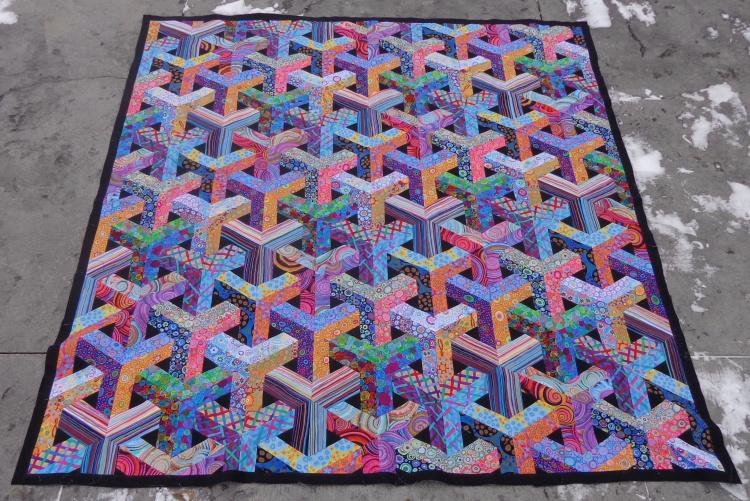
A long time ago, I showed you the Escher quilt that I’d sewn from a kit. Here’s the pieced top again from that original post. There’s snow on the driveway!

Escher quilt from kit pieced by Deborah Cooke

This one became my first big quilt that I machine-quilted. I’ve already completed two smaller test quilts – this one and this one. The first lap quilt used up the scraps from this quilt. This one is about 62″ by 64″, still not a full-size quilt but big enough that I had to wrestle it through the machine.

If I’d been quilting this by hand, I would have made circles or curves to contrast with the piecing. With free motion quilting, I would have made those all-over squiggles. But at this point, I’m making lines with my walking foot, so I had to come up with a different plan.

I used a cotton Gutermann quilting thread in variegated yellow, which looked nice against both the backing and the front.

The back is a quilting cotton that I’d originally bought to make a shirt for Mr. Math. He didn’t love the print, though—the birds are bigger than expected from the pix online—so it’s been in my stash, waiting for opportunity. There wasn’t quite enough of it for the entire back, especially after I matched the print, so I did a little patch of leftover blocks from the quilt top.

back of Escher Quilt made by Deborah Cooke

For the quilting design, I marked the middle of the quilt, with the plan of quilting on either side of the diagonal lines – the quilting is about 1/4″ outside of the seam on either side of the seam. I started at the top left corner—where the stripey Y is—stitched on one side of the seam, pivoted at the middle point, then quilted up to the opposite top corner. Once I’d quilted both sides of the seam, I dropped down to the next diagonal line. There’s a floral Y there. I did this three times, then flipped the quilt and did the same from the other edge. That left two triangles on either side of the middle unquilted. I followed the same idea, pivoting one column outside of the middle column until the top had all the diagonal lines quilted.

This turned out to be a really good idea and a plan I’ll follow in future. The fabric adhesive I used (Odile 505) isn’t permanent and washes out. I wondered whether it would lose its grip over the course of quilting this quilt, with all the turning and wrestling with the fabric, and it did. So, it was good to have those main lines already quilted by the time I got to the final sections.

I could have just used the walking foot to make more parallel lines but wanted some curves. I like those sinuous curves that look like water flowing. I decided to treat each black triangle like a rock in a stream—I sewed one line down the middle of each space, going around the “rocks”. I added two more quilting lines in each gap, one on either side of that wavy line and undulating between it and the straight line.

I was stumped on the binding for a day or two. I didn’t have any of the component fabrics left over, and (incredibly) anything I pulled from my stash didn’t work. The pinks were too yellow or too blue, the oranges too bright, etc. Finally, I found a piece of Kaffe Fassett Roman Glass in black and red. That colourway isn’t in the quilt top, but that design is. It’s perfect. Here’s a detail shot of one corner:

Detail of Escher Quilt made by Deborah Cooke

This is a small quilt comparatively, but bigger than either of my test quilts. It felt like I did a lot of wrestling to get this one done! The weight was a bit of an issue, which means I need a bigger work surface next time. Also, my walking foot didn’t walk as well as previously, maybe also because of the weight. I’ll make some changes to my set-up before tackling another one of this size. My curved lines are smoother, despite all that, and my stitch length is more consistent. I only had one teensy tuck in the top and none in the backing, which is a triumph.

Here it is:

Escher Quilt made by Deborah Cooke

I’m really glad it’s done. 🙂

I’m also trying to remember where I put the pattern. The kit came with the fabric and was quite a mix. The result is chaotic and fun, but I’m curious how it would look with a more limited palette, and one in which I love every fabric. I think I’ll quilt that one (if and when I do it) with parallel lines.

What do you think of this one?

Test Lap Quilt #1

One of my goals for this year was to finish up my quilts. I have a lot of quilt tops pieced but they haven’t become finished quilts. Part of this is because I’ve always pieced by machine but quilted my tops by hand, so the first part of the process is much faster than the second. Either I needed to hire someone to quilt my tops, or I needed to learn to machine quilt them myself. I went for option B and ordered a walking foot for my machine.

This (ironically) meant that I needed to make more quilt tops in order to practice machine quilting before taking on my existing quilt tops. Also, I thought it would be easier to work with a smaller quilt first, and my existing tops are mostly big. So, I began to piece lap quilts from scraps.

This one was inspired by this YouTube video from Missouri Star, Make a Summer Squares Quilt. They suggest using a jelly roll with two contrasting solid fabrics, but I dove into my scrap bag instead. I have a lot of strips in there, many of them from my Escher quilt, and it drives me crazy to waste fabric. I grouped strips into lights and darks to piece them together, using a Kaffe Fassett stripe in greens cut crosswise and KF yarn-dyed solid mauve as my contrast squares in the middle. Here it is:

Scrappy Test Lap Quilt by Deborah Cooke

I used all the pieces leftover from the Escher quilt but was missing two strips to make enough blocks for this layout. I used some lime Roman Glass in my stash then added one non-KF fabric – it’s the lime with polka dots that’s in the border. Because fabric was so tight, I didn’t really manage the light and dark assignment of colours in the Missouri Star quilt, but I like how bright and cheerful mine is.

The walking foot was delivered while I was piecing this, so I got right down to quilting by machine for the first time. (eek) I added one more tool to my arsenal – Odif 505 temporary fabric adhesive. (That’s an Amazon link.) You spray it on the batting then iron the fabric to it, then flip it over and do the same with the backing. It keeps the layers from sliding around as you stitch and is pretty awesome. (It washes out.)

Singer 185 sewing machine

I watched this video and thought this diagonal quilting was something I could do. The trick was that I’m using my vintage Singer 185 for this project, which is a workhorse but a straight stitch machine. (My Elna has an appointment for a sewing-machine-spa-day next month!) In the video, she uses a wave stitch chosen from the machine’s options. I decided to make my own waves, even though they’d be less regular.

I used Guterman 100% cotton thread in black, a Schmetz 14 sharp “chrome” needle, and my new walking foot. I set the guide on the foot for an inch but didn’t follow it faithfully. I wanted a more organic look to the “waves” and I like how they worked out. There are a few tucks but I expected that since my borders were a bit wavy (which comes from sewing fabric cut on the crossgrain onto strips with a bias edge. Next time, I’ll be more careful!)

It was a bit of a wrestle moving the fabric, but I got used to it. And my waves improved over the course of quilting. I noticed that the 185 likes to stop with its needle up, so I learned to crank it down before doing anything else (to avoid any little jumps). My curves were also smoother when I didn’t stop in the width of the quilt. Faster and smoother is better, too. Lessons learned. 🙂

There are a lot of things you can buy to make this machine quilting easier, but I’m trying to keep a lid on expenses until I decide whether I like it or not. Instead of buying quilting gloves, for example, I used a new pair of garden gloves. I did find it a bit tough to move the quilt, even with the walking foot, so I ordered a LaPierre Studio Supreme Slider (that’s another Amazon link.) This is a reuseable plastic sheet that you lay over the machine bed to make it smoother and more slippery.

The cool thing about this quilt is that it came completely from the stash and my scrap bag, even the batting. I’d bought a big roll of 100% cotton batting to layer up all my quilt tops and this is 1/3 of the last piece. (The very last piece is destined for Scrappy Test Lap Quilt #2 which is a bit bigger than this one.) The backing is a piece of yarn-dyed cotton that I got at the thrift store, leftover from the Purl Soho apron I made for the mister.

Back of the scrappy test quilt made by Deborah Cooke

You can see some pins there – I’ll sew the bias binding down by hand on the back side. The finished quilt is about 30 by 42″.

The one thing I’d change was the colour of the thread for the quilting. I used black, because I didn’t know what to pick, but I don’t love the look of the black on the solid mauve border. So, in future, I’ll hold the quilting thread against the most solid fabric to choose a colour.

On to the next one! I’ll have some knitting to show you soon, too – a cowl, a new pair of socks and a cardigan.

Quilting my Pineapple Star

I’m working on a number of projects this week, trying to finish things up, which means I have no completed project to show you. I’ve finished the second orange sock but you’ve seen the first and (surprise) the second is the same. It’s not very newsworthy. I’ve also been knitting on the Halo cardigan while watching movies at night (the back is done). I’ll definitely run out of Koigu KPPPM on that, so need to make a plan. Hmm. (Those links go to previous blog posts here at A&K.)

Sewing-wise, I’ve finished two Schoolhouse Tunics and don’t like either of them, so won’t be showing those off. (That link goes to the designer’s site.) I finished my Purl Soho Cross Back Apron and don’t love that on me either – fortunately, the straps were long enough that I could position them for the mister. He loves to cook and the apron looks great on him, so that’s solved. It’s a good pattern, if you’re looking for one, well described and comes out with a nice finish. (That’s a link to the pattern on the PS site.) I’ve just come to the conclusion that my friend Terri is right: square pieces of fabric don’t look good on round bodies. 🙂 I’m currently in the midst of making some bucket hats. Of course, I need to tweak the patterns – I’ll show you the results soon.

This may be more interesting.

Inspired by a friend’s machine quilting, I’ve decided to learn and finish up some of my quilt tops. I ordered a walking foot for my sewing machine, but in the meantime, I’ve put this quilt back on the frame. I’d started the hand quilting and put it away. Time to finish up.

Pineapple star quilt pieced by Deborah Cooke

This is my Pineapple Star quilt, being quilted. I pieced this one a while ago – I know it was before we could shop easily online because I ran out of the big poppy print. I remember that the local shop that carried KF fabrics was out of stock of that one, so I had to piece one of the squares for the corners. Now, I’d just order another meter from someone else.

You’ve probably noticed that I’m quilting with embroidery thread. I like using this thread, even though it’s a bit thicker. I usually choose a contrasting colour – like the lime here – so the stiches show up. I split the thread into two strands of three ply each.

Here’s the quilt in progress, when the central star was completed, so you can see the design. I fussy cut the center of the medallion from that large scale Kaffe Fassett peony print. (The print is actually called Kimono. It’s fabulous, but discontinued.) The only other KF fabrics in the top are the lime green at the points of the stars and the cherry red outside the lime green ring – both are the same print, Roman Glass. The purple is a batik, the dark pink is kettle-dyed, the light pink is a solid (probably Kona, because it’s thick) and the lime green is a fun print with suns. There’s yellow Kona in the central squares in each point, with a leaf fussy-cut from another print in each one.

Pineapple star quilt pieced by Deborah Cooke

After this, I added additional triangles of the poppy fabric to the corners to square it up and added outer borders. It has a skinny border of that lime green from the middle and then a slightly wider border of purple batik – not the same batik as in the middle, since I’d run out of that too. (You may have guessed that this quilt wasn’t planned in advance.) I have some of the cherry Roman Glass cut on the bias for the binding.

Pineapple Stars by Sharon Rexroad

The inspiration was a book called Pineapple Stars by Sharon Rexroad. Here’s the book at right and here’s an Amazon.ca link. It says at the ‘zon that the book was published in 2005, so I’ll guess that I pieced this top fifteen years ago or so.

Right now, I’ve got the big corner squares left to quilt – they’ll be quick, since I’m just doing them with diagonal lines – then the borders and binding. I’m going to try a technique featured in one of the serger tutorials I’ve been watching – the instructor uses her serger to trim the outer edge of her quilts while sewing one edge of the binding in place at the same time. I’ll handsew the other edge on the back side.

I like this quilt. It’s bright and cheerful, just the kind of thing to work on right now. What do you think?

Inspired by Kaffe Fassett’s Heritage Quilts

Heritage Quilts by Kaffe FassettI’ve been borrowing some books from the library for inspiration while we shelter-in-place, so thought I would share one of my fabric adventures that resulted. The book is Kaffe Fassett’s Heritage Quilts, which includes a quilt (the one on the cover) called Autumn Crosses. (Clicking on the book cover will take you to the book’s product page on Amazon.com. The book, for some reason, isn’t on KF’s website.)

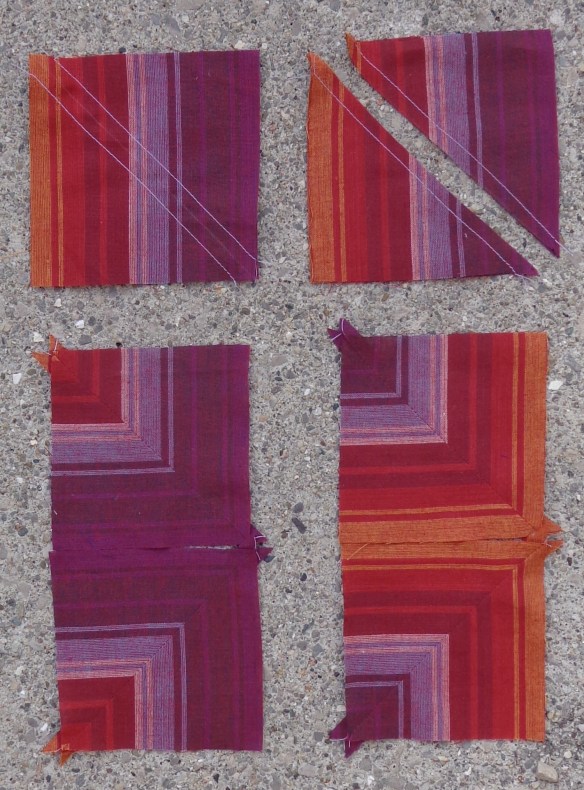
I was intrigued by the use of his striped fabric in this quilt. Each block is a cross, and each cross is made up of four squares: each square has a diagonal seam to make a mitred corner.

The instructions are quite clever: you cut 8 identical squares, mark the diagonal, sew two seams (1/4″ on either side of the marked cutting line), then cut the squares after sewing. When you press the seams open, ta da, there’s one of the four mitred squares for the cross. The diagonal seam line is on the bias, of course, and it’s much easier to sew a stable seam this way. And actually, out of those 8 squares, you get two different cross blocks.

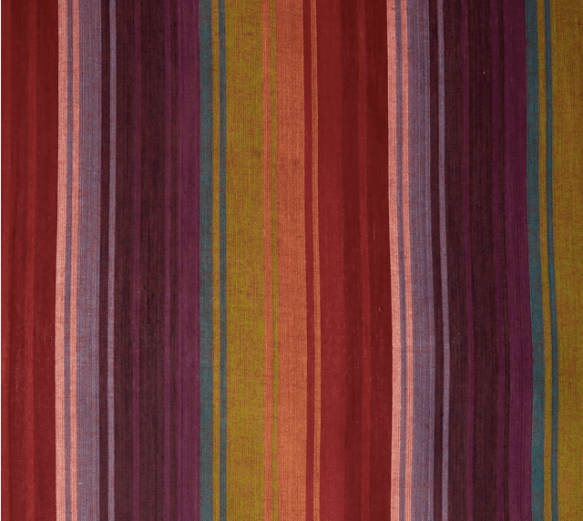
My fat quarter was of his Exotic Stripe in the colourway Warm. It looked like this:

Kaffe Fassett Exotic Stripe WarmIt’s so gorgeous that I had to snap it up. I’ve had it in my stash for years but haven’t wanted to cut it. Here’s my first batch of squares in progress:Mitred squares sewn of Kaffe Fassett's Exotic Stripe by Deborah Cooke

At the top left, there’s a pair of squares with their two diagonal seams. Top right, the squares have been cut between the seams. Below are two blocks pressed open – you get a square of each from each block. The original squares are cut 3 7/8″ square and the block of four is 6.5″ square. It’ll finish out to 6″ once it’s seamed.

Out of the fat quarter, I got three batches of eight squares, which resulted in six blocks. I’m not so fond of crosses, but I played around with my mitred squares and think they’re awesome like this:Mitred squares sewn of Kaffe Fassett's Exotic Stripe by Deborah Cooke

I’ve paired them together for the shot: each top and bottom came from the same seamed block. It’s amazing how different they are!

Six blocks isn’t a lot, though. The quilt in Kaffe’s book has eleven rows of nine squares each, or 99 blocks. I’d make a smaller quilt, but still need more. This fabric is discontinued – that’s the hazard of hoarding stash! – but I did find another fat quarter of it in my stash. (Yay! Proof that it was irresistible!) I also found some more fat quarters of KF stripes in similar colours:

The third one from the right isn’t pink at all, even though it looks that way in the photograph. I have more striped fabric but wanted to focus on that brick red and the olive green.

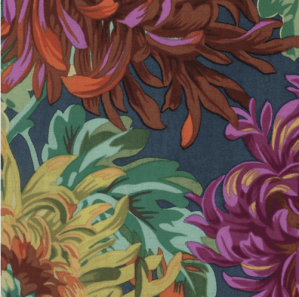
I’m thinking I might set alternate blocks of these stripey squares and an exuberant floral print – or one with lots of curves to contrast with the stripes. Here are two colourways of a Philip Jacobs print I love, called Japanese Chrysanthemum:
Japanese Chrysanthemums by Philip Jacobs Japanese Chrysanthemums by Philip Jacobs

Here are two more Philip Jacobs prints, Luscious on the left and Shaggy on the right:

Luscious by Philip Jacobs Shaggy by Philip Jacobs

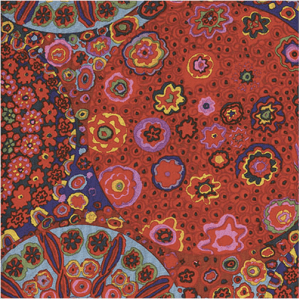
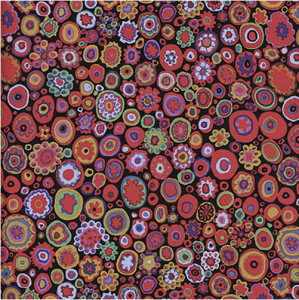
Here are two favorites of mine—KF’s Millefiore on the left and Paperweight by KF on the right:

Millefiori by Kaffe Fassett Paperweight by Kaffe Fassett

Of course, all of these prints come in many colourways. I’ll have to make a bunch of squares, then take them to the fabric store to find the print that pops.

My Escher Quilt

Last fall, I told you about a quilt kit I’d ordered. (That post is here.) The pattern is called Escher and the kit came with Kaffe Fassett fabrics to piece the top. I pieced it in December and here’s what it looks like:Escher quilt from kit pieced by Deborah Cooke

It’s much MUCH more vivid in real life.

This pattern was pretty easy to sew and the instructions were clear. I enjoyed putting it together. There was extra of every colour, so when I made a mistake in the final piecing (I cut a block that I shouldn’t have) I had enough to remake that block. The black was used for the little triangles at the center of each block: I cut up what I had left to make the widest black border possible. It’s not very wide but I like how it frames the bright colours. The top is about 62″ by 64″. I tried a couple of borders but thought they made it too busy, so it will be a bit of a small finished piece.

Mr. Math loves the finished top, but it’s a bit too wild for me. I think I might do this again, with solids or with a more restricted palette. This will be the first top that I take to be quilted on a long-arm machine, and I’m curious to see how that works out.

What do you think?

Escher Quilt Kit

I’ve been sewing a little bit lately and working on a couple of quilt tops. When they’ll actually be finished and quilted is anyone’s guess, but I like playing with the colours.

Escher quilt kit

I particularly like the fabrics designed by Kaffe Fassett, so it shouldn’t be much of a surprise that this kit caught my eye.

It’s called Escher and was designed by Christopher Weinhold. You can buy a kit right here.

I’m so excited about this one that it will probably jump my queue of sewing projects so I can get started. I’ll share my progress with you!

What do you think of this quilt design? Would you make it?

Update on the Earth Stripe Wrap

Last week, I showed you the beginning of my Earth Stripe wrap. Well, I got a little further and made a choice, so this week, you get a progress report!

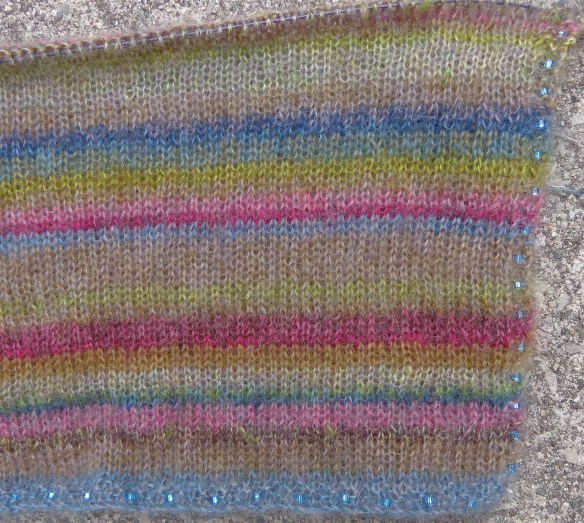
Here’s where I was when I decided there was an issue. The whole thing looked too brown to me.Earth Stripe Wrap by Kaffe Fassett knit in Rowan Kidsilk Haze by Deborah Cooke

I went back to the original colours and reconsidered my substitution for Meadow. I used the Aloe at the bottom right in this picture. The top call is KSH in Jelly, which is also one of the colours in the shawl. Meadow was a pale silvery green, so I dug into the stash and found the yarn at the bottom left. It’s not KSH but another kid mohair and silk blend of similar proportions and a handpainted yarn from Capistrano Fiber Art Studio in a colourway called Irish Moss. I decided to use it instead of the Aloe. (I bought this yarn in New York at Habu Textiles on one of my trips to Manhattan.)shades of green kidsilk haze

The needle in the first picture shows how far I needed to frog back the shawl. I actually had to go a little further, since the first dark brown stripe is also knitted with the yarn I was changing out.

Kidsilk Haze isn’t the nightmare to frog that many knitters think it is – you just have to take your time. When I have to unravel KSH, I think of it as unknitting, not as ripping or frogging. Slowly, slowly, and all will go well. 🙂

Here’s a shot of the reknit shawl, up to the same point – of course, the needle wanted to curl:Earth Stripe Wrap by Kaffe Fassett knit in Rowan Kidsilk Haze by Deborah Cooke

Can you see the difference? There isn’t a lot of colourway F in this section, so the difference is subtle, but I’m much happier with it. Let’s take a couple of slices and line them up:

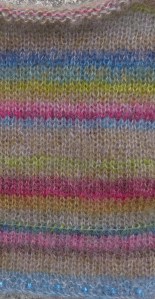
Earth Stripe Wrap by Kaffe Fassett knit in Rowan Kidsilk Haze by Deborah Cooke Earth Stripe Wrap by Kaffe Fassett knit in Rowan Kidsilk Haze by Deborah Cooke

Where are the differences? Starting at the bottom, the first dark brown stripe is knit with Bark and F – on the left, F is Aloe and on the right, it’s Irish Moss. Continue up to the second difference – it’s the greyish band above the needle on the left picture. In the right picture, you can see a brighter green with the grey in that band. You have to look way up to find the next use of F – it’s above the 3R blue band near the top. There’s a row with dark blue and turquoise, followed by two rows of dark blue with grey, followed by two rows of bronze with grey. Above that are four rows of grey and F, then a row with the two greens knit together. This is the section that prompted me to make the change. Everything above the blue looked brown to me on the first version, so that new silvery-green stripe makes me happier.

The beads are more interesting than I’d expected. They’re the Rowan beads made by Swarovski and are particularly sparkly. The holes aren’t just silvered. They seem to be faceted inside. In real life, they’re adding a wonderful glimmer to the sides of this shawl.

And onward I go! I’ll show you the shawl again when I’ve completed one entire repeat.

The Earth Stripe Wrap

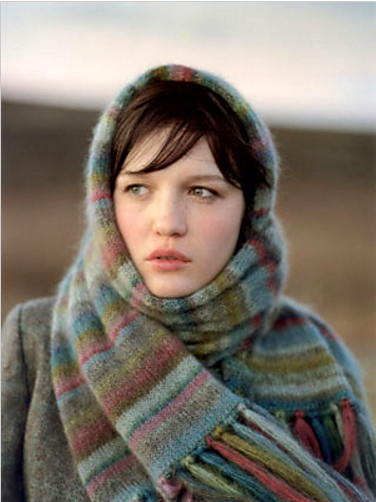
Earth Stripe Wrap by Kaffe Fassett in Rowan Kidsilk HazeThe Earth Stripe Wrap is striped shawl designed by Kaffe Fassett and knit in ten shades of Rowan Kidsilk Haze. It was published in Rowan magazine #42 (Autumn/Winter 2007/2008). The image to the right is from the original magazine – I found it online but the copyright on the image belongs to Rowan.

Given my love for KSH and my admiration for Fassett’s use of colour, I’ve always wanted to knit this piece. This week, I finally cast on.

The biggest challenge with this piece is that some of the colours of KSH specified in the pattern have been discontinued and are no longer available. (Whenever a knitter is DISO (desperately in search of) KSH in Jacob, you can make a good guess that he or she plans to knit the Earth Stripe Wrap.) Rowan has published an updated version of it as a free download on their website, which substitutes new colours, but I wasn’t that crazy about all of their changes. Let’s have a closer look.

The original pattern specifies the following colours:
A – Hurricane #632 – available
B – Jacob #631 – discontinued
C – Elegance #577 – discontinued
D – Drab #588 – discontinued
E – Candygirl #606 – available
F – Meadow #581 – discontinued
G – Majestic #589 – available
H – Trance #582 – available
I – Jelly #597 – available
J – Blushes #583 – available

This wrap is knit with two colours held together in a stripe pattern that repeats over 186 rows. The way the colours are combined changes the appearance of each colour in each stripe, which is part of Kaffe’s magic.

The discontinued colours aren’t shown on the Rowan website anymore, and here’s where Ravelry completely rocks. Knitters photograph their stash yarns and post the pictures to Ravelry. Even given the inevitable differences in lighting, over 50 images of the same yarn, you can get a good idea of its colour. You’ll need to log in to Ravelry to follow these links, but it’s free to set up a Ravelry account. Here’s the Rav link for stashes of Meadow, for example, which proves to be a pale silvery green. (There are 600 pix, but you don’t need to look at them all!) Three of the discontinued colours – Jacob, Elegance and Drab – are muddy browns or greens. Elegance might be called bronze. Drab is a medium greyed brown. Jacob is a bit elusive, as it seems to be particularly changeable in various lighting. (That’s probably what KF liked about it.) It’s similar to Drab but also a greyed brown, maybe a little warmer in tone.
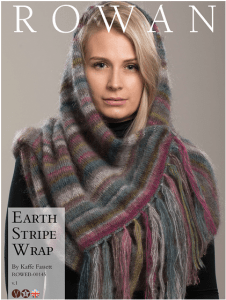
Earth Stripe Wrap by Kaffe Fassett in Rowan Kidsilk HazeIn the new version of the pattern, Rowan has made these substitutions:
B – Anthracite #639, which is a medium cool grey
C – Bark #674, a medium to dark brown
D – Drab #611 (apparently reintroduced with a new shade number, which suggests that the colour is slightly different. I don’t actually know.)
F – Ghost #642, which is a pale silver.

You can see the current shades of Kidsilk Haze on the Rowan site, right here.

Anthracite and Ghost are unexpected suggestions, to my thinking. To use cool greys instead of a mucky warm brown and a green is going to change the overall hue of the wrap. The newly photographed version does look more cool in colour. It’s still pretty, but it doesn’t have that “moors in the mist” look of the original to my eye.

So, I dug in the stash.

It turns out that I had some Elegance in my stash, which was a complete bonus. I didn’t have any Drab, but I had some Putty, which looks pretty similar to me. I couldn’t quite envision the green of Meadow with the other colours, so I used another company’s silk/mohair blend: Elann’s Silken Kydd in Aloe, which is a silvery green but more green than silver. I had a chat with a yarn store owner about Jacob and she remembered it well, suggesting Bark as the closest substitute.

So, my colour combination is:
A – Hurricane
B – Bark
C – Elegance
D – Putty
E – Candygirl
F – Aloe
G – Majestic
H – Trance
I – Jelly
J – Blushes

A quick peek through the projects on Ravelry also revealed that many people needed an additional ball of Majestic, using three balls instead of the specified two. Since I had to buy this colour, that was good to know in advance.

I put each colour of yarn in its own ziplock with one corner snipped off the bottom and the end of the yarn fed through that gap. Each ziplock is labelled with the letter of the colour, so I don’t have to try and figure out which mucky brown I should be using. In bright light, I can see the differences, but I often knit in the evening, so this works better. I think it’s imperative with a project like this to have a system for dealing with ends as you go. Weaving them all in at the end would be a nightmare (and for me, a job that just wouldn’t happen). I’m weaving mine in as I go, but some Ravellers used Russian Joins as they went. I find that a join makes KSH a bit stiff, so would rather weave them in as the soft fluidity of the finished piece is part of what I like so much about knitting with KSH. That’s a personal choice.Earth Stripe Wrap by Kaffe Fassett knit in Rowan Kidsilk Haze by Deborah Cooke

The wrap is designed to be knit entirely in stockinette stitch, then a round of double crochet is worked all around the perimeter. This is probably to keep it from curling. There’s also a lavish fringe added to each end. I’m not much for fringes and don’t want to do the crochet round. I decided instead to work the first three rows in moss stitch, as well as the first three and last three stitches on each row. And to give the shawl edges some weight, I’m adding beads. These are Rowan/Swarovski beads in the turquoise that matches Trance.

Here’s my progress so far.Earth Stripe Wrap by Kaffe Fassett knit in Rowan Kidsilk Haze by Deborah Cooke
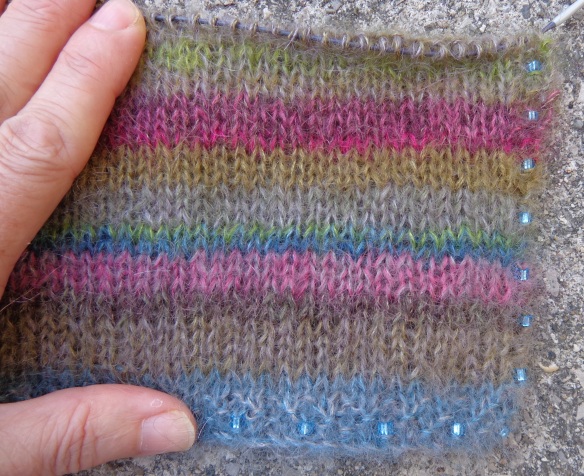
What’s fun here is that you can see the blending that results from using two colours at once. The lowest pink stripe is Blushes with Majestic, a rose with the blue-grey. The next pink stripe has two combinations – there’s one row of the bright pink, Candygirl, with the dark brown, Bark, then three rows of Blushes with Bark. The two three-row bands with Blushes are different pinks, because of the second colour used with it. It’s fascinating. There are two combinations with Jelly, which is a vivid apple green – in the lowest one, it’s knit with Trance for a single row, which is a light teal (right above a single row with Trance and Hurricane, a darker blue). Right below the needles, Jelly is knit with Elegance for two rows–that’s one of those golden browns. Again, we get two very different shades of green. I’m finding this an addictive knit because it’s so fascinating to watch the colour combinations develop.

What do you think?