You might remember me posting about the Rowan yarns Mystery Knit-A-Long a few weeks back, which is an incremental pattern for an afghan. Each week, there’s a pattern published for a new afghan block, and each week, you’re supposed to knit six of that week’s block. After 8 weeks of this, knitters will each have 48 blocks. The subsequent weeks include instructions for the border and for assembling the afghan.
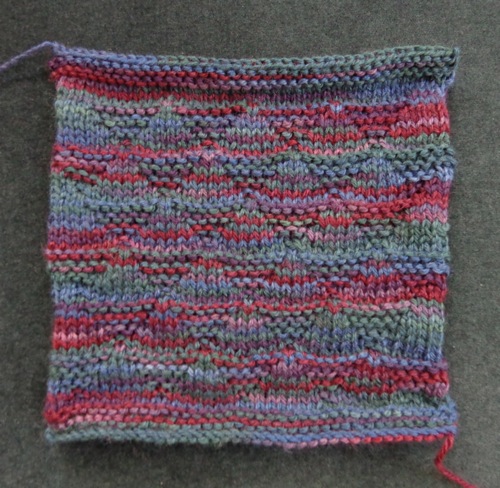
Here are the first four block patterns in my substitution yarn. (Knitters are only eligible for prizes from Rowan if they use the specified yarn, Rowan Pure Wool Worsted, which is available in 50 solid colours. I chose to stash-dive instead.) My yarn is Patons Decor and it is variegated, which adds some spice to the blocks. These aren’t blocked to size. I block lace, but am not going to bother with afghan blocks. If I did block them, they’d all be perfectly square and the exactly the same size—blocking means that the damp or wet squares are gently stretched to shape and left pinned until they dry.
The variegated yarn definitely obscures the stitch pattern in the blocks and makes them more visually busy—but it’s also pooling in a very predictable pattern. “Pooling” refers to the way that the colours in a variegated yarn come together in a knitted piece. Some pooling is beautiful (see Dayana deliberately playing with pooling here – as well as explaining a lot about it) and some is ghastly. What works is also a question of personal taste. Knitters tend to get excited about pooling—if you’re on Ravelry, you might want to check out this thread for thousands of examples. The thread is six years old and still active, a sign of how much pooling can agitates knitters. (Some call pooling “clown barf” which is another hint.)
The pooling is similar in each block here because the blocks are the same number of stitches in width and the variegation—done by a machine—occurs at fixed intervals. Even so, it’s more regular than I anticipated it would be. I’d thought I would have to cast on at the same point to make the pooling match, but didn’t do that because I thought the stitch pattern would also influence how the colours fell. Apparently not. I’m curious to see whether the eye dismisses the pooling when all 48 blocks are assembled. If so, the stitch pattern might appear to be more evident. We’ll see. (This afghan is an experiment, and it will be warm and useful either way. My opinion of it will determine only its final location: living room, television room or dog bed.)
This pooling pattern also means that unless the border is the same number of stitches in width, the pooling in the border will be different from everywhere else in the afghan. That might be distracting, and I’m considering the possibility of making the border in a solid colour—either the teal or the burgundy, depending upon which I can match. Again, we’ll see.
As anticipated, I’m behind on my squares already. I need to do three more from week 3 (the one with the zigzag) and five from week four (the XOX’s). Since there will be a new clue on Monday, I’ll probably fall farther behind. C’est la vie!
 Alive & Knitting