It’s been a bit crazy around here lately. I apologize for the silence here on the blog. I have a number of posts queued up that need pictures. Today, I’ll make a start on finishing them up to be shared.
First up, I finally got back to Kate Mitsubachi’s books, Barbie Mode. Previously, I made the Double-Breasted Suit and the Soirée evening gown from Kate’s other pattern book, Stylebook for Dolls. I had an idea when I first got these that I’d make every garment for the girls, but life happened and I was distracted by other projects. In December, I dug back in.
Both books are in Japanese, but the instructions have illustrations and are easy to follow. I have a print copies of the books, but you can buy scans of them on Etsy.
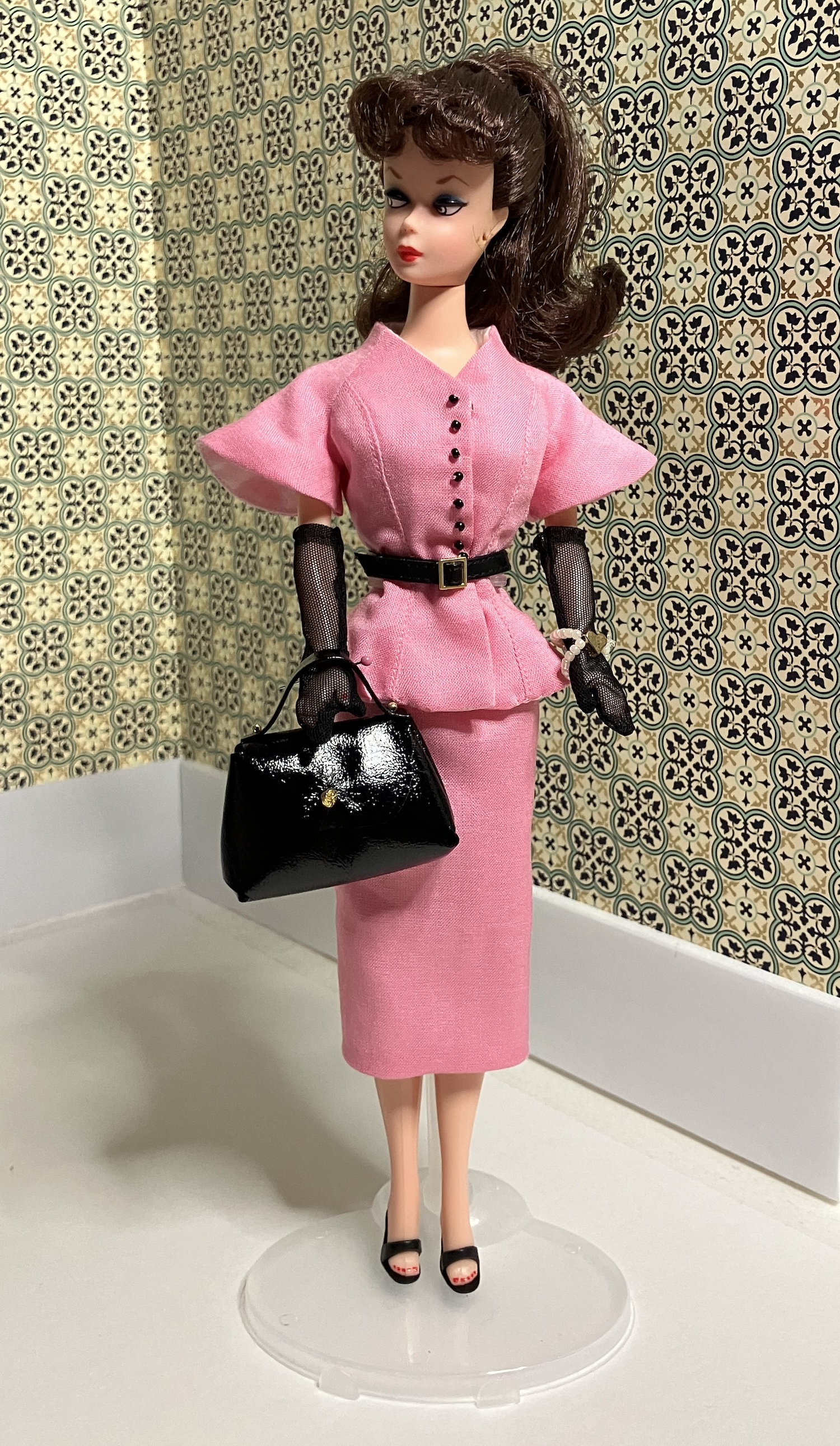
The third garment featured in Barbie Mode is a two-piece suit called Danielle, which is shown in red and black. At left is the picture from the book.
I made mine in a linen and cotton blend, because it looked to me as if the sleeves would hang better in a lighter weight of fabric. I lined mine with white voile, and it came out pretty well. I haven’t made the hat and am not sure I will.
Here’s mine:
I like the seed beads on the front of this one. I think the belt in the book is made of satin ribbon, but I made this one of belting that’s available for dolls. I thought the sleeves might be softer in such a fine fabric, but they’re still a bit structural.
One change I made was to add some top-stitching to the jacket. I find that princess seams on a jacket lie flatter in doll-size if they’re sewn down. I pressed the seam allowances away from the centre, and trimmed one to 1/8″ inch before pressing then top-stitched on the outside of the seam, catching the seam allowances underneath. It would have been tidier if I’d sewn a little more of the jacket hem before turning it and handstitching the rest, but overall I’m pleased with the result.
This is my second make from Kate Mitsubachi’s book, Stylebook of Doll’s Dress for Barbie. It’s called Soirée & Cape.
I love how glamourous and retro the fashions are in this book, and how lovingly they’re photographed. If you want to sew vintage for Barbie, this book is definitely worth a look.
Here’s the image of the dress from the photoshoot part of the book:
And here are the pattern instructions, just so you can see the mix. The instructions are all written in Japanese, but there are a lot of illustrations – if you know how to sew, it’s pretty easy to work out what to do.
That said, I’m finding that with each pattern, I have to make one to see where there need to be modifications. (This is actually true of all Barbie patterns so far. Every one of them seems to need a tweak. Part of that is the variation between different body sculpts, but the other part is construction choices.) This pattern shows a similar choice as that of other dress patterns for the girl – the bodice is lined, but the bodice and lining are sewn together at first, then treated as one piece after that. That leaves the raw edges of the big dart exposed on the inside of the bodice, and the seam allowance from the waist exposed, too. I don’t really see the point of lining the bodice if you’re not going to tuck all those seam allowances inside. (The point is that it’s easier to do it that way but the result still doesn’t give me joy.)
The first version of this dress I made in red crepe back satin. (Possibly a bad choice as that stuff is slippery!) It took me ages to figure out that pleat across the front, but now it seems so obvious. I then pleated the bodice lining, in reverse. I sewed the darts in the skirt at the waist, then pressed the pleats for that cluster of pleats. This was pretty easy – I laid the fabric on top of the pattern piece and folded it, one pleat at a time, then pressed the crease for that pleat before moving to the next one. This made it much simpler to gather those pleats together – because they radiate, they’re not all on the grainline. I sewed the bodice to the skirt waist, then sewed the bodice facing to the bodice. I hand-stitched the waist on the bodice facing, then added the “buttons” on the outside.
The tricky bit in my version is that the skirt waist extends beyond the CB of the bodice which leaves raw edge bits at the waist beyond the bodice. I finished the edge on those tabs, along with the CB edges of the skirt, then pressed the waist edge down. After sewing the CB seam, I top-stitched those waist edges and along the back opening of the skirt. I don’t love the back. 😦
I decided to hem the dress with self-bias, so cut 1″ wide bias from the fabric. I trimmed 1/4″ off the hem so the dress would finish to the same length as intended, then bound that edge. A pair of snaps on the back and it was done.
I’m only going to show you the front because the back still vexes me.
This is polyester crepe back satin, and those are seed beads on the bodice. I made the capelet of cotton velveteen lined with rayon Bemberg and used a small fancy button as a clasp. The gloves are made of that super-thin shiny knit from Fabricland that I mentioned previously—wow, does my sewing machine hate this stuff!—and she has another clasp purse from that McCalls pattern. It turns out I don’t love my hem solution. Mr. Math thinks the gloves make her look like she’s handling hazardous materials. I think the outfit looks Christmas-y.
The back remains vexing because 1/ those edges; 2/ the facing is bulky with the darts which means 3/ the fit is snug on vintage B—so skinnier Silkstone B wins this one. Here she is again with a “fur” cape that I knit for her:
Our model is Best in Black Silkstone B, (that’s an Amazon link since Mattel has taken the unavailable dolls off their site) who was divested of her crunchy black dress upon arrival. I took out the ponytail and just combed the hair over. I like her hair better loose although it is a bit wild.
The floor and wall are for my shop diorama but aren’t installed yet. I just propped them up on my sewing table to set the scene.
I had a think about the back of the ballgown and decided to try an alternate version with a simpler bodice facing. After pleating the bodice, I traced it on a piece of paper to make a pattern piece for the bodice lining. It’s a curve cut on the bias with no darts, and I cut it from Bemberg lining. I sewed the top seam of the bodice, attaching the lining, pressed the seam allowances toward the lining, then understitched that edge. It worked beautifully to make a nice edge at the top of the bodice. I sewed on two of the beads on the front to hold the pleat before sewing the bodice to the skirt, and also pressed up the waist edge of the lining. I also finished the CB seam allowances on the skirt.
After sewing the bodice to the skirt, I sewed the center back seams on the bodice. When piecing, I matched the cluster of pleats with the bottom of that front dart—that meant that one edge was even with the back of the bodice and the other extended 3/8″. The flush one was turned in 1/4″ and pressed, then top-stitched. I fused some knit interfacing to to the other edge to stabilize it at the waist, turned it in 1/8″ and top stitched across the extension at the waist, then down the CB seam. When I sewed the CB seam of the skirt, there was overlap in the skirt, instead of the dreaded butt opening – and all the edges are finished.
This makes me happy.
In fact, this version of the bodice gave me buckets of joy. It was simpler to constuct and the back is much neater. It also fits better – making this one a bit of a nipple-flasher for Silkstone B (if she had nipples, that is.)
This version is cut of black “Chinese brocade”, which is a very heavy polyester damask. Often these are multi-coloured but this one is just black. Our model is Dusk to Dawn Silkstone, a recent addition to my girls, and that’s another Amazon link. Her cape is knitted from a faux-fur yarn, closed with a hook-and-eye that has a sparkly.
Because of the thickness of the brocade, I knew I’d never manage a turned hem that was only 1/4″ wide in total. Instead, I fused knit interfacing to the wrong side to stabilize the edge, turned the hem 1/4″ and machine stitched it in place. Because it wanted to flip, even after pressing, I trimmed the seam allowance close to the stitching line.
I’m quite pleased with these and might manage to complete a few more in time for New Year’s Eve. Another completed mission in my Kate & Me challenge!
Next week, we’ll talk about stoles and capes, and making gloves.
Time for an update on my sewing for Barbie. You might remember that I was planning to make the Soirée ballgown from this Japanese pattern book, Stylebook of Dolls Dress by Kate Mitsubachi, but I got distracted by the Double Breasted Suit instead. That started a little adventure that led me down a rabbit hole.
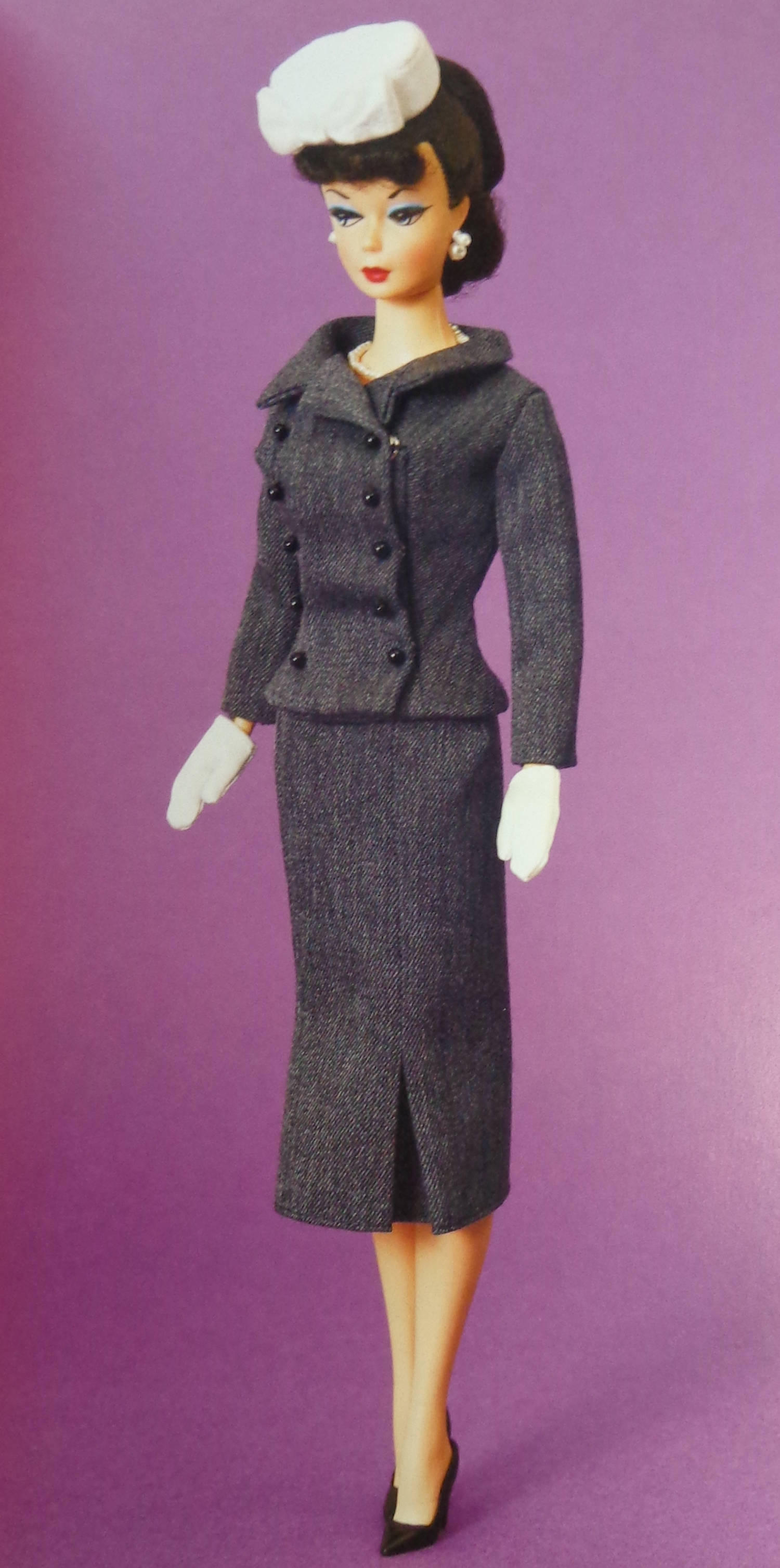
First, the suit pattern. Here’s the image from the book at right. It’s very cute.
The patterns in this book are written in Japanese, but there are illustrations for the assembly. You can see in the pattern layout below that the dark grey fabric is the main fabric – that’s the skirt, placed on the fold, the jacket cut twice, the sleeve cut twice, and the bias panel to line the skirt which only needs to be cut once – the stripe is the lining and the light grey fabric is the white used for the hat.
For this one, they’d forgotten to include the collar on the layout for the main fabric, but that was easily remedied.
I was less happy that the jacket is supposed to be unlined. I made one version as instructed, but didn’t finish it. I then cut another suit with a lining.
It was a bit tricky to line the skirt, given the construction order. In the end, I changed it. I cut a skirt lining the same as the main fabric piece, sewed the hem, the center back seam (which I made narrower, to allow more overlap for the snap) and then the pleats. I lined the top of the skirt with the bias piece, then hand-sewed that piece over the lower part of the skirt.
For the jacket, I needed a lining pattern piece. I traced the main jacket pattern and laid the back neck facing over it, tracing it. I then folded back the pattern on the front foldline and traced the self-facing of the fronts. Then I had to mark the seam line, and add a seam allowance on the other side before cutting the lining pieces. I also decided to cut the back collar facing in the main fabric, just as you would do with a bigger jacket, instead of in lining as instructed.
This also changed the construction order. I sewed the darts in both lining and jacket, then the center back seam in the fabric. I sewed only part of the CB seam in the lining, so I’d have a way to turn the jacket. I inset the sleeves in both lining and jacket (I basted these by hand first), then sewed the sleeve hems. Finally, I sewed all around the outsides and turned the jacket. When it was pressed and seamed, I added snaps to the jacket front and skirt back. The pattern suggests seed beads as mock buttons, but I had teensy Barbie buttons in black, so I sewed ten of them up the front.
So, here we are with the finished suit:
It’s important to press as you go with Barbie’s clothes as the garment keeps getting smaller and it becomes harder to get to the seam allowances. I made myself a little helper, not unlike a pressing ham, but rolling some cotton flannel into a tight tube, a little more than an inch across. I can get that into the waistband of any garment to press it. Sleeves require a skinnier tube, so I rolled more flannel around a dowel. These two funny little rolls are now part of my Barbie dressmaking toolkit.
What leads me astray with Barbie outfits are the accessories, because Barbie doesn’t just throw something on. She pulls it all together. It took me a while to finish the hat for this outfit, not because it was hard but because it was tiny and had to be handsewn. My pillbox hat doesn’t have quite as crisp of an edge, so I’ll have to figure out how to fix that next time. It’s possible I tugged the thread a bit and gathered it slightly.
I became a big fan of Avery mailing labels while making this outfit. They’re a really useful way to temporarily mark the finished size of any element – you cut a template out of the mailing label and stick it on the fabric. I did that with the crown of the hat, which allowed me to sew the band in place with more accuracy.
For the accent on this hat, after much deliberation, I went with a contrast bow like the one suggested in the pattern. There’s more inspiration on this website, though. (Actually, the whole site is pretty amazing as a fashion reference.)
Can this suit be worn without a string of pearls? I thought not. I used the tiniest jelly elastic I could find (it was at Fabricland and is .5mm wide) along with some seed “pearls” from the bridal department at Len’s Mills. I played around with different lengths and also pendants. This one has a black bead rose. I’d love to have a string of pearls that was shorter, but there are limits to how much the jelly will stretch to go over her head. (And clasps are another rabbit hole. I did find this teeny one.) The jelly has a square knot at the back, which has been reinforced with a dab of glue. There will be more on necklaces in next week’s post. They’re like potato chips – it’s hard to have just one.
Of course, she needs a purse. There’s a clutch bag on the McCalls 7550 pattern which reminds me of the classic dimpled gold clutch from days of yore. (I still have one.) It’s really easy to make and just requires a bead as a clasp. I made this one out of a red faux-leather which is very thin. I ordered a piece of it from I Sew For Doll and am using it sparingly. The clasp is a black bead in this case.
Finally, she needed gloves – which are actually mittens even though we always call them gloves. (Why do we do that??) I’m getting better at making these, although they’re still not perfect. Again, the mailing labels help. I traced the finished glove dimensions on a label, and cut it out as a template. I then hemmed a square of the fabric for the gloves so the wrist edge was finished, folded it, stuck the label on the fold and sewed around it. I trimmed it to the glove shape after sewing, not before. They’re tricky to turn as they’re so small, but a little crochet hook helps. These are made from a stretch knit with a shiny coating that looks like patent leather. It’s a very thin fabric. I got it at Fabricland in several colours, including metallics, specifically for gloves. Next time, I’ll try a second row of stitching parallel to the first. It might keep her from poking her finger out between the thumb and fingers of the mitten.
Barbie is modelling this suit on the construction site for my new diorama of a shop. I’ll talk more about that process another day.
What do you think of outfit #1 in my Kate & Me challenge? (The problem with sewing for Barbie and having multiple dolls is that now they all want a new suit.)
I love Japanese sewing books so was pretty excited to find these two for vintage Barbie dolls.
The first one is called Stylebook of Doll’s Dress by Kate Mitsubachi. The second is Barbie Mode: Dresses for Classic Barbie Dolls, also by Kate Mitsubachi.
These books are both out of print and unavailable new. There are some vendors selling PDF scans of them on Etsy, but this made me uneasy – as a writer myself, I know that “unavailable new” isn’t the same as “in the public domain”. They’re probably still copyrighted material, and since I intend to use the patterns, I hunted down used copies of both books. They weren’t cheap, but they are beautiful. Most of the text is in Japanese, except for titles.
First there are photographs of the garments, as you’d expect. The next section is one I particularly like – it identifies the model of doll wearing each garment, and one book includes a picture of that doll as originally sold.
Then there are the patterns and instructions, again, all in Japanese. It’s a bit of a drag to be unable to read the specified notions or recommended fabric, but the illustrations are pretty easy to follow if you know how to sew. (It’s interesting that one book has the seam allowances included on the pattern pieces and one doesn’t.)
My plan here is to do a Julie & Julia thing and make all of the garments in both books. Here’s my first candidate:






 Alive & Knitting