Purple Knee Socks

I’ve been making a lot lately for my girls instead of for myself, so my count of finished projects for myself is pretty low this year. I lost a bit of my making mojo this year, thanks to a lot of projects that made me say “hmmm”. The girls have helped me to recover a bit of that, so over the next few posts, we’ll have a look at a few of those stalled projects. Coming back to them with a fresh eye has given me some ideas.

First up, the knee socks.

I’m not sure why knee socks intrigue me so much. They’re a lot (a LOT) of knitting and I seldom wear them once they’re done. All the same, I can’t resist them. It’s inexplicable.

For example, I made these in 2009 and have never worn them. Not even once. I take them out of the drawer and look at them sometimes, though. I do like that they exist.

Striped Noro Knee Socks knit by Deborah Cooke
Rowan Fine Art Collection

The current choice of knee socks is Quail, designed by Martin Storey to be knit in Rowan Fine Art. Those are Ravelry links, as the yarn is (naturally) discontinued. I’ve been eyeballing these since I bought the book when it was first released in 2013.

The pattern is in this book for Rowan Fine Art: Fine Art Collection. It should be available for sale individually, but Rowan’s buy links from Ravelry are a trainwreck since they updated their website (and didn’t update the links.)

Here’s Rowan’s pic of the socks from the book. Of course, it’s a lovely photograph as is always the case with Rowan, but one that doesn’t let you see the detail in the socks very well.

Quail knee socks knit in Rowan Fine Art, in photograph from Rowan's Fine Art Collection

It turns out that they have bobbles, which I’m leaving out since I hate bobbles. I hate knitting them and I hate that they look like warts when they’re done. No bobbles for me.

This should mean that I need less yarn and I hope that’s true. The pattern calls for three skeins of Fine Art, which has 400m per skein. That’s a lot of yardage for socks, even for knee socks – usually you need 350 – 400m for socks and double that for knee socks, with lots leftover for knitting for the girls – even with a light fingering like this one. I have two skeins of Fine Art in a plummy colour, so right from my cast-on, I’m playing yarn chicken.

The colourway is called Rowan. (That’s a Ravelry stash link, because I think it’s fun to see pictures of a specific yarn in a whole bunch of knitters’ stashes.)

I’m knitting them in the round on 2.0mm needles. Here’s where I stalled:

Quail socks designed by Martin Storey and knit in Rowan Fine Art by Deborah Cooke

The top looks huge, which is always the way with knee socks. What made me go “hmmm” was the pooling. On the cuff, it made a nice little stripe, but once the stitches were added for the cables, it made a big moving pool. I’ve started the decreases and you can see that the width of the pool is decreasing. It’ll spiral down to a narrow stripe again by the ankle. I’d rather have stripes or cables, but not both at the same time.

I made another pair of socks in this yarn, in another colourway, and they did a similar striping, just in short plain socks. Here they are:

socks knit in Rowan Fine Art by Deborah Cooke

I’m not wildly in love with this pooling, but I can live with it since the socks are just in plain rib.

Here’s the shawl I made in this same yarn, which also pooled:

Starling Wrap designed by Marie Wallin knit in Rowan Fine Art by Deborah Cooke

The thing is that I like the pattern of the pooling in the shawl, even with the lace stitch. I think it’s because it falls into a regular stripe that doesn’t vary over the length of the shawl. It’s the changing width of the stripes that I find distracting in the socks.

So, these socks are going to Frog Pond, and the yarn is returning to the stash. I’ll use it on a shawl, I guess, or another project that has the same number of stitches per row.

Maybe one pair of knee socks to admire is enough. 🙂
Basic Sock Variations

Last week, I explained how I knit a basic sock. Today, I’ll explain two variations: heavy socks and knee socks.

Heavy Socks
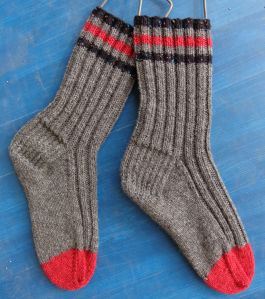
Ribbed Sport Socks by Patons knit in Briggs and Little Tuffy by Deborah CookeMr. Math likes thick socks in the winter – he wears them instead of slippers in the house. I use a Canadian yarn for these socks called Briggs & Little Tuffy. It’s wool with a bit of nylon and comes in heathered colors, as well as a marl or two. It’s yarn that remembers the barn, so expect some vegetable matter to be spun in. It’s a thicker yarn than the sock yarn mentioned last week.

You’ll need two skeins of Tuffy for a pair of socks, but will have a fair bit left over – not enough for another pair of socks, but plenty for contrasting toes and cuffs. (My neighbor says two skeins make three socks, so four skeins make three pairs, but I’m not sure about this.) I use 3.0mm needles for these socks and cast on 56 stitches, but otherwise, just follow the basic sock instructions. They knit up pretty fast compared to socks in regular sock yarn.

A side note here on washing hand-knit socks: I wash our hand-knit socks in the washing machine, but I wait until there’s a load of them and use the delicate cycle. They’re wool, after all, and I don’t want them to felt (and shrink). You can also wash them by hand, which will keep them looking their best. NEVER put them in the dryer, because then they will shrink. With socks knit in B&L Tuffy, I also use sock stretchers. This ensures that the socks don’t shrink as they dry, or if they have shrunk a bit in the wash, it stretches them back out again.

Knee Socks
I love the idea of knee socks. I’m not sure why, as I don’t wear them much and they take a long time to knit. (All that ribbing. Ugh. But the ribbing gives them a better chance of staying up.) Invariably, I have a pair on my needles – sometimes for quite a while.

Knee socks are (duh) longer than regular socks, but they also need to be wider at the top to accommodate your calf muscle.  They take a lot of yarn as a result – buy twice as much yarn as you need for regular socks. You’ll have some left over, but not as much as you might expect.

If you’re using sock yarn, go with your usual 2.25mm or 2.5mm needles. Cast on 96 stitches, and work in 2×2 ribbing for 2 inches. Then knit in 6×2 ribbing for 30 rows. (You might be taller than me. Adjust this measurement so that you’ve knit to the widest part of the calf, with a two inch cuff.) Now you have to decrease down to 72 stitches to finish the sock. There are two options for this: hide the decreases or create a gusset.

Hide the Decreases:
knee sock knit in Fleece Artist Trail Sock by Deborah CookeThe second of this pair of socks is currently on my needles. It’s knit in another yarn from the Maritimes: Fleece Artist Trail Socks in the Hercules colorway. Because it’s a handpainted yarn, the repeat on the stripe sequence isn’t precise, as it tends to be on commercial yarns. The color increments are also much smaller, which makes swirls instead of bands.

You can hide the decreases by changing gradually from a 6×2 rib to a 4×2 rib.

Decrease round #1: *SSK, K4, P2, K4, P2, K4, P2, repeat from * to end of round.

Work 9 rows.

Decrease round #2: *K5, P2, SSK, K4, P2, K4, P2, repeat from * to end of round.

Work 9 rows.

Decrease round #3: *K5, P2, K5, P2, SSK, K4, P2, repeat from * to end of round.

Work 9 rows.

Decrease round #4: *K3, K2tog, P2, K5, P2, K5, P2, repeat from * to end of round.

Work 9 rows.

Decrease round #5: *K4, P2, K3, K2tog, P2, K5, P2, repeat from * to end of round.

Work 9 rows.

Decrease round #4: *K4, P2, K4, P2, K3, K2tog, P2, repeat from * to end of round.

Done! You have 72 stitches. Now, work in 4×2 ribbing for the rest of the sock, following the basic instructions.

Create a Gusset:
Dr Seuss Socks knit by Deborah Cooke in Noro Kureyon SockThis pair of socks are knit in Noro Sock yarn. Although this is a yarn from a big commercial mill, there’s a deliberate wabi-sabi attitude toward self-striping repeats in Noro yarns. Sometimes a color is missing from the sequence. Often the color segments are of different lengths. The repeat is less perfect and more organic, which I like a lot. These socks are knit from alternating balls – 2 rows from ball A, then 2 rows from ball B, then back to ball A for two more rows etc. This is one of my favorite ways to show off self-striping yarns.
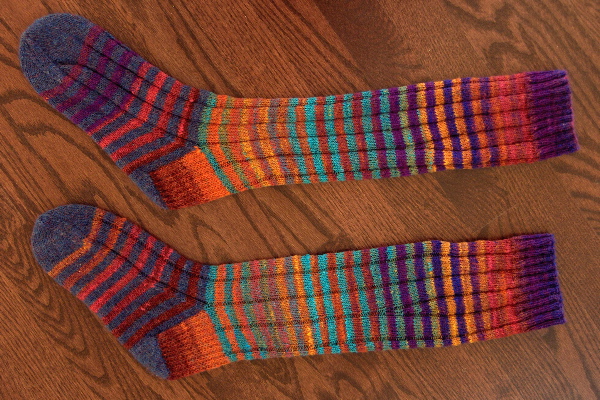
You can see that I still had the matchy-matchy disease badly enough to start both colourways at the same point of the repeat. (There is no cure.) On the foot, I changed out one ball of Noro Sock for Briggs and Little Durasport, which is about the same weight but wears better. That’s the solid denimy-blue.

These socks were a bit skinnier than the pair I’m currently knitting. They were my first knee socks and I cast on 88 stitches. They’re a bit more snug and more likely to fall down. That’s why I now start with 96 stitches. In this picture, you can see one of two gussets on each sock. Essentially, one of the 6×2 rib repeats is decreased until it disappears into the next rib. The gussets are also centered over the heel – on this pair, there are three plain ribs between the gussets. There are two gussets in these socks, but if I cast on 96 stitches, there would need to be three. I’d eliminate the rib in the center back in addition to the two shown here – like this:

Work as above to the decrease row.

Decrease round #1: SSK, K4, P2, K6, P2, SSK, K4, P2, K6, P2, SSK, K4, P2, continue in 6/2 rib to end of round.

Work 3 rows.

Decrease round #2: SSK, K3, P2, K6, P2, SSK, K3, P2, K6, P2, SSK, K3, P2, continue in 6/2 rib to end of round.

Work 3 rows.

Decrease round #3: SSK, K2, P2, K6, P2, SSK, K2, P2, K6, P2, SSK, K2, P2, continue in 6/2 rib to end of round.

Work 3 rows.

Decrease round #4: SSK, K1, P2, K6, P2, SSK, K1, P2, K6, P2, SSK, K1, P2, continue in 6/2 rib to end of round.

Work 3 rows.

Decrease round #5: SSK, P2, K6, P2, SSK, P2, K6, P2, SSK, P2, continue in 6/2 rib to end of round.

Work 3 rows.

Decrease round #6: K1, P2 tog, K6, P2, K1, P2tog, K6, P2, K1, P2tog, continue in 6/2 rib to end of round.

Work 3 rows.

Decrease round #7: SSK, P1, K6, P2, SSK, P1, K6, P2, SSK, P1, continue in 6/2 rib to end of round.

Work 3 rows.

Decrease round #8: SSK, K5, P2, SSK, K5, P2, SSK, K5, P2, continue in 6/2 rib to end of round.

From here, just carry on with the basic sock instructions. Make sure when you set up your heel that the gussets are centered over it.


Dr. Seuss Socks in Noro

My Dr. Seuss socks are done and I love them to bits.Noro Stripey Socks by Faith A D  knit by Deborah Cooke in Noro Kureyon SockFor those of you planning to make your own pair, I cast on 88 stitches on 2.5mm needles. After 20 rows of 2×2 rib, I switched to a 6×2 rib for the sock. This is my usual sock formula – the ribbing means that they stay up. After about five inches, I began to eliminate two ribs – you can see how one diminishes in a V – one on each side of a central 3 ribs that go at the centre back.

To eliminate the selected ribs, I needed to make 6 knit stitches and two purl stitches go away for each one. To do that, I K2tog on the second row of every stripe until the rib was done to one stitch. Then I P2tog once on either side of that shrinking rib (still decreasing on the second row of the next two stripes), then one last K2tog to make the last stitch disappear. I was back to my usual 72 stitch sock.

After that, I carried on until it was a bit too long, turned the heel and finished as usual. The only tricky bit was making sure those three centre back ribs were centred over the heel flap. And voilà!

I would wear them with a fox.
I would wear them in a box.

The strange thing is that I used two 100g balls of colour 150 Noro Kureyon Sock yarn. And putting the remnants on the scale, shows that there’s about 100g left over — even though I made knee socks. This must be because of the Briggs & Little Durasport on the feet and toes – it’s a colour called Blue Jean and is the (surprise) blue stripe there. It wears much better than the Noro. My Noro socks have worn out right at the bottom of the heel and under the ball of the foot – maybe I walk harder there, but these have Durasport there instead.
But theoretically, there’s enough yarn for another pair. Hmm.

I would wear them with a mouse.
I would wear them in a house.

They’re not quite identical, as I eyeballed the breaks instead of measuring them. Since each colour repeat is long, I got some closer than others. I think it’s a good compromise between perfectly matching and not matching at all.

I would wear them here or there.
I would wear them EVERYWHERE!

What do you think?