Another Bag Finished

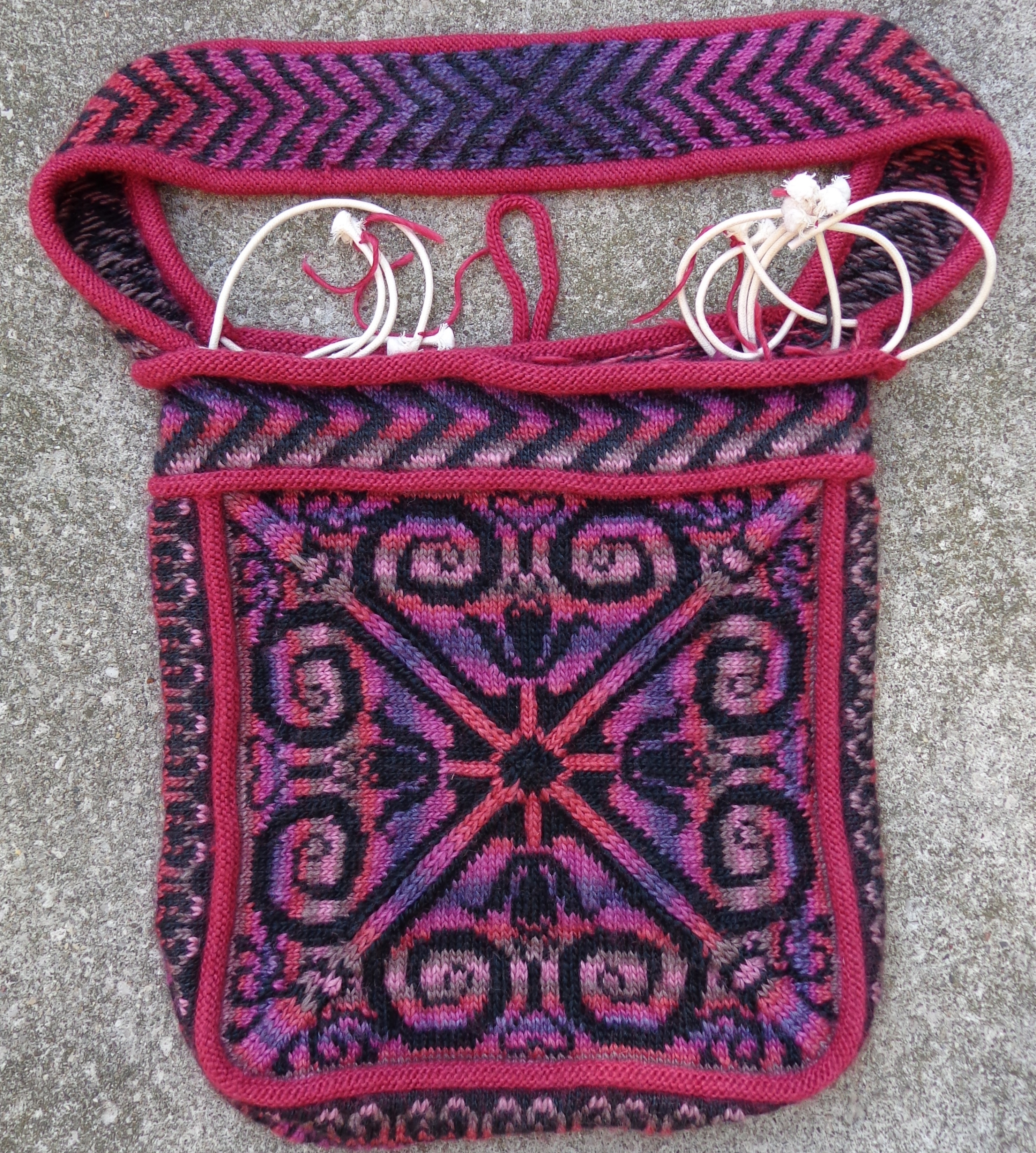
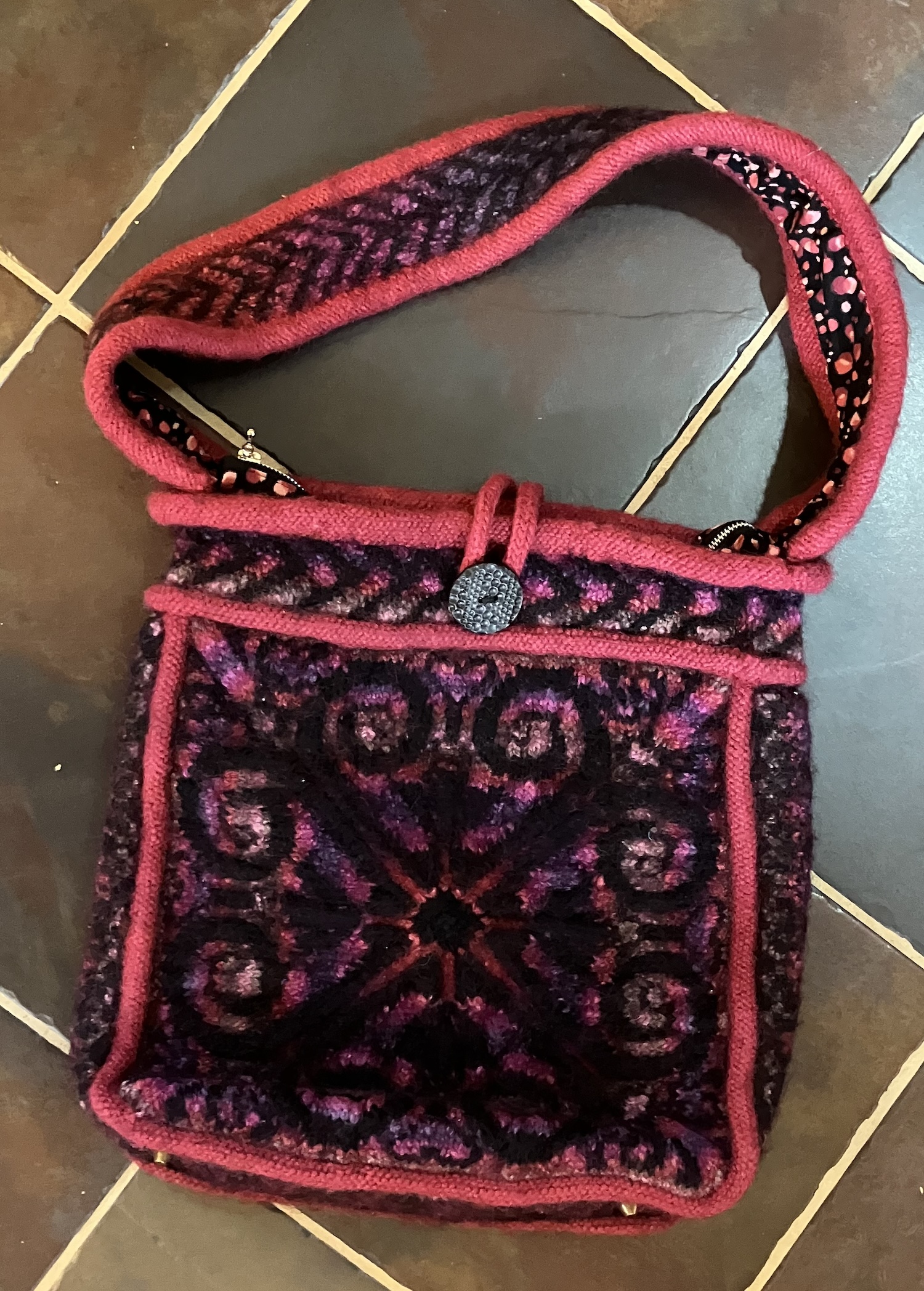
I found this bag partly completed in a stash of WIPs. The pattern is Sipalu and I knit it in Patons SWS. (That’s Soy Wool Stripes in the red mix and Soy Wool Solids in the solid red. I used another yarn with the same content for the solid black, Gjestal Garn Bris. I suspect that yarn is discounted. The SWS is.)

Sipalu Bag by Kerin Dimeler-Laurence knit in Patons SWS by Deborah Cooke

My Ravelry project page says I knit it in 2011 and finished it in 2013 – but that, alas, is not entirely true. It was completed this far – as above – but the lining pieces were only cut out and unassembled. They were stashed away with it.

Here’s my original blog post about it.

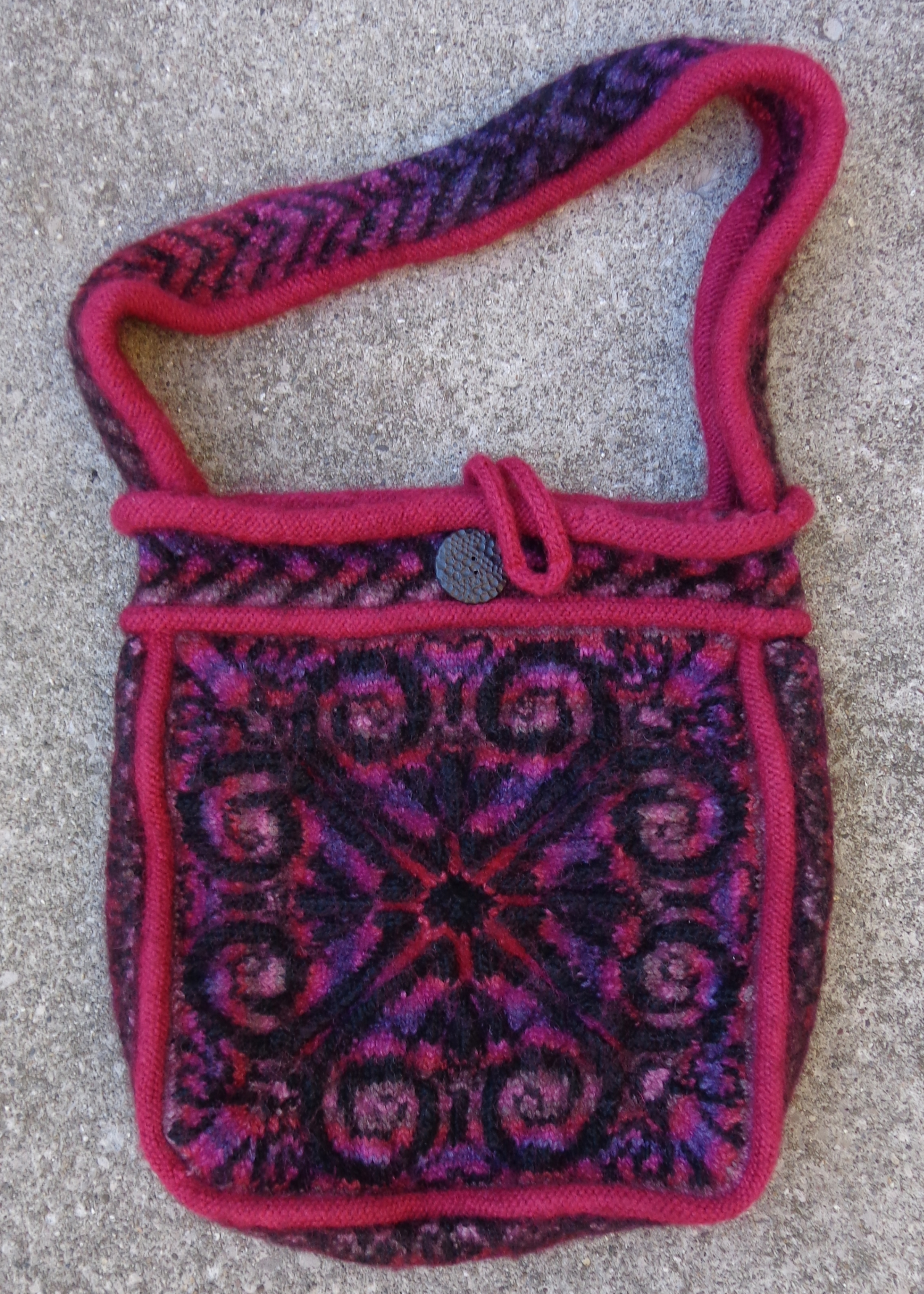
I added piping to the interior of the red bands and you can see them in the picture above. That one is a before-felting picture – the one below is after felting. That button is a porcelain one from a local maker and I just love it.

Sipalu Bag by Kerin Dimeler-Laurence knit in Patons SWS by Deborah Cooke

So, the lining. I suspect I put this aside because the construction of the zippered edge was a little complicated. I had assembled the lining for the body and put a pocket on it already.

Base of Sipalu bag knit by Deborah Cooke in Patons SWS

I’d also secured a plastic base in the bottom with some purse feet. Ikea makes these thin ones that come in packs of two, and you can cut them to size with a utility knife. The colours change with each new batch, but I always have a few in my materials stash.

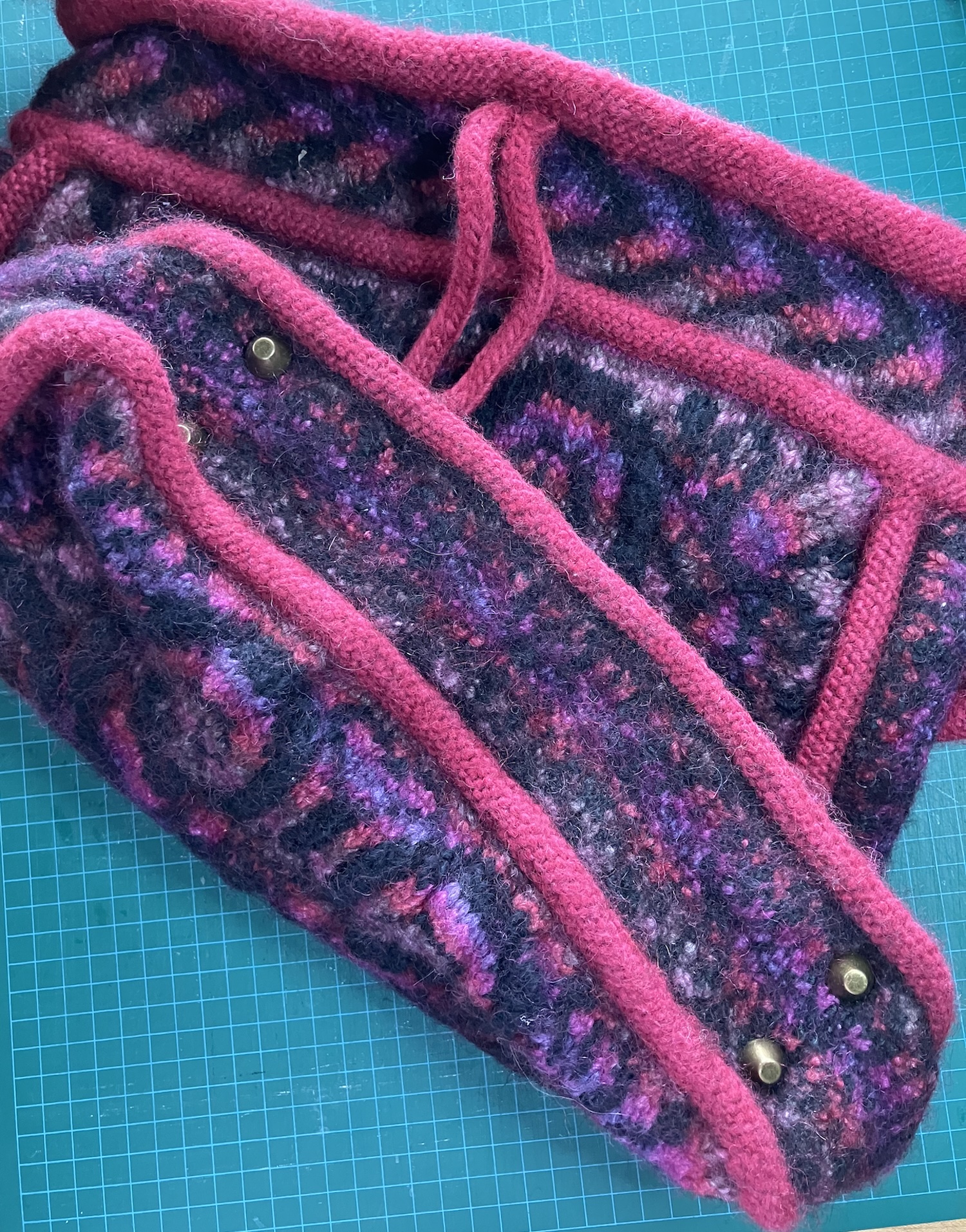
Now that tricky bit. The bag is essentially a box and is maybe 3″ deep, so I needed to centre the zipper between two pieces across the top, between the handle ends. Once I got out my ruler and made a plan for that, the lining came together quickly. There was a good bit of handsewing, to line the handle and secure the bag lining, but it wasn’t that big of a job.

Lining of Sipalu bag knit by Deborah Cooke in Patons SWS

Why is it that these incomplete projects that sit waiting for years always take a very short period of time to finish up? It happens every time.

And here’s the finished bag. It looks a bit dark in this pic, thanks to a dingy day – but it’s DONE!

Completed Sipalu bag knit by Deborah Cooke in Patons SWS

Weekend Getaway Satchel

I can’t believe this beast is finally done. I love it, but it was a lot more work than anticipated.

Then I couldn’t figure out how to photograph it!

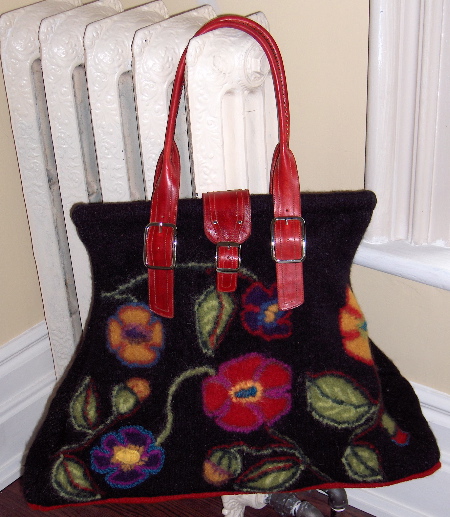
But finally, here it is, my Weekend Getaway Satchel from Interweave Knits (hmm. I can only find a picture on Ravelry), designed by Marta McCall:

Weekend Getaway Satchel knit in Patons Classic Wool by Deborah CookeMake no mistake – it’s huge. The base is 24 x 8 and it’s so tall that I have to put it on my shoulder. Part of the height issue is my fault – I couldn’t bear to cut away all the excess knitting to make the felted pieces the same size as the schematic, so mine is a few inches taller than recommended. I never thought about the extra height from the handles (or my lack of height) but the end result is that I can’t just carry it in my hand without it dragging. Oh well. I like shoulder bags.

I changed the handles as well, using leather handles from Grayson E. instead of the felted handles suggested in the pattern. I don’t find that felted handles stand up to stress that well – plus didn’t like the idea of knitting that enormous length of red strap shown in the pattern. These handles are beautiful but expensive – I could only justify them by using odd balls and mill ends for the wool. It’s mostly Patons Classic Merino, which is now called Patons Classic Wool – you can see that one teal blue, the one that outlines the flower at the bottom left, was NOT wool and didn’t felt, but I like how frilly it looks.

working on the Weekend Getaway SatchelThe pattern is easy to follow and the knitting isn’t complicated. Most of the detail is embroidered on to the intarsia. I had thought to pattern the back as well, but by the time I finished the front, I was ready to knit a plain back as the pattern specified. The finishing, though, was a bear. I lined the bag – because I hate unlined bags – and sewing that lining in, after the base was installed, the handles were sewn on and the hex frame was sewn in, was an acrobatic feat. Fortunately, blood doesn’t show in black tweed because I stabbed myself with the needle a number of times!

I really love this bag, but I won’t be in a hurry to make another. In fact, I think I’m worn out with felted bags for a while.

What do you think? Do you knit felted bags?

Cabled Denim Bag 3

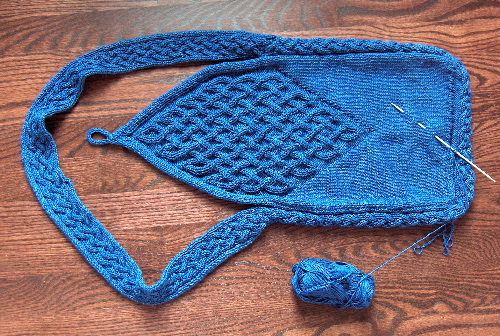
My denim cabled bag is getting closer to completion:

Cable Bag knit in Rowan Denim by Deborah CookeYou can see that I finished the flap. I had increased the cables to the top of the bag, then worked a couple of repeats in the full width to come across the top of the bag, then decreased down to the point.

Then I started with applied I-cord. As much as I love the look of applied I-cord, it’s pretty boring to knit, and invariably, you need a lot of it. It’s not good TV knitting, either, because you have to keep looking to pick up that stitch. I feel as if I’ve knit a couple of kilometers of it so far! It kind of disappears, but does give the edge a better appearance – if you look at the handle, at about 7 or 8 o’clock, you can see the difference between the two edges.

I’ve done all around the other side and around the flap – the button loop is I-cord that isn’t applied – and need to continue around the bag and the one edge of the strap. The I-cord does cover up the picked up stitches nicely across the lower edge of the bag – you can compare and contrast here, between the part with the I-cord and the part I still need to do.

I also found some zingy lining fabric in the remnant bin, a Madras cotton stripe in hot pink and denim blue which might be a Kaffe Fassett fabric. As those are distributed by Rowan, it seems appropriate. I like it either way.

All I need to find now is a great button.

Rowan Denim is said to shrink quite a bit in the length when it’s blocked/washed – just the way jeans used to – so I’m curious to see what happens when I wash this. It wouldn’t break my heart if the fabric was a bit stiffer. I washed the lining already, so everything will be pre-shrunk by the time it gets joined together.

Plus the additional feet for my Weekend Getaway Satchel arrived this week, so I’ll finally be able to finish that. It looks really good – what a fun project. A lot of hours of work but none of it was too hard, and the felting was fun. If you follow this link to Interweave, it will show you all of the patterns in the Fall 2005 issue – the Weekend Getaway Satchel is about a third of the way down the page. Of course, mine is a bit different – why make it the same as everyone else’s?!

Cabled Denim Bag 1

Rowan sent a kit to me with my subscription to their magazine last year. It’s a kit for a denim bag called Charlie, which includes the pattern and six balls of Rowan Denim. The Charlie bag in the kit pattern is a plain stockinette shoulder bag with a flap. Very nice, but the pattern didn’t excite me, so the package had been chucked aside. I like the yarn, though, so I cruised the ‘net and my pattern stash for ideas.

I found Tasha on Knitty, a bag pattern that uses (hey!) Rowan Denim. The cable on the bag is very neat, but I didn’t like that it had an open top. Big zipper fan, that’s me. I’m good enough at losing things that I need all the help I can get. Also I found a pattern in Rowan #35 by Martin Storey, for a bag very similar to Charlie but with cables on the flap. I liked that MS lined his bag and saw zipper potential under that flap, esp with the lining. Hmm.

The thing that all of these patterns have in common is that you knit all the pieces, wash/block them, then sew it all together. Blech. Plain stockinette is boring enough without knitting plain stockinette rectangles that have to be sewn together later. One thing I really liked about Tasha was that cable, but not that it only ran along the strap. So, I began to ponder…

What if the strap was one continuous loop, knit with that cable pattern, and made the bottom and sides of the bag as well?

What if I picked up the stitches from the base, then knit the bag in the round to the top opening? That would eliminate the seaming. Hmm.

Let the calculations begin!

I started with the bottom and made a strip of the cable pattern. The cable pattern is 14 stitches wide (5 x 2 st stockinette cables plus 4 purl stitches in between), so I cast on 24 stitches. For each right side row, I slipped the first stitch, P4, work the cable pattern, P5. For each wrong side row, I slipped the first stitch, K4, work the WS of the cable pattern, K5. (If you’re looking at the Tasha pattern, the designer has 3 stitches on either side of the cable. The first stitch is slipped on each row, but that’s not listed in the pattern directions, just the P2 or K2 at either end.) I worked for about 10 inches in length, ending with a WS row.

Then I switched to two circular needles. One side of the bag and one end would be on each needle. This is much easier (I learned) than working on 4 dpns – the long sides want to jump off the needle – or one circular – the curve is too tight.

Here’s what it looks like now, so you can visualize what’s going on:

Cable Bag knit in Rowan Denim by Deborah CookeYou could technically join the bag into a complete circle and work it in the round, but I left one seam open and am working it back and forth – it’s easier for me to keep track of the cable pattern that way and I don’t mind sewing one seam.

So, I worked the next row of the cable pattern across the end of the bag base, then picked up all those slipped stitch loops on the left end of the cable needle. I worked down that long side, knitting one stitch into the first loop and two into the next one – for every two loops, I picked up three stitches. This might be a bit full, and I’m thinking now that four stitches for every three loops might have worked better. We’ll see.

To make one stitch in the loop, you simply knit the loop. To make two stitches in a loop, you knit into the front of the loop, then without removing the loop from the left needle, knit into the back of the loop. Then you remove it from the left needle.

I switched to the second circular and picked up 22 stitches from my cast-on, purling above the purl and knitting above the knit stitches. (I initially cast on 24, but the other two stitches – one at each end – became the slipped stitches which were picked up for the long sides. Each end is now 22 stitches, with four reverse stockinette stitches on either side of the cable.) Then I picked up the other long side, the same way I’d picked up the first one.

When I’d gotten all the way around the bag, I turned the work and worked back on the WS. The front and back of the bag are in stockinette, so I purled all those stitches I’d made, then kept the ends in the cable pattern bordered with reverse stockinette.

At the beginning of the next row, I made one stitch at the beginning of the cable panel. This is the seam stitch – I’m knitting it on the RS and purling it on the WS. When I sew that seam, it will disappear into the back of the bag. There are some holes along the bottom where I picked up all those stitches, but I’m going to border the bag with I-cord so the holes will be covered up.

The picture is the bottom of the bag. The opening, which will be the seam, is at the top left corner. The stitches on the left side and across the bottom are on one circular needle. The stitches on the right side and across the top are on the second circular needle.

I have a feeling that the cable pattern stitch on the side of the strap that came from the picking up the cast-on is upside down or backwards or something. I’m just knitting to make it look right and not following the directions anymore, so if you try this, keep an eye out on that side.

Back and forth I’ll go, until the bag looks deep enough – probably about ten or twelve inches, guesstimating from the other pattern instructions. Then I’ll cast off one long side and divide the straps from the other long side. The remaining long side will become the flap and the straps will continue to make that big loop. I think I’ll knit the strap on one side and graft the strap at the top of the bag on the opposite side. And I suspect that the flap will need a cable, maybe one that starts on the back side. I’ll have to have a peek at some cable designs.

For the moment, I’m happily keeping track of that braided cable – you can see at the top right that I crossed one the wrong way. I picked that back and fixed it. Then, after I’d worked about two inches from the base, I was able to put it all on one circular needle and just work back and forth.