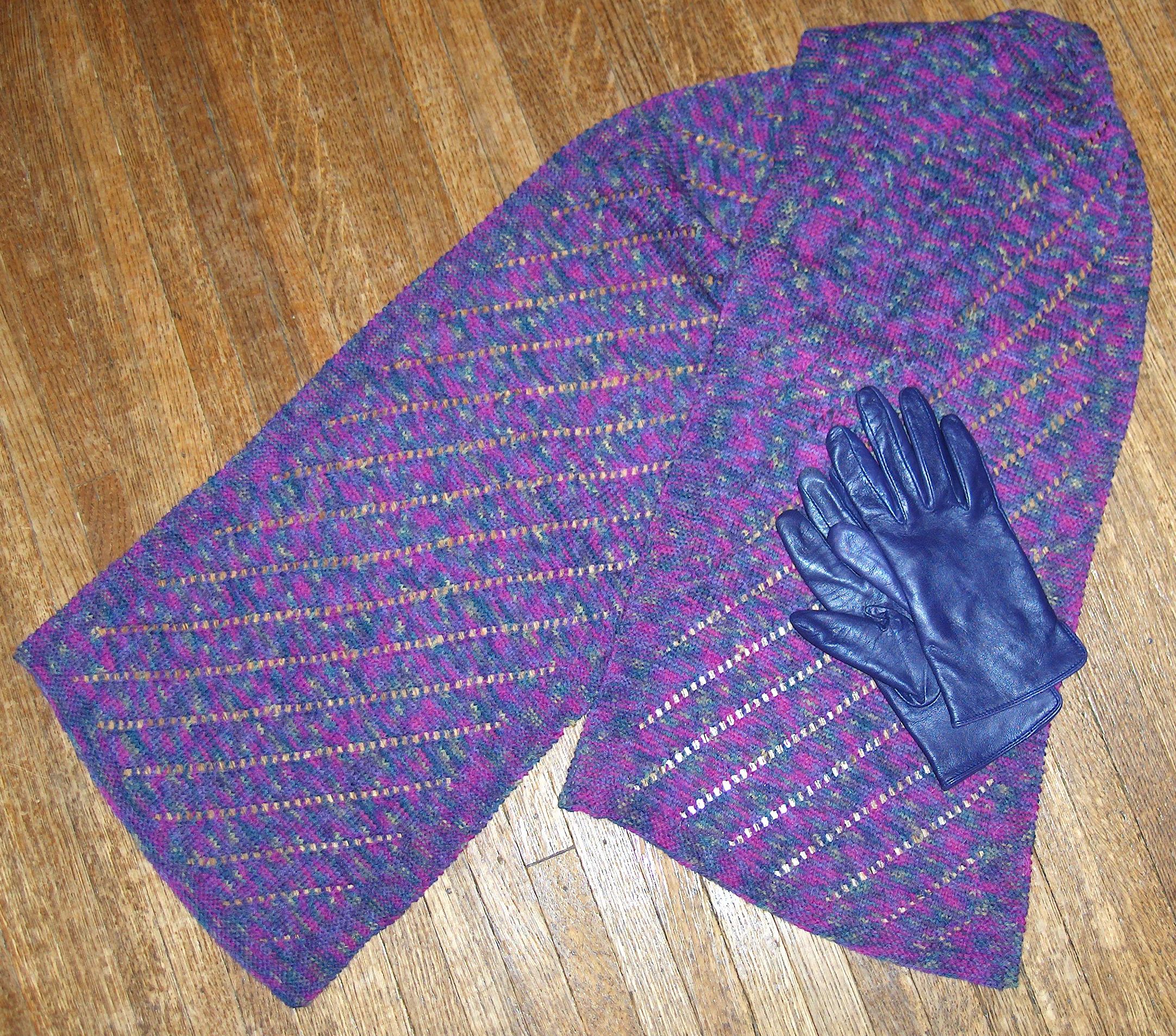
 This post is about modifying the Slippery Slope Shawl.
If you use thick yarn, you’ll get quick results and a different look. You could make an afghan with this stitch pattern, for example, and it would be wonderful. You could also do this scarf in very fine lace weight yarn, and it would be lovely too. Either way, you’ll have to figure out your own stitch counts.
Here’s how I figured out mine for the instructions given yesterday.
1/ The ball band is your friend.
Yarn always has a ball band, which includes a bunch of useful information. Have a look at yours. My ball band says that each ball of the Diamond Fancy Free is 50g in weight and 206 m in length. (Be warned that I flip between meters and yards, as the difference isn’t enough to really matter.) I had three skeins, so I had 618 m of yarn.
The ball band says that on needles between 2.5mm and 3.5mm, I should get 30 stitches to 10cm (which is a whole lot like 4″). That means 7.5 sts to the inch. That’s a big range in needle sizes though. I know my own knitting and would guesstimate that on 3.5mm needles, I’ll get more like 6 stitches to the inch.
When choosing a needle size for knitting lace, go a bit bigger than you would otherwise (or than the ball band recommends). For socks, for example, I always use a 2.5 or even a 2.25 mm needle. For lace with the same yarn, I’ll use 3.5mm. The spider’s web shawl I showed you a while back was knit on 4.5mm needles, and the Noro Silk Garden Sock yarn is both thinner and thicker than this Fancy Free. Lace needs a fluid fabric to show it off, so go up a size or even two sizes from what you’d expect to use with that yarn. (And yes, when in doubt, swatch.)
So, if I’m going to get 6 stitches per inch and I want to make a wide scarf that’s about 12″ wide, then I’ll need (6 x 12) 72 stitches. By happy coincidence, that’s a multiple of 8. Use the same calculation for your yarn, then round up or down from your calculated result to get a multiple of 8 for this scarf/stole.
2/ The 7th Row Sneaky Trick
If you want to use up all of your yarn and make your scarf/stole as long as possible, then you need to know how much yarn it takes to knit a row. Before you knit the 7th row of the garter stitch border, mark one yard (or one meter) on the yarn that you’ll knit. Measure right from your needle – where the yarn comes from the last stitch on the 6th row – and tie a slip knot at the 1 yard point. Make it loose enough that you can pull it out, but tight enough that it stays put. Then knit the row.
If you have to knit past the slip knot, then measure another yard/meter from that point, remove the first slip knot and knit on.
When you get to the end of the row, calculate how much yarn it took you to knit that row. For example, if you didn’t reach the knot, measure back from the knot and subtract – a knot at 36″ with 4″ left means it took you 32″ to knit the row. For my wide scarf, it took 46″ to knit a row.
This is your magic number. Multiple this magic number by 10. This distance is how much yarn you must leave to knit the end border on the shawl. My 46″ is a whole lot like 117 cm – since metric is easier to multiply, I rounded that up to 120 cm or 1.2 m. So, I will need 1.2m x 10 = 12m to finish the last garter stitch border on my shawl.
If you are compulsive (like yours truly) measure that point from the other end of your yarn (or from the last end of the last ball) and put a slip knot there. This slip knot marks the very latest point at which you can begin the garter stitch border at the other end of the scarf/shawl. Now you have no stress about running out of yarn. Isn’t that fun?
3/ How big?
The second part of this sneaky trick is even better – you can ballpark the finished length of your shawl with this number. I know, for example, that I need 1.2 m per row and I know that I have 618 m of yarn in total. So, I can calculate that I’ll be able to knit (618 divided by 1.2) 515 rows in total. A peek back at my ball band revealed that I should get 10 rows per inch – so the finished length of my scarf will be at least 51.5″.
In reality, since I’m using larger needles, I suspected I’d get more like 8 rows per inch, which would give me a finished length of 64″ or so. (That’s exactly what I am getting.) I’m good with scarves and shawls being bigger – what I hate is when they’re too small. So, consider the ball band calculation to be a worst case (or smallest case) scenario. If you’re good with it, knit on. If not, rip back those couple of rows and try a different number of cast on stitches.
4/ Math Geek Bonus Round
Deep in my heart, I am a math geek. I loved math in high school, loved it so much that I was excited when a guidance counsellor told me I could have a job that involved doing math all the time. Wow! What kind of a job would that be? He told me I could be an actuary, or a high school math teacher. The prospect of being an actuary did not make this girl’s heart go pitapat, and neither did the idea of facing a room full of hostile teenagers every day for the rest of my life. So, I wandered off and ultimately became a writer instead.
If I’d had a more imaginative guidance counsellor – maybe one who wasn’t so floored by the idea of a girl liking math – I could have been off calculating the area inside parabolas every day, or figuring missile trajectories, or constructing elaborate proofs. There you go. Be careful what you tell teenagers – they might believe you.
So, my inner math geek loves this bit. When I finished knitting one whole skein of yarn, I counted up my rows and refined my 1.17m/row ballpark estimate. It turned out that I got 162 rows out of that skein. With 72 stitches per row, there were 11,664 stitches in that skein of yarn. (Who knew?) But if I know that I can get that many stitches on that size needles, then I can figure out how many rows I’ll get from each skein with 56 stitches or with 88 stitches. Multiplied by the number of skeins, that tells me how long each piece will be, and how many repeats of the pattern I’ll get. And that’s how I figured out the instructions for the other two sizes of the scarf without actually knitting them.
Ha.
Don’t you feel empowered? Go forth and knit!
 Alive & Knitting