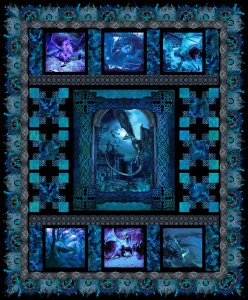
 I told you a while ago about ordering this quilt kit and (yay!) it finally arrived. Despite all the other things in progress on my worktable, I immediately dove in because, well, dragons.
I was worried that the fabric might feel too much like ink, but it’s quite nice. It’s very smooth and seems a bit lighter than other quilting cotton. The instructions say not to pre-wash the fabric, as it might shrink and the panels might be too small to cut to size. The issue for me is that the fabric wouldn’t be able to be washed ever if I did that. I like to pre-wash so the worst case scenario has already happened before I sew, so into the washing machine it went.
It shrank, of course, as it’s 100% cotton. I like the feel of the fabric much better – it’s a bit thicker now and not as smooth. The unexpected thing was that it shrank in the width and not so much in the length. I measured those six square dragon panels before washing. They have a 1/4″ black border around each image and were 12 1/8″ square at the inside of the black border. After washing, they were 11 1/8″ wide and 11 3/4″ tall. The instructions are to cut them 12.5″ square with .25″ going in the seam allowance, so, exactly as warned, I couldn’t cut them to size.
I’d expected this and had two contingency plans.
The second contingency plan was the tougher one: that I’d make the entire quilt slightly smaller overall and have to recalculate everything. (Gah.) Fortunately, the first contingency plan worked. I checked the black fabric and there’s a lot in the kit, mostly because they included some for the quilt binding. They instruct you to cut the binding on grain, though, which I won’t do – I always cut binding on the bias – so those 9 X 2.5″ crosswise strips of black are now extra fabric. (Actually, that’s 22.5″ by 43″ or so, maybe more if the kit is generous, so it might be enough to cut binding on the bias. We’ll see.)
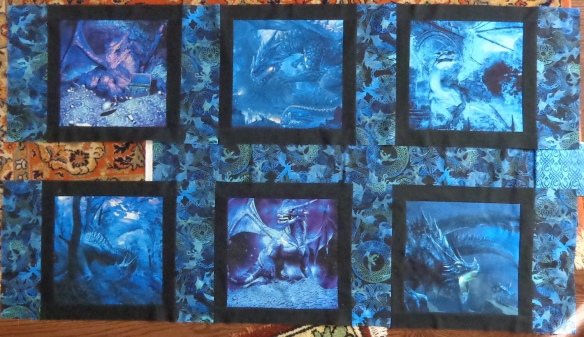
Each of the six dragons are bordered in black: the instructions call for 1.5″ strips of black for those borders, and the squares end up being 14.5″ square. Once they’re sewn in, they’ll have a 1″ black border. I cut my shrunk dragon panels so that the black border was the seam allowance on the width and made them square. Then I cut my black strips 2″ wide. After sewing on the black borders, I trimmed them up to be 14.5″ square. A teeny bit of the dragon image in the height was lost – less than .25″ – and the black borders are a little bit wider than specified – mine will be about 1 3/8″ wide once the blocks are sewn in – but my finished measurements are all good. (It doesn’t look square in this image because I had the camera at an angle. 🙂 It IS square!)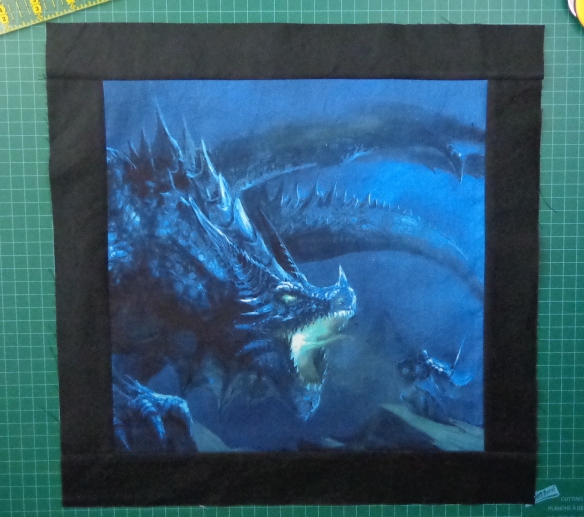
There is a lot of extra fabric around the image in the central panel. Mine just has a little more background than the one in the picture. I’m good with that.
 When I started to piece the other blocks, things got interesting. The scale print is a one-way design: the scales are shaded at one end and not at the other. It seems to me that I’d want them all to be in the same direction. To my relief, the person who made the sample quilt thought the same thing, because they are aligned that way. At right is a close-up of the side panel from the image on the kit: you can see that the scales are all aligned. I apologize that it’s not really crisp but I wanted it big enough that you could see the scales.
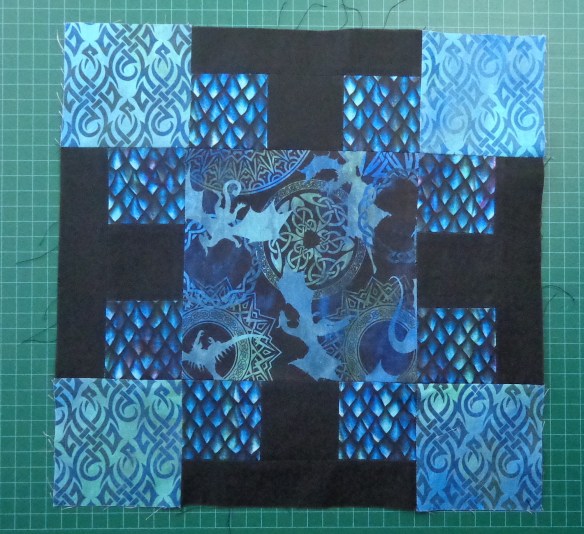
If you follow the instructions, this isn’t the result you’ll get. That’s because of the one-way design. Let’s look at that. There’s a little unit of three squares created by cutting crosswise strips of black and the scale fabric. You sew them together, then cut the blocks from them, like this: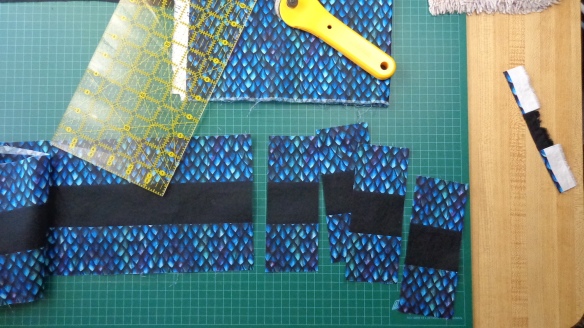
You join them to an outside rectangle of black then put them around the central square in the block. But look what happens when you change their orientation by placing them around the square: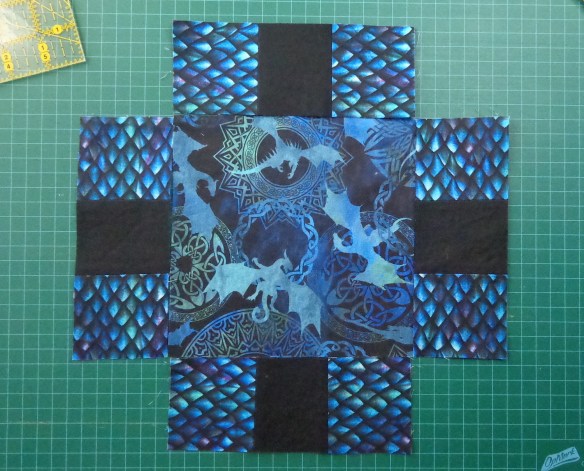
The implication of the one-way design strikes! Cutting the strips as instructed will only create the units to be placed vertically, if you care about the scales being oriented the same way. I do, so I’ll take apart the other pieced strip (there are two), cut the strips into squares, and piece them individually with the scales aligned the way I want them for the horizontal blocks.
It also means that I need to divide my units into groups, to make sure the black rectangle is sewn on the outside edge. I’ve split this first group of twelve with vertical scales into two groups: I’ll put the black rectangle on the left side of six of them, and on the right side of the other six. 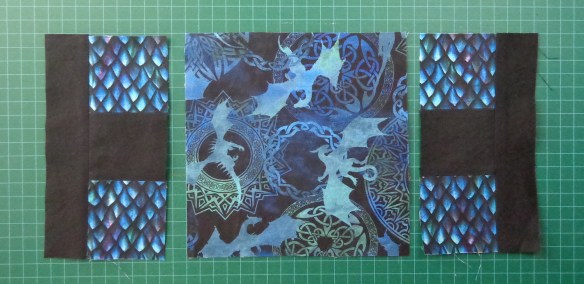 Similarly, when I piece the units for the horizontal scales, I’ll put the black rectangle on the top of six of them and on the bottom of the other six. That got a bit more complicated, didn’t it?
This also means (hmm…) that I won’t be able to rotate the blocks when I arrange them for the quilt. Their orientation will be set, because of the scales. Prints often repeat across the width of the fabric as well as down the length, so I laid out the six central blocks to check: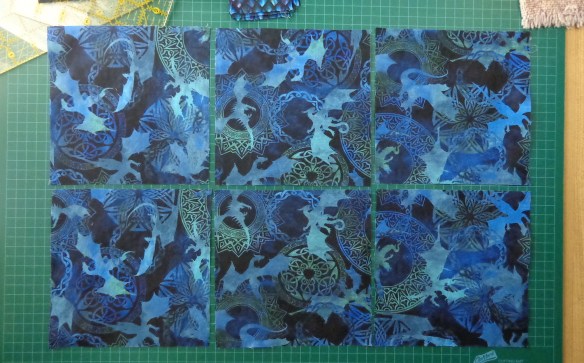 I’m thinking I might notice the similarities, particularly between the two on the left and also on the two in the middle. Those light-coloured dragons draw my eye! I rotated the blocks before sewing on the pieces with the scales:
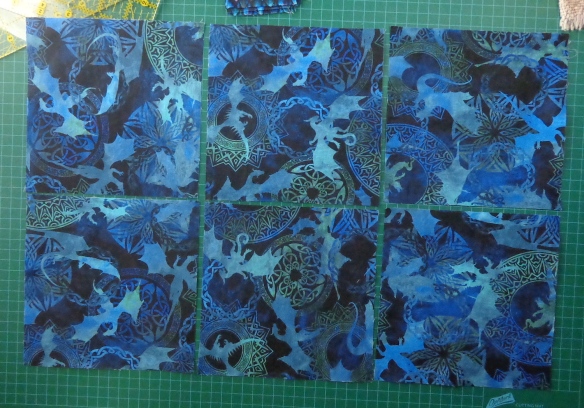 The similarities are less obvious this way. Now, I’m ready to piece those six blocks!
What about the quilt in the picture provided with the kit? Either the person who pieced it didn’t follow the instructions and did as I did, or it might be a computer-generated image. That’s interesting, and it means I’ll be keeping my eyes open for other tweaks as I work.
This quilt is a lot of fun! I can’t seem to leave it alone, so I’ll show you more next week.



 I put some of the leftover fabric between the rows—it ran out at the left, because these bands are 58″ or so wide—and put a little bit of the flames at the right. I like it better with the background all the same colour, but even one panel of these six-dragon-panels would make a fun quilt.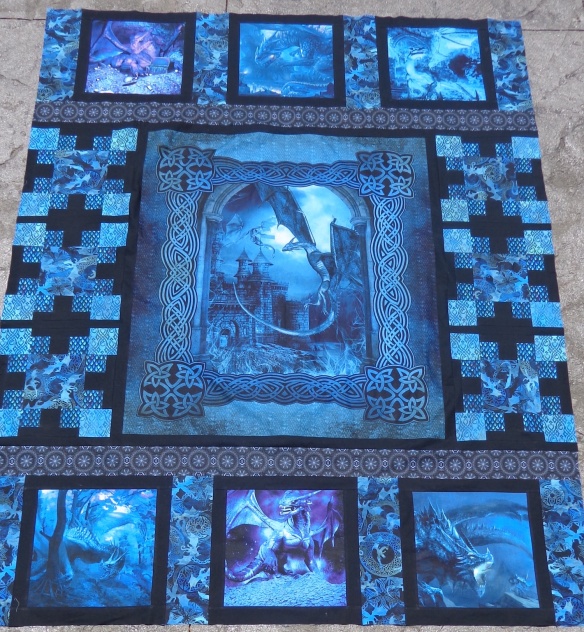
 Alive & Knitting