Here’s another UFO found in that stash – an unfinished chullo hat.
This hat is knit of Knitpicks Palette and was a kit. Here’s the Rav page for the Andean Chullo Hat pattern, which is still available. Here it is at Knitpicks. The kit, which isn’t available any longer, came with several balls of Palette – I’m thinking maybe 8 colours. Palette is a fingering weight wool, which comes in a lot of colours.
I remember the pattern being a bit of fun, as there were numerous motifs that you could place on any of the sections and knit in any combination of the colours to make your hat your own. Have a peek at the projects on Rav to see the many variations. Of course, I had to march the llamas around the hat, though they might have shown up better if I’d knit them in the white in the kit. It’s also possible I mucked up the decreases at the crown because the circumference does diminish very quickly. (?)
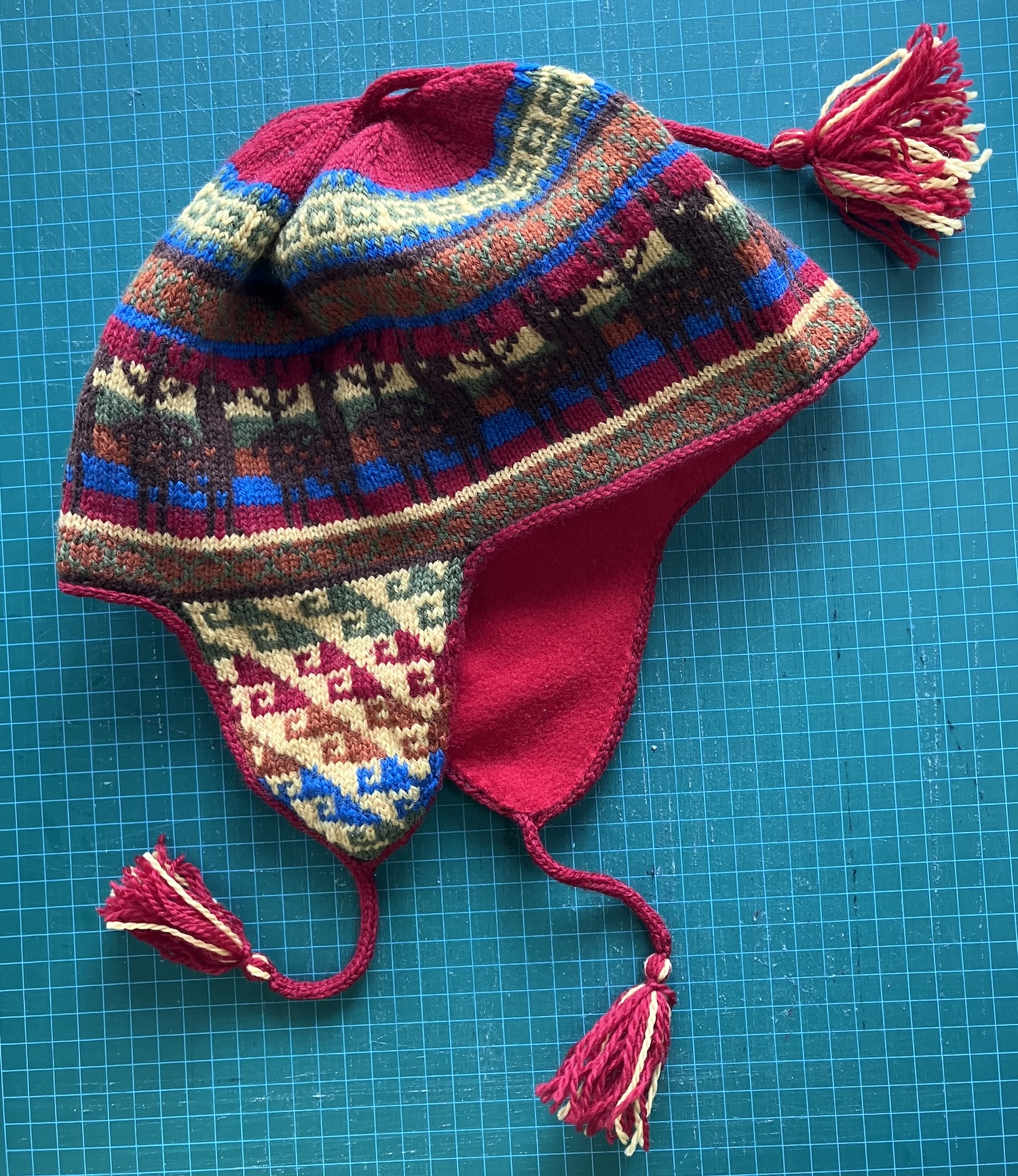
This hat stalled without the tassels, partly because of the chullo hat shown below. I didn’t knit this one – I bought it at the Mountain Equipment Co-op a billion years ago (give or take). (In the 90s there were a lot of South American knits available for sale.)
It’s knit of a yarn that seems a lot like Lopi Alafoss – but its special magic is that it’s lined with polar fleece. The mister grabs this hat whenever it’s really cold.
I meant to do the same with my chullo hat, but was stymied as to what shape to cut the pieces for the crown. Now I realize that the creator of this hat avoided that challenge by only lining the main part of the hat and the flaps. I’ll do that with mine.
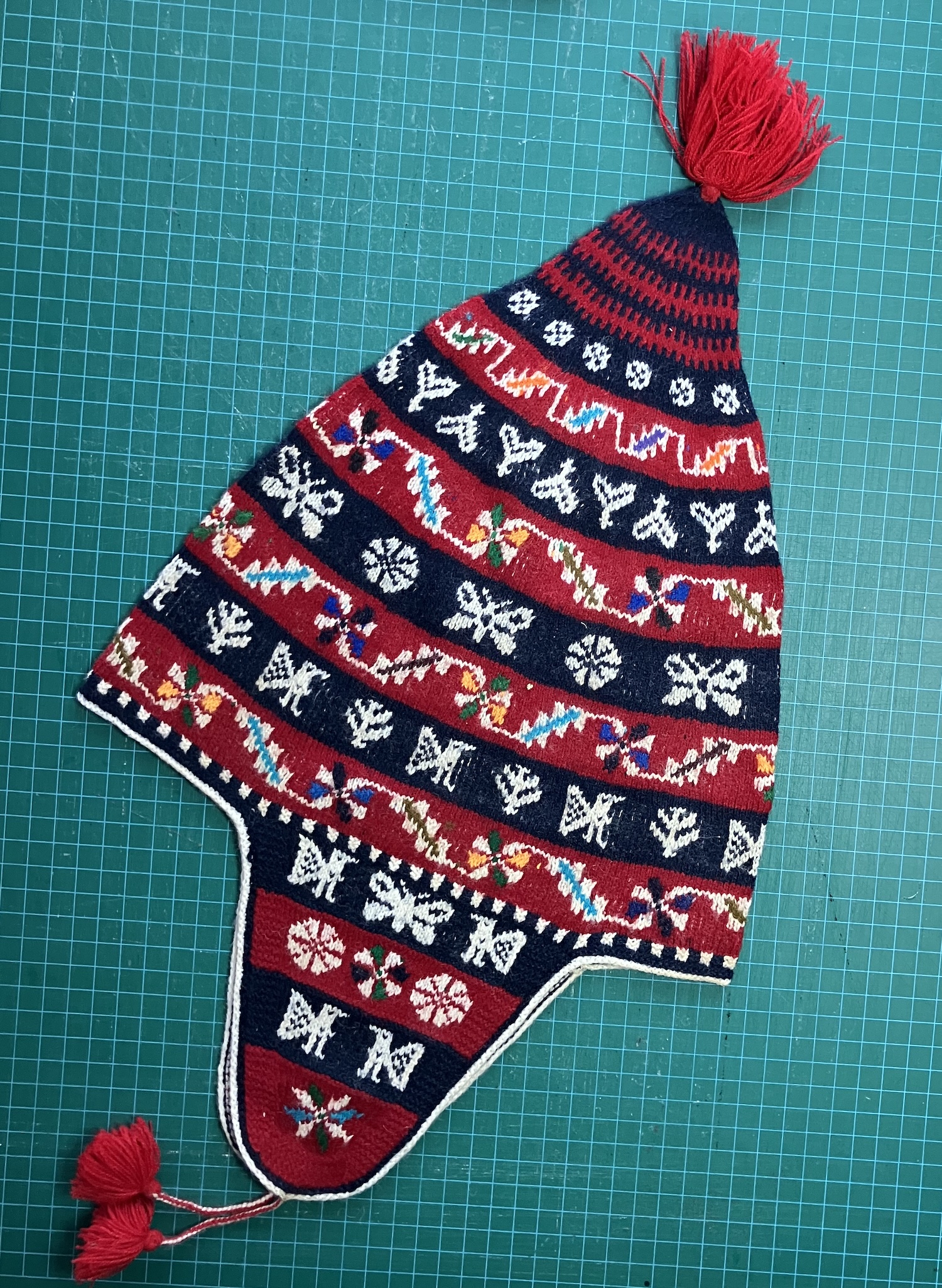
We also have a couple of chullo hats from one of the mister’s trips to South America. He hiked the Inca Trail back in the day (to end up at Machu Picchu at dawn) and it was so cold that he bought two hats from the local knitters. Both are chullos. He wore this navy one.
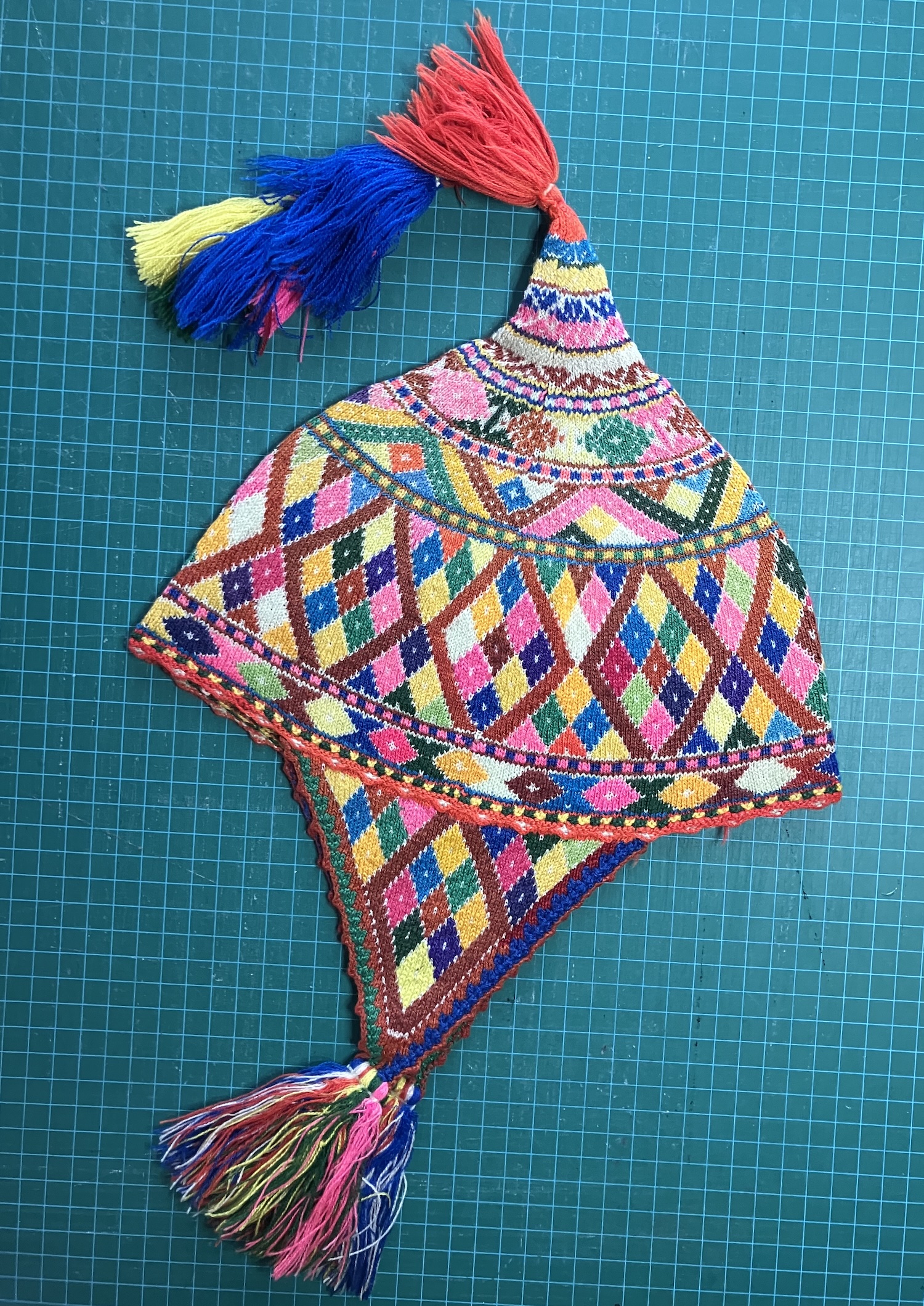
He bought this second hat just because, and I’m glad he did. It’s so beautiful.
The wool is so fine, it’s almost thread. Look at the detail.
Someone had a very fine set of needles! I love that the colour placement is apparently random. It’s such a lovely piece of work – and very inspiring.
And here, finally, is my own lined and finished chullo.
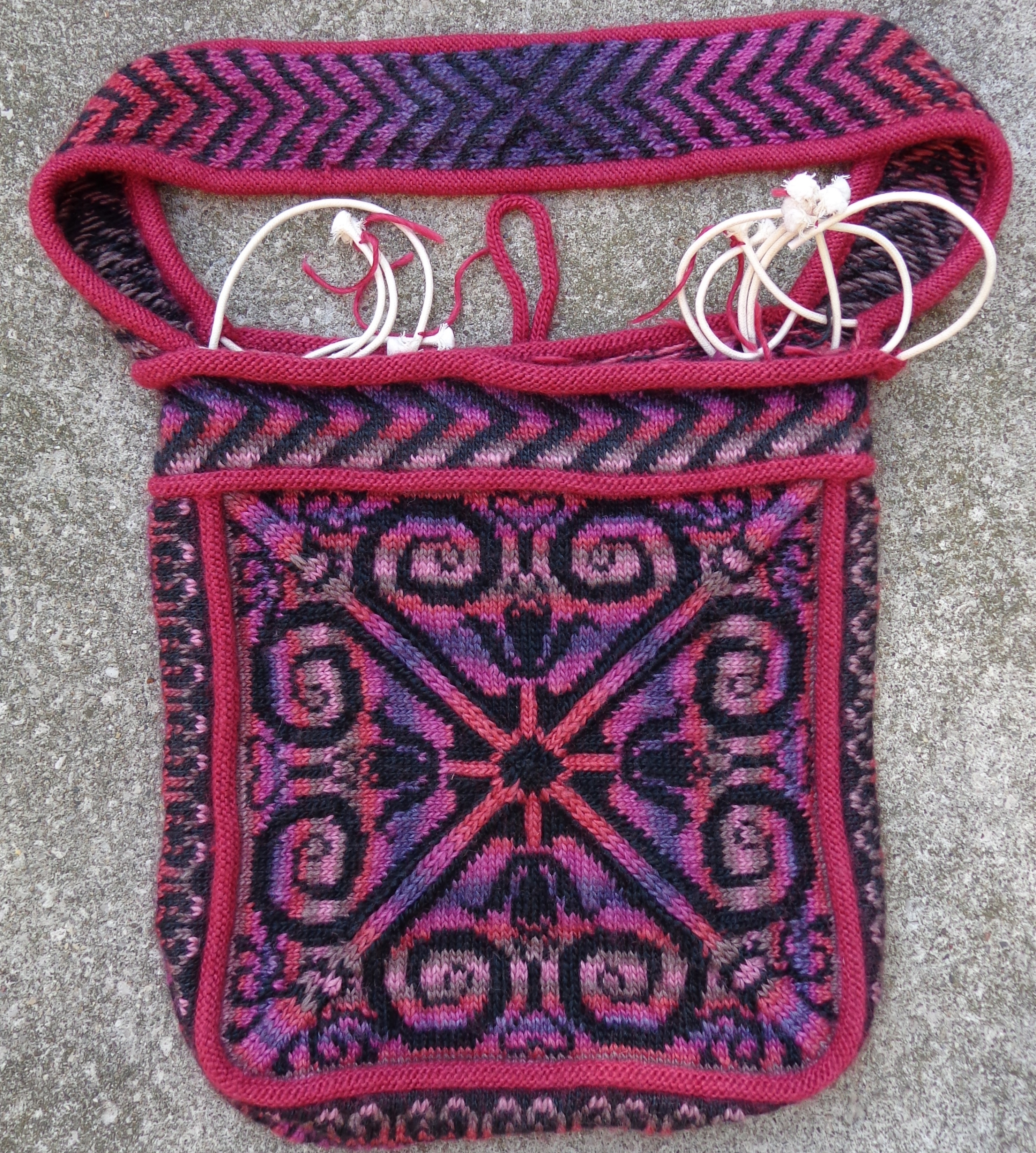
I found this bag partly completed in a stash of WIPs. The pattern is Sipalu and I knit it in Patons SWS. (That’s Soy Wool Stripes in the red mix and Soy Wool Solids in the solid red. I used another yarn with the same content for the solid black, Gjestal Garn Bris. I suspect that yarn is discounted. The SWS is.)
My Ravelry project page says I knit it in 2011 and finished it in 2013 – but that, alas, is not entirely true. It was completed this far – as above – but the lining pieces were only cut out and unassembled. They were stashed away with it.
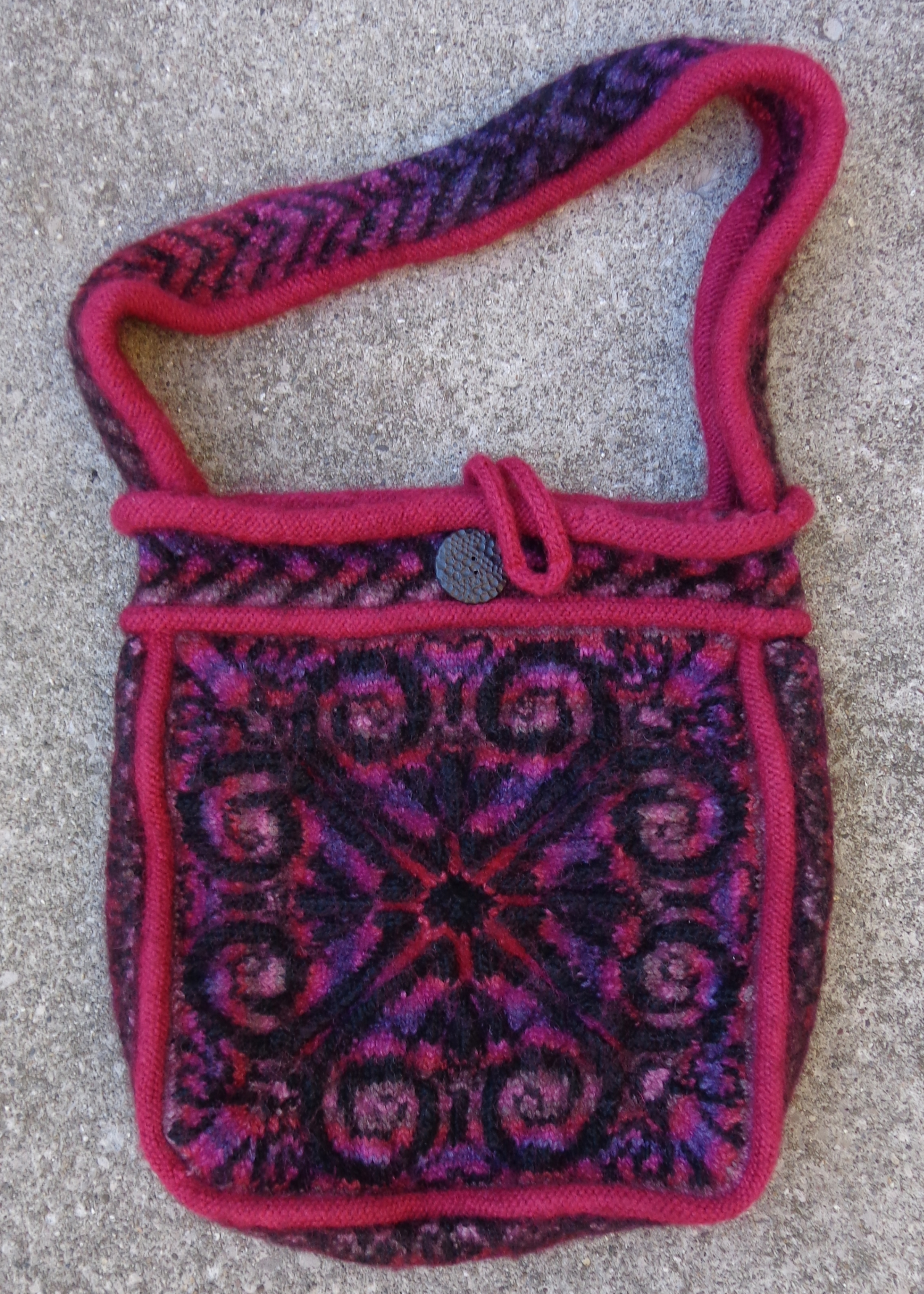
I added piping to the interior of the red bands and you can see them in the picture above. That one is a before-felting picture – the one below is after felting. That button is a porcelain one from a local maker and I just love it.
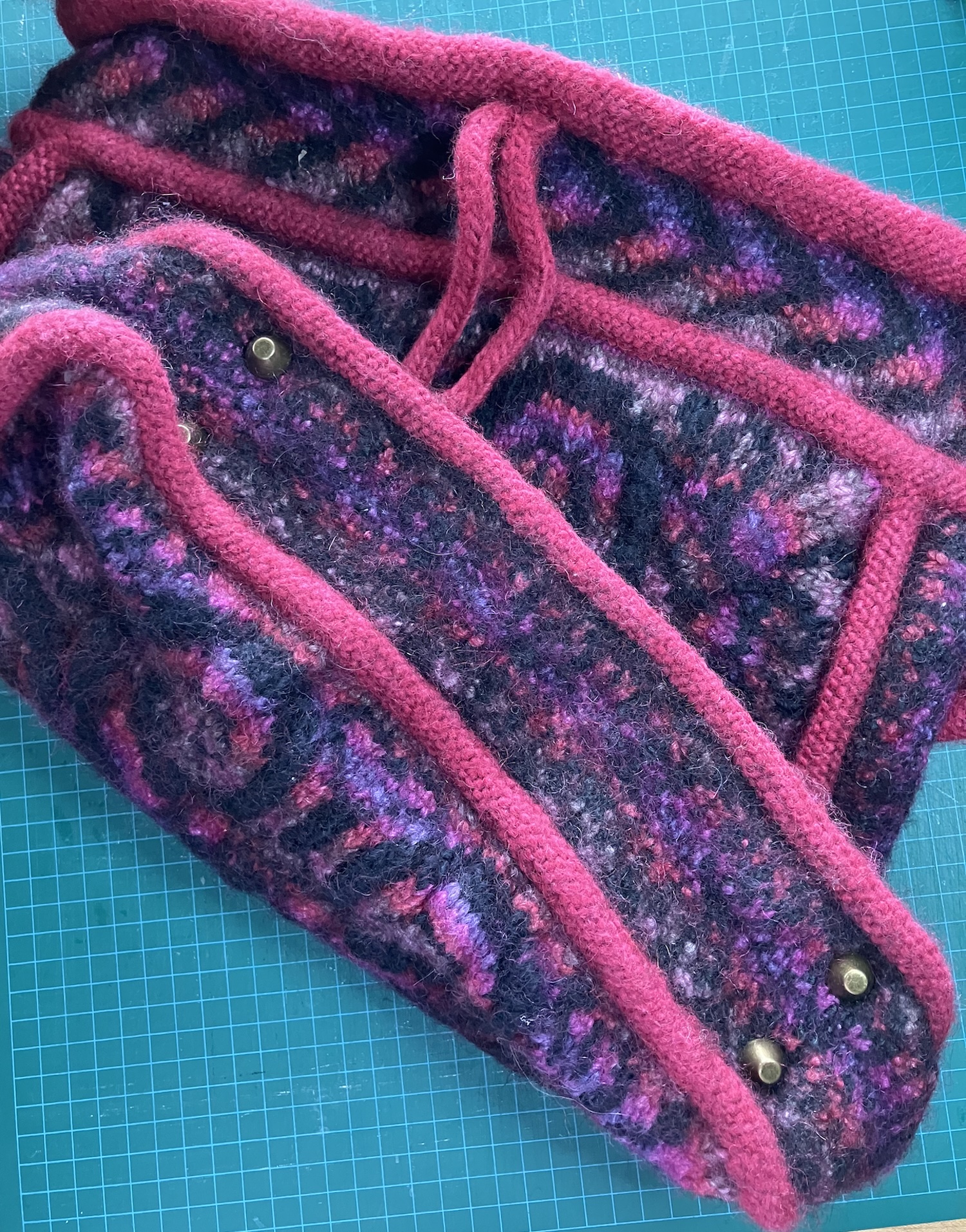
So, the lining. I suspect I put this aside because the construction of the zippered edge was a little complicated. I had assembled the lining for the body and put a pocket on it already.
I’d also secured a plastic base in the bottom with some purse feet. Ikea makes these thin ones that come in packs of two, and you can cut them to size with a utility knife. The colours change with each new batch, but I always have a few in my materials stash.
Now that tricky bit. The bag is essentially a box and is maybe 3″ deep, so I needed to centre the zipper between two pieces across the top, between the handle ends. Once I got out my ruler and made a plan for that, the lining came together quickly. There was a good bit of handsewing, to line the handle and secure the bag lining, but it wasn’t that big of a job.
Why is it that these incomplete projects that sit waiting for years always take a very short period of time to finish up? It happens every time.
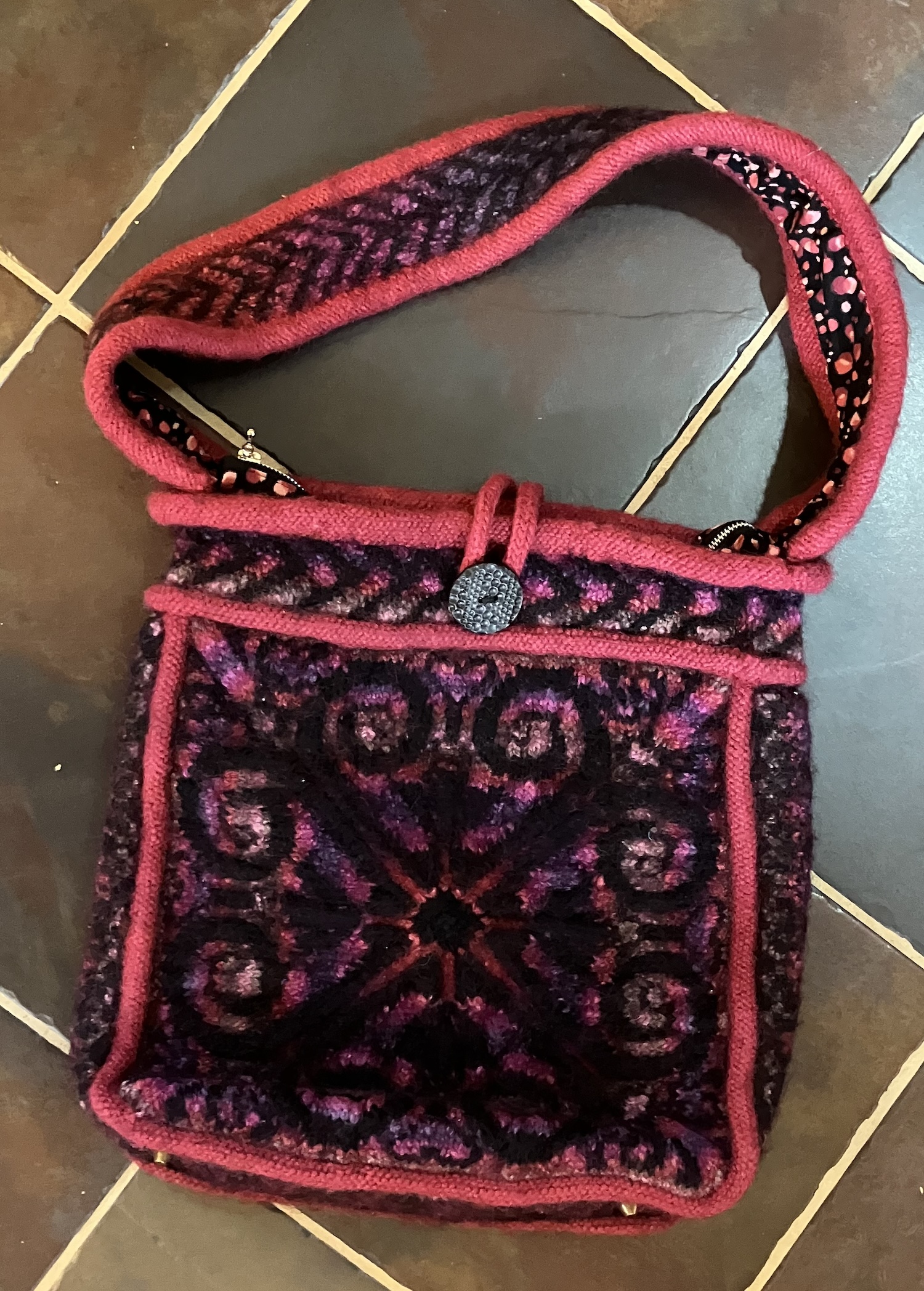
And here’s the finished bag. It looks a bit dark in this pic, thanks to a dingy day – but it’s DONE!
Things have been a little quiet here, mostly because of real life. When things get busy and even a little unpredictable, I always choose some comfort knitting. Lately that’s been knitting for the girls, as well as mittens and socks. Today, we’ll look at my latest completed project for the girls.
This is another free pattern from Sticka till Barbie, this time for a knitted coat. It’s amazing that I’m always learning more about fitting clothes for the girls – this time, I learned that vintage Barbies have shorter arms than modern Barbies. MTM and Silkstone (articulated and original) all have longer arms than vintage B.
I knitted the first coat following the instructions for #101 Yellow Coat. Here’s a Ravelry link for the pattern. The original website was taken down in 2022. The wayback machine’s backup of the original site has changed now – previously you could download individual patterns from there. There is also this other backup at the Internet Archive. Scroll down for the link to download a zip file of all the patterns. I’d do this soon, as it seems the content is vanishing. There are so many clever patterns in this collection.
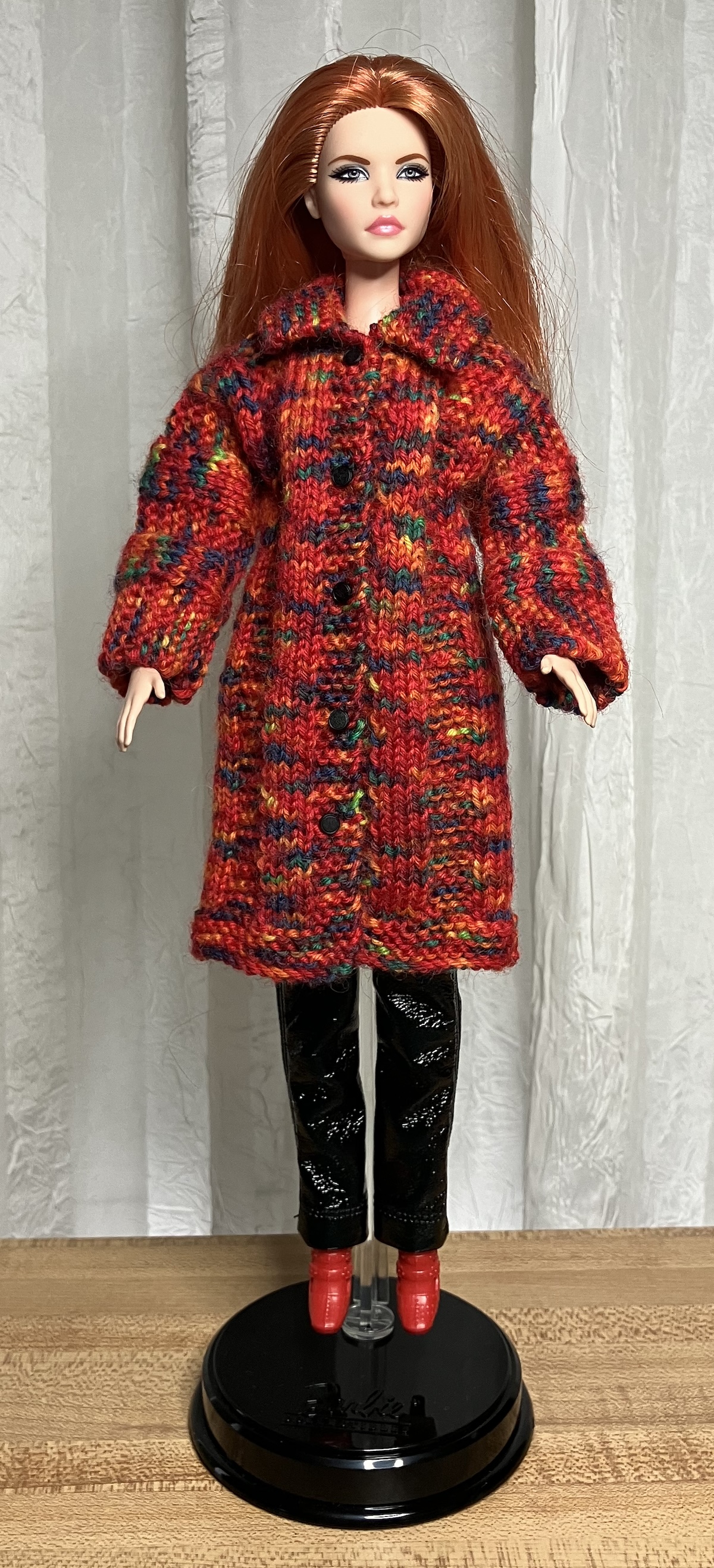
Here’s my first coat in Patons Kroy sock yarn, on a MTM doll.
This coat is knit from the front hem up over the shoulder and down the back. You knit one front, then the other, then join them at the back collar line and knit down the back. The sleeves are added as you go – it’s shaped like a T, kind of like a kimono. Stitches are picked up at the neck for the collar.
This coat took 35g of Patons Kroy – I just barely made it with my partial ball of the red mix, so couldn’t make the hat shown with it in the pattern picture.
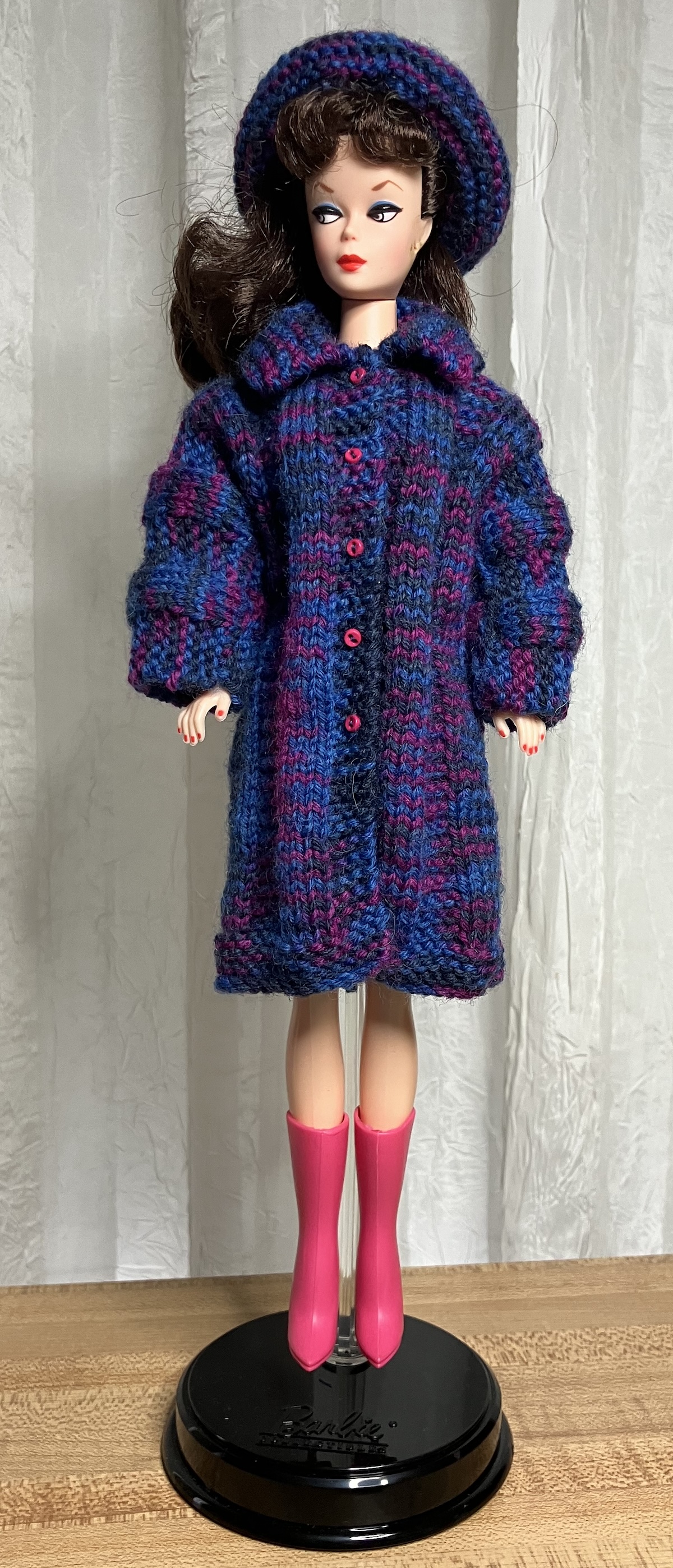
I cast on a second version and cast on two less stitches on each sleeve, to make shorter sleeves for vintage B. Here’s that one – this time, I had enough yarn for the hat, too.
The hat is cute and quick to make. I joined mine in the round so there wouldn’t be a seam, although the instructions are to knit it flat. The hat pattern is A-41.
I’m working on a modification of the coat, resizing it for the 16″ girls. I’m knitting it in a kettle-dyed Koigu that is quite pretty. It’s amazing how much more knitting that requires, but I’m headed down the back now and should have it done soon.
The colour is pretty true in this picture. I really like this sweater: it’s light, warm and red! I’m swatching with another yarn (we can gasp in unison at that bit of news) to try the pullover version next.
Here’s a better shot of the buttons that don’t quite match.
They’re a little more pink than russet, but I like those two gold lines in them a lot. They’re staying. 🙂
I’m also embarked on a long-overdue sort of my fabric stash, which will continue to my yarn stash. It’s time to get organized, and time for some things to find new (more appreciative) homes.
I’ve noticed that the fabrics headed out the door fall into three groups: the first group is the biggest. My colouring was Autumn before I let my hair turn grey, so I had a lot of Autumn-favouring fabrics in my stash. I still like the russets and burgundies, the olive and some of the brown. The gold, taupe and beige, though, just don’t work for me anymore. I also used to wear white shirts a lot, and they don’t work for me anymore either —they’ve been culled from my clothing stash and are leaving my fabric stash, too. (There are compensations. Now I can wear black.)
The second group of fabrics are graphic prints. I like bold prints on the bolt and often admire them in the store. Some have come home with me over the years. I tend not to like them as much once they’re garments, or I like them but don’t wear them. They’re leaving, too.
Finally, there’s a shade of pink. Maybe it’s a pink that is supposed to work for Autumn colouring. (?) We used to call it dusty rose – it’s a mucky pink, not a clear clean one. Now it looks like Pepto-bismol to me, so out it goes.
It is very interesting to see how things pull together after my measuring, sorting and stacking. There’s a new cohesiveness in my stash, which I like — it makes me want to display it, not pack it away LOL — and which is also inspiring. I can see how things coordinate and work together, which gets me planning. It’s proving to be a useful exercise, though a time-consuming one. I expect I’ll be sewing more in the near future and not just for the girls. That makes me happy. 🙂
As promised, here’s a post about a sweater knit a while ago. First, let’s talk about the pattern. I used The Incredible Custom-Fit Raglan. I think it appeared in Threads magazine once upon a time and you can find it online now. It’s less of a pattern than a formula, so it can be used for any size of person and any yarn. Here it is on Ravelry with links to the Wayback Machine. It looks like you can download it from Rav, too.
I used this formula a couple of times to make sweaters for Mr. Math, including the Elrond Sweater. That’s the link to my Ravelry project page, and here’s my blog post. Below is the sweater. Ha. I knit it in 2009 and he still loves it. 🙂
The sweater I wanted to write about today, though, is this one, which was knit so long ago that it doesn’t even have a Ravelry project page.
My No. 9 sweater reminded me of it, so I dug it out. This sweater was knit from a huge ball of yarn that I bought at Lewiscraft, probably in the 1970’s. It was called A Pound of Mohair or something similar. (How fun. I found an article on Knitty about Lewiscraft upon its demise in 2006.) As you can see, it was gradient-dyed.
This is not the mohair of KSH but the older variant, which is more prickly and thicker, blended with a bit of synthetic. Hayfield 80 (80% mohair, 10% nylon 10% acrylic) which is an aran weight is more similar to this one. (That’s a Ravelry link.) The scary thing is that I have another 1 lb. cone of similar mohair in graduated tones in my stash, which I bought in NYC, but that’s another story.
So, this cardigan was knit maybe 40 years ago. I was so proud of myself for getting the gradient on the sleeves to match! That was only possible because I used a contrasting yarn for the ribbing, although I don’t remember what it was. It doesn’t have any detail on the ribbing increases – like the one for the mister, the increases are just made on either side of two stitches that define the raglan line. It would be easy to increase the stitch count there and do a little cable, or the P2K2P2 of the No. 9 sweater.
The other cool thing about this sweater are the buttons. They’re clear with bugle beads inside. They’re very sparkly and special – I bought them from a little button shop on Queen Street West in Toronto, which was gone the last time I went looking for it. It was one of those places with all the boxes of buttons, and you bought buttons individually. (Yes, I have a button stash. Don’t you?)
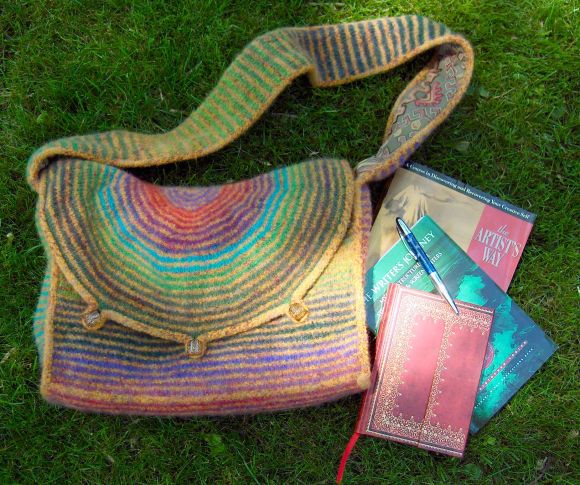
I used similar gold buttons that have metallic threads inside, bought at the same time, on my felted Stripey Noro messenger bag. (That link goes to the pattern page at Ravelry. This design of mine is a free pattern download.)
This button place reminded me of excursions with my mom when I was a kid – she would make the trek from suburbia on public transit to Dressmakers’ Supply on Avenue Road for notions like buttons. I thought it was an amazing place – all those boxes of buttons, sorted by colour! I also thought it was about six million miles north of Bloor St., but really it was maybe three blocks. We always walked that bit. Dressmakers’ Supply moved down to Queen St. West at some point and has since closed down.
There is another button store on Queen St. West now called Trillium Button – or maybe it’s the same place but on the other side of the street now – which I’ll have to check out the next time I’m downtown. Ha! I found a blog post from 2012 about the button store and it IS the same store, but moved west and to the north side of the street. Definitely worth a trip. (Here’s that blog post, which has some pix.)
And hmm. Now I’m wondering what to do with all that mohair in the stash…
Last year, I knit a lot for the girls as there’s something satisfying about finishing up a project quickly. It was time for a human-sized knit! This sweater for me really took a while, as I knitted it twice. Will I ever learn to knit a gauge swatch? Probably not. I just don’t like doing it and if the price is having to knit something twice, well, I don’t mind so very much. Usually, I realize what I’ve done sooner than I did this time. Often, I find other things I want to change in the sweater, anyway. That happened this time, too.
So, let’s take a look. The pattern is Sweater No. 9 by My Favourite Things. Here’s a Ravelry link and here’s the link to the pattern on the designer’s website. It’s a top-down sweater with some ribbing detail on the raglan lines, with two suggested lengths. Here’s one of the designer’s official pix:
I used some Rowan Kidsilk Haze Trio from my stash, in Loganberry. This yarn is wonderful and squishy as well as very light. It’s discontinued now, but you could replicate it easily by knitting with three strands of KSH (or similar) held together. The colourways have three different harmonious colours each – this one has a red, a burgundy and a more orangey-red hue.
Here’s a pic of the yarn, knitted up in green and in the ball in the red, as well as my Felix cardigan knit of a KSH-ish yarn held with a fingering weight merino. That gives a similar effect to the KSH trio but is a little bit heavier:
I had bought this yarn in two colourways, as you see above, and knit a sweater of the green colourway, called Fern, a while back. I used a Rowan pattern called Paige but turned it into a cardigan. Here’s my Ravelry project page and here’s my blog post. I don’t wear that one much, because the drop shoulders and the length make it seem like a droopy blanket. It is very light and warm, though. Here’s that sweater:
And here’s the new red cardigan – with one sleeve still on the needles. The pictures are less than ideal as it’s snowing and grey today. There’s not a lot of light, even with all the lights on in the kitchen.
I’ll finish it up this week – this yarn knits up quickly! – and when there’s a sunny day, I’ll take a pic of it outside.
The benefit of knitting something twice is that I can see what things I don’t love and change them out in my version. For example, I really dislike when ribbing doesn’t line up with the pattern in the body of the sweater. If you’re knitting a K2 P1 rib for the collar, as here, and there’s a K2 in the raglan rib, they should align IMO so that the K2 in the ribbing just continues on down into the sweater. That isn’t going to work in this case, since there’s only a P1 on either side of the K2 and the raglan lines are P2 K2 P2. So I changed the counts in my collar, plotting out the placement of the raglan lines from the outset and working P2 K2 P2 in the collar to line up with that. You can see the knit ridge in this photo, that continues up the collar.
My second change was also a result of that test knit. I tried on the sweater and oooooo, that yarn was itchy itchy on my throat. I know I can’t wear KSH against my skin but I had a moment of (unmerited) optimism. So, when I ripped it back, I split the front of the sweater, turning it into a cardigan with two moss stitch bands down the front. I wasn’t sure of my ultimate row count so I winged it with the buttonholes, but it worked out fairly well.
My third change was a result of comments on Ravelry. The fronts and the backs of a sweater should not be the same and interchangeable, since the neck should be lower in the front. I added four short rows between the back raglan increases before starting those raglan increases – I could see the P2 K2 P2 place in the ribbing – to make the back a little higher at the neck. It was an easy change.
Change number four was an inadvertent one. I finished the yoke and wasn’t sure what to do with the ribbing lines from the raglan once the body was joined in the round. Just stopping them looked silly to me, so I picked up an extra stitch to have another K stitch in the middle of the 4 purls, and carried them down the virtual side seam of the sweater. To my delight, everything matched up at the hem for the K2 P1 ribbing at the waist, just as I’d set it in the collar.
There are two suggested lengths in the pattern for the sweater and mine is in between. I tried it on, because there were a couple of Ravelry comments about the hem being in an unfortunate location and I wanted to be sure. I generally don’t like cropped sweaters as they seem too short for me, and as a shorter person, I often need to shorten a “regular” length sweater so I don’t look overwhelmed. 12.5 – 13″ from underarm to hem is good for me. That’s 32 – 33cm. This one is 22 cm from underarm to the top of the ribbing and the waist ribbing is 10 cm. It’s perfect for me.
The buttons aren’t a perfect match – a bit more burgundy than russet – but I like the bit of gold in them and they came from my stash, which is even better. (That is a fuzzy pic!) The funny thing about them is that the shafts aren’t all drilled at the same angle. I’m a little OCD about things lining up and buttons being at the same angle, so I may take these off and re-sew them so that the little gold swoosh has the same orientation on all of them. Right now, all the buttons are sewn on with the hole in the shaft at the same angle.
I really like this sweater. I like it so much that I’m thinking of ripping back the Ferny Paige and knitting a green version of this sweater of that yarn instead. I also have a sweater quantity of a tweedy yarn in the same weight, so will try the pullover with that first.
It also reminds me of a mohair sweater I knit a looooooong time ago, and I’ll tell you about that tomorrow.
Things have been quiet here on the blog. I’ve been writing a lot and solving a lot of publishing things – I’m still knitting and crafting but have been waiting to have a finished project to show you.
Here’s one.
This project jumped onto my needles after our trip to the Koigu Tent Sale in August. You might remember my acquisitions:
Those three reds were screaming to become a shawl, along with the grey/red mix and one of the lighter greys off to the right. (Not the lightest one.) Those two light greys look like a progression in hue, but they’re actually two dye lots of the same colourway. The right one is a bit more blue.
I showed you the shawl in progress, but here it is again:
I used a longer colour transition than the one recommended in the pattern: this is the one that The Unique Sheep suggests with their graduated colourways. It takes 24 rows when you’re working back and forth, 12 if knitting in the round. When changing from A to B and knitting back and forth:
With B, work 2 R. With A, work 6 R. With B, work 4 R. With A, work 4 R. With B, work 6 R. With A, work 2 R.
In the round, the row counts would be 1, 3, 2, 2, 3, 1.
It’s interesting how much evident the colour changes are in a photograph than in real life.
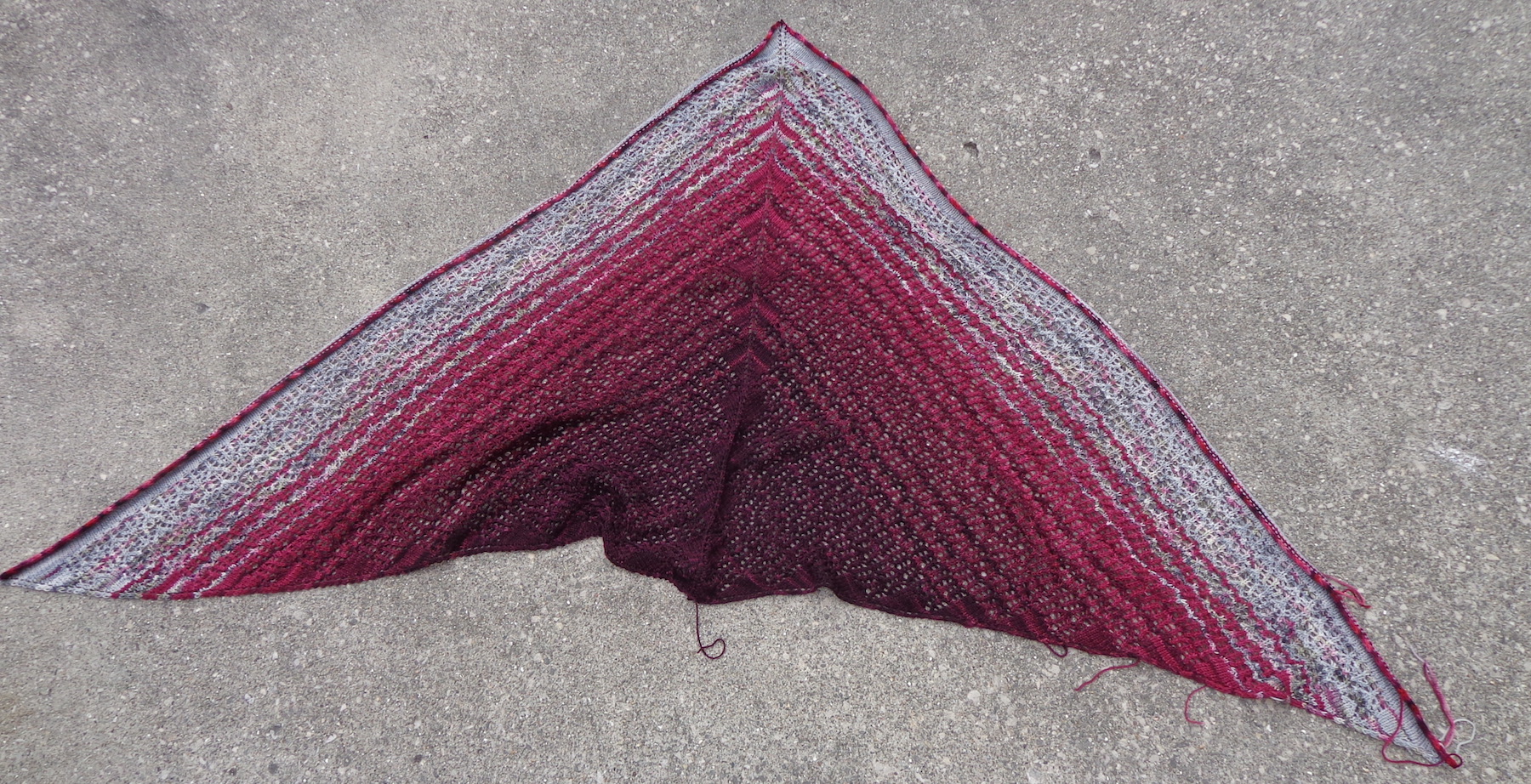
Here it is, fresh off the needles:
This used pretty much all of those five skeins of Koigu KPPPM – the bind-off I-cord is knit in the leftover red from my Lunenberg Cardigan. My Ravelry project page is here.
Here it is, stretched out to block. I was amazed that it blocked to 80″ – wingtip to wingtip – by 45″ deep.
Here it is finished up (well, the ends need to be stitched in.)
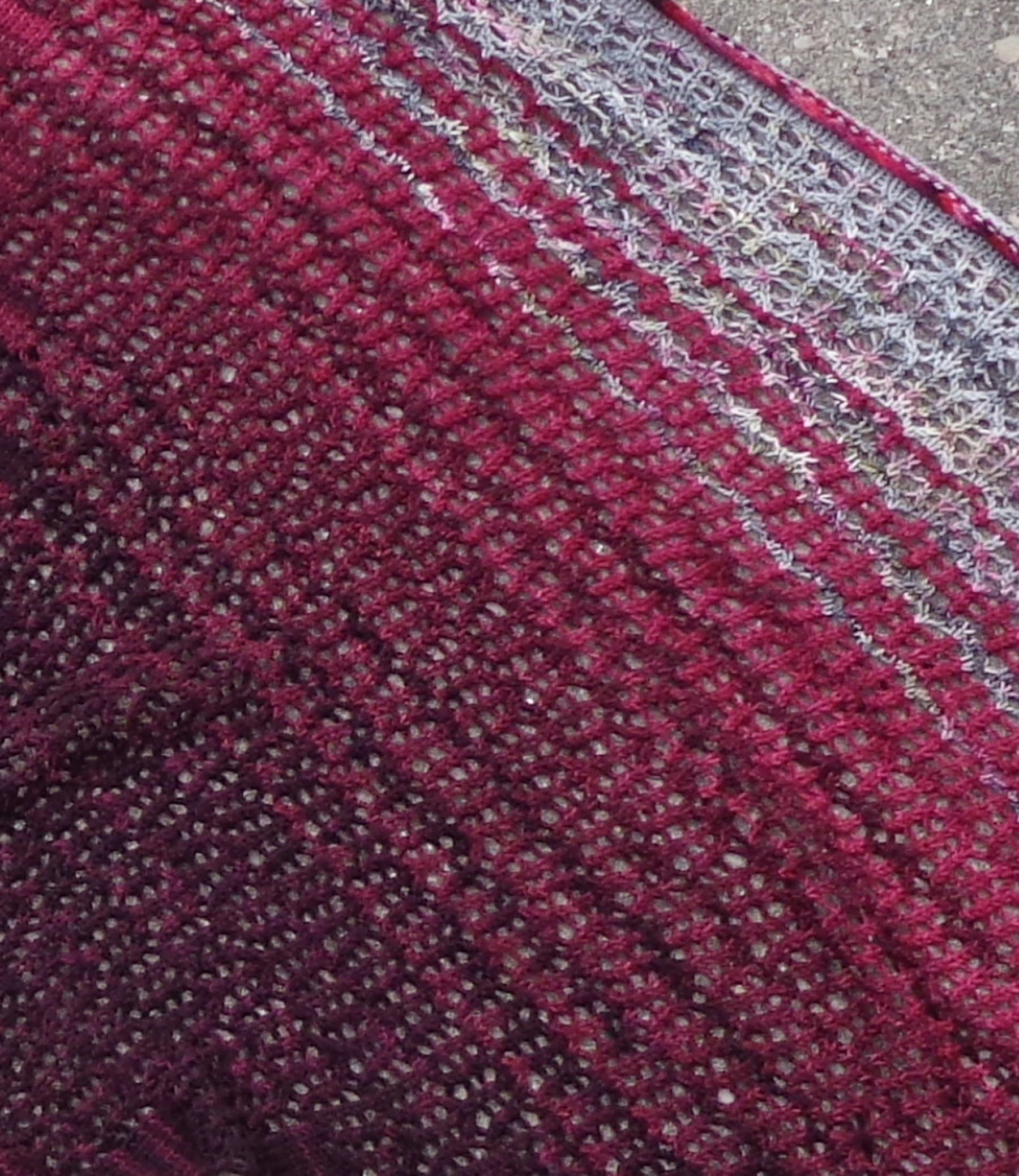
And a detail shot:
I did think it was too stretched after I’d blocked it, so I tossed it into the dryer with some towels that were finished up. (Just for about 10 minutes.) That took it down 4″ in the length and about 8″ across the top, and also improved (to me) the look and feel of the stitches.
I want to make another shawl, maybe not with the same stitch pattern, from those skeins to the right of the reds. I’ll start with the almost-black and work down to the pale grey. That will give me four skeins, so it will be a bit smaller than this one. I have a partial skein in a lovely purple-pink mix that will be great for the I-cord bind-off.
I’ve also been working on an Entrelac scarf for the mister in that Noro from the thrift store. I’ll show you that next week, whether it’s done or not. 🙂
I’m a day late this week in posting. Holiday Mondays tend to throw my game. I wrote on Monday, but didn’t get the other things done.
One thing we did in August was run away for the day to the Koigu Tent Sale. We always take a picnic and enjoy the scenic drive – plus, of course, there’s yarn that comes home with us.
Here’s what I bought this year:
It’s all Koigu KPPPM. (That link will take you to the Koigu site.)
I’m always looking for purply-blue yarn, esp since I used up the Koigu KPPPM that I had in blue for my Halo cardigan. I think this lot on the left will replace that lot 🙂 for a Latitude sweater. (That’s a Ravelry link.) I still have a lighter blue and white for the contrast.
The turquoises on the bottom row coordinate with the leftovers from my Navelli and will likely become a shawl.
The row with the burgundy through the black will become two shawls with gradient hues – the reds have already jumped onto my needles for another Charlotte’s Web shawl. (Another Ravelry link there.)
Here’s a picture of it in progress:
So far, these are in the order of the stash pic above, but I’m going to end with one of those pale greys. They’re the same colour but different dye lots – the left one will finish out my red shawl and I have scraps of another red – from my Lunenberg cardigan – for the I-cord bind-off. I prefer that to a fringe. The black and grey shawl will only have four skeins, so it’ll be a bit smaller. I have bits of a purple-pink mix to bind off that one which will be fun.
It’s interesting how much easier it is to see the colour changes in a picture than in real life. I’m using a 24R transition instead of the 16R one suggested in the pattern, the same sequence recommended when using Unique Sheep gradients. (My Urdr shawl is an example, though knit in laceweight.)
I also found some Noro Silver Thaw at the thrift store recently (that’s a Ravelry link) which will probably jump queue and leap onto my needles.
There are three skeins but I’ve already balled up one of them. I wanted to see how the colourway would work, whether it would stripe or fleck. It will stripe, like most Noro yarns, so I’m going to make an entrelac scarf and hat from this lot.
Berroco has a tradition of publishing patterns for miniature knitted sweater ornaments. Every year, I think I’m going to knit a bunch of them and make a garland of mini-sweaters as a Christmas decoration. This was the first year I actually cast on one of them. Here’s what happened.
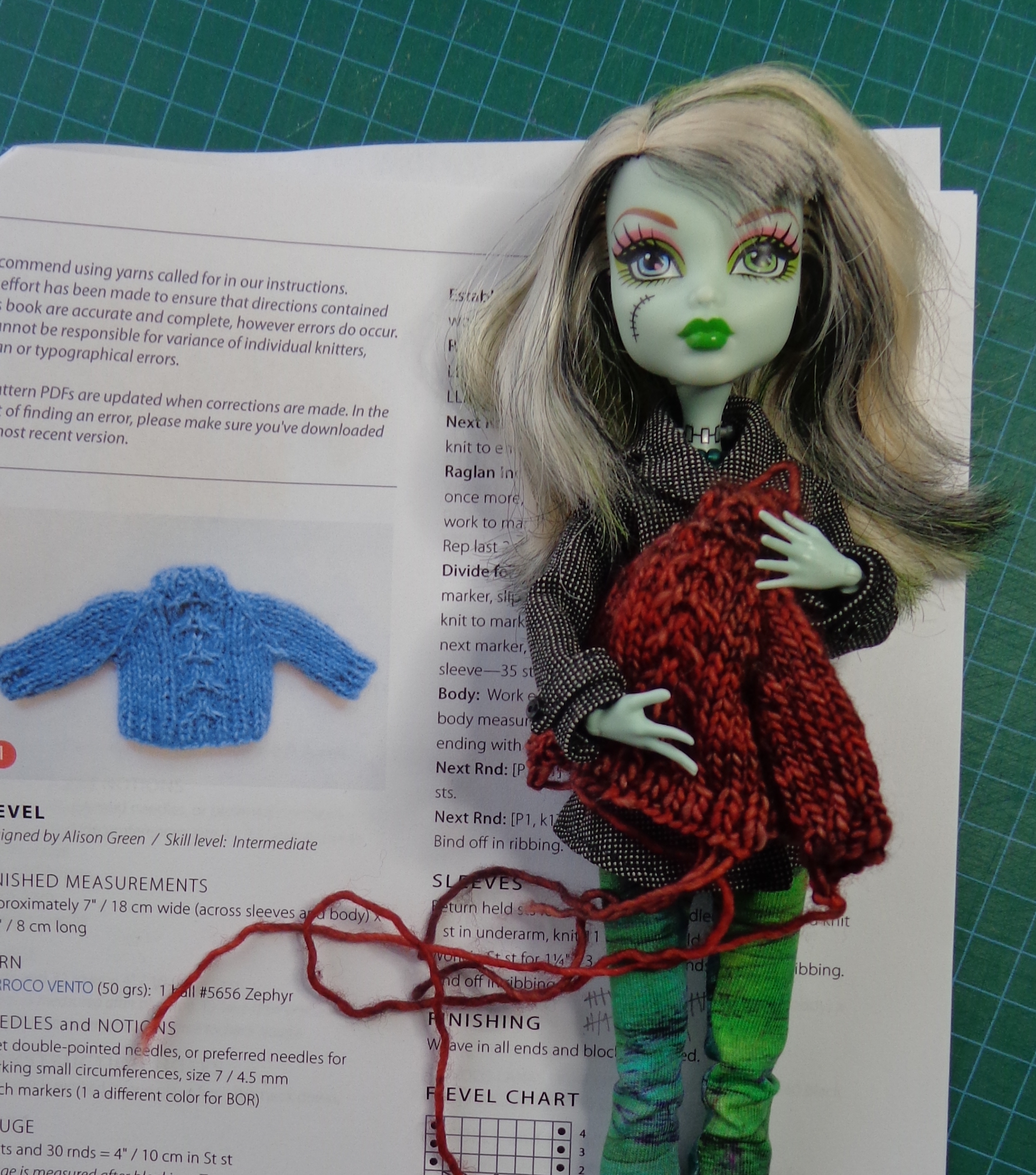
Fievel is one of the 2022 Minutia designs from Berroco. (Here’s the Ravelry link and here’s the Berroco link. This is a free download in both places.) It’s supposed to be knit in a DK weight yarn on 4.5mm needles, but I decided to make mine smaller. Here it is in MadTosh Merino Light in Cardinal, knit on 2.5mm needles:
There’s a small difference – I don’t have a single knit stitch following the raglan line on mine. Maybe that stitch is missing from the instructions. (?) The result is quite cute, though.
I was thinking about the size of this little sweater and then this happened:
She’s right. It would fit her – if she could get it on. And so, I revised the instructions: as instructed, you start knitting at the back left shoulder and work in the round. There’s not an opening, just an end to sew in. So, I moved the starting point to the center back and added a stitch so there’s a wee bit of overlap. I worked flat until the work was divided for the sleeves, then continued in the round. I had to make the sleeves longer (fortunately, you can take off the hands of MH dolls to get a sweater on).
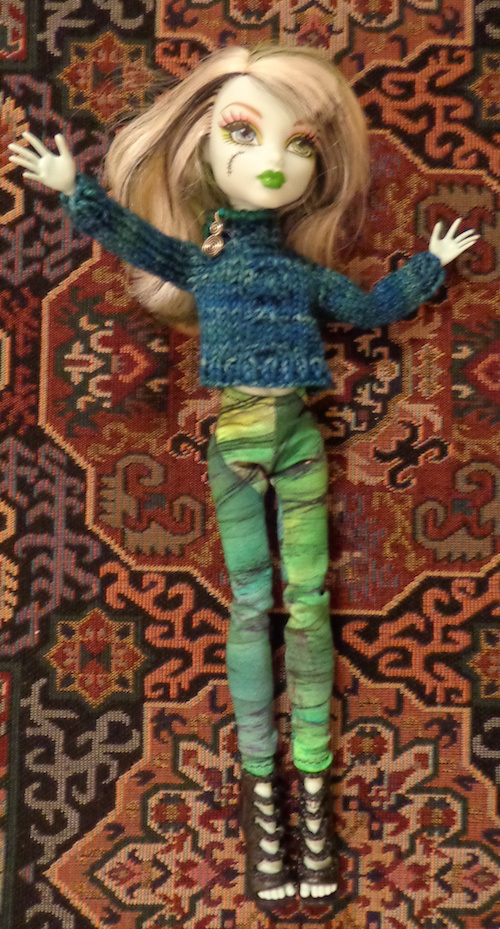
Here’s Frankie at right with her holiday sweater, a giftie from me. This one is Malabrigo Sock in Rayon Vert, knit on those 2.5mm needles.
Oddly, she doesn’t look much happier.
You can guess what happened next: Babs wanted one, too.
I used those same directions with the split at the center back but used a thicker yarn – this is Kidsilk Aura knit on 4.0mm needles. I’d been envisioning a chartreuse fluffy sweater for B with this yarn, as a good match with this fakey leather skirt. I had to frog this one back a couple of times, given B’s curves – I kept ending up with too much sweater in the back.
The final result has decreases on the back after the work is split for the body and arms, making the back narrower. It’s also shorter, more of a cropped sweater that ends at the waist. It opens all the way down the back – I’d thought of joining it, but there was all that bulk and I went with simple. There are snaps on the back and little non-functioning buttons.
If I knit it again (ha!) I’d change the stitch distribution so there were more stitches on the front than the back. It is a bit stretched over her bust, and that’s where the extra bulk is in the back. At least two stitches should move, maybe four. The decreases in the back might not be necessary then.
Here are the three versions.
Phew. Do I dare to cast on another mini-sweater Christmas ornament?
About ten years ago, I designed a cozy for our French press coffee pot called Java Ninja. It’s a free download from Ravelry. The original Ninja looked like this:
I knit this one in two colours of Patons Classic Wool Tweed. It’s knit top-down, then I added to contrasting I-cord at the top and the flap to go under the handle for the buttons.
Over the years, coffee dribbled, the wool soaked it up, the wool felted when washed and we broke that French press. Our current one is a bit taller. Mr. Math also was not a fan of the buttons – since he makes the coffee, his opinion rules.
I made a new coffee cozy recently. I called it Rogue Ninja because I simplified the pattern. There’s only one colour of yarn, there’s no flap or buttons and no contrasting I-cord at the top. I also used a heavier yarn and knit it more tightly. Red Heart Gemstone is an acrylic yarn with a slow gradation. It won’t felt. It’s also a bulky weight instead of a worsted, so I knit it on bigger needles and increased the top to fewer stitches all around.
Here’s the result:
This used 55 grams which is just over a quarter of a ball. I’m quite pleased with how it came out. It’s very sturdy and will actually stand up by itself, which makes it look like a medieval knight’s tent.














 Alive & Knitting