Nightshift Update

Nightshift is a gorgeous shawl pattern by Andrea Mowry (Drea Renee Knits). Hers is knit in a beautiful self-striping yarn called Spin Cycle Yarns Dreamscape. It’s an aran weight yarn, though, and I was worried about the shawl ending up like a blanket. I decided to use up some of my Koigu KPPPM, which is a fingering weight, for my Nightshift. Of course, using a thinner yarn means knitting twice as many stitches to make a shawl of decent size. I cast on last July with these skeins.

Nightshift shawl by Andrea Mowry knit in Koigu KPPPM by Deborah Cooke

I’ve blogged about this shawl a couple of times already: Nightshift in Koigu KPPPM and Navellia, Nightshift and Audrey.

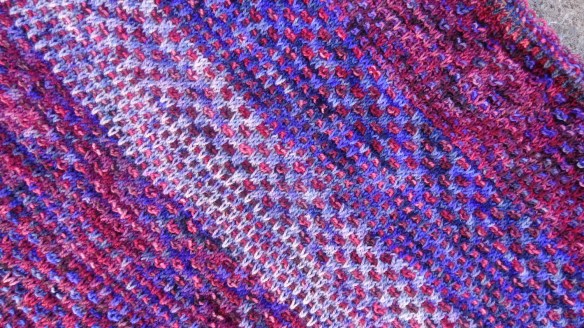
I’ve been working on this while sheltering in place, and am making steady progress. It’s not done, but I thought I’d show you today how it’s coming out. Here it is on the needles – it’s big enough that I can’t stretch it out to its full width:Nightshift shawl knit in Koigu KPPPM by Deborah CookeI’m on the 11th repeat and am hoping to do 15. I’ll see how the yarn lasts.

Here’s a detail shot:Nightshift shawl knit in Koigu KPPPM by Deborah CookeI like how the colourways mix and mingle with each other, because several of the same reds appear in both my red main colour and several of the contrast ones.

How is your knitting during Covid-19?

Comfort Fade Cardigan Completed

In moving my posts over and updating their links, I found some gaps. Here’s one: I’d said I would show you my completed Comfort Fade Cardigan in Rowan Colourspun, but never did. Here are the older posts: Comfort Fade Cardigan 1 and Comfort Fade Cardigan 2.

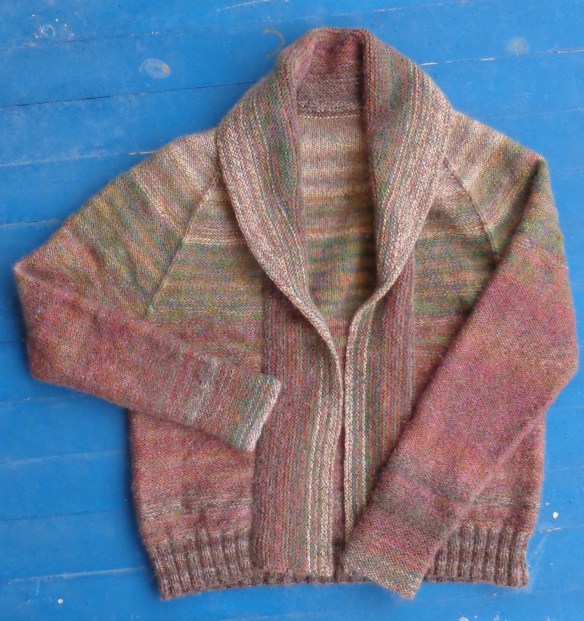
And here’s the finished cardigan:Comfort Fade Cardi by Andrea Mowry knit in Rowan Colourspun by Deborah CookeI’ve worn this a fair bit. It is odd that it doesn’t have a front fastening, although I’m sure I could add one. I do think I mucked up the sleeve decreases as they’re narrow – fine for wearing but less fine for pushing up to the elbow as I’m inclined to do with my sweaters. They’re also a bit long for me. And I know that I somehow did too many short rows on the collar: it’s quite substantial! That makes it snuggly, though – and is one of the hazards of knitting anything other than plain rows while watching tv.

It is a pretty cardigan, though, and a warm one. It’s a complete bonus that I knit it out of stash yarn! What do you think?

Felix, A New Sweater

I recently finished a new cardigan with yarn from my stash. Now that it’s blocked and finished, let’s have a look.

Felix Cardigan by Amy Christoffers knit in Rowan Renew by Deborah CookeThe pattern is Felix, (that’s a Ravelry link) a boxy top-down raglan cardigan with a nice detail on the raglan increases. It knits up pretty quickly and, since it’s knit top-down, you can try it on as you go to check the fit. I used Rowan Renew, a discontinued yarn with a tweedy fleck. (That’s a Ravelry link for the yarn, since it’s not on Rowan’s website anymore.) The yarn is made of recycled wool – hence the name – which is pretty cool.

I really like that raglan detail and I love this yarn. It has a subtle stripe as well as the tweedy fleck.

Felix Cardigan by Amy Christoffers knit in Rowan Renew by Deborah CookeThe red colourway is called Pick-up, but I didn’t have enough of it for the whole sweater. I added the dark grey, also Renew, in the colourway Lorry, and modified the pattern to have striped edges in garter stitch. It turned out that I used 1.4 balls of grey and had 1 ball of red left over, so I could have almost made it all red. The buttons came from my stash, too. I like the leaves on them for this sweater, since the red reminds me of autumn colours.

Here’s my Ravelry project page for this sweater.

In addition to modifying the ribbed hems and button band to be garter stripes, I made the sleeves narrower at the cuff. I like the narrower sleeves on my Koigu Lunenberg cardigan. This was all good until I washed the sweater to block it. It stretched like mad! I put it flat to dry but knew all that extra length wasn’t going to just disappear – so I tossed it into the dryer when it was still damp. This meant that the wool fulled as the sweater shrank back to its original length. It’s thicker and softer than it was, which is good, but it’s also a little bit narrower. The sleeves still fit, but I can’t push them up as much as I like to. (Maybe this will break my bad habit…) I’m curious about this stretching and wonder whether it had something to do with the wool having been recycled. (?)

Either way, I’ve cast on another Felix in Rowan Renew in a green colourway called Digger. I have twelve balls of this colour and the sweater takes 11.5 so it can all be one colour. I’ll make the sleeves a few stitches wider at the cuff on this one, in case the same thing happens when it’s washed. I haven’t decided whether to rib the cuffs and button band, like the pattern, or do them in moss stitch. Here’s that Ravelry project page.

What do you think?

The Red Koigu Cardigan Completed

I finished my red Lunenberg cardigan (that’s a Ravelry link) and I just love it. This is a basic cardigan but using the Koigu KPPPM really made it spectacular.

Lunenberg Cardigan by Andrea Hungerford knit in Koigu KPPPM by Deborah CookeOnce again, the colour isn’t true in the pictures. It’s a cherry red, but seems to photograph pink.

I was really pleased that the colours didn’t pool at all. The sleeve caps ended up looking a bit lighter than everything else, but it was just the way the colour worked out.

I showed this sweater to you earlier, without the sleeves, in this post.

I changed out the ribbing for garter stitch, because I really like how KPPPM looks in garter stitch. I used just over 8 skeins of KPPPM, so there could be another of these in my future. Here’s the link to my project page on Ravelry.

What do you think?

Progress on the Red Cardigan

I haven’t had any knitting to show you for a while, because I’ve been knitting away on a couple of big projects. I’ve almost finished the Wingspan shawl – I’ve knit the wing tips and cast off half of the shawl width. I have to do the other side, then block it, so I should have that to show you soon.

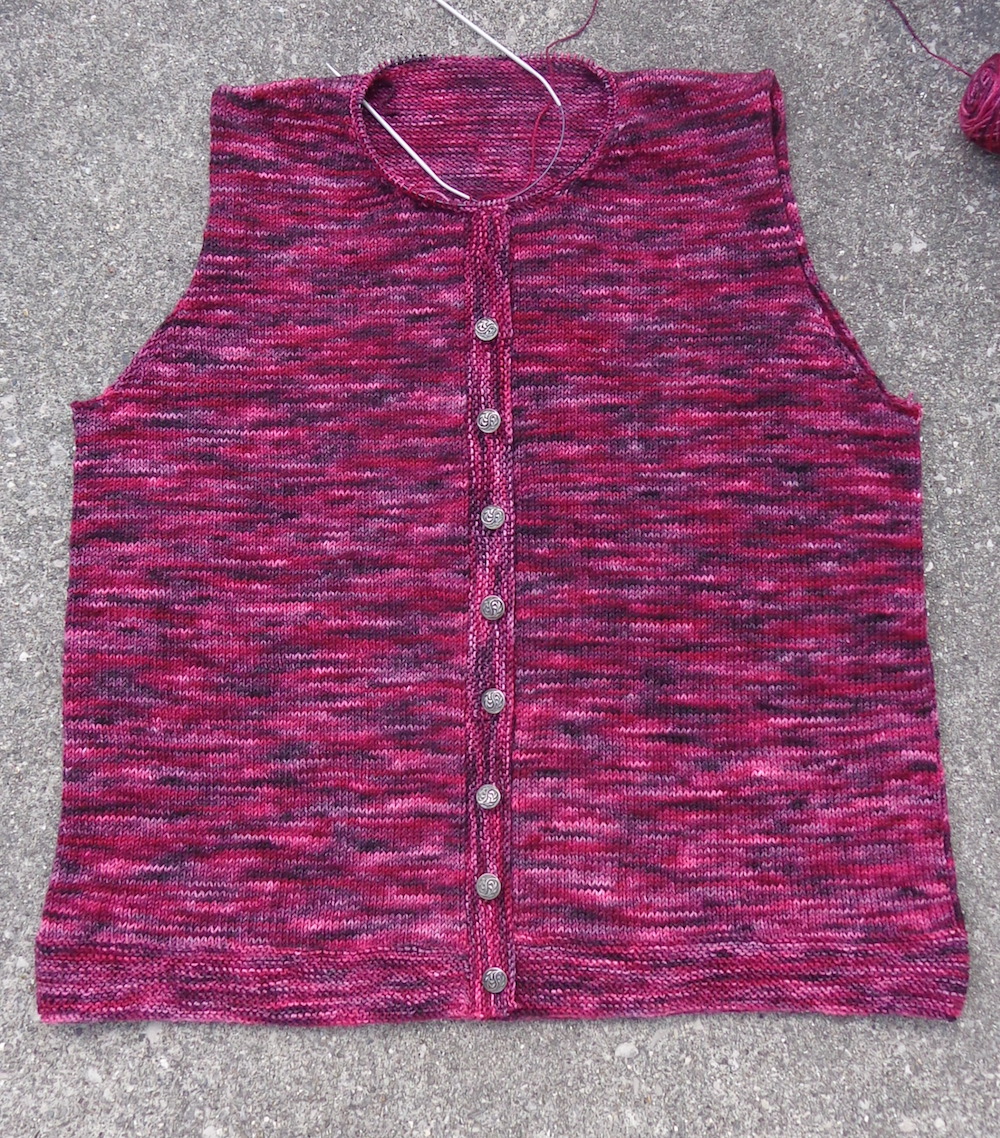
Here’s a progress report on my red cardigan in Koigu KPPPM. I’m working on the collar right now – you can see my needle in the stitches – then have just the sleeves to knit.

Lunenberg Cardigan by Andrea Hungerford knit in Koigu KPPPM by Deborah CookeOnce again, the colour looks a lot more pink in this image than it actually is. The yarn is a wonderful rich red and not very pink at all. (I talked about that in my last post about this project.) It actually matches the currant jelly I made this week. 🙂

The pattern is the Lunenberg cardiganhere’s a Ravelry link. The pattern is included in By Hand Serial #9 – you can see more about that publication on their website, here.

I’ve made some changes. Instead of ribbing on the hem, button bands and collar, I’m using garter stitch – mostly because I love how garter stitch shows off the colours of Koigu. I made a mistake in my calculations for the button band – there are supposed to be 8 buttons on the button band and one in the collar, but the way I figured it out, there are 9, plus the one in the collar. I’m not going to rip it back because I have another card of these buttons. Here’s my project page on Ravelry.

I am loving the softness and the colours of this yarn – which means, yes, we’ll be making another trip to the Koigu tent sale this August.

What do you think?

Comfort Fade Cardigan 1

There is a new(ish) knitting trend to knit with colours dyed in a progressing, fading from one to the next. For me, this started with Andrea Mowbry’s shawl Find Your Fade, which was published in December 2016 and is enormously popular. There are over 8000 projects on Ravelry! Andrea has designed other knitwear that features this kind of colour shift, and I’m knitting one right now.

Her Comfort Fade Cardi is an open-front, shawl collar cardigan, which is knit from the top down. It has raglan sleeves and requires four colours to fade into each other over the length of the cardigan. Since I always find it a bit dull to knit cardigans in stockinette stitch, I thought that watching the colours might motivate me. (It worked for my Hebrides cardigan, knit in striped KidSilk Haze.)
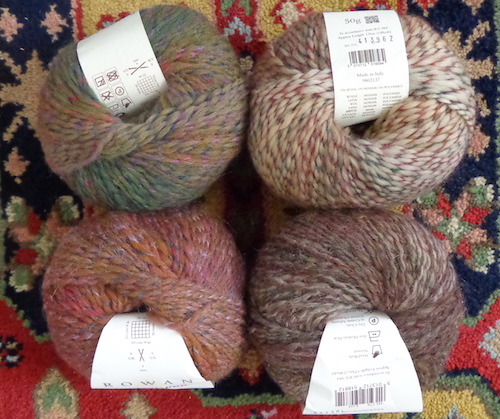
Rowan ColourspunFor this project, I raided my stash and chose my leftovers of Rowan Colourspun. I had knitted Mr. Math a vest in this yarn, then bought more to make myself a sweater when it was discontinued. Here’s a post about his vest. The pattern is called Skye.

So, in my stash, I have a russet, a brown, a green and a taupe in the Colourspun. This yarn has a gradual gradation and is kind of heathered. I thought it would be a good choice for a fade. I don’t have the right quantities that the pattern calls for – I have enough yardage, but more russet than I need and less brown. The yarn is discontinued, so I’ll work it out.
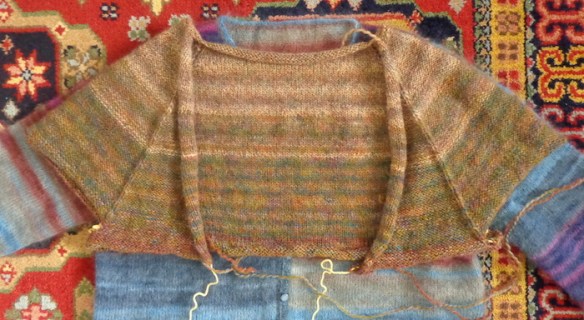
Comfort Fade Cardi by Andrea Mowry knit in Rowan Colourspun by Deborah CookeHere’s the cardigan as of last Sunday. I’d just divided for the arms. You can see that the ribbing for the neckline has a good bit of space to fill – this sweater is designed to be worn open, so the fronts with the ribbing will just meet. It’s also designed so that the purl side is worn out, which makes it look even more blended.

I used the taupe first, then the green and have just started to fade into the russet. think it’s funny that the brightest bit of the taupe fell in the last two rows of it after fading into the green. 🙂

Here’s a look at the many colours in this yarn – I’ve been knitting more since the other pix were taken on Sunday, so it’s longer now:Comfort Fade Cardi by Andrea Mowry knit in Rowan Colourspun by Deborah Cooke

At the right is the taupe, fading into the green – which you can see is striping on its own – then into the russet. At the left, I’ve just started to transition to the brown.

I have a hard time getting a good fit with top-down raglans, but I think I’ve finally figured out why – which means I know what to do about it in future. I hadn’t finished the specified increases but it looked big, so I took it off the needles to try it on. (This is a very cool thing about top-down raglans – you can try them on as you go.) Then I compared it with a sweater I already have, which fits – in this case, one of my Hebrides in KSH. The Hebrides has a closer fit and is in a finer yarn, but you can see that it was definitely time to break for the sleeves. If I’d knit those remaining 12 rows, the sweater would have been droopy.Comfort Fade Cardi by Andrea Mowry knit in Rowan Colourspun by Deborah Cooke

And here’s where I had my Eureka moment. See how wide the neckline is compared to the other sweater? Of course, the style is different, but when I try it on, it’s trying to fall off my shoulders. I’m narrow in the shoulders and when I sew, I always cut a smaller size above the bust to accommodate that. I should be casting on a smaller size than the one specified for my bust when I knit a raglan sweater for exactly the same reason. Aha!

I’m not going to frog this and start over, though. It’ll be a little slouchier than the original design, but I really like it. I have a feeling I’ll be knitting this pattern again, and will incorporate my changes then. In the meantime, I can fix another sweater that’s been waiting on me because I know what to do.

What do you think of this cardi so far?
Stylish Dress Book – Sleeveless Dress A

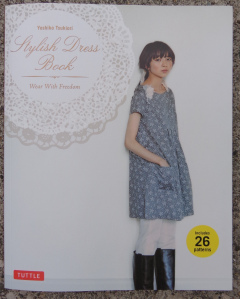
Time for more reports about sewing from Japanese pattern books. Today’s feature is a sleeveless dress pattern (A) from Stylish Dress Book.

Pattern A  is an A-line sleeveless dress. I made it first in black linen – since I’d had such success with the smock, I decided not to do a practice dress.

Sleeveless Dress A from Stylish Dress Book sewn in linen by Deborah CookeIt came out beautifully, although I found it a little tough to roll the narrow bias hem with the linen. The pattern calls for a lighter fabric and the weight made a difference on that narrow bias. If I used linen again, I’d cut the bias strip 1/4 wider.
I love how it looks. It’s a great layering piece.

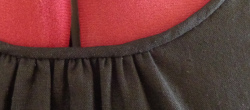
Sleeveless Dress A from Stylish Dress Book sewn in linen by Deborah CookeHere’s the neat neckline. It’s a little detail that gives the dress the perfect interest, I think.

I made another one of these in a red cotton border print. This is a lot more flashy, but also a fun simple dress.

Sleeveless Dress A from Stylish Dress Book sewn in cotton by Deborah CookeThe stripe was on the selvedges, so I cut the dress crosswise to have the stripes at the hem. This meant that it took very little fabric to make the dress: I only had 2m of this because I bought the end, and it was just 42″ wide. I was excited to be able to get a dress out of it. I matched the position on the hem and let the height fall. You can see that there is more of the stripe on the opposite selvege at the shoulder on the front than on the back—that’s because the bodice darts make the front slightly longer than the back. That’s an excellent reason to match the borders at the hems rather than at the shoulders.
This cotton is a little bit stiff, although it may soften over time. The next one of these I make will be in a fabric with more drape, just to see the difference. I suspect that it works best in fabric that has more body, but we’ll see.

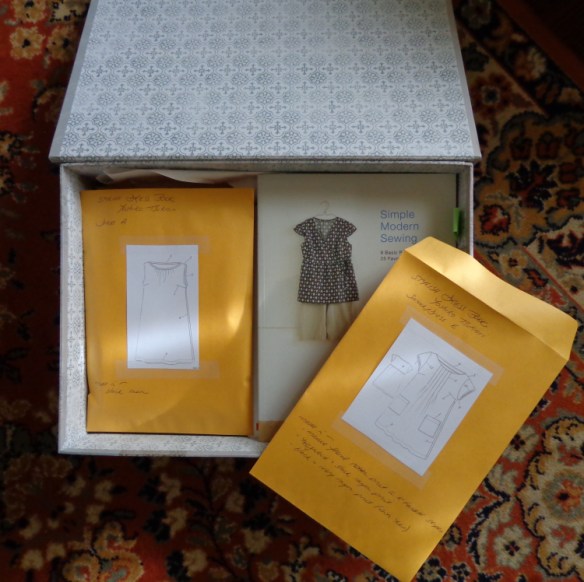
I needed to get organized with these patterns, too. Because you trace them out yourself, there’s no neat way to store them away when you’re done with each piece. I decided to mimic store-bought patterns and bought some envelopes as well as a pretty box at Michaels (they were on sale). The envelopes fit perfectly and there’s one for each pattern. The books also fit in the box.

Here’s where my patterns live now:
Deborah Cooke's pattern box

Finished Snow Angel Shawl

You might remember that I was knitting a lace shawl. The pattern is called Snow Angel and it’s by BooKnits – here’s the Ravelry link for the pattern. I knit it in a gradient dyed yarn called Freia Ombré Lace in the colourway Autumn Rose. I actually ran out of yarn, so used some Elann Silken Kydd from my stash. I think the colourway is Baked Apple, and I worried it might be a bit dark, but I like it. I also used green glass beads with copper linings, in the positions specified in the pattern.

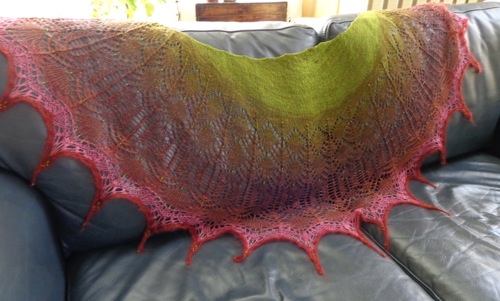
Here’s the finished and blocked shawl on the back of the couch. I’m not sure why I’m so surprised by the size of it but I am. I had in mind that it was going to be a scarfy little thing, but it’s a shawl. The colour is the most true to life in this first picture.Snow Angel by Boo Knits knit by Deborah Cooke in Freia Ombre Wool/Nylon Lace

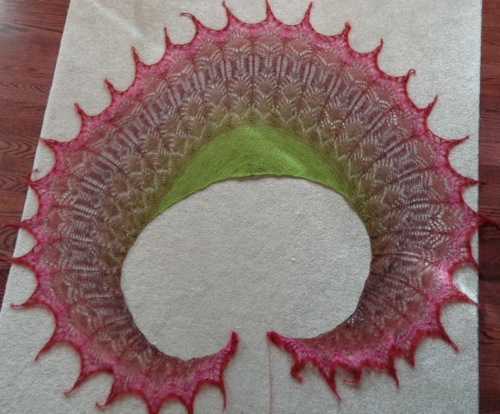
Here’s the whole thing spread on a rug so you can see the crescent shape of it, and the gradation in the colour. And yes, it’s too big for this rug!Snow Angel by Boo Knits knit by Deborah Cooke in Freia Ombre Wool/Nylon Lace And here’s a detail of the middle of the shawl, though it’s a bit blurry. It’s always amazing to see how the lace opens up when it’s blocked. It was hard to discern the pattern in those photographs taken while the shawl was on the needles, but not it’s obvious.Snow Angel by Boo Knits knit by Deborah Cooke in Freia Ombre Wool/Nylon LaceI’m very happy with this one. What do you think?
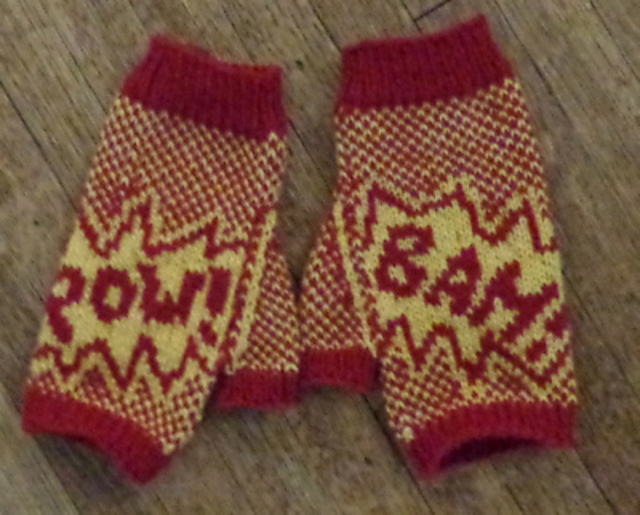
Fightin’ Words

These were too much fun – I love knitting them and I’m hoping the recipient loves wearing them. In fact, I’ve cast on another pair.

The pattern for these fingerless gloves is Fightin’ Words (that’s a Ravelry link) and I knit them in Knitpicks Palette. (Every time I look at this yarn on the KP site, I’m tempted by their Palette Sampler, which includes one ball each of 150 different colours. What fun!) The pattern was available at a special price for December as part of an indie-designer knit-a-long.Fightin' Words by Annie Watts knit in KnitPicks Palette by Deborah CookeWhat do you think?

Sipalu Felted Bag

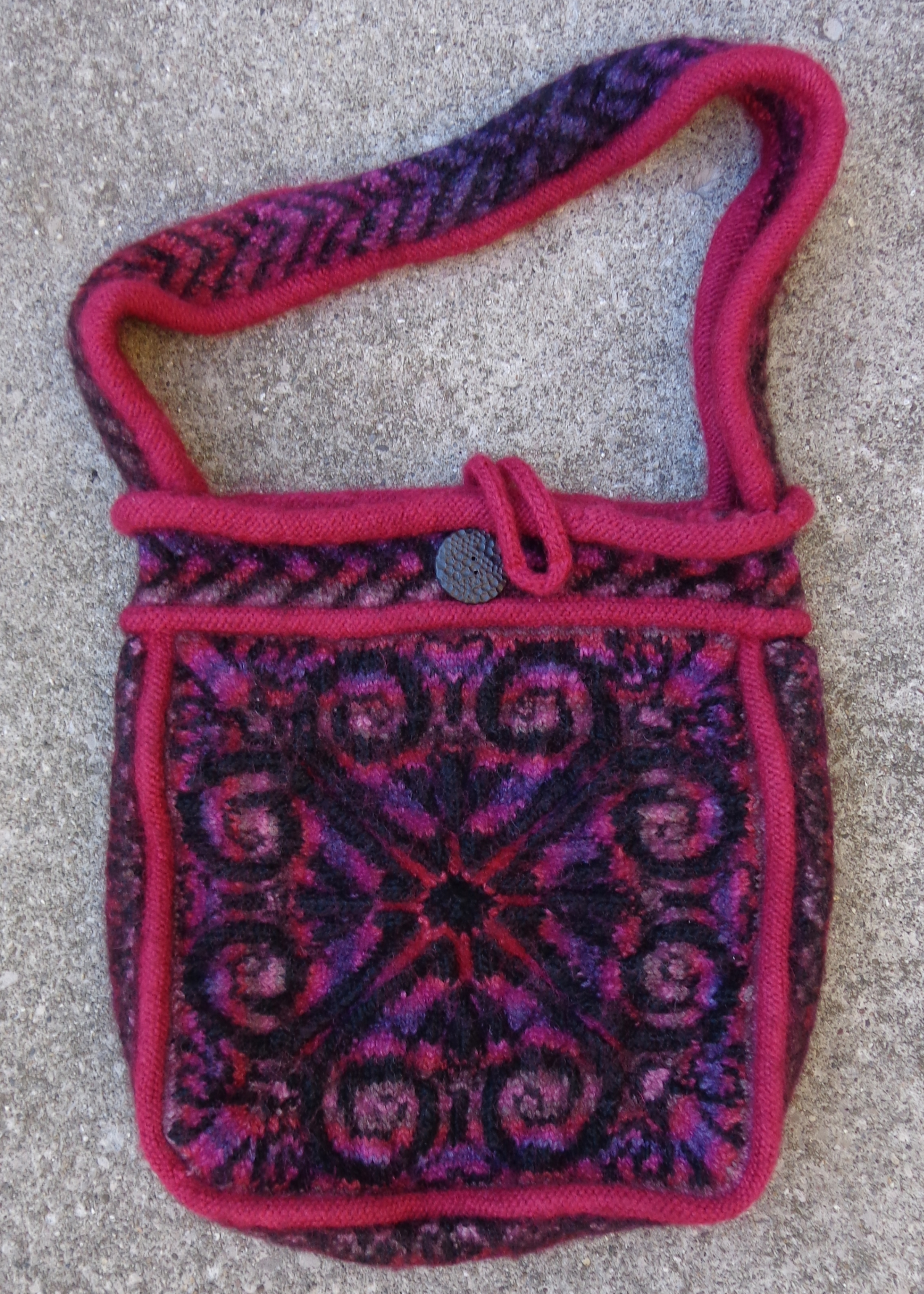
I’ve finished another felted bag – is it possible to have too many of them? – and although it still needs to be lined, I thought I’d show it to you today. It won’t look any different from the outside once it’s lined, after all. 🙂

The Sipalu bag was available from Knitpicks as a kit, including the wool, but I didn’t like that it wasn’t felted. I knew the result would be less sturdy unfelted, particularly knit of a fingering weight yarn (the kit came with Palette.) The pattern for the Sipalu bag was and is available on its own, so that’s what I bought. The pattern specifies knitting with a number of colours, but I decided to use a self-striping yarn with a contrasting solid instead. I dug into my stash and came up with my felting standby, Patons Soy Wool Stripes and Soy Wool Solids. I used Black and Natural Plum.

I did run out of black. Since the SWS yarn is discontinued, I couldn’t find any more. (I tried.) I then substituted solid red SWS, but didn’t like it in the fair isle – there wasn’t enough contrast with the self-striping Natural Plum – so I frogged that back but used the red on the garter stitch edges. The bag sat, unfinished, in my knitting basket while I tried to figure out what to do. One day I saw a very similar yarn to SWS balled with another company’s label, which gave me the idea of using the Ravelry search engine to find a substitute. Ravelry has a great search engine that lets you specify many variables – I used the content (soy and wool) and the weight (aran) , then looked for single ply yarns in solid colours. I found Gjestal Bris, with a buy link, so ordered some of that. It’s a bit thinner than the SWS, but since I was felting the end product, it worked out just fine.

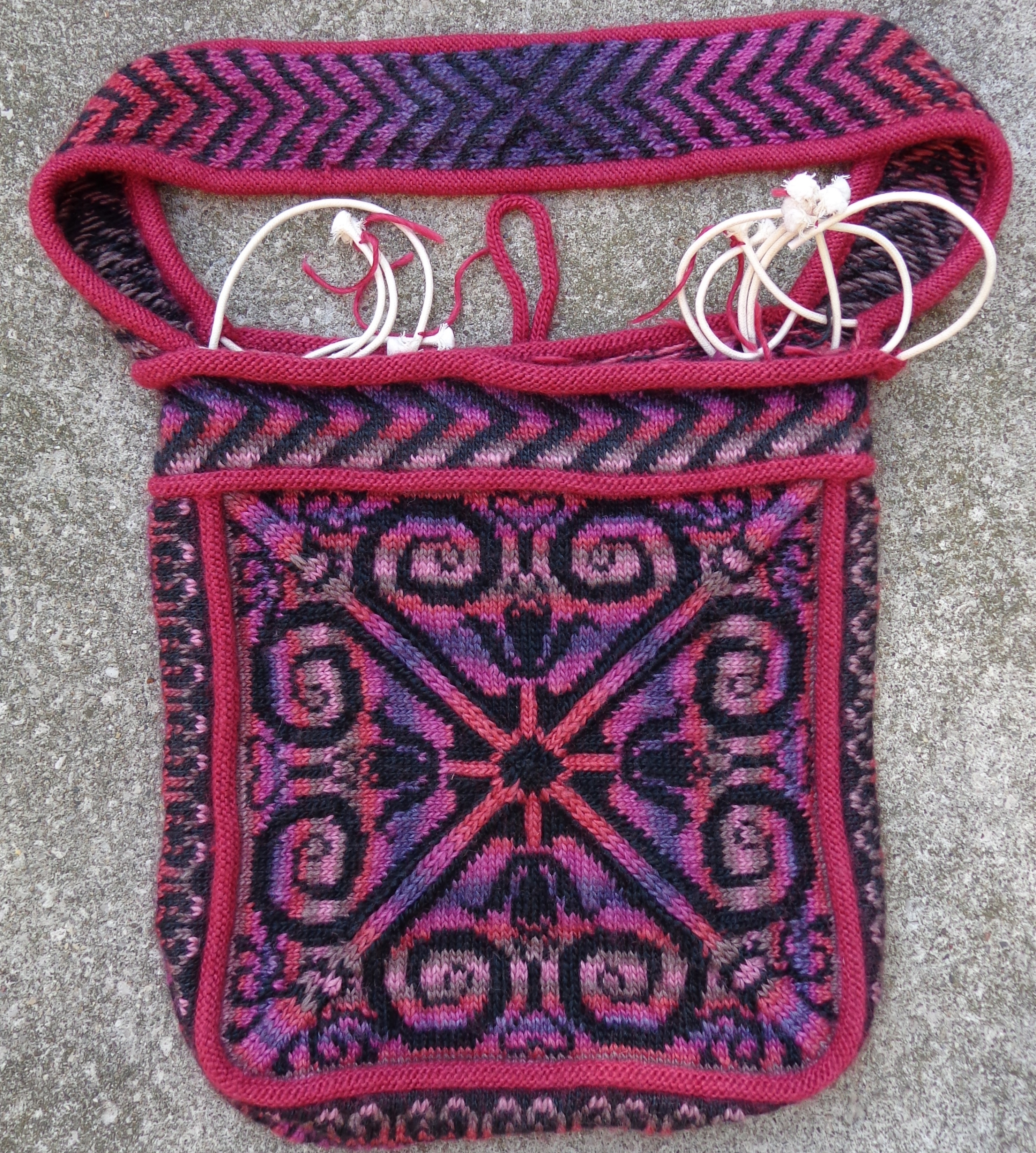
Here’s the unfelted version of the bag: Sipalu Bag by Kerin Dimeler-Laurence knit in Patons SWS by Deborah CookeYou’re probably wondering about the white cording. I decided that I wanted the edges of the bag to be more round than the garter stitch alone would make them. I wanted them to be like piping around the edge. So, I bought some cotton cord at the fabric store, the kind that’s used to make piping (!), and sewed it in to all the edges. (I slip-stitched the garter stitch ridge closed on the inside of the bag, with the cord trapped inside.) Because I wasn’t sure if the cord would shrink – or whether it would shrink at the same rate as the SWS – I left the ends long. After the felting was done, I tugged the cords so that the piping was smooth on each edge, then trimmed them and secured the ends inside the bag.

Here’s the bag felted and ready for its lining. It could have been felted just a little bit less, but felting is an inexact science. The button is handmade of porcelain. Sipalu Bag by Kerin Dimeler-Laurence knit in Patons SWS by Deborah CookeHere’s my project page on Ravelry, if you want to see more nitty gritty details.

What do you think?