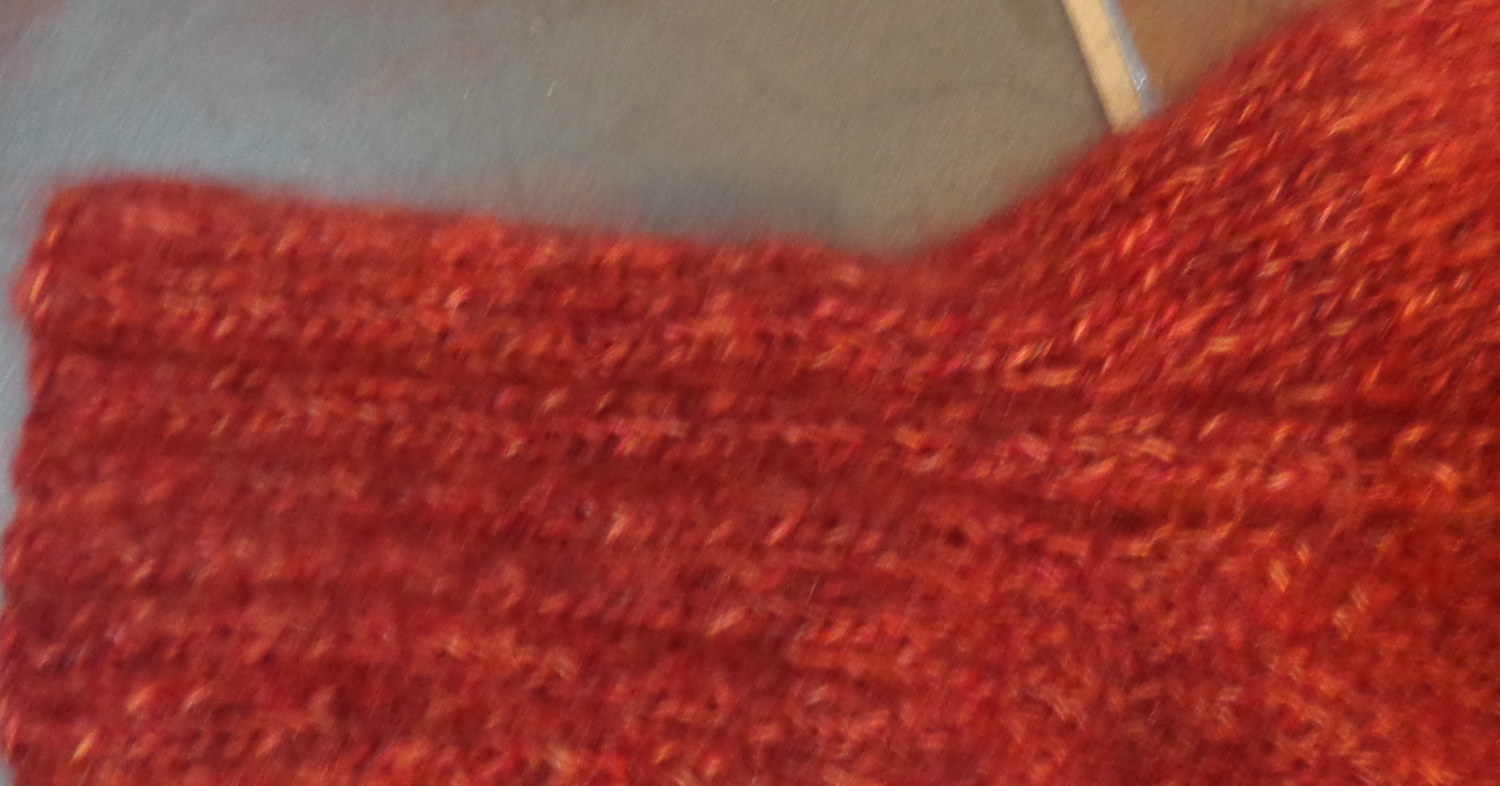
The colour is pretty true in this picture. I really like this sweater: it’s light, warm and red! I’m swatching with another yarn (we can gasp in unison at that bit of news) to try the pullover version next.
Here’s a better shot of the buttons that don’t quite match.
They’re a little more pink than russet, but I like those two gold lines in them a lot. They’re staying. 🙂
I’m also embarked on a long-overdue sort of my fabric stash, which will continue to my yarn stash. It’s time to get organized, and time for some things to find new (more appreciative) homes.
I’ve noticed that the fabrics headed out the door fall into three groups: the first group is the biggest. My colouring was Autumn before I let my hair turn grey, so I had a lot of Autumn-favouring fabrics in my stash. I still like the russets and burgundies, the olive and some of the brown. The gold, taupe and beige, though, just don’t work for me anymore. I also used to wear white shirts a lot, and they don’t work for me anymore either —they’ve been culled from my clothing stash and are leaving my fabric stash, too. (There are compensations. Now I can wear black.)
The second group of fabrics are graphic prints. I like bold prints on the bolt and often admire them in the store. Some have come home with me over the years. I tend not to like them as much once they’re garments, or I like them but don’t wear them. They’re leaving, too.
Finally, there’s a shade of pink. Maybe it’s a pink that is supposed to work for Autumn colouring. (?) We used to call it dusty rose – it’s a mucky pink, not a clear clean one. Now it looks like Pepto-bismol to me, so out it goes.
It is very interesting to see how things pull together after my measuring, sorting and stacking. There’s a new cohesiveness in my stash, which I like — it makes me want to display it, not pack it away LOL — and which is also inspiring. I can see how things coordinate and work together, which gets me planning. It’s proving to be a useful exercise, though a time-consuming one. I expect I’ll be sewing more in the near future and not just for the girls. That makes me happy. 🙂
Last year, I knit a lot for the girls as there’s something satisfying about finishing up a project quickly. It was time for a human-sized knit! This sweater for me really took a while, as I knitted it twice. Will I ever learn to knit a gauge swatch? Probably not. I just don’t like doing it and if the price is having to knit something twice, well, I don’t mind so very much. Usually, I realize what I’ve done sooner than I did this time. Often, I find other things I want to change in the sweater, anyway. That happened this time, too.
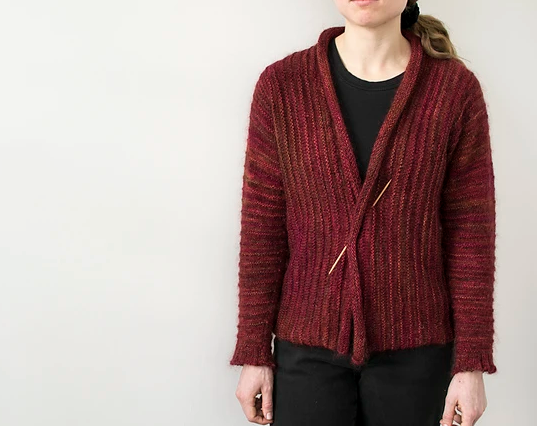
So, let’s take a look. The pattern is Sweater No. 9 by My Favourite Things. Here’s a Ravelry link and here’s the link to the pattern on the designer’s website. It’s a top-down sweater with some ribbing detail on the raglan lines, with two suggested lengths. Here’s one of the designer’s official pix:
I used some Rowan Kidsilk Haze Trio from my stash, in Loganberry. This yarn is wonderful and squishy as well as very light. It’s discontinued now, but you could replicate it easily by knitting with three strands of KSH (or similar) held together. The colourways have three different harmonious colours each – this one has a red, a burgundy and a more orangey-red hue.
Here’s a pic of the yarn, knitted up in green and in the ball in the red, as well as my Felix cardigan knit of a KSH-ish yarn held with a fingering weight merino. That gives a similar effect to the KSH trio but is a little bit heavier:
I had bought this yarn in two colourways, as you see above, and knit a sweater of the green colourway, called Fern, a while back. I used a Rowan pattern called Paige but turned it into a cardigan. Here’s my Ravelry project page and here’s my blog post. I don’t wear that one much, because the drop shoulders and the length make it seem like a droopy blanket. It is very light and warm, though. Here’s that sweater:
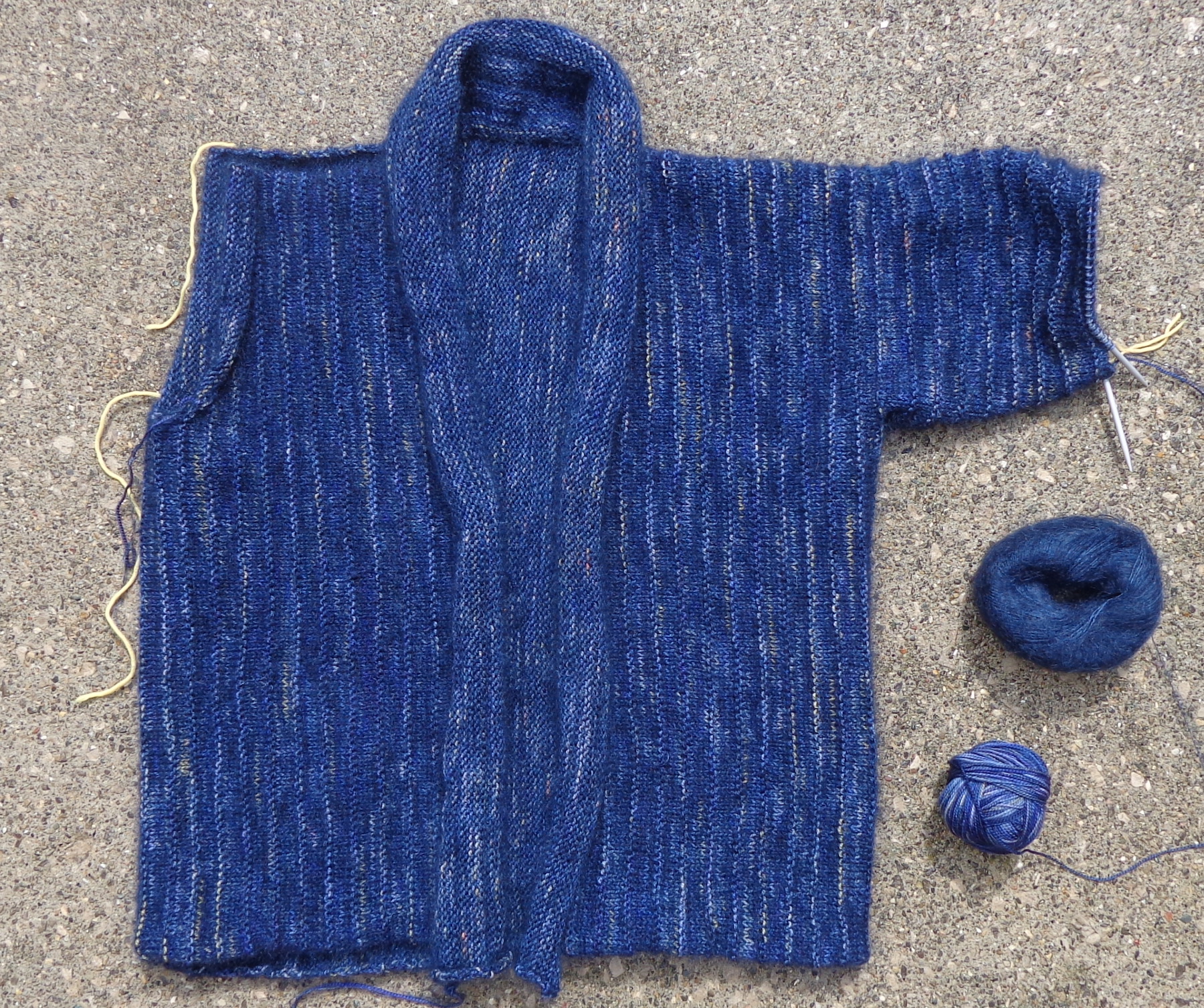
And here’s the new red cardigan – with one sleeve still on the needles. The pictures are less than ideal as it’s snowing and grey today. There’s not a lot of light, even with all the lights on in the kitchen.
I’ll finish it up this week – this yarn knits up quickly! – and when there’s a sunny day, I’ll take a pic of it outside.
The benefit of knitting something twice is that I can see what things I don’t love and change them out in my version. For example, I really dislike when ribbing doesn’t line up with the pattern in the body of the sweater. If you’re knitting a K2 P1 rib for the collar, as here, and there’s a K2 in the raglan rib, they should align IMO so that the K2 in the ribbing just continues on down into the sweater. That isn’t going to work in this case, since there’s only a P1 on either side of the K2 and the raglan lines are P2 K2 P2. So I changed the counts in my collar, plotting out the placement of the raglan lines from the outset and working P2 K2 P2 in the collar to line up with that. You can see the knit ridge in this photo, that continues up the collar.
My second change was also a result of that test knit. I tried on the sweater and oooooo, that yarn was itchy itchy on my throat. I know I can’t wear KSH against my skin but I had a moment of (unmerited) optimism. So, when I ripped it back, I split the front of the sweater, turning it into a cardigan with two moss stitch bands down the front. I wasn’t sure of my ultimate row count so I winged it with the buttonholes, but it worked out fairly well.
My third change was a result of comments on Ravelry. The fronts and the backs of a sweater should not be the same and interchangeable, since the neck should be lower in the front. I added four short rows between the back raglan increases before starting those raglan increases – I could see the P2 K2 P2 place in the ribbing – to make the back a little higher at the neck. It was an easy change.
Change number four was an inadvertent one. I finished the yoke and wasn’t sure what to do with the ribbing lines from the raglan once the body was joined in the round. Just stopping them looked silly to me, so I picked up an extra stitch to have another K stitch in the middle of the 4 purls, and carried them down the virtual side seam of the sweater. To my delight, everything matched up at the hem for the K2 P1 ribbing at the waist, just as I’d set it in the collar.
There are two suggested lengths in the pattern for the sweater and mine is in between. I tried it on, because there were a couple of Ravelry comments about the hem being in an unfortunate location and I wanted to be sure. I generally don’t like cropped sweaters as they seem too short for me, and as a shorter person, I often need to shorten a “regular” length sweater so I don’t look overwhelmed. 12.5 – 13″ from underarm to hem is good for me. That’s 32 – 33cm. This one is 22 cm from underarm to the top of the ribbing and the waist ribbing is 10 cm. It’s perfect for me.
The buttons aren’t a perfect match – a bit more burgundy than russet – but I like the bit of gold in them and they came from my stash, which is even better. (That is a fuzzy pic!) The funny thing about them is that the shafts aren’t all drilled at the same angle. I’m a little OCD about things lining up and buttons being at the same angle, so I may take these off and re-sew them so that the little gold swoosh has the same orientation on all of them. Right now, all the buttons are sewn on with the hole in the shaft at the same angle.
I really like this sweater. I like it so much that I’m thinking of ripping back the Ferny Paige and knitting a green version of this sweater of that yarn instead. I also have a sweater quantity of a tweedy yarn in the same weight, so will try the pullover with that first.
It also reminds me of a mohair sweater I knit a looooooong time ago, and I’ll tell you about that tomorrow.
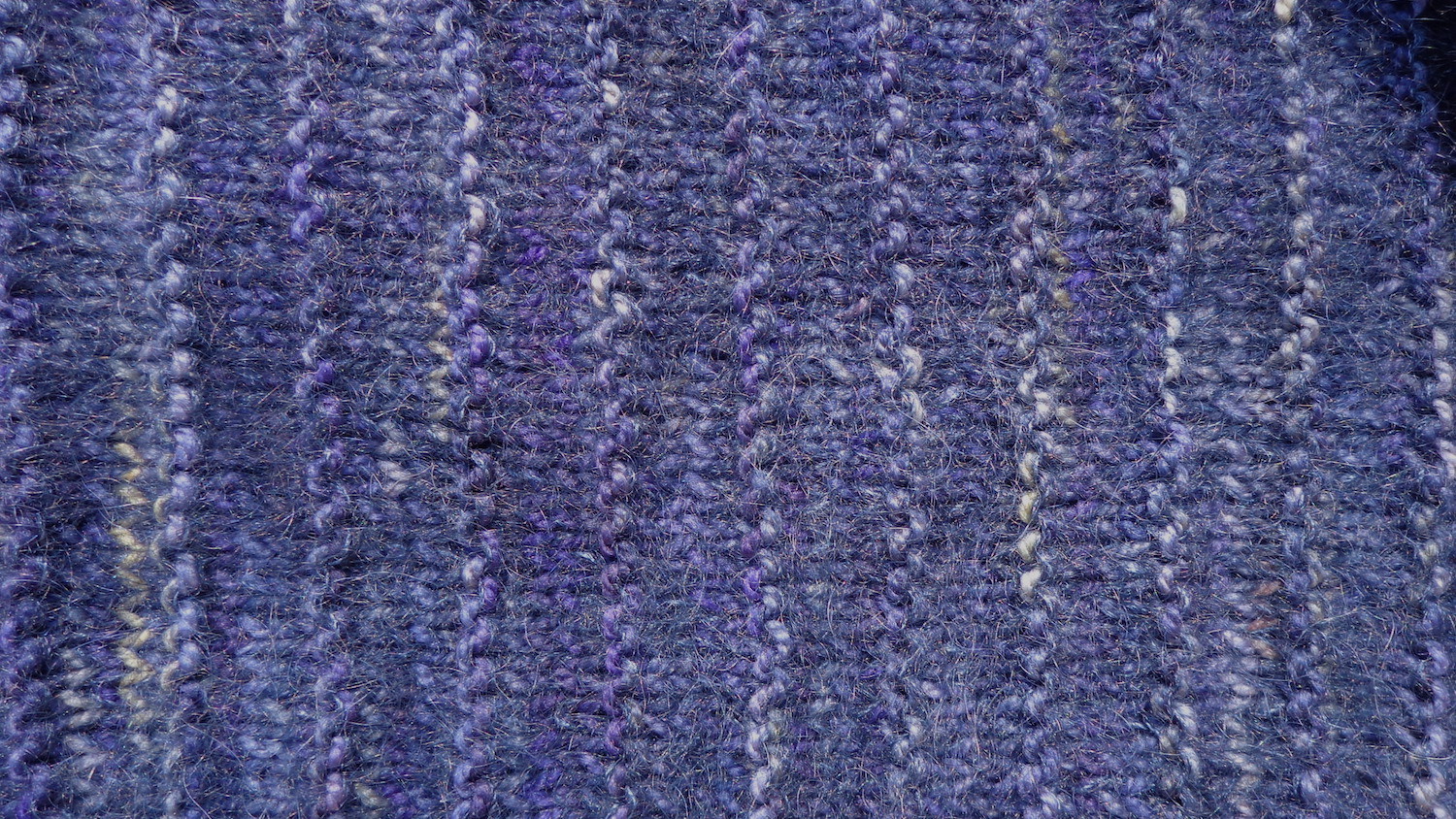
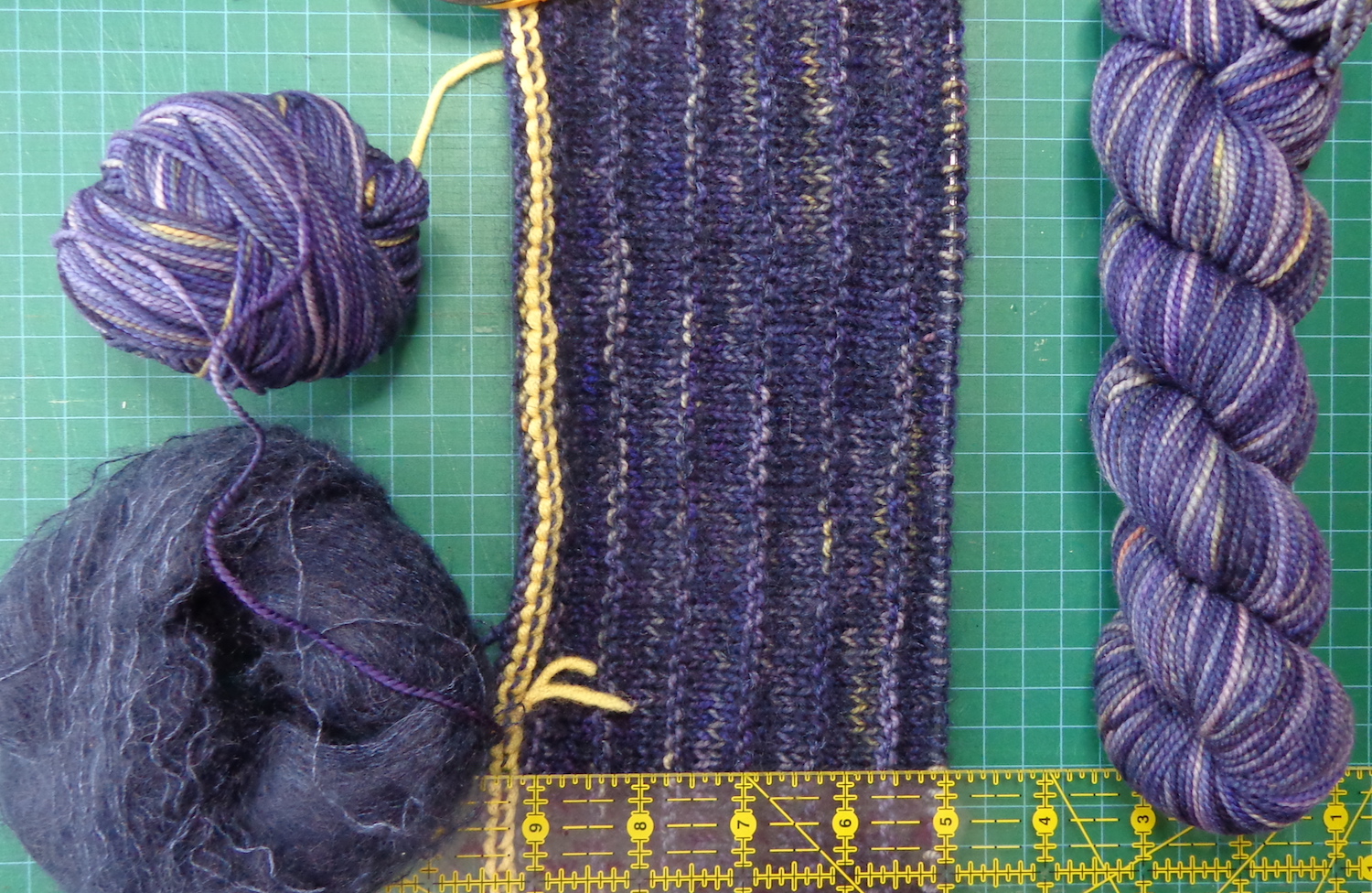
I started this project a year ago, in February 2022. (It was a free pattern then, but might not be so now.) I liked the design a lot but didn’t want to buy more yarn, so I shopped my stash. I came up with some Koigu KPPPM in a mixy blue and some Rowan Kidsilk Haze in Turkish Plum which matched. The resulting fabric is lovely and soft, with enough variation from the Koigu to make the colour interesting.
Mmm. Squishy goodness.
The construction is interesting. You can tell by the ridges that it’s a sideways knit. You cast on provisionally at what might be considered a sideseam, knit across the back, cast off stitches for the sleeve, then knit across one front. You put those stitches on a holder. You go back to the provisional cast-on to pick up enough stitches for the other front, then when it’s done, put them on a holder. You sew the shoulder seams, then start knitting those front stitches, up one side, pick up stitches across the back for the collar, then down the other front. This makes a self-rolling shawl collar after you knit five inches of it. Then you go back to each sleeve opening to pick up stitches and knit in the round, decreasing down to each cuff.
By the elbow of the second sleeve, I was sure that I would run out of yarn. I stopped knitting so I could look for something matchy-matchy at the Koigu tent sale in August. The best I could do was some solid-ish navy (it looks kettle-dyed) so I decided to use it on the cuffs and the front edge of the collar, if necessary. I frogged a lot of the collar to be sure I had enough Koigu for the second sleeve. By this time, I’d lost momentum and the project sat. As is so often the case, I picked it up finally and finished it in a couple of evenings.
And – ha! – I didn’t run out of yarn. I took the remaining Koigu and knit on the collar until it was gone.
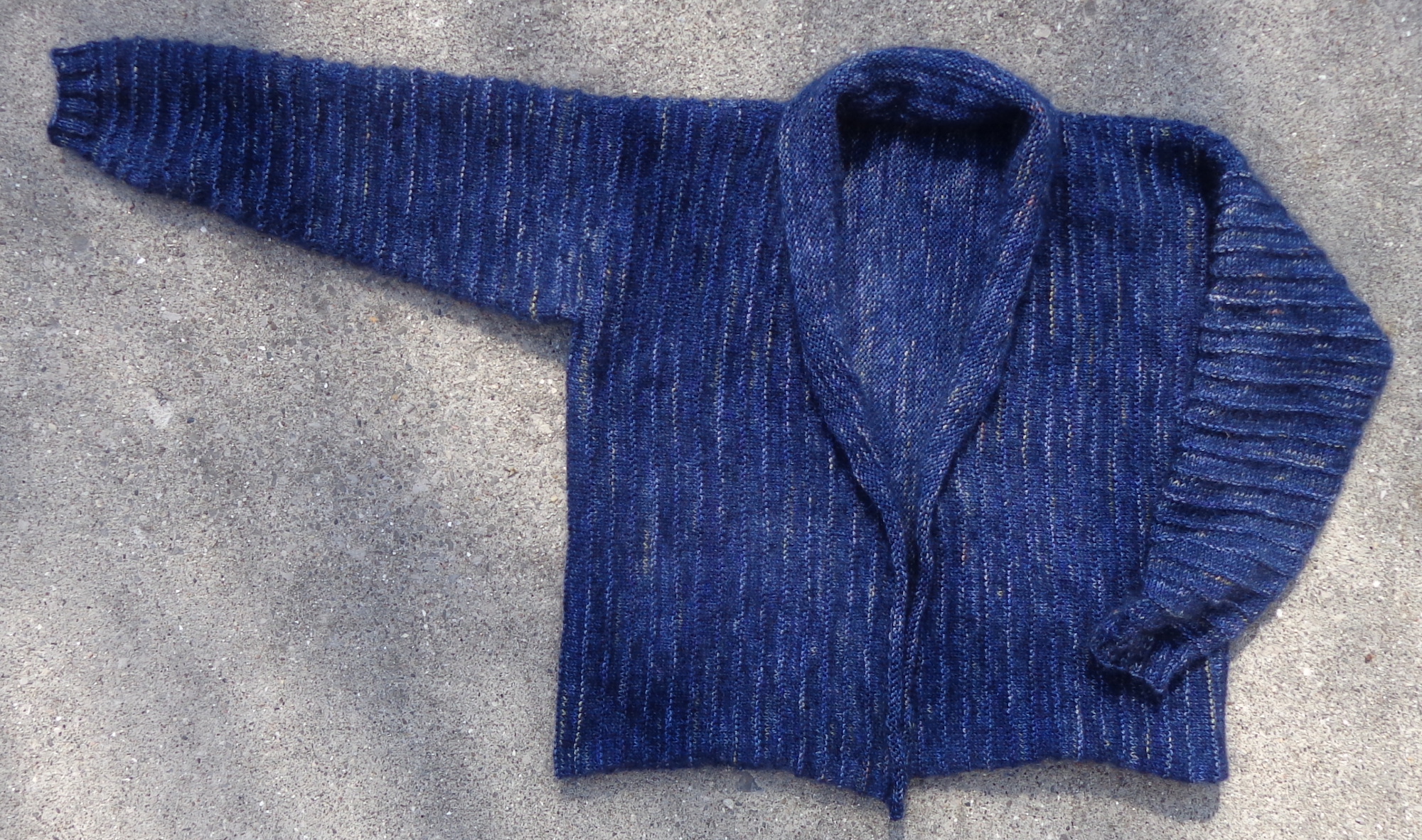
Here’s Halo completed.
Morning sunlight through the tree branches makes for dappled light and shadow. 🙂
Mine came out a bit smaller than anticipated. I made the larger size, which meant it should have been 25″ long and 48″ wide. There’s no row gauge specified, probably because it’s stretchy, but the stitch gauge is 20 sts to 4″. Mine is right on, but my sweater is 22″ long and 42″ wide. So, if and when I make another of these cardigans, I’ll add 15 stitches to the length and 7 or 8 repeats to the width, probably 4 across the back and 4 on each front.
I’m thinking I might knit a second one of these rather than another Lunenberg-meets-Hebrides cardigan. I have more of the KPPPM in the teal colourway than I had of the navy, so that should work out well – plus I have KSH in Trance to knit with it. Or I might buy a Halo bundle from Fleece Artist and actually knit the sweater in the specified yarn. (Had to sit down for a minute there. Phew. What a concept.) We’ll see after I finish up a few projects still on the go.
Here’s a sweater I started a while ago and shoved away. I dug it out again recently and got back to work. What made me put it away? The yarn is black and it’s Rowan Kidsilk Haze – and I knit at night while watching TV. Fortunately, it’s in stockinette and I was able to find my rhythm this time.
Here’s the current state of my progress on the back of the sweater:
You can see that it’s crumpled where it was shoved in the bag. What I’ve knit recently is smoother. The pattern is Hebrides, which was a free pattern from Rowan by Lisa Richardson – although it was designed for Kidsilk Haze Stripe. I knit it twice in that yarn:
It’s just a basic sweater with long sleeves and a round neck. I wear these cardigans all the time, especially the purple and green one. The KSH is awesome, too – the sweater is light (it weighs less than 150g) and I especially loved it for travel. You can scrunch it into any bag then pull it out whenever you need it.
I’ve needed a plain black cardigan for a long time and had the black KSH in my stash, so a match was made. Sometimes Ravelry is a bit scary – I evidently cast on the back of this sweater in July 2016. (!!) Well, I’ll get it done by next July. I remember that the back was the trudge and the project picked up speed after that. Maybe not the best choice of a night knitting project in the winter, but knitting KSH in the summer heat didn’t work out either.
I’ll keep on keeping on with this one, but will probably sneak some smaller projects into the queue in between.
We took a little road trip last week and went to the tent sale at the Koigu farm. This annual event has been on hiatus thanks to the pandemic, and I was really excited that it happened this year again. Here’s an old picture of the Koigu barn, taken the first year we went to the tent sale:
Of course, I bought some (more) KPPPM home. 🙂 I have such a hard time choosing from the array of colours at this sale, but here’s this year’s selection:
The top seven are all the same colour and dye lot. They’re a little less blue than they look here, more pinky-lavender. I’ve already balled one up and cast on a Tegna. I’ll show you that when I’ve made more progress than just casting on.
The blue at the bottom left is insurance yarn for my Halo jacket. (That’s the Ravelry link for the pattern. Here’s my previous post about mine.) I think I’m going to run out of the KPPPM blue before I get to the cuffs. (Yes, I’m knitting faster, just in case.) That’s not a huge surprise as I’m a bit short on the yarn requirements.
This jacket has an interesting construction – it’s knit sideways, starting at one side. You knit across the back and around to the centre front, then go back to the cast-on edge and knit to the other front. Then you pick up the stitches from the shoulder to knit down each sleeve to the cuff. I love the feel of the KPPPM knit with Rowan Kidsilk Haze – it’s a wonderfully squishy soft sweater. When I started the sleeves, I had two skeins of KPPPM left, so one for each sleeve, then (maybe) some of this other blue at the cuff.
Here’s my progress on Halo so far:
The other four skeins that I bought at the tent sale are just pretty. They’re more earth-toned than they look here, russet and brown with some green. Three are the same colourway and I chose the dark one because it coordinated. I think they’ll be a shawl, probably another Charlotte’s Web. The one I made for Nikoo used four skeins and it was a nice size, even without the fringe.
I hope they have the tent sale again next year. By then, I might have more of my Koigu stash knit up.
Sometimes, you just need a quicker project. I have a lot of projects on my needles right now, but most of them use small needles, which means slow progress. I’ve finished eight repeats of the pattern on my Rowan Lace Scarf and am partway through the fifth ball of the six provided in the kit. I’ve almost finished the body of my Noro Mitred Jacket. I’m coming down to the hem on my Spector pullover, which may be the slowest knit on the planet for me. (Will it languish on Sleeve Island? Maybe…) And I’ve been knitting a lot of Barbie clothes. There’s a whole pile of them waiting for their ends to be sewn in. Last weekend, I felt in need of some more immediate knitting gratification.
And then, an ad from Fleece Artist sailed across my screen. Ooooooooo. I’m a complete sucker for their gorgeous yarns.
The Halo Jacket is a free pattern from Fleece Artist. (That’s one of the pattern images from Fleece Artist.) You can download it from their website, or grab a copy here on Ravelry. It’s knit side to side with two yarns held together, a fingering yarn and a mohair-silk laceweight yarn (which creates, hey, a halo!) Here are the yarn bundles at Fleece Artist — as usual, their colours are absolutely scrumptious.
But….in the interests of managing my own yarn inventory, I decided to shop the stash. I have some Koigu KPPPM in a purpley-blue, which I bought for a sweater I ultimately decided not to make. I also have some Rowan Kidsilk Haze in Turkish Plum. I’m a little short of yardage in the Koigu, but fortunately, the original pattern (the one that wasn’t knitted) required two coordinating colours. I have the coordinating colour and will use it on the cuffs and collar if necessary. The best part is that those bits are knitted last, so I can decide after the majority of the garment is done.
Here’s my start:
I’ve pinned it down because it wants to roll into a tube! The actual colours are darker than they appear in the photo, but look at how much the KSH darkened the KPPPM. I hadn’t knit up this Koigu because it wasn’t dark enough – although it’s very pretty – but I love it combined with the KSH. The fabric is wonderfully squishy and soft.
Last week, I shared a pair of mittens knit from a free pattern, Alaska Mittens. It’s not a free pattern anymore, btw. I had started a second pair and since they’re done, I’ll show them off today.
This time, I used two yarns together – a strand of that same Sirdar Tweedie Chunky and a strand of Rowan Kidsilk Haze. The KSH makes the knitted fabric softer and gives it a bit of fuzz. It might prove to be warmer, as well. I incorporated my changes from last time, and started the thumb gusset four rows later – that took out two increases, which made the thumb smaller. They fit perfectly!
My only quibble is that since I started the thumb gusset later, I should have kept working the stitches on the palm side in ribbing, instead of changing to stockinette. See?
You can guess what this means. I’ve cast on a third pair, in the green Sirdar Tweedie Chunky again with a strand of a yarn similar to KSH. This pair will be perfect. 🙂
I have some other projects moving closer to completion and hope to be able to show you something more than mittens soon! Happy knitting!
I knit some mittens this past week—even though it was a zillion degrees outside. This pattern was free and it looked intriguing. I had some yarn in my stash so away I went.
The pattern is called Alaska Mittens by Anna Zhuravleva—here’s a Ravelry link—and it’s still free as I write this. It calls for aran weight yarn, and I had some Sirdar Tweedie Chunky in my stash—that’s a Ravelry link, too—it’s discontinued so I’d found it on sale once upon a time and just liked it. I have three colourways but used the dark green, which is #285.
Here are the mittens, knit in the M size:
I found this pattern a bit confusing and ended up writing all over my chart while knitting the first one. The second one went more smoothly as a result. You work Row 2 fifteen times, and since the next row is labelled R3, I missed that the first time – I changed it to be R17 and renumbered the rest of the chart. I also added a G on the rows that I was to add a gusset stitch and drew a line across the chart where the palm changes from ribbing to stockinette. I think there is one mistake in R13 of the original labelling of the chart – the two knit stitches should be purls.
The chart for the fingertips really confused me, so I drew it out again. I wanted the decreases to be one stitch in from the edges, so there are two stitches that run up to the top of the mitten. The chart shows it that way, but if there are two knit stitches, you can’t K1, SSK without taking up the third stitch. I also had to work two additional rows in the middle before doing the middle twist, as it occurs every 4 rows, not every 2.
I also found the thumb a bit too wide for me at 16 stitches and took it down to 12. I had added four extra rows of ribbing to make a longer cuff on this pair. These mittens weigh 73g and I have 76g left of the green. I’m hoping I can knit another pair with just the specified cuff length.
I cast on another pair in another colourway of the Tweedie Chunky and am working it along with a strand of Kidsilk Haze. The result is very squishy and soft:
This one has the cuff in the specified length. I also started the gusset increases four rows later, so I’ll have two less stitches for the thumb—instead of having to decrease twice, I’ll just have to decrease once to get the thumb the right width.
You have to pay a bit of attention with this pattern, but the mittens are really nice. I particularly like that the cables mirror each other on the left and right mittens. They fit well, too.
Sometimes, the best-laid knitting plans go wrong. Sometimes pretty projects stall. I have a habit of zooming along on a sweater until I get to the sleeves, then putting the project aside, sometimes for years. I used to think this was because I dislike knitting sleeves, but the truth is far simpler—when the body is done, I can try on the sweater, and if I don’t love it, I lose the motivation to finish it.
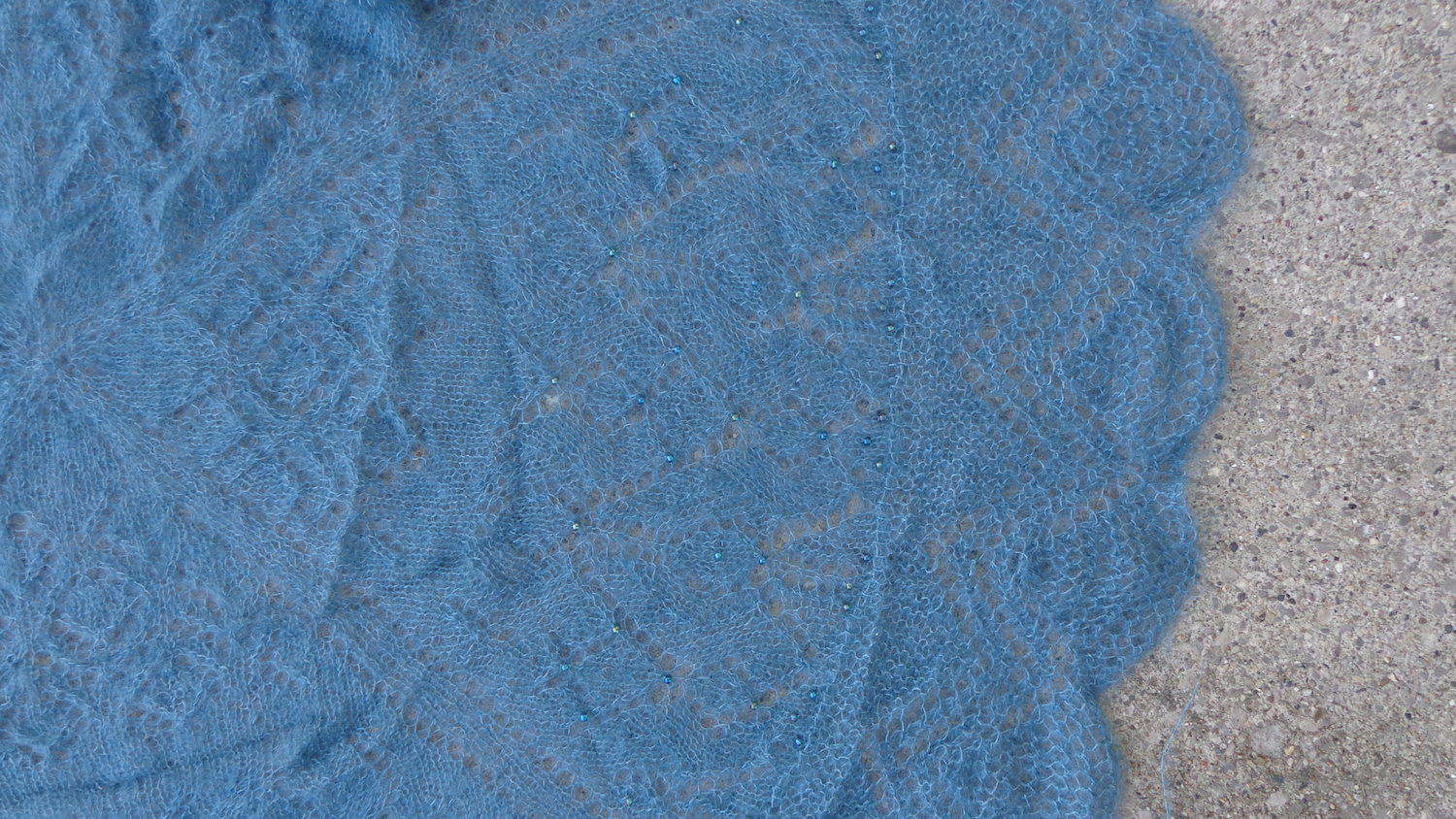
I’ve been sorting through my stash, my patterns and my projects, and these two are being ripped back. First is a lace circle cardigan designed by Brooke Nico which was in Vogue Knitting’s Fall 2010 edition. (Here’s the Ravelry link.) It’s knit in Kidsilk Haze, which I adore. I cast on in a hurry, using Trance, a colour I love, and even added beads. I did this despite the awareness that I never ever like or wear circle sweaters once they’re done. I’ve frogged every single one of them. They look good on some people but not yours truly.
I got to the sleeves. I tried it on. It’s been waiting for me to knit the sleeves for at least 9 years. Since that time, there’s been an explosion of patterns that use KSH held together with another yarn, to make a squishy, soft, fabulous fabric. I want these six skeins of Trance back!
Here’s the commemorative picture of the sweater so far. I’ve even knit the lace edging.You can see that I had one sleeve on the needles. The red is the waste yarn holding the other sleeve’s stitches. And yes, that is my toe.
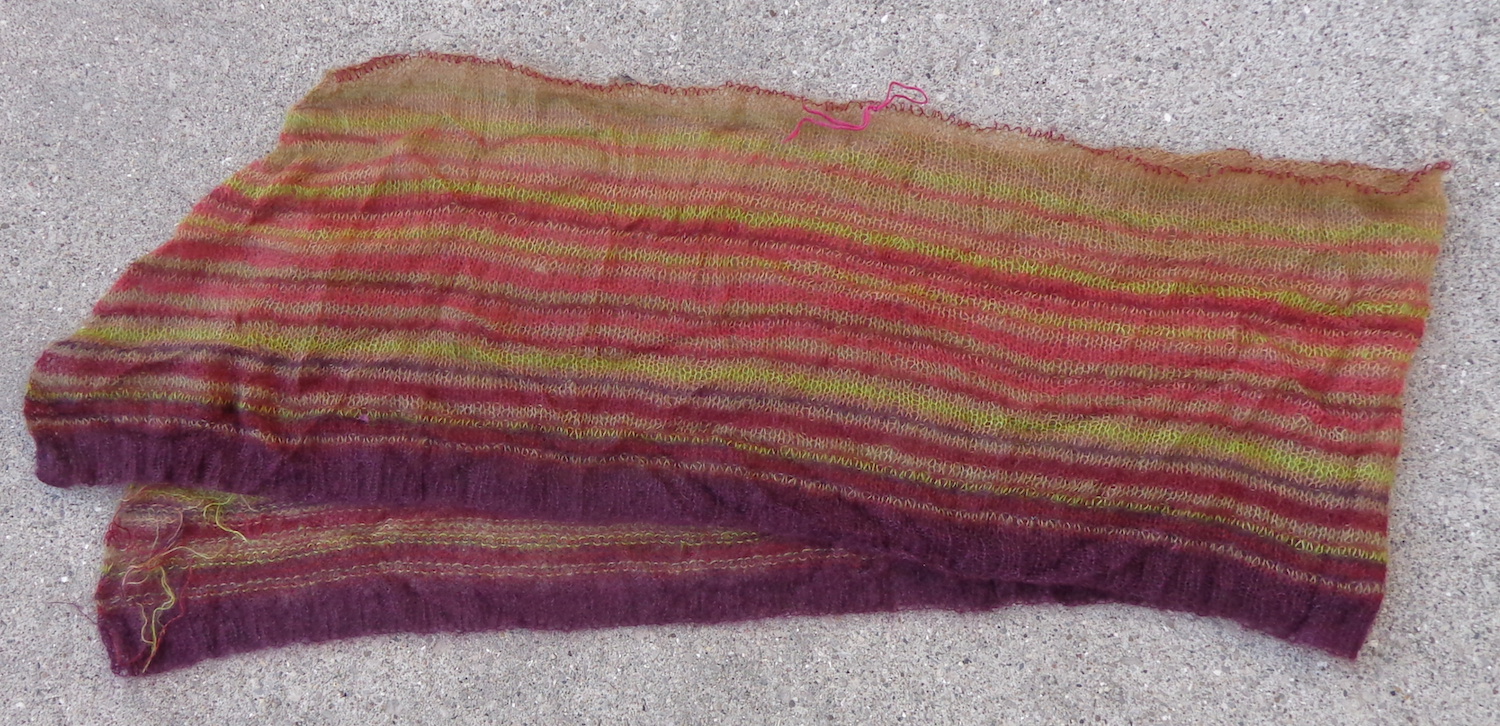
Here’s a detail image so you can see the beads.The second project to come out of the project stash so it can be ripped out and returned to the yarn stash is also knit of Rowan Kidsilk Haze. This is my version of Belarus, a pattern by Kaffe Fassett that was published in 2014. (That’s a Ravelry link.) I loved the stripes in this design but was less happy with the design. Dropped shoulders don’t suit me, so I had planned to modify this pattern and make it a raglan. I also charted my own colour combination, which I liked better than the oranges and pinks of the original. I actually knit the entire body, realized it was too long, and frogged back to this.
Ironically, since I’ve let my hair go grey, the oranges and pinks would have suited me better than these golds and reds.Rip, rip, rip. Back it all goes to the stash. I’ll have to weigh the various colours of KSH to update how much I have.
It’s hard to make these decisions, but once they’re made and the ripping begins, I actually feel relieved. KSH has to be frogged slowly – un-knit, really, not ripped – so it will be a bit of a meditative process too.
And then that Trance KSH can join forces with the teal Koigu, the one I used in my Navelli, for a wonderful squishy soft sweater. 🙂 I can’t wait!
Last week, I showed you the beginning of my Earth Stripe wrap. Well, I got a little further and made a choice, so this week, you get a progress report!
Here’s where I was when I decided there was an issue. The whole thing looked too brown to me.
I went back to the original colours and reconsidered my substitution for Meadow. I used the Aloe at the bottom right in this picture. The top call is KSH in Jelly, which is also one of the colours in the shawl. Meadow was a pale silvery green, so I dug into the stash and found the yarn at the bottom left. It’s not KSH but another kid mohair and silk blend of similar proportions and a handpainted yarn from Capistrano Fiber Art Studio in a colourway called Irish Moss. I decided to use it instead of the Aloe. (I bought this yarn in New York at Habu Textiles on one of my trips to Manhattan.)
The needle in the first picture shows how far I needed to frog back the shawl. I actually had to go a little further, since the first dark brown stripe is also knitted with the yarn I was changing out.
Kidsilk Haze isn’t the nightmare to frog that many knitters think it is – you just have to take your time. When I have to unravel KSH, I think of it as unknitting, not as ripping or frogging. Slowly, slowly, and all will go well. 🙂
Here’s a shot of the reknit shawl, up to the same point – of course, the needle wanted to curl:
Can you see the difference? There isn’t a lot of colourway F in this section, so the difference is subtle, but I’m much happier with it. Let’s take a couple of slices and line them up:
Where are the differences? Starting at the bottom, the first dark brown stripe is knit with Bark and F – on the left, F is Aloe and on the right, it’s Irish Moss. Continue up to the second difference – it’s the greyish band above the needle on the left picture. In the right picture, you can see a brighter green with the grey in that band. You have to look way up to find the next use of F – it’s above the 3R blue band near the top. There’s a row with dark blue and turquoise, followed by two rows of dark blue with grey, followed by two rows of bronze with grey. Above that are four rows of grey and F, then a row with the two greens knit together. This is the section that prompted me to make the change. Everything above the blue looked brown to me on the first version, so that new silvery-green stripe makes me happier.
The beads are more interesting than I’d expected. They’re the Rowan beads made by Swarovski and are particularly sparkly. The holes aren’t just silvered. They seem to be faceted inside. In real life, they’re adding a wonderful glimmer to the sides of this shawl.
And onward I go! I’ll show you the shawl again when I’ve completed one entire repeat.








 You can see that I had one sleeve on the needles. The red is the waste yarn holding the other sleeve’s stitches. And yes, that is my toe.
 The second project to come out of the project stash so it can be ripped out and returned to the yarn stash is also knit of Rowan Kidsilk Haze. This is my version of
  Rip, rip, rip. Back it all goes to the stash. I’ll have to weigh the various colours of KSH to update how much I have.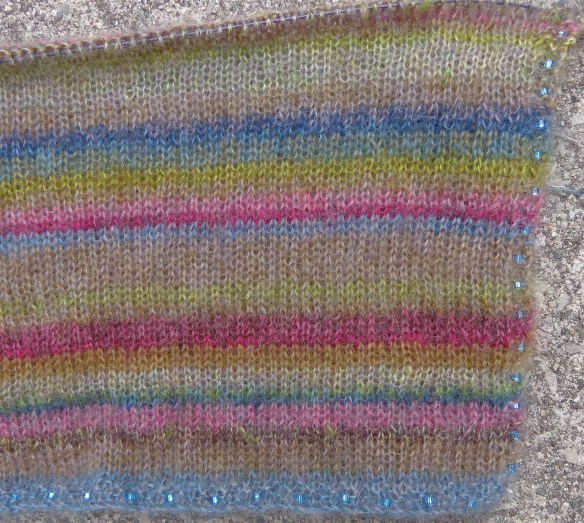


 Alive & Knitting