Ups-and-Down Cowl

I just finished this cowl, in time for fall!

The pattern is free from Yarnspirations and you can download it from their site here. It’s also listed on Ravelry right here. The specified yarn is Red Heart Boutique Treasure, which is discontinued. Here’s the Ravelry page for the yarn and you can see that it’s a two-ply yarn with a slow gradation of colours and made of acrylic. I used a yarn from Lionbrand called Scarfie in the Charcoal/Aqua colourway. It’s not listed on the manufacturer website anymore, so here’s a Ravelry link.

What I liked about this cowl is the buttons. I find cowls are great outside, but then too warm if I step into a shop or get in the car. This one gives you the option of unfastening a bit of it without taking it off.

And here’s the finished cowl:

Ups and Down Cowl knit by Deborah Cooke in Lionbrand Scarfie

I used 5mm needles because I liked the look on the knitting better on that size, but that also meant that I used a lot less yarn. (a LOT less. Maybe the yardage is wrong on the pattern.) This one took 140g, leaving 10g from one ball of yarn. That’s just 265m and the pattern says you need three balls of yarn with 138m in each.

What’s funny is that I don’t love the buttons so much now that it’s done. They don’t seem to make a lot of difference, since the cowl gapes open at the throat anyway. So, I’ve cast on another one in Caron Cakes in the colourway Rainbow Sprinkles, modifying it to be worked in the round. I’ll knit this one on 6mm needles and see how that affects the yardage. I kind of want to use the whole ball to get through the entire gradation, but it’s 350m.

Interestingly, this yarn has vanished from the Michaels website, which is where I bought it. Seems like everything gets discontinued these days before I even find it!

I’ll show you that one when it’s done.

A Citron Shawl in Noro

Citron is a free pattern for a semi-circular shawlette Hilary Smith Callis. It’s available from Knitty.com and has been around for a while. (Ha. It’s in the Winter 2009 edition, so that is a while!) Here’s a link to the pattern at Knitty.com.

Here’s the Ravelry page for the pattern.

I’ve made a couple of these in the past. First, I made one for my MIL in Noro Kureyon Sock. (This yarn is discontinued, which is a sad truth. Here’s its page on Ravelry.) She wanted something cheerful and bright.

Citron by Hilary Smith Callis knit in Noro Silk Garden Sock by Deborah Cooke

There are a couple of variations in this version from the original pattern. The original has stockinette bands alternating with gathered sections for a ripple effect. I added some eyelets and beads to this version. Here’s the blog post about it (which has now reminded me of the Gaia Shawl, also a nice one skein knit and a free pattern. That’s a Ravelry link. Hmm.)

One of the things that still irks me about this shawl (I have it now, since my MIL passed) is the lack of a second band of pinky-purple. Knots in yarn are frustrating, but in self-striping yarns, a knot may also mean that part of the colourway is missing. This was made from one skein of Noro Kureyon Sock, but it had a knot. Instead of a second repeat of the pink and purple part at the outer edge, I got a third repeat of the green. It looks to me as if the pink and purple part shouldn’t be there at all.

The second version I knit of this shawl was in one colour, a kettle-dyed laceweight yarn from an indie dyer.

Citron by Hilary Smith Callis knit in Waterloo Wools Kirkland and Malabrigo Lace by Deborah Cooke

I added beads to this one, as well, gradually increasing the number of them toward the hem. It’s edged in black Malabrigo Lace. There’s a blog post about this one here.

And now on to the new version. This is knit of Noro Silk Garden Sock in the colourway 211.

Citron by Hilary Smith Callis knit in Noro Silk Garden Sock by Deborah Cooke

It’s had a gentle block to make it rounder, but not a hard one to stretch it out. I wanted to preserve the ripple (which was lost in the first one for my MIL, because of a very hard block.) I could – and maybe should – have knit it on larger needles. The fabric is quite sturdy on the 4.0mm needles but I do like the colourway. Here’s the yarn on Ravelry, and here it is on the Diamond Yarns website, which is Noro’s distributor in Canada.

The put-up for this yarn is less because it’s thicker – it’s a sport weight (while Kureyon Sock was a fingering weight) and has 300m per skein (while Kureyon Sock had 420m). So, having two balls didn’t make a huge shawl.

I also added some eyelets and beads but not as many as the first one.

Citron by Hilary Smith Callis knit in Noro Silk Garden Sock by Deborah Cooke

For the cast-off edge, I did a simple crochet edging to keep it frilly. A single crochet in each stitch, then chain 2 before repeating. I ran out of yarn when the cast-off was almost done so substituted in a piece of leftover Silk Garden Sock from another colourway (in my stash for sock yarn squares). I picked out the turquoise section so it would match a bit.

Citron by Hilary Smith Callis knit in Noro Silk Garden Sock by Deborah Cooke

The first skein had no knots at all, which made me happy. The second one, however, had three knots in rapid succession. I can see what that did to the colour progression (grr) but still I like this shawl a lot. It’s 22″ deep and 44″ across the long edge, just enough to hang over my shoulders to the elbows.

What do you think?

More Kroy Socks

I’m due for some new socks so took on that project for my summer knitting. After all the sock yarns I’ve tried, I keep coming back to Patons Kroy Socks. The colours aren’t as unique as hand-painted yarns, but the socks always wear well. (My other fave yarn was Fleece Artist Trail Socks, which was both pretty and durable, but they don’t use that yarn base anymore.)

Kroy Socks (that link goes to the Yarnspirations site) is a thicker version of this yarn, with four plies instead of three, so it has less yardage. There’s 166 yards per ball. Usually, I buy three then have close to half a ball left over. This time, I decided to use just two balls.

The first pair is a blue colourway called Magic Stripes. (It’s the last colourway on the Yarnspirations site.)

socks knit by Deborah Cooke in Patons Kroy Socks

I used my usual sock pattern, casting on 72 stitches, working in 2/2 rib for about 12 rows, then switching to 6/2 ribbing to the heel. I usually knit a total of 72 rows before starting the heel (because it’s easy to remember) but this time I worked only 56 in the hope of making each sock out of one ball. As you can see, I ran out and had to make the toes black. :-/

For the next pair, I followed the same strategy, accepting the fate of black toes. This colourway is called Mexicala Stripes (it’s the second colour in the third row of swatches on the Yarnspirations site). I’m always up for some bright socks and these are definitely bright. The colourway has a really long repeat: there were only two repeats in the skein. You can see that the yellow from the top of the cuff starts again at the end of the heel flap.

Sock knit in Patons Kroy Socks Mexicali Stripes colourway by Deborah Cooke

This time, I worked 55 rows to the heel flap, then only 18 RS rows on the heel flap. (There were 19 on the blue pair above.) I was surprised by how much difference this made – I not only finished the first sock from one ball but had 3g of wool left over. The second sock is still on the needles, but it will match exactly.

How do you make socks match exactly and effortlessly? This strategy only works when you shop in-person and can look at the skeins. Choose two that start at the same point in the repeat of the colourway. My second ball of Mexicala Stripes starts with the same yellow band, so the socks will match without any trouble at all. When you order online, of course, the person filling the order will usually just grab the next two balls, so this plan won’t work.

My next lot of Kroy Socks is three balls in the colour Blue Raspberry. I’ll make taller socks and have some left over for my sock afghan. I’ve been adding to the one made of mitred squares. Hmm. I talked about those in this post, although they don’t have a post of their own. I’ll write a post about that for Friday.

Have you knit any socks lately?

A Soft Stripey Chemo Hat in Aran

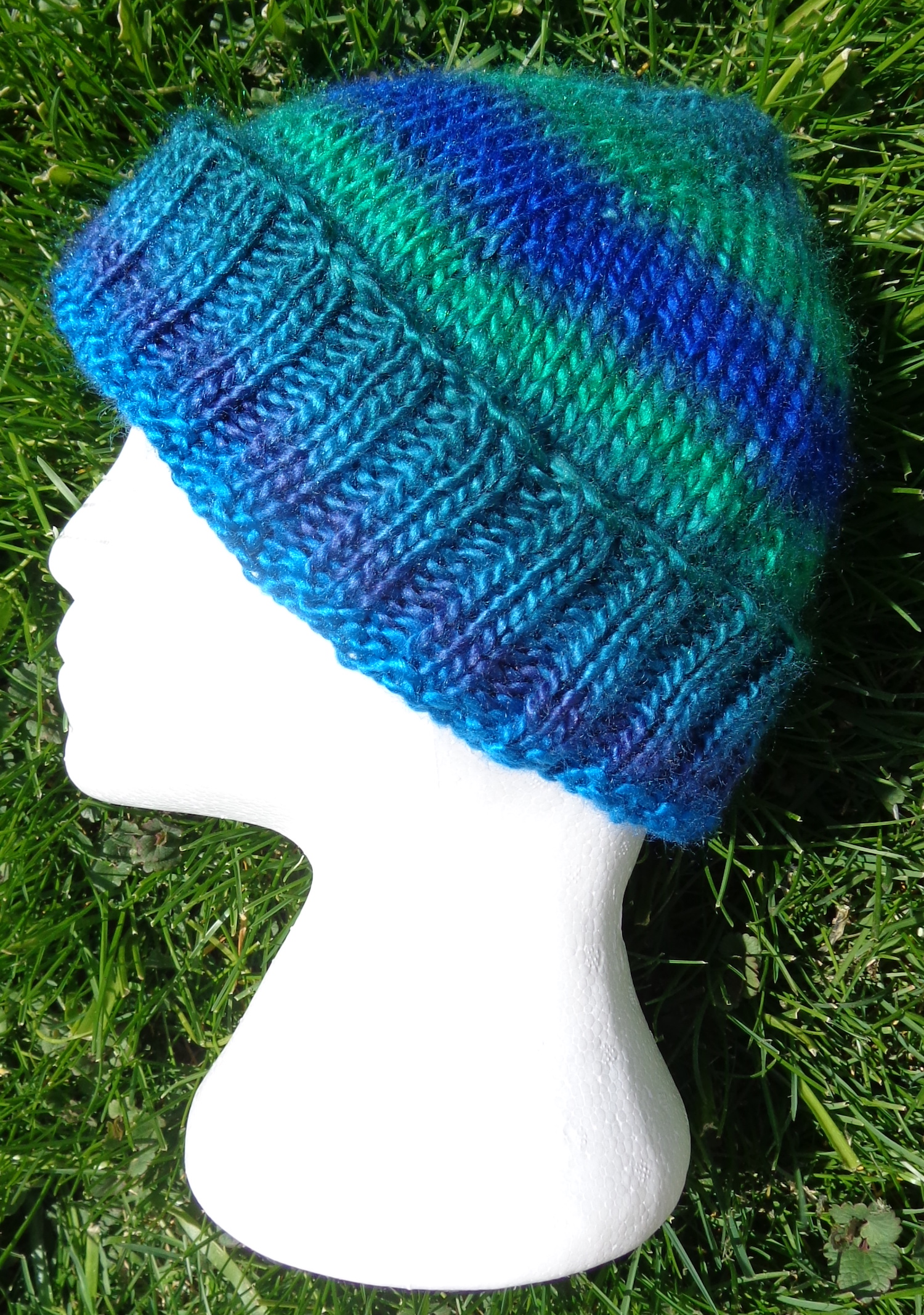
I know far too many people who are battling cancer right now, and recently offered to make some chemo hats. I expected this to be an easy project, but it was a challenge instead. When I found a yarn I liked (soft and squishy), I couldn’t find a pattern for it (or even its gauge) that I also liked. In the end, I merged some patterns together and came up with my own.

Here’s one, for an aran weight yarn.

Chemo Hat in Aran weight yarn by Deborah Cooke, knit in Lion Brand Landscapes by Deborah Cooke

This yarn is Lionbrand Landscapes, a 100% acrylic yarn that comes in wonderful graduated colours. (That link will take you to the Lionbrand website product page.) I used a colourway called Blue Lagoon for this first one, and bought the yarn at Michaels. One thing with this yarn is that it’s a loosely spun single ply, so be careful not to split the strand when knitting. I ended up making more of a scoop motion than usual to catch the entire ply and that worked really well.

This hat is knit from the top down. Many of the ones that were knit cuff-up ended up having too tight of a cast-on edge, so I preferred this method. You might prefer it inside out as the knit side of the stockinette is smoother. Check with the recipient before you sew in the ends as you’ll want them on the wrong side, whichever side that’s going to be.

You’ll need:
• one skein of Lionbrand Landscape yarn (I used .7 of a ball in Blue Lagoon for the hat with the ribbed cuff, and .85 of a ball in Wildflower for the version with the rolled hem.)
• 6.0mm needles, a set of DPNs and (if you prefer) a 40cm circular
• 5.5mm needles, either a set of DPNs or a 40cm circular (for the ribbing)
• stitch markers (optional) You’ll need one to mark the beginning of the row, and five more (in a different colour) to mark the repeats.
• a needle to sew in the ends.

Gauge: 18 stitches and 22 rows = 4 inches, in stockinette on 6.0mm needles

There are instructions for two sizes for the finished hat is 21″ (regular) and 23″ (large) around. If the recipient has a much smaller head (or you aren’t sure) the version with the ribbed cuff is more likely to stay put.

Instructions:
Cast on 6 stitches on a 6.0mm DPN and arrange them over three needles (2 stitches on each). Join in the round and place a marker at the beginning of the round.

Round 1: KFB in each stitch (12)
Round 2: Knit
Round 3: *K1, KFB, place marker. Repeat from * to end of round. (18)
Round 4: Knit
Round 5: *K to one stitch before marker, KFB. Repeat from * to end of round. (24)

Repeat rows 4 and 5 until you have 78 (for regular) or 90 (for large) stitches. Change to the circular needle when you have enough stitches, if that’s what you prefer.

Knit the next round, removing the markers after each wedge and leaving only the marker at the end of the round. Continue to knit for 3″ after the last increase.

Work next row in K1 P1 ribbing, changing to 5.5mm needles as you work the row. Continue in ribbing on the smaller needles for 2.5″ (In my case, that was 13 rows.) Cast off in ribbing.

Sew in ends and you’re done!

Variations:
• I wanted 2/2 ribbing on the blue hat, so I knit two stitches together halfway through the first row of ribbing and again at the end of the round. That gave me 88 stitches instead of 90, which is divisible by 4.
• you can also make a variation with a rolled brim. I made one with the colourway Wildflower but forgot to take a picture before sending it away. Instead of changing to ribbing, just keep knitting in stockinette to at least 8″ from the cast-on edge. I made mine with 6″ of stockinette after the last increase, then cast off loosely. This used more of the ball but had a nice rolled cuff.

Abbreviations:
K: Knit
P: Purl
KFB: Knit front and back. This increases one stitch, making one stitch into two. You could substitute any other increase you prefer, like M1 (make one) or YO (yarn over).
Cheater Stripes

Here’s another project that’s been hanging around for too long, without a very good reason to do so. This sweater was stuck on Sleeve Island because I was too lazy to cake up another skein of yarn for the second sleeve. The cakes I had didn’t start at the right point in the stripe sequence to match.

Finally, I got out my swift, caked the yarn and got back to knitting.

Here’s the finished sweater:

Stripes by Drea Renee Knits knit in Sugar Bush Motley by Deborah Cooke

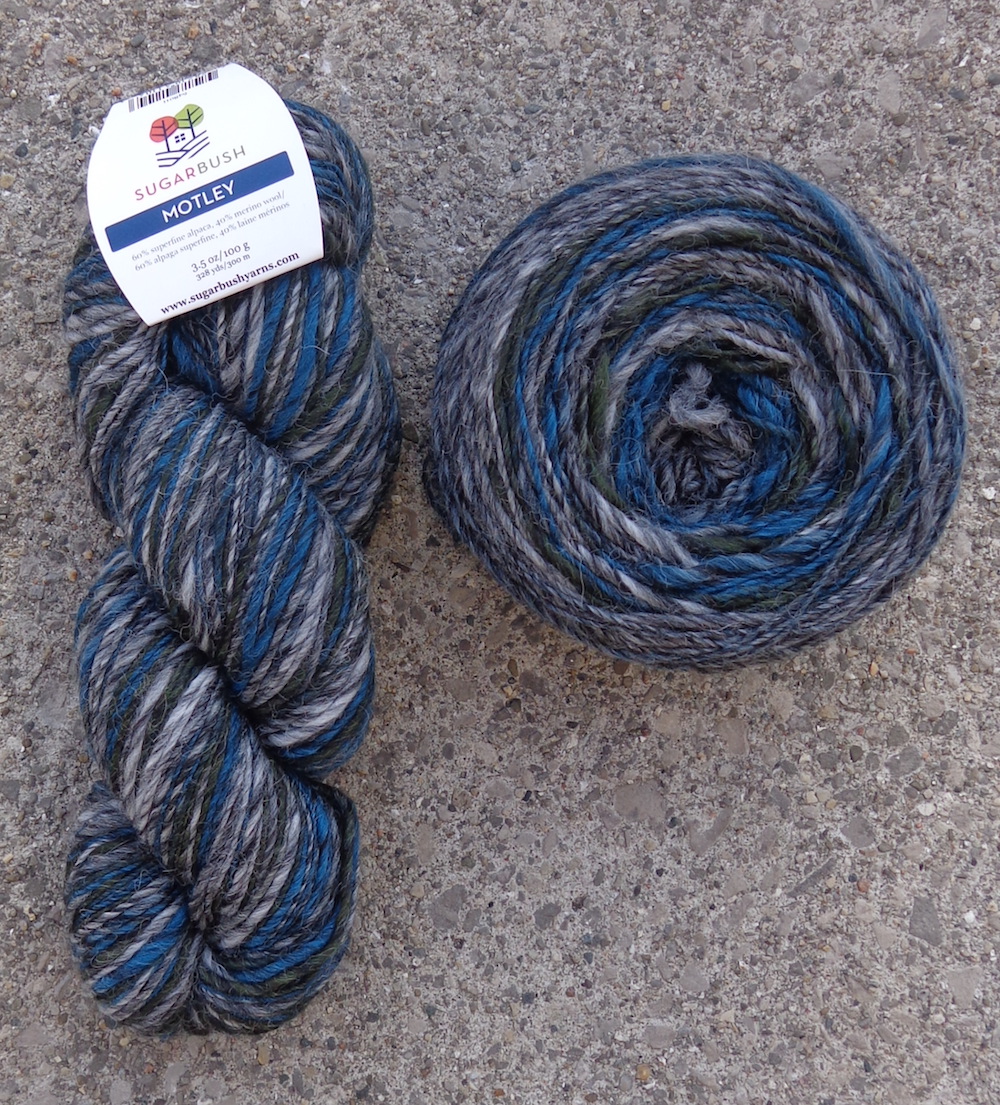
The pattern is Andrea Mowry’s STRIPES!, (that’s a Ravelry link, although you can buy it directly from her website, too.) Instead of knitting it in a multitude of colours and creating stripes, I knit mine in a self-striping yarn. The yarn is Sugar Bush Motley in Peppered Teal. (That’s a Ravelry link, too – here’s one for Yarnspirations.) Of course, a self-striping yarn has a fixed repeat, which means that as the number of stitches in each row changes, so does the width of the stripes. I kind of like how this one came out anyway.

I first posted about this sweater in March.

Of course, I had my usual panic moment of being convinced I didn’t have enough yarn, and raced back to get another skein in the same dye lot. There were only two left so I bought them both, and (you saw this one coming) I didn’t need either of them, so I have a lot leftover.

Motley is a soft yarn made of an alpaca and merino blend. It runs thick and thin, which I always like better in the skein than when it’s knitted up. It’s a little bit itchy, so I’ll need to wear a t-shirt underneath.

Basic Sweater by Louisa Harding knit in Rowan Colourspun by Deborah Cooke

I have this sweater which I knit of Rowan Colourspun a few years ago, which is a bit big for me and looks dumpy as a result. I never do the waist shaping because it always ends up in the wrong place, but this sweater would have benefitted from a bit of that. I do like the long ribbing on the cuffs and the collar. The yarn is soft and has a lot of other colours in the grey, which is pretty.

I wanted this new one to fit a little more snugly and it does. Here they are, dancing together:

two sweaters compared

It’s good to compare them, because it shows other differences. I think the sleeves are a bit skinny on this new one – which happened with my Comfort Fade Cardigan from the same designer, too, so I should have kept that in mind – and it feels a bit short. Just an inch! My bind-off is a bit tight, so I may pick that back and add an inch of ribbing at the waist. maybe another inch on each sleeve, too. I don’t love the round yoke – it has a bit of a ripple in it still – but then, round yokes fit me so seldom. I really should concentrate on sweaters with set-in sleeves.

Another one off the needles!

Edited to Add – I picked out the hem last night and added another inch and a half. That extra length makes me much happier. 🙂

Green Socks

This past weekend was Thanksgiving in Canada. After cleaning and cooking and cleaning, I’m behind on everything after the holiday. It was a really good dinner, though, and everyone went home with some leftovers.

My completed knitting project today isn’t very exciting—it’s a new pair of socks for me. I like them, though, and given that I’m behind on everything, a new pair of socks suits me just fine. I knit these from stash yarn—Rowan Fine Art is discontinued. (That’s a Ravelry link because it’s not on the Rowan website anymore.) I liked this yarn a lot even though it was comparatively expensive when it was new. When it was discontinued, I stashed quite a lot of it. The colours are rich and it’s handpainted—they did the colour variations in a very regular manner, though, which means it makes patterns in the knitting like a variagated yarn.

Here are my new socks, knit in Lapwing:

socks knit in Rowan Fine Art by Deborah Cooke

They took 76g or about 3/4 of a skein.

This is the pattern I have memorized that varies slightly as I knit. I cast on 72 stitches on 2.5mm needles—I wrote up this pattern for my niece a while back and you can find it here. Since this yarn is thinner, I could have used 2.25mm or even 2.0mm needles.

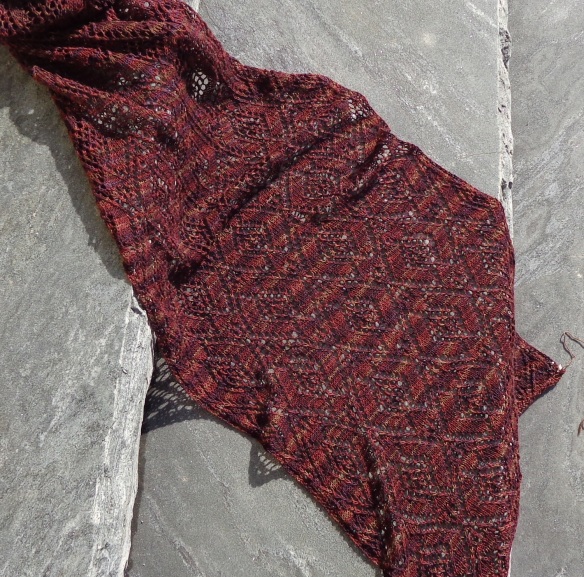
When you look at the skein, there are four colours in the handpaint: a light almost-lime green, a medium green, a dark olive green, and a blue-green. It’s kind of interesting how they end up pairing off and making spirals of pooling. I like the efect in socks but would be less happy with this pooling in a sweater. You might remember that I made a shawl in Rowan Fine Art in a reddish-brown colourway called the Starling Wrap. You can see that there were four colours in that colourway and they paired off into repeating stripes, too. That’s something I’ll need to keep in mind as I use my stash of this yarn.

Starling Wrap designed by Marie Wallin knit in Rowan Fine Art by Deborah Cooke

And here’s an interesting project with Rowan Fine Art Aran – the same yarn in a heavier weight – by DayanaKnits, using planned pooling. This project is possible because of the regularity of the colour repeat, and I find it fascinating. Have a scroll through Dayana’s projects while you’re on her blog. She’s a prolific and talented knitter.

I’m off to a knitting fair this weekend for the first time in years. I have a little list and am hoping to find some graduated dying by local knitters. It’ll be great to have the chance to smell the yarn fumes and squish the skeins again!

Noro Mitred Jacket

Noro Magazine #17, Fall/Winter 2020

Remember when I showed you this?

It’s Noro magazine #17, the fall/winter 2020 edition. I bought it online just because of the jacket on the cover. It’s made of mitred squares and knit in Noro Ito.

The plan was to finish a few things before casting on, but I love knitting mitred squares so that resolution didn’t last too long. I ordered some Noro Ito, which comes in huge balls of 400m each, then cast on. That link will take you to the distributor’s site. The sample in the magazine is knit in colour #4 and I ordered colour #24.

The construction of this is so interesting. You make I-cord which runs along the hem from that front corner where the neck starts on the bodice all the way around to the other side. Then you pick up stitches to knit the first square, which is in the location of that beigey one on her right hip. You make the squares individually on the hem, all the way around to the one under her left hand. Then you make the in-between ones for the back, then for the two fronts.

Here’s my jacket in progress:

Mitered Jacket knit in Noro Ito by Deborah Cooke

At this point, I’m wondering whether the i-cord should have been knitted on a larger needle since it’s tight at the lower points and wants to roll. Hmm.

I love mitred squares because they’re addictive knitting – in a self-striping yarn, they’re even more so. I can finish one or two squares easily each night while watching tv – although I had to write out the directions for the square again to get them right. Now I have it memorized.

I wish the schematic had more measurements, and that the gauge was for a square instead of rows in stockinette stitch. I was so excited to get going that I didn’t swatch so I’m hoping the size is coming out right.

What do you think?

Stripes!

I can never resist a new project, even when I have a lot of projects to finish up. There’s something very satisfying about casting on.

In November, Andrea Mowry published a new pattern called Stripes! which I liked a lot. (That’s a Ravelry link.) It’s a top-down pullover with lots of options to vary the results. It looked like a quick and easy project – plus I had the perfect yarn in my stash (or so I thought).

I bought some Sugar Bush Motley at Spinrite last year because I really liked how it looked in the skein. (That link goes to the Motley project page on the Sugar Bush site.) I was expecting it to create an all-over speckly pattern. Once it was caked up, though, it was clear that this yarn was dyed to make repeating stripes. (This colourway is called Peppered Teal.)

Sugarbush Motley in Peppered Teal

I set it aside then, but pulled it out again for this sweater. I’d have stripes without changing colours every 8 rows. Of course, the stripes would vary in width, depending on the number of stitches on my needles, but I thought it would be okay.

Here’s the sweater so far:

Andrea Mowry's Stripes top-down pullover knit in SugarBush Motley by Deborah Cooke

This yarn is a merino-alpaca blend, so it will be warm. I decided that I wanted a turtleneck on this sweater, so I did a provisional cast-on, then knit down the sweater yoke as instructed. When I had a few inches done on the yoke, I picked up the neck stitches and knit up in ribbing to create the turtleneck. I also inverted the colour sequence – starting from the other end of the skein – because I knew the collar would be folded down and I wanted it to match up with the body. I had a hard time assessing the depth to knit – I thought it was long enough because I tried it on before the yoke was done. Once I divided for the underarms, though, the neck pulled down a bit and I had to rejoin the yarn and knit a few more inches on the neck.

I like the yarn, even though it’s a single-ply, loosely spun and a bit splitty. I like it because of the result. The knitted fabric is soft and light, with a really nice drape. I think this will be a sweater I wear a lot.

I can hear you asking why I’ve only managed this much since November. As is so often the way with “quick” projects, I made a mistake. I had knit this sweater well past this point, almost to the waist ribbing, when I took it off the needles to check the size. I find it hard to assess the size of a top-down pullover, even when I try it on, until I knit past the bust. It was huge, way too huge – because (ugh) my gauge was off. I figured out that I needed 50 less stitches in the body and would still have a loose fit, so I ripped all the way back to the neck. I could have changed to smaller needles, but I liked the drape of the fabric I was getting, so I followed the instructions for the next smaller size. That made a difference of 30 stitches in the body. Then I added 20 less stitches at the underarm, 10 less on each side, and carried on. I’m quite happy with the fit now.

And I figured out a new trick. Instead of transferring all the stitches to a length of wool to try on the sweater, then putting them back on the needle, I knit half the body on one 80cm circular, and the other half on a second 80cm circular. That means I can put the sweater flat to measure it, and also that I can (carefully!) try it on, without transferring the stitches. 🙂

Onward with this one. Looks like it will be a sweater to wear next winter…

Pink Socks

The problem with finishing big projects is that I haven’t had much to show you. You’ve seen enough in-progress pictures of everything currently on my needles.

I did make a pair of socks, though. There’s something particularly cheerful about self-striping yarn in bright colours, isn’t there?

Of course, I had to make them match. 🙂

socks knit by Deborah Cooke in Online Supersocke Comedy Color

The yarn was in my stash – it’s Online Supersocke Comedy Color, and the colourway is 1280. The yarn is discontinued, so that’s a Ravelry link.

First Snow Hats

First Snow is a hat pattern I really like. (All the links in this post are Ravelry links.) It was a free pattern when I downloaded it, although it looks as if it’s no longer available. 😦 I started using this pattern a few years ago, for these Caron Chunky Cupcakes self-striping yarns – each skein came with a matching pompom:Caron Cakes hats knit by Deborah Cooke using First Snow pattern by The Vulgar KnitterThe cables made these a more interesting knit than they would have been otherwise, and I liked the finished hats.
I also used this pattern for two bundles of Caron X Pantone, one in Faerie Cake and one in Morning Blues. These took me forever to finish because I don’t really like the feel of the yarn.

Although these hats ended up with bands of colour a lot like the ones above, in this product, there are five separate skeins of yarn. The cakes at the top include self-striping yarn. That makes an easier knit (no ends to sew in) but you can’t change the order of the colours.

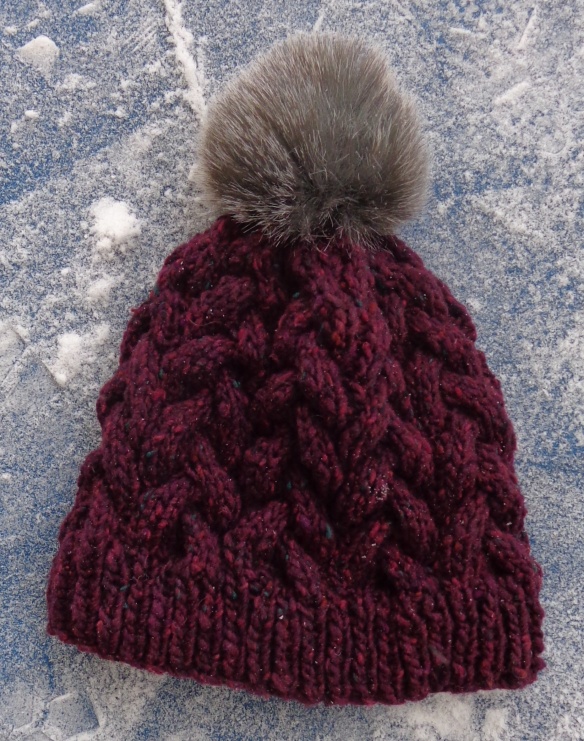
Last fall, I used a ball from the mill ends of a purple tweed and made yet another hat. This one has a commercial fake fur pompom. I like this one!

First Snow hat pattern knit by Deborah Cooke in a mystery tweed mill end

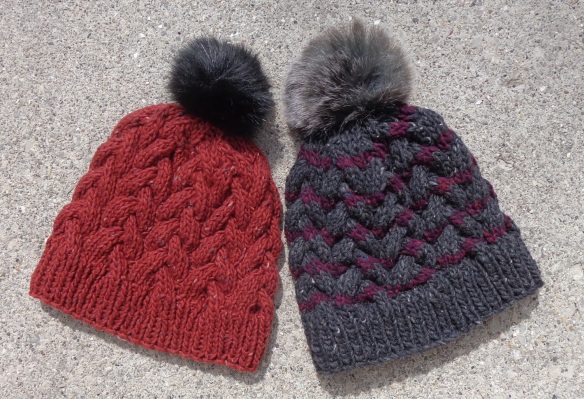
I had more of those tweedy mill ends in my stash, so this summer, I knit it up into a few more hats, also with commercial pompoms.Wool hats knit in First Snow pattern by Deborah Cooke

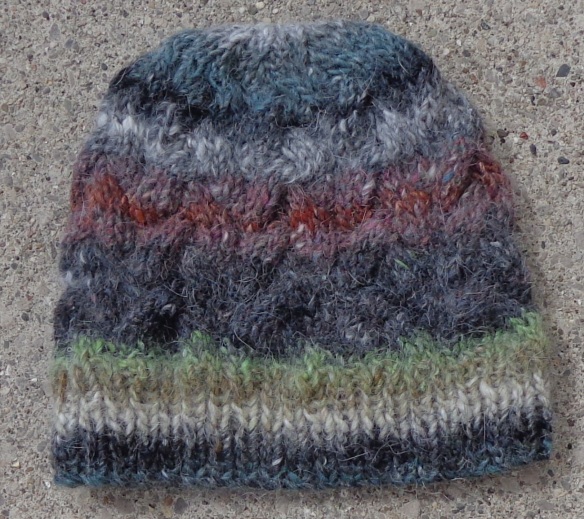
Finally, I used up the last of the Noro Kochoran in a hat for the mister:First Snow in Noro Kochoran knit by Deborah CookeThis one is a little smaller, because I forgot to do the increases after the ribbing. I was too worried about matching the stripes – I had a lot of bits and ends to use up for this hat. It fits more like a watchcap, but the mister likes it that way, so all is good.

Do you have a favorite hat pattern?