Socks

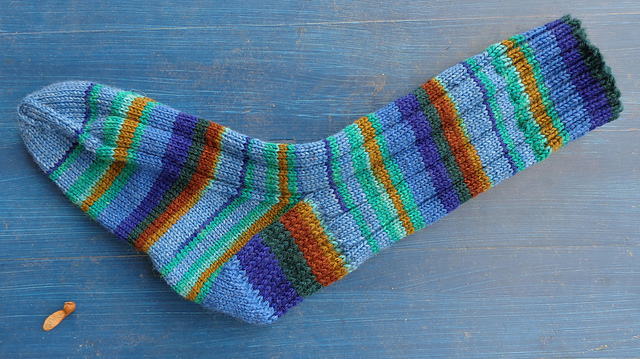
We’ve done a couple of road trips lately, and in my universe, road trips mean sock knitting. I started this pair of socks for myself last year, and they’ve been stalled for a while. I finished them on the way to Lori Foster’s RAGT in Ohio, and now I have new socks! I also knit the first sock of another pair, although there’s no telling when the socks will be done. (We have no road trips planned right now.)

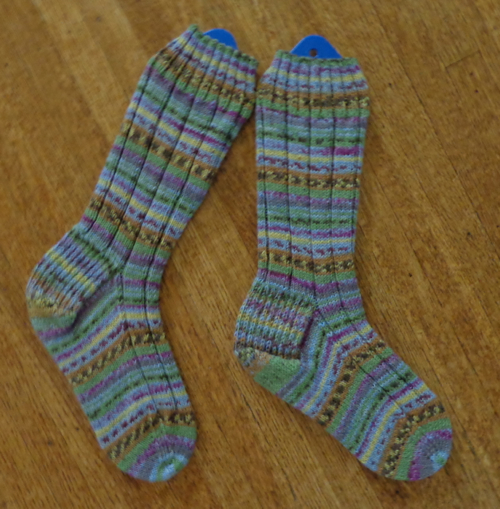
Here are the new socks:socks knit in Jawoll aktion by Deborah CookeThe yarn is a self-striping sock yarn called Lang Jawoll Color Aktion (yup, another German sock yarn) and it came with the dyed-to-match spool of reinforcement yarn. I used it in the heels and toes, as usual, but since my socks always wear out under the ball of the foot, I also wove some in there after the socks were done. We’ll see how that works out. The pattern  is my usual one – if it was ever in a book, I forget where. I bought this yarn on a stash enhancement day with Pam, the last time RWA National was in Dallas. I forget the name of the shop, but it was very cute.

It turns out that the new girl is a great liberator of knitting wool and knitted items. She doesn’t chew them or even lick them – she just relocates them. These socks have some miles on them already, and I haven’t even worn them yet!

Jess

I seem to always have a lot of knitting projects on the go, and last winter I figured out part of the reason why that is: I tend to take on big projects. They’re either really detailed or take miles of yarn, or both, which means they take a long time to knit. In March, I decided that I needed a little break from those epic knits and planned for some instant gratification.

Of course, it didn’t quite work out that way.

This sweater is from a book called Colourscape Folk – that’s a Ravelry link – which features a Rowan yarn called Colourscape Chunky. It’s a single-ply yarn, spun in the UK, with self-striping colourways designed by Kaffe Fassett. The yarn is currently discontinued. I’ve used this book and yarn before: here’s a long vest in shades of pink that I made for myself (it’s not so hot a pink as the flash makes it look), and here’s a vest I made for Mr. Math, also from this book and in this yarn. Both of those projects were quick knits and came out well.

When this yarn was discontinued by Rowan, a very similar yarn appeared in the inventory of another British company Texere, called Olympia Chunky. British knitters on Ravelry who had fingered both yarns suggested that Olympia Chunky might really be Colourscape Chunky with new ball bands. I had knit Mr. Math’s vest from Colourscape Chunky and had stashed more for him for another cardigan, but the colourways I wanted for myself were gone. I bought Olympia Chunky for the pink vest and couldn’t tell the difference between the two yarns. I also bought Olympia Chunky for the project I’m talking about today.

Here it is:Jess by Sarah Hatton knit in Texere Olympia by Deborah CookeThe cardigan pattern is called Jess, and it’s from that same Rowan book. I’ve even knitted it in the same colourway as shown in the book. While I’m quite happy with the finished vest, it was a nightmare to knit and far from the instant gratification I’d expected. This batch of yarn was filled with knots. The problem with a knot in a self-striping yarn is that the two ends knotted together invariably don’t match. In order to match the colour gradation, you have to sift through the other skeins, trying to find the match, then break and join the yarn there. You can see how this ends up being an inefficient use of yarn. While Colourscape Chunky did run thicker and thinner (as do many single ply yarns) this batch varied more wildly. Some stretches were less than half the thickness the yarn was supposed to be, and those stretches went on for a long time. The parts knit in that thinner yarn actually looked lacy. I knew the yarn would full some in washing, but not that much, so I had to break out those parts and seek matches, etc. etc. In the end, I used parts of 6 skeins for a cardigan that required less than 4, and ended up with mounds of bits.
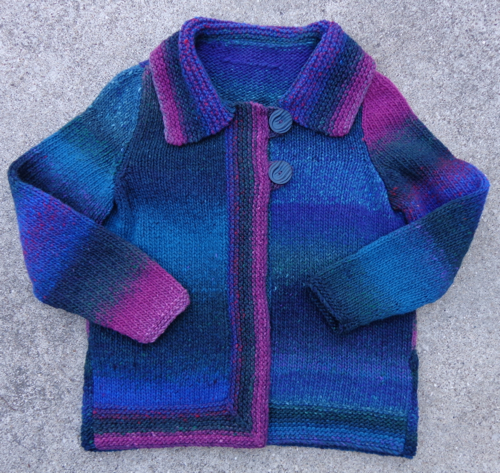
I had some issues with the fit through the shoulders, too, both in terms of the sleeve cap being too short to fit well into the armhole and the armhole being too shallow for me. I think I knit the sweater from the armholes up at least three times. The interesting thing is that it feels huge, even though it has finished out to the correct size (and the correct size for me.) I think that’s because those wide garter stitch bands at the front are designed to overlap, but since the front of the cardigan hangs open, they seem to be extra width. The collar is larger and lower than I’d expected, but it’s staying the way it is now.

Of course, I finished this winter cardi just as summer is beginning! I think I’ll stick with my epic projects for a while.
Knitting Mittens

When things are really busy, knitting helps me to organize my thoughts. I don’t think directly about anything, but just knit along and To Do lists organize themselves in my mind, like magic. This is a wonderful and useful thing, and you can believe that with the publication of Thorolf’s book last week, I’ve been knitting a lot.

This trick works best when I knit a familiar pattern, so invariably, very busy periods of my life lead me back to a basic mitten pattern. It’s a free Patons pattern that I was given when I first learned to follow a pattern. My copy has been folded and refolded so many times that Mr. Math ran me a few copies of it before it disintegrated forever. It provides basic mitten instructions in worsted weight yarn, with variations for a number of sizes, all on a single 6 by 9 sheet of paper.

I have modified the pattern slightly over the years. It’s designed to be knit on two needles, then seamed up the outside of the hand. I don’t like seaming much, so I now knit these in the round. This free pattern from Coats looks like an updated version of mine, with the addition of a hat. They’ve made the change to knitting in the round, as well. I also knit the mitts for charity, building up a bag of them to give away each fall. I usually buy some new yarns to try them out, then use up odds and ends from my stash. Changing the yarns and using stripes makes them more interesting to knit.

This year, I tried a yarn from Bernat called Mosaic. It looks a bit like Noro Kureyon, but is acrylic so it feels different. It’s actually been discontinued now. Although it’s an aran weight, I still used the same pattern and needles. They’re just thicker mitts.

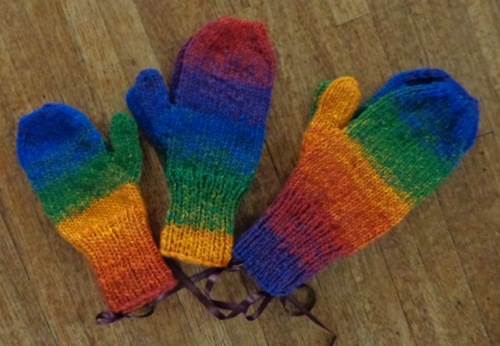
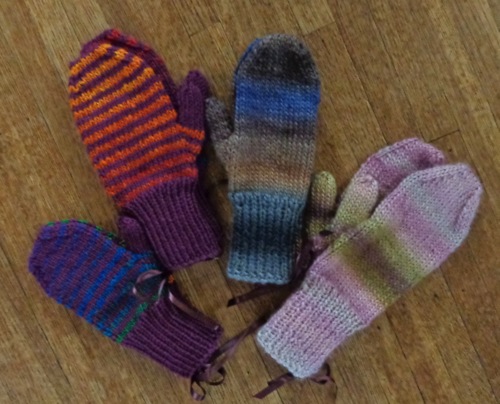
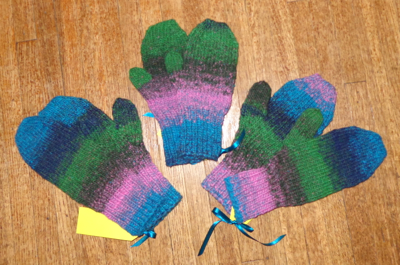
These first mittens are in the colourway Calypso. I bought two balls, and got three matching pairs.mittens knitted in Bernat Mosaic by Deborah CookeHere are the stripey ones with the leftovers, mixed with some Bernat Satin. There are also two pair here of odds and ends of Patons SWS from my stash, a wool and soy blend that self-stripes. I have another pair in the same colourway as the pink ones on the right that are nearly done. SWS is also discontinued (even stash ages!) so here’s a Ravelry link for SWS.mittens knit in Patons SWS, Bernat Mosaic and Bernat Satin by Deborah CookeAnd here are another three pair in Bernat Mosaic, in the Aura colourway. I’m down to bits of this now, so will make some stripey mitts with the leftovers. mittens knitted in Bernat Mosaic by Deborah CookeWhat do you do to organize your thoughts? If you knit, do you have a pattern you return to, over and over again? Do you knit for charity?

Another Cameo

Last year, I knit a small shawl called Cameo. That’s the Ravelry link for the pattern, and here’s the post about the other shawl, which is still on the old website.

I started to think about knitting this pattern in self-striping yarns, and finally just had to try it. I had two different colourways of Mille Colori Socks and Lace, so I cast on. Here’s the result:Cameo by Paulina Popiolek knit in Lang Yarns Mille Colori by Deborah CookeThis picture is a teensy bit blurry because I took it without the flash and didn’t hold quite still enough. The one with the flash made the colours look all wrong. You can see how the first yarn striped in those wide bands, and that they got narrower as the rows became longer. Then there’s the alternating stripes between the two colours, but what surprised me was that when I continued in the second colour to the hem, the rows were long enough that it kept striping like the alternating section. You can see the striping better in this detail shot:Cameo by Paulina Popiolek knit in Lang Yarns Mille Colori by Deborah CookeThat top point is on the right and you can clearly see where the alternating rows of stripes begin. It’s a lot tougher to tell where they end. (It was at the green stripe, just to the right of the grout line in the floor.)

I didn’t do the lace on this one, as I thought it would be too much. It’s pretty and bright, a cheerful scarf for a dull winter day.

What do you think?

Nevis Sweater and Entrelac Bag

I recently finished a sweater knit in Noro yarn. I’m trying to both stash-down this year, and also to finish what I start (instead of having dozens of projects on the go). Also, it’s really cold this winter, so a new warm sweater seemed just the thing – with the weather to inspire me to finish. I remembered that I had a bag of Noro Hitsuji, a bulky single ply wool, which seemed to be the perfect choice. I used an older Rowan pattern by Kim Hargreaves called Nevis – it’s in a pattern book called A Season’s Tale. It reminds me of Mary Maxim sweaters, but with more of a trim fit. Knit in the self-striping Noro, I think it’s fun.

Here it is: Nevis by Kim Hargreaves knit in Noro Hitsuji by Deborah CookeI did make some modifications to the pattern. The waist shaping is supposed to be done at the side seams, but I moved it into the body of the sweater. I positioned the decreases like darts in a tailored shirt, halfway between the centre and the side seam. I lucked out on the matches of the colours: I began both fronts and the back at the same point in the variegation, knowing that the fronts would match (so long as there were no knots). The back matches at the top and the bottom – it’s really twice the width of one front, which makes sense even though I didn’t think of that in advance. I figured the sleeves were about the same width as the fronts but longer, so started earlier in the variegation – I guessed, then decided blue cuffs would be nice. The matches worked out surprisingly well.

The front button band is supposed to be knitted afterward in its entirety. I wanted the hems to match so cast on an extra six stitches for each front. When it was time to start the stockinette stitch for the body, I put those six stitches on a safety pin. When I knit the button bands, I just matched the colour in the yarn and carried on. In the pattern, the buttoms were placed higher without one at the hem – I respaced them because I thought it looked as if one had been lost. I found some buttons with fun swirls on them which I like a lot.

The Hitsuji was a bit stiff while knitting and almost like a pencil roving for spinning. It softened up very well when soaked for blocking (like most Noro yarns). The finished sweater is very warm, which is just about perfect when it’s 20 degrees below zero outside.

Here’s the link to my Ravelry project page, if you’re interested in more detail.

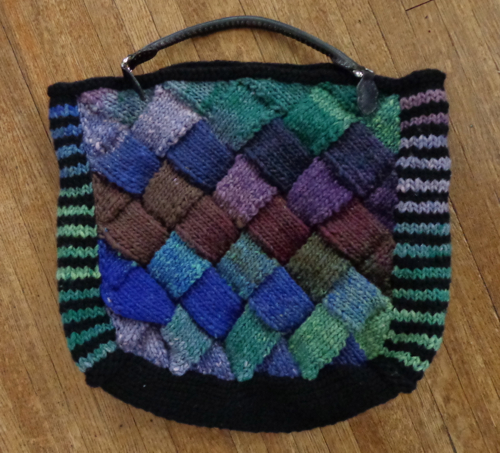
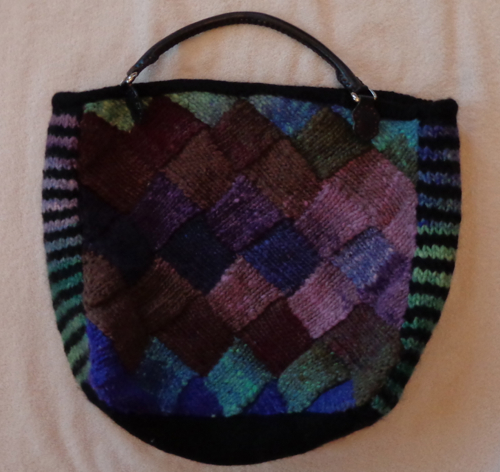
Now, I had a bag of 10 balls of Hitsuji and this sweater only used 6.5 of them (although I did break into three more, seeking matches.) I was determined to not send the rest back to the stash, but to use it up. I also had a pair of black leather handles in my stash, bought for a purse that I didn’t like knitting so frogged. So, I decided to knit an entrelac tote bag and felt it, using up the Hitsuji and also some black roving from the stash.

Here’s the bag before felting:Entrelac Bag knit in Noro Hitsuji by Deborah CookeAnd here it is afterward, still in need of a lining:Entrelac Bag knit in Noro Hitsuji by Deborah CookeThe black felted much faster than the Noro, so I’m thinking I’ll stop felting now. Here’s the project page for the entrelac bag on Ravelry.

What do you think?

Socks in Tuffy and Regia

I haven’t posted about my knitting for a while, mostly because I’ve been knitting gifts. Since they’re surprises, I don’t photograph or talk about them – that would spoil the fun!

But I’ve also been knitting socks for Mr. Math. I have this idea that I can clear out at least one corner of my stash. It’s a bit of a quixotic goal, but can’t hurt to try. He really likes these ones.

They’re ribbed socks knit from Briggs & Little Tuffy, one of my fave sock yarns (and spun right here in Canada). The dark grey is called Oxford, and I used up some bits for the red (also Tuffy) and the black (mmmm, something else from the stash!) to jazz them up.Ribbed Sport Socks by Patons knit in Briggs and Little Tuffy by Deborah CookeAlso, here are the socks for him that are currently on my needles – one is done. You might remember that I knit a vest for him from this yarn – it’s Regia six-ply, with colourways designed by Kaffe Fassett. Well, there were three balls left, so he gets matching socks. Here’s the first one – the second is knit to the heel and will be just the same (because I have fussy knitter disease).Sock knit in Regia Design Line by Kaffe Fassett 6-fädig by Deborah CookeI also have some lace on the needles (because winter is coming, and I knit lace in the winter) but right now, it just looks like a lump. I’ll show you after it’s blocked.

Sipalu Felted Bag

I’ve finished another felted bag – is it possible to have too many of them? – and although it still needs to be lined, I thought I’d show it to you today. It won’t look any different from the outside once it’s lined, after all. 🙂

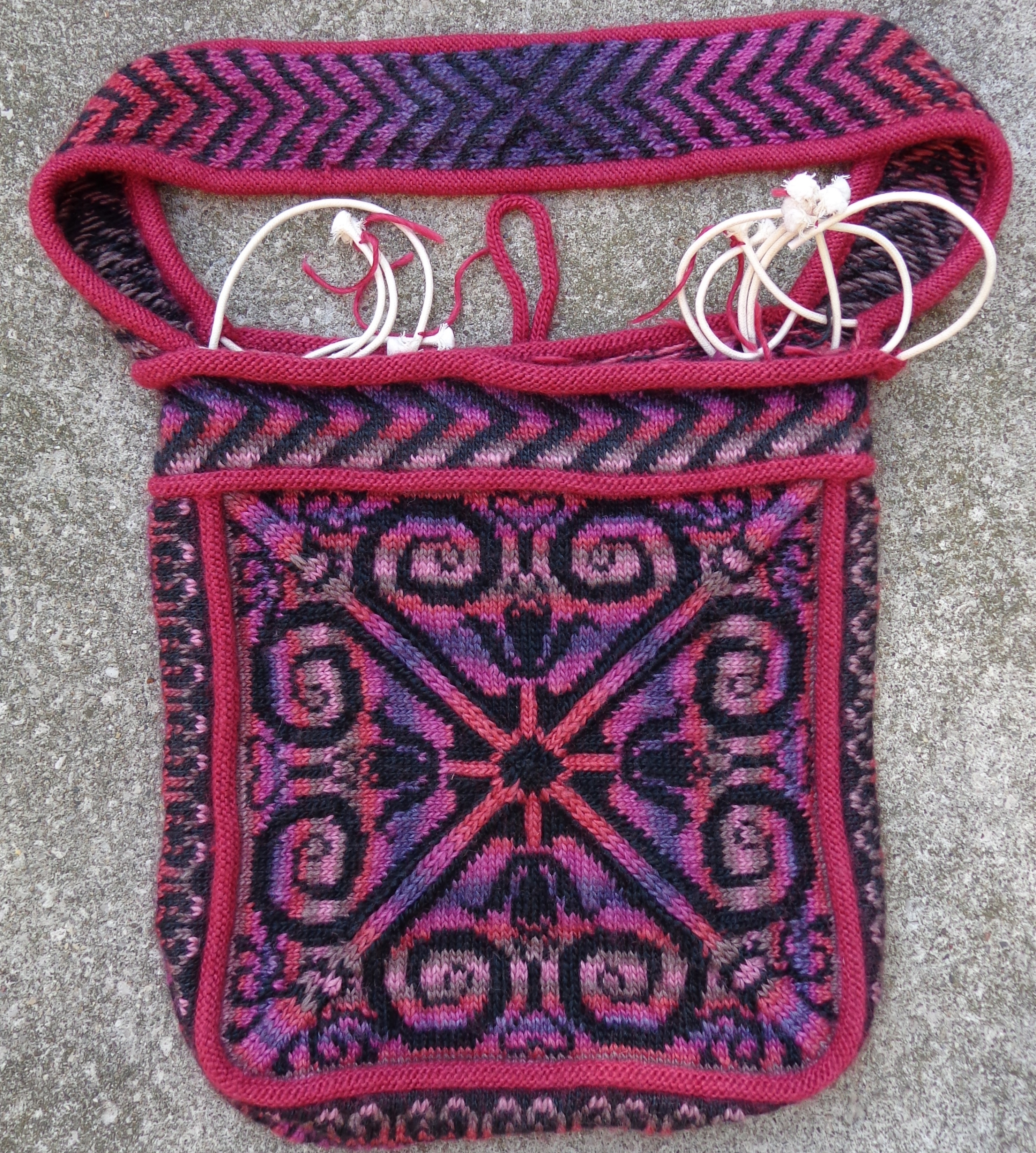
The Sipalu bag was available from Knitpicks as a kit, including the wool, but I didn’t like that it wasn’t felted. I knew the result would be less sturdy unfelted, particularly knit of a fingering weight yarn (the kit came with Palette.) The pattern for the Sipalu bag was and is available on its own, so that’s what I bought. The pattern specifies knitting with a number of colours, but I decided to use a self-striping yarn with a contrasting solid instead. I dug into my stash and came up with my felting standby, Patons Soy Wool Stripes and Soy Wool Solids. I used Black and Natural Plum.

I did run out of black. Since the SWS yarn is discontinued, I couldn’t find any more. (I tried.) I then substituted solid red SWS, but didn’t like it in the fair isle – there wasn’t enough contrast with the self-striping Natural Plum – so I frogged that back but used the red on the garter stitch edges. The bag sat, unfinished, in my knitting basket while I tried to figure out what to do. One day I saw a very similar yarn to SWS balled with another company’s label, which gave me the idea of using the Ravelry search engine to find a substitute. Ravelry has a great search engine that lets you specify many variables – I used the content (soy and wool) and the weight (aran) , then looked for single ply yarns in solid colours. I found Gjestal Bris, with a buy link, so ordered some of that. It’s a bit thinner than the SWS, but since I was felting the end product, it worked out just fine.

Here’s the unfelted version of the bag: Sipalu Bag by Kerin Dimeler-Laurence knit in Patons SWS by Deborah CookeYou’re probably wondering about the white cording. I decided that I wanted the edges of the bag to be more round than the garter stitch alone would make them. I wanted them to be like piping around the edge. So, I bought some cotton cord at the fabric store, the kind that’s used to make piping (!), and sewed it in to all the edges. (I slip-stitched the garter stitch ridge closed on the inside of the bag, with the cord trapped inside.) Because I wasn’t sure if the cord would shrink – or whether it would shrink at the same rate as the SWS – I left the ends long. After the felting was done, I tugged the cords so that the piping was smooth on each edge, then trimmed them and secured the ends inside the bag.

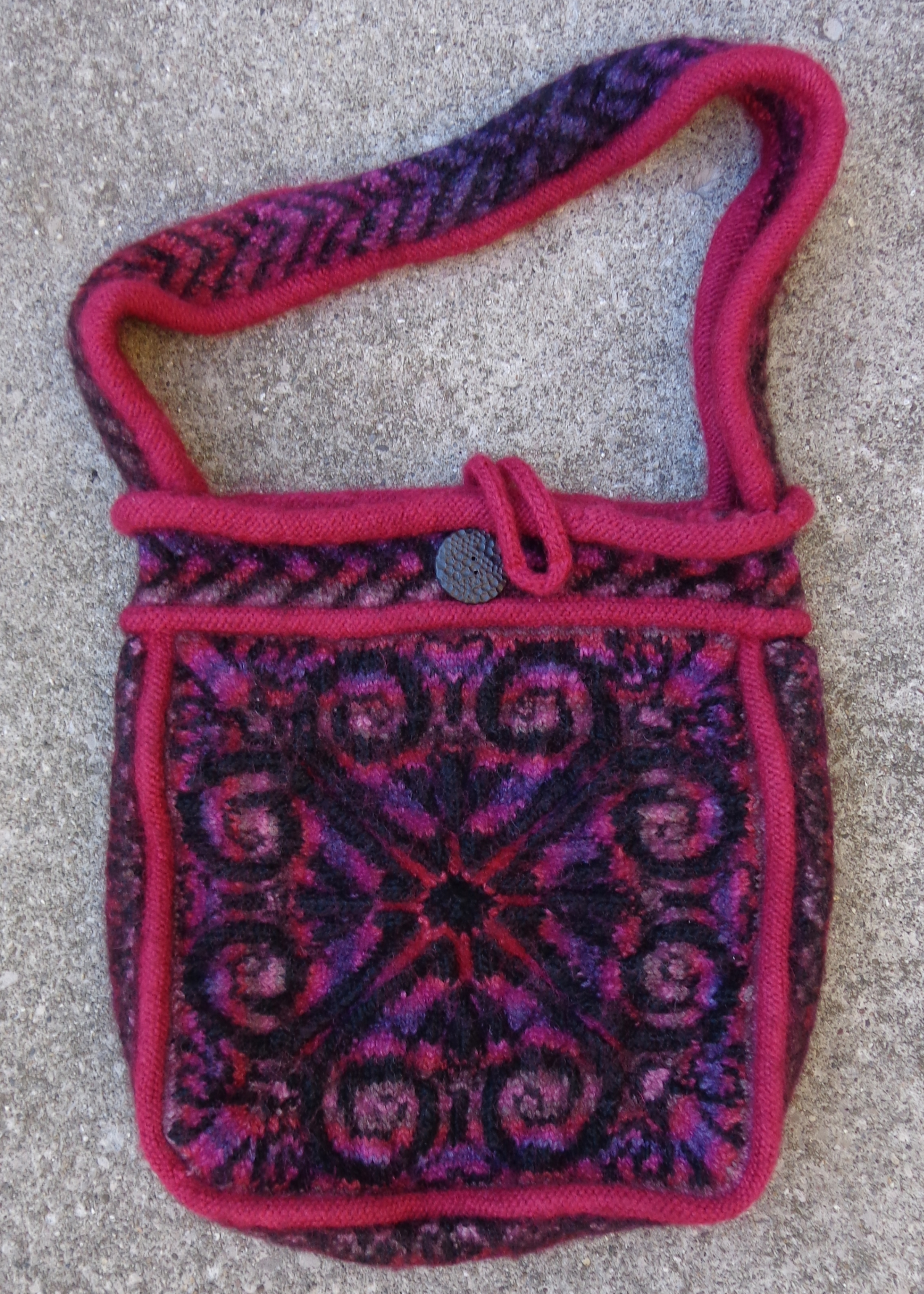
Here’s the bag felted and ready for its lining. It could have been felted just a little bit less, but felting is an inexact science. The button is handmade of porcelain. Sipalu Bag by Kerin Dimeler-Laurence knit in Patons SWS by Deborah CookeHere’s my project page on Ravelry, if you want to see more nitty gritty details.

What do you think?


Hebrides Cardigan

This is a cardigan that I finished this week – I love it so much that I wore it before taking a photograph of it! It’s knit in my favourite yarn, Rowan Kidsilk Haze, in one of the KSH Stripe colourways, Twilight. As you can see, this yarn is self-striping, which is another of my fave concepts in yarn.

In addition, I think this is the first time I’ve ever knit a pattern not just in the specified yarn (no substitutions here) but in the colour illustrated. Here it is: Hebrides by Lisa Richardson knit in Rowan Kidsilk Haze Stripe by Deborah CookeAnd here’s the pattern, called Hebrides, which is a free download from the Rowan website. It’s in stockinette stitch with moss stitch borders – the colour in the yarn does all the work of making it beautiful. I used more buttons than the pattern did, but that was just about my only change. I really like abalone buttons, and they look particularly good here. 🙂

This sweater is so wonderful. It’s light and soft, yet very very warm. Perfect!

I’m going to knit another, because I know I’ll wear this one so much. I already have more KSH Stripe in the Cool Colourway. I did knit another cardi in KSH Stripe in the Forest colourway, but I don’t wear it at all. The difference is that it has a sweetheart neckline, which looked great in the pattern photo but doesn’t look right over shirts and blouses. (The model was wearing it without a blouse underneath.) So, before I cast on the Cool cardi, I’m going to frog and reknit the fronts of the Forest one, to give it the same neckline as this one. I’m not really looking forward to that job, but it will be worth it in the end.

What do you think?

Hippocamus Mittens

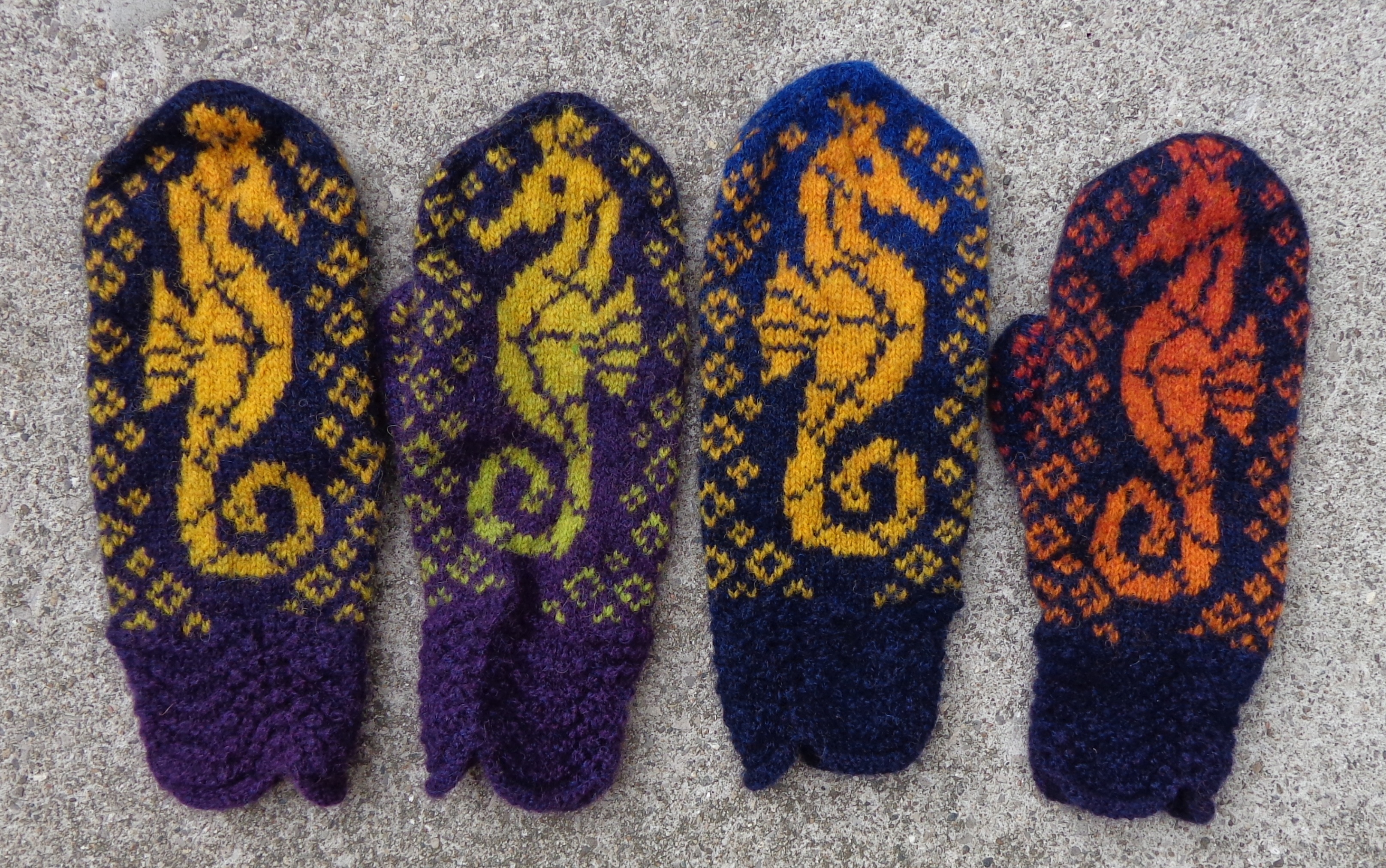
I haven’t shown you any knitting for a while, but I’m really proud of these so you get to see.Hippocamus Mittens by Tori Seierstad knit in Kauni Effektgarn by Deborah CookeThis pattern is called Hippocampus Mittens (here’s the Ravelry link). I’ve liked them for years and finally decided to knit a pair. I had some bits and ends of Kauni Effektgarn left over from knitting Mr. Math’s Elrond Sweater so I could shop the stash for this project. I have sweaters on the go, but sometimes a small project is exactly what you need.

I knit the middle pair first, but didn’t think they looked like a match. Since the pattern used less yarn than I’d expected, I had enough for a second pair. I then knit the outside pair, ensuring that the background on the cuff for each matched one of the original mitts. So, these are the two pairs resulting. They then went into the washer to full and shrink a bit, and here they are. I like them a lot – pluse there’s one pair for me and one for a Christmas gift. 🙂

There’s a pair knitted in Noro on the pattern page, which is a very tempting possibility. I might have to knit another pair (or two).

It’s very strange for me to have a Christmas gift knitted before July, but it appears that I’m organized this year. Ha! Isn’t that a good thing?

Striped Cropped Cardigan

Well, I finally finished the reknitting of the sleeves on my stripey Noro cardigan. As you might remember, I had to reknit the sleeves. While that might have gone fairly quickly, there was a necessary period of mourning – I had to chuck it in the corner and sulk about the frogging and reknitting for a few weeks before I could actually do it.

Finally, I’d brooded enough and just did it.

This week, I’ve been seaming it up and even though that’s not quite done, I’ll show it to you today.Cropped Jacket by Irina Poludnenko knit in Noro Silk Garden Sock by Deborah Cooke

I’m still not entirely thrilled about the sleeves, which is why I haven’t finished the seaming. (It also hasn’t been blocked yet.) Where it changes from dark blue to light blue at the top of the sleeves, there are a number of decreases to shape the sleeves. Now that it’s assembled, I’m wondering if there are too many too soon. On the other hand, if I decrease more slowly, I could end up with a lot of fabric (like a dolman sleeve) around the underarm and that bulk wouldn’t be welcome. I’ll have to baste the sleeves and try it on to be sure.

Fingers crossed that it looks good, because I really don’t want to knit the sleeves again.

What do you think?