Garter Stripe Square Bag

I’ve had a nasty cold this past week and a half, one that didn’t want to go away. It wasn’t so bad that I could stand to spend days in bed (I have to be at death’s door for that) but was sufficiently bad that I couldn’t write new work. I’ve been doing administrivia – editing, proofreading, updating links etc. etc. – and got pretty much fed up with this particular cold virus.

Even worse, it also been affected my knitting. I couldn’t knit lace, or do any armhole shaping, or knit anything that required much thinking. I didn’t think I’d finish things well in this state – my stripey Noro cardigan is done, with the sleeves reknitted, but grafting those side seams has been beyond my abilities and energy level. I also wasn’t able to recalculate – I had started to seam together my Knit, Swirl cardigan, only to discover that the sleeves are too narrow. I need to re-plan, frog, and reknit the sleeves, but not while this virus was in residence. All my plans to finish everything before casting on something new were trashed by this cold.

Garter stitch has been suiting me pretty well. Knit, knit, knit. Easy, peasy. I didn’t have anything like that on my needles, so needed a plan.

Since my Noro cardigan is done, I have a lot of Noro Kureyon Sock left over in one colourway. (#289) It’s all bits and ends, though, because I needed to match the colour sequence and there were breaks in the yarn. I was going to put this in to my stash for the Sock Hexagon afghan, but it seemed like a lot of one colourway. I had a look in that stash and found even more Noro sock yarn….soooooooo, a plan was born. Altogether, I gathered over 500g of ends of Noro Kureyon Sock and Noro Silk Garden Sock.

A big chunk of it is becoming a stripey tote bag.

This pattern is for a felted bag, made of striped squares assembled in a clever way. Here’s the creator’s blog post about it – it’s in Japanese, but has lots of pictures. What a cute bag! There are some English instructions on Ravelry, right here. Essentially, you cast on an odd number of stitches and knit a square with the same number of ridges – 25 stitches knit to 25 ridges, for example. You make 22 squares and join them as indicated, add an I-cord handle and trim, and felt it. (If you’re on Ravelry, there’s a project by another knitter who used Kauni Effektgarn and the entrelac technique to create two gorgeous bags, right here.) It appealed to me to make a project not just from stash, but from leftovers. There will still be plenty of scraps for the Sock Hexagon afghan.

I started this project with alternating stripes of Noro – 2 rows of A, 2 rows of B, 2 rows of A, etc. – and even managed to mess that up a few times. That tells you all you need to know about my recent mental state. (It might have been the cold, or the cold medication. Either way, I cast on with birch Brittany needles, not really sharp pointy ones.)

So, I sorted out the Noro stash and chose a dark colourway of Silk Garden Sock leftover from my Inky Spider Shawl, to alternate with Kureyon Sock in #180. I have a lot of this, in bits and ends, and think it must have been from my infatuation with Kureyon Sock when the yarn was originally introduced. I knit a lot of socks for myself in it because I loved the colours – it looks like I bought a second ball in this colourway to make the socks match – but it really wasn’t good sock yarn for me. Those socks were like butterflies: beautiful, admired, and short-lived.

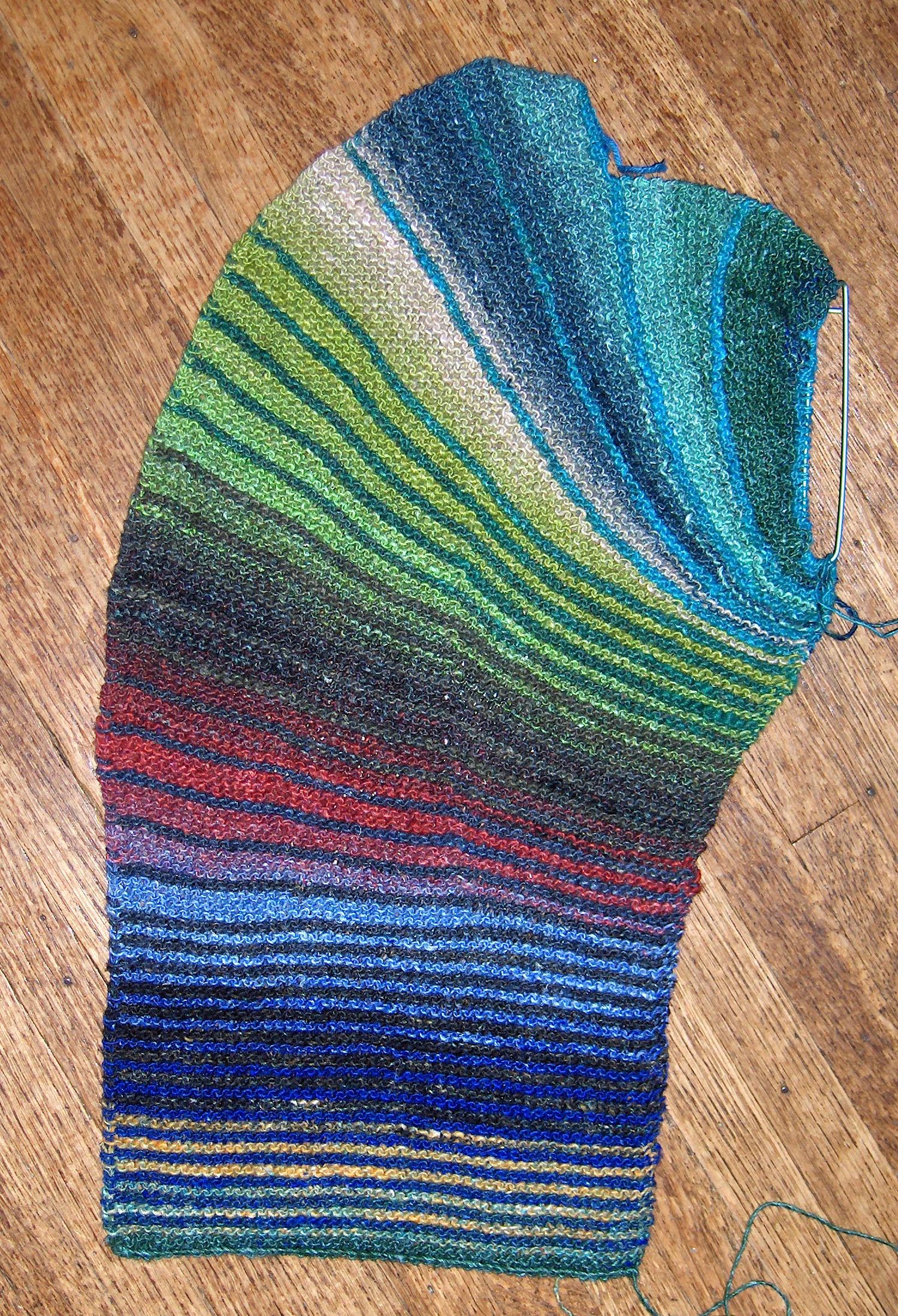
I started at the bottom of the bag, because it made most sense for it to be dark, and the central four squares there. I knit each one, then pick up the next one along the side to carry on. Seaming as I go. That works for me. Here it is so far:Garter Stripe Square Bag by Ishi-knit knit in Noro Kureyon Sock by Deborah Cooke

The black and turquoise striped square was the first one and the bottom needle is pointing at the middle of the bag. Those are the four squares that will make the base. The dark Silk Garden Sock is gone, so I’ve moved into the #289 left over from my Noro cardi. There’s enough #180 to knit for a while. Things are getting brighter now. I’ll knit five on the top, then five on the bottom, just like the schematic.

What do you think? Does your knitting change with your health and welfare? Do you have “comfort knitting”, too?
Wingspan 2

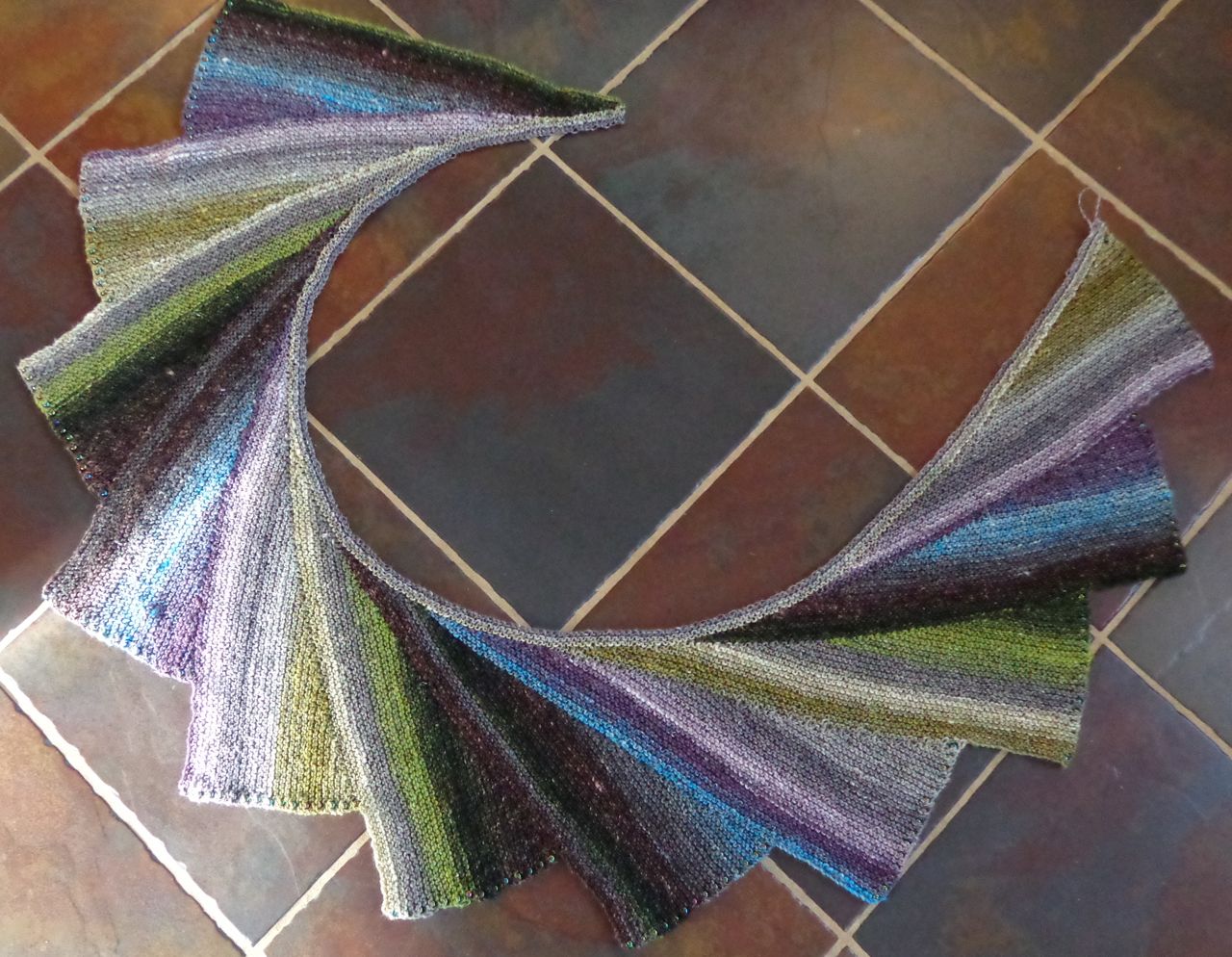
I just finished another version of that Wingspan shawl. This one is in Noro Silk Garden Sock and used two balls:Wingspan by maylin Tri'Coterie Designs knit in Noro Silk Garden Sock by Deborah CookeI had enough yarn to do ten triangles this time. And I figured out what I’d done wrong the last time – the pattern says to Slip 1, Knit 2 before placing the traveling marker after each work and turn. I only saw the K2, so my W&T’s on the first shawl are two stitches apart. They should be three stitches apart, as they are here. Doing it the other way made each triangle wider, but also made the shawl wider. This version is more like a scarf.

It does have beads at the base of each triangle, one on every fourth row on the second stitch in from the edge.

I like it a lot. What do you think?

Purple Socks

I haven’t shown you any knitting for a while, but today, that changes. I’ve finished a shawl, but it needs to be blocked. I’m not sure how I’ll manage that with the house at sixes and sevens, but maybe I’ll manage it before next Friday. I’ve finished the knitting of a cowl and it’s been waiting to have its buttons sewn on. I started to sew together a sweater that’s been patiently awaiting my attention, only to discover that my suspicions about the sleeves were right – they’re too long and too narrow. (Clearly, there’s a sleeve troll loose in my knitting projects. Remember that I had to frog the sleeves on my Stripey Noro sweater, too. Until recently, I didn’t even know there was a sleeve troll, but you learn something new all the time.)

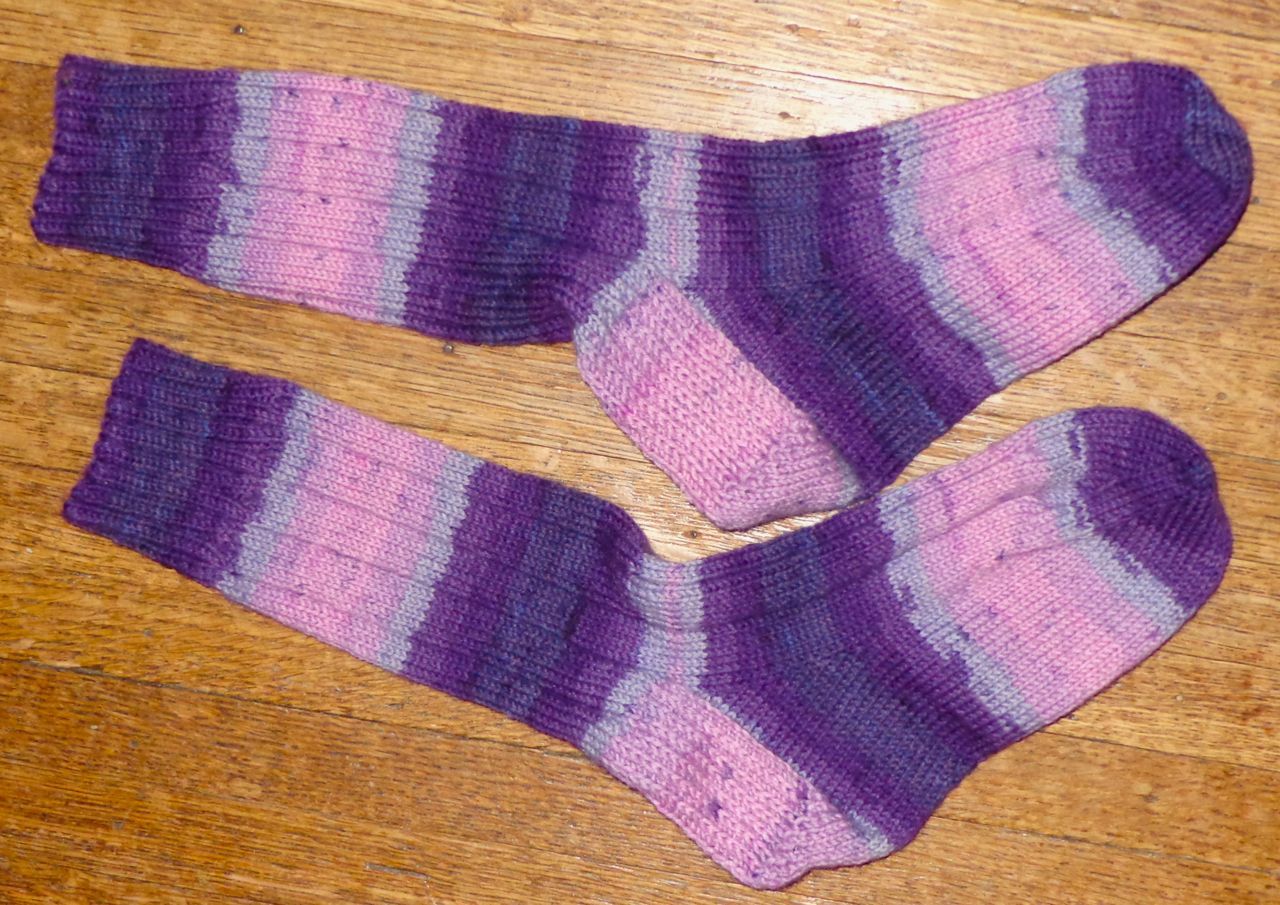
I did finish this pair of socks – and they’re purple, too. Ta da!socks knit in ONline Supersocke 6 fach/6 ply Wellness II Color by Deborah Cooke

Have you finished any knitting lately? I need to finish some more projects before I cast on anything new…

Wingspan 1

Here’s the knit I started before Christmas.Wingspan by maylin Tri'Coterie Designs knit in Patons Lace by Deborah Cooke

It’s from a free pattern called Wingspan. This is a really neat garter stitch shawlette – although mine came out a bit smaller than anticipated. I was only able to finish 6 wedges with my ball of Paton’s Lace, instead of the 8 that the pattern specifies. Either my gauge was way off, or the ball – which was from the mill ends – wasn’t a full ball.

I used a bit of a ball of a solid colour of Paton’s Lace for the 4 rows on the long edge, and put some beads in it to make it look less stark in contrast. This colourway is called Woodrose, and the ivory on the edge is called Vintage.

I’m quite pleased with it and am going to cast on another.

Noro Cropped Jacket in Revision

Last week, I showed you a cardigan in garter stitch that I thought was almost done – that post is right here. It soon became clear, though, that I’d been ridiculously optimistic about its completion.

(Interestingly, Tupperman’s story has been doing much the same thing to me. That’s another story.)

At issue was the seaming. As mentioned to you last week, once the knitting was done, I would just fold the sweater in half, then seam up the shoulders and neck, then seam the underarms and sides. It was a great theory, but once I folded the sweater, I saw the problem.

Actually, there were two problems and they’re both on the back. Here’s a close-up:Cropped Jacket by Irina Poludnenko knit in Noro Silk Garden Sock by Deborah Cooke1/ First of all, the back has a little flange on each side at the side seam. On the left side, there are three green stripes between blue, and on the right there are three blue stripes between blue. That little tab doesn’t fit into anywhere when seaming up the underarms. Apparently, I should have added stitches from the top of that flange when I picked up the stitches for the sleeves. Oops! I had left the stitches live for the sleeves from the fronts and back, and my count came out correct without picking up anything from those bits. I was thinking it might be a gusset, but it can’t be.

I don’t really want a little flappy bit at each side seam.

2/ Have a peek at the collar and shoulder seams. That little Christmas tree shape should be sewn up. If you look on the right side of the image, it’s more clear that the back shoulder seam is too long to be matched to the front shoulder seam. It could be eased in – garter stitch does that pretty well – but my impression was that there was too much to ease. It might end up more like a gather, which isn’t a good thing at the shoulder. (Most of us don’t have puffy bits there. I don’t and I’m glad.) This likely happened because I just knit too many rows on the back for the shoulder, possibly because the movie was at such a good bit I lost count. (Feh.)

So. What to do? There were two choices.

1/ Frog the sleeves, frog part of the back to make the shoulder section shorter, pick up the sleeve stitches for the whole length and reknit the sleeves.

Not an appealing option.

Or 2/ Cheat.

Both issues are with the back, and I had live stitches on both edges of the back. Remember I told you about knitting upside down? Well, this looked like another great opportunity put that technique to work. I thought I’d take one row apart at the shoulder, narrow the back, delete the flange, then reknit the pieces together without ever unraveling the sleeves. My intent was to remove about 4 garter stitch ridges from the back. This would also fix another detail that was bugging me – the backs ended on the dark teal at the shoulder seam. The fronts ended at the bright turquoise in the contrast colour. By pure coincidence, the contrast colour ended at the same bright turquoise on the back, but the extra two rows of teal meant it didn’t look like the pieces matched when joined for the sleeve.

The problem with cheating? It would make the body of the sweater 4 to 5″ narrower in the body. That meant it wouldn’t fit me. It’s a trim-fitting cardigan, without a ton of ease. I wasn’t going to do this much work and end up with a sweater that didn’t fit.

So, I frogged the sleeves. I’ve fixed the backs and am knitting the sleeves all over again. I’m trying to be a Big Strong Knitter and just fix this – instead of chucking it into my knitting basket to fester for a year or so while I sulk about it – so we’ll see how that goes. Right now, I’ve finished those two shoulder wedges and am knitting down, knitting both sleeves simultaneously. I took advantage of the opportunity to rewind the yarn (again) and continue the colourway in order. The shoulder wedges are now blue.

It seems very fitting that I called this sweater ‘Compulsion’ in my Ravelry projects!

As consolation, I cast on a scarf for a Christmas gift, which I can’t possibly mess up. It’s in Patons Lace Sequin and I’m going to knit until it’s long enough. (Quite intellectually demanding, this project.) The colour is Amber, which is kind of taupe, because it’s for a person who likes taupe a lot. This is also a person who doesn’t like to handwash things and can’t wear wool, so the acrylic is the way to go. I’m liking the sparkles and will show you next week.

Noro Cropped Jacket in Progress

There is something about Noro yarn that speaks to my knitter’s soul. I love the colour variegations in these yarns, and – unlike many knitters – I love the texture of the yarn. I love that it’s a single ply, spun loosely, that it runs thick and thin, and that it’s a “yarn that remembers the barn”. I don’t mind sticks in my string.

Earlier this summer, I started a jacket in Noro Silk Garden. Here’s the first post about it. I could call it a cardigan, but the shaping is so structural and the finished fabric so firm that it feels more like a jacket to me. I’ve almost finished the knitting now and love it even more.

Here it is, with one sleeve not quite done:Cropped Jacket by Irina Poludnenko knit in Noro Silk Garden Sock by Deborah CookeThat’s the back of the sweater at the top, with the back hem at the very top. Sleeves on either side, fronts at the bottom. (And my foot! That sock is knit in Lorna’s Laces, btw.) The shoulder seams are still open and the notched bits are the collar, which will be joined. Then the whole thing will be folded down the length of the sleeve, so I can seam the sleeves and each front to one side of the back.

Although I was very matchy-matchy, I don’t think the mirroring will be perfect. Oh well. You can see on the back, for example, that I didn’t have a second run of that black through gold bit, so I had to fake it. The sleeves are slightly different from each other – the one still on the needles will probably end before it gets to the bit of green at the cuff of the other one.

Cropped Jacket by Irina Poludnenko knit in Noro Silk Garden Sock by Deborah CookeIt’s funny how the blue looks so prevalent in the picture. In real life, it looks very green.

I did make a few modifications to the pattern:

1/ I left the stitches live instead of binding them off when instructed, and used a provisional cast-on where there would ultimately be a seam. That means my seams will be grafted instead of sewn. The shoulders have no seam at all – I just picked up stitches and kept knitting. I’m curious to see whether this affects how stretchy the finished garment is – it might well be that the sleeves get droopy without that seam.

2/ I rewound the yarn multiple times to try to keep the colour variegation consistent. I did do one goofy thing. When starting the first sleeve, I misread the colour progress from the front and inverted the order of colours on the sleeve. Instead of the shoulder of the sleeve beginning with that beige, it should have started with the deep and ultramarine blues.

3/ I slipped the first stitch on each row while knitting the fronts and the backs to keep the edge neater. I really didn’t need to slip the first stitch on the edge of the fronts that goes into the side seam, but it was easier to slip every row and not think about it.

4/ I think there is an error in the instructions for the larger size, because the two wedges at the top of the sleeve aren’t centred over the sleeve if you follow the directions. I recalculated and centred them. I made a mistake on the first sleeve and didn’t start the decreases right away after finishing the wedges – those instructions that give lots of details for striping or whatever, then say “at the same time…” get me every time! – but began them after the third repeat of the 6 rows A and 2 rows B stripe. I decided this might work out better for ease in the underarm, so just carried on and did the same on the other sleeve.

Now I have to wash it, block it and sew up the seams. I’ll show it to you again next week, once all that nitty gritty work is done. I do love it, though. It’s amazing how all those colours blend into a coherent whole. Here’s my Ravelry project page, btw.

What do you think?

Noro Striped Cardigan

This past year, the first Noro magazine was published. As you might expect, it’s full of wonderful patterns that show the colours of Noro yarn to great advantage. I had to get a copy when I saw this jacket, the cropped jacket by Irina Poludnenko. This link for the jacket is a Ravelry link.

It’s a very clever piece of business, using short row in garter stitch to tailor the jacket. It also uses two colours of Noro Silk Garden Sock, so you get that wonderful alternating stripe thing going on. That’s really striking in Noro yarns because they self-stripe, so the striping pattern is constantly in transition. The jacket  is cropped and fitted, with a shawl collar and long sleeves.

Here’s the left front of mine:Cropped Jacket by Irina Poludnenko knit in Noro Silk Garden Sock by Deborah Cooke

This is the left front, so the edge on your left is at the centre front, then forms the collar. The edge on your right is the side seam. The notch at the top is where the collar of the front meets the collar of the back and the shoulder seam is beside it. The stitches on the stitch holder are the front side of the shoulder seam – even though the instructions say to cast off this edge, I left the stitches live so that I can simply pick them up along with the back shoulder stitches and keep knitting. After the fronts are done, the back is knit side to side, then the shoulder seams joined. The sleeves are then knitted down from the shoulder to the wrist, and the side seam – from wrist to waist – joined last. I thought it would be better to eliminate that shoulder seam. The two colourways I’m using are 289 for the main colour and 313 for the contrast. Of course – because I’m fussy like that – I rewound the yarn so that the colours in the right front will mirror the left one. I’m deciding how fussy I’ll be about matching the backs and sides – you can see that I didn’t cut the yarn at the shoulder, just in case.

Self-striping yarns are always addictive to knit – using two colourways at once seems to be even more so! I’m really enjoying this knit.

A New Blue Vest

I’m not really sure how this happened, but I ended up knitting a wool vest for Mr. Math in the hottest July I can ever remember enduring. It was a comparatively quick knit and is done now.

That makes two vests I’ve knit for him this summer. Impetus for this was the zipper breaking in his polar fleece vest last winter. He decided not to buy another one, because he wanted to wear handknits instead. (Yay!) But he didn’t have any vests, which are a winter favourite. So, out came the books and the stash to find out what he liked and why.

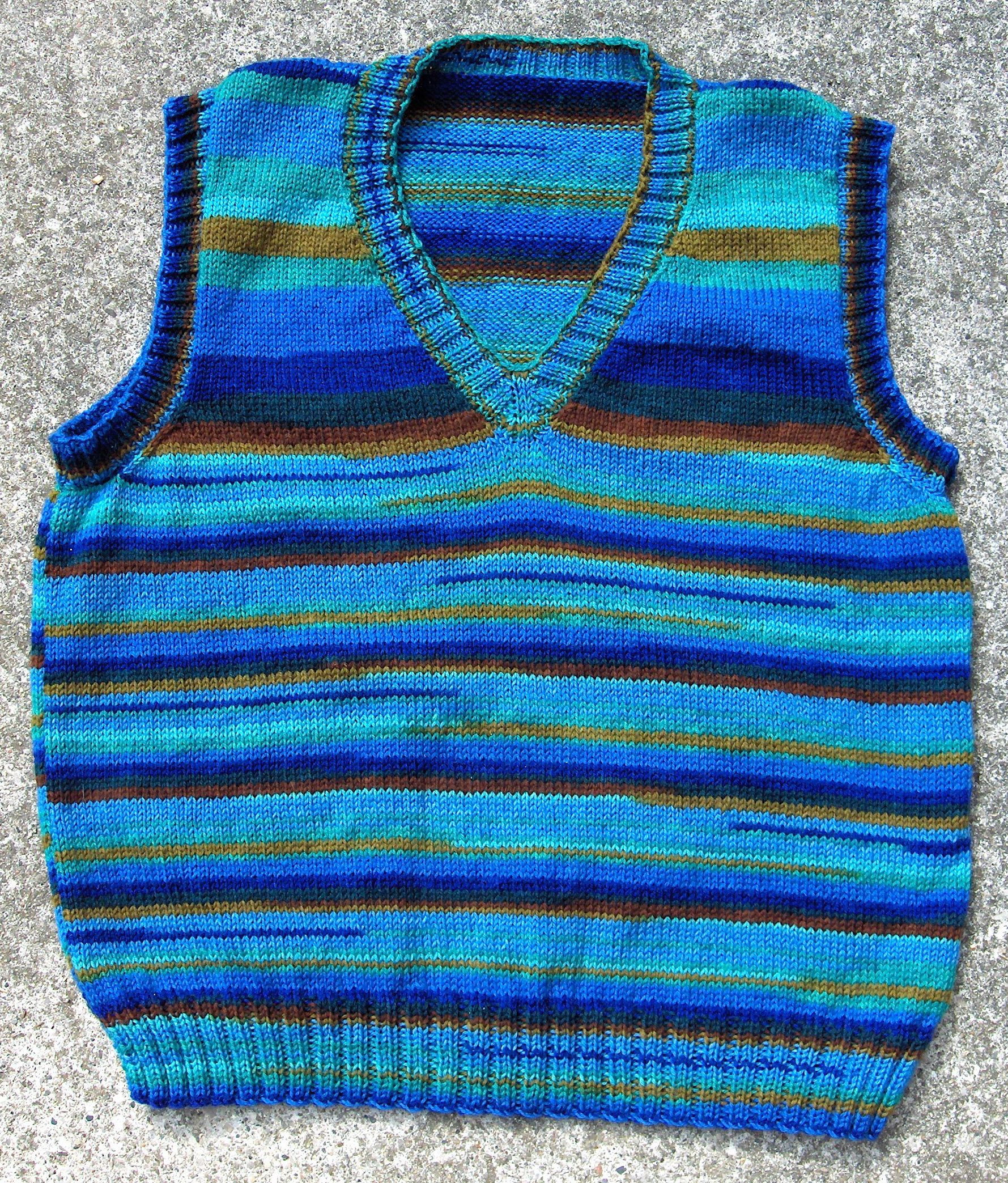
This is a free pattern, available on Ravelry, called Conservative (but Pretty) Dad Vest. (That’s a Rav link, but you can create an account there for free.) Mr. Math isn’t a dad, but he liked the vest and I liked that the instructions were in the right gauge for the yarn he chose. The yarn is a Kaffe Fassett sock yarn – Regia 6 ply – which self-stripes. Here’s the finished vest:Conservative (but Pretty!) Dad Vest by Julia Trice knit in Regia Kaffe Fasset Design Line by Deborah CookeIt fits him perfectly and he likes it, so all is good. It could stand to be blocked, but I’ll do that when the weather cools off.

On to the next project!

Conservative Dad Vest

Here’s another project that I’ve been working on. Strange but true – it’s wool.Conservative (but Pretty!) Dad Vest by Julia Trice knit in Regia Kaffe Fasset Design Line by Deborah CookeThis is the back of another vest for Mr. Math. It’s knit of a heavy sock wool – Regia Design Line 6-ply – in a colourway designed by Kaffe Fassett. The yarn is doing the striping, all by itself. The pattern is Conservative but Pretty Dad Vest, which is a free pattern – here’s the Ravelry link and here’s the designer’s link. (It’s the pattern in the bottom left corner of this display – if you click on it, you can download the pdf.) The pattern is great – very easy and straightforward, and also easy to modify. Mr. Math is leaner and taller than the designer’s dad, but I’ve got it covered.

These socks are knit from the 4-ply variant of this same yarn, in the same colourway, but in the variegation that doesn’t stripe. Here’s my post on the socks – I can see now, though, that there are slight differences in the colours. There’s no brown or dark green in this variant.Socks in Schachenmayr Regia Design Line by Kaffe Fassett 4-fädig knit by Deborah Cooke

Why knit with wool in the summer? Well, because it’s my favourite. Wool isn’t frustrating to knit with. It doesn’t shed. This is unlike the KSH projects I have on my needles right now – I have no patience for finding mohair fibres everywhere when it’s hot! Wool has elasticity, too, so tension comes out beautifully even. I have a cotton sweater on my needles right now, too, but knitting with cotton is never my favourite. Also, this vest is mostly plain stockinette – I just knit a row and purl a row and repeat. Self-striping yarn is a good choice for this weather because I find it entertaining. It keeps me knitting, just to see how the colours come out next.

Which is why I’ve knit the back of this vest in less than a week, in a heat wave.

What do you knit in the summer, and why?

Sonny Vest

Here’s a finished project to celebrate the end of the week. This vest is for Mr. Math and is knit of Rowan’s Colourscape Chunky. The colourways were designed by Kaffe Fassett, so you can imagine that I’ve been fingering this yarn (and lusting after it) since it was introduced. It’s a single ply chunky weight yarn, spun of merino – and now it’s discontinued.

Here’s the vest:Sonny vest by Sarah Hatton knitted in Colourscape Chunky by Deborah Cooke

The pattern is called Sonny, from the Colourscape Folk Collection pattern book. I knit it almost 2 inches longer because Mr. Math is tall. It’s even knit in the same colourway as in the book – Camouflage – and Mr. Math is very happy with it. It was a pretty quick knit.

The yarn is fabulous. It has so many more colours than even show in the photograph. And it’s soft. I hope it doesn’t pill as single plies often do, but we’ll see. On the one hand, I’m disappointed that it’s discontinued because that means it will eventually disappear from the world. On the other hand, the fact that it’s discontinued means that it’s on sale at a lot of outlets, and that price drop makes it easier to acquire.

I’d bought four skeins – the pattern calls for three – thinking I might need more for the extra length. I did go into the fourth ball to play matchy matchy on the second side of the v-front, but all my bits together weigh more than one skein. Theoretically, I could have bought just three skeins, but I do like the matchy matchy. And I love the orange on the neck ribbing. I was hoping for that!