Socks in Gedifro Sportivo

Today I have a new pair of socks. Having a new pair of handknit socks in November is such a wonderful thing that it’s impossible to blog about anything else.

Here they are:Socks knit in Gedifra Sportivo by Deborah CookeThe flash, as usual, has really lightened the colour. These are much darker in real life, and they look like they match better. It’s my usual ribbed pattern that I kind of modify as I go. The yarn is Gedifra Sportivo, which I bought years ago because I thought this was a Dragonfire colourway. I still think that – and now, it’ll keep my toes toasty warm too.

Have you gotten or knit any nifty socks lately?

Fitted Cardigan

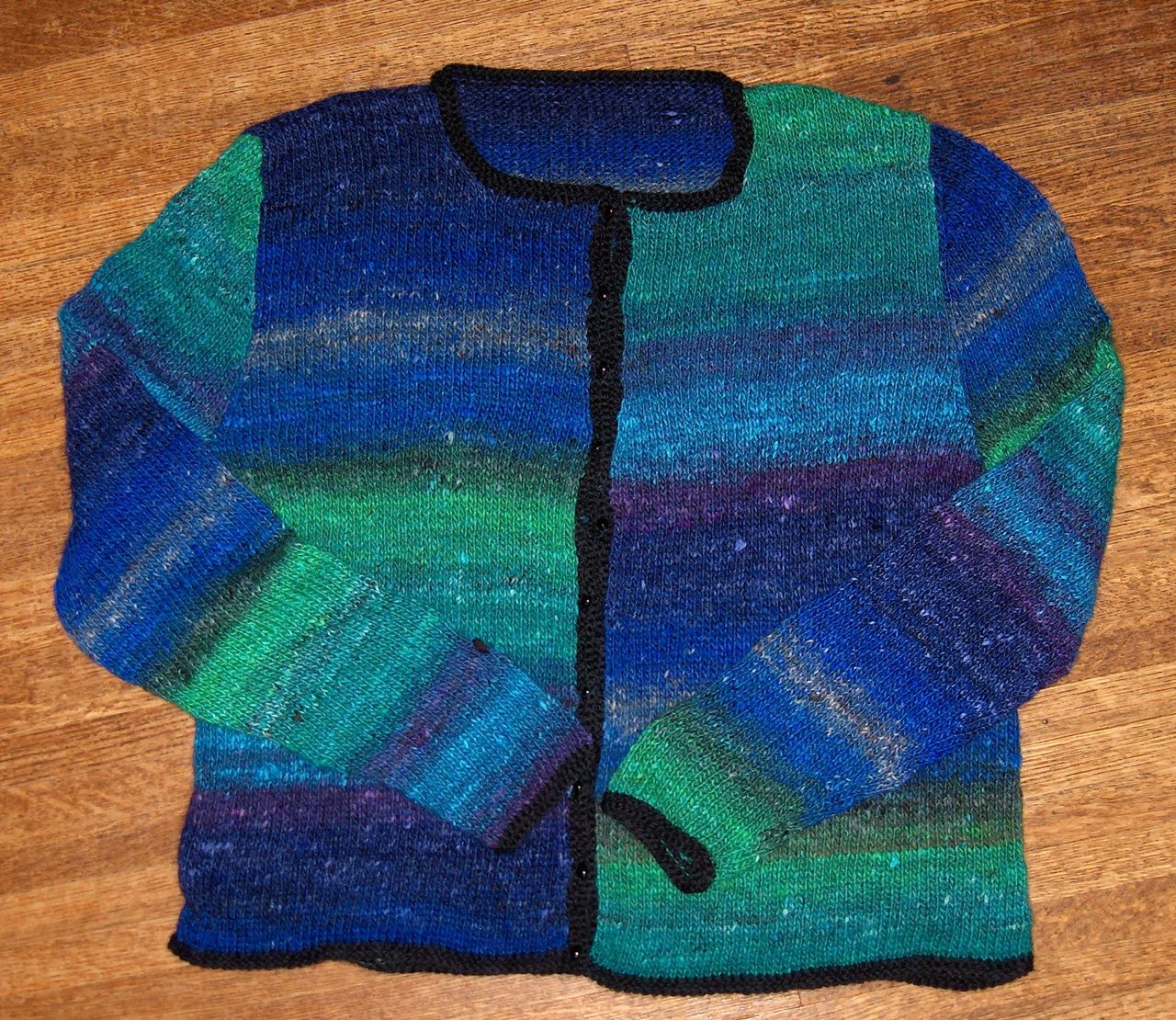
This is a cardigan I’ve just finished of Noro Silk Garden. I’ve had this yarn for years and knit and frogged it so many times that Mr. C. is convinced it’s the best yarn investment I’ve ever made. Well, this time it’s staying knit! Here’s the cardi:Fitted Cardigan by Jane Ellison knit in Noro Silk Garden by Deborah CookeThe pattern is from a book called KNITTING NORO by Jane Ellison, which I like a lot. It has a lot of basic patterns in the main Noro yarns that I buy – Kureyon and Silk Garden. This is called a Fitted Cardigan, which it’s not – it should be called a Boxy Cardigan, but I like it anyway. I could have made it a little smaller, but it will have a visit to the dryer when it’s just about dry. The one in the book isn’t matched up so I took a deep breath and went with it.

It took a bit longer to finish than expected because the sleeves were too narrow for me. The only modification I made was to taper the sleeve from the wrist to the elbow, because I hate floppy cuffs. (The pattern has straight sleeves.) But even the upper part of the arm was a bit snug when I finished the sleeves. So, I frogged a few inches from the cuff and reknit the black garter stitch edging, then frogged down to the last increase and added a few more increases. They’re still slim, but they fit better.

What do you think? I love it!

SuperSocke Wellness Socks

I finished these socks.socks knit in ONline Supersocke 6-ply / 6-fach by Deborah CookeThey’re knit of a self-striping yarn called Online SuperSocke Wellness II. The “wellness” bit is presumably because the yarn has jojoba and aloe vera added to it. (?) I’m not really sure how that doesn’t wash out, but it does make the yarn nice to knit with. It’s a pretty thick sock yarn, so these are warm socks. I just used my usual system for making socks, which is more of a method than a pattern.

One thing that surprised me was the way it striped. I’d thought from looking at the ball that the colour changes would be more gradual. But they look good and I had enough to make them match. There’s a good bit left, so I could have even made a pair for Mr. C. and had them match. This is good, as I have two more balls of this stuff in different colourways.

What do you think? Have you finished any projects lately?

Undine Shawl

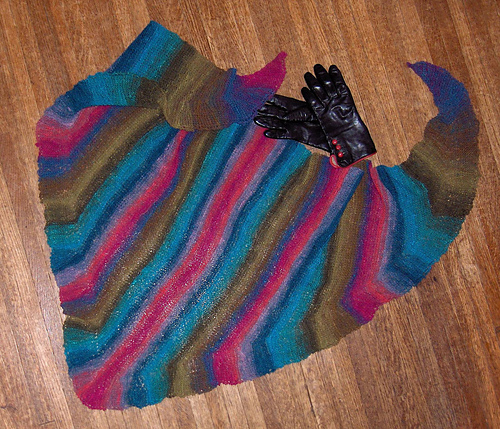
Here’s another of my knitting patterns, now available for free download.Undine by Deborah Cooke knit in Noro Kureyon Sock by Deborah CookeIt’s a triangular shawl, knit in garter stitch, with a ruffled edge. That edge has a picot border. it’s also knitted sideways, which makes for fun stripes in self-striping yarn. You can make this shawl in any size – basically, you follow the directions to increase the width of the shawl until half your yarn is gone. Then you use the directions to decrease down to the other point.

Undine by Deborah Cooke knit in Noro Kureyon Sock by Deborah CookeI used Noro Kureyon Sock for mine. This is two balls-worth and it’s a pretty good sized shawl. Something about the colours and that ruffley picot edge made me think of mermaids and seaweed, thus the name.

The pattern is on Ravelry right HERE.

Damask Bag in SWS – 1

I have a tendency, it seems, to make things more complicated than they need to be.

In fact, I really enjoy when a project of any kind evolves into a much more complicated project than I’d originally anticipated. This is true of books and it’s true of knitting projects. In a way, a project that becomes a complicated beast is a good thing – it means, to me, that the project has taken on a life of its own, and demands its own shape. And when it does that independent of how such a move impacts my own scheduling and other demands, I know it’s not just got a life of its own – it’s got a bit of attitude. I like that a lot.

So, this month, I have been wrestling with a book manuscript that ran off and did that, as well as a knitting project that has run off and done that. We’ll talk about the knitting project today. This was supposed to be straightforward.

Uh huh. Nothing worth doing is ever straightforward, and this bag has proven to be very much worth the doing.

Here’s the basic idea. There is a fair isle pattern which is extremely popular in the land o’ knitters, and is particularly gorgeous in our old fave Kauni Effektgarn. It’s become known as Damask.

Here’s the sweater and quite possibly the first reference to it. (The stripey bits in the middle are for steeks – she would later cut open the front to make a cardigan.)

As much as I like this sweater, I didn’t want to make a cardi like this. I have other plans for my Kauni.

But then, I saw this pattern, for a tote bag, using the same fair isle pattern. It’s called Kauni Damask Understated Bag. (Not sure if you can see this without being on Ravelry, but it’s free to create an account. Go for it.) Since I noticed in the notes that some people were unhappy with the resolution of the design once the bag was felted, I decided to use thicker yarn. Venturing into the almost-endless wealth of the stash, I discovered a hoard of Patons SWS, which is excellent for felting. I decided to use one variegated colourway with black.

Of course, I didn’t actually have enough of either colourway in my stash, so had to hunt down more. This was my first complication. Both are discontinued, but I found the yarn with some online searching. Getting it only required a trek through the snow on a Friday to a LYS which isn’t particularly local. No worries. I had the materials.

Time for the second complication. This bag is worked in the round. You knit the rectangle for the bottom of the bag, then pick up stitches on all four sides and knit up. This works because the Kauni has very long colour gradations. SWS does not. Sooooo, I decided to knit the front of the bag, then knit the back. This would allow the SWS to do better stripey things.

I cast on. As I knit the front, the third complication came to me. I realized that the flower would have to be right side up on both sides of the bag. I hadn’t started at one edge – I’d started at the bottom and I would have to start the other side from the bottom as well.

Okay. After I knit the front, I put all my stitches on waste yarn because I’m not sure yet about the flap. I then picked up stitches for the bottom of the bag on the cast-on edge. (At this point, I realized that a provisional cast-on would have been an excellent idea, but no, I hadn’t done that. This counts as a consideration, not a complication. It’s not that hard to pick up from a cast on edge and since the bag is going to be felted, any extra tension there isn’t an issue.) I knit the bottom, then started up the other side, reversing the colour usage. Just because.

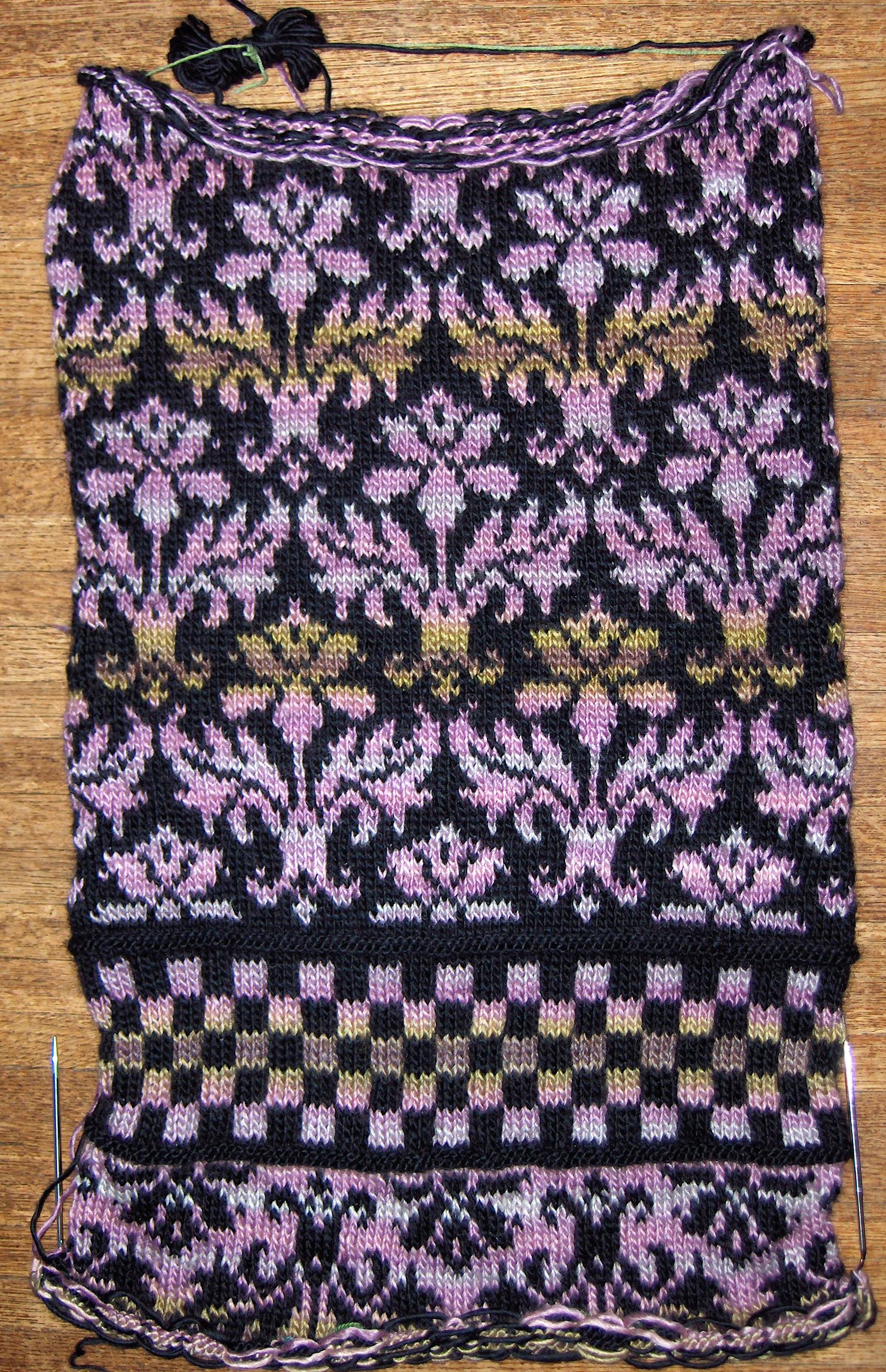
It’s a good thing I really like how it’s coming out. Here’s how it looks, on the needles and unfelted.Kauni Damask Understated Bag by Karen Stelzer knit in Patons SWS by Deborah Cooke

Time for another complication? It is! I had been thinking of putting a flower on the bag flap, instead of leaving it plain as in the pattern. That’s why I left those stitches on waste yarn – I was pretty sure I wanted the first colour combo on the back, and I figured I’d just grab those stitches and knit the flap. As I knit the other side, though, I realized that the flower on the flap would also have to be knit right side up. There’s our complication. Instead of carrying on from the back to knit down the flap to the point, I’ll have to cast on the point of the flap and knit UP, then graft the flap to the back of the bag.

I haven’t even thought about the handles yet. There’s got to be another complication there, just lurking…

Do you ever start projects that morph into more than you expected? Do you like that challenge or not?

Easy Top Down Raglan Cardigan

I seem to be convinced that I need cardigans, because I cast them on all the time. And I LOVE self-striping yarns. They entertain me enormously. I saw some Noro Kureyon on sale and could not resist.

On Ravelry, in the listing for Noro Kureyon, it says that “Kureyon” is the way that Japanese speakers pronounce “Crayon”, so the yarn is named for its bright colour combinations. Noro, of course, is a Japanese manufacturer. This is such a good story that I hope it’s true.

Top down raglans are insanely easy to knit and to fit – you can just try on the sweater as you go and adjust the fit accordingly. And there’s no sewing at the end! No seams! It’s all one piece. You just have to sew in the ends.

I used Laura Chau’s (a.k.a. CosmicPluto Knits) free pattern for an Easy Top Down Raglan, partly because she had knit it with the same weight of yarn. I did use smaller needles, though – 4mm instead of her 5.5mm – because I wanted a denser fabric. The only difference that made (because you do try it on as you go) was that it took more increases to get to the underarms. Laura suggests 24 but I did 30. Instead of ribbing, I worked the edges in seed stitch. I left out the buttonholes for a cleaner front. I did some waist shaping, but mostly I wanted a big loose cardi in pretty colours. I also was (big surprise) pretty compulsive about keeping the self-striping in sequence, even when changing balls of yarn.

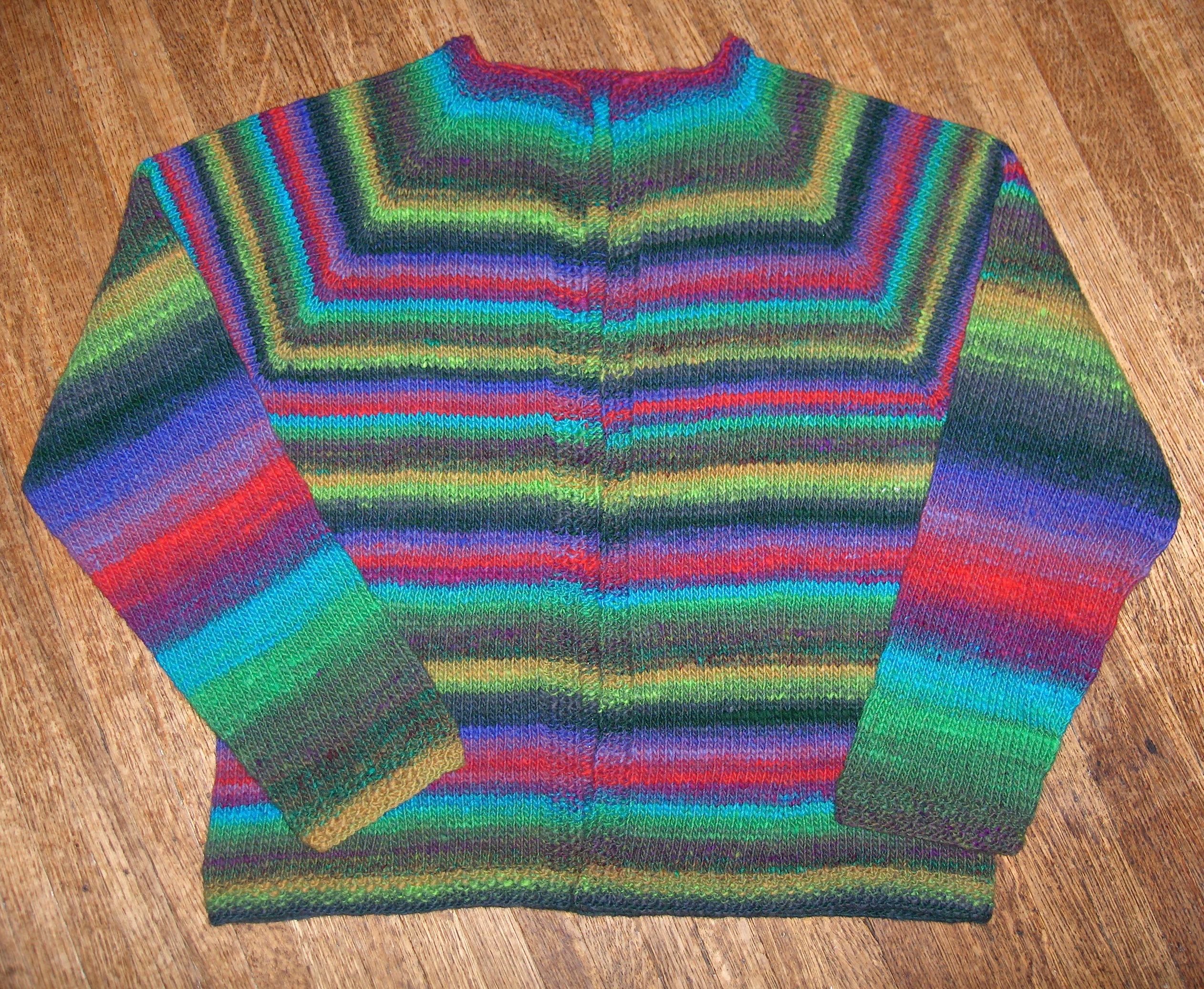
It’s had a good soak (and is much softer for it), then a block. Here’s the result:Top Down Raglan by Laura Chau knitted in Noro Kureyon by Deborah Cooke

You can see that the sleeves aren’t a perfect match. I had to change balls in the light green near the top of the sleeve on your right, and it looks like I didn’t break off enough green. See the dark green line in the middle? The dark green band should have started there, not three or four rows down. That’s what threw off the match, but by the time I saw it, I didn’t want to rip back. It did become more out-of-step as the sleeves became more narrow, but I’ll live with it.

A couple of notes:

• From the 12 balls of Noro Kureyon, I used parts of 11 balls in my matchy-matchy fussiness. There’s a little more than 150 g left, though – so if I hadn’t been fussy, but had just knit it as it came off the balls, I would have needed 9.

• I did change the method of increasing at the raglan seams. The pattern instructs you to knit to one stitch before each marker, then KFB, move marker, KFB and continue. I don’t like how knitting front and back into the same stitch looks. Because each stitch is made into two, a knit stitch and a purl stitch, it makes a purl stitch right where the marker is and again to the left of the stitch after the marker.

I prefer when there is a neat line down the length of the raglan. So, I kept the increases outside of the two stitches that bracket the marker, leaving those two stitches to make that line. To do that, I knit to one stitch before the marker, make 1, knit 1, move the marker, knit 1, make 1, and continue.

Here’s a picture of different styles of increases so you can see what I mean. KFB is near the bottom of the sample. I’m not sure which of the M increases is the one I use, as these are the poster’s assigned names – it’s either M1A or M1L/F (and the corresponding M1T and M1R/B). It’s amazing to see how many ways there are to make a new stitch, isn’t it?

Of course, I’ve finished this winter cardi exactly as summer starts. This is pretty funny. It’s done just in time to be stashed away – while all the cotton ones linger on the needles. OTOH, in September, I’ll have a new sweater to wear. Look at the yummy colours!

Top Down Raglan by Laura Chau knitted in Noro Kureyon by Deborah CookeHave you ever knit a top down raglan? What did you think of the method? And the result? Is your knitting “in season”? Or do you finish things at the wrong time to wear them, like me?

Bitterroot Shawl in Kauni

I have been getting some knitting done this winter, so it’s time to show you a few things.

First is a shawl in Kauni Effektgarn. The pattern is a free one from Knitty.com, called Bitterroot by Rosemary Hill.

Bitterroot by Rosemary Hill knit in Kauni Effektgarn by Deborah CookeYou can see that I had a hard time finding a big enough space to photograph it. As it was, I had to stand on a chair – and there’s junk in the corners. Photography isn’t my best trick! Here’s a detail shot of the centre tip:Bitterroot by Rosemary Hill knit in Kauni Effektgarn by Deborah CookeThis shawl was a surprisingly quick knit – or maybe it was just too addictive to put down! I did add beads, as specified by the pattern. The beads are silver, so they hide (especially in the pictures) but they catch the light in a starry kind of way. I like how the outside edge is just barely black. That was a nice coincidence with the colour changes.

My Ravelry project page is here.

I’m really happy with this one, and just might have to knit another…

Crazy Zauberball Socks

I finished these a few weeks ago, but forgot to show you. These are knit from a Crazy Zauberball – “crazy” means that it’s the marled sock yarn. Both Crazy Zauberball and Zauberball have long slow gradations of colour.

Here’s what mine looked like when I bought it:

zauber.JPG

And here are my finished socks:

crazyzaub.JPG

The LYSO warned me that I wouldn’t be able to match the socks – she knows how matchy matchy I am! – and they don’t match. In fact, I think the first repeat is still to come in the partial ball leftover from my socks, so it wasn’t even possible to make them match. All the same, they do look like they belong together. I like that the light bands on the feet are in roughly the same place and that they both have dark toes.

The colours in this yarn are pretty and it was nice to knit. It’s thinner than I’d realized though – I wish I’d knit my socks on 2.25mm or even 2.0mm needles (instead of 2.5mm) as they seem rather well-ventilated. I washed them before taking this shot and the yarn fuzzed up a bit but didn’t full or shrink. It’s very soft, soft enough to use for baby garments, and it’ll be interesting to see how it wears.

Have you knit any interesting socks yet? Have you tried the Zauberball? What do you think of it?

Kauni Fair Isle

I’m fascinated with the wool with the long colour gradations called Kauni Effektgarn. (That’s a Ravelry link.) This is going to be a zip-front cardigan for Mr. C. – the plan is for it to replace one of his fleeces. It’ll be warmer, plus I think it’ll look better than recycled pop bottles ever could.

Not that I’m biased toward knitted sweaters!

I decided to knit a top-down raglan. This is because you do all the math at the beginning, then just knit. Also, the pieces match perfectly – a good thing with stripes like the Kauni makes – and the only seam you have to sew up is a little teeny one in each underarm. Finally, you can try it on as you go, and check the fit. This beats the heck out of frogging an entire sweater.

There are a lot of free top down raglans available in the wide world. Here’s one at Woolworks. Designer Stephanie Japel has created a lot of patterns for top down raglans – here’s her instructions on designing your own.

Once you’ve made the basic calculations, you can play.

I had bought two colours of the Kauni – the slowly changing blue called EL and the rainbow gradation called EQ. My plan was to do “something fair isle”. Since it’s for Mr. C. and I knew he wouldn’t wear it if it was too vivid, the idea was for the jacket to be mostly blue with intermittent fair isle stripes in the two colourways.

A terrific resource for fair isle – including its history and a number of patterns – is Alice Starmore’s Book of Fair Isle Knitting. This book has been out of print for some years, and used hard cover copies were selling for incredible prices. The good news for all of us knitters is that the book is being reprinted in paper this year – you can preorder a copy at the online booksellers for $20 or so. Or you can look in your library for a copy.

I had Mr. C. choose three fair isle patterns that were variations on a theme – a “peerie” or narrow pattern, a wider pattern and a border. All of the ones he chose use the same motif – in this case, a diamond, although there are lovely patterns in stars, X’s and O’s, lots of choices. These were the ones he liked and it’s his sweater. Let’s call them 1, 2 and 3, 1 being the narrowest and 3 the widest. I’ve knit them 1 – 2 – 3 – 2 – 1 – 2 – 3 – 2 etc. with 6 rows of the blue between each one.

I just split the work for the underarms, so you can have a peek. Here we are.
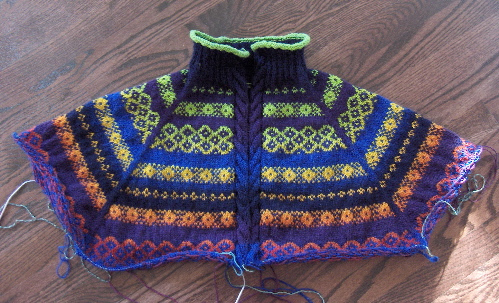
Elrond Cardigan knit in Kauni Effektgarn by Deborah CookeKnitting this has been addictive. There’s just something about self-striping yarns that always has me knitting one more row “just to see”. I’m not a fast knitter, but I can be an obsessive one! One of the fun things about fair isle is that if you make a small mistake, it tends to get lost.

Mr. C. loves this sweater. He says it awakens his inner Celt – we all have one – but I think the way the colours shift and change on this sweater is even more magickal than that. I’m calling it the Elrond Sweater, just the thing for those chilly evenings at Rivendell.

A few details:

• Most of these raglan patterns suggest starting at the collar line, then going back, picking up stitches and adding the collar when the rest of the sweater is done. I knew the blue probably wouldn’t match if I did that, so I took a chance and started at the collar cast-on instead. I used the same number of stitches that I’d calculated to cast on at the neck, then because it looked SO BIG, I worked it in 2×2 ribbing. Voilà. The collar is done and it matches.

• I also ran a cable down either side of the front, the two cables mirroring each other to frame the zipper. I like the look of cables with fair isle – one designer who seems to put the two together a lot is Fiona Ellis. This particular cable is a 12 stitch band on each side, with 2 purl stitches on either side of the 8-stitch cable – purl stitches always make cables pop from the background of the sweater – and the cable twists every 8 rows.

• I’ll knit I-cord down the fronts as well, in contrast, to accent the opening even more, then will edge cuffs and hem the same way as the collar. I’d like them all to be the same green, so here’s hoping I have enough.

• It’s kind of fun how the gradation of the rainbow is working out – I like that it made one cycle from green to red from the neck to the underarms. The rainbow goes from red into purple, blue and turquoise, but I’ve broken that section of the colourway out of the yarn. There just won’t be enough contrast in the fair isle against the blue background. I’m heading back from red to green again.

The sleeves will change colour more slowly than the body, because there will be fewer stitches. I had debated the merit of breaking the yarn to make everything matchy-matchy, but have decided to just go with it. As long as the sleeves match each other, it’ll look good.

It’s going to shrink a little bit when I wash and block it, about 1/8″ for every inch, so the yarn will tighten up and the fair isle will snap even more. The wool also softens and fulls in the wash, making it look a bit fuzzier. I like how the swatch looks, so am aiming for the same finish.

So, what do you think?
Inky Spider’s Web Fichu Shawl

As you know, I’m very fond of Jane Sowerby’s book VICTORIAN LACE TODAY and have knit a few projects from it. Here’s another. This is the fichu variation of the Spider’s Web Shawl, knit in Noro Silk Garden Sock. I love this inky colourway and added some iridescent beads to it, too.Spiderweb Fichu shawl by Jane Sowerby knit in Noro Silk Garden Sock by Deborah CookeTechnically, this should block out as a half a hexagon, but mine came out more like 3/4 of a square. It’s a nice size and just falls to the elbows. Here’s a detail shot of the edging with the beads:Spiderweb Fichu shawl by Jane Sowerby knit in Noro Silk Garden Sock by Deborah CookeI love the colours and the texture of this one and know I’ll wear it a lot. What do you think?