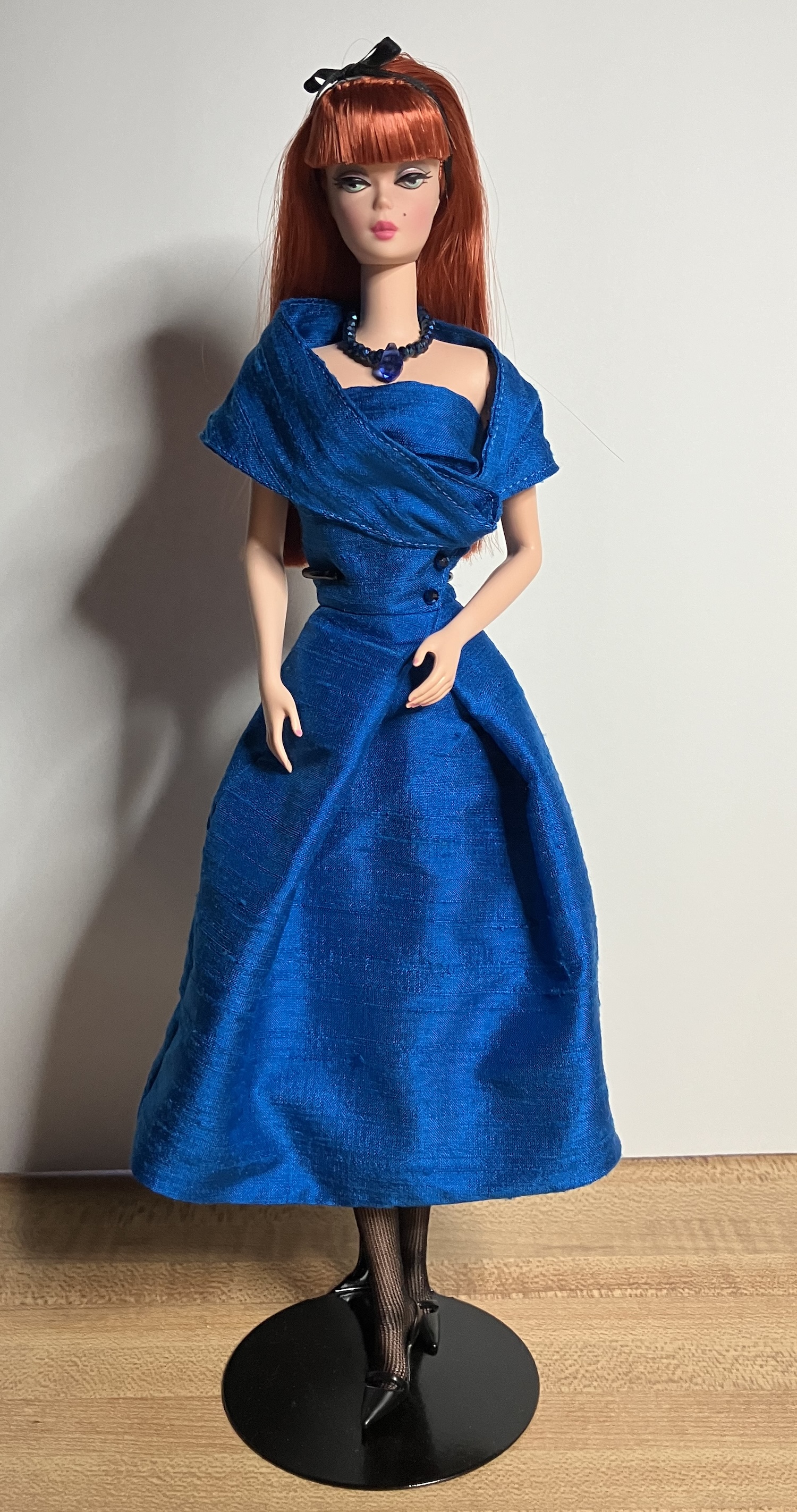
Hankie Chic Caracas Dress for 12″ dolls

Caracas pattern for 12" dolls by Hankie Chic

I made some holiday dresses for the girls, using this pattern by Sylvia Bittner at Hankie Chic. The pattern is called Caracas, and you can buy the downloadable PDF from her online store right here.

This dress has an interesting wrap around the shoulders. It’s attached to a bodice flap overlapping the front body of the dress. The skirt has a big pleat in the front, then there are three bead buttons at the side of the bodice.

I found this pattern an easy make, so long as I didn’t think about it too much. I referred to the pictures of the final dress for that front pleat, because I would have sewn it down wrong otherwise. Similarly, I wrapped that shoulder bit a couple of times before I was convinced that I had it right. It folds back on itself (kind of) which confused me at first.

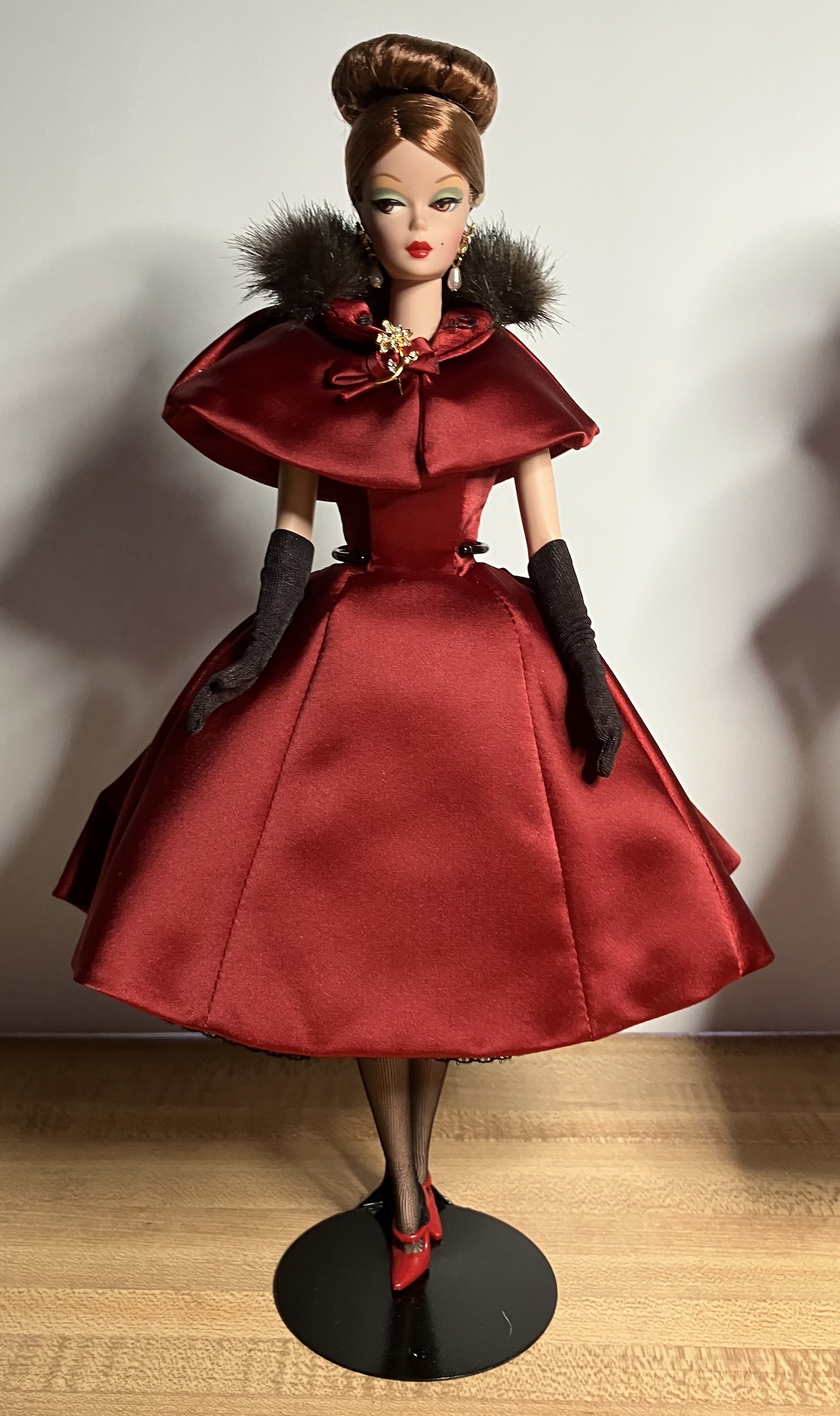
Here’s the first one I made, modelled by Continental Holilday Silkstone B.

Caracas pattern for 12" dolls by Hankie Chic made in red silk by Deborah Cooke

The three little “buttons” are gold beads, although they’re hard to see from this angle. I also bought the girls some Kaiser stands, which are pretty awesome. They almost disappear and are much more stable than the stands that come with the dolls.

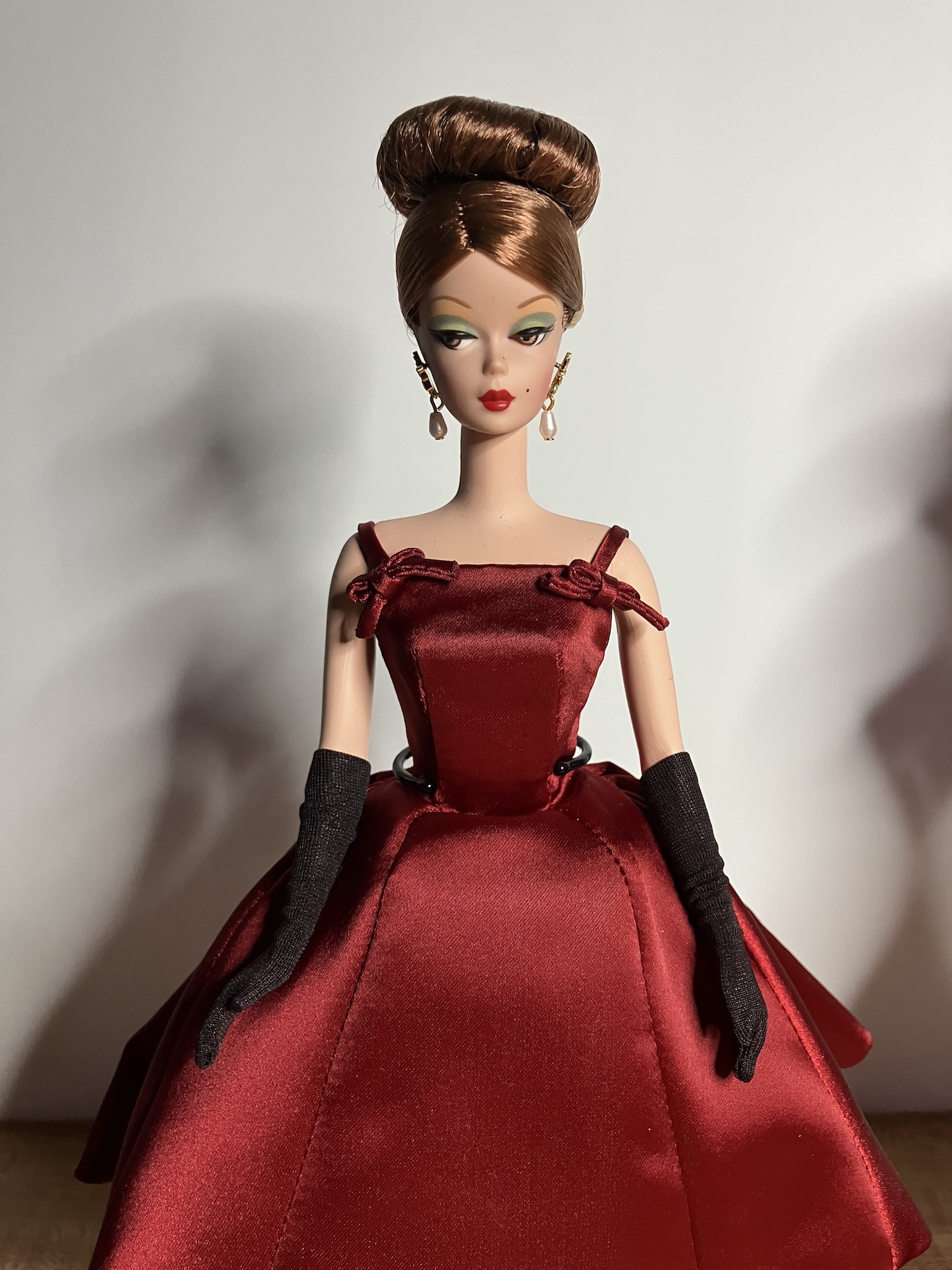
I really like the base bodice design on this dress – it has a center front vertical seam from the waist to the bust, then a crosswise dart on the bust – and may use it in other garments. It fits quite well.

Caracas pattern for 12" dolls by Hankie Chic made in red silk by Deborah Cooke - bodice detail

I did change the order of assembly, in my usual way. I really like to sew the skirt and the lining together at the hem while they’re still flat, then understitch the lining. I did that with the skirt, then the same with the bodice. My handsewn seams end up being the waist seam in the lining, then the back edges to finish up.

I am lucky to have a number of friends who sew and who give me scraps of their wonderful fabrics. The red dress is made from a silk taffeta given to me by Laura.

Caracas pattern for 12" dolls by Hankie Chic made in blue silk by Deborah Cooke
Caracas pattern for 12" dolls by Hankie Chic made in pink silk by Deborah Cooke

The blue and the pink are from silk remnants given to me by Helen. The girls like them all. 🙂

These models are Lingerie #6 in the blue and Lingerie #2 in the pink.

After the first doll was dressed, I realized that she reminded me of Ravishing in Rouge from 2001. I had a look and found one at the right price, so she’s joined the other girls here. She really is lovely.

2001 Ravishing in Rouge Silkstone Barbie

I’ve still planned to make another Caracas, with the wrap in a contrasting fabric. For the moment, though, the girls have some party dresses for the festive season ahead.

A New(ish) Resource for Sewers

I’ve been looking for years for a way to organize my sewing, similar to how I organize my knitting on Ravelry. I mostly want to inventory my patterns and be able to search through them – without digging through boxes in the attic.

Well, I’ve found it. Threadloop is a comparatively new online app, which lets you do just that. You can also inventory your fabric and notions there, and there are forums for discussion as well. I’ve only just dipped into it, but I like it a lot – and it’s free.

Learn more about Threadloop here.

Clematis Wristlet

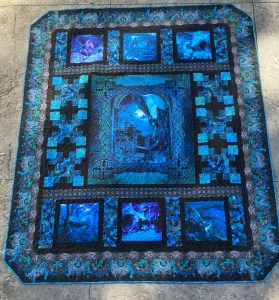
In the beginning dragon quilt in blue, assembled by Deborah Cooke, and completed.

I’ve gotten back into making bags this fall and here’s a completed one to show you. I’ve been waiting for a sunny day to take some pictures, but it’s raining raining raining, so we get some pix taken on my sewing table instead. The blog has been too quiet and I’m done with waiting for sun.

You might remember my blue dragon quilt, which was a kit (and is now FINISHED! HA!). That’s it at right.

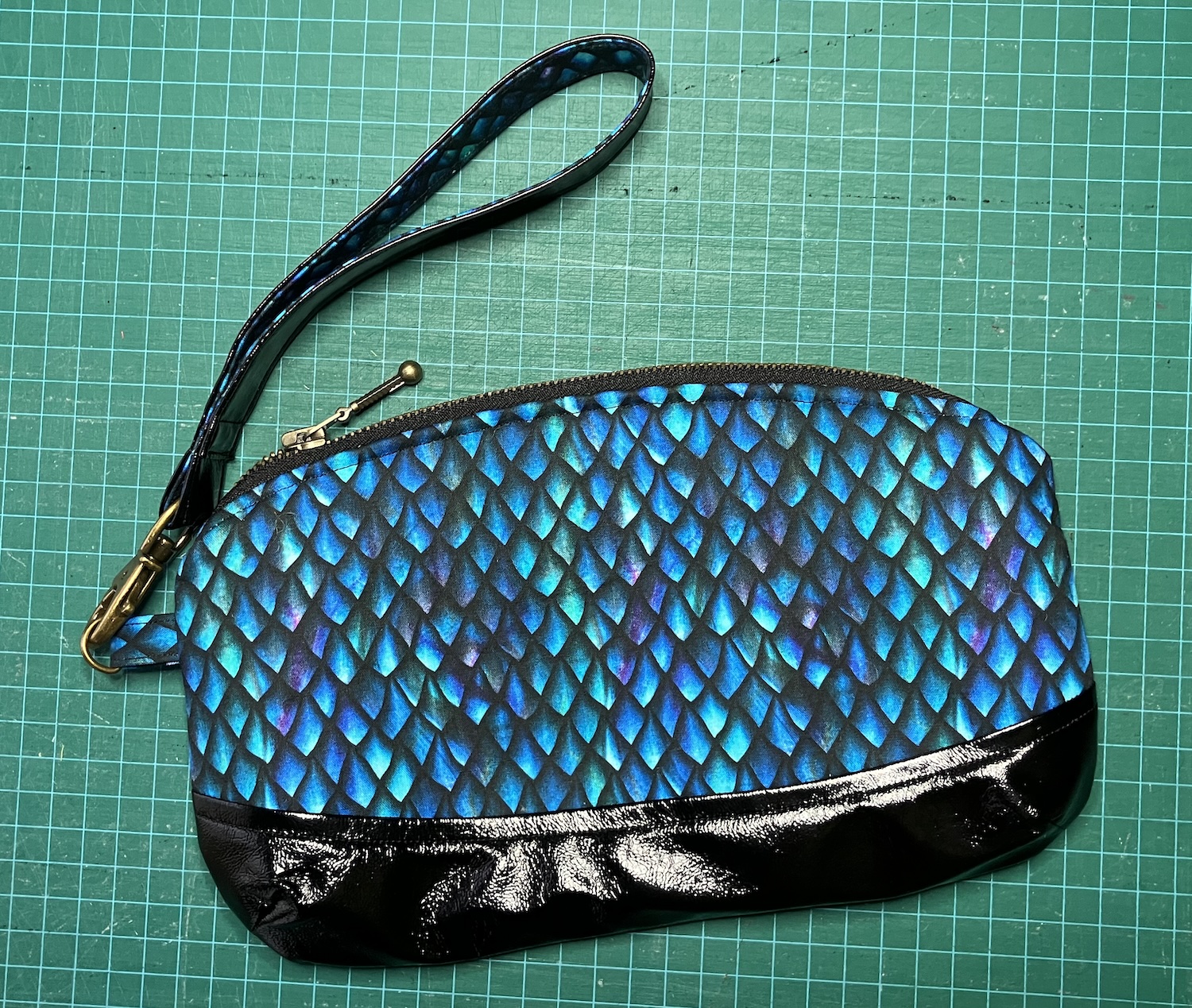
I had some leftover of the various fabrics and used them for this, along with a shiny black pleather. They really were bits and ends, so it ended up a bit patchworky but everything coordinates well.

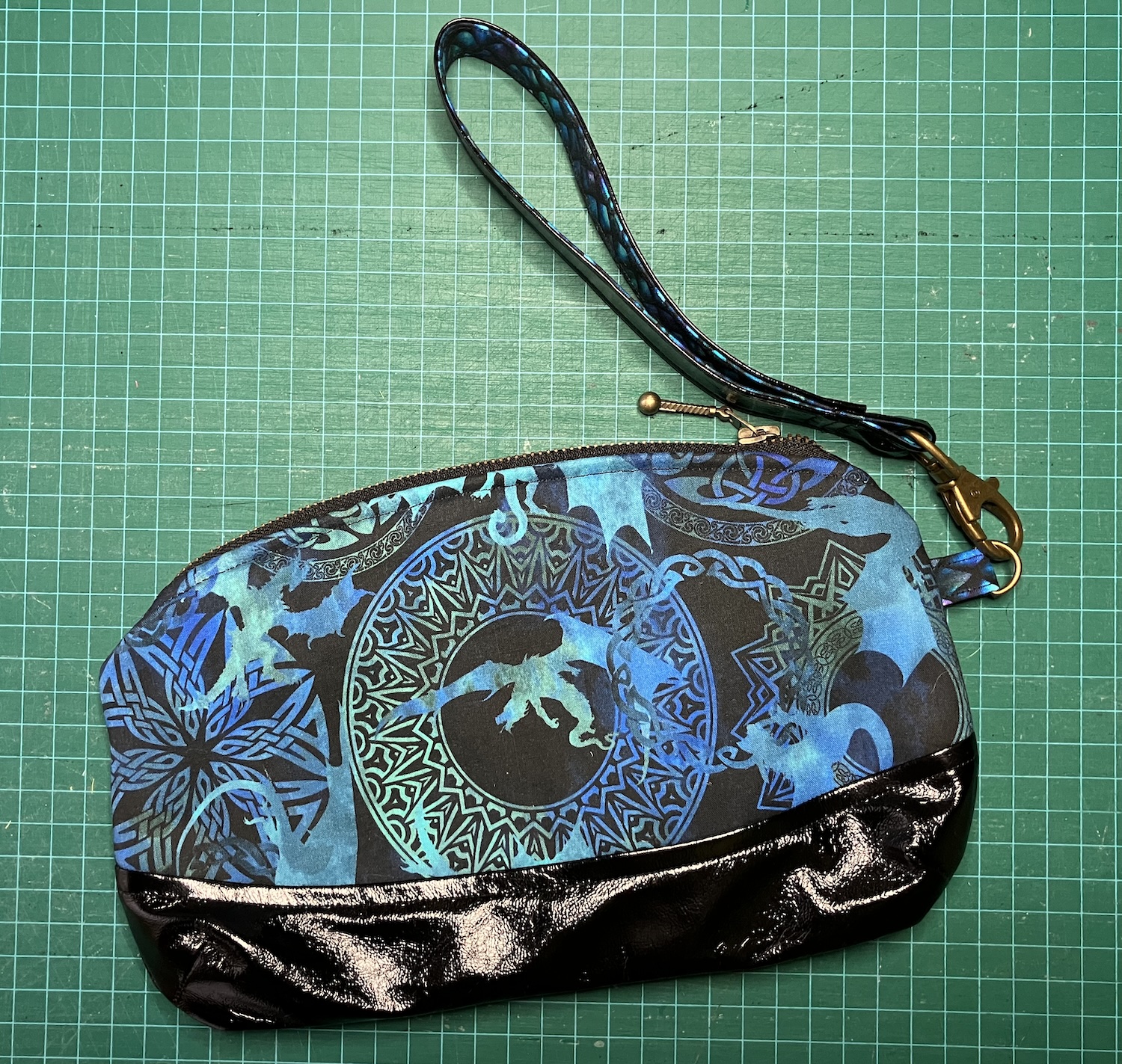
This is the Clematis Wristlet, a free pattern from Blue Calla Patterns. This little bag has fusible fleece on the outside pieces, which gives it a bit of substance, and more interfacing besides. I didn’t have a 9″ brass zipper, so I cut down a 14″ one for this project.

Clematis wristlet by Blue Calla patterns sewn by Deborah Cooke

On one side, I used the scales. I also had a strip of this print to use on the inside of the strap.

Clematis wristlet by Blue Calla patterns sewn by Deborah Cooke

On the other side, I used the background with dragons and circles.

Clematis wristlet by Blue Calla patterns sewn by Deborah Cooke

The lining is the Celtic/tattoo background fabric. (I see I picked up a thread on my cutting table and included it inadvertently in this shot.)

Clematis wristlet by Blue Calla patterns sewn by Deborah Cooke

And the pocket inside is made of the dragons from the border print. There are only scraps now, so they’ve gone into my bag for real patchwork.

This pattern is a pretty easy make, and the finished bag is a useful size. I’m always looking for something flat to hold my cash at bookfairs and this might just do the trick.

I like the idea of the dragons watching over my hoard!

Making Book Covers

I’ve been making a lot of book covers lately. Although I initially learned how to make them from a blog post (one with many video ads. Ugh.) I’ve figured out a few tips and tricks. Having this post here is as much for you as for me, as I keep having to figure them out all over again. 🙂

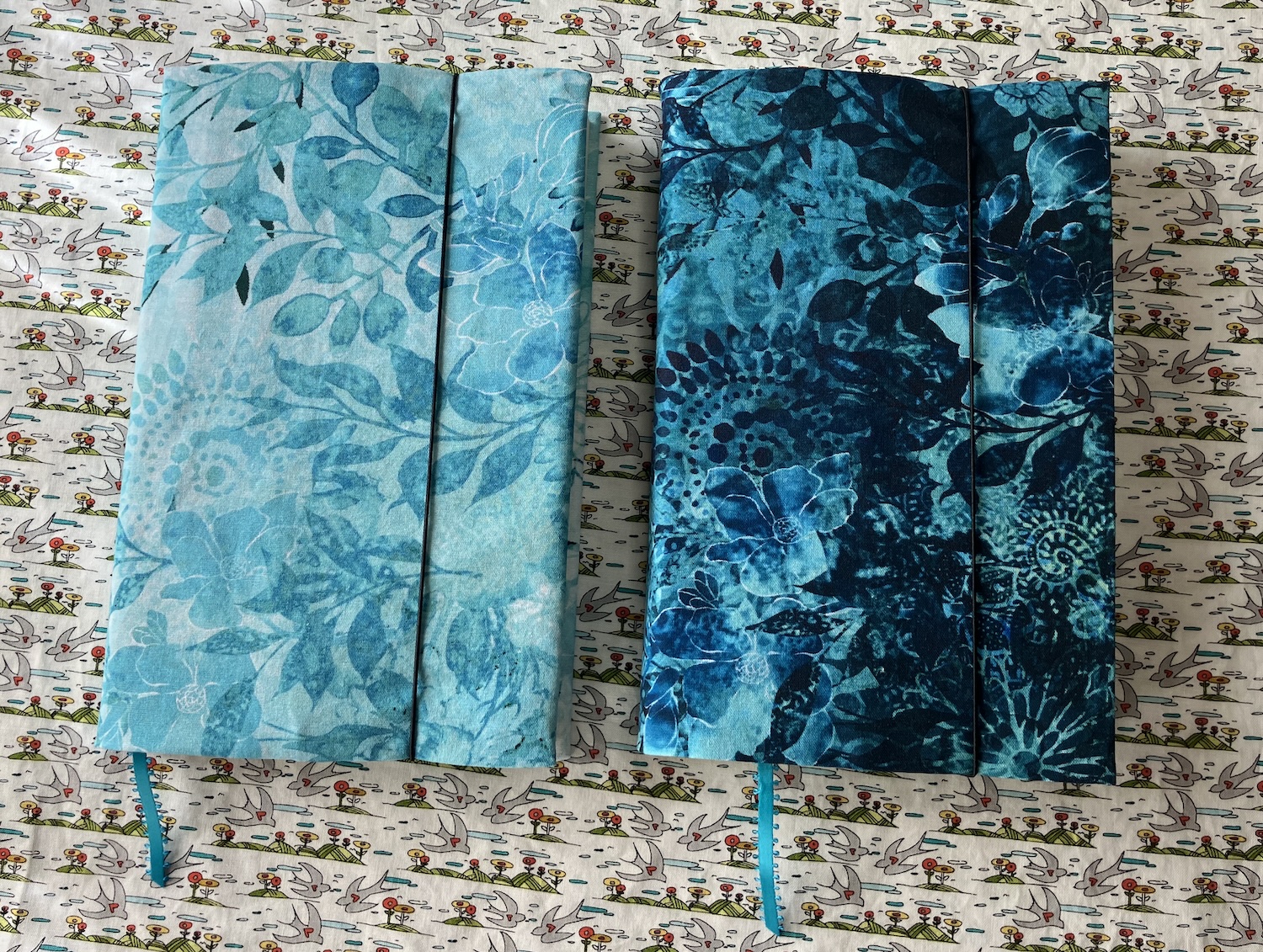
Here are the book covers I just made for a giveaway of my books at a reader conference:

book covers sewn by Deborah Cooke

And the one in the pictures below is for a reward tier in my most recent Kickstarter campaign.

First, assemble your materials. You’ll need two (cotton) fabrics that match or contrast, along with a length of ribbon and a length of elastic.

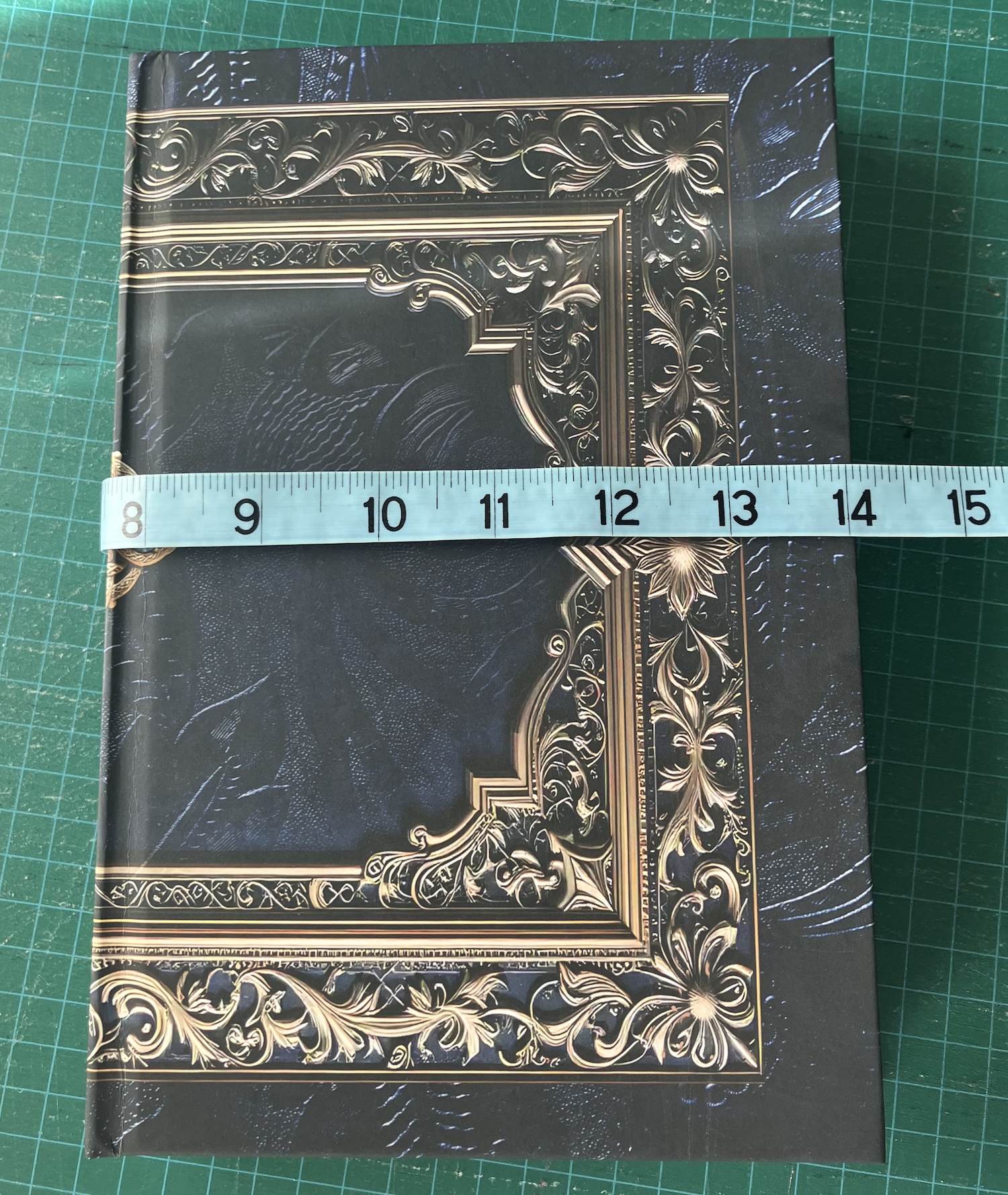
measure for a book jacket

Then, measure your book. The height of the book is the actual height. The width is the width of the entire cover, from the front edge, across the spine, and around to the back edge.

In this case, the book is 9.5″ and the width is 14″.

For the height to cut, we need to add a seam allowance top and bottom. I use 3/8″ inch seam allowances on these, which is 10cm. Two of them (2 x 3/8″) is 3/4″. We also need to add .25 to .5″ for ease – since this is a hardcover and a bit thicker, we’ll add .5″ So, our cut height will be 9.5 + .75 + .5″ or 10.75″.

For the width, we need to add a 3″ flap at each end plus the two seam allowances. We’ll also add that half inch for ease. So, the cut width will be 14″ + 6″ + .75″ + .5″ which will be 21.25″

Since the chosen fabric is 45″ wide, I can cut two from the width – each length of 11″ will give me two sides for a book cover. To make six book covers, I’ll need 33″ or so of two different 45″ wide fabrics.

I can also cut the elastic – each cover will need a 12″ piece – and the ribbon bookmark – each cover will need a 15″ piece.

The first seams to sew are the ends of the flaps. For the front edge, sew the entire seam. For the back, leave a gap in the middle for turning.

If it matters to you which way is up, then sew the front flap seam first. It’s the complete one so once it’s done, it becomes a reference. In this case, I wanted those pale tulips to grow upward, so I pinned and sewed the front flap seam with them properly oriented. The seam will be on the right and the pin is at the top.

sewing a book jacket 1

Turn and press, then topstitch where you’ve sewn (leaving the back gap open.) I placed the rotary cutter to show the open back seam. Look closely to see that I’ve only topstitched part of that back flap edge.

sewing a book jacket 2

The top and bottom are sewn next, but I find it easier to position the elastic and ribbon first. With the right side facing, mark the 3″ for each book flap with a pin on the top edge of the top fabric. Pin the ribbon at the top edge near the middle. If your elastic is round and hard to pin, put a bit of tape on each end so you can pin it in place. Pin it to the top fabric 2″ inside the pin for the back flap. Mark the flaps with pins on the bottom edge of the top fabric, then pin the elastic in place, as well.

making a book jacket 3

Remember that the pins are only in the top (blue) fabric.

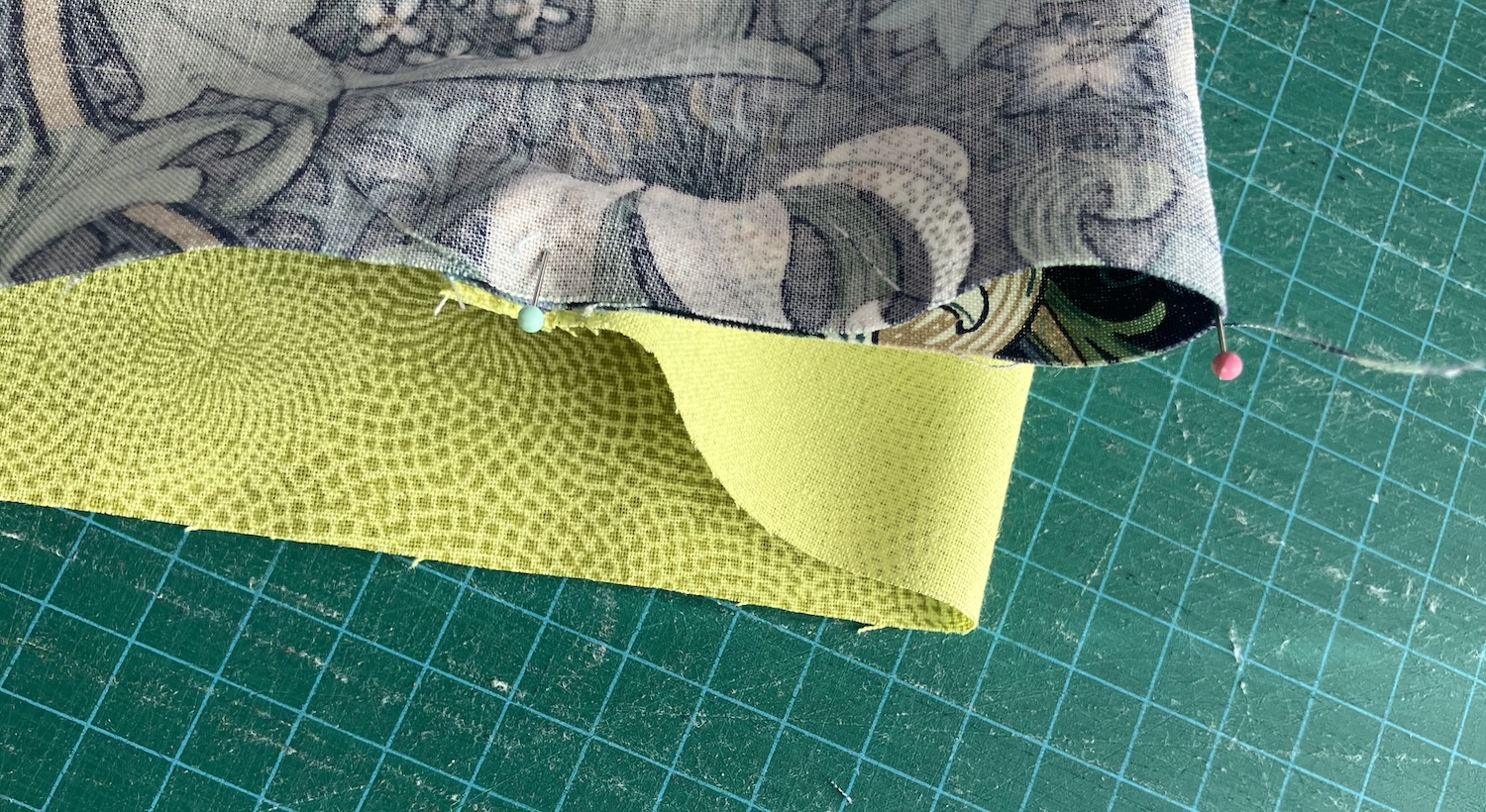
Turn the book cover so it is right sides together. This is the tricky bit. The flaps are folded in like an accordian, but it all comes out right in the end. At one end, pinch the fabric right sides together at the pin marking the flap. Pin the seam allowance in place, folding it inside the book cover, then fold the lining so that it aligns with the pin at the edge.

sewing a book jacket 4

Repeat for the other three corners.

This is inside the front flap with the edges pinned in place. The seam ripper is just holding the flap open so you can see the accordion fold. On the back flap, there’s an opening in the seam so you can turn the book cover right-side out.

sewing a book jacket 5

Sew right across the top, then right across the bottom.

Reach through the gap in the back flap and turn the book cover right side out. Since the cover is reversible, you can choose which fabric is on the outside. (Invariably, I get the fabric planned for the lining on the outside and have to think about it for a minute.) Push out those corners so that they’re nice crisp points.

Pin the opening of the back flap shut and top stitch it closed.

sewing a book jacket
the finished book cover

Press, press, press.

Insert the book, place the bookmark in the book, and wrap the elastic around the outside to hold the book closed. You can trim the ribbon bookmark or even add a charm to it, if you choose.

And there you go!

Changes Out There

This week sees some more changes in the world of makers like me. I’m not in the States but was saddened to see Joann’s Fabric stores closing there recently. There’s nothing like a local store to finger fabrics, and pick up notions.

This week, there are two more changes. One is more local to me. The Spinrite factory in Listowel Ontario is closing down. It’s been there over seventy years and the retail store is a great place for mill ends and sales. They haven’t been spinning yarn there for a while, but they ball-and-band yarns for Patons, Bernat, Red Heart and various store brands (like Michaels). Their annual tent sale is a huge summer event. I like to drive up there (or have the mister drive me) when I’m thinking. It’s a lovely drive through farmland with yarn at the end. I will miss it.

Here’s an article in the Kitchener paper about the closure.

The second big change was announced yesterday – the parent company of the big four pattern brands (Simplicity, Butterick, Vogue and McCalls) was sold to a liquidator. It’s the same company that liquidated Joann’s. Curiously, it seems that the impact of tariffs on sewing product brands owned by the parent (Wrights trims and Boye needles, for example) was a driving factor in the decision, as well as the loss of distribution with the closure of Joann’s in the US. It seemed that they were struggling with the shift to digital in recent years, but it’s sad to see them go.

Here’s the article.

What happens from here? Are we shifting to smaller companies and boutique suppliers, or are we becoming a society of people who don’t make things themselves? I know which option I prefer. I’m not sure who I’d be if I wasn’t always making something.

I also feel vindicated for having my various stashes. If this is the apocalypse for makers, I’m all stocked up.

Tumbleweed Toiletry Bag

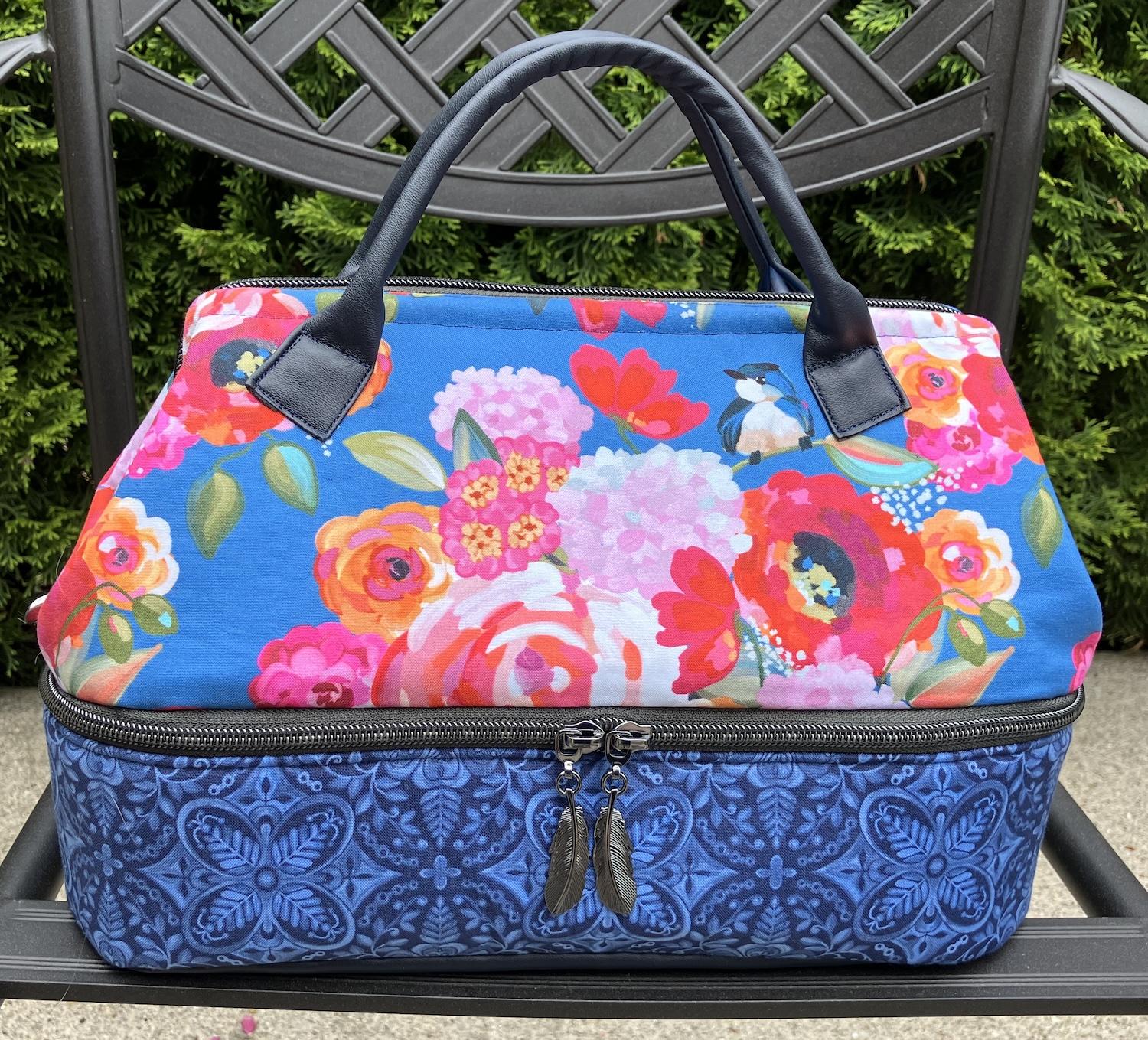
Tumbleweed Toiletry Bag from Blue Calla Patterns

This was a satisfying project. The Tumbleweed Toiletry Bag is a beautiful bag filled with lovely little details. I first saw it when the owner of Blue Calla Patterns did a presentation to our sewing guild, and knew I had to make one. Here’s the page on their site where you can buy the downloadable pattern. The pic at right is from from their site, also linked to that page.

I was hoping for a kit, like the one I bought from Blue Calla for the Foxtail Cross Body Sling, but there wasn’t one available. There was a kit for the hardware, which are always the toughest bits to find IMO. (It lives at that link, but availability of all the various options does vary.) They did have a sale running at the time, so I chose fabric and zippers etc., and essentially built my own kit. I did have to buy the fusible foam from my local fabric store as they were out of stock of that.

And here’s my finished bag:

Tumbleweed Toiletry Bag, pattern by Blue Calla Designs and sewn by Deborah Cooke

I love these fabrics and the little bird in the floral print. The construction was remarkably easy, once I stopped overthinking it and trying to figure out how it would all come together. I just needed to follow the instructions and let it happen.

I made only two changes. First, I used a fake leather for the base and the handles, instead of fabric or cork. Secondly, I inserted a piece of 1/4″ cord into the handles to make them round. In the pattern, they’re just flat.

I love this bag so much!

Here’s the inside of the bottom section. It has a zippered mesh pocket, which is on the bottom of the top section.

Tumbleweed Toiletry Bag, pattern by Blue Calla Designs and sewn by Deborah Cooke

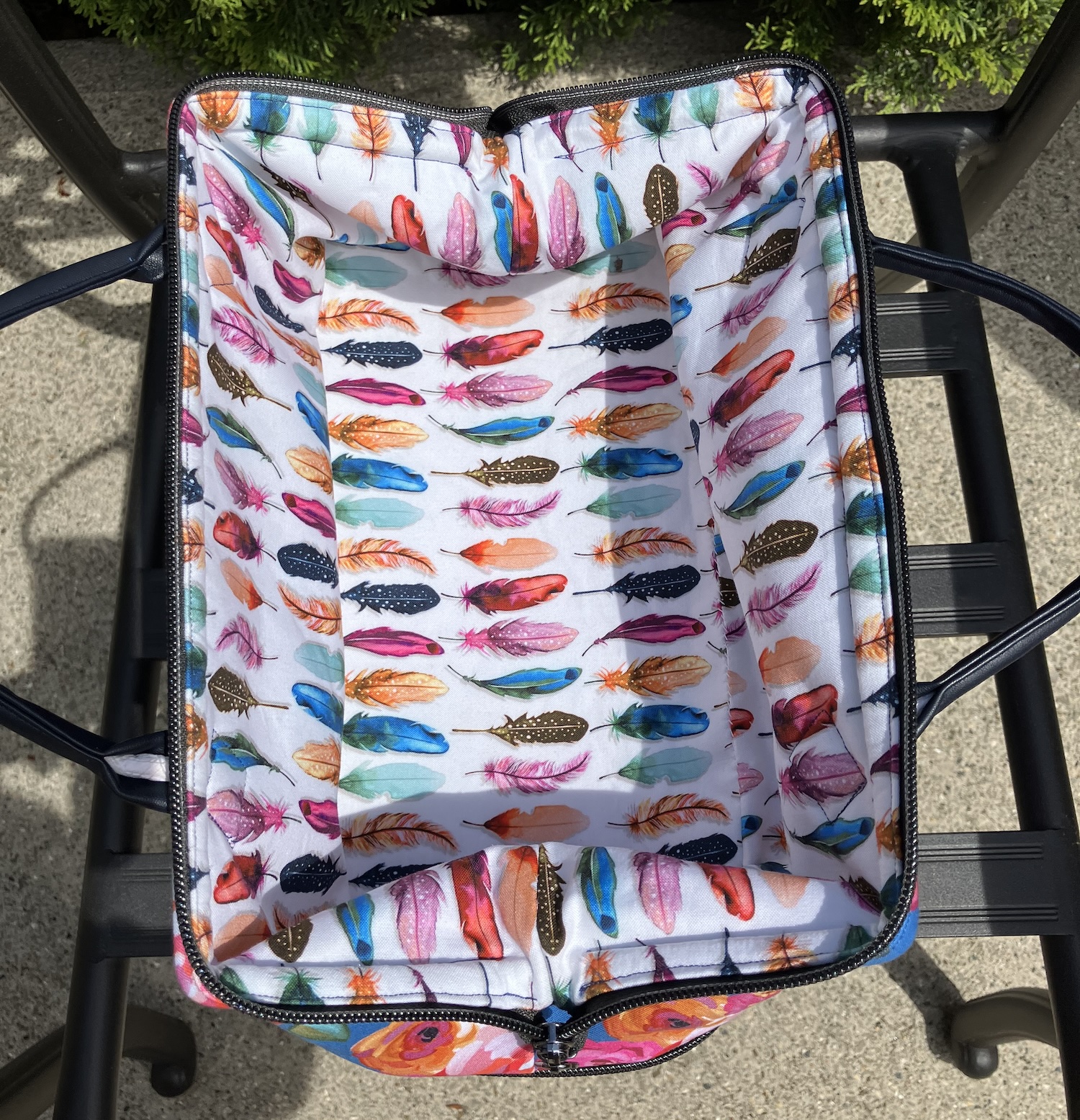
And here’s a peek inside the top section:

Tumbleweed Toiletry Bag, pattern by Blue Calla Designs and sewn by Deborah Cooke

I picked the feather zipper tabs to coordinate with the lining fabric.

I had some trouble sewing the thicker areas with my domestic machine. For example, the stitching line around the top to hold the frame should meet below the hinge, but with those seam allowances, I couldn’t manage it. I left a gap and it’s fine. Similarly, I couldn’t do the topstitching on the top side of the lower zipper, for the same reason.

When I make it again, I’ll add some more topstitching – around the base, for example, and on the top side of that zipper, as well as in the base of the lining – just to manage the seam allowances better. I have a crazy amount of materials left over, so there will be more bags in these fabrics, as well as at least one in this design.

I’m not planning a trip so don’t really need a toiletry bag. I’m thinking I’ll use it as a knitting project bag – the yarn supply can go in the bottom, the needles and notions in that zippered pocket, then the project on the needles in the top section.

The Weekender Bag

The Weekender Travel bag by Amy Butler

Finishing up that Foxtail Cross Body Sling had me digging into my unfinished projects. I remembered starting this bag a few years ago, becoming overwhelmed with some detail and putting the project aside. I got it back out again and finished it up.

The pattern is from Amy Butler and is called The Weekender Travel Bag. You can buy the pattern on her site, from this page. (Just scroll down a bit to find it.)

Here’s the official picture at right. (Clicking on it will also take you to her PDF download page to buy the pattern.)

Although I love the look of this bag, I was worried about using quilting cotton on the exterior, specifically how well it would wear. For this first one, I used several table runners that had a woven design. I think they’re polyester. They were available in two colour combinations – here’s a green one, uncut.

uncut table runner

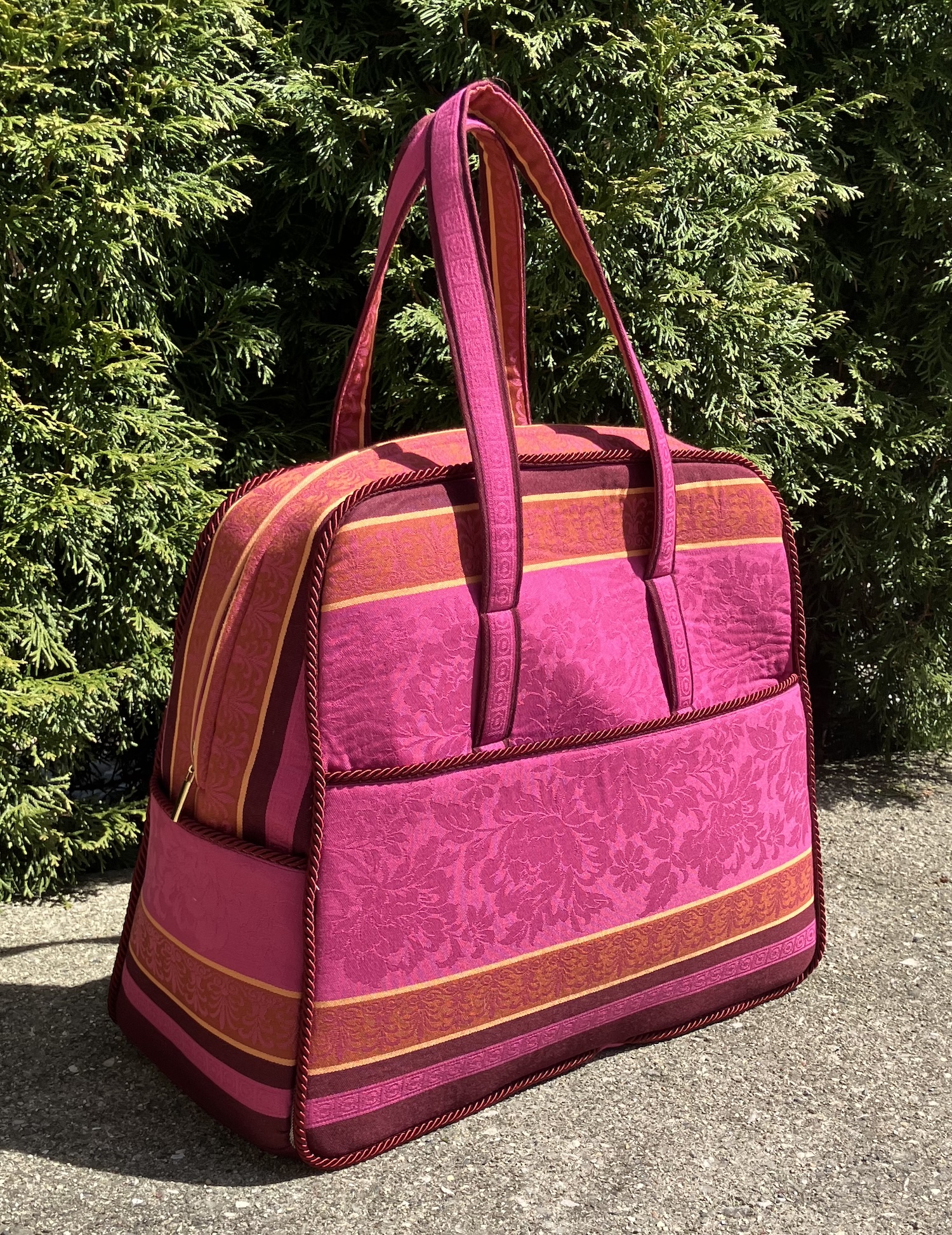
I used the burgundy/pink variant for my bag and fussy-cut the pieces to play with the design. Instead of making my own piping, I bought drapery piping in a coordinating colour. Here’s my bag:

Weekender Travel Bag designed by Amy Butler and made by Deborah Cooke

I did add piping to the tops of the pockets on the bag ends, though there isn’t supposed to be any. I had some left and liked the look of it.

I also used the needle off-set on my machine for the final row of stitching along the piping, so that I could get as close to it as possible. I still didn’t get as close as I’d like, but it worked out pretty well.

The reason I put my bag away initially was the zipper. I couldn’t find one with tabs that met in the middle. (I’ve since learned how to make one from the Blue Calla tutorials – I’ll tell you about that with another post about bag-making.) At the time, I bought two heavy plastic zippers to use instead – a burgundy one for each side – but wasn’t entirely happy with that solution. (Now, after making the bag, I think that the heavy plastic zips might be too heavy. It gets a bit bulky around the zipper opening with that fusible foam inside.) Recently, though, there were some separating zippers discounted at my local fabric store, probably because the zipper tape is mustard yellow. There was a 32″ one that was long enough for me to cut off one end, and the mustard matched the stripe in the fabric.

One change I did make was putting a heavier bottom in the bag. I often use these cutting boards from Ikea for that – they’re inexpensive and easy to cut to size with a heavy knife. The base of this bag was too big, though. The mister came up with a solution for me – he’d noticed cheap cutting mats at a discount store. They aren’t the same quality as the one I use on my cutting table, but in this case, one was perfect. I cut it down to size and put it in the bottom of the bag, before the lining went in.

I also really (really) like bag feet. I put eight on this one, because they’re smaller in size than might be ideal. They’re secured to that cutting board base, which means the base doesn’t come out and the bag can’t be washed. Would I wash an overnight bag? Not likely. If anything, I’d spot-clean it. I can’t imagine that this fabric, and all the layers of fusible goodness, would survive a trip through the washing machine either.

This bag is quite easy to assemble. There are a lot of layers but not many pieces and the instructions are excellent. The tricky bit was getting close enough to that piping, but a lot of that is on me, because I used heavier fabric and heavier piping than specified. I had no fun putting in the lining, but again, that’s on me – because I had put that hard base into the bag, I couldn’t turn it inside out as instructed. There were a lot of contortions to get the lining sewn in as a result!

I had thought this fabric might be easy to clean and mark-resistant, and I was proven right. When sewing in the lining, I stabbed my finger and bled on the bag. The mark came right out with cold water. 🙂

If you want to make a small bag, this is a good one to try! Keep it simpler than I did, though, and use the specified weight of fabric and binding.

You’ve probably guessed that the green runner is destined to become a different bag. I’ve already cut it out…and yes, it uses another of the sale zippers with mustard tape.

Foxtail Cross Body Sling

Foxtail cross body sling by Blue Calla patterns

Here’s something a little different today. Last year, I attended a presentation on bag-making given by the founder of Blue Calla, and bought one of her kits. It’s the Foxtail Cross Body Sling.

Here’s the pattern for the bag on the Blue Calla website. (Clicking on the picture will also take you to this page.)

I don’t see any kits on the site now, but I do recommend a kit for your first bag. It’s a good way to make sure you have all the parts, especially the hardware.

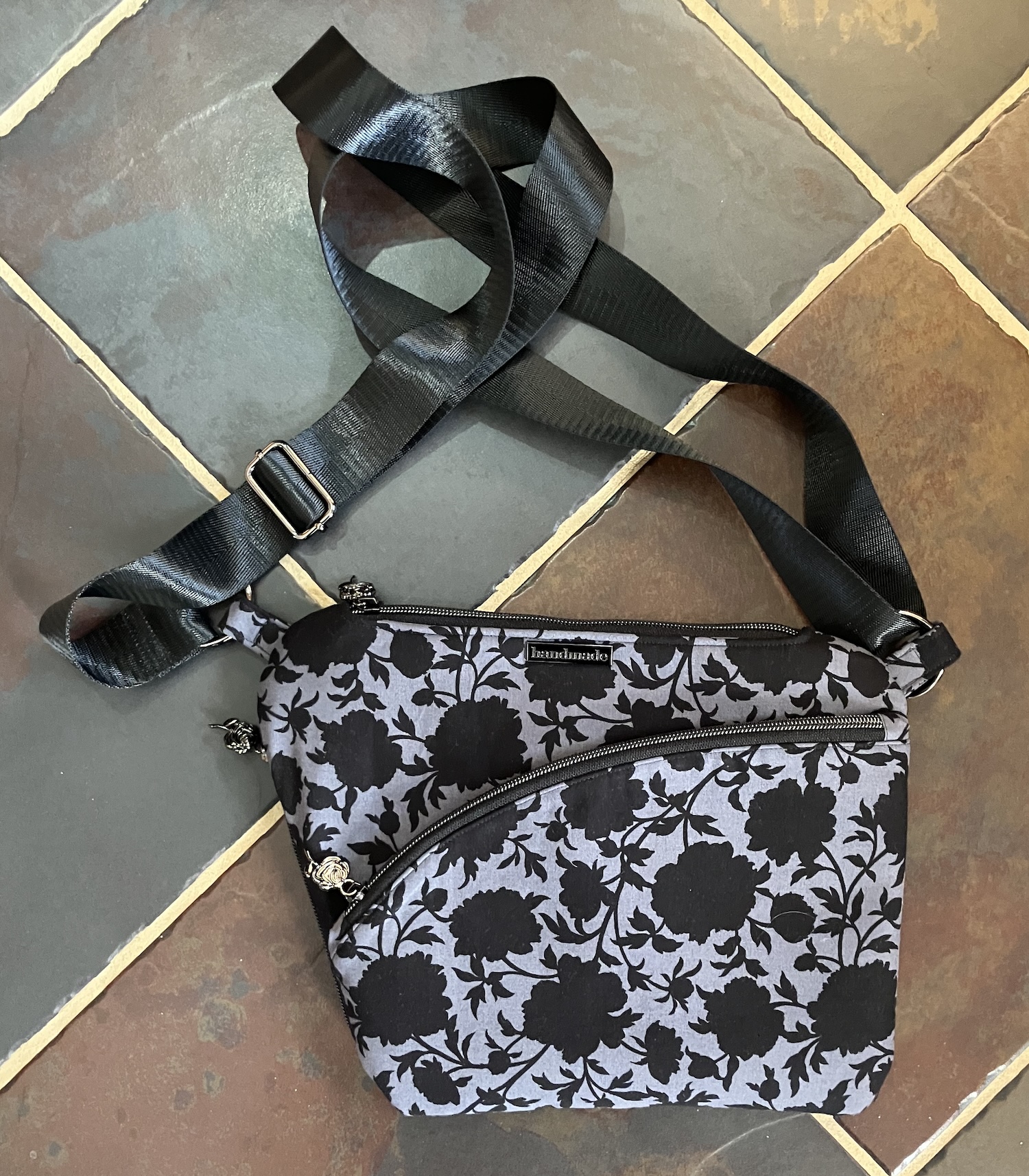
And here’s my Foxtail:

Foxtail cross body sling by Blue Calla patterns, made by Deborah Cooke from a Blue Calla kit

I’m really pleased with how well it came out, and it wasn’t very difficult. I really like that fabric, too. (The inside is an abstract print from the same line, with a light background, just the thing for a bag interior.) The instructions were clear, though I had to read them through a couple of times – since bagmaking is comparatively new to me, I tended to overthink it all. I should have just done what I was told and not worried about it. 🙂

The only thing I had to redo was the strap – I put it on upside down the first time, so had to unpick the stitching at the one end to redo it. That actually makes sense, since I routinely attach bra straps upside down. This is a similar technique, with a loop so that the strap length can be modified.

Foxtail cross body sling by Blue Calla patterns

One thing I didn’t consider was which way I sling a crossbody bag. I always put the strap over my left shoulder, as shown in this pic of the bag from Blue Calla’s site. But this means that all the zipper tabs are at the left and the compartment along the left side is a little tough to reach.

Now, imagine the bag is slung over the right shoulder. It would tip to the right then, and all the zipper tabs would be front and center.

I think I’m going to make a second one that’s the mirror image of this one that I’ve made. That way, when I put the strap over my left shoulder, all the zipper tabs will be readily accessible. This one, I’ll wear over the right shoulder.

One thing about making bags is that it’s addictive. I had started a bag years ago and wasn’t sure I had all the right pieces so put it aside. I’ve dug that one back out to finish it up, and ordered all the parts (I hope) to make a different Blue Calla bag. They also offer a free pattern, the Clematis Wristlet, and I’m going to try that one, too. Oh, there are some kits available for that one, right here.
Have you ever made a bag or a purse?

Danielle Two-Piece Dress

Barbie Mode: Dresses for Classic Barbie Dolls by Kate Mitsubachi

It’s been a bit crazy around here lately. I apologize for the silence here on the blog. I have a number of posts queued up that need pictures. Today, I’ll make a start on finishing them up to be shared.

First up, I finally got back to Kate Mitsubachi’s books, Barbie Mode. Previously, I made the Double-Breasted Suit and the Soirée evening gown from Kate’s other pattern book, Stylebook for Dolls. I had an idea when I first got these that I’d make every garment for the girls, but life happened and I was distracted by other projects. In December, I dug back in.

Danielle dress from Barbie Mode

Both books are in Japanese, but the instructions have illustrations and are easy to follow. I have a print copies of the books, but you can buy scans of them on Etsy.

The third garment featured in Barbie Mode is a two-piece suit called Danielle, which is shown in red and black. At left is the picture from the book.

I made mine in a linen and cotton blend, because it looked to me as if the sleeves would hang better in a lighter weight of fabric. I lined mine with white voile, and it came out pretty well. I haven’t made the hat and am not sure I will.

Here’s mine:

Danielle two-piece suit pattern from Barbie Mode by Kate Mitsubachi, sewn in a linen blend by Deborah Cooke

I like the seed beads on the front of this one. I think the belt in the book is made of satin ribbon, but I made this one of belting that’s available for dolls. I thought the sleeves might be softer in such a fine fabric, but they’re still a bit structural.

One change I made was to add some top-stitching to the jacket. I find that princess seams on a jacket lie flatter in doll-size if they’re sewn down. I pressed the seam allowances away from the centre, and trimmed one to 1/8″ inch before pressing then top-stitched on the outside of the seam, catching the seam allowances underneath. It would have been tidier if I’d sewn a little more of the jacket hem before turning it and handstitching the rest, but overall I’m pleased with the result.

I’m ready for a break from pink, though.

Coco – A Chanel Suit for the Girls

There’s something classic and feminine about a Chanel suit, so I’ve been seeking a good pattern to make them for the girls. Here’s one pattern I tried recently.

Coco by HankieChic

This one is Coco from HankieChic. This designer has moved from Etsy to another host since I last posted about one of her patterns: you can now find her patterns here.

I wasn’t sure about the big bow, but tried the pattern anyway. The top and skirt are actually a dress, and the top is a halter. It’s shown with an added belt. Both the dress and the jacket are lined.

I cut the suit from a yarn-dyed silk obi in taupe, and the blouse from a scrap of silk leftover from a blouse I made for myself ages ago. I cut the skirt and jacket lining from Bemberg rayon, and lined the halter top with the same silk fabric.

The jacket has raglan sleeves and a shoulder dart, then princess seams. The skirt has side seams and a center back opening.

There aren’t grainlines on the pattern pieces, which is characteristic of these HC patterns. I guessed, making the grainline vertical on all the pieces. I had some bias stretch on the front edges of the halter so if I made it again, I’d stabilize that edge by putting it on the grain.

Here’s the finished suit:

Coco by Hankie Chic sewn in silk by Deborah Cooke

I think the neckline on the jacket is a bit wide on this one, and to me, the shoulders of the jacket are a bit big for B. There’s a gap between the neck of the halter and the jacket that could be addressed by adding maybe 1/8″ to the neckline all around. I might do the skirt differently too, with darts or pleats in the front and back. Also, I’ll probably lengthen the sleeves. I’m not much for a bracelet length sleeve on a jacket, though it’s common for dolls (probably because it’s easier to get a shorter wider sleeve over their hands.) So, modifications planned for this one. Overall, though, it’s quite cute – and I like the bow better than anticipated. 🙂

I also cut out a pillbox hat in the silk, using the pattern from that first suit, but haven’t sewn it together yet. They are fiddly to make.

I’m also in the midst of trying another suit pattern (the quest continues!) and will show it to you when it’s done.