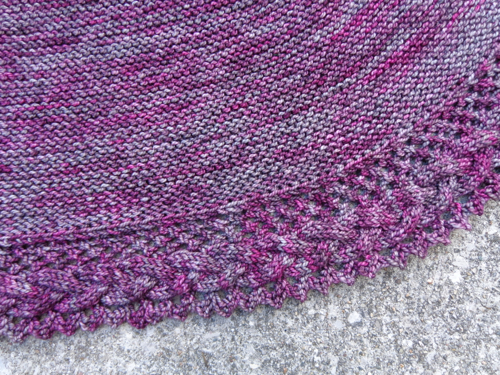
Crystal Twist Shawl

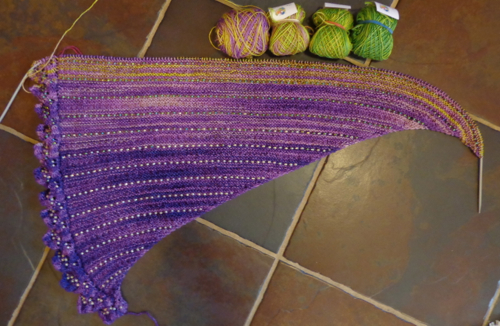
Crystal Twist is a triangular shawl with a cabled border. (That’s a Ravelry link.) It’s knit in fingering weight yarn with beads. I saw a kit for this pretty little shawl, but decided to buy the pattern on its own and shop my stash instead of buying the kit.

I had a skein of Knit Picks Bare Merino Silk fingering, which was one of several yarns including in a dye-your-own kit I bought from them ages ago. I made mine purple and there it is on the left. (The yarn on the right is KP Stroll which is a sport weight that I haven’t knit up yet)

Knit Picks yarns acid-dyed by Deborah Cooke

The incredible thing is that I didn’t have any beads to match a purple yarn. I guess I’ve used them all up. This is a bit of a wasteland for buying beads so I decided to knit the shawl without any.

I was a bit confused by the first chart, because row 1 is a wrong-side row, making row 2 and all even-numbered rows right-side rows. This was the opposite of my expectation, but once I had that sorted out, I was off. It’s a nice easy pattern to knit – you start at a point and increase until you have six cable bands, then the other stitches are in stockinette as the shawl grows wider.

I had another small issue when I started the second chart – which starts on row 1, a right-side row! – in that I was short a stitch. I did it over and over but couldn’t find the stitch. I had 52 stitches as specified but when I count the chart, I get 53, which could be the issue. In the end, I just crossed out the column for stitch 16 and carried on.

Here’s how it looks so far:

Crystal Twist shawl designed by Emily Wood and knit by Deborah Cooke

I like the colours and the pattern, but am not that fussed about the yarn. I thought it would be soft, but it feels a lot like cotton when it’s knitted up. Maybe I’ll knit a second shawl in another yarn and with beads. For the moment, I’m knitting on!

Pretty Little Shawl

Last year, at the readers’ conference Romancing the Capital, Carol gave me some of her beautiful merino handspun. She’d dyed it, too, and I spent a lot of time looking at the (very soft!) yarn, trying to figure out how to show it off.handspun marl

I finally decided on a pattern called Daybreak by Stephen West. It’s written for fingering weight yarn and this was heavier, so I just winged it. I started with the purple, then striped in the turquoise. When I ran out of purple, I switched to the pink, then did the edging in pink when the turquoise was gone.  I’m very happy with how it came out:Daybreak shawl by Stephen Wesst knit in handspun by Deborah Cooke

It’s just the perfect size to sit over the shoulders and falls to my elbows. I love shawls of this size as they keep my back warm but stay out the way.

The pattern was great and I’ll definitely knit another.

I’m heading to RTC again next week, and I’m going to wear the shawl. I’m hoping that Carol will be there.

What do you think?

Another Undine

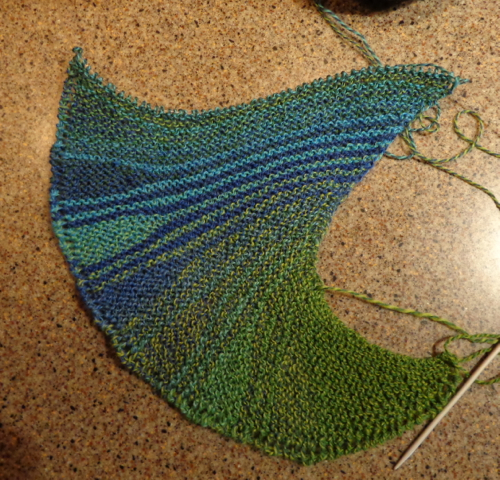
I started this stripey shawl almost a year ago. It’s my own Undine pattern, but with a modification (and a correction). I blogged several times already about this one: Knitting for a Mermaid, Progress on the Mermaid Shawl, More Progress on the Mermaid Shawl, and The Mermaid Shawl Puzzle. It’s been a bit of a process, and I won’t review all my revelations and corrections again today.

It’s done!

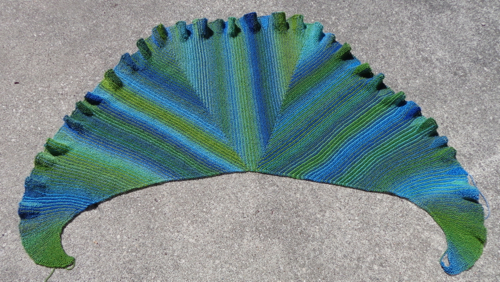
variation of Undine by Deborah Cooke knit in Crazy Zauberball sock yarn by Deborah Cooke

It’s knit of Crazy Zauberball, which is a self-striping sock yarn, and I started with two balls. I alternated two rows from each ball. I thought I did some clever calculations to finish the shawl with two balls, but there was an error in my calculations. I needed 2.7 balls to finish.

variation of Undine by Deborah Cooke knit in Crazy Zauberball sock yarn by Deborah Cooke

I love how the stripes came out, and the ruffled edge. I’m not going to block this one – I don’t usually block shawls knit in garter stitch because I like the springiness of them – so once the ends are sewn in, it’s ready to wear!

My Ravelry project page for this one is right here.

What do you think?

The Mermaid Shawl Puzzle

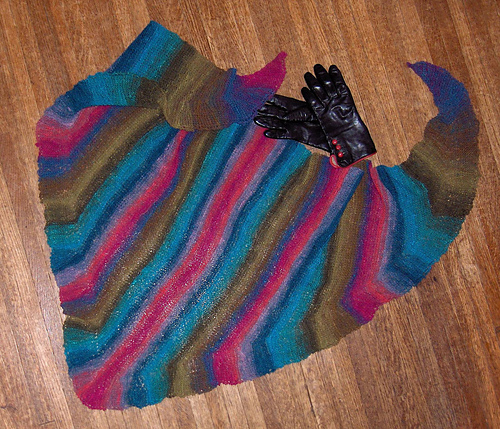
The Mermaid Shawl has had me puzzled. Last week, I figured out what was going on. Even though I’m using my own pattern, Undine, I didn’t follow the directions. In Undine, the ruffle is created with short rows at the outer edge of the shawl, and this ruffle remains the same width across the shawl. Any changes to the total width of the shawl are made in the body of it, right before the ruffle. (The increases are between the ruffle and the main part of the shawl.) This means that the rows in the body of the shawl are perpendicular to the lead edge, like this:Undine by Deborah Cooke knit in Noro Kureyon Sock by Deborah CookeWhen I began to knit the Mermaid Shawl, though, I didn’t read my own directions! I made my increases at the lead edge (i.e. the beginning of the right side row). This skewed the knit rows. Because of the location of the increase stitch, the rows fall at an angle to the lead edge, like this:Undine shawl by Deborah Cooke knit in Crazy Zauberball by Deborah CookeThe gussets that make the ruffles don’t appear to be in a separate band either. They just flow from the main shawl – in a way that would definitely please a mermaid.

This is pretty interesting. I had no idea this would happen. I would have expected my mistake to make very little difference. I was wrong about that!

If I had just continued, following the rest of the directions for Undine, the stripes would have been at an angle for the entire shawl. But, I had decided to make an inverted V in the back, again with short rows, to emulate the shawl in the Jane Eyre movie. The finished V looks like this:Undine shawl by Deborah Cooke knit in Crazy Zauberball by Deborah Cooke

My revised plan had been for the inverted V to be the middle of the shawl, BUT the knitting still doesn’t line up. In fact, it’s only this new part that is perpendicular to the lead edge, and that means that the picture above is actually the midpoint of the shawl.

I need to knit another inverted V of short rows before decreasing to the end of the shawl to make the shape come out right. The finished shawl will have three triangles. This means that I’ll run out of yarn – I’m half done, but have only 30% of my yarn left. I’m going to have to buy a third ball to finish. I do like it, though, and it will bug me if I don’t finish it so that the rows are straight.

What do you think?

More Progress on the Mermaid Shawl

I’ve been knitting and thought it time to show you my progress on that stripey shawl.Undine shawl by Deborah Cooke knit in Crazy Zauberball by Deborah CookeI’m just past the midpoint. I made a variation to the pattern on a whim. I decided to do some short rows in the middle, so there will be an inverted V down the centre back. This will make the shawl narrower but will also give it a slightly different shape. I worked two stitches less for every second row from about the lime stripey bit until I got down to just a few more stitches than the godets require. (There are more details on my Ravelry project page.)

Look at the ruffled edge at the top and you can see the green godet which is the middle point of the shawl. (It’s the top green godet.) From that point, I’ve been adding back two stitches every second row and will continue until I’m working all of the stitches again. Once there, I’ll carry on with the decreases in the pattern to finish the shawl.

I’ll show you another picture of the turns once I’ve made more progress and you can see the inverted V more clearly. I’m quite happy with this one. What do you think?

Knitting for a Mermaid

Because I’m having an administrivia week, I needed something to knit in garter stitch. I decided to use one of my own patterns, but make it stripey. The colours in this yarn are shades of blue and green, so that makes it fit for a mermaid. 🙂

The pattern is for a shawl with a ruffled edge and is called Undine. That’s the Ravelry link to the pattern (which is free download) but I also blogged about my first one here. That one was knit in a self-striping yarn – Noro Kureyon Sock – and I mirrored the striping pattern. I’ll add the picture here so you don’t have to click through:Undine by Deborah Cooke knit in Noro Kureyon Sock by Deborah CookeFor this new one, I wanted stripes. I had two balls of Crazy Zauberball sock yarn, which is a self-striping yarn, in the colourway 2136. Originally, I planned to knit knee socks with this yarn, but I wasn’t happy with the way they were coming out. Plus, I’m more likely to wear a green shawl than green knee socks.

I found a mistake in my own shawl pattern in the set up! Yikes! So, I’ll have to fix the PDF, but here’s a detail shot of the set up tip of the shawl. Although I’m using two balls of yarn for this project, I did this part with only one.Undine shawl by Deborah Cooke knit in Crazy Zauberball by Deborah CookeI joined the second ball after this, and began alternating between the balls, working two rows from each. Here’s a progress shot:
Undine shawl by Deborah Cooke knit in Crazy Zauberball by Deborah CookeWith the change in colours, you can see the godets more clearly in this version. At this point, I’ve worked seven godets, which make the hem of the shawl ripple when worn.

I’m having fun with this one. It’s not quite a mindless knit, which will keep me interested, as will the self-striping yarn. I also like how the striping is periodically disappearing when the colours from the two balls are similar. This could be avoided by using a solid yarn as one colour or a completely contrasting colourway, but I like when things slide in and out of focus. My Rav project page is here, if you want more detail.

What do you think?

Bitterblue in Progress

Time to show you some knitting again!

I had lots of plans to finish more of my projects on the go, but so much for good intentions. I had ordered a kit for the Bitterblue Shawl from Earthfaire in the Magic Carpet colourway, and when it turned up in the mailbox, I just had to cast on right away.

I inverted the order of the colours and am approaching the halfway point. This shawl uses yarn that has been dyed in gradients, each skein slightly different from the previous one so that the end project shades from one colour to the another. In this case, it shades from plum to green. Unique Sheep Gradiance is the name of the company and the line of these meticulously dyed yarns: you can see some of the other colourways on their site, right here.Bitterblue by Barbara Benson knit in Unique Sheep Luxe (kit from Earthfaire) by Deborah CookeIf you looked at the pattern on Earthfaire’s site, you will have noticed that my shawl looks different – and not just because I inverted the colours. The pattern has a larger cast-off after every third repeat of the border pattern. When I tried that, though, I didn’t like the look of it. I thought I’d prefer the shawl if the line between the border and the body of the shawl was smooth, instead of stepped off, so that’s what I’ve done.

The result of that choice will likely be that the shawl will come out a bit shorter – because mine will be wider and there’s a finite amount of yarn. When you use gradient yarns, you’re supposed to ease the transitiion into each colour change, alternating between the old and new colour, before changing completely to the new colour. (Here’s the Unique Sheep tutorial.) This always gives me stress when the rows are of different length, because I fear I’ll leave the wrong amount of yarn and run out in the middle of a row. OTOH, I don’t want to have yarn left over when I’m concerned about the overall size of the shawl. So, I’m just changing from one skein to the next, without easing into the change, and using a Russian join between them. I think it looks good.

You can’t see another change I’ve made: on every row knitting back toward the border, the first stitch is to be knit according to the pattern. I thought the edge was too tight that way, so began to slip that first stitch instead. (And actually you can see it if you know what you’re looking for. The shawl begins at that lower point, where the purple end of yarn is showing. You can see that the right edge curls more in those first few rows – I changed to slipping the stitch before that row of 5 beads.)

And YES, this shawl had beads. A lot of beads. The beads change colours too. I started with yellowy ones on the purple, then shaded into greenish ones. I’ve just changed to the ones called Root Beer and will finish out with purple beads. You can see the beads better in the image below:Bitterblue by Barbara Benson knit in Unique Sheep Luxe (kit from Earthfaire) by Deborah CookeThe wool in this kit is really lovely. I’m not often a fan of silk blends, but this is wool and tussah silk, which is sometimes called wild silk. I love the feel of tussah silk in fabric, and also love it in this yarn. I’ll be wearing this one a lot when it’s done! I might not even block it because I like the look of the garter stitch. We’ll see.

French Cancan

This is a small shawl that I just finished. It was all together in a kit that I bought from one of the vendors at the Knitters’ Fair in September, and so pretty that I had to cast on right away (even though I had lots of things on the needles to finish). The pattern is French Cancan, and the yarn is Zen Yarn Garden‘s Serenity DK. Wow, what a scrumptuous, squishy yarn! It’s a merino and cashmere blend, and the colour is simply gorgeous.

Here’s the finished shawl, although I haven’t blocked it.French Cancan by Mademoiselle C knit in Zen Yarn Garden Serenity DK by Deborah CookeI don’t really like blocking garter stitch, but prefer to let it do its own thing. The braid doesn’t really need blocking as the points already sit out nicely, so I’ll probably leave it be.

 Zen Yarn Garden Serenity DK It has a lovely crescent shape and drapes nicely over the shoulders. It takes 2 skeins – one for the garter stitch body and one for the border. I was (of course) worried about running out for the border, but I had some of the second skein left over. The finished shawl is smaller than I’d hoped, more of a scarf than a shawlette. This is funny because I saw a sample when I bought the kit, so my expectations should have been in line with reality. OTOH I’ll probably wear it more than I would have worn a shawl, because it’s just the right size for wrapping around my neck under a winter coat. I suspect I’ll be making another of these – I quite liked the pattern, and the edging pattern was easy to memorize – and maybe I’ll make a larger one.

What do you think?

Another Cameo

Last year, I knit a small shawl called Cameo. That’s the Ravelry link for the pattern, and here’s the post about the other shawl, which is still on the old website.

I started to think about knitting this pattern in self-striping yarns, and finally just had to try it. I had two different colourways of Mille Colori Socks and Lace, so I cast on. Here’s the result:Cameo by Paulina Popiolek knit in Lang Yarns Mille Colori by Deborah CookeThis picture is a teensy bit blurry because I took it without the flash and didn’t hold quite still enough. The one with the flash made the colours look all wrong. You can see how the first yarn striped in those wide bands, and that they got narrower as the rows became longer. Then there’s the alternating stripes between the two colours, but what surprised me was that when I continued in the second colour to the hem, the rows were long enough that it kept striping like the alternating section. You can see the striping better in this detail shot:Cameo by Paulina Popiolek knit in Lang Yarns Mille Colori by Deborah CookeThat top point is on the right and you can clearly see where the alternating rows of stripes begin. It’s a lot tougher to tell where they end. (It was at the green stripe, just to the right of the grout line in the floor.)

I didn’t do the lace on this one, as I thought it would be too much. It’s pretty and bright, a cheerful scarf for a dull winter day.

What do you think?

Inspired by the Kleks Shawl

Last fall, I came across a wonderful lace yarn in my LYS. It was dyed to change colours once over the length of the yarn. The yarn is Knitwhits Freia Handpaints Freia Ombré Lace, and the colourway I chose – Grapevine – changes from purple through brown and green to chartreuse. I thought it would look great in a semi-circular shawl – crescents of colour – and was inspired by the Kleks Shawl. This is the Ravelry link for the Kleks.

I really like the look of this shawl, with its alternating bands of stockinette stitch and bramble stitch, but wanted a shawl that was a wedge out of a circle with a rounded neck – like the letter C. It’s clear from the projects shown on Ravelry that the Kleks doesn’t have that shape. I also was confused by the increase instructions in the shawl pattern (it’s easy to confuse me about such things) and noticed that many Ravellers had issues with the stitch counts.

So, I made a plan for some variations. This is how my shawl came out:Kleks by Marlena Górska knit in Freia Ombre by Deborah Cooke
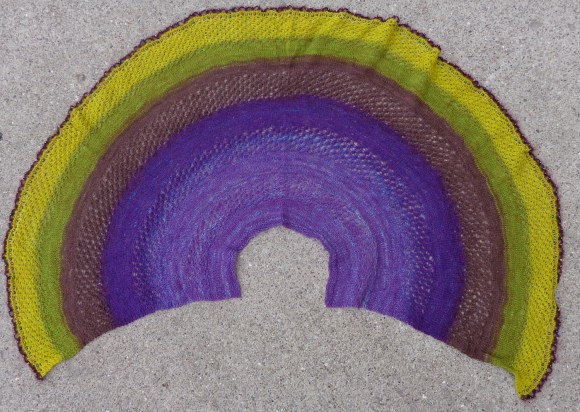
The colour is richer than that, but the flash did what it does. The crescent is about 18″ deep, so the full width is roughly 45″. It falls to my elbows and comes together nicely at the front. I love it!

Here’s how I knit this variation. You need a multiple of 4 for the bramble pattern, plus there are 3 stitches on each border. It made sense to me to cast on a multiple of 4 plus 6 stitches, then to always increase stitches in multiples of 4. If I can avoid counting stitches, I will!

(Actually, in order to make the lace pattern come out symmetrically, you need a multiple of 8 stitches plus 4, plus the borders, but I missed that bit. You might want to modify the counts if asymmetry troubles you.)

Here we go!

Collar:
Cast on 86 stitches.
Knit 1 row. Knit 5 more rows, slipping the first stitch on each row. (This gives a neater edge.)

First Stockinette Stitch Band – You’ll add 8 stitch markers in this band.
19 rows in total
Row 1 – Slip 1, K2, K8, M1, place marker, * K9, M1, place marker. Repeat from * six times. K to end. (94 stitches.)
Row 2 – Slip 1, K2, purl to last three stitches, K to end.
Row 3 – Slip 1, knit to end.
Row 4 – as Row 2.

Repeat this four row sequence four times, as follows:
Row 5, 9, 13 and 17 – Slip 1, K2, *K to marker, M1 before marker. Repeat from * seven times. K to end.

After each increase row, your counts will be as follows:
Row 5 (102 stitches)
Row 9 (110 stitches)
Row 13 (118 stitches)
Row 17 (126 stitches)

Remove the stitch markers anytime after Row 17. You’ll need them in different places for the next stockinette stitch band. End after Row 19, with the wrong side facing. (Yes, you knit the pattern stitch on the wrong side.)

First Lace Panel – 15 rows in total. This is one repeat more than the pattern specifies, which is why I have 15 rows instead of 11. Work in trinity stitch (or bramble stitch. Call it whichever) as specified in pattern, keeping three border stitches in garter stitch. There are no increases in this panel.

Second Stockinette Stitch Panel – This time, we’ll put 16 markers in the work.
19 rows in total.
Row 1 – Slip 1, K2, K7, M1, place marker, * Repeat from * fifteen times. K to end. (142 stitches.)
Row 2 – Slip 1, K2, purl to last three stitches, K to end.
Row 3 – Slip 1, knit to end.
Row 4 – as Row 2.

Repeat this four row sequence four times, as follows:
Row 5, 9, 13 and 17 – Slip 1, K2, *K to marker, M1 before marker. Repeat from * fifteen times. K to end.

After each increase row, your counts will be as follows:
Row 5 (158 stitches)
Row 9 (174 stitches)
Row 13 (190 stitches)
Row 17 (206 stitches)

Remove the stitch markers anytime after Row 17. You’ll need them in different places for the next stockinette stitch band. End after Row 19, with the wrong side facing.

Second Lace Band – as first lace band.
15 rows total.

Third Stockinette Band
Following the same increase strategy, add 24 stitches to every increase row. You’ll end with 326 stitches.

Third Lace Band – as first lace band.
15 rows total.

Fourth Stockinette Band
Following the same increase strategy, add 36 stitches per increase row. I forgot to count the stitches after this one.

Fourth Lace Band – as first lace band.
15 rows total.

Border
In an ideal universe, I would have had enough yarn to mirror the 19 rows of stockinette stitch followed by 6 rows of garter stitch at the collar. I was running out of yarn, though, so had to adapt. I worked 3 rows of garter stitch after the last last panel, putting beads on the second row, on every second stitch. I didn’t have enough yarn left to cast off (there’s about a meter of it) so I knit a row with some Kidsilk Haze in BlackCurrant that was in my bits and ends, then cast off with that. For the cast off edge, I used a crochet hook – this is the cast-off from the Fiddlesticks Knitting Peacock Shawl, which I liked on it. *Work 3 stitches together, place bead, chain 5, repeat from * to end, work last chain into last stitch and bind off. (I was short one stitch at the end, but just worked 2 together before the last loop instead of 3.)Kleks by Marlena Górska knit in Freia Ombre by Deborah Cooke

And that’s it! What do you think?