A Cabled Cardigan for Tyler

Another post about the girls this week. I’m knitting for myself, too, but it takes a lot longer to finish up a project. Right now, I’m knitting the sleeves for a cardigan in black Kidsilk Haze, using the Hebrides pattern. I’ve knit it twice before, and it’s a gem. These little jewel-necked cardis aren’t terribly exciting, but I do get a lot of wear out of them. I’ve wanted a black one for a while, though this may be the last time for black Kidsilk Haze to jump onto my needles. I have the fronts and backs done, and will pick up the buttonbands in daylight on those 2.75mm needles.

I also finished the Storm at Sea quilt, which feels like a huge accomplishment. It’s been a finished top and unfinished quilt for so long. I’m working on the hand quilting for the Pineapple Star – just two corners to go, then I can bind it. It’s time to get all these unfinished tops done.

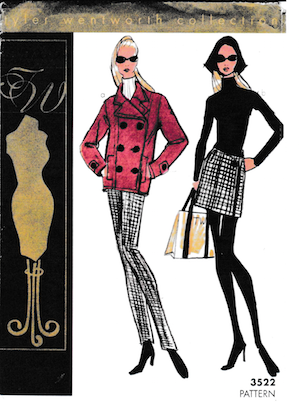
In the meantime, I finished a little top-down cabled cardigan for the girls and that’s what we’ll look at today. Here’s Tyler modelling it, along with the top from McCalls 3701 and pants from Tyler Wentworth 3522.
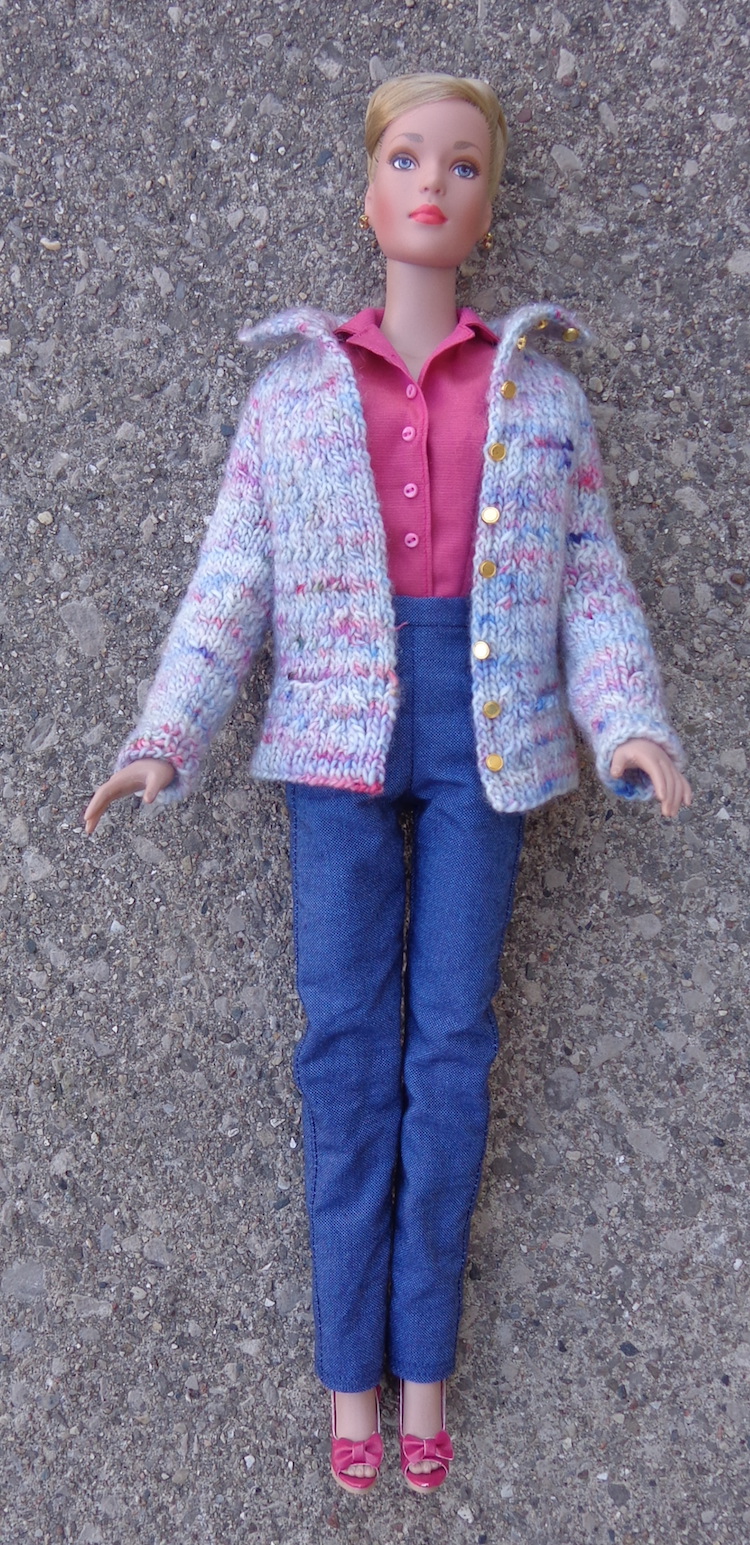
Cabled cardigan knit by Deborah Cooke for Tyler Wentworth

I didn’t have a pattern for this, just cast on with sock yarn and made it up as I went. I kept notes so I can do it again. I also kept the cables simple on this one – it’s a two-stitch cable with a purl stitch in between each one – so I could keep track of the counts better. Now that I’ve figured them out, the plan is to make another with more elaborate cables. Those are working buttons with buttonholes, though the small holes are tricky to find.

My favorite detail is the pockets in the fronts. You can just see the one on the left side (the doll’s right). I put the stitches on a holder where the pocket should go, then cast on the same number in the next row. That gave me a slit. I continued to the hem and finished the body of the sweater, then went back to those held stitches. I knit down to make a square, then sewed its edges to the inside of the sweater. Pockets!

Cabled cardigan knit by Deborah Cooke for Tyler Wentworth

You can see the cables better on the back of the sweater, as well as the single stitch on the raglan lines. I worked purl-knit-purl on each raglan line, and increased before and after it. As soon as I had two stitches for a new cable, I started one. The cables are turned in opposite directions on the left and right, then the center back cable is four stitches on each side of the central purl stitch.

The wool is some leftover sock yarn and I worked on 2mm needles. The only change I’ll make when I knit it again is to add a few rows to the collar – it wants to curl up – and I’ll play with the cable patterns, too.

These are the patterns for the sewn garments.

McCalls 3701
McCalls 3701 for 16″ dolls
Tyler Wentworth sewing pattern 3522 Weekend Wardrobe
Tyler Wentworth 3522

The pink shirt is made of French shirting cotton, which is really lovely and fine. The weft is a slightly different colour, so it changes in the light. (Yes, I made a shirt for myself of this fabric once upon a time.) It’s actually a bodysuit but made of woven instead of knit. It was a little tricky to turn those collar points but a nice little project. Those buttons don’t work – there are snaps behind them to close the fronts.

The pants from 3522 are the ones I’ve made multiple times in pleather for the girls. This pair look a bit like jeans thanks to the fabric choice, but I’ll need to add pockets to the back of the next pair to complete that illusion. They are quick basic pants to sew.

Cheater Stripes

Here’s another project that’s been hanging around for too long, without a very good reason to do so. This sweater was stuck on Sleeve Island because I was too lazy to cake up another skein of yarn for the second sleeve. The cakes I had didn’t start at the right point in the stripe sequence to match.

Finally, I got out my swift, caked the yarn and got back to knitting.

Here’s the finished sweater:

Stripes by Drea Renee Knits knit in Sugar Bush Motley by Deborah Cooke

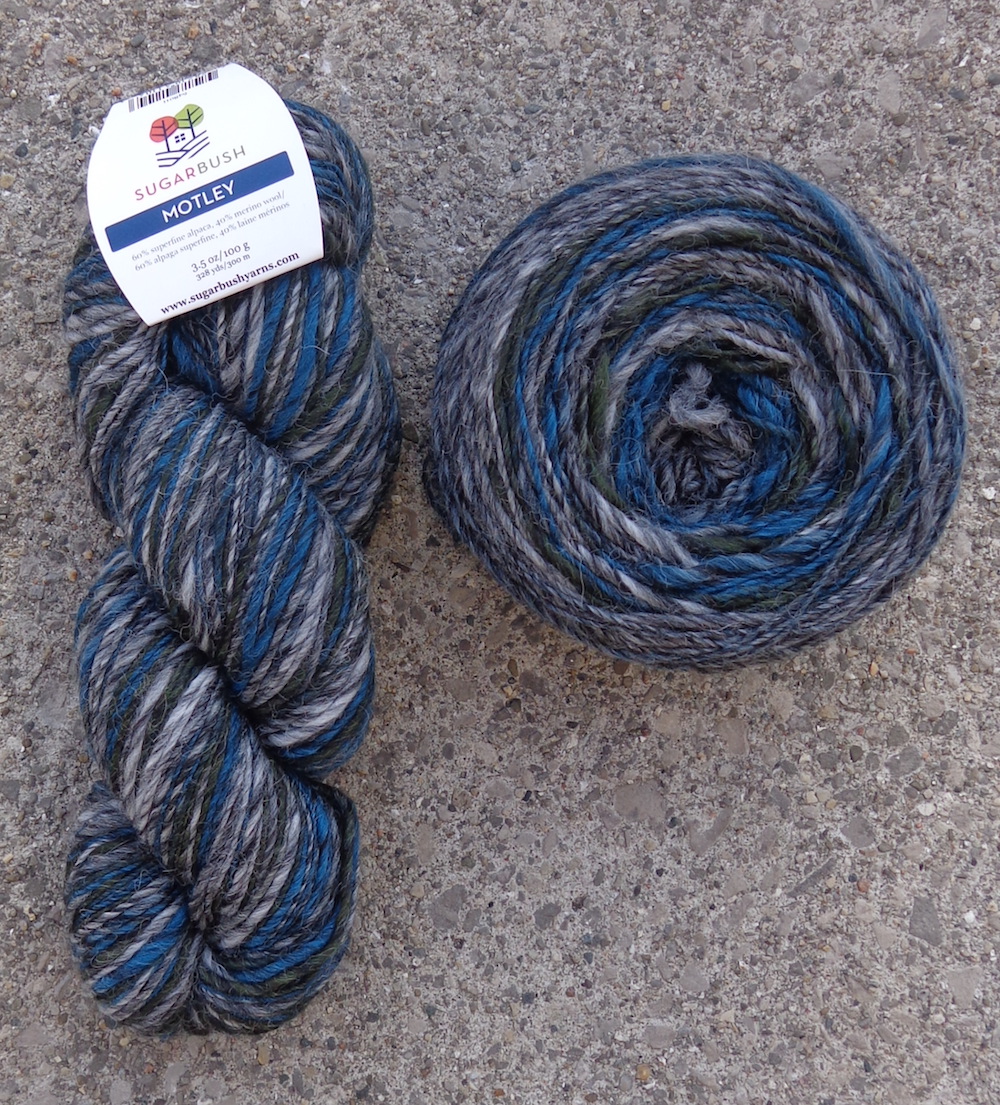
The pattern is Andrea Mowry’s STRIPES!, (that’s a Ravelry link, although you can buy it directly from her website, too.) Instead of knitting it in a multitude of colours and creating stripes, I knit mine in a self-striping yarn. The yarn is Sugar Bush Motley in Peppered Teal. (That’s a Ravelry link, too – here’s one for Yarnspirations.) Of course, a self-striping yarn has a fixed repeat, which means that as the number of stitches in each row changes, so does the width of the stripes. I kind of like how this one came out anyway.

I first posted about this sweater in March.

Of course, I had my usual panic moment of being convinced I didn’t have enough yarn, and raced back to get another skein in the same dye lot. There were only two left so I bought them both, and (you saw this one coming) I didn’t need either of them, so I have a lot leftover.

Motley is a soft yarn made of an alpaca and merino blend. It runs thick and thin, which I always like better in the skein than when it’s knitted up. It’s a little bit itchy, so I’ll need to wear a t-shirt underneath.

Basic Sweater by Louisa Harding knit in Rowan Colourspun by Deborah Cooke

I have this sweater which I knit of Rowan Colourspun a few years ago, which is a bit big for me and looks dumpy as a result. I never do the waist shaping because it always ends up in the wrong place, but this sweater would have benefitted from a bit of that. I do like the long ribbing on the cuffs and the collar. The yarn is soft and has a lot of other colours in the grey, which is pretty.

I wanted this new one to fit a little more snugly and it does. Here they are, dancing together:

two sweaters compared

It’s good to compare them, because it shows other differences. I think the sleeves are a bit skinny on this new one – which happened with my Comfort Fade Cardigan from the same designer, too, so I should have kept that in mind – and it feels a bit short. Just an inch! My bind-off is a bit tight, so I may pick that back and add an inch of ribbing at the waist. maybe another inch on each sleeve, too. I don’t love the round yoke – it has a bit of a ripple in it still – but then, round yokes fit me so seldom. I really should concentrate on sweaters with set-in sleeves.

Another one off the needles!

Edited to Add – I picked out the hem last night and added another inch and a half. That extra length makes me much happier. 🙂

Juicy Gloss Cardigan Done

Juicy Gloss is a top-down cardigan designed by Asja Janeczek, which I cast on in Koigu KPPPM in April 2018. (Here’s my project page on Ravelry.) Yup. Three years ago. I’ve blogged about this one a few times – Juicy Gloss in Koigu, and Juicy Gloss in Progress – but (as is so often the case) I stalled out when it was time to knit the sleeves.

Here’s what it looked like the last time I showed it to you:

Juicy Gloss by Asja Janeczek knit in Koigu KPPPM by Deborah Cooke

It’s a long cardigan, longer with my modifications to the front, and the colour variegation is very pretty. Here’s a detail shot of the Koigu – it still doesn’t do the color justice:

Juicy Gloss by Asja Janeczek knit in Koigu KPPPM by Deborah Cooke

This cardigan was marooned on Sleeve Island for a while. I think that happens because there’s always counting to do with sleeve decreases and I tend to knit while watching television – it’s easy to lose track and even easier to just pick up another project with a few thousand miles of stockinette to knit. In this case, I also realized after I knit the first sleeve to the elbow that it was too wide. Projects that need to be frogged and reknit often end up in time-out for me.

I frogged back to the armhole and decreased an additional 8 stitches from the sleeve at the underarm. The pattern specifies to knit two inches before beginning the sleeve decreases but on this version, I started the decreases right away. I was working four rows, then decreasing on either side of the marker (at the middle underarm) in the next row. I did that twelve times. If I’d wanted the elbow length sleeves like the pattern, I could have continued to the specified length and done the cuff, but I wanted long sleeves.

I continued, working 5 rows between the decrease rows. I did that fourteen times. The sleeve needed to be 34cm long, so I knit 62 rows to get the length then worked the I-cord cuff as specified.

Here’s one finished sleeve (although the ends still need to be sewn in):

Juicy Gloss Cardigan knit in Koigu KPPPM by Deborah Cooke

I could have continued the decreases and made the cuff fitted, but I know I’ll push up the sleeves.

When I blocked the sweater, the Koigu stretched like mad. It seems that the yarn loses its “boing” when wet. It’s freaked me out before, but I just had to let it dry as planned. When it was just a little damp, I put the sweater in the dryer on the Touch Up cycle. That’s 15 minutes on low heat on my machine, and I checked it every five minutes. It came out perfectly after ten minutes, then I left it overnight to be sure it was completely dry.

I still have to sew in the ends, but here’s the finished cardigan!

Juicy Gloss Cardigan knit in Koigu KPPPM by Deborah Cooke

It looks a little lighter at the top right because there was a bit of sunshine there.

Here’s my Ravelry project page with the modifications.

What do you think? I’m really pleased with this one.

Stripes!

I can never resist a new project, even when I have a lot of projects to finish up. There’s something very satisfying about casting on.

In November, Andrea Mowry published a new pattern called Stripes! which I liked a lot. (That’s a Ravelry link.) It’s a top-down pullover with lots of options to vary the results. It looked like a quick and easy project – plus I had the perfect yarn in my stash (or so I thought).

I bought some Sugar Bush Motley at Spinrite last year because I really liked how it looked in the skein. (That link goes to the Motley project page on the Sugar Bush site.) I was expecting it to create an all-over speckly pattern. Once it was caked up, though, it was clear that this yarn was dyed to make repeating stripes. (This colourway is called Peppered Teal.)

Sugarbush Motley in Peppered Teal

I set it aside then, but pulled it out again for this sweater. I’d have stripes without changing colours every 8 rows. Of course, the stripes would vary in width, depending on the number of stitches on my needles, but I thought it would be okay.

Here’s the sweater so far:

Andrea Mowry's Stripes top-down pullover knit in SugarBush Motley by Deborah Cooke

This yarn is a merino-alpaca blend, so it will be warm. I decided that I wanted a turtleneck on this sweater, so I did a provisional cast-on, then knit down the sweater yoke as instructed. When I had a few inches done on the yoke, I picked up the neck stitches and knit up in ribbing to create the turtleneck. I also inverted the colour sequence – starting from the other end of the skein – because I knew the collar would be folded down and I wanted it to match up with the body. I had a hard time assessing the depth to knit – I thought it was long enough because I tried it on before the yoke was done. Once I divided for the underarms, though, the neck pulled down a bit and I had to rejoin the yarn and knit a few more inches on the neck.

I like the yarn, even though it’s a single-ply, loosely spun and a bit splitty. I like it because of the result. The knitted fabric is soft and light, with a really nice drape. I think this will be a sweater I wear a lot.

I can hear you asking why I’ve only managed this much since November. As is so often the way with “quick” projects, I made a mistake. I had knit this sweater well past this point, almost to the waist ribbing, when I took it off the needles to check the size. I find it hard to assess the size of a top-down pullover, even when I try it on, until I knit past the bust. It was huge, way too huge – because (ugh) my gauge was off. I figured out that I needed 50 less stitches in the body and would still have a loose fit, so I ripped all the way back to the neck. I could have changed to smaller needles, but I liked the drape of the fabric I was getting, so I followed the instructions for the next smaller size. That made a difference of 30 stitches in the body. Then I added 20 less stitches at the underarm, 10 less on each side, and carried on. I’m quite happy with the fit now.

And I figured out a new trick. Instead of transferring all the stitches to a length of wool to try on the sweater, then putting them back on the needle, I knit half the body on one 80cm circular, and the other half on a second 80cm circular. That means I can put the sweater flat to measure it, and also that I can (carefully!) try it on, without transferring the stitches. 🙂

Onward with this one. Looks like it will be a sweater to wear next winter…

Spector in Mad Tosh Merino Light

Spector is a pattern by Joji Locatelli, a top-down pullover with some stitch detail on the yoke. It also uses four different colours to create a gradient. The pattern is designed to use Madeline Tosh Merino Light and for once, I’m using the specified yarn.

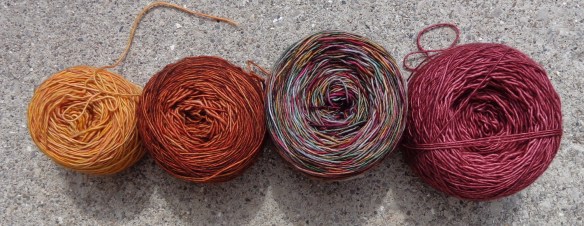
Here are my choices for the gradient. The colourways, from right to left, are Spicewood, Saffron, Simmer Pot and Red Phoenix. MadTosh Merino Light for Deborah Cooke's SpectorThat Simmer Pot is really something and the photograph doesn’t do it justice. I bought it on a whim. Here’s the page on Ravelry that shows it in stashes – because many Ravellers are much better photographers than I am. (I don’t see the colourway on the MadTosh website.)
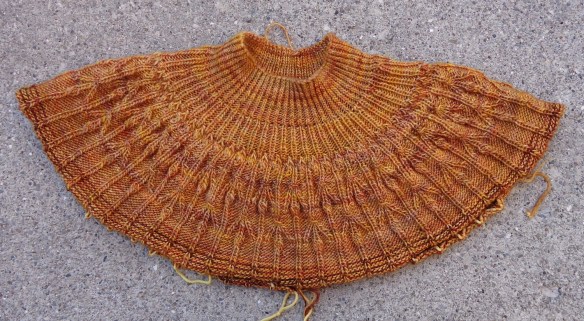
And here’s the beginning of my yoke. I’ve started the first gradient change and am supposed to split the yoke for the sleeves. I’ve put it on a thread to try it on first, which is the wonderful opportunity of knitting top-down sweaters.

Spector by Joji Locatelli knit in MadTosh Merino Light by Deborah CookeIt seems that this sweater is supposed to tug down, to make a scoop neck. When I tried it on at this point, it seems too soon to split for the sleeves as it’s challenging to tug it down enough for it to reach my underarms. My gauge is spot-on. On Ravelry, people have commented on how stretchy it is and how well it fits. Hmm. I’m small in the shoulders, so this should work. Hmm. I decided to knit a litte more before splitting for the underarms, since I prefer more of a round neck and I dislike tight sweaters. I ended up knitting another 3/4″.
I’d just started the change to the second colour in this picture and you can see a teeny bit of it at the bottom of the yoke. I did the first round of bud stitches incorrectly, just below the ribbing for the neck, but I did them consistently 🙂 so I’m not going to frog back.

When the yoke is split for the underarms, there’s a neat little trick to turn the work inside out, so the body is mostly knit instead of mostly purled. I’m not doing that, as I don’t mind purling and I think there might be a gauge difference.

I also did some recalculations for dividing the body and sleeves because the pattern warns that the rib stitch might not line up. Of course, I want it to so I made some changes. I’m making the L or the fourth size. Instead of beginning the division at the marker, I worked 2 stitches first (P2), then put 66 stitches on a holder instead of 68. I cast on 6 stitches, placed a marker, then cast on 6 more. (This is two repeats of the ribbing pattern. The instructions are to cast on 7 PM and co 7 more.) Then I worked 125 for the front instead of 122, put 66 on a holder, cast on 6 stitches, placed a marker, then cast on 6 more. I worked to the end of the row, then removed the end-of-row marker and worked to the middle of the underarm in pattern. That’s the new beginning of the round.

Because I was in the middle of a colour transition, I alternated between the two colours from the old marker to the new one, then continued in the specified transition.

Instead of 68-122-28-102, I ended up dividing my stitches 66-125-66-103 for the sleeve-front-sleeve-back. With 12 sts cast on at each underarm instead of 14, my total stitch count is still 252, as the pattern specifies. Ha.

Now, it’s TV knitting. Onward!

Iced in Noro Kochoran

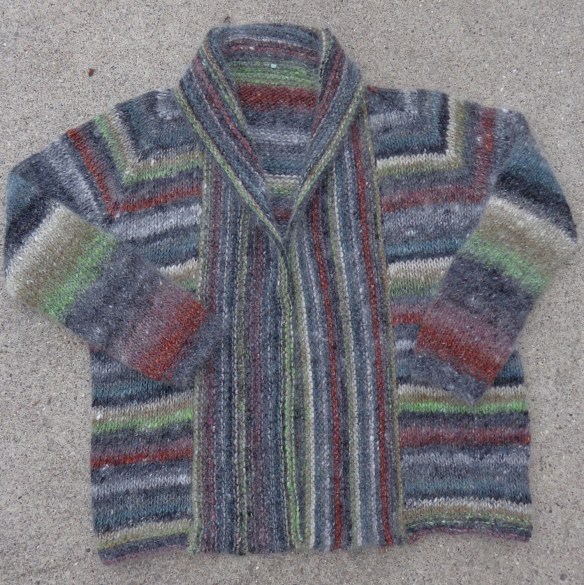
I haven’t shown you any knitting lately because I’ve been working on this beast. It’s heavy wool on big needles but still a lot of knitting. Here’s the sweater:Iced by Carol Feller knit in Noro Kochoran by Deborah Cooke

The pattern is Iced, which is a free pattern from Knitty and a top-down cardigan. Here’s the page on Knitty where you can print the pattern and here’s the Ravelry page.

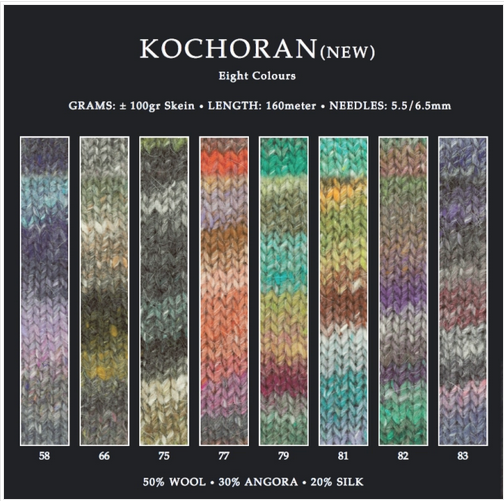
The yarn I used is Noro Kochoran, a discontinued bulky yarn that’s a blend of wool, angora and silk. I’ve had it in my stash for quite a while. (That’s the Ravelry page for the yarn, since it’s not on the distributor’s site anymore.) My colourway is #75. Here’s a shade card that I found online:

Noro Kochoran shade card#75 is third from the left. I also have #83 which is on the far right. It’s a really fuzzy yarn and was a bit of a splurge at the time. In the skein, it didn’t look so stripey, but (of course) it is. It shed a bit while I was knitting, but I hope it’s done with that.

I’ve been looking for a pattern for this yarn for quite a while, and was inspired by a Ravelry project of this sweater in this yarn. That knitter said that pattern and yarn were a perfect match, so away I went. On the needles, the tension looked a bit loose – it matched gauge for the pattern, but seemed too loose for the yarn. I knit a swatch and washed it and was much happier with it – the yarn fulled nicely when it was washed.

I did drop a needle size for the collar after knitting it on the specified needles and thinking it was too loose. I’m much happier with it now – even though it was three nights’ of knitting unraveled to redo it. I later unraveled the rows of garter stitch at the hem and reknit them on the smaller needles to match. I didn’t have 7mm needles small enough to do the same at the cuffs, so I knit their garter stitch cuffs on 6mm needles. I can tell the difference but I doubt anyone else will. Here’s the sweater with the fronts overlapped, which is how it would actually be worn. (I was just showing off my matchy-matchy! LOL)Iced by Carol Feller knit in Noro Kochoran by Deborah Cooke

The result is a very snuggly cardigan. It has that “bathrobe” look that shawl-collared cardigans so often have for me (maybe that’s because of the stripes) but I like it anyway. I haven’t put buttons on it yet and probably won’t.

Here’s my Ravelry project page.

Sonny vest by Sarah Hatton knitted in Colourscape Chunky by Deborah CookeI used about 6 skeins of the Kochoran so there are 4 left. I realized that the yarn has exactly the same weight/yardage as Rowan Colourscape Chunky – woo hoo! – which gives me another pattern stash. I’ve made this vest for Mr. Math of the Rowan yarn – it’s called Sonny and was designed by Sarah Hatton – which took 490 yards, so I have enough of the Kochoran, maybe even to be matchy. (Fingers crossed.) I’ve now cast on this vest in the Kochoran.

Here’s my Ravelry project page for the vest at right. I think it’s going to look really good in this yarn.

VK Bohus Inspired Pullover

Vogue Knitting magazine winter 2015/16For a while now, I’ve been working on a pullover from Vogue Knitting’s winter 2015/2016 issue, a Bohus-inspired pullover. (If you’re on Ravelry, here’s the magazine issue and here’s the sweater.) It was on the cover, and was pretty much the reason I bought the magazine. What intrigued me about the sweater was the fit. It didn’t look like an Icelandic sweater with a round yoke, but like it had more of a straight yoke. Icelandic sweaters fit men really well IMO but often look puffy on women. This one looked sleek. It also used Bohus design elements. I have a Bohus kit (Vildapplet cardigan, right here) but am a bit daunted by it. Bohus style sweaters use multiple colours of yarn in a row (three or even four) and also purl stitches on the right side. They also are worked on tiny needles in colours that gradually shade into others, so I thought this VK sweater in a larger gauge would be good practice.

I didn’t have the yarn specified, so I dipped into my stash to look for options in that weight. I found my Rowan members’ yarn pack, which was three balls of Felted Tweed, one in Avocado, one in Bilberry and one in Watery. Hmm. The Avocado would work for the Leafy Palm: the Watery for Caspian, and I used the Bilberry for both the Oxblood and the Mecca. (I thought about adding a fourth colour, but couldn’t find one that I liked with the others.) What about the white and grey? I’ve knit Felted Tweed with Colourspun several times, which works out to be a nice squishy combination, plus Colourspun has been discontinued. (Boo.) This was a chance to make another sweater in that yarn before it’s gone forever. I bought Colourspun in Semer Water for the charcoal grey, and in Winterburn for the white. These two shades of grey are much closer together than the white and grey used in the pattern, but Bohus is known for its blending of colours so I figured I had that covered.

This is a top-down sweater, so the cast-on is at the neck. One good thing about top-down sweaters knitted in the round is that it’s easy to try them on as you go—just put the stitches on a thread and tug the sweater on.

There has been goofiness with this one, which is why you haven’t seen it yet even though I’ve been knitting since April. I’ve knit the yoke three times. The first time, I missed the purl stitches on the schematic and had just knit them, so I frogged back. The second time, I made the L size, because I wanted a nice sloppy sweater, but the yoke ended up being enormous. I tried it on, then had Mr. Math pinch back the yoke from behind me until it looked right in the mirror. Then I counted the repeats to take out. It turned out I needed to knit the smallest size in the yoke, so I knit it again. My gauge is slightly off—instead of getting 21 stitches in 4 inches, I’m getting 20. I like the fabric and don’t want it to be stiffer by using smaller needles. The thing is that over 200+ stitches, that little difference adds up.

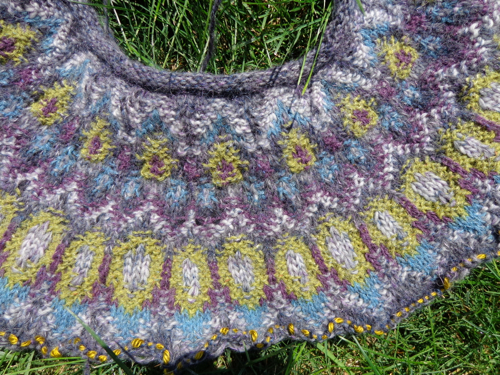
I like the colours a lot, but it is a round yoke.Bohus inspired pullover knit by Deborah Cooke

I’d expected it to be more like a Bohus sweater yoke, which isn’t a complete circle when flat. Here’s a Bohus yoke photographed flat in the Swedish Bohus Museum, so you can see what I mean. I’ve seen other Bohus yokes that are closer to 3/4 of a circle, but they’re seldom fully round—When people photograph the pullover yokes, the knitting pulls up into a cone closer to the neck, rather than lying flat. That’s why Bohus sweaters tend to fit women well through the shoulders. We’ll talk more about Bohus sweaters when I get mine a little further along and post about it. I’d like to finish that yoke before showing it to you. (Right now, it’s about 1″ deep!)

So, this pullover going to fit a lot like a round yoke Icelandic sweater, when all is said and done. It looks like an Icelandic sweater in most of the finished projects on Ravelry, too. I’m resigned to the good chance of it being puffy, but because I do like the colours and the yarn, I’m carrying on.Bohus inspired pullover knit by Deborah CookeThe purl stitches look quite neat, and they blur the transitions between the colours in true Bohus style. I also like the slight variegation in the Colourspun. There are little bits of colour in the dark grey as well that don’t show up in the photo—a bit of blue, a bit of purple—and they pull it all together very well. Now that I’m into the plain knitting, it’s going much more quickly. I’ve divided for the arms and am working down the body, and will show you more soon.

I’m already thinking about the hems and the neck—the pattern has ribbing on the hems, but I might just let them roll. It also has the ribbed neck knitted separately and sewn on, which is unusual. I had thought about casting on with the ribbing at the neck (at the very top!), but I’m not sure I want it as tall as in the pattern. It’s good to be able to try it on to decide, but I’m concerned about the join showing. I’ll probably pick up the stitches, knit up and hope for the best.

I have no idea how I ended up knitting this warm fuzzy beast in the hottest summer I can remember, but there you go.