Another Upcycled and Felted Bag

In the midst of all this blog tour frenzy and book promotion, let’s talk about something different.

Let’s talk about knitting.

In fact, let’s talk about recycling other people’s knitting. I stepped away from my computer and from my desk this weekend to create something. Here it is:Felted bag made from an upcycled sweater by Deborah Cooke

The bag is a gift – for someone who almost certainly doesn’t read my blog, so it’s safe to show it here. It’s made primarily from a Gap sweater, which was a crew neck pullover with raglan sleeves and lovely fair isle patterning. I got it at the thrift store for a buck, because someone had tossed it into the washing machine and started the felting process. It probably hadn’t fit the person after that. I brought it home and tossed it into the washing machine again to felt it even more. I really liked how colourful it was and knew it would make a great bag.

The bag itself is made of the body of the sweater – you can see the ribbing from the hem at the bottom of the bag. I often cut that off, but this sweater had shrunk a lot and I didn’t want to make the bag smaller than it could be. (It’s about 12″ deep finished and 13″ wide.)

As far as shaping goes, I used the body of the sweater up to the underarms. The flap is actually the front of the sweater. I cut the raglan seams open on either side of the front and kept all of the front, shaping it at the neck to have a nice curve for the flap. Then I cut straight across the back of the sweater at the underarms – the fair isle pattern made it easy to do that straight! – and removed the sleeves.

The sleeves will become another small purse. I’ve cut the pieces and all that will go in the trash from this sweater is the neck ribbing. 🙂

Then I dove into my fabric stash, which is quite considerable. I chose a colourful check for the contrast piping and cut it on the diagonal, making piping with cotton cording. The lining is the same cotton. The bag is lined with a drawstring top, contrast piping all around and nylon straps. I like the button a lot. I’m less happy about the straps but handles are always an issue for these bags. I have bought leather handles in the past, but they’re expensive and I haven’t seen any locally for a while. I used the handles and lock strap from Grayson E. on this bag, for example, but the set cost over $100. It was fine for a special project – I had actually knit this bag myself – but is not something I’ll do for every bag.The tapestry bag also has feet, which I didn’t put on this newest little purse.

As far as the purse goes, my only regret is that I didn’t put a zippered pocket inside – I usually put one in the lining but just forgot this time.

What do you think? Do you recycle anything to make it into something else?
Upcycled Bags

Another day on the re-useable bag theme. Today’s bags aren’t vintage bags in themselves – although it can be fun to score an oldie but a goody. I saw airline totes from the 1970’s the other day in a thrift store. So cool!

These bags are made from old sweaters.

It’s one thing to felt a piece of new knitting. But you can also felt a piece of old knitting. Or machine knitting. Or make use of a wool sweater that you might not use otherwise – one that doesn’t fit anymore, one you don’t like anymore, or one you bought for $2 at the thrift store.

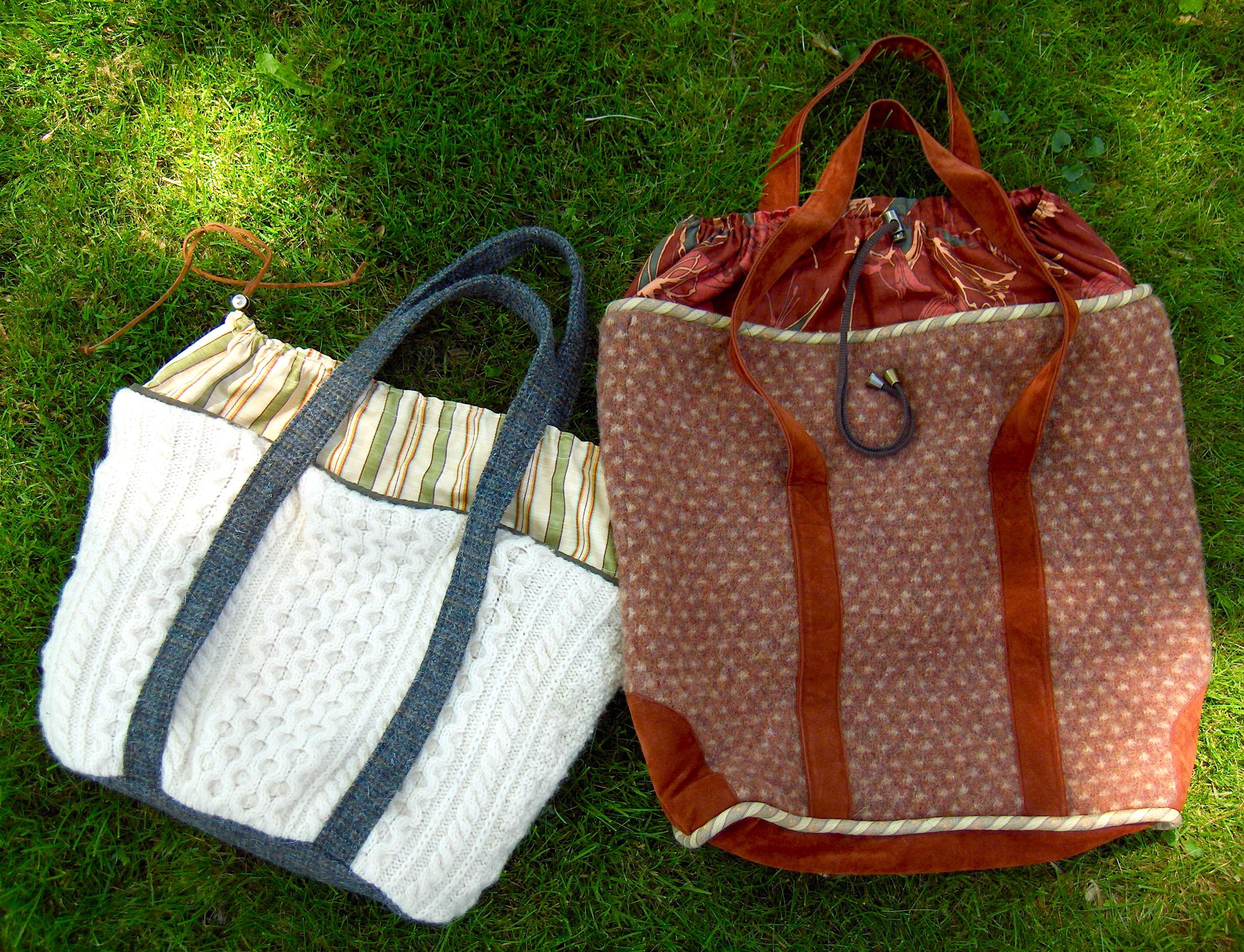
Like this:upcycled bags made from felted vintage wool sweaters by Deborah Cooke

The first thing you need is a 100% wool sweater. Ideally, it will also be a colour (or pattern) that you like.

The second thing you need to do is felt the sweater. Knot it up in a pillow case and toss it into the washing machine, with some towels and/or jeans to balance the load. If it doesn’t felt enough to lose stitch definition – i.e. if you can see the individual stitches – put it in for another round. Heat and agitation make wool felt. Front loading washing machines are more gentle and will require more repeats to felt an item. Hot water works faster. You can also fill the tub with hot water, toss in the sweater, put on your rubber boots, grab a plunger and get in there to agitate it. Your choice.

Once the sweater is felted, you need to decide which part to use. You can cut felted knitting without worrying about it unravelling. The bag on the left was the simplest kind – I cut it off straight at the underarms. The bottom ribbing became a seam allowance (a big one) in the base. The base is oval, just eyeballed from the size of the bottom plus a seam allowance. I edged the top with some piping from my fabric stash, made matching handles and a lining, and that’s that. I’m not much for open bags, but that would have been even easier.

The one on the right was one I wanted to be as big as possible. Those fake suede patches at the base actually cover the armscye from where I cut away the sleeves. The waist ribbing from the sweater is at the top, underneath that piping edge. This one has a square bottom which was a little bit trickier to sew. To cut the right size rectangle, I flattened the bag, then measured the whole width. The sum of the narrow side of the rectangle base and the long side of that base had to be the same as the width of the flattened bag. The other thing with this one was that I discovered after getting home that it had one little moth nibble. I unravelled some yarn from the cuff (which I knew I was going to cut off anyway) and darned the hole with the same wool. After felting, I couldn’t even find the repair again.

Have you made any bags from recycled or thrifted materials?