Colonnade in Wool Clasica

I have a tendency to buy yarn because I like it, without a specific project in mind. (This inclination is worse if the yarn is on sale.) That means I guess on quantities and sometimes, I guess too low. That’s what happened with these skeins of Manos del Uruguay Wool Clasica—that’s a Ravelry link btw. Here’s a Fairmont Fibres link, which I think is the US distributor. I loved the colour (it’s #114 Bramble – this link shows the colourway on the FF site) and bought four, but four skeins of aran weight yarn isn’t very much. It’s just 604m and I wanted to make a garment from this.

I first made a vest from this yarn and had to even use the bits from the tags to finish casting off. Even so, the vest was too snug for me so (after some mourning), I frogged it and returned the yarn to the stash. And there it’s been for about a decade.

I rediscovered it recently and remembered how much I liked it. I searched on Ravelry for patterns specifying this very yarn and found Colonnade, a free pattern on Knitty by Stephen West. It might have been one of his earliest patterns—it was posted in 2009. Here’s the Ravelry link, and here’s the Knitty link. The pattern calls for three skeins of this yarn, and uses two different colours. I had four and wanted to use them all up. Hmm. Here’s a picture of the shawl laid flat from the Knitty website:
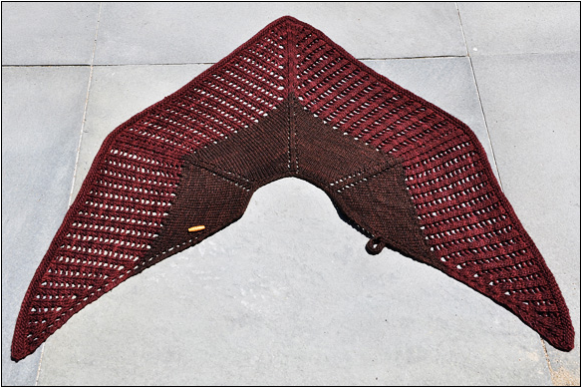
Colonnade shawl by Stephen West from the Knitty website

You can see that the shawl is in four quadrants. If you look a little closer, you’ll see that each quadrant has increases on just one side: the increases are at the front edges and on either side of the centre back. I looked through the project images on Ravelry and it seemed that many knitters found the neck a bit snug—they’d added stitches, but I decided to add an entire section. My fifth section is inset into that centre back seam to keep the shawl symmetrical—and to keep it symmetrical, this new section has increases on both sides. The idea was to make the shawl wider but not much deeper, and use up the four skeins.

The pattern has a four-row repeat for the lacy part: I considered those instructions to be for sections one, two, four and five, then did my addition in the middle. If you’re inclined to do this yourself, here’s the pattern stitch for that new section in the middle:

Row 1: K1, YO, K4 [YO2, K2tog, K2tog] to 5 stitches. YO2, K4, YO, K1
Row 3: K1, YO, K2 [YO2, K2tog, K2tog] to 3 stitches. YO2, K2, YO, K1

I cast on 52 (instead of 42) stitches and worked as instructed. I had 212 stitches when it was time to start the lace and 38 stitches between markers.

I did nine repeats of the lace pattern, then cast off. With a gentle block, here’s the result:

Colonnade shawl by Stephen West knit by Deborah Cooke

And a closer view:

Colonnade shawl by Stephen West knit by Deborah Cooke

I’m really pleased that it didn’t pool, but that’s probably because the number of stitches increases every second row. There’s just 23g of the Wool Clasica left over, so that’s one more gone from my stash.

Here’s my Ravelry project page.

Mystery Afghan KAL – 2

You might remember me posting about the Rowan yarns Mystery Knit-A-Long a few weeks back, which is an incremental pattern for an afghan. Each week, there’s a pattern published for a new afghan block, and each week, you’re supposed to knit six of that week’s block. After 8 weeks of this, knitters will each have 48 blocks. The subsequent weeks include instructions for the border and for assembling the afghan.

Here are the first four block patterns in my substitution yarn. (Knitters are only eligible for prizes from Rowan if they use the specified yarn, Rowan Pure Wool Worsted, which is available in 50 solid colours. I chose to stash-dive instead.) My yarn is Patons Decor and it is variegated, which adds some spice to the blocks.Pure Wool Mystery Afghan by Martin Storey knit by Deborah Cooke in Paton's DecorThese aren’t blocked to size. I block lace, but am not going to bother with afghan blocks. If I did block them, they’d all be perfectly square and the exactly the same size—blocking means that the damp or wet squares are gently stretched to shape and left pinned until they dry.

The variegated yarn definitely obscures the stitch pattern in the blocks and makes them more visually busy—but it’s also pooling in a very predictable pattern. “Pooling” refers to the way that the colours in a variegated yarn come together in a knitted piece. Some pooling is beautiful (see Dayana deliberately playing with pooling here – as well as explaining a lot about it) and some is ghastly. What works is also a question of personal taste. Knitters tend to get excited about pooling—if you’re on Ravelry, you might want to check out this thread for thousands of examples. The thread is six years old and still active, a sign of how much pooling can agitates knitters. (Some call pooling “clown barf” which is another hint.)

The pooling is similar in each block here because the blocks are the same number of stitches in width and the variegation—done by a machine—occurs at fixed intervals. Even so, it’s more regular than I anticipated it would be. I’d thought I would have to cast on at the same point to make the pooling match, but didn’t do that because I thought the stitch pattern would also influence how the colours fell. Apparently not. I’m curious to see whether the eye dismisses the pooling when all 48 blocks are assembled. If so, the stitch pattern might appear to be more evident. We’ll see. (This afghan is an experiment, and it will be warm and useful either way. My opinion of it will determine only its final location: living room, television room or dog bed.)

This pooling pattern also means that unless the border is the same number of stitches in width, the pooling in the border will be different from everywhere else in the afghan. That might be distracting, and I’m considering the possibility of making the border in a solid colour—either the teal or the burgundy, depending upon which I can match. Again, we’ll see.

As anticipated, I’m behind on my squares already. I need to do three more from week 3 (the one with the zigzag) and five from week four (the XOX’s). Since there will be a new clue on Monday, I’ll probably fall farther behind. C’est la vie!