New Socks for the Mister

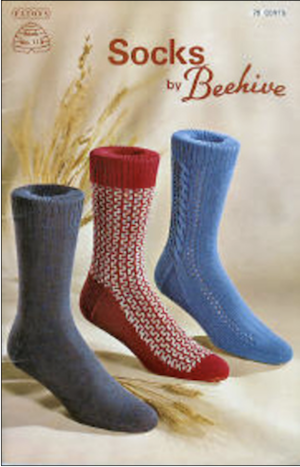
Socks by Beehive

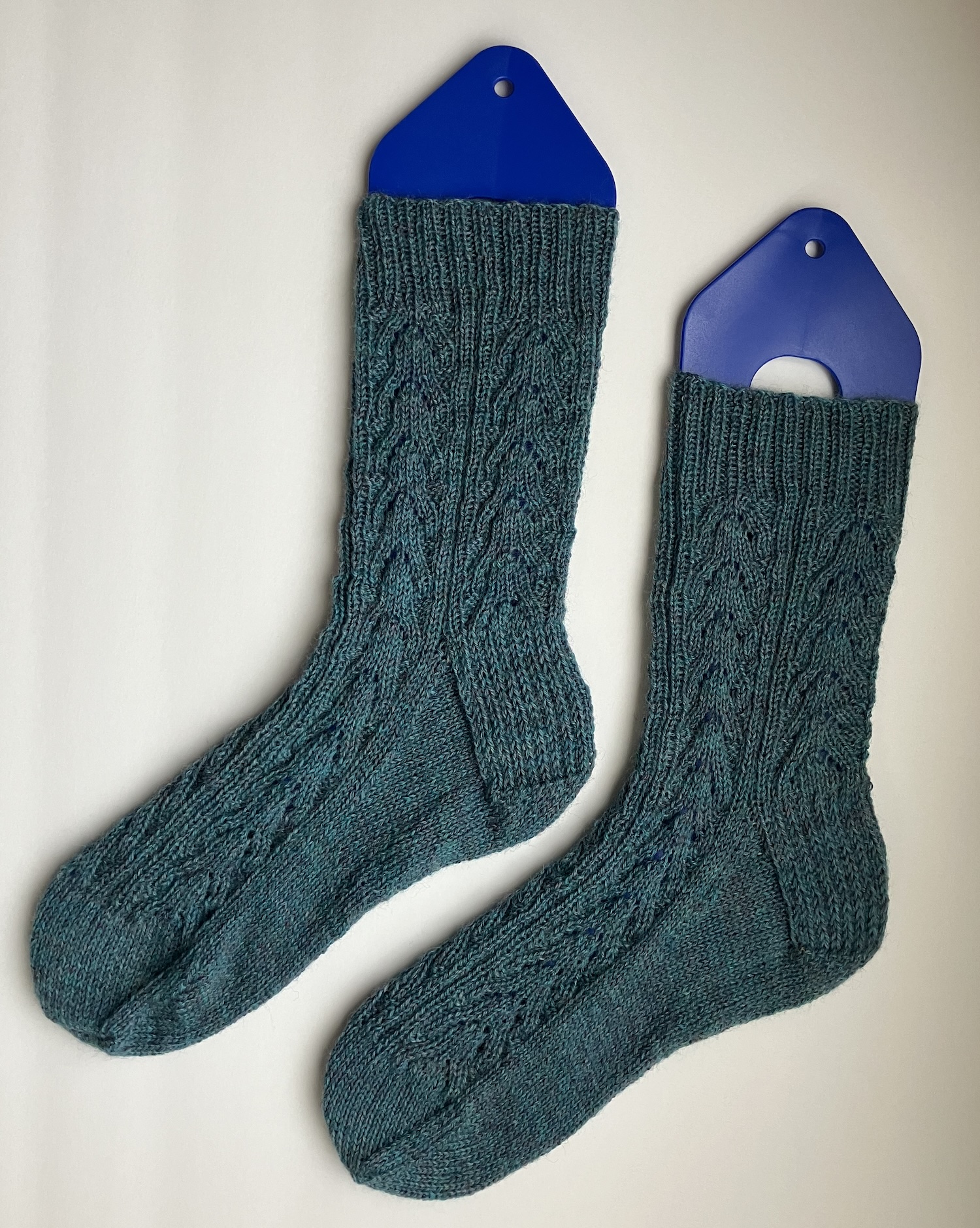
The mister’s new socks were done in time for him to put his best foot forward for the new year!

The pattern is an old one, from a Beehive book called Socks by Beehive #113. They must have printed a lot of copies of this booklet as they’re pretty easy to find in thrift stores and antique markets. This pattern is Knotty Pines. (Those are both Ravelry links.)

I really like this pattern and have made it several times, long before Ravelry existed (so those socks aren’t listed on my project pages there.) The yarn is vintage Patons Kroy in a heathery blue.

Patons Knotty Pines socks, knit in Patons Kroy by Deborah Cooke

The legs are shorter than stipulated in the pattern because I was going to make these for myself. They ended up being too wide in the foot for me (I should have seen that coming, with 76 stitches around) so they became socks for the mister instead. He really likes them.

Now that I have my needles back, I could cast on a pair for myself. First, though, I’m going to finish those pretty socks.

I hope you all have a happy new year – with lots of cozy socks! – and wish you and yours all the best for 2026.

McCalls 6260

McCalls 6260

This is a vintage pattern for dolls which is out of print. I found a PDF version on Etsy. Like most such PDFs, the sizing of the pages was a bit off – I ended up printing mine at 104% in order to have the measuring tape scale come out the correct size.

Thank goodness it had the scale! If you ever download a pattern that doesn’t have a scale, you can print the pattern pages at different sizes until the seam allowance comes out to 1/4″ – if that’s what the pattern uses. Most of them do.

I like the vintage look of some of the pieces. The kimono reminds me of a bathrobe my grandmother made for my dolls when I was a kid – she (very cleverly) used a baby wale corduroy for that robe, then pre-made narrow bias tape which she applied with a decorative zig zag. (Yes, I still have it.)

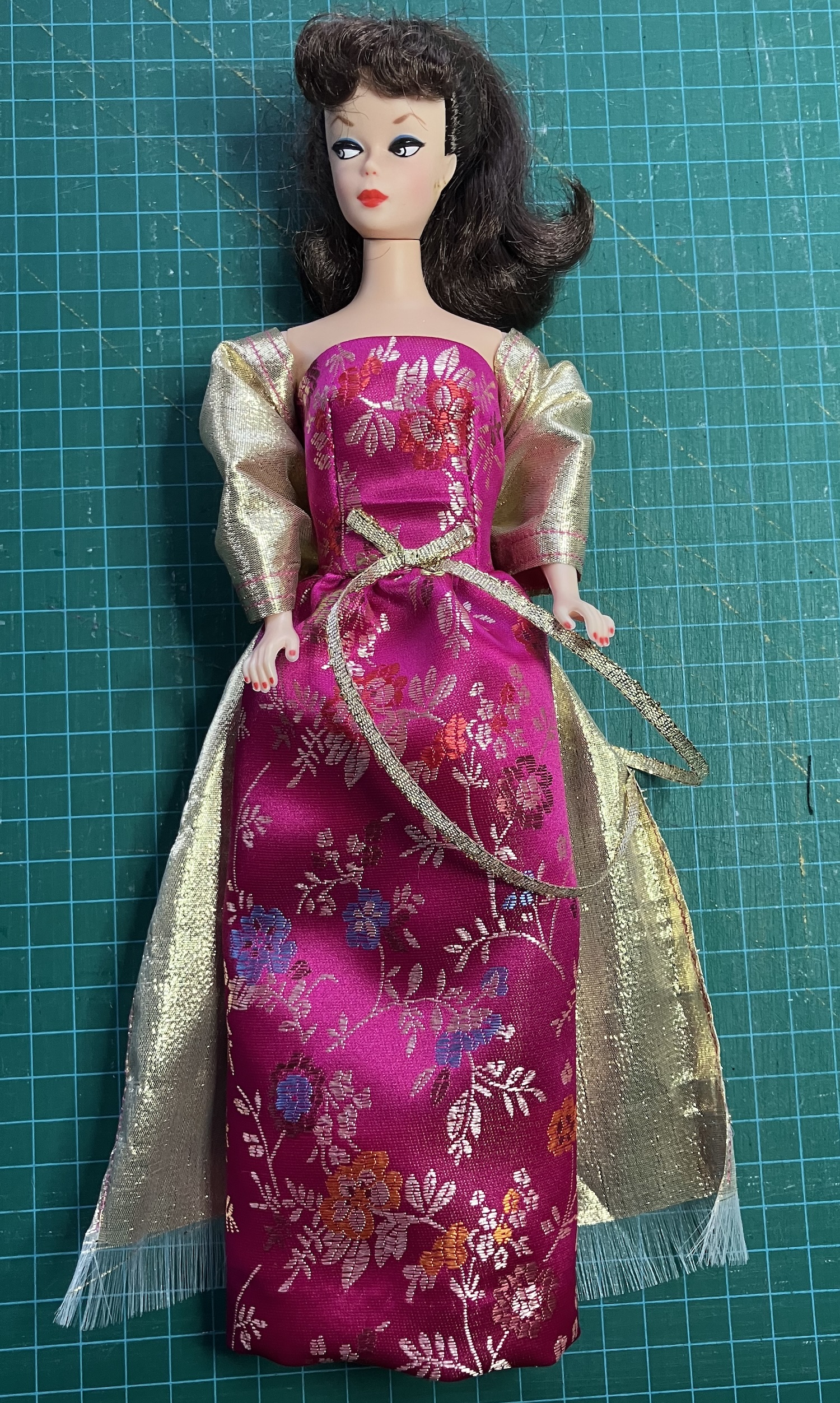
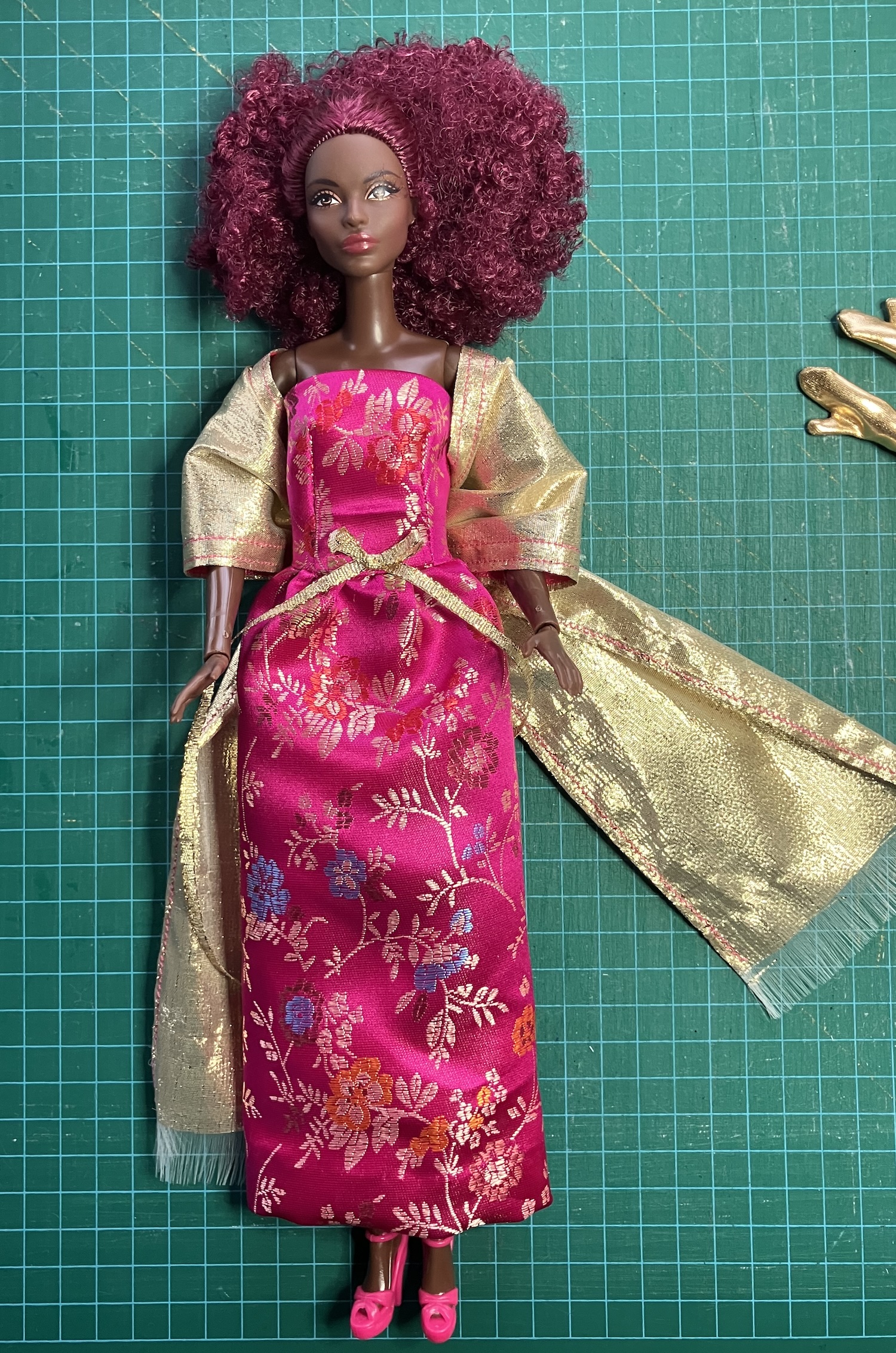
I made the ballgown first, which is view B. This one fits pretty well, though the bodice could be a little more snug. I used Chinese brocade, which is quite thick, and that could be a contributing issue. I lined the bodice, as instructed, but not the skirt, also as instructed. When I make it again, I’ll line the skirt too. That brocade sheds like mad, even though I finished the edges.

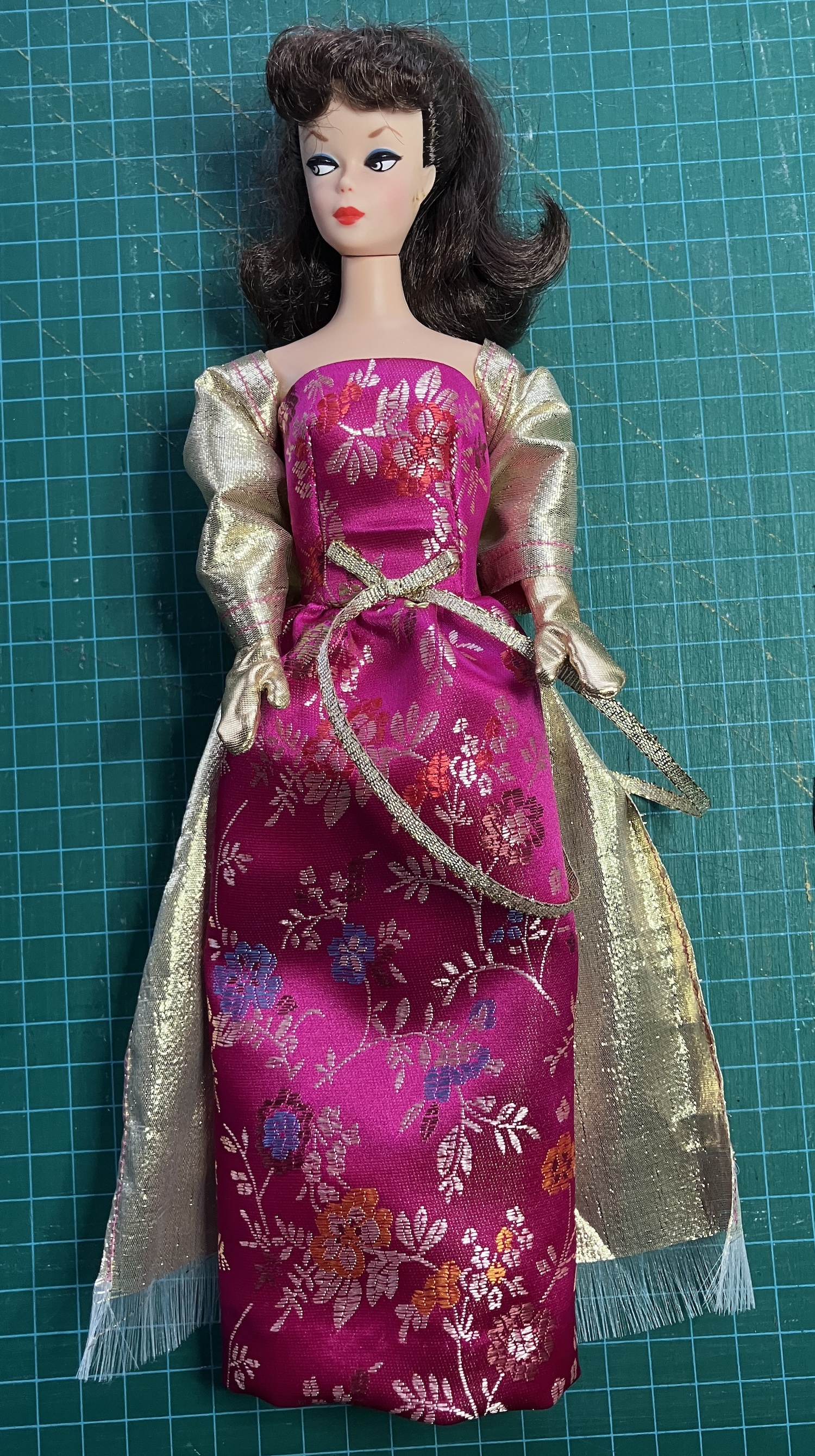
Of course, I made B a pair of gold opera gloves to go with the dress.

McCalls 6260 gown made by Deborah Cooke
McCalls 6260 gown with stole made by Deborah Cooke
McCalls 6260 gown with stole and gloves made by Deborah Cooke
McCalls 6260 gown with stole made by Deborah Cooke

The stole is interesting. I thought it was like the big bow on the back of that other ballgown, but it isn’t. For this one, the doll’s arms go through the loops of the bow – ha! I looked back at the historic images I found for that bow dress and sure enough, the Balenciaga from 1950 has a stole with similar design. I had found this pic before but hadn’t noticed her arms going through the loops of the stole. You can see that the top loop, for her arms, is lined with another fabric, while the other loops and train are plain tulle. B is always so very stylish, isn’t she?

Balenciaga evening gown, 1950

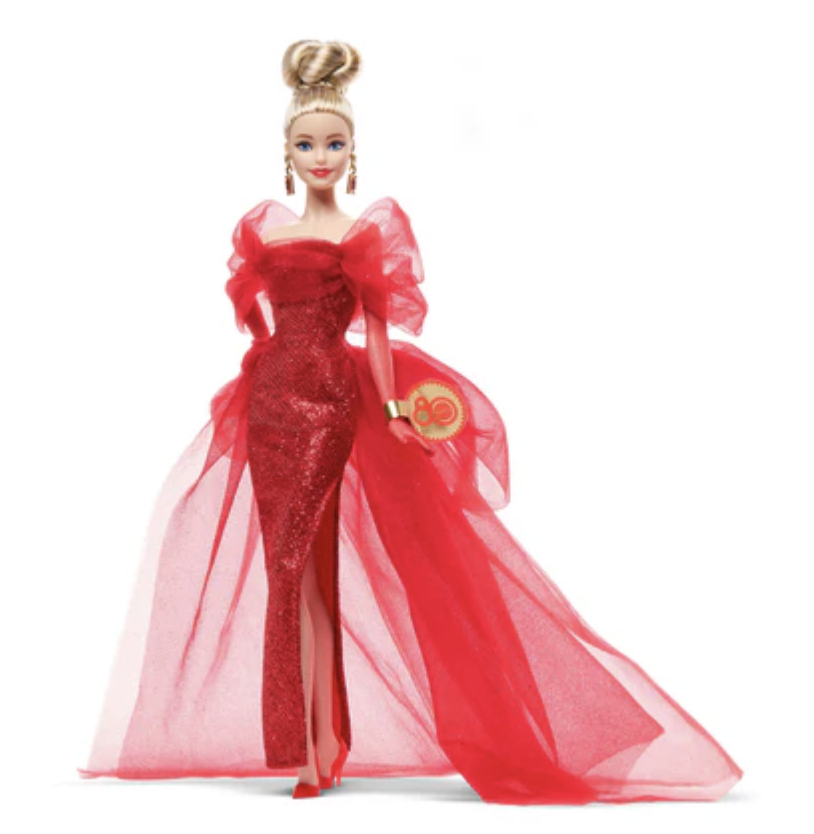
Interestingly enough, the 80th anniversary Barbie has a gown and stole that looks to be inspired by the same Balenciaga design.

80th anniversary Barbie

The skirt on this gown could be a teensy bit shorter for vintage B (which might be my fault) and I’m thinking I’ll add a back slit next time around. The colour made me think of this tall B.

McCalls 6260 gown with stole made by Deborah Cooke, modelled by a tall Barbie

It is a fabulous shade for her. She’s thinner than vintage B, so the bodice is a bit loose on her, but the fabric is perfect. (The dress could be maybe 1/4″ longer for her.) I’m thinking she needs a frock coat of this pink brocade, maybe with a pair of black silk cigarette pants and some great boots.

In this image, you can see the topstitching on the part of the stole that goes around the doll’s arms. It’s faced with ribbon and I decided to use a contrasting one. So, the ribbon is bright pink and so is the stitching. It gives the sheer fabric a bit more structure, too.

I also made the coat from this pattern. It’s a swing coat, which I cut from a cotton flannel that looks (in scale) like wool coating. I cut the collar of a thin (very soft) fur and the undercollar of rayon Bemberg lining.

McCalls 6260 coat made by Deborah Cooke

I lined the pockets (which is not suggested by the pattern) with the same rayon Bemberg as well as the coat itself. I like the result, but similar to other swing coat patterns I’ve made for B that are cut this way, there’s really a lot of fabric in the bodice for size of the doll. I’d like to modify this design to make a more flattering swing coat for her – and I have the perfect leopard print fur for that.

It’s hard to see on the pattern image but there’s a matching fur hat for this coat. It’s a band of fur, lined with ribbon, with a bit of elastic at the ends. This is a clever idea, but the one I made was far too small for B. The instructions specify that the fur strip should be cut to 3.25 inches long, which makes it 2.75″ once the edges are turned under. B’s head is over 5″ around, so my elastic wasn’t nearly stretchy enough. I tried another with a strip of fur that was 5.5″ by 1″ and that worked out reasonably well. I think it could be a little bit smaller. In future I’ll start with the circumference of the doll’s head then maybe take it down by half an inch. The elastic stretches but the fur doesn’t. I can’t show it to you because this whole ensemble has been shipped off to a friend. 🙂

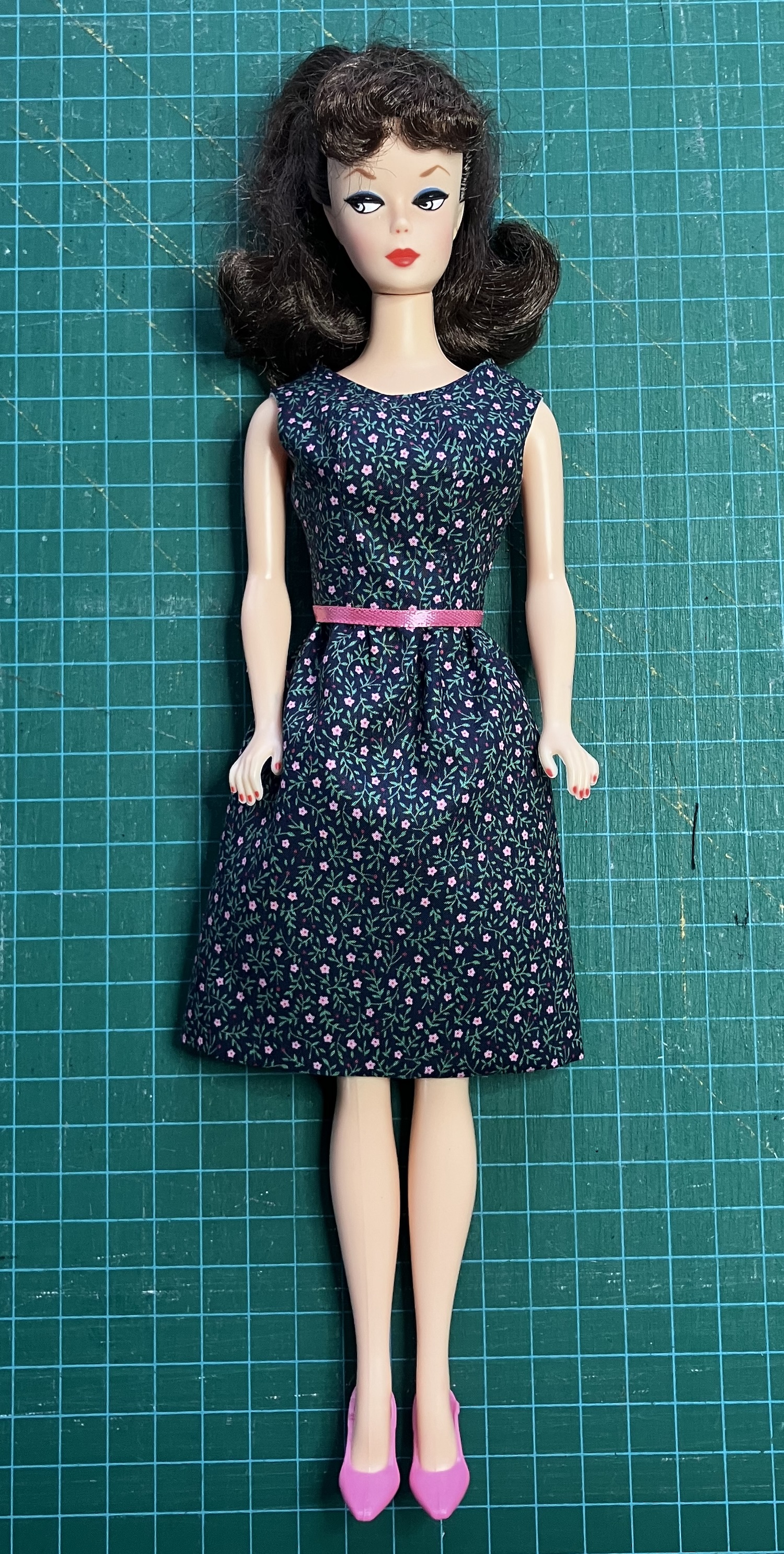
Finally, I made dress A in cotton. This pattern is a real gem. The bodice fits B really well.

McCalls 6260 dress made by Deborah Cooke

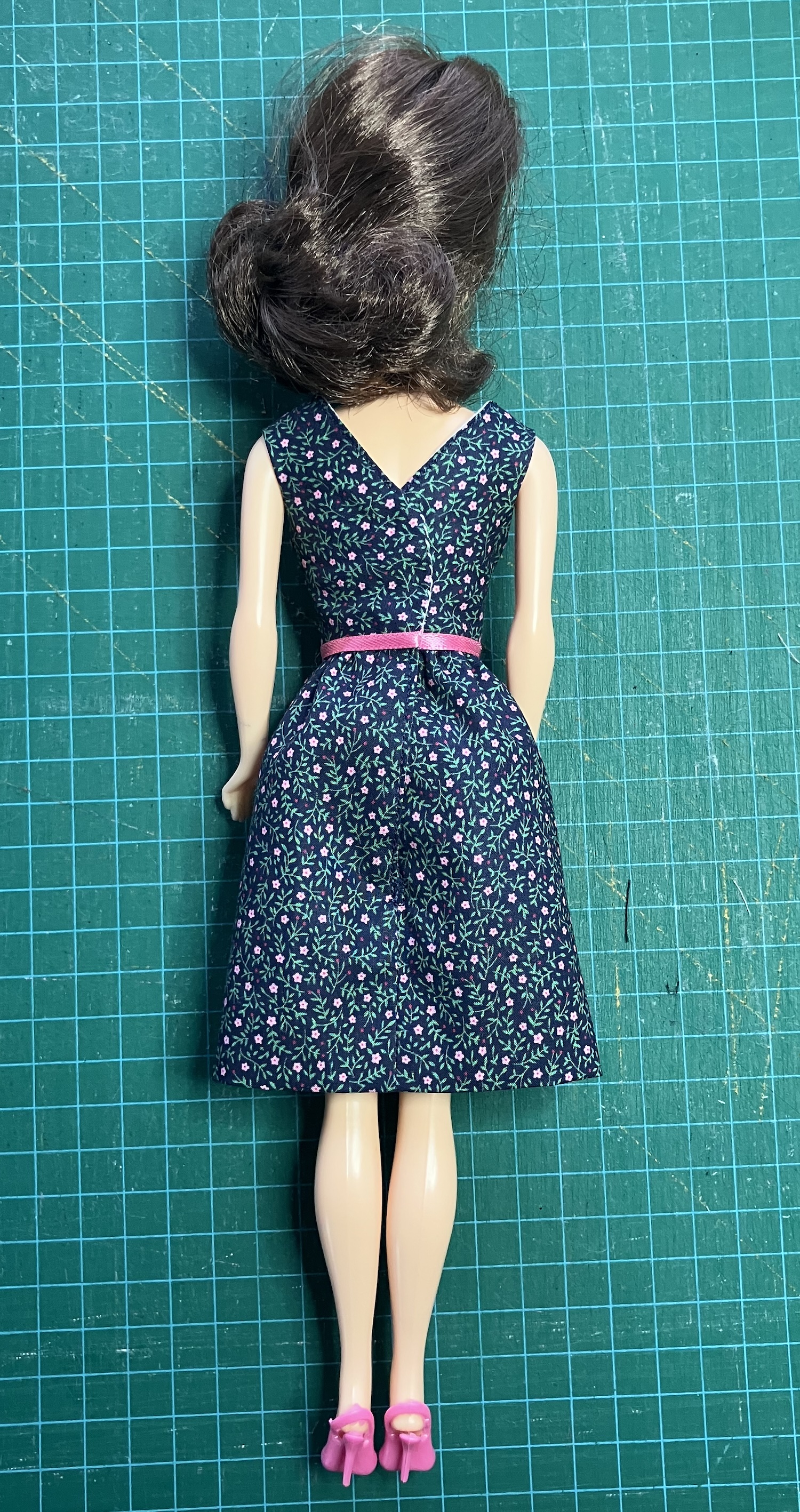
I lined the bodice – as instructed – but didn’t follow the assembly directions. The pattern says to join the bodice and lining, and turn, then to sew the darts with the two pieces of fabric held together. Since the seam allowance on the dart is trimmed afterward, this would leave raw edges on the inside of the garment. The side seams are also to be sewn with both fabrics held together, which would give more raw edges on the inside. Instead, I did the darts on each piece separately so the raw edges could be trapped between them.

McCalls 6260 dress made by Deborah Cooke

The skirt wasn’t supposed to be lined, but I lined it anyway. (Are you surprised?) I then followed my usual dress construction sequence. I sewed the hems of the skirt and skirt lining together, pressed the seam, and understitched the hem. I then sewed the center back from the lining below the opening around to the main fabric below the opening. I turned and pressed the skirt and top stitched the edges of that back slit. The skirt went into the bodice in the main fabric, then I enclosed all the seam allowances under the bodice lining, sewing the side seams in the bodice by hand. In the picture, you can see that I understitched the neckline as well. I added a ribbon belt, too.

This one had quite a deep hem in the original design, so I could modify the skirt and lining pieces to make the lining longer.

McCalls 7550

I really like this little dress, and of course, the skirt could be easily changed to be straighter, fuller, longer or some combination thereof. What’s unusual about it is how easily the bodice can be turned, once the lining is sewn to the neck edge and the sleeve edges. Because there isn’t a shoulder seam in either the bodice or the bodice lining, it’s easier to turn the garment. It reminds me of the sleeveless dress bodice McCalls 7550, one of the first patterns I used to sew for B, but turning that bodice was much more challenging – possibly because the neck was smaller. I’ll have to take a look and compare the two.

I had cut a piece of lace for the overskirt as shown in this dress pattern, but decided that it looked too much like an apron, and a permanent one at that. I left it off. I do have a dress that my grandmother made for my dolls which uses lace and taffeta together – they’re treated as one fabric, with the lace giving more interest to the taffeta, instead of the lace being a separate skirt. I may try that with this pattern.

I had originally planned to make view E as well, the jacket and trousers, but the pants are actually cut of a knit. You need the stretch to pull them over her hips. I didn’t have a knit thin enough to be in scale for the girls, but I’ll keep looking.

See how it is? I finish trying out one pattern and end up with a whole list of potential modifications and projects!
Vintage Knitting Patterns for Dolls from Mary Maxim

Last week, I discovered these older knitting patterns for 11.5″ fashion dolls available as PDFs from Mary Maxim. They were also on sale at the time, so I snapped them up. They include quite a number of garments each.

Mary Maxim's Fashion Doll Wardrobe

The first one is called Fashion Doll Wardrobe – you can find it on the Mary Maxim site right here.

It includes a (blue/white) houndstooth coat with pants, top and hat; a (green) poncho and dress; and a (peache/blue) capri set with top and short pants.

Apparently, the top and capris both have a beaded fringe at the hem, although it’s tough to see in the picture. The whole thing looks like an old photocopy. 🙂

Mary Maxim's Fashion Doll Wardrobe

The second one is also called Fashion Doll Wardrobe – the pattern samples are all knit in red and white.

It includes a “skating outfit” with sweater, skirt and headband; an “aran outfit” with sweater and skirt; a “casual outfit” with sweater and pants (I think that’s the top middle one); an “office outfit” of dress and short jacket; and an “evening outfit” of a long skirt and sleeveless top.

Again, the PDF pattern looks like a photocopy, but there’s a chart for the top sweater. It has a contrast star on the back.

Mary Maxim Teen Doll Pattern

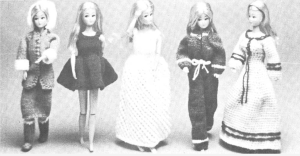
The third pattern has a black and white product image, which is very fuzzy. This one is called Teen Doll Pattern.

From left, the pattern includes a coat and boots, worn with a straight skirt; a skating dress with panties; a long dress with an eyelet pattern on the skirt; a jacket, pants and tank top; and finally, a crocheted long dress.

Mary Maxim Teenage Doll pattern book

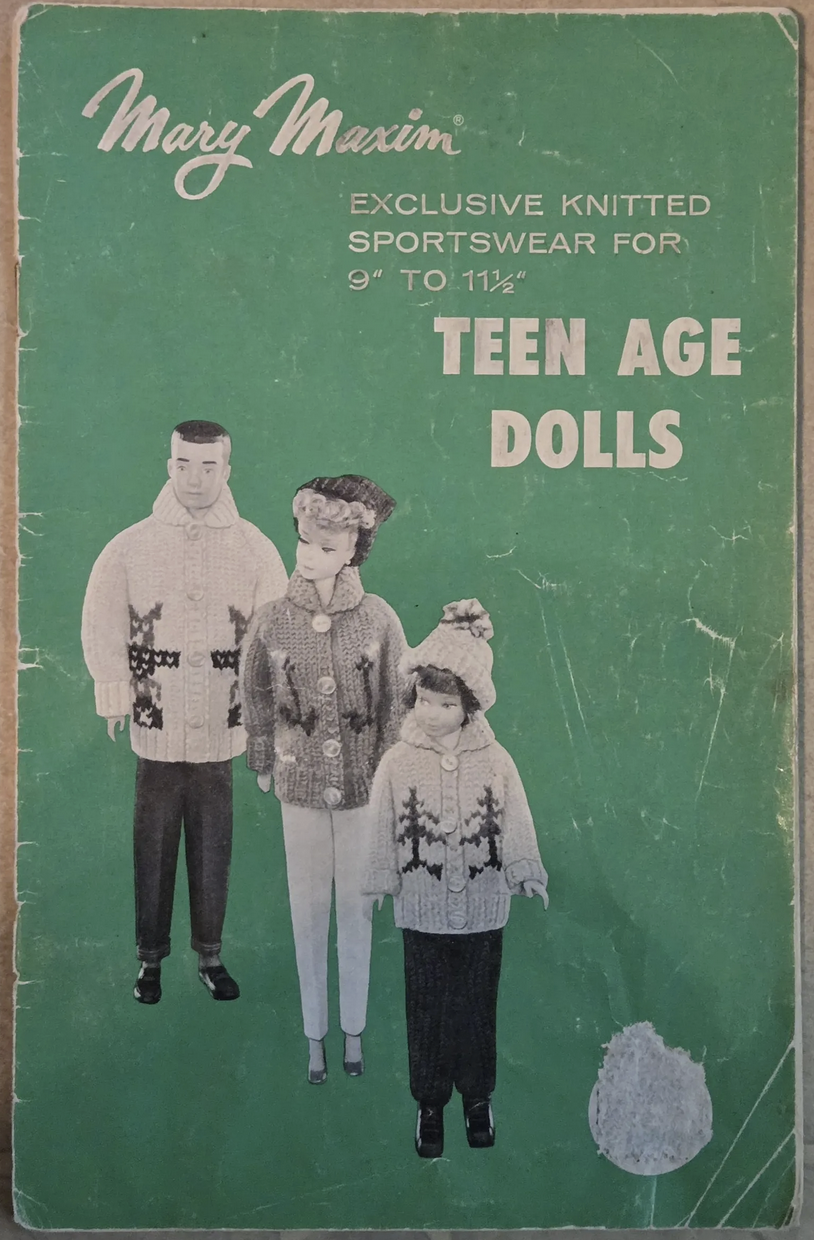
Finally, there’s a very vintage pattern, Teen Age Doll Pattern Book. The description says it includes 8 outfits. Ravelry lists the original publication date of this book as 1950 but that can’t be right. The doll on the right is Midge, who was introduced in 1963.

There is the 3-piece suit for B shown on the cover, and the 3-piece outfit for K shown on the cover. There are two dresses for B: one “off-shoulder” and one v-neck. Both have a hat and purse. There’s a v-neck sweater and hat for both B and K – these look like polo shirts to me. There’s a Bermuda shorts set for both B and K, including shorts, sweater, knee socks and hat. There’s a sweater, skirt and hat for B with Rudolph on the sweater front. (That’s what it says. I don’t see it, but maybe it will be more clear in real life.) There’s a coat, hat and purse for B with fur trim which is very pretty. Then there are “ski outfits” for both B and K, with sweater, pants, mittens, socks and hat – knit in a variegated yarn, they look a bit like pjs. 🙂 I count more than 8 outfits in total, so there’s a lot of knitting in this little book.

All of the knits call for either fingering weight yarn on 2.75mm needles, or DK/sport yarn on 3mm needles. Sounds big to me, but I’ll check it out.

Mary Maxim Teenage Doll pattern book

Ravelry shows a book (Mary Maxim, Teen Age Dolls, Vol 2: Mary Maxim Exclusive Knitted Sportswear for 9″ to 11½” Teen Age Dolls, Vol 2) which has classic Mary Maxim sweaters for Barbie, Ken and Skipper. Those would be fun to knit.

I found a print copy of this one on Etsy and have ordered it. I figured I’d print it out since the sweaters are charted, so a print copy made sense. I’ll tell you more about that one once I dig in.

Socks in Old Patons Kroy

I have been sorting my stash lately, sending some of it on to find new fans. During that process, I rediscovered some old Patons Kroy. It feels so nice and I love the colour so much that I cast on a pair of socks. I also fell down a rabbit hole…

Kroy sock yarn over time

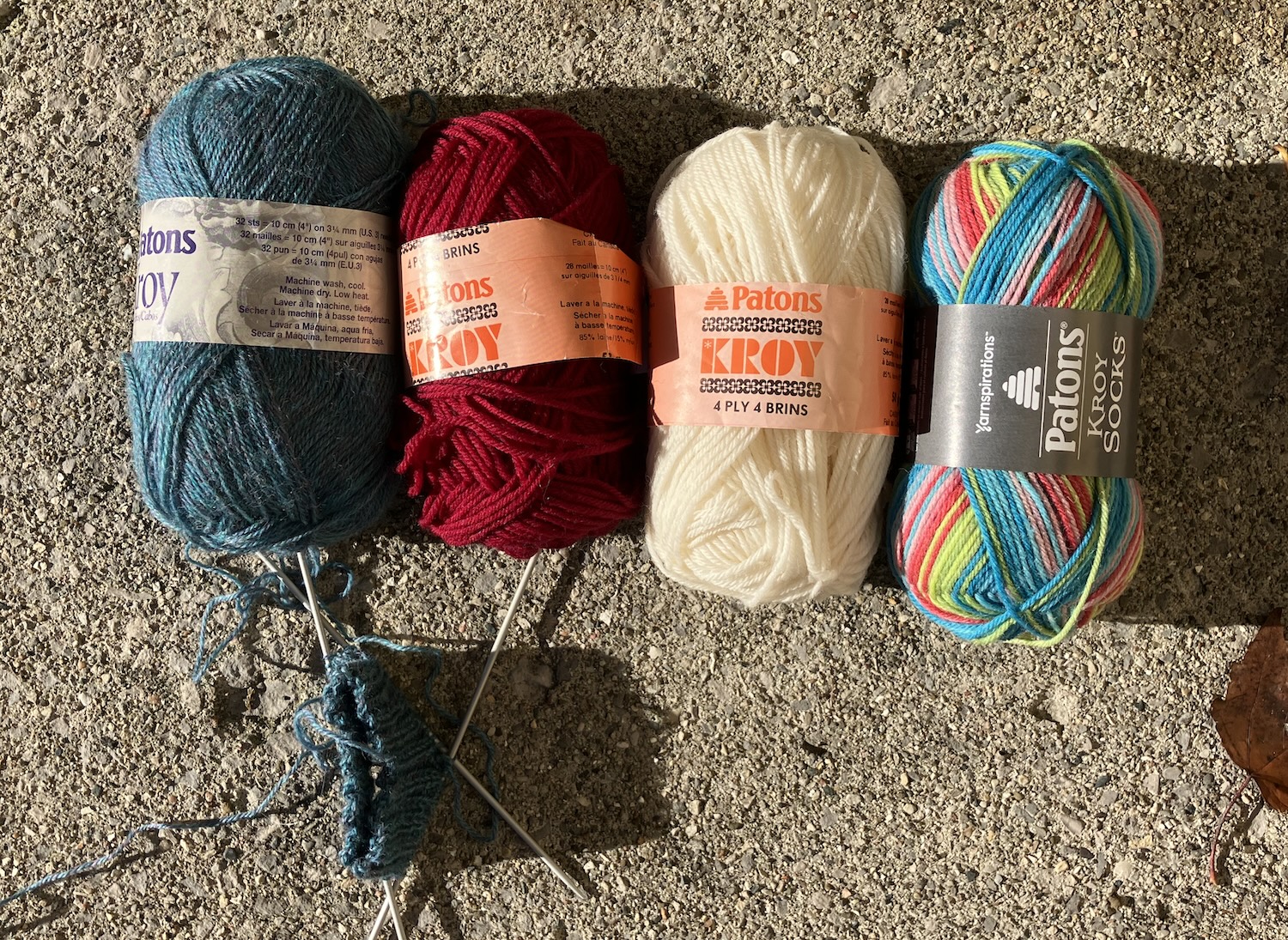
Patons Kroy is a sock yarn. It’s been available for a long time, so it makes sense that there have been some changes over the years. This Patons Kroy is a 3-ply yarn – it’s the heathered blue one on the left – while the current Patons Kroy Socks (the variegated one on the right) is a 4-ply. The 50g put-up on the old Kroy has 250 m, while the new one has 151m. There was another older 4-ply that had 186m per 50g ball, and it’s a really soft squishy yarn. (It’s in the middle.) I have a bit of that, too. With the old 3-ply, you can get a man’s sock out of one ball; with the new 4-ply, you might run short on even a smaller sock.

I bought this 3-ply Kroy yarn about 30 years ago, in two colours – this seagreen mix and a purple. There was a yarn store on Bloor St. W. in Toronto, close to Spadina Ave. on the north side. I don’t remember the name of it – it’s possible that it was a short-term rental in an empty retail space and had no sign – but it was an outlet store like Spinrite. They sold mill ends by the ounce. It might have been another Spinrite outlet.

At that time, there was a Patons mill in Toronto still. It was on Roselawn Ave. I remember it closing and being developed as condos – it is, in fact, Forest Hill Lofts, which were developed in 2003. (Yes, I had some fun checking out the condos for sale.) Patons had a mill store a little west of there for a bit, on Dufferin near Castlefield, but then closed that as well. There was only the Spinrite factory in Listowel after that, which closed earlier this year.

Socks Socks Socks

I bought the Kroy in two colours to make a pair of entrelac socks, from Socks Socks Socks. (That’s a Ravelry link.) They ultimately frustrated me so much that I frogged them back. (The issue was entirely user error: the pattern called for sport weight yarn, and 3-ply Kroy is a light fingering. I was going to change the stitch counts to make it work, but with entrelac, that was complicated.) The yarn has been loitering in the stash ever since – although I’m not sure where the purple has hidden itself away.

It’s surprising to see that this yarn was made in Canada. The current Kroy is made in Turkey, and has been balled and banded in Canada. I’m not sure what happens now since the Listowel mill is closed. Will the yarn be discontinued? Or will they ball and band in the US? Hard to know and harder to care at this point. Patons is a Canadian company no more so I’ll be knitting from my stash.

Socks by Beehive

The pattern is an old one, from a Beehive book called Socks by Beehive #113. They must have printed a lot of copies of this booklet as they’re pretty easy to find in thrift stores and antique markets. This pattern is Knotty Pines. (Those are both Ravelry links.) I really like this pattern and have made it several times, long before Ravelry (so those socks aren’t listed on my project pages there.)

Looking at the pattern on Rav, I see the recommended yarn is Kroy 3-ply by Lady Galt, which was made by Newlands in Cambridge Ontario. Here’s a blog post I found with a bit about Newlands – and LOL I have that knitting book, too. I remember my grandmother buying Lady Galt yarn at Eatons, a long-closed department store, which is another peek at the past. (I wonder if that Newlands building in Cambridge is condos now, too. Hmm. There are a bunch of them there.)

In the meantime, here’s the first Knotty Pines sock knit in the 3-ply Kroy:

sock knit by Deborah Cooke in Kroy 3-ply sock yarn, in Beehive Socks Knotty Pines pattern

I was planning to knit these for myself, so made the leg shorter than the pattern. The foot, though, ended up being too wide for me (at 76 stitches) so the sock ended up being for the mister. He doesn’t mind that it’s a bit shorter. I’ve started the cuff on the second one – it takes a bit of concentration, since it’s not as regular a ribbing as usual. The bonus is that the ribbing lines up with the pattern once you start it, so it’s worth paying attention for a few rows.