 For a while now, I’ve been working on a pullover from Vogue Knitting’s winter 2015/2016 issue, a Bohus-inspired pullover. (If you’re on Ravelry, here’s the magazine issue and here’s the sweater.) It was on the cover, and was pretty much the reason I bought the magazine. What intrigued me about the sweater was the fit. It didn’t look like an Icelandic sweater with a round yoke, but like it had more of a straight yoke. Icelandic sweaters fit men really well IMO but often look puffy on women. This one looked sleek. It also used Bohus design elements. I have a Bohus kit (Vildapplet cardigan, right here) but am a bit daunted by it. Bohus style sweaters use multiple colours of yarn in a row (three or even four) and also purl stitches on the right side. They also are worked on tiny needles in colours that gradually shade into others, so I thought this VK sweater in a larger gauge would be good practice.
I didn’t have the yarn specified, so I dipped into my stash to look for options in that weight. I found my Rowan members’ yarn pack, which was three balls of Felted Tweed, one in Avocado, one in Bilberry and one in Watery. Hmm. The Avocado would work for the Leafy Palm: the Watery for Caspian, and I used the Bilberry for both the Oxblood and the Mecca. (I thought about adding a fourth colour, but couldn’t find one that I liked with the others.) What about the white and grey? I’ve knit Felted Tweed with Colourspun several times, which works out to be a nice squishy combination, plus Colourspun has been discontinued. (Boo.) This was a chance to make another sweater in that yarn before it’s gone forever. I bought Colourspun in Semer Water for the charcoal grey, and in Winterburn for the white. These two shades of grey are much closer together than the white and grey used in the pattern, but Bohus is known for its blending of colours so I figured I had that covered.
This is a top-down sweater, so the cast-on is at the neck. One good thing about top-down sweaters knitted in the round is that it’s easy to try them on as you go—just put the stitches on a thread and tug the sweater on.
There has been goofiness with this one, which is why you haven’t seen it yet even though I’ve been knitting since April. I’ve knit the yoke three times. The first time, I missed the purl stitches on the schematic and had just knit them, so I frogged back. The second time, I made the L size, because I wanted a nice sloppy sweater, but the yoke ended up being enormous. I tried it on, then had Mr. Math pinch back the yoke from behind me until it looked right in the mirror. Then I counted the repeats to take out. It turned out I needed to knit the smallest size in the yoke, so I knit it again. My gauge is slightly off—instead of getting 21 stitches in 4 inches, I’m getting 20. I like the fabric and don’t want it to be stiffer by using smaller needles. The thing is that over 200+ stitches, that little difference adds up.
I like the colours a lot, but it is a round yoke.
I’d expected it to be more like a Bohus sweater yoke, which isn’t a complete circle when flat. Here’s a Bohus yoke photographed flat in the Swedish Bohus Museum, so you can see what I mean. I’ve seen other Bohus yokes that are closer to 3/4 of a circle, but they’re seldom fully round—When people photograph the pullover yokes, the knitting pulls up into a cone closer to the neck, rather than lying flat. That’s why Bohus sweaters tend to fit women well through the shoulders. We’ll talk more about Bohus sweaters when I get mine a little further along and post about it. I’d like to finish that yoke before showing it to you. (Right now, it’s about 1″ deep!)
So, this pullover going to fit a lot like a round yoke Icelandic sweater, when all is said and done. It looks like an Icelandic sweater in most of the finished projects on Ravelry, too. I’m resigned to the good chance of it being puffy, but because I do like the colours and the yarn, I’m carrying on.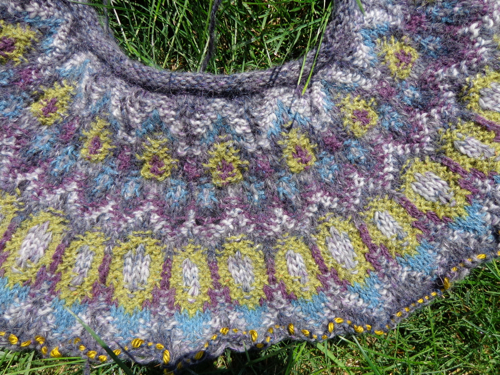 The purl stitches look quite neat, and they blur the transitions between the colours in true Bohus style. I also like the slight variegation in the Colourspun. There are little bits of colour in the dark grey as well that don’t show up in the photo—a bit of blue, a bit of purple—and they pull it all together very well. Now that I’m into the plain knitting, it’s going much more quickly. I’ve divided for the arms and am working down the body, and will show you more soon.
I’m already thinking about the hems and the neck—the pattern has ribbing on the hems, but I might just let them roll. It also has the ribbed neck knitted separately and sewn on, which is unusual. I had thought about casting on with the ribbing at the neck (at the very top!), but I’m not sure I want it as tall as in the pattern. It’s good to be able to try it on to decide, but I’m concerned about the join showing. I’ll probably pick up the stitches, knit up and hope for the best.
I have no idea how I ended up knitting this warm fuzzy beast in the hottest summer I can remember, but there you go.
 First, here’s the issue of VK (fall 2016) and the hat in question. The hat is in the Modern Fair Isle article, which has some lovely patterns. (If you scroll down and click on the image of the hat, some alternate views will be displayed in a pop-up window.) The hat is knit of Rowan Felted Tweed and was designed by Mary Jane Mucklestone, inspired by some traditional Shetland hats in the museum there. I immediately liked the colors of the hat, so bought the magazine based on the cover.
 What do you think?


 Alive & Knitting