I have a tendency to buy yarn because I like it, without a specific project in mind. (This inclination is worse if the yarn is on sale.) That means I guess on quantities and sometimes, I guess too low. That’s what happened with these skeins of Manos del Uruguay Wool Clasica—that’s a Ravelry link btw. Here’s a Fairmont Fibres link, which I think is the US distributor. I loved the colour (it’s #114 Bramble – this link shows the colourway on the FF site) and bought four, but four skeins of aran weight yarn isn’t very much. It’s just 604m and I wanted to make a garment from this.
I first made a vest from this yarn and had to even use the bits from the tags to finish casting off. Even so, the vest was too snug for me so (after some mourning), I frogged it and returned the yarn to the stash. And there it’s been for about a decade.
I rediscovered it recently and remembered how much I liked it. I searched on Ravelry for patterns specifying this very yarn and found Colonnade, a free pattern on Knitty by Stephen West. It might have been one of his earliest patterns—it was posted in 2009. Here’s the Ravelry link, and here’s the Knitty link. The pattern calls for three skeins of this yarn, and uses two different colours. I had four and wanted to use them all up. Hmm. Here’s a picture of the shawl laid flat from the Knitty website:
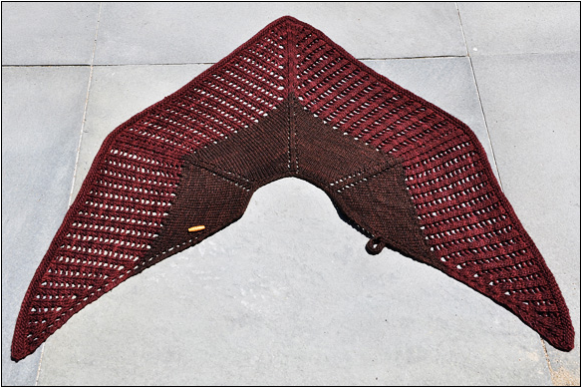
You can see that the shawl is in four quadrants. If you look a little closer, you’ll see that each quadrant has increases on just one side: the increases are at the front edges and on either side of the centre back. I looked through the project images on Ravelry and it seemed that many knitters found the neck a bit snug—they’d added stitches, but I decided to add an entire section. My fifth section is inset into that centre back seam to keep the shawl symmetrical—and to keep it symmetrical, this new section has increases on both sides. The idea was to make the shawl wider but not much deeper, and use up the four skeins.
The pattern has a four-row repeat for the lacy part: I considered those instructions to be for sections one, two, four and five, then did my addition in the middle. If you’re inclined to do this yourself, here’s the pattern stitch for that new section in the middle:
Row 1: K1, YO, K4 [YO2, K2tog, K2tog] to 5 stitches. YO2, K4, YO, K1
Row 3: K1, YO, K2 [YO2, K2tog, K2tog] to 3 stitches. YO2, K2, YO, K1
I cast on 52 (instead of 42) stitches and worked as instructed. I had 212 stitches when it was time to start the lace and 38 stitches between markers.
I did nine repeats of the lace pattern, then cast off. With a gentle block, here’s the result:

And a closer view:

I’m really pleased that it didn’t pool, but that’s probably because the number of stitches increases every second row. There’s just 23g of the Wool Clasica left over, so that’s one more gone from my stash.
Here’s my Ravelry project page.
 Alive & Knitting