Which Way Shawl Completed!

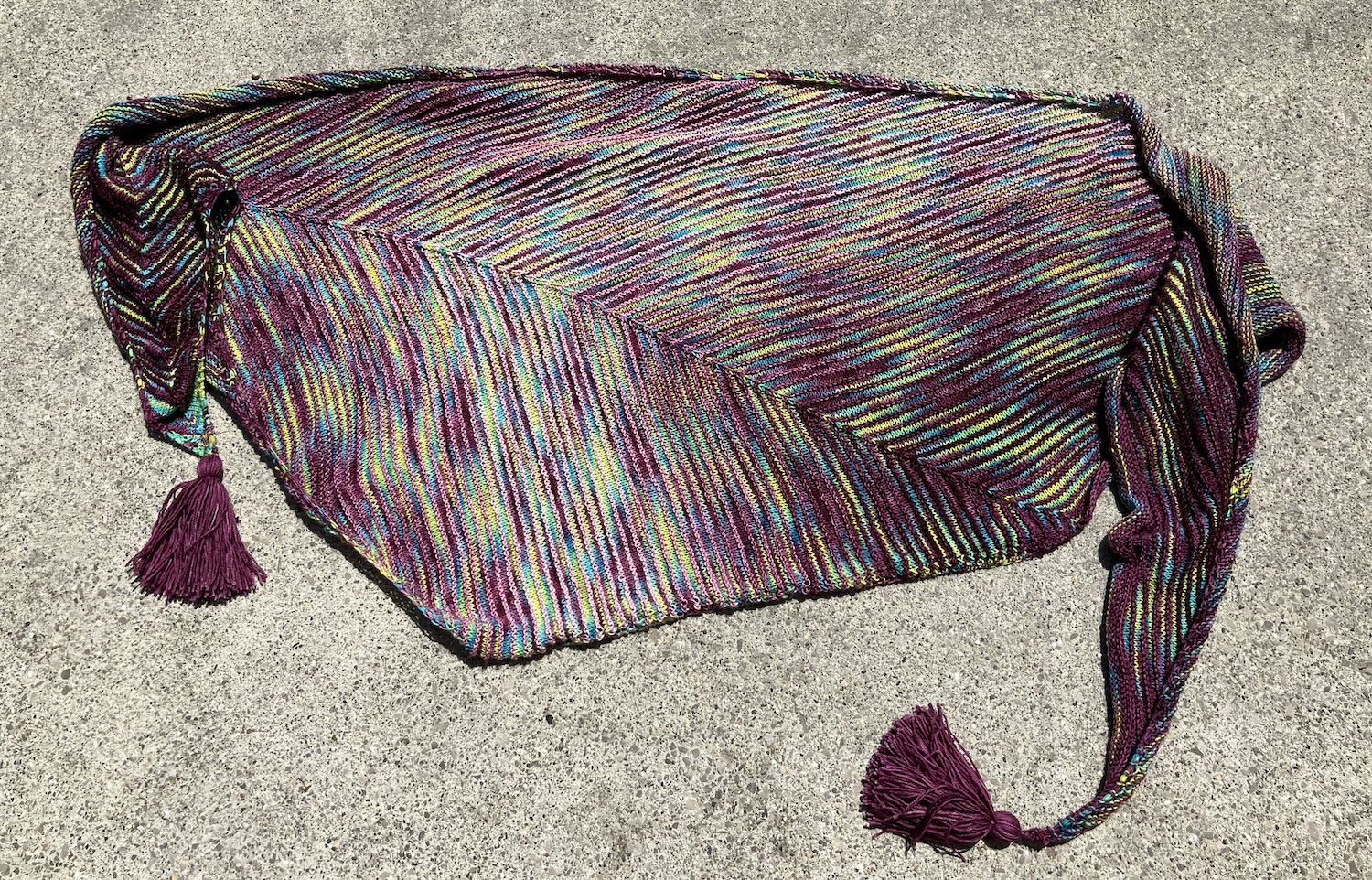
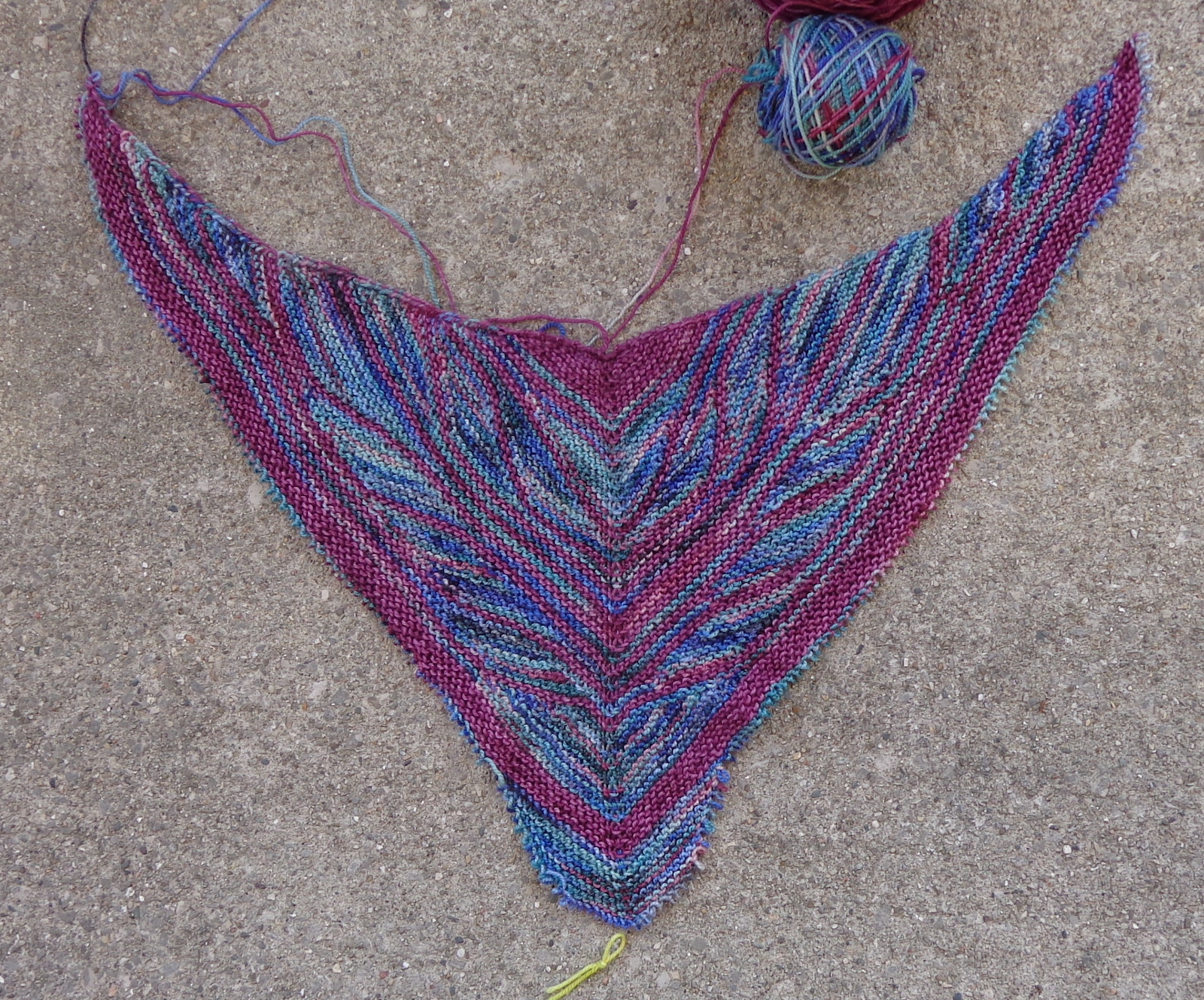
Another project off the needles. The Which Way Shawl is done and here it is:

Which Way shawl knit by Deborah Cooke

Here’s the pattern on Ravelry again.

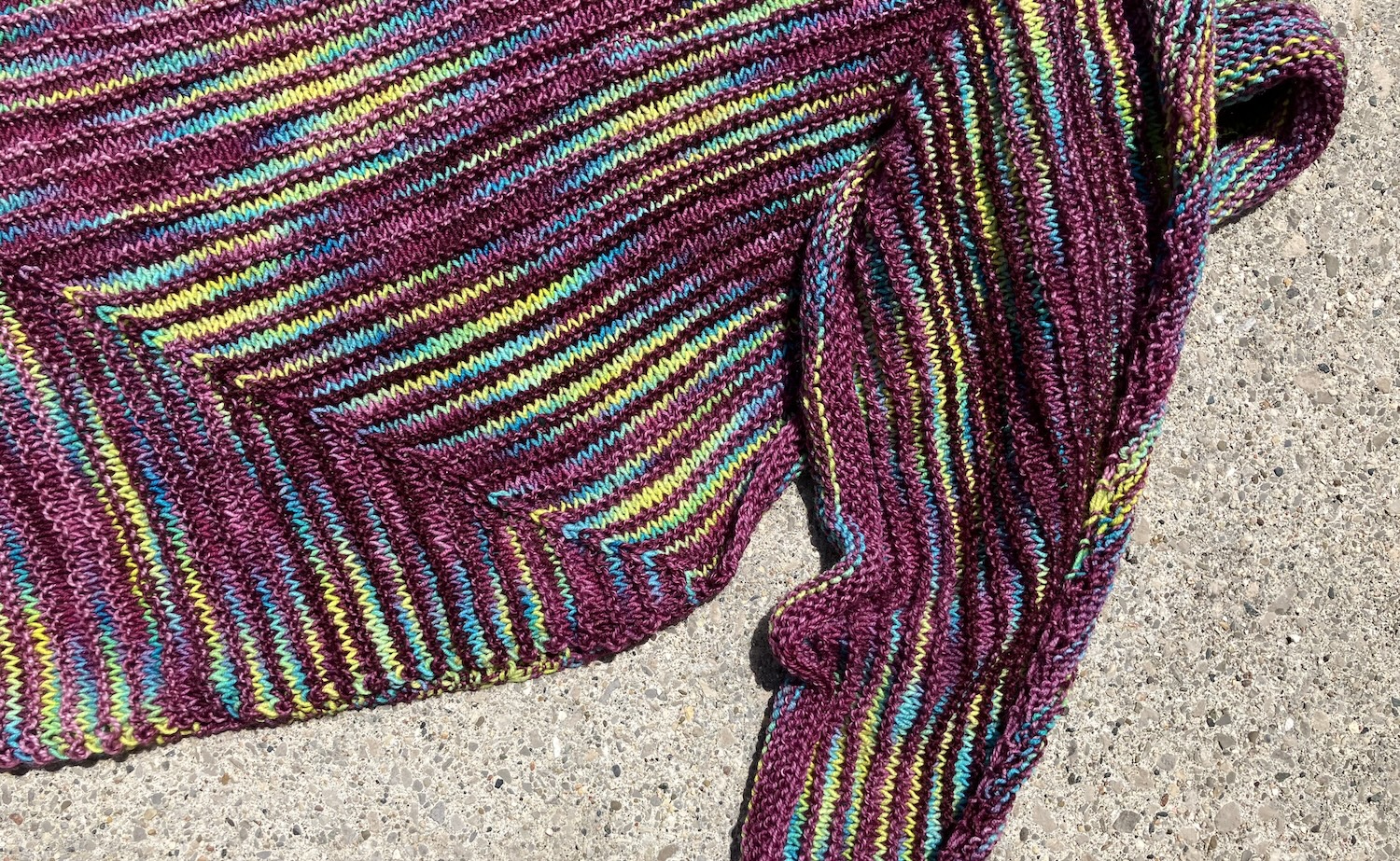
Do I love this shawl? Mmmmm, I dunno. The design is interesting – I’d probably go down a needle size if I ever made it again, though it is nice and squishy. That contrast colour is a different choice for me – while it’s a good idea to try new things, I think I would have loved the result more if I’d gone with my original impulse of using a navy or black for the main colour. Maybe it will be just the right bright thing on a winter’s day. I do like the colours better at the ends than in the middle.

Which Way shawl knit by Deborah Cooke

The shape of the shawl is unusual, but it makes a manageable cowl when wrapped around the neck. I expect I’ll wear it that way when I do wear it. I added tassels to the points that I’ll probably tie together.

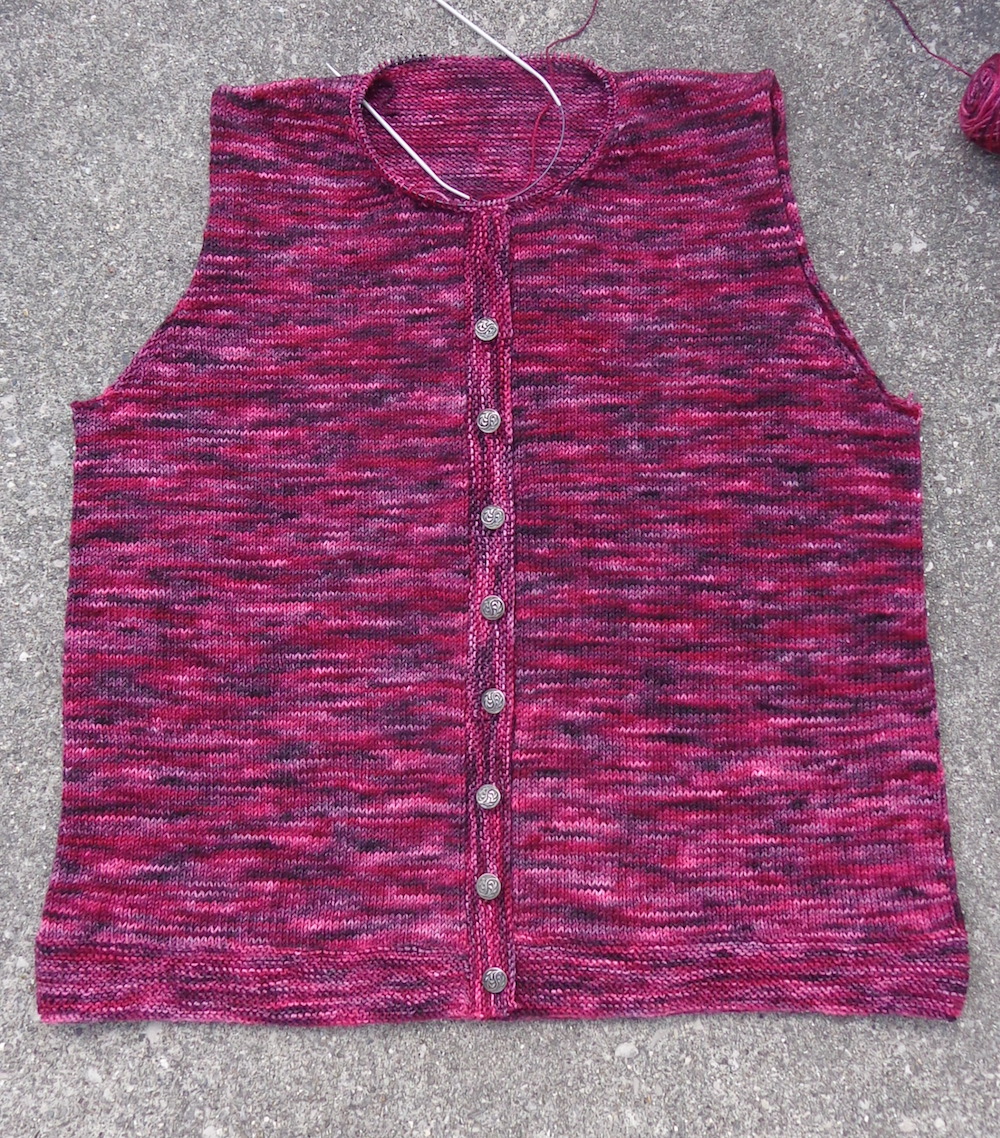
Now to choose another project. It would be best to finish up something already started. There’s a little summer cardigan that would be a good choice to finish right now, and I love the colour of it. It’s a Martin Storey pattern called Peridot, which I’ve been knitting in Patons Silk Bamboo for half of forever. (Lots and lots of stockinette stitch.) That’s a Ravelry link, btw. Also my chunky No. 9 pullover in Blackstone Tweed still needs sleeves – funny that it’s almost the same shade of blue as the little cardigan. More blue on the needles with my Water shawl that needs finishing. That’s a blog post link. And of course, there’s my Wild Grass pullover which is at the point of needing acres of stockinette knit.

While considering all of these options, I cast on the purple version of the Quintessential cardigan. I’d bought two kits, one in green and one in purple, so will knit the second one with a few changes. It also requires miles of stockinette, but it’s purple and I need a purple cardigan. 🙂

More on the Which Way Shawl

I have been making progress on the Which Way shawl. I first told you about it in this post than updated you in this post. This is a whole lot of knitting.

Today’s milestone is that I’ve run out of yarn. :-/ Both bundles of gradient-dyed yarn are used up and the shawl isn’t done. This is likely because I’ve somehow mucked up the decreases. I want the lower edge to be decreased to nothing before binding off, as I think it might look odd otherwise. This requires a lot more repeats than specified in the pattern.

I have a persistent feeling that I’ve made a mistake, so took the shawl off the needles to have a look.

Here we are. It’s a dingy day and raining too hard to take the shawl outside for a pic. Also, it’s huge, and I couldn’t get it all in the shot.

Which Way shawl knit by Deborah Cooke

It’s that bottom wedge that I’m diminishing until it vanishes. At this point, there are 18 stitches there so I’ll need another 9 contrast stripes to finish that out. The pooling is from the main colour, which is hand-dyed, but it seems to have worked out pretty evenly. I don’t mind it. And I don’t mind the size of the shawl. I’m just wondering where I went wrong…

You can just barely see the orange marker in the middle when the decreases were started. The shawl from this point should (I think) be rectangular, and it looks like it will block out that way. I pulled that right tip out longer when I was laying out the shawl.

The pattern specifies 22 contrast stripe repeats after the decreases begin (where the orange marker is). I’m currently at 43. Following the directions, the decreases would have stopped around the point that the contrast yarn (the gradient) started to get darker. (Eyeball a halfway point between the orange marker and the live stitches at the right.) I think the shawl would have been too small then, and an odd shape. There are some finished project pictures on Ravelry that are shaped the way my shawl is now, which does nothing to explain the 21 contrast stripe difference.

Here’s the pattern on Ravelry again. It calls for 4 oz of the main colour, a sport weight yarn, (that’s 113g) and 5 oz of the gradient skeins (let’s call it 150g), knit on US 6 needles (4.0mm). My yarn is fingering weight so I used 3.75mm needles. (I could actually have gone down another size as it’s a loose garter stitch, but it is nice and drapey this way.) I had 144g of the gradients, and 2 skeins of the main colour for 220g total (732m). I’m into the second skein of the main colour and I guess it was predictable that I’d run out of the contrast.

Fortunately, I have another skein of sock yarn in a mulberry shade that is pretty close to the gradient colourways – probably more like the fifth shade than the sixth (maybe even the fourth. You can see it on the right.) I’ll go with it anyway. The fiber content is the same.

I’ll keep knitting and will show you better pix once it’s completed. I still have no clue what I did wrong, but the end result looks okay, so it will be what it will be.

Update on the Which Way Shawl

Things have been quiet here at the blog, because real life hasn’t been very quiet of late. Add spring cleaning and my annual bout of reorganization and it’s been busy around here.

I have, however, been making progress on the Which Way shawl. I first told you about it in this post. Here’s what it looks like now:

Which Way shawl knit by Deborah Cooke

Still on the needles, so it’s not laid flat, but you can see the orange marker on the decrease stitch in the middle. That’s the point where the pattern changed, from increasing at both edges to decreasing on the right edge and increasing on the left. I have to believe the result of this is that middle stitch takes a bend to the right when the shawl is laid flat. After 22 garter stitch rows, the pattern will change one more time to decrease down to a point again.

The colour combination is unusual for me. I’m not sure I love it. I might have been happier pairing the gradient dyed skeins with kettle-dyed black or plum, but that would have been a predictable choice. I’m also wondering if I should have done the progression in the opposite direction, having the darkest hue in the middle, but I’m not frogging it back now. I’ve just started into the second bundle of skeins, so the contrast will get steadily darker now.

It’s interesting how the whole shawl looks paler as the gradient skeins get lighter, even though the main colour is consistently the same. The main colour is pooling a bit, but it seems to be small pools evenly spaced which is fine.

Here’s a detail picture:

Which Way shawl knit by Deborah Cooke

I’m hoping it works out that I use the full bundle of gradient yarns, and the contrast gets all the way back to the darkest plum. We’ll see!

On Wednesday, I’ll show you something else I’ve been working on, for the girls.

New Projects

There’s an unusual confluence of variables in my life right now, which means I’m starting both new writing projects and new knitting projects. It’s amazing to me how similar the two situations are. It’s not just about choosing the project—the bigger issue is getting the combination of variables right. Possibilities abound! I need to get some of them settled so I can start creating effectively.

Let’s talk about the knitting project here.

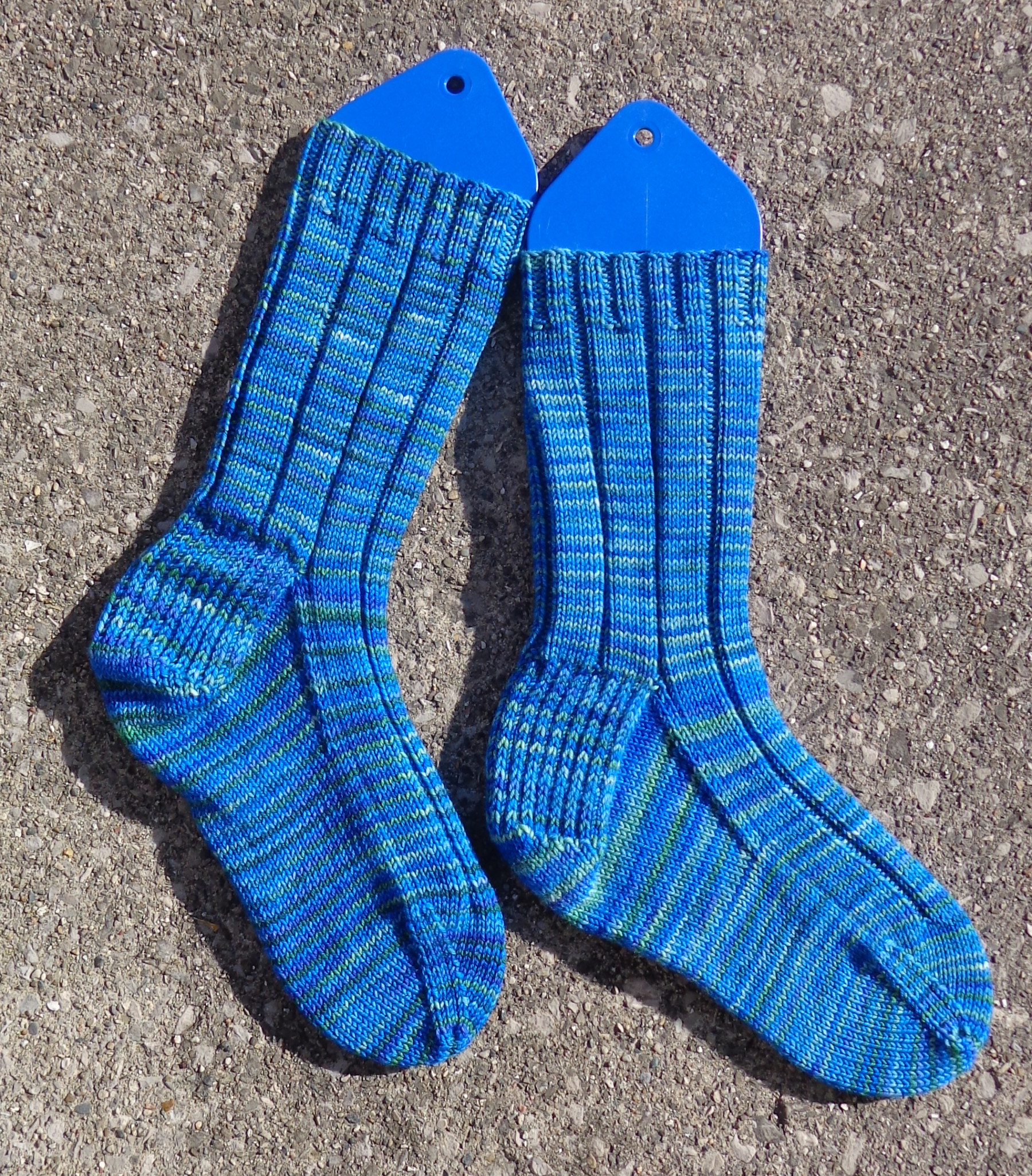
First off, I finished another pair of socks. These are knit in my usual pattern, the one I have memorized, in Fleece Artist Kiki. (That’s a Ravelry link.)

socks knit in Fleece Artist Kiki by Deborah Cooke

The tag says the colourway is Pansy but I think it’s really Nova Scotia (there’s no purple in this skein). I was excited to get this yarn on sale and realized later that it’s discontinued. It’s quite a thick sock yarn, so I went down to 64 stitches from my usual 72. I knit another pair of socks in another colourway of Kiki and showed them to you earlier this year. It’s a nice squishy yarn and good to have another pair of socks done for the winter. (I may have to cast on another pair of socks, just to have an anchoring project in my currently chaotic world.)

Water by Sylvia McFadden

I also cast on a new shawl. Water is a pattern I’ve wanted to knit for a while (that’s a Ravelry link) and I finally found the perfect yarn for it. The designer is Sylvia McFadden and one of the official pix of the shawl is at right. (Click through on the Ravelry link to see more.) You can see that it’s in garter stitch with lovely wavey insertions.

I bought a collection of her patterns and knit Waiting for Rain from it – that’s the Ravelry link for the pattern and this is my blog post about my shawl.

In case you don’t feel clicky, here’s my Waiting for Rain shawl.

Waiting for Rain shawl knit in MadTosh Dandelion by Deborah Cooke

In that pattern, the insertions were of a different lace pattern and they were knit in a contrasting color. There was a lot of stripe-y goodness in that design.

Waiting for Rain shawl knit in MadTosh Dandelion by Deborah Cooke

I’m knitting my Water shawl with Fleece Artist Anni (that’s a Ravelry link), a limited edtiion yarn that is also discontinued. It’s fingering weight and a blend of merino and mohair. It’s a bit more itchy for me than anticipated, so is a better choice for a shawl than a sweater. The colorway is called Frozen Ocean, which seems very apt.

Here’s how it looks so far:

Water designed by Sylvia McFadden knit by Deborah Cooke in Fleece Artist Anni in Frozen Ocean

The color is really not true in this image. It looks very green here, but is actually turquoise. I made good progress but am now at the first insertion and need to pay attention to the lace stitch. This bit isn’t TV knitting. 🙂

Portia deisgned by Norah Gaughran for Berroco

Which meant (inevitably) that I was casting around for a TV knit, since we’re binging mystery series these evenings. I’d been thinking of making an asymmetical sweater for the girls, which reminded me of this pattern. Portia is another sweater I always intended to make. (Yes, that’s a Ravelry link.) It was designed by Norah Gaughran for Berroco and has such an interesting design.

I actually have the specified yarn, Berroco Peruvia, but don’t have quite enough of it. I could make the smallest size, but that seems overly ambitious. It’s unlikely that I’ll lose a bunch of weight, sitting on the couch knitting. (That’s a Ravelry link because yes, Peruvia is discontinued.)

So I ended up auditioning yarn candidates from my stash – which is awfully similar to auditioning opening scenes for a book, my daytime task this week. The first candidate was some Rowan Felted Tweed Aran, which is exactly the same weight as Peruvia. (That’s a Rowan link as my colorway is discontinued but not the yarn itself.) Mine is a rosy colour, though, and I’m not sure I’ll wear a sweater coat in that shade. It’s a lot of pink. Beautiful yarn, though. I need to figure out what to do with it now.

Next up, some Debbie Bliss Donegal Luxury Tweed Aran in a scarlet shade. (Another discontinued yarn; another Ravelry link.) Very pretty but I thought the yarn looked too thin when knit to gauge. I could use smaller needles, but then the dimensions of the garment would be changed. Given the design of this sweater, it’s tough to anticipate how to adjust the fit.

#18 Shawl Collared Coat from Noro Magazine #1, designed by Mari Tobita

Next candidate: Noro Nadeshiko. This is lovely squishy yarn, an angora, silk and mohair blend. It’s a little heavier than Peruvia but I really like the firmer fabric when knit to gauge. I had bought this to make another sweater coat, this one from the original Noro magazine, designed by Mari Tobita, at left. It’s called #18 Shawl Collared Coat. (Yes, more Ravelry links. The problem with a well-aged stash is that everything is discontinued.) This coat has really pretty shaping in the back.

The colourway I have is less stripey than the one in this picture. It’s mostly shades of grey with a little bit of brick-red and a bit of white. I’m concerned that it might look too stripe-y in Portia, but am giving it a try. Here’s what I have so far:

Portia by Norah Gaughran knit in Noro Nadeshiko by Deborah Cooke

This is the centre-back braid, knit down from the back yoke, so it’s going to taper from here to that lowest point. The red looks more emphatic in the photo than in real life.

After this triangular piece is knit, you then pick up the side panels along the edges and knit toward the front. If I continue with the Noro, I’ll have to make sure that the stripes are symmetrical. I’m just too matchy-matchy to be happy with the result otherwise. I’ll see how it looks when the triangle is done.

With any luck, I’ll soon have both a knitting project and a writing project launched!
Mitred Squares Sock Yarn Afghan

Last week, I mentioned my afghan in progress made of mitred squares knit in leftover sock yarn and realized I’d never given that project its own post. Today we fix that!

Here’s the base square. This one is knit in (hmm) Collinette Jitterbug, in the colourway Monet. That’s the Ravelry link as it looks like this yarn might be discontinued.

Mitred square knit in sock yarn leftovers by Deborah Cooke

I like knitting mitred squares. They’re easy and the result looks good. One of my favorite books about them is Domino Knitting by Vivian Høxbro – here’s the Amazon.ca link for the book, here’s the Ravelry link and here’s VH’s website. This is a lovely little book with a number of interesting projects.

From this, I developed my sock yarn square. For a mitred square with a central stockinette stitch, you cast on an odd number of stitches, and this makes the outer edge of the L. That central stitch remains in stockinette (knit on the right side and purled on the wrong side) while the rest of the square is knit in garter stitch (all knit, all the time). It makes a prettier edge if you slip the first stitch on each row, and that also makes it easy to pick up stitches and add new squares to the existing ones. it saves you seaming if you just knit them together.

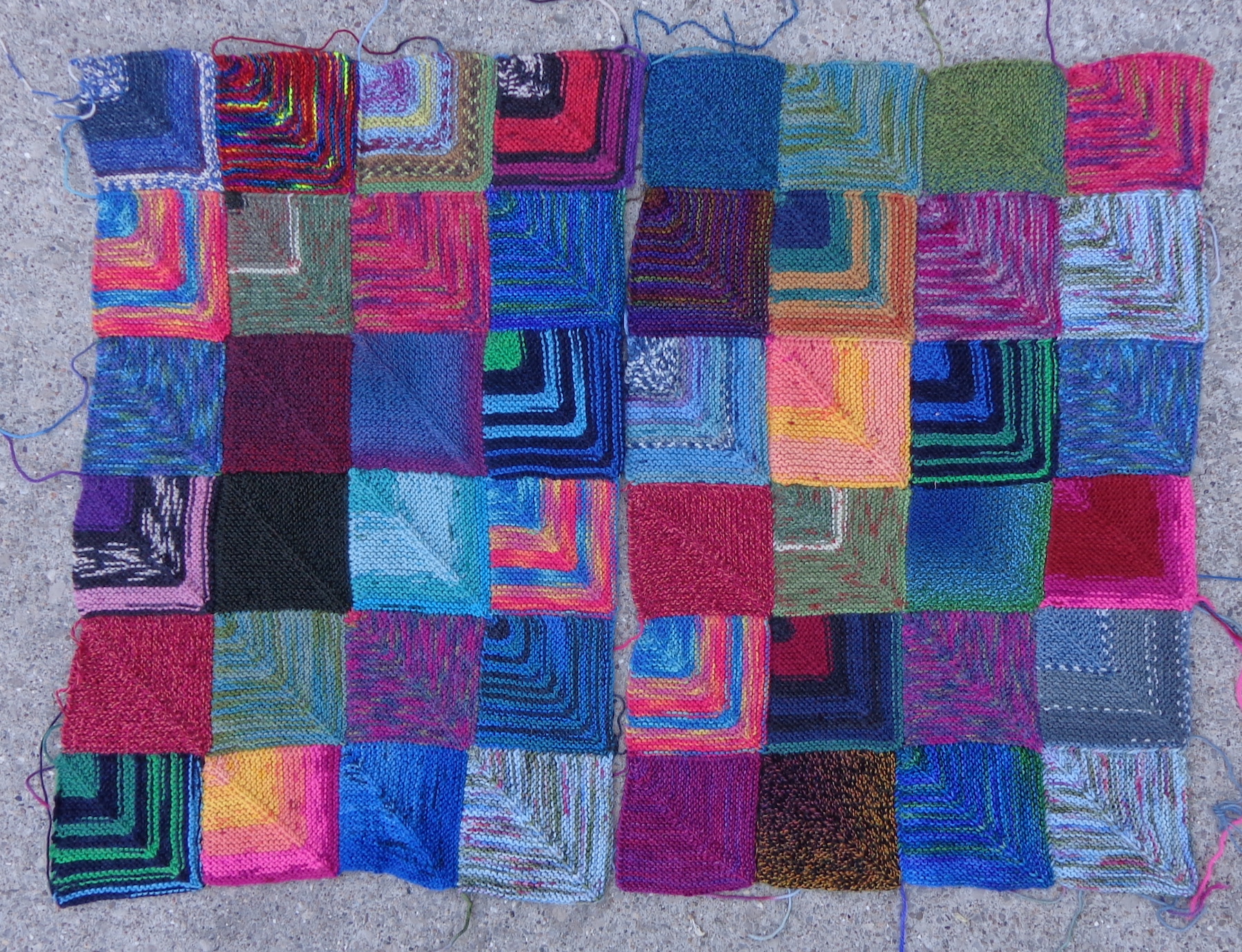
Here are my afghan blocks so far:

Mitred sock yarn squares afghan knit by Deborah Cooke

I’m piecing them together in blocks of 24 squares. I decided on a big block size to keep from having too many repeats in the same area – you can see that these two blocks shouldn’t be right beside each other. I might set them up to make them radiate from a central point instead of like this. We’ll see.

Mitred Sock Yarn Block
I knit mine on a 2.5mm needle.

Cast on 49 stitches.
R1 (RS): Knit
R2 (WS): knit 24, P1, place marker, knit 24
R3 (RS): Slip one, knit to 2 sts before marker, k2tog, slip marker, k1, SSK, knit to end.
R4 (WS): Slip one, knit to 1 stitch before marker, P1, knit to end

Continue as established, repeating rows 3 and 4 and decreasing two stitches on each RS row, until there are 3 sts left. SSK and draw end through the loop to finish.

Papillon Done

Papillon is a garter stitch short-row shawl worked in two colours, which I started in May. That link will take you to my first post. I used Noro Silk Garden Sock and a local black alpaca yarn from my stash. There’s a lot of counting with this one, and a lot of turning, but it’s a pretty easy knit otherwise. Here’s my finished shawl:

Papillon shawl knit in Noro Silk Garden Sock by Deborah Cooke

This is a big shawl! Mine probably feels more substantial because both yarns are a little heavier than a fingering weight, maybe closer to sport. It took all of the black that I had, and just over 2 balls of the Noro Silk Garden Sock.

This was an addictive knit, but then, it often works out that way for me with self-striping yarns.

I knit the shawl just as the directions instructed, but added some beads at the hem.

Papillon shawl knit in Noro Silk Garden Sock by Deborah Cooke

You can just see them in the black border. (I like how they nestle in there and are a bit subtle.) You knit four rows of garter stitch before casting off, and I added the beads in the third row. They’re 2/0 beads and I used the crochet hook method, putting a bead on every fifth stitch. It took about 100 beads, which was just about all I had left of those. (I used them before, on another Noro shawl and these were left over. Hmm. Can I find it? This one! Noro spider web fichu. Ha!)

What do you think?

Papillon

Things have been quiet here on the blog for a bit, and I apologize for that. I was slammed at work in April and didn’t have much time for crafting, then had a few fails. 😦 That’s always disheartening. I may circle back to them and see what can be salvaged, then share the results with you. In the meantime, here’s one that is having a happier adventure the second time around.

Papillon is a beautiful and clever shawl pattern using short rows and designed by Marin Melchior. (That’s a Ravelry link.) It’s knit in fingering weight with two colours, one solid and one not.

Remember this Koigu KPPPM that I first used in the body of my teal Navelli?

Navelli by Caitlin Hunter knit in Koigu KPPPM and Shibui Knits Sock by Deborah Cooke

I frogged it back because of the pooling. This yarn has longer sections of each colour (at least for Koigu) so I thought it might work for Papillon.

Papillon shawl knit in Koigu KPPPM by Deborah Cooke

It didn’t really work in this pattern either. :-/

I was determined to use my stash yarn, though, and dug in again. This time, I chose some Noro Silk Garden Sock, which has longer colour changes, and for contrast, a very black alpaca yarn from a local farm. There’s a tiny shimmer of blue spun in with the black alpaca yarn, too. Here’s the beginning:

Papillon shawl knit in Noro Silk Garden Sock by Deborah Cooke

I’m much happier with this version! This is knitting up much more thickly even on the same needles, but since I’m not sure how much black there is (that label’s long gone) I’m sticking to the 3.5mm needles and hoping I have enough black to finish.

Finally, a success!

I have some sweaters breaking free of Sleeve Island and will share one with you next time.

Felix, A New Sweater

I recently finished a new cardigan with yarn from my stash. Now that it’s blocked and finished, let’s have a look.

Felix Cardigan by Amy Christoffers knit in Rowan Renew by Deborah CookeThe pattern is Felix, (that’s a Ravelry link) a boxy top-down raglan cardigan with a nice detail on the raglan increases. It knits up pretty quickly and, since it’s knit top-down, you can try it on as you go to check the fit. I used Rowan Renew, a discontinued yarn with a tweedy fleck. (That’s a Ravelry link for the yarn, since it’s not on Rowan’s website anymore.) The yarn is made of recycled wool – hence the name – which is pretty cool.

I really like that raglan detail and I love this yarn. It has a subtle stripe as well as the tweedy fleck.

Felix Cardigan by Amy Christoffers knit in Rowan Renew by Deborah CookeThe red colourway is called Pick-up, but I didn’t have enough of it for the whole sweater. I added the dark grey, also Renew, in the colourway Lorry, and modified the pattern to have striped edges in garter stitch. It turned out that I used 1.4 balls of grey and had 1 ball of red left over, so I could have almost made it all red. The buttons came from my stash, too. I like the leaves on them for this sweater, since the red reminds me of autumn colours.

Here’s my Ravelry project page for this sweater.

In addition to modifying the ribbed hems and button band to be garter stripes, I made the sleeves narrower at the cuff. I like the narrower sleeves on my Koigu Lunenberg cardigan. This was all good until I washed the sweater to block it. It stretched like mad! I put it flat to dry but knew all that extra length wasn’t going to just disappear – so I tossed it into the dryer when it was still damp. This meant that the wool fulled as the sweater shrank back to its original length. It’s thicker and softer than it was, which is good, but it’s also a little bit narrower. The sleeves still fit, but I can’t push them up as much as I like to. (Maybe this will break my bad habit…) I’m curious about this stretching and wonder whether it had something to do with the wool having been recycled. (?)

Either way, I’ve cast on another Felix in Rowan Renew in a green colourway called Digger. I have twelve balls of this colour and the sweater takes 11.5 so it can all be one colour. I’ll make the sleeves a few stitches wider at the cuff on this one, in case the same thing happens when it’s washed. I haven’t decided whether to rib the cuffs and button band, like the pattern, or do them in moss stitch. Here’s that Ravelry project page.

What do you think?

The Red Koigu Cardigan Completed

I finished my red Lunenberg cardigan (that’s a Ravelry link) and I just love it. This is a basic cardigan but using the Koigu KPPPM really made it spectacular.

Lunenberg Cardigan by Andrea Hungerford knit in Koigu KPPPM by Deborah CookeOnce again, the colour isn’t true in the pictures. It’s a cherry red, but seems to photograph pink.

I was really pleased that the colours didn’t pool at all. The sleeve caps ended up looking a bit lighter than everything else, but it was just the way the colour worked out.

I showed this sweater to you earlier, without the sleeves, in this post.

I changed out the ribbing for garter stitch, because I really like how KPPPM looks in garter stitch. I used just over 8 skeins of KPPPM, so there could be another of these in my future. Here’s the link to my project page on Ravelry.

What do you think?

Progress on the Red Cardigan

I haven’t had any knitting to show you for a while, because I’ve been knitting away on a couple of big projects. I’ve almost finished the Wingspan shawl – I’ve knit the wing tips and cast off half of the shawl width. I have to do the other side, then block it, so I should have that to show you soon.

Here’s a progress report on my red cardigan in Koigu KPPPM. I’m working on the collar right now – you can see my needle in the stitches – then have just the sleeves to knit.

Lunenberg Cardigan by Andrea Hungerford knit in Koigu KPPPM by Deborah CookeOnce again, the colour looks a lot more pink in this image than it actually is. The yarn is a wonderful rich red and not very pink at all. (I talked about that in my last post about this project.) It actually matches the currant jelly I made this week. 🙂

The pattern is the Lunenberg cardiganhere’s a Ravelry link. The pattern is included in By Hand Serial #9 – you can see more about that publication on their website, here.

I’ve made some changes. Instead of ribbing on the hem, button bands and collar, I’m using garter stitch – mostly because I love how garter stitch shows off the colours of Koigu. I made a mistake in my calculations for the button band – there are supposed to be 8 buttons on the button band and one in the collar, but the way I figured it out, there are 9, plus the one in the collar. I’m not going to rip it back because I have another card of these buttons. Here’s my project page on Ravelry.

I am loving the softness and the colours of this yarn – which means, yes, we’ll be making another trip to the Koigu tent sale this August.

What do you think?